Plantations with native trees produce more coffee which is also of better quality
Forest trees are good, not just for the environment but for your coffee too: having more forest trees in coffee plantations maintains tree diversity and also increases coffee production and quality, shows a study. This could be vital information as native trees are being replaced with exotics in coffee-growing landscapes to increase coffee production.
India, the world’s sixth largest coffee-producer, grows ‘shade’ coffee, under the canopies of naturally occurring native trees such as jackfruit, Black dammar (dhup) and Magnolia (champa) which are legally-protected. However, some planters now replace dead native trees with exotics like Silver oaks which are not protected and can be felled for timber. Silver oaks also serve well as pepper stands, and cultivating pepper on them supplements planters’ incomes. This ‘intensification’ – reducing and replacing native shade tree cover – contributes to forest loss in the tropics, where coffee is cultivated.
Scientists at ETH Zurich (Switzerland) and the College of Forestry (Kodagu) examined whether this intensification affects native tree biodiversity and coffee productivity in Karnataka’s Kodagu district, which produces more than one-third of India’s coffee. They studied tree species diversity in 25 coffee plantations varying in native shade tree cover, with some having only non-native Silver oaks as canopies.
The benefits
Their results, published in the journal Agriculture, Ecosystems and Environment, show that 95 native tree species offer shade for coffee in Kodagu; and intensification decreases this tree diversity. Some plantations, which still retained native trees, even had red-listed tree species (designated as threatened by the IUCN), and some of them in high numbers. The team found that such plantations produced more coffee, which was also of better quality . Silver oak-dominated plantations showed more single-seeded fruits and attacks by the Coffee berry borer, a major pest.
“This is likely due to reduced predators such as ants, birds, or parasitoids, in Silver oak-dominated plantations,” says lead author Maike Nesper (ETH Zurich). Protecting native trees could be crucial, she adds.
“Some regions are re-diversifying tree canopy cover in coffee agroforests, as consumers are increasingly interested in biodiversity conservation and ready to pay premium prices…but to gain the same level of native diversity by reforestation is nearly impossible, and it is crucial to diversity in the first place.”
source: http://www.thehindu.com / The Hindu / Home> Sci-Tech> Environment / by Aathira Perinchery / September 30th, 2017
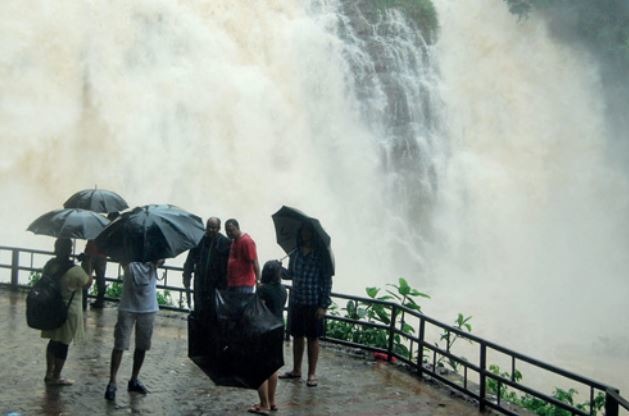
Tourists at Abbey Falls near T Shettigeri, with rain catching up by monsoon end, all falls in the State are putting up their best show
Madikeri :
City dwellers might hate rain with its attendant problems but when they flock to Kodagu, the rain is an added attraction. Tourist inflow has gone up in the rainy months which were once considered off-season.As many as 91,619 visitors came to Kodagu in July, a jump over the figures for 2016.
Between January and July this year, 6.9 lakh people visited Kodagu, of whom 91,619 people visited in July. This is a jump of 21% over last year, when just 75,492 tourists came. In 2015, only 74,798 tourists visited in the month of July. But even these are conservative numbers, say officials, since it only accounts for guests at registered homestays. The number could be almost double if the other homestays, not on paper, are factored in as well.
What helped probably was that the rain wasn’t as heavy as expected. The district as a whole received 51cm of rain in the month against a normal of 90cm, allowing tourists to enjoy the showers while finding time to move around as well. The tourist count estimate for this August had crossed 50,000 by the middle of the month.
While most tourists visit the staples in Kodagu -Talacauvery, Cauvery Nisargadhama in Kushalnagar, the Nalaknad palace in Kakkabe and Raja’s Seat – some also make their way to Irupu falls near Shrimangala, Mallalli falls off Somwarpet, Abbey falls near Madikeri, the golden temple at Kushalnagar, Dubare elephant camp, Ha rangi and Mandalapatti near Madikeri.
Shobha Shetty , a retired bank employee from Mangaluru, says she had a magical experience visiting Talacauvery in the morning hours. “The mist-covered slopes, the moving fog and the gathering dark in daylight made me forget everything else. This can happen only during monsoon,” she says. Around 45,616 tourists visited Talacauvery between January and May this year.
Shashi Monnappa, who runs Mythili homestay at Madikeri, said many tourists preferred to visit during monsoon and opted to go to waterfalls, for river rafting and on safari in Nagarahole.
Boosting the tourist inflow, homestays drop rates during the rainy off-season. Coravanda Madan Somanna, who runs a homestay in BB estate at Kadagadal near Madikeri, said the discounts ranged between 25% and 30% on the room tariff.
Kushalnagar assistant conservator of forests Chinnappa said an average of 3 lakh tourists visit the Dubare elephant camp every year.And around two lakh tourists visit Irupu falls in south Kodagu every year, says Kodagu DFO Jaya.
Given the surge, the tourism department has taken up some development projects. It is building a Kodava heritage centre at Madikeri at a cost of Rs 2.6 crore, a pathway for tourists at Mallalli falls at Rs 1.4 crore and providing a chain barricade at Abbey falls for Rs 86 lakh.
The district administration has sent proposals for another 12 projects which include road development in Mandalapatti, Talacauvery and Dubare; building a hanging bridge to Irupu falls and setting up a garden at the Nalaknadu palace. It has also proposed building a concrete road from Nanjarayapatna to Dubare to reach the elephant camp. These proposed projects will need nearly Rs 17 crore from the government.
source: http://www.timesofindia.indiatimes.com / News> City News> Bangalore News / TNN / September 25th, 2017
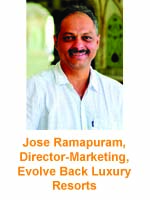
The House of Ramapuram, promoters of The Orange County Resorts, as part of taking their eco-friendly and community based resorts concept beyond the borders of Karnataka in India and also beyond India, has taken a new brand name, Evolve Back. Notwithstanding the renaming, the promoters assert that they will continue to uphold the time tested ethos and philosophy embedded in the ‘spirit of the land’. Jose Ramapuram, Director-Marketing, Evolve Back Luxury Resorts in an interaction with P Krishna Kumar elucidate the reasons behind the renaming, future expansion, investment challenges in the eco-resort space, etc.
Q What made you rebrand Orange County, a well-established resort brand, as Evolve Back Luxury Resorts? What is the significance of this rebranding in the future journey of the company?
We, The House of Ramapuram, are planters by tradition, diversified into the hospitality business in 1994 by setting up a small resort in their 100-year-old, 300-acre ChikkanaHalli Estate in Coorg. What came naturally to us was to share our way of life and warm hospitality with our primarily urban guests. As we are prepared to expand the locational footprint of our resorts to other parts of India, Africa and Asia, we felt we need a universal name that was inspired by our ‘Spirit of the land’ philosophy.
The Orange County name was chosen for our first resort at Coorg, in memory of the captivating fragrance and flavour of this wonderful fruit which was, not long ago, part of the spirit of Coorg.
Being crafted specifically for our resort in Coorg, it was not conveying the ‘Spirit of the land’ character of our new resorts – Kuruba Tribal Village themed resort at Kabini and the Vijayanagara Palace themed resort at Hampi.
Moreover, we found that in the global tourism markets, the brand name ‘Orange County’ had a very strong association with a county in California, USA.
Today, as we prepare to expand the locational footprint further in India, and to Africa and Asia, we realised the need to rename the brand to reflect our ‘Spirit of the land’ spirit but with a universal appeal. That’s how we arrived at a more appropriate name ‘Evolve Back’.
Q The core of Orange County has been your commitment to sustainable and responsible luxury. What significant changes the rebranding would bring to that core or what additional aspect you would stress upon in Evolve Back?
‘Evolve Back’ is the new brand name given to the same ‘Spirit of the land’ experience which we strive to immerse all of our guests in. It is inspired by the past when the air, land and all of nature was pure, hospitality was from the heart, life was simple, nice and peaceful, culture was of the land and food was from the goodness of nature. Evolve Back is the signature style of delivering all these with the best in comforts and luxuries.
In short, nothing has changed besides, just the name. The journey with Evolve Back will be the same mystical trip down the roads of history and culture. Despite the name change, the ownership, management, and operations or the company are still under the ownership of Orange County Resorts & Hotels Ltd.
Q Since the rebranding coincides with the launch of your new property in Hampi, how would the brand ethos be reflecting in that property? How your latest resort in Hampi is different from the other two resorts?
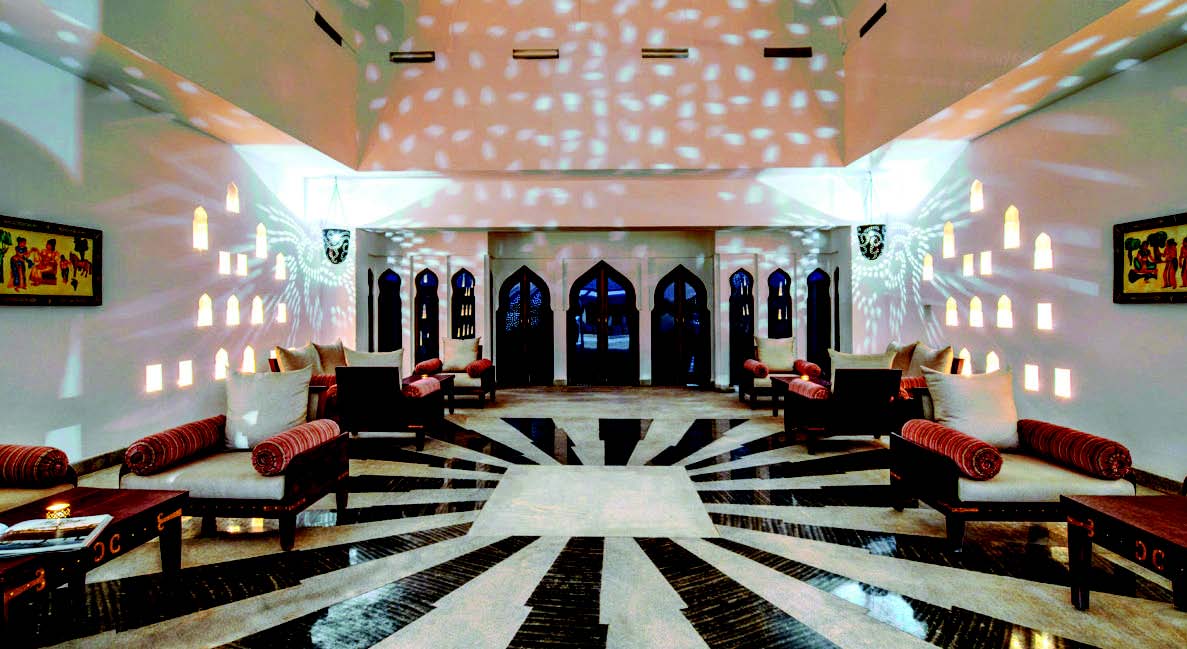
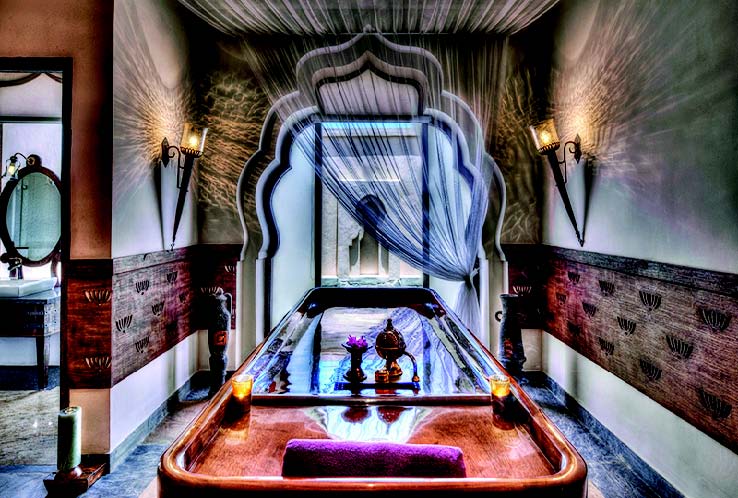
Evolve Back Kamalapura Palace in Hampi is inspired by the grandeur and magnificence of the 14th Century Vijayanagara Empire and is located 4 kilometres from the historic ruins of Hampi. Kamalapura Palace complements its surrounding by adding to its beauty and splendour, while enthralling its guests with its luxurious offerings.
The Evolve Back property in all its resplendence is a glorious tribute to the hey days of the Vijayanagara empire. The entire project has been designed after spending many months with the locals and in studying the history of the region. Special care has been taken to weave in the cultural and traditional aspects of Hampi into the architecture, the theme, the interiors and other aspects of Evolve Back Kamalapura Palace. Visitors to the property will get to soak in a slice of history though the myriad elements that make a play for one’s senses during their stay.
Q You have recently announced your plans to go scouting for properties outside Karnataka in India as well as to overseas destinations in Asia and Africa. Could you share your future investment plans and timelines for these developments?
Evolve Back is looking to expand over the next three years, during which we expect to open four new properties across India and abroad. The investment for the expansion is estimated to be around INR 112 crore. This entire investment amount is planned to be raised with a mix of internal accruals and debt.
We are looking to tap the new-found interest among people for experiential travel, especially at untapped destinations. We usually avoid overcrowded destinations, and scout for those un-spoilt markets where we sense the potential to grow — not just for us, but also for the destination.
We will be developing a resort at Kumta in North Karnataka district over an area of 30 acres with an investment of INR 50 crore. This resort is planned to be themed on a local fishing village. We are also looking at a palace-themed resort at the medieval town of Mandu in Madhya Pradesh. This property is expected to see an investment of INR 35 crore.
In the interim, a property each in African and an Asian country are being planned.
Q What are the challenges investors in eco-resorts face in India considering it requires comparatively large land area at ecologically sensitive and fragile locations?
The biggest challenge we face is in acquiring land in these locations. Land in many parts of India is largely fragmented and furthermore we will need to acquire the land from multiple individuals. The next challenge is in getting the required clearances for the project from multiple departments and signatories. Environmental laws are typically very rigid and hence take a lot of time and effort to comply with all the requirements.
In addition to this, because of the vast distances between locations, basic services such as electricity and water are typically hard to come by. In fact, most of the basic infrastructure that we take for granted, is missing or inadequate and needs to be developed from scratch. All this is not only extremely time consuming causing unnecessary delays but also ends up escalating costs as a result.
krishna.kumar@saffronsynergies.in
source: http://www.hospitalitybizindia.com / Hospitality Biz India.com / Home> Interview / Friday – September 15th, 2017
The Western Ghats has been plundered over the years, resulting also in progressively hotter summers in Bengaluru. While afforestation efforts to save the Ghats have been on for years, a team of passionate and dedicated Bengalureans is trying a different approach to save the many tree species. They are planting acres-wide groves in private and public lands that fall in the range, for now focussing on Coorg and Wayanad.
Meera, Rajesh, Sheshadri Ramaswamy, Uma, Anil Panolil Chirikandoth and Dhandapany collectively form Forest First Samithi (FFS) – a society that aims to engage and empower local communities in ecological conservation by educating them about endangered and endemic plant species. What started off as a team of four has today grown into a family with ten permanent members and over 30 volunteers.”FFS is trying to conserve endangered tree species by creating an eco-system where birds, small mammals and insects can also thrive,” says Meera, one of the founders of FFS, adding that the organization was started in 2008, and that most of their early years were spent on learning.
FFS’ vision for degraded lands in Kodagu started this May, and they have already spoken to local organizations and communities to get them on board. “Since we started work in Kodagu, we have already managed to add 35 species of endangered plants into the groves we worked on, and plan to touch 100 species,” she says, adding that the lands they are focusing on are public spaces ranging between 5 acres and 30 acres.
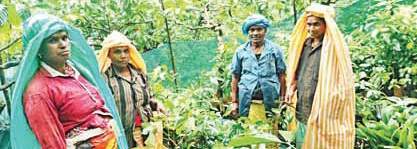
Workers in Wayanad grove Pics courtesy: Meera Rajesh
How it all started
FFS started work in the biological hotspot that is Wayanad, where a lot of native tree species have been chopped to give way to silver oak, coffee and teak plantations. Meera says that unless one ventures deep into the forest, it is unlikely you’ll come across any traditional species. “During the summer months, we noticed how trees in Wayanad were being chopped at an alarming rate for timber. That’s when we decided to do something about it. We got involved in a lot of discussions with research organizations and experts on how to go about it, and also spoke to locals to get them involved,” she says.
Years of hard work and research resulted in the complete transformation of a private farm land in Wayanad, where a section of it was partitioned to create what is called a ‘farm grove’. This grove comprises endemic, endangered tree species, while the rest of the land can be used for economic purposes. By getting farmers and land owners involved in understanding how these endangered species will actually better their crops in terms of soil quality, water retention and pollination, FFS has managed to conserve 100 species of trees in Wayanad.
source: http://www.newindianexpress.com / The New Indian Express / Home> Cities> Bengaluru / by M Shriya Sharma / Express News Service / September 06th, 2017
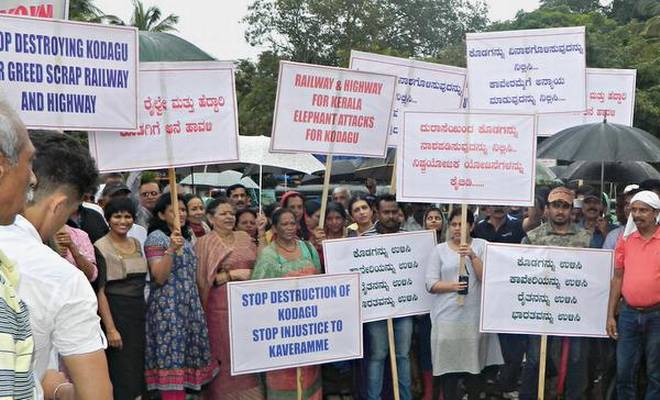
Up in arms:Activists protesting as part of the ‘Save Kodagu, Save Cauvery’ campaign at Kutta in Kodagu on Saturday.Special Arrangement
Activists from nearly 30 organisations hold Save Kodagu, Save Cauvery rally
To draw public attention to the rapid ecological devastation of Kodagu brought about by development projects, scores of people staged a protest at Kutta as part of the ‘Save Kodagu, Save Cauvery’ campaign on Saturday.
Activists and citizens from nearly 30 organisations and NGOs participated in it to stem the tide of what they described as the growing ecological destruction of Kodagu district, which is also the catchment area for the Cauvery.
The activists assembled first at Ponnampet and were joined by others at Kutta, bordering Karnataka and Kerala where a rally was taken out. The highway was blocked for nearly an hour.
The campaign had its share of critics who questioned the motives and rationale of the conclusions of the activists but the latter described them as misguided by vested interest groups.
The crux of the issue revolves around new projects such as two railway lines that will link Kodagu or cut across the district, besides national highways.
The rapid urbanisation of the region, besides indiscriminate tree felling under the guise of “development” has reduced the green cover of the district over the years, according to the activists.
They have objected to the Mysuru-Kushalnagar railway line which is being bandied about as a market link for coffee growers of the district with the rest of India while the other railway line is the proposed link between Mysuru and Thalassery in Kerala which passes through some of the dense forests and elephant habitat. Col. C.P. Muthanna (retd) of Coorg Wildlife Society said such projects would only escalate human-animal conflict in Kodagu as these so-called development works would lead to habitat fragmentation, disturbance and destruction.
The Save Kodagu, Save Cauvery campaign also highlighted the vanishing green cover in the district and linked to it depleting rainfall in the region since the last few years which has affected local agriculture.
Being the catchment area for the Cauvery the forest cover had to be protected and if the river and its ecosystem was not saved, then nothing would survive, said the activists, pointing out that the river served as a source of drinking water to people in south Karnataka region, including Mysuru and Bengaluru.
Reiterating that every hectare of land acquired for development projects in Kodagu would result in the felling of nearly 350 fully grown and mature trees, the activists said the extent of tree-felling and damage to the ecology could only be imagined as large swathes of land extending to hundreds of hectares were needed for such projects.
source: http://www.thehindu.com / The Hindu / Home> National> Karnataka / by Special Correspondent / Mysuru – August 27th, 2017
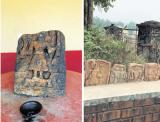
Since ancient times, kings have dedicated hero stones, called Bira Kall in Kodava language, to the memory of martyrs. Many hero stones have been found in North Kodagu, especially around Somwarpet. These coarsely sculpted granite tablets, often issued by the rulers or commissioned by affluent families, are also known as Kolle Kallu, stones of the killed.
A number of hero stones have been lined around the Government Museum in the Madikeri Fort. Often, the hero stone comprises of 2 or 3 panels. Usually, on the top of the hero stone, a sun and a crescent moon are inscribed. At the bottom, figures of men and women holding weapons such as swords, shields and bows are carved.
Some sculptures in the classic style have been found elsewhere in Karnataka, such as Mysuru, Shivamogga and Belagavi. In such hero stones, the topmost compartment, underneath the sun and moon, would be a linga and a bull with worshippers around them. The second would show the hero ascending the heavens with apsaras on either side fanning him. The third would have the hero battling other warriors during his life on earth. Sometimes there is a fourth, the bottommost compartment, which might have a horse and an elephant etched.
A peep into history
Of these, the most well-known Bira Kall in Kodagu, made in 1768, has an image representing Kannanda Doddayya, a dalavayi or army general, wearing a traditional costume, called the kuppya chele, with a gun in one hand and a native war knife, an oide katti, in the other. It is said that when Hyder Ali unsuccessfully attacked Kodagu, Doddayya stood before King Muddu Raja II on the eve of the battle and declared: “Twice before have I returned after defeating Hyder and bowed to you. But this time, I shall not be back.” Indeed in 1767, Doddayya was fatally wounded near Kajur Bagilu even as the army returned victorious. Later, his house was destroyed and 24 members of his family were killed by Hyder’s son Tipu Sultan.
According to G Richter’s Manual of Coorg, which was published in 1870, Doddayya’s Bira Kall was first placed in a paddy field, upon a hill slope and opposite the Mercara Central School.
A kaimada, a small sanctuary built in remembrance of ancestors, was built a few decades ago and the Bira Kall was shifted into it. In front of this place, which is also called Birappa Sanctuary, and to the right is a shrine dedicated to Vishnu Murthy (Vishnu’s spirit). To the left of the sanctuary is a shelter, called the pavali, where a number of devotees can sit within. Behind the sanctuary and to the left is a trishul, planted upon a raised platform. There are two raised stone seats, one behind the other and facing the sanctuary.
The Kannanda family has 3 more memorial stones, featuring some more family members, placed inside another shrine. While one stone has a male ancestor with younger members, the second has a woman with children around her and the third shows two male ancestors holding weapons. Beside this second shrine is another pavali with stone benches inside. When I paid a visit to the Bira Kall site, I met some members of the Kannanda family — Suresh, Ashwini, and a clan elder, Pookunhi to know more about the hero stone. They narrated the legend of Doddayya. Accordingly, Doddayya’s Kodagu army had successfully defeated Hyder Ali’s army and was returning back victoriously. But unfortunately Doddayya was struck and wounded on the way.
The king, pleased upon seeing the return of the victorious army, was dismayed when he heard of the dying general. Doddayya was led up the walls of Madikeri Fort and all the lands that he looked upon were then granted to his family by the grateful King. Part of this was what is today called the Kannanda bane (land), the area beyond Mann’s compound and Ajjamada Devaiah circle in Madikeri. Doddayya passed away and a Bira Kall was made for him. Some more land grants were made to the Kannanda family by the king. Thus the family came to own lands in seven places: Bavali, Madikeri, Haleri, Poramale, Kajur, Noorokkal and Katakeri. It is said that at one point, the Kannanda family owned half of Madikeri. Family members sold away most of their lands over the years. Now only 3 of the original 7 places remain with them.
Folk culture
A week after the festival of Shivaratri, the Pade Bira (war hero) Kannanda Doddayya is remembered and a two-day festival is organised. Dance and enactment performances, called there, are arranged. On the first day, prasada is prepared and the Guru Karana, an ancestor who was the preceptor as well, is remembered. The bhandara, money offered at the temple, is moved that evening. Throughout the night, the Anji Koot Murthy (five spirit deities) is held. At dawn the next day, the Vishnu Murthy There is held.
The final function, Pade Bira There, has a performer imitate Kannanda Doddayya and the Nari Pooda (tiger spirit) There has another performer emulate a tiger. The Pade Bira There and the Nari Pooda There performers together dance frantically around the place. While the Pade Bira sits upon the seat near the temple, the Nari Pooda sits upon the seat away from the temple.
The Nari Pooda performer leaves early while the Pade Bira performer is the last one to remain.
Not only do the hero stones allow us to remember those who have sacrificed themselves, they also allow us to understand a time in history.
source: http://www.deccanherald.com / Deccan Herald / Home> Supplements> Spectrum / by Mookanda Kushalappa / April 26th, 2016
E-base, Kodagu, is addressing various local issues such as man-animal conflict prevalent in the area, protecting the Kaveri river, and water conservation.
Nestled in the lush Western Ghats, surrounded by coffee plantations, elephant corridors, and forests alike, Titimati is not far from the Nagarhole Tiger Reserve. A green and resilient building made of clay bricks, local stones, Mangalore tiles and bamboo stands there. It is the E-base at Kodagu — an embodiment of responsible and sustainable living.
Located in the popularly known Coorg district of Karnataka, it is the fifth E-base in the world that started in June 2016. An E-Base serves as a symbolic model for educational, environmental and energy issues throughout the world. The first one was established in Antarctica in 2008.
E-base, Antarctica
Sir Robert Swan, OBE, who established the first E-base in Antarctica, was the first man to have walked, unassisted, to both the North and the South Pole. He has served as the United Nations Environment Programme (UNEP) Goodwill Ambassador.
After successfully removing 1,500 tonnes of waste from the shores of Antarctica, Sir Robert Swan stood at the Bellingshausen Russian Base and envisioned an education base that would allow him to share the beauty of this continent with students and leaders around the world.
Powered entirely by renewable energy, Robert and a small team lived in the E-Base and broadcasted clean technology and energy saving techniques to schools and universities around the world.
The purpose of an E-base is to inspire a global audience to tackle the issue of climate change by showing that if we can achieve the seemingly impossible in Antarctica, we can all take small, achievable steps in our own backyards.
Since Antarctica, E-bases have been established in Pench, Madhya Pradesh; Leh, Ladakh; and Blue Ridge Mountains, USA. All have the common objective to educate and learn about global climate issues, while addressing local sustainability challenge
Visit to Forestry College, Ponnampet.
Taking the E-base to India
Charulata Somal, IAS, CEO Zilla Panchayat of Kodagu, driven by the zeal to make the best things happen in the district, started the E-base in 2016.
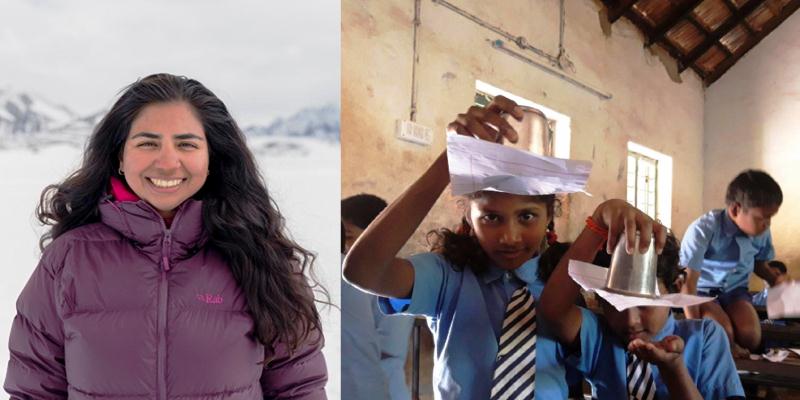
It all started in the March of 2016, when Charulata went to Antarctica on an expedition led by Robert Swan for ‘A Leadership on the Edge Programme to the Last Wilderness on Earth,’ not just once but twice the same year. A passionate environmentalist, Charulata, after her return from Antarctica, decided to take forward the concept of E-base in her district to safeguard its flora and fauna through education.
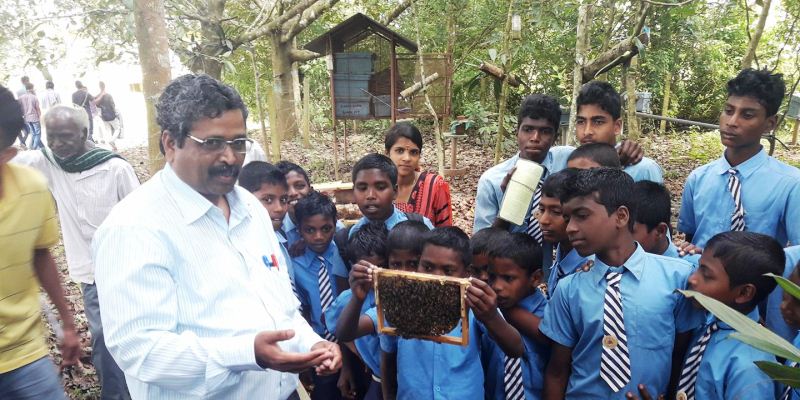
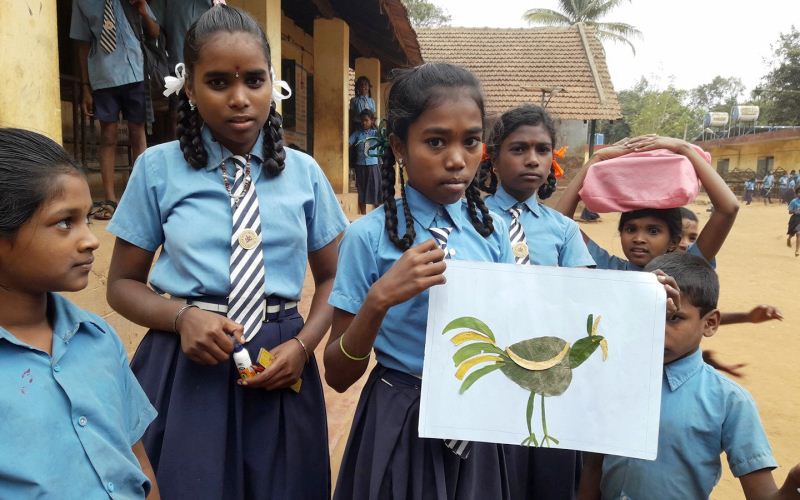
E-base, Kodagu, was established at Titimati Ashram School, a residential government school for tribal children. The E-base runs a paid fellowship programme every year which brings bright, young, motivated individuals to work with the children and build a curriculum on sustainability while imparting life skills to the kids.
With a strength of 250 children and a potential to reach out to over 500 children in the neighbourhood, the E-base gives the fellow a broad canvas to teach and explore.
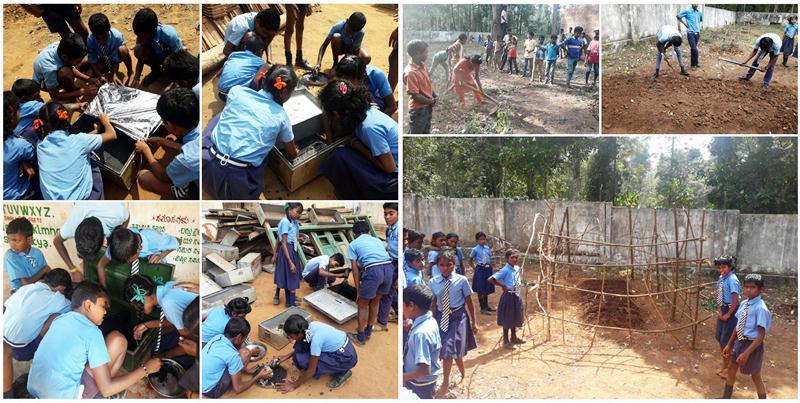
Children building solar cooker from waste and managing a vegtable garden at E-base.
“We have had one fellow till now and will be receiving our second fellow in June. Our previous fellow, Deepti Bhatt implemented 14 mini projects, core projects, field trips and workshops which included activities like creating and nurturing a vegetable garden at school and making eco-friendly toys. We hope that these efforts will be carried forward by our incoming fellow,” says Aarati Rao, an educator who worked for building a sustainability curriculum for a similar concept learning space, i.e. the E-base in Leh before meeting Charulata Somal on the International Antarctica Expedition 2016.
Practicality and hands-on learning are of prime importance at the E-base and fellows are chosen on the basis of their ability to integrate project-based learning and experiential learning into their teaching style. “The fellow’s role becomes important in utilising the infrastructure and the resources available to provide access and exposure to the children to the outside world while staying rooted in their traditions,” explains Aarati.
Environmental education hub
“E-base, Kodagu, serves as a space for kids to learn about environmental conservation and drive change through activism and ownership. Its objective is to address various local issues such as man-animal conflict prevalent in the area, protecting the Kaveri river, water conservation, and native tree preservation. It also aims to be a space that’ll serve as a window to the world since it is internet-enabled,” says Aarati, who, along with Charulata, realised the vision of starting an E-base in a biodiversity hotspot like Kodagu.
Children demonstrating their art made using leaves.
The E-base integrates rainwater harvesting technology, organic farming and clean energy for teaching children sustainable practices from a very young age.
The long-term vision is to make the students capable of countering environmental challenges and inspire them to be the problem solvers of the world. There are 11 ashram schools that are catering to the tribal kids at Kodagu, and the E-base team hopes to make use of the E-base as a learning centre.
Although there are merely five E-bases across the world, the team at Kodagu hopes that there would be an E-base in every country which would virtually connect kids and help them come up with solutions for the big challenges the world faces today.
“That is the big picture which we hope to achieve in the long run,” says a member of the E-base.
source: http://www.yourstory.com / YourStory / Home> Education / by Hema Vaishnavi / August 23rd, 2017
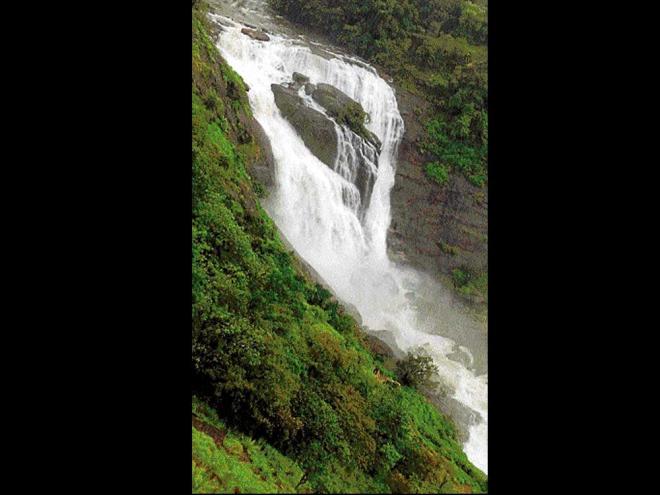
Mallalli waterfall in the taluk has come alive following heavy rain in the region. The milky flow of water is attracting tourists from across the district and also the state.
A vast patch of land on the top of the waterfalls helps tourists peek into the water spectacle. The row of peaks of Western Ghats on the otherside, as if kissing the skies, makes for a visual treat. The Pushpagiri shrine enhances the visual treat.
The Kumaradhara river that jumps from a height of 150 foot here, flows towards another small waterfall.
The waterfall, in particular, has been drawing people in hordes. Students and tourists from different parts of the State visiting the waterfall.
The footfall swells during holidays and the available space is too small to hold the crowd. It also exposes lack of basic amenities in the place.
The waterfall is located within a distance of three km from Hanchinahalli on the way to Pushpagiri.
Pushpagiri can be accessed through Shanthalli located at a distance of 22 km from Somwarpet.
If one is lucky, he or she may also behold the sight of rivulets enroute Mallalli.
source: http://www.deccanherald.com / Deccan Herald / Home> District / by DH News Service / Somwarpet (Kodagu) – August 13th, 2017
Protest planned against ‘ecologically destructive’ projects
Members of nearly 30 organisations have launched a “Save Kodagu, Save Cauvery” campaign to protest the ecologically destructive projects sanctioned in Kodagu on Saturday.
The activists will stage a protest in Kutta on the Karnataka-Kerala border to register their opposition to the 400 kV power line project passing through the district, the proposed railway line – one linking with Mysuru and the other with Thalassery in Kerala — besides linking of NHs cutting across the district.
“Most of these projects are not required for Kodagu which is an environmentally fragile and sensitive region and entails large scale felling of trees,” said Col. C.P. Muthanna of the Coorg Wildlife Society, which is also a part of the campaign. He estimated that lakhs of trees were at the risk of being felled to pave way for the projects based on the broad estimates of land acquisition.
“Each hectare of land in Kodagu supports nearly 350 fully grown and mature trees and one shudders to think of the extent of tree-felling that will take place given the vast tract of land that will be acquired,” he said.
The thrust of the campaign is to highlight the imperatives of conserving the catchment area of the Cauvery.
Rampant destruction of environment is evident in the depleting rainfall over the years and it is time to rethink such destructive development, according to activists. The railway line for Kodagu is being touted as an important link providing connectivity to the coffee market across India. But there is little value addition to coffee cultivated in Chikkamagaluru because of rail connectivity in Hassan, he said. The Mysuru-Kushalngar-Madikeri railway line has no real benefit to the district but could open up a can of new problems, including unbridled urbanisation of an environmentally sensitive region, he added.
The planned demonstration has received support from various quarters cutting across geographical region and the organisers have received endorsement from like-minded individuals and groups on social media groups as well.
The activists will congregate at Ponnampet and then go to Kutta where they will go in a procession at 11 a.m. and demonstrate near the check post on the border.
source: http://www.thehindu.com / The Hindu / Home> News> States> Karnataka / by Special Correspondent / Mysuru – August 24th, 2017
As Tamil Nadu gets set to mark rare event, devotees in the state seek a share
When it comes to Cauvery, nothing is simple between Karnataka and Tamil Nadu. This time, it’s about the puja being offered to the river on the occasion of Cauvery Pushkara, an event that is marked once in 12 years. The religious ceremony is a puja offered to the river aimed at plentiful rainfall and prosperity. While the Karnataka government has not made any plans to celebrate the occasion, Tamil Nadu, at the behest of Kanchi Mutt, has decided to hold elaborate rituals at three places.
The Pushkara tradition is associated with 12 major rivers of India, and this year it is the Cauvery’s turn.
According to Vidwan Ganesh Galapati, the Kanchi mutt has not only written to the Tamil Nadu government but also planned major functions at several places, including Hogenakkal, Nerur, Trichy, Thiruvaiyaru, Kumbakonam, and Mayiladuthurai. While the rituals will be held between September 12 and 23, the pundits in Karnataka are not happy with the fact that there has been no communication from the Religious Endowment department of Karnataka on the celebrations.
“The government did Parjanya japa in the first week of June and similarly it should also take up Pushkara ritual that has come after 12 years. Cauvery has been the backbone for both states. We all know what it would mean to not have any water in the river. As the purpose of the ritual is to pray for bounteous rains and prosperity of the state, the government must initiate a programme to take up the rituals either at Talacauvery or T Narasipur,” said Galapati. Bhagandeshwara Temple’s executive officer Jagadish Kumar confirmed that, so far, no such orders have been issued. “If the government issues any such order, we will arrange for such rituals.”
About the Puja
Vidwan Ganesh Galapati explains: “Each river is associated with a zodiac sign. Depending on where Jupiter is positioned during the cycle, the puja is done. This time, Jupiter will enter Libra (Tula) sign from Virgo (Kanya) by first week of September, which will be regarded as Pushkara Kala. The rituals will not only purify the river but also bring prosperity,” he explained.
source: http://www.bangaloremirror.indiatimes.com / Bangalore Mirror / Home> Bengaluru> Others / by Niranjan Kaggere, Bangalore Mirror Bureau / July 03rd, 2017
WELCOME. If you like what you see "SUBSCRIBE via EMAIL" to receive FREE regular UPDATES.
Read More »