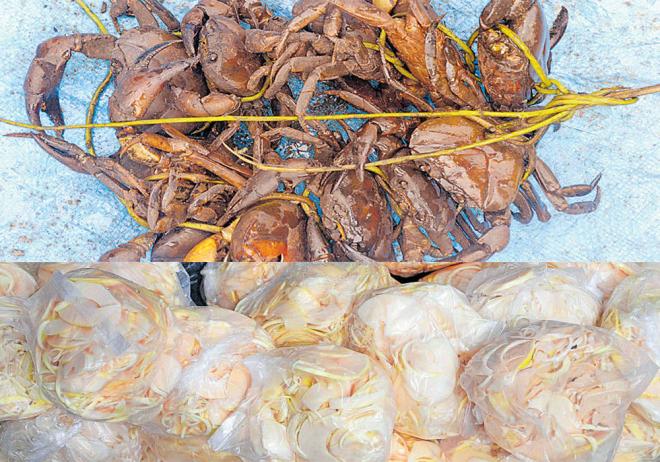
Crabs being sold near Madikeri KSRTC bus stand and Bamboo shoots laid out for sale. DH Photos
It’s that time of the year when the sale of crabs and bamboo shoots in Madikeri goes up. Monsoon is indeed an ideal time to indulge in crabs as they are considered good for generating heat in the body which helps in braving the chill in the air.
To keep oneself warm, people in Kodagu adjust their food habits during monsoon. Likewise, the roadsides in the town are lined up with crabs and bamboo shoots.
Earlier, crabs were available in plenty at paddy fields and water bodies but in spite of an increase in demand, crab sellers have been on the decline. A deficit in rainfall has affected the availability of crabs.
“Demand for crabs increases in the month of Aashada. Since paddy fields have declined in the district and many have been converted into homestays, I collect crabs from Harangi reservoir, Periyapatna, HD Kote and Beemanahalli and bring it to Madikeri for sale. The price of a kg of crab is Rs 200 while a bundle of crab (12 crabs in a bundle) costs Rs 250. A pack of bamboo shoots is sold for Rs 50,” H L Kumar, a seller from Indira Nagara told DH.
Venu said that, “Earlier, crabs were available in the shandy market but with chemical fertilisers and insecticides being sprayed in paddy fields, the number of crabs have declined,” he said. Venu signs off by stating that crabs are delicious to savour as crab fry instead of curry.
source: http://www.deccanherald.com / Deccan Herald / Home> District / DH News Service, Madikeri / July 22nd, 2017
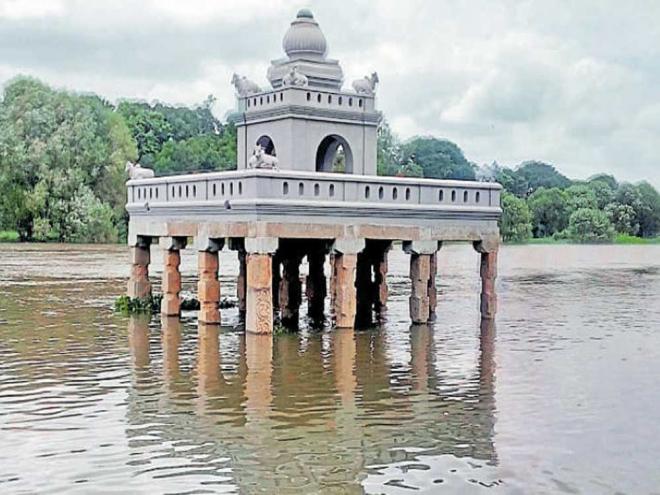
Hadinarukallu Mantap and the bathing ghat are partially submerged in swollen Kapila river following the release of water from Kabini reservoir in Nanjangud taluk on Sunday. dh photo
Reservoirs in the state continued to receive good volume of water despite a lull in monsoon showers. The inflow to Tungabhadra reservoir has increased following the release of water from Tunga dam in Shivamogga district.
The reservoir near Hosapete has received a staggering 8 tmcft of water since Friday. The storage level in the reservoir on Sunday stood at 26.211 tmcft. It was 18.305 tmcft on Friday. The inflow was 51,162 cusecs while the outflow was 2,359 cusec.
Harangi reservoir in Kodagu district is only 2 feet short of reaching the full reservoir level (FRL). The water level at Harangi on Sunday was 2,857.21 feet while the FRL is 2,859 feet.
About 1,200 cusecs water from the reservoir was released into the river.
Minor Irrigation, Superintending Engineer, M N Chandrakumar, said, “ Based on the volume of inflow to the reservoir, water would be released into the river in phases.
A meeting of the irrigation consultation committee will be held in Bengaluru on July 25. After the meeting, the decision will be taken to release water through canals for agricultural activities.”
Keeping in mind the safety of the reservoir, the water level would be maintained at 2,857 feet, said Executive Engineer S C Rangaswamy.
At present, the Harangi reservoir has a storage of 7.89 tmcft. The reservoir had reached FRL last year on July 10. The reservoir irrigates 1,34,895 acre farm land in Kodagu district and Periyapatna, Hunsur, KR Nagar in Mysuru district and Arkalgud in Hassan district.
Meanwhile, the six low-laying barrages-cum-bridges across Krishna and its tributaries in Chikkodi taluk in Belagavi district continued to remain under water despite a lull in showers in Maharashtra. Krishna river has recorded an inflow of 1.71 lakh cusecs on Sunday while its tributary Malaprabha received 20,113 cusecs. Doodhganga and Vedganga are flowing in full spate.
source: http://www.deccanherald.com / Deccan Herald / Home> State / DH News Service, Bengaluru / July 24th, 2017
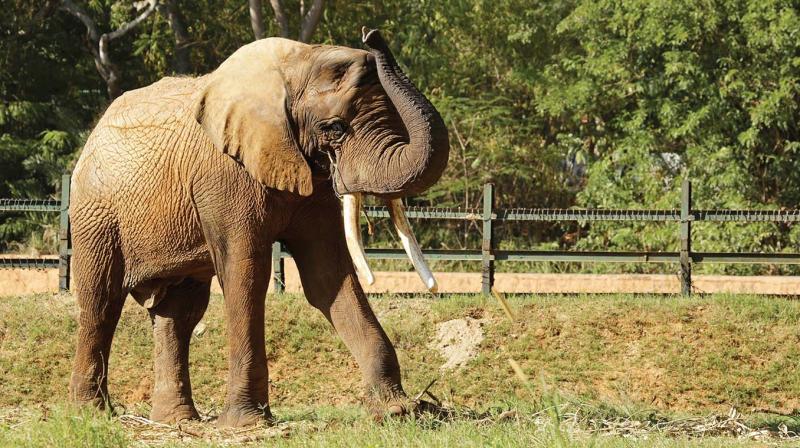
As many as four new animals have been added to the zoo which has also witnessed eight animal births. The animals will be available for public viewing after they finish the quarantine period. (Representational Image)
Mysuru:
Mysuru Zoo, celebrating its 125th anniversary, has new additions to its animal fraternity. As many as four new animals have been added to the zoo which has also witnessed eight animal births.
Zoo executive director Kamala said they have received two Lion tailed Macaques, Rama and Anitha, from Arignar Anna Zoological Park Chennai. The animals will be available for public viewing after they finish the quarantine period.
The quarantine period of a female and a male leopard, which the zoo got from Virajpet and Kushalnagar forests, on April 22 and May 14 respectively, has ended and they are now on display at the zoo.
Ms Kamala added that Mysuru Zoo has seen the birth of a Tufted Capuchin Monkey baby which is being nursed at the baby incubator in the zoo hospital. Also, two swamp deer fawns and three Gaur fawns were born at the zoo enclosure and two dusky lorry chicks have hatched in the zoo aviary.
source: http://www.deccanchronicle.com / Deccan Chronicle / Home> Lifestyle> Pets and Environoment / by Shilpa P , Deccan Chronicle / June 20th, 2017
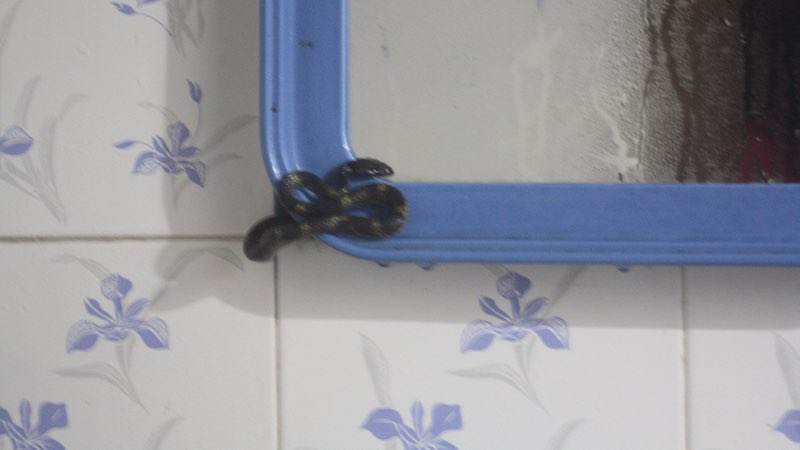
The Travancore wolf snake sprawled near the bathroom mirror of the author’s room / Photo by Medha Saxena
Homestays in Coorg offer visitors a glimpse of a unique eco-system. Coorg or Kodagu is part of the Western Ghats that have been declared a world heritage site. It has many plantations that host hundreds of threatened species
It had beautiful dark coffee-brown scales with yellowish stripes and a sinuous slender body stretching no more than two feet.
The languid Tranvancore Wolf snake lay sprawled on the bathroom mirror. It had sneaked in to avoid the gentle night precipitation and was basking in the steam left behind by the hot water running earlier. It was hard to miss once the solar light was flicked on.
Gradually, it coiled back and slithered to a safer, darker corner behind the mirror. I was not sure at the time if it was venomous since it resembles the common Krait and is often targeted for the same reason. Suffice to say that I lay awake for most part of the night, wondering whether my nocturnal guest would like to take a peek at the room as well.
This was my penultimate night at the Rainforest Ecolodge on Mojo Plantation nestled at 1100-m altitude in Kodagu, Karnataka. The monsoon in a rainforest comes with its own delights and surprises. Leeches are a case in point. They crave to attach themselves to any warm body passing by to satisfy their desire for blood. But their presence also indicates a fertile soil and ecosystem. They are both the predator and the prey.
Beautiful butterflies found in plenty during monsoon in the rain forests of the Western Ghats / Photo by Medha Saxena
Then there are the frogs, toads, spiders, wasps, dragon flies, lizards, snakes and birds. Their tribe multiplies and diversifies with every shower of water it seems. And the heavens provide them plenty of those here. But they only proliferate in undisturbed habitats. Each one of the creatures that call the rainforest home have adapted themselves to it over the millennia.
Each adaptation and evolution is a fascinating revelation. Weaver ants are a marvellous example. Thousands of them coordinate with each other to stitch together nests out of leaves much bigger than themselves.
Trees themselves appear like curated art installations climbing vertically and horizontally. They are draped with vines, creepers, fungi, moss, lichen, orchids and a variety of other epiphytes that resemble emeralds and jewels on a bride. They glisten and shine best on bright wet mornings.
Twinkling fireflies circle the trunks during nightfall. The valley was covered with a million of these mating fireflies a month or so earlier in a perfect ‘symphony in light’ as the student-interns Meghna and Lily, working at the plantation recounted.
Being in a rainforest during monsoon is also a musical extravaganza. Its inhabitants are engaged in a synchronised performance at all hours of the day. Louder than revellers in a marriage procession the frogs and cicadas often accompany the sound of rain, streams and wind. The cacophony is coupled with serenity in equal measure. If you listen hard enough everything in the forest sings. But how many of us really listen?
Geography and Bio-Diversity
Kodagu is part of the wide-ranging Western Ghats, older than Himalayas, spanning from Gujarat to Kerala for 1600 kms. It directly intercepts the Indian monsoon winds. One of the eight ‘hottest hotspots’ of biodiversity, it has 325 globally threatened species (flora, fauna, bird, amphibian, reptile and fish) and many that are unique to this area.
The lush green forests also help with carbon sequestration and reduction of global warming / Photo by Medha Saxena
This mosaic of natural beauty was inscribed as a world heritage site in 2012 meant to be protected by the Western Ghats Natural Heritage Management Committee (WGNHMC) and receive international support.
The tag was achieved after much opposition by states that feared that development will be impeded. Critics said that an informed consent was not obtained from the gram sabhas and Forest Rights Act 2006 was not implemented properly during drafting of the proposal for grant of heritage status. It could also violate the historic customary rights of the adivasis.
The forests of Western Ghats, however, aid economy and transportation by keeping the ports and creeks along western coast silt-free. The forests and mangroves also help with carbon sequestration and reduction of global warming.
Other critics say that the declaration has no effect on damaging developmental activities. As recently as June 2, 2017, there were protests in Madikeri over destruction of wildlife habitat, Cauvery river catchment area and forest land for the construction of railways, highways and power lines. As more of the landscape is disturbed there is more human-elephant conflict. Illegal construction, mining and corruption have caused water scarcity during summer months in an area that is generally overfed by rains.
The ensuing struggles repeatedly point us back towards essential questions of what is development. Who is it meant for? Who do the forests belong to? And how are decisions to be taken in the interest of all parties concerned?
Organic Farming
In ancient times the exotic products of the Kodagu region were traded along the Silk Route and on oceanic routes via the Arabian Sea. Cardamom and black pepper were indigenous to this region. Rice was the main crop. Coffee was brought from Yemen to Chikmagalur in India by Baba Budanin in 1670.
Legend has it that the Coorg Rajas may have given land to Moplahs near Nalkanad who introduced coffee seeds to the area. In the mid-1850s many European coffee plantations sprung up followed by private Indian ones. When the British left, they sold their lands to the local population. There are strong remnants of British culture here, like the North Coorg Planters Club dating back to 1883.
A walk through the greens gives an idea of the rich biodiversity of the region / Photo by Medha Saxena
Now a good chunk of the land is covered in coffee, tea, rubber and palm oil plantations. Commercial chemical-based farming and unsustainable agriculture have eroded this landscape. Smaller landholders and farmers still find it difficult to turn a good crop and farmer suicides affect the Western Ghats as well. There has been an attempt to set up farmer-owned companies by Agriculture and Organic Farming Group India. Hundreds of homestays have also come up in Coorg in the past few years to complement agricultural income.
Sujata and Anurag Goel, owners of Mojo Plantation, have successfully experimented with organic farming doing multiple cropping with cardamom, black pepper, coffee and vanilla under the shade of the rainforest. Spice trees, fruits and vegetables are also grown in open areas.
A molecular biologist, Sujata Goel explained that fungi secrete enzymes to release nutrients from decaying wood and dead organisms. Shivani, the manager, described on a tour of the plantation that fungal mycelium act as telecommunication networks for the trees to convey threats. They are also used as biological pest control. Similarly, termites redistribute soil and recycle nitrogen. Even weeds have an important role to play as temporary hideouts for insects.
Plants themselves synthesise compounds (terpenes, tannins, phenolics) to repel insects and convey distress signals to other plants and predators. Chemical pesticides kill the natural defence mechanisms of plants..
The Wise, Old Relic
Meghna and Lily recount a magnolia tree that they variously describe as a ‘tree of life’, ‘tree mother’, ‘earth mother’, ‘magical beautiful wise old relic’ that has twists, turns and huge branches that one can climb and roots that open up into giant cave systems and tunnels underneath – in the middle of a coffee plantation.
It was ‘a metaphor for India’ for them, probably signifying layers of wisdom, age and continuity in a land of general mayhem. Neither trees nor our bodies survive in exclusion to their environment. The commune with nature is complete. If you listen carefully, everything in the forest sings.
The author teaches in Delhi University
source: http://www.nationalheraldindia.com / National Herald / Home / by Medha Saxena / June 10th, 2017
The JD(U) leaders offered baagina to river Cauvery at Triveni Sangama in Bhagamandala on Sunday.
JD(U) state president M P Nadagouda, women’s wing president Manjula Umesh, Kodagu district unit president Sunil Kumar, Mandya district unit president Basave Gowda also offered special prayers at Bhagandeshwara Temple.
Speaking to reporters, Nadagouda said the state government and opposition parties have failed to fulfill the demands of the people. There is a need for alternative forces in the state. In this background, efforts are being made to strengthen JD(U). With the both Centre and state governments mud-slinging against each other with regard to waiver of loans, the farmers are in distress.
Manjula Umesh said that farmers are backbone of the country. Having unable to repay the loans, the farmers are committing suicide.
source: http://www.deccanherald.com / Deccan Herald / Home> District / DHNS / Madikeri – June 12th, 2017
No new hotels or resorts can take shape in the Talacauvery sanctuary
The government has declared the Talacauvery Wild Life Sanctuary spread across 105.59 sq km as an eco-sensitive zone. This comes after the Environment Ministry notification on the proposed ecologically sensitive areas (ESAs) in the Western Ghats. The state has about five national parks and 27 sanctuaries, seven conservation reserve and one community reserve. The draft notification was issued on May 25 last year and the final notification was issued on May 15.
Kodagu Chief Conservator of Forest Manoj Kumar told BM this is an eco-sensitive zone under the Environment Protection Act. As per the Act, the area around the protected area could be heritage sites and others and there has been a provision to declare them as sensitive zones. But this was not being done and the National Wildlife Board based on the Supreme Court direction had stated that it is about 10 km, if not declared. Hence, so far it used to be 10 km. “But we started rationalising the area and had sent a proposal. Each proposal is now being approved and the rest of the sanctuaries in the area around will soon be declared as sensitive zones. It is not the Kasturirangan report. It is a statutory requirement and the state government after discussion with the district administration and representatives had sent a proposal,” he said.
As per the notification the region around the sanctuary from 1-16 km has been declared as the eco-sensitive zone. No commercial activity such as mining can be conducted and no new industries can be set up here. It also prohibits extension of industries that cause pollution, major hydel power plants, saw mills as well as rearing of animals. This declaration is also likely to hamper the union government highway project from Bhagamandala to Kerala’s Panathoor.
source: http://www.bangaloremirror.indiatimes.com / Bangalore Mirror / Home> News> State / Bangalore Mirror Bureau / June 06th, 2017
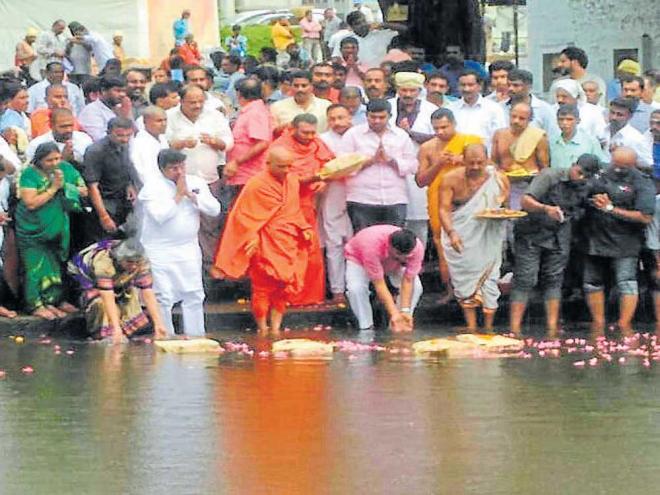
Water Resources Minister M B Patil, Adichunchanagiri mutt seer Nirmalanandanatha swami, MLA P M Narendraswamy offer baagina at Triveni Sangama in Bhagamandala, Madikeri taluk on Sunday.
To propitiate the rain gods, the officials of Cauvery Neeravari Nigama Ltd (CNNL) chanted Parjanya japa at Talacauvery, the birthplace of River Cauvery on Sunday.
As there was stiff opposition for conducting parjanyahoma using government funds, homa was not performed. Only Parjanya japa and special prayers were held. CNNL Executive Engineer Basavaraj and his wife took part in the special prayers held under the guidance of priest Prashanth Achar. Water Resources Minister M B Patil did not take part in the japa.
Patil, who arrived at Bhagamandala at 3 pm along with the Adichunchanagiri Mutt seer Nirmalanandanatha Swami, offered baagina at the Triveni Sangama in Bhagamandala. Later, he offered prayers at the Bhangadeshwara Temple and Talacauvery.
Speaking to reporters, the minister said “if offering prayers to motheris wrong and a superstititious belief, then I am ready to conduct such prayers several times. Some offer prayers to lifeless stones. Why should one oppose offering prayers to the river Cauvery, the lifeline of crores of people,” he asked.
“The Krishna and the Cauvery are the lifeline of the state. I have offered prayers to mother Cauvery for good rainfall. Offering prayers to rivers is part of our tradition,” he said.
“Chief Minister Siddaramaiah does not believe in Parjanya homa and japa and termed it a superstitious belief. Doesn’t his wife offer prayers at temples? Has he not benefited from it?” Patil retorted.
Though the visit was termed as private, the itinerary given to local elected representatives mentioned it as a government programme. MLA P M Narendraswamy, MLC Veena Acchaiah, Patil’s wife Asha Patil, Water Resources department principal secretary Rakesh Singh, officials Gurupadaswamy, Manjunath and Rangaswamy and Kodava Sahitya Academy President B S Thammaiah were present.
source: http://www.deccanherald.com / Deccan Herald / Home> State / DH News Service / Madikeri – June 05th, 2017
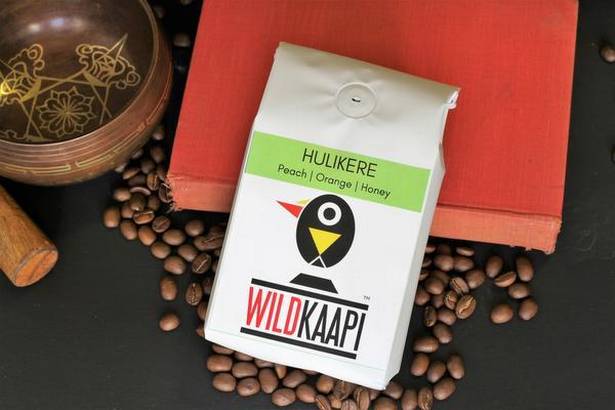
Wild Kaapi, your morning coffee comes from certified estates that support gaurs, elephants and monkeys, along with Arabica beans
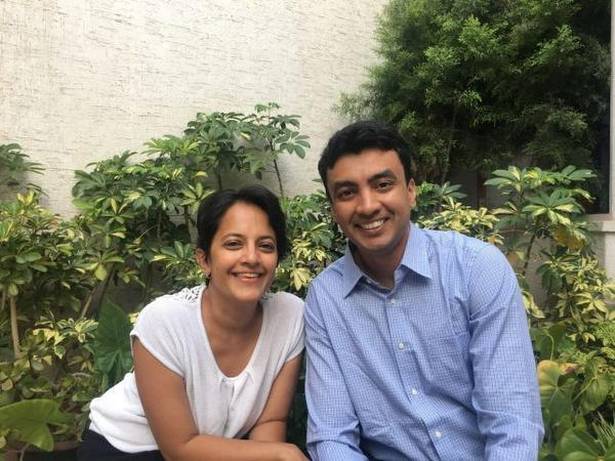
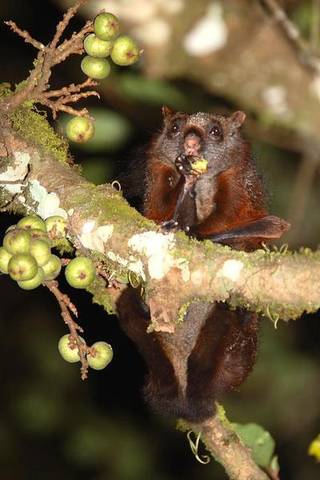
Under the cool canopy of native trees in the Western Ghats, coffee bushes spread out, gleaming with red berries. In the early morning hours, if you are lucky, you may spot rare species like the Malabar grey hornbill, water snow flat butterfly or the Asian fairy bluebird among these shade-loving plants. And now, thanks to the efforts of Wild Kaapi — the world’s first ‘certified wildlife-friendly’ coffee brand — you can ensure your morning brew comes from plantations that foster fauna on their lands. Started by wildlife conservationist, Krithi K Karanth — who has has been working in the Western Ghats, a biodiversity hotspot, for the last 19 years — and her husband, Avinash Sosale, the coffee brand got its certification this April and opened its doors to buyers last month.
(photo credit: Ramki Sreenivasan)
Live and let live
Wild Kaapi started as an offshoot of a three-year research project (part of a grant by the National Science Foundation to study coffee, areca and rubber plantations in the Western Ghats). Karanth, of the Centre for Wildlife Studies — with Paul Robbins of the University of Wisconsin-Madison and Dr Ashwini Chhatre of University of Illinois — measured biodiversity, and studied labour practices and market dynamics of the farming areas.
During the project, she interacted with over 1,000 planters in the three coffee growing areas of Karnataka — Kodagu, Chikmagalur, and Hassan — and realised how frustrated they were “because they weren’t getting value for their coffee due to the middlemen involved”. That’s when the idea for Wild Kaapi originated, and the duo is now exploring new ways to get a premium price for products that support wildlife. “This includes social enterprises that can contribute to conservation action. (After all) traditional wildlife conservation relies heavily on donors,” says Sosale, who quit a career in automotive business to be a part of the venture. “At this stage we have two commitments: we have told coffee growers we will pay them the highest price, and, with the profit we generate, we will build a conservation fund to award grants to young conservationists,” he adds.
Animal tales
Millennials are more discerning towards coffee, observes Sosale. “Today’s consumer is informed. Ethical and conscious consumption is what we want to tap into.” To qualify for certification, the coffee not only had to have a good cupping (tasting) score, but the plantation had to support a vast biodiversity. Of the more than 187 farms they audited (recording the species of birds, butterflies, mammals, amphibians and trees), only four made the cut: Agora (with 124 species), Bindiga (137), Hulikere (119) and Cornerstone (120). Wild Kaapi has named their single-origin Arabicas after the plantations they are sourced from.
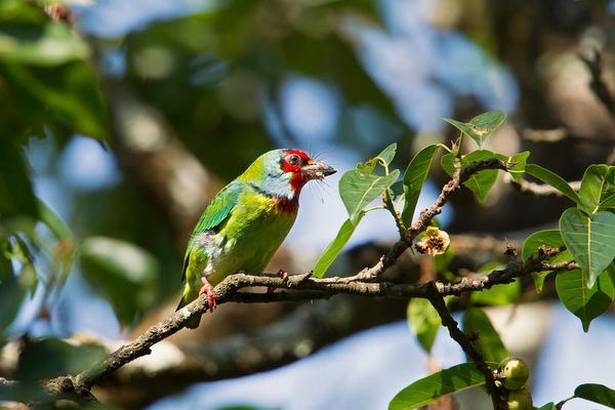
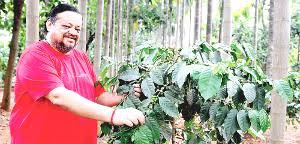
Shreedev Hulikere, a third-generation coffee grower with 60 acres in Chikmagalur, who is partnering with Wild Kaapi, says he wasn’t aware of the numerous wildlife species on their estate till now. “While my ancestors traditionally hunted, I’m a conservationist. I tell my labourers not to destroy any bird nests. I know that barbets nest here and they eat the borer worms that destroy coffee. Similarly, I’m not going to chase away the monkeys and civets that eat my coffee because I’m being compensated elsewhere. Just because a porcupine destroys a pepper creeper, I’m not going to hunt it down,” he says.
Love thy neighbour
The audit also revealed a few surprises. “We found frogs listed as endangered or threatened in the IUCN Red List (the world’s most comprehensive inventory of global conservation status) at these plantations,” says Karanth. The certification not only places their coffee in a premium space, but also paves the way for a new movement. “If you have wildlife-friendly practices, you can promote sustainable agriculture. We are trying to establish a new model — a profitable enterprise that also enables better livelihoods. This hasn’t been tried before; it’s a new way of thinking,” says Karanth.
(photo credit: Ramki Sreenivasan)
While their immediate goal is to prove that such a model is sustainable, Sosale is also mulling introducing coffee scrubs, soaps, candles and flavourings — all huge product lines in the international space. Moving into pepper and cardamom, which grow hand-in-hand with coffee, also holds much promise.
Prices start at ₹390 for 250 gms.
To know more, and buy the coffee, check out wildkaapi.com.
source: http://www.thehindu.com / The Hindu / Home> Life & Style> Homes and Gardens / by Bhumika K / June 02nd, 2017
What do you do when you have a long weekend at hand and you wish to escape from the hustle and bustle of the IT capital? Driving to Coorg, the ‘Scotland of India’, is definitely not a bad option. That’s precisely what we did on one such weekend that had a public holiday attached. We decided to make the most of it by driving to that part of the world, where one can be at peace at the Buddhist Monastery, be one with nature at the vast coffee estates sipping a hot cup of filter ‘kaapi’, play Peeping Tom to bathing elephants and relish some delicious local delicacies.
How did we go?
The drive from Bengaluru (Whitefield) can take around six hours with a couple of breaks, so we decided to leave office early post lunch on a Friday with the intention of beating the weekend traffic that piles up on Mysore Road. The drive from Whitefield until the Mysore Road exit can be taxing and no sooner had we entered Bidadi that we started our countdown to the restaurant. We regularly halted on Mysore Road for some nice ‘thatte idli’ and filter coffee. Post our refreshment break, we drove non-stop until we reached Aishwarya Suites (at New Bamboo Bazaar Road, Mysuru City) for our overnight stay. On day two, we got off at around 7 am and headed towards Coorg.
The stay
We stayed at the Leisure Vacation’s Brook Stone Villas at Thalatmane village on the Mysuru-Mangaluru highway. The location is around six km from Gen Thimmaiah Circle as one turns towards Mangaluru. One has to traverse through acres of coffee estates on a ‘kuccha’ road, giving the driver a semi off-roading experience.
What did we do?
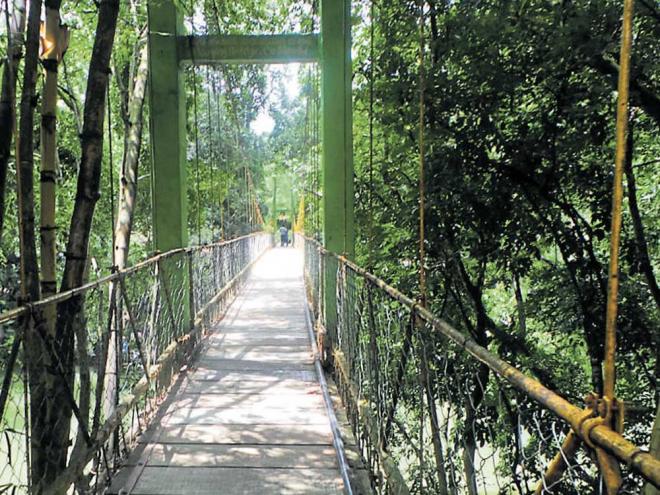
Driving through the scenic road flanked by tobacco farms, we visited the Buddhist Golden Temple. After paying homage at the temple, our next port of call was Nisargadhama Island on the Kaveri river. Here one can visit the island via a hanging bridge, suspended over the river. Later in the day, we visited Abbey Falls and called it a day after visiting Raja’s Seat — a picnic spot that offers a West facing beautiful valley and sunset view, a nice flower garden and a musical fountain treat.We covered Talakad on the second day. At Talakad, one can visit the temple and the higher altitude offers some good sights of the valley beneath. On day three, post breakfast, we headed back to Bengaluru albeit with lots of lovely memories.
(The author can be contacted at srikanthmenon@yahoo.com)
source: http://www.deccanherald.com / Deccan Herald / Home> Supplements> MetroLife / by Srikanth Venugopal / May 11th, 2017
Arjun Belmar owns 34 acres in T Dasarahalli, off Tumkur Road
For close to 30 years, Arjun Belmar hasn’t spent a penny on buying coffee. He lives in the city and grows his own coffee. Yes, you read that right. He does. Belmar and his family offer proof that coffee is not only grown in Chikkamagaluru and Kodagu, but also right here in our city.
The businessman has been growing coffee in the face of scorching summers or water scarcity. “Bengaluru is 900mt above sea level and the land can be utilised for coffee. But one needs to grow it properly in the shade,” he explains.
When Bangalore Mirror visited his 3,000 sq ft coffee plantation, it felt like a forest in the middle of the concrete hub.
“Years ago, T Dasarahalli was away from the city. Just about 100 people lived here and we had only one bus to our house from City Market. My father used to love plants and we grew everything on our land. Not just variety of trees and plants, we also had many cows which used to give us 200-300 lt of milk. We used to share it with whoever came to our home,” Belmar says.
The grand old times are gone, but the family continues its green tradition. They keep bees and harvest honey too on their property.
However, Belmar, remembers a time when they just had to dig up to half a foot to find water. “That is how we were able to grow ginger, grapes, vegetables, paddy, wheat, sugarcane, betel, pepper and other plants,” he said.
On how they started growing coffee, Belmar’s explanation is simple – Everyone in the family loves coffee and wanted to taste the authentic thing. “We used to have our own cows and buffaloes for milk and grow sugarcane for jaggery and sugar. Why then, can we not have our own coffee plants, we thought. Then we went to
Chikkamagaluru in search of the plants.”
Though they were unsure if coffee plants can survive in Bengaluru, they kept going with their plan. “Today we have around 50 plants,” he says. “We had other bigger trees on the land. Coffee grows in semi-shade so we put them between these big trees. We watered the plants continuously and saw the first flowers on the plants,” he says.
He recalls that his father had tears in his eyes when he saw the coffee plant flowering at last.
“Each coffee plant gives around 2-3kg of coffee fruit. In a year, we get close to 50 kg. We pluck the fruit and clean it and keep it for drying. Once it has dried properly, we give it for processing and get it done in a customised manner. We tell them whether we want it with or without chicory,” he said.
His friends and family, who visit the farm, are in awe of the plantation. “My friends used to ask me if I were living in Madikeri or Bengaluru. They love the coffee we give them in packets. People who visit us from abroad wait to visit again to refill their stock,” he said.
Belmar also grows the cocoa plant. He has close to 150 cocoa plants, the seeds of which he sends to Mangaluru for processing.
“We drink premium coffee personally handled by us. It is better than the coffee grown in Chikkamagaluru,” he says, with a hint of pride.
It’s all about the honey
Belmar says they started keeping bees as his grandfather was one of the founders of the Bee-keepers Association in the city. “We have been harvesting honey on our land for the past 40-50 years. Keeping bees easy here because of the rich bio-diversity.”
Bee-keeping in the city dates to the times the British were here. Belmar says, “It was during the British rule that the Bee-keepers Association began. These days, people are trained to keep bees and harvest honey.”
He has one special information about the honey. “When the Neem tree is flowering, the honey tastes best and it is clear. In the mango season, the honey is quite reddish and very sweet. When the tamarind tree is flowering, honey is a little sour. For each season, we have a different flavour of honey.”
source: http://www.bangaloremirror.indiatimes.com / Bangalore Mirror / Home> Bangalore> Others / by Kumaran P, Bangalore Mirror Bureau / May 10th, 2017
WELCOME. If you like what you see "SUBSCRIBE via EMAIL" to receive FREE regular UPDATES.
Read More »