Category Archives: Nature

Coffee growers spar over poly wrap method to curb white stem borer

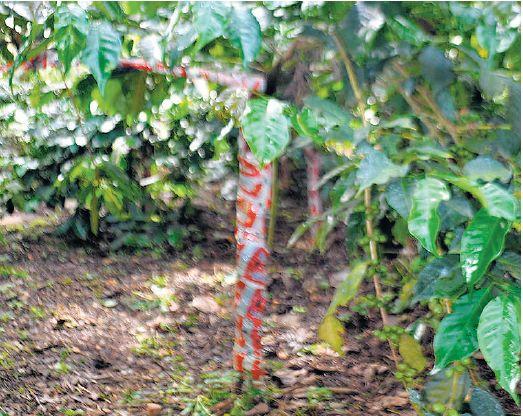
Better solution: An arabica plant stem wrapped with cellophane tapes to prevent it hosting the white stem borer on a coffee estate in Kodagu. / The Hindu

Results are good, says Coffee Board; some planters raise environmental concerns
An ingenious method has been found to control the ruinous white stem borer in coffee estates where the arabica variety is grown. But coffee planters are split over the effect of the solution with some even questioning its impact on the environment.

According to A.K. Bhandari, coffee planter and former President of the United Planters Association of Southern India, wrapping the stem of the arabica plant with cellophane, called poly wrap, helps in containing the borer menace. The wrap prevents the female beetle from laying eggs in cracks and crevices of the plant.

“We came across this solution some two-and-a-half years ago when some planters used old plastic to wrap the stems. It prevented the borer from laying eggs and controlled the spread of the pest,” he said.

Coffee white stem borer, Xylotrechus quadripes, is a pest found in arabica coffee causing huge yield loss. A blackish brown coloured beetle, it can also be found on rosewood, sandalwood and teak.

Ten to 12 days after the female beetle lays the eggs on the stem, the larvae enter the woody tissue and burrow up to the roots. This leaves the plant impaired and the only known solution is uprooting the plant totally and burning it.

“Poly wrap physically stops the insect from laying eggs on the plant. Growers had, at one point of time, wrapped plants with old fertiliser bags. Now, they have begun to use strip wraps and the results have been good,” said Jawaid Akhtar, Coffee Board Chairman.

History traces the borer menace to 1837 and the first reference was made in 1838 by H. Stokes, Mysore Commissioner. In 1868, the Madras Commissioner had reported the ravages of the borer in Mysore and Coorg.

YIELD LOSS

“We have been suffering from the borer menace for over a decade now. It has affected arabica production. In some estates, nearly 50 per cent of plants had to be uprooted,” said Bose Mandanna, a grower in Kodagu and former vice-chairman of Coffee Board.

The borer menace has resulted in arabica production stagnating around one lakh tonnes annually for almost a decade after rising to a record 1.21 lakh tonnes in 2001-02 (October-September) season. Its share in total coffee production (robusta makes up the rest) has decreased from over 50 per cent in the 1980s to around 30 per cent now.

This year, out of the estimated 3.47 lakh tonnes production, arabica output has been pegged at 1.11 lakh tonnes. However, growers expect it to be lower than 90,000 tonnes.

“The poly wrap seems to be working very well. Most of the growers have reported 99 per cent success. About 10 estates can be taken and the experiment tried for 2-3 years,” said Bhandari.

The Coffee Board had sent an advisory on the poly wrap but not much progress seems to have been made.

“Labour shortage is the reason why poly wrap has not picked up. Also, there was short-supply of wraps. That has ended now as supply is ample. Results are encouraging and the wrap does not affect the plant’s growth,” said Akhtar.

But, there are voices of dissent too.

“The poly wrap was tried in small pockets and it has not been successful when tried on a large-scale. It prevents plants from growing. The bark growth is stunted and we feel this is not a scientific solution,” said the Karnataka Planters’ Association Chairman, Nishant Gurjer.

Some of the corporates involved in growing coffee have now begun to experiment the method. “We have begun the poly wrap on Coffee Board’s suggestion and are assessing the results,” said an official of Tata Coffee at its Margolly estate in Kodagu.

However, concerns are being raised over its effect on the environment.

“When the poly wrap gets old, it could lead to environment problems since it won’t disintegrate easily,” said Mandanna.

Gurjer agrees. “Plastic will add to the mechanical damage to the plants,” he said.

Other growers say that until a better solution is found, the poly wrap method should continue.

source: http://www.thehindubusinessline.com / Business Line / Home> Industry> Agri-Biz / by M. R. Subramani subramani.mancombu@thehindu.co.in / November 07th, 2013
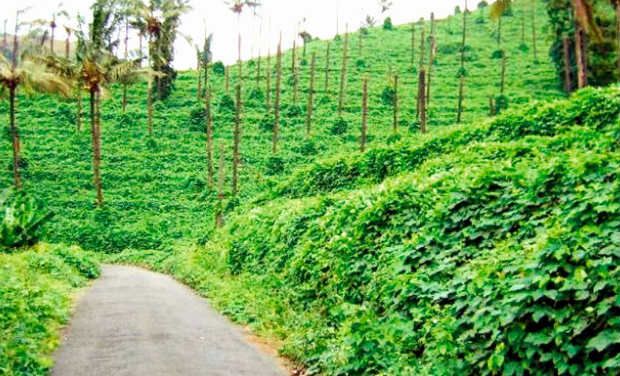
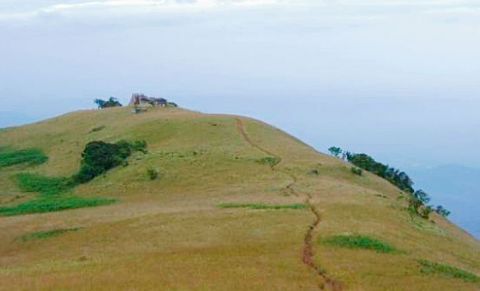
Peek into Coorg from Kannur

PaithalmalaKF04nov2013
Paithalmala is an enchanting hill station and a trekkers’ delight. This hilly region, about 1372 metres above sea level and 65 km away from Kannur, is the highest geographic peak of Kannur. Nestled along the Kerala-Karnataka border, it is one of the favourite spots for nature enthusiasts, photographers and trekkers alike.
Paithalmala2KF04nov2013
Paithalmala, situated near the Kodagu forest, is located along huge mountains spread over 500 acres of land amidst dense forest.

There are two trekking seasons at Paithalmala-monsoon and summer.

Monsoon trekking offers an adventurous experience and is the best time to capture the beauty of the mountains enveloped in a blanket of mist. However, trekking during monsoon is more difficult because of the extreme weather. Trekkers are also cautioned about leeches and occasional elephant visits. So, the best time for trekking is January to March.

Trekking begins through the dense forest followed by the plain grassland on the hilltop. An observatory tower built by the tourism department on the hilltop can be reached after a 45-minute walk from Paithal valley. The tower offers a breathtaking view of the valley and one see most parts of Kannur.

The best part of the trek is the walk from the observatory tower to the dense forest.

One can walk along the top of the hill enjoying the mesmerising beauty of the Coorg forest and Paithal valley. Small streams and ponds within the forest are special attractions.

source: http://www.deccanchronicle.com / Deccan Chronicle / Home> Lifestyle> Travel / by DC / Serin Sam / October 25th, 2013

Lakhs throng Talacauvery

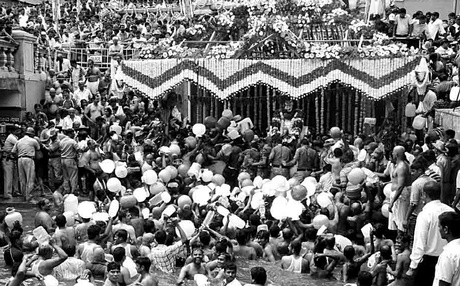
Devotees thronging Triveni Sangama at Talacauvery in Bhaghamandla on Thursday | Express photo

The Madikeri- Bhaghamandla- Talacauvery Road was jampacked from early Thursday as lakhs of devotees arrived for the ‘theerthodbhava’ near Brahmakundike.

It is believed that every year on this day at a specified time water from the Cauvery springs up in the form of a small fountain from ‘Brahmakundike’ at Talacauvery. And this water from this temporary fountain is considered to be holy.

A team of archakas, led by Ananthesh Kedilaya, announced the arrival of theerthodbhava at 12.01 pm, following which they sprinkled the holy water on the devotees near the Bramhakundike.

Kodagu police had enforced strict monitoring around the region to ensure that people do not enter Bramhakundike until after the theerthodbhava to prevent any untoward incidents such as a stampede.

SP M N Anucheth was seen standing near the pond and personally supervising arrangements with his subordinates.

Cultural programmes were performed by various artistes throughout the day. Ninada from Ponampet sang Kodava devotional songs while B A Ganesh from Shanthalli rendered Kannada devotional songs. Padmanabha and team from Melkote played the Nagaswara and Ramanajneya Bhajana team from Madikeri sung bhajans.

For the second consecutive year, the temple committee provided lunch for the devotees. MLA K G Bopaiah and Kodagu ZP vice-president B Usha Devamma supervised the catering arrangements.

The theerthodbhava was witnessed by the temple Thakka’s Kodi Madappa, Kodi Motaaiah, Balladka Appaji, MP A H Vishwanath, Deputy Commissioner Anurag Tiwari and others.

source: http://www.newindianexpress.com / The New Indian Express / Home> States> Karnataka / by Express News Service – Madikeri / October 18th, 2013

International band to shoot music video in Karnataka

The international band Naguale has chosen Karnataka to provide the backdrop for its music video. The band from Romania has zeroed in on Coorg and Mangalore to shoot its brand new video, which is a collaboration with Punjabi rap artiste Sukhbir.

(Naguale band member Ovidiu…)

“India and its colourful culture is hot on the international circuit right now. Since the song also features Sukhbir, they wanted an Indian touch to the video. I suggested that they come and shoot in Karnataka since such a varied choice of locations are available here,” says Akshat Mudbidri, who’s managing the band’s India operations.

Naguale will begin shooting in Coorg shortly, with the coffee plantations and Coorg culture receiving prominence. “We will then proceed to Mangalore and capture its scenic beaches. Local art forms like Yakshagana and tiger dance will also feature on the video,” explains Akshat.

Ovidiu Baciu, one of the members of the band, confirms that they have been getting glowing reviews about Karnataka and were looking to shoot amid nature and lots of culture, “So we’re here,” he says. The three member band will also have Bangalorean models grooving in the background to the song that’s titled Killa.

Encroachers volunteer to vacate forestlands in Kodagu dist

There is good news for the Forest department, which is striving to clear encroached forestlands. Villagers, who had encroached upon Subraya sacred grove, in Korangala village, near Bhagamandala, have voluntarily decided to vacate the land and have submitted a letter of consent in this regard.

On survey number 106, behind Subramanya temple, in Korangala, there is sacred grove of 59.34 acres. Six persons, who had encroached upon 8.70 acres of land, have decided to vacate it voluntarily.
N S Bojappa (two acres), N J Somanna (1.5 acres) N N Kalappa (1.50 acres), J S Subraya (two acres), B N Lokanath (1.5 acres) and N N Jnanashekar (0.20 acre) have handed over the land to the Forest department. In a meeting held in front of Nangaru Ainmane, the villagers handed over a letter of consent to ACF C Shashi. Following the development, T B Somappa (0.50 acre) and K D Seetha (two acres), who had encroached upon Ayyappa sacred grove at Sannapulikotu, have also decided to vacate the land.
Speaking to Deccan Herald, J S Subraya said, “Our ancestors had encroached upon the sacred grove land, knowingly or unknowingly, and we were cultivating coffee and cardamom. The forest officials brought the issue to our notice. So, we decided to vacate the land and help conserve forests.”

There are approximately 13,371 acres of sacred grove lands in Kodagu district. Some of them have been encroached upon by local farmers. There is no exact statistics on the encroachment.

However, we can identify the encroached land, said Shashi. “We are trying to convince the villagers to vacate the land on their own. Basavanna Devara Bana Samithi had issued notices to farmers, through its lawyer, urging them to vacate the encroached land at Valnoor-Thyagathur Basavanna Sacred Grove.

Now, we have written letters to all sacred grove committees, seeking details and have asked them to vacate encroachers. If the encroachers fail to vacate voluntarily, we have to do it legally,” he said.

source: http://www.deccanherald.com / Deccan Herald / Home> District / by Srikanth Kallammanavar, Madikeri / DHNS / October 24th, 2013

Govt gives green signal for high-tension power lines

Amidst opposition from the environmentalists, the State government has given green signal to the Kodagu district administration to re-start the work on Mysore-Kozhikode 400 KV high-tension electricity supply lines.

In a letter written to the the Kodagu DC, State Forest, Environment and Ecology Dept Principal Secretary S Sivashailam has said, “If the electricity wire, that passes through 55 km area in Kodagu is laid above 15 metres above the ground, it would not harm the elephants. Therefore, the electricity wire laying work can be re-started.” It can be noted that normally electricity wires are laid 9 metres above the ground.

The letter, has evoked opposition from the environmentalists. Recalling the recent High Court judgement which had directed the government to re-consider all the work that passes through elephant corridors, an environmentalist said that Lingapur, Maldare, Thithimathi, Kanur, Nalkeri, Kutta and surrounding areas where the proposed hi-tension wire passes through, are habitats of elephants. Several trees will have to be cut for laying the hi-tension wire, which will adversely affect the animal habitat, the environmentalist said.

Following the opposition from the environmentalists, Deputy Commissioner Anurag Tiwari had written to the government on October 21, requesting the government to re-consider the matter. In reply, forest department principal secretary has directed the DC to start the work.

Government’s letter

The letter by the forest department chief secretary, states further, “the State government while giving permission to the work on March 1, 2012, had imposed a condition to the Powergrid Corporation that the hi-tension wire which passes through reserved areas of elephants in Kodagu and Mysore, should be laid six metres above the normal height.

The elephants even if they raise their trunk, can not reach the wire at 15 metres height. Therefore, laying wire at this height, would not harm elephants.”

Further, the letter clarifies that the High Court in its judgment on October 8, too has imposed a condition that the electricity wire should be in such a height that elephants should not be able to reach it. Hence, laying wire at 15 metres height would abide by the HC directive too.

The 120 km long 400 KV hi-tension wire from Mysore to Kozhikode will pass through 55 km land in Kodagu. Of this, 4.45 km is forest land, while the remaining is private land and plantations.
The wire laying work has been completed from Mysore to Lingapur (Mysore-Kodagu border) on the one side, and from Kozhikode to Manandavadi (Kerala-Kodagu border) on another side. As the work faced severe opposition from environmentalists in Kodagu, the work was halted for sometime. If the project is implemented, it would provide 520 MW power to Karnataka and 260 MW to Kerala from Koodankulam nuclear power plant.

source: http://www.deccanherald.com / Deccan Herald / Home> District / by Srikanth Kallammanavar, Madikeri / DHNS / October 24th, 2013

Lakhs throng Talacauvery

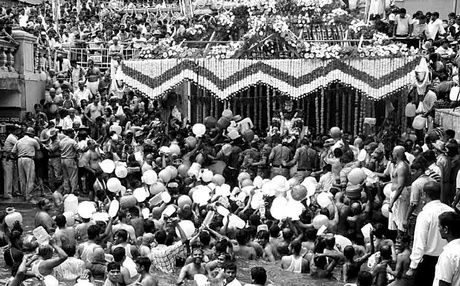
Devotees thronging Triveni Sangama at Talacauvery in Bhaghamandla on Thursday | Express photo

The Madikeri- Bhaghamandla- Talacauvery Road was jampacked from early Thursday as lakhs of devotees arrived for the ‘theerthodbhava’ near Brahmakundike.

It is believed that every year on this day at a specified time water from the Cauvery springs up in the form of a small fountain from ‘Brahmakundike’ at Talacauvery. And this water from this temporary fountain is considered to be holy.

A team of archakas, led by Ananthesh Kedilaya, announced the arrival of theerthodbhava at 12.01 pm, following which they sprinkled the holy water on the devotees near the Bramhakundike.

Kodagu police had enforced strict monitoring around the region to ensure that people do not enter Bramhakundike until after the theerthodbhava to prevent any untoward incidents such as a stampede.

SP M N Anucheth was seen standing near the pond and personally supervising arrangements with his subordinates.

Cultural programmes were performed by various artistes throughout the day. Ninada from Ponampet sang Kodava devotional songs while B A Ganesh from Shanthalli rendered Kannada devotional songs. Padmanabha and team from Melkote played the Nagaswara and Ramanajneya Bhajana team from Madikeri sung bhajans.

For the second consecutive year, the temple committee provided lunch for the devotees. MLA K G Bopaiah and Kodagu ZP vice-president B Usha Devamma supervised the catering arrangements.

The theerthodbhava was witnessed by the temple Thakka’s Kodi Madappa, Kodi Motaaiah, Balladka Appaji, MP A H Vishwanath, Deputy Commissioner Anurag Tiwari and others.

source: http://www.newindianexpress.com / The New Indian Express / Home> States> Karnataka / by Express News Service – Madikeri / October 18th, 2013

Teerthodbhava occurs at Talacauvery at 12.02 p.m.

Madikeri:

The annual spectacle of ‘Teertodhbhava’, symoblising the emerging of holy water from the ‘Brahmakundike’, a tiny niche, at the foothills of mighty Brahmagiri Hills at Talacauvery in Kodagu, occurred at 12.02 p.m., amidst the chanting of Vedic hymns by priests and the delirium of devotees on Thursday. River Cauvery’s journey originates from Talacauvery.

Thousands thronged the spot vying with each other to catch a glimpse of the occurrence. A large number of devotees had reached Talacauvery much ahead of the scheduled occurrence. Anil, of the visitors, told The Hindu that the gathering was less when compared to last year. ‘Everything went off well’, Manu Muthappa, president of the Bhagandeshwara-Talacauvery Temple Management Committee, said.

Devotees are streaming into Bhagamandala to take a holy dip at the Triveni Sangama, offer prayers and proceed towards Talacauvery, located about eight km away.

Police had a tough time in preventing devotees from jumping into the main pond in front of the Brahmakundike at Talacauvery before the ‘Teerthodbhava.” A team of priests sprinkled the ‘teertha’ on the devotees as soon as it emerged from the Brahmakundike. The holy water is not be allowed to overflow from the niche since it is considered inauspicious.

Distribution of teertha to the general public would take place today evening and tomorrow morning. Television news channels beamed the event live through which many were above to see the occurrence.

Mysore-Kodagu Member of Parliament, A.H. Vishwanath, former Speaker and Virajpet MLA K.G. Bopaiah, Deputy Commissioner Anurag Tewari, and Superintendent of Police M.N. Anucheth, were present.

source: http://www.thehindu.com / The Hindu / Home> News> National> Karnataka / by K. Jeevan Chinnappa / Madikeri – October 17th, 2013

State prepares for biggest elephant capture operation since 1971 ‘khedda’

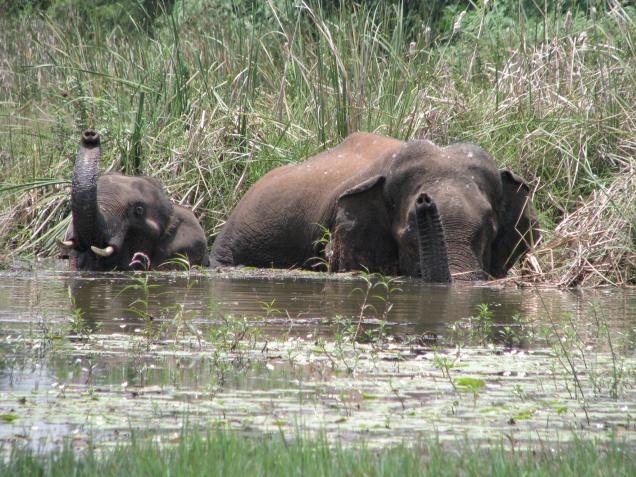
OUT OF PLACE?: In Alur taluk, a herd of 25–30 elephants inhabit a tiny 5-sq. km forest patch circumscribed by agricultural fields that they routinely raid, according to M.D. Madhusudan, a member of the Karnataka Elephant Task Force./  File photo / The Hindu
OUT OF PLACE?: In Alur taluk, a herd of 25–30 elephants inhabit a tiny 5-sq. km forest patch circumscribed by agricultural fields that they routinely raid, according to M.D. Madhusudan, a member of the Karnataka Elephant Task Force./ File photo / The Hindu

At least 25 wild elephants are set to be caught in Alur taluk of Hassan district

With a green signal from the Karnataka High Court on Tuesday, the Department of Forests now sets about planning its biggest ever operation to capture wild elephants since the State’s last ‘khedda’ in 1971, when 47 animals were captured.

At the very least, this would mean the capture and taming of around 25 elephants in Hassan’s Alur taluk, the epicentre of human-elephant conflict in the State. The Karnataka Elephant Task Force in its report to the High Court in September 2012, identified two regions — Alur and Tumkur district’s Savandurga — as “elephant removal zones” for the “unacceptable levels” of conflict they encountered.

The department, however, places “the outer limit” for the number of elephants to be captured at 150 and hope to extend the ‘removal zone’ to parts of Kodagu where human-elephant conflict is intense. “The actual number we capture will be much less, but we’ll have to take a call on areas such as Kodagu based on an assessment of conflict levels and perceptions of people here,” said Principal Chief Conservator of Forests (Wildlife) G.S. Prabhu.

‘Extreme measure’

Members of the task force don’t quite agree. Removing wild elephants from a natural landscape is “an extreme measure” and one that should be done with the “greatest judiciousness”, said M.D. Madhusudan, scientist with the Nature Conservation Foundation and task force member. Only two areas have been identified by the task force as potential “removal zones” and Kodagu is not one of them, he said.

Alur was an anomaly of sorts and justifies the approach, he explained. The conflict in Alur was intense, and the elephant population was ecologically unviable. “Here, a herd of 25–30 elephants inhabit a tiny 5-sq. km forest patch circumscribed by agricultural fields that they routinely raid.” Between 1986 and 2011, elephants killed 46 people and injured over 240, according to the task force report, creating a “fear psychosis among people that hampers their ability to work and live normal lives.”

The situation in Kodagu was not adequately studied yet, said Raman Sukumar, chairman of the Centre for Ecological Sciences, Indian Institute of Science. “We first need to assess the conflict situation in Kodagu, understand the dynamic of elephants here (are they transitory, for instance) before we decide on a course of action.”

Meanwhile, the Department of Forests has set aside Rs. 4 crore to create kraals to restrain elephants captured, which typically take a year to tame, and new elephant camps. “The project can only begin in January, after the rain,” Mr. Prabhu said, and added that the department would be using a combination of methods that incorporate elements from traditional ‘khedda’ (stockade traps) and also modern-day chemical tranquilising.

BACK TO THE WILD

Even as it prepares for a large-scale capture of elephants, the department, ironically, admits that its 10 camps, which together have 91 elephants, are too crowded.

“We are looking at the possibility of returning around 30 of these back to the wild,” Mr. Prabhu said.

source: http://www.thehindu.com / The Hindu / Home> News> National> Karnataka / by Divya Gandhi / Bangalore – October 13th, 2013

Problem elephants might be captured, tamed

Governor H.R. Bhardwaj with Ashit Sagar Puttannanavar, one of the prize winners, at the valedictory function of the 59th Wildlife Week in Bangalore on Monday. / Photo: Bhagya Prakash K. / The Hindu

Wild elephants that have for years posed a major problem to the lives and livelihoods of residents in Hassan’s Alur taluk and in Kodagu’s Virajpet could soon be captured and tamed, Principal Chief Conservator of Forests (Wildlife) G.S. Prabhu said on Monday.

The Department of Forests had, earlier this year, proposed the capture of several problem elephants that routinely raided crops and came in conflict with people.

Mr. Prabhu was speaking at the valedictory function of the 59th Wildlife Week organised by the department, where schoolchildren were given prizes for essay and painting competitions on the theme ‘The importance of environmental protection’.

A sum of Rs. 21 crore had been earmarked to mitigate the human-animal conflict in the State, Minister for Forests, Environment and Ecology, B. Ramanath Rai, said.

Governor H.R. Bhardwaj said several species across the world were endangered because of human greed. He added that the budget allocation for wildlife conservation should be increased.

source: http://www.thehindu.com / The Hindu / Home> News> National> Karnataka / by Special Correspondent / Bangalore – October 08th, 2013