The Tamara resort in Coorg recently won the award for most romantic resort at a travel awards show hosted by a Hindi business channel. It is listed in the top 20 honeymoon destinations by Conde Nast Traveller India.
This is a luxury 56-key resort located in the hills of Coorg near Madikeri. It has been set up within an estate of 170 acres that produces coffee, cardamom, pepper and honey, and claims to be one of the few places in the world that is built inside a functional coffee plantation.
Its promoters say that it is set on a slight slope, and offers a breathtaking view of the Western Ghats and lush green forests along with two waterfalls flowing within the premises. Tourists either head out on guided treks and nature trails, or opt for a plantation tour with the coffee experience.
A bridge overlooking one of the waterfalls serves as a multi-cuisine restaurant. The resort is in the second phase of development that will have new luxury cottages and premium suites apart from sit-out decks at a height of 3,600 sq ft overlooking the hillside. An indoor private jacuzzi and spa is also on the anvil.
source: http://www.timesofindia.indiatimes.com / The Times of India / Home> Business> India Business / by Bella Jaisinghani, TNN / July 06th, 2013
Gustasp & Jeroo Irani encounter the Cauvery in the forests of Karnataka.
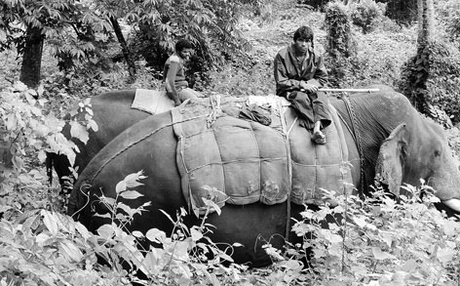
A deep trench, meant to keep elephants away from the lush coffee plantation, had the imprint of a large footprint. An elephant had just lumbered past. “He is in the vicinity,” whispered Ganesh, our naturalist-guide.
As we soldiered on through the Dubare Forest in Kodagu or Coorg, Karnataka, past stands of dead bamboo and soaring rosewood and sandalwood trees, the jungle resonated with an air of menace. “Shhh! He’s there, not too far away!” Ganesh said, as our hearts beat a harsh tattoo against our chests. We were in search of the legendary river Cauvery and it seemed like in the process we would be trampled by an elephant. We stood as still as the tall matti trees from whose sturdy trunks tribals draw water to drink. And then, to the huge relief of our group of four, we heard the lone tusker tramp away in the opposite direction.
Parting thickets of leaves and dry twigs that clawed at us, we trod up and down red paths to suddenly arrive at a clearing. An expanse of emerald-green waters, rippled below, tripping over smooth boulders… the Cauvery at last! The mythical maiden river had played truant even with Sage Agastya who fell in love with her. Legend says the sage asked a disciple to keep an eye on his beautiful wife Cauvery and put her in a vessel. The mischievous and self-willed lady was upset and started to flow away. When the young lad protested, she went underground. That is why, it is said, the river disappears from her source at TalaCauvery, high in the Western Ghats in Coorg, to re-emerge at Bhagamandala, a few kilometres away where a charming temple is dedicated to her.
In the land of her birth, the river is worshipped as a living goddess. Every Coorg or Kodava home is adorned with a photograph or oleograph of the Cauvery and a heavy brass lamp is lit every morning and evening to honour the ancestors. We, however, washed our faces in her life-giving waters and splashed it on one another, while Ganesh sang a song to Ma Cauvery, his voice riding over the sound of the rushing river.
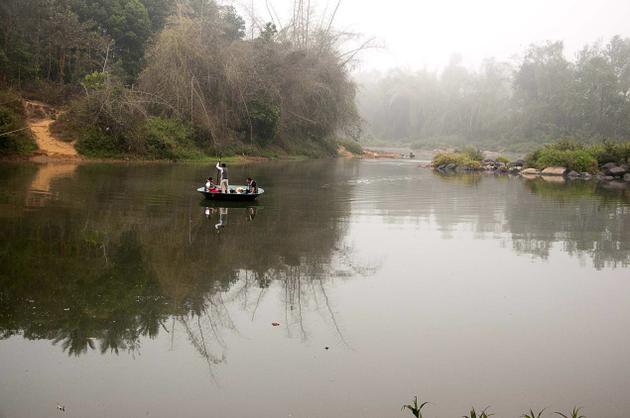
When we were there recently, the river was fairly shallow but coracles bearing locals drifted along its length to the various villages. We too twirled down the river in a coracle to the riverside village of Karadigodu, with trusty Ganesh, when the fragrance of freshly-baked local bread wafted over the slowly-awakening hamlet. Children were getting ready for school, cramming into an auto rickshaw that doubled as a school bus, while grandmothers packed tiffin boxes with lunch for their men-folk on their way to work in the coffee plantations. Mothers swung infants on ample hips and waved to older children heading for the nearest college, heaving backpacks on frail backs. The village has an aura of sleepy prosperity. / Photo: Gustasp and Jeroo Irani / The Hindu
The village had an aura of sleepy prosperity. Neat little cottages were strung in rows, painted in vivid shades of pink, purple, mauve and green and, in some, TV sets played out the latest South India soaps. We stopped at a local stall (grandly called The Riverside Hotel) for some South Indian filter coffee, fresh sweet bread and smoke-flavoured onion bhajias that had just been whipped off a wood fire. And in front of the village flowed the mercurial Cauvery which, when it is in spate, can break its banks and flood the hamlet and the first row of houses! Yet when we took part in harvesting coffee berries in a plantation, we began to understand how the locals feel an almost mystical attachment to the river.
“Without the river and the land that it waters, we are nothing,” said one of the women coffee pluckers whose nimble technique of prying coffee berries off the bush, we tried hard to imitate. “Ma Cauvery is our goddess!” she exclaimed.
After coffee harvesting ends in February, pepper is culled and so it goes on till June when, with the rains, the Cauvery brims with revitalising waters again, the soil sprouts anew and the cycle of life is renewed.
We met the river goddess again in Kabini, a three-hour drive away, past fields of ripening corn, sugar cane and paddy. The forests of Nagarahole were a dark-green tangled smudge beyond the coiling river Kabini which, incidentally, is a tributary of the Cauvery!
As our boat put-putted down the Kabini that circles the south-eastern edge of the Nagarahole National Park, we saw a couple of wild elephants, long tusks grazing the ground, a marsh crocodile sunning itself on a bank, as still as a log of wood, an iridescent kingfisher that dived for his meal and emerged triumphant. All around us was a world as fresh as at the dawn of time and we thanked Ma Cauvery for her life-nurturing presence which even embraces the wilderness.
source: http://www.thehindu.com / The Hindu / Home> Features> Sunday Magazine / by Gustaspjeroo Irani / July 13th, 2013
Kodagu District In-Charge Minister Dr. H.C. Mahadevappa is seen inspecting the damaged Mysore-Madikeri road yesterday. Former Minister T. John, MP H. Vishwanath and others are seen. Madikeri :
Kodagu District In-Charge Minister Dr. H.C. Mahadevappa, who visited the district yesterday, inspected the damaged road at Boikeri village linking Mysore and Madikeri. He also visited Thayagaraja Colony in Madikeri town where houses were damaged due to heavy downpour.
Later, speaking to press persons at Sudarshan Guest House, Dr. Mahadevappa, who holds the PWD portfolio, said that as per the preliminary report submitted by the district administration, the district has incurred a loss of at least Rs. 24 crore due to heavy rainfall. Based on the consolidated report, the government is committed to sanction funds to take up relief works, he said.
Stating that the district had received more than double the amount of rainfall than last year by this time, he said that the average rainfall this year till date was 219.79 cms (86.54 inches), while it was 91.67 cms (36.03 inches) last year. “I am aware the heavy downpour has adversely affected normal life. I have directed the DC to undertake relief work on a war footing,” he said.
Gabion technology for Madikeri road repair
Karnataka Road Development Corporation Limited (KRDCL) Managing Director R. Srinivas, speaking to press persons here yesterday, said that there were two options to repair the massive breach in Mysore-Madikeri road at Boikeri village – either build a concrete retaining wall or use the Gabion technology. “Senior officials have been told to inspect the spot and submit a report, based on which repair work will be undertaken,” he said.
The highway work between Sampaje and Maani, which is progressing in a slow pace, will be expedited to complete by May 2014, Srinivas said.
What is Gabion technology
A gabion is usually a box filled with concrete or sometimes sand and soil for use in civil engineering, road building, and military applications. A gabion wall is a retaining wall made of stacked stone-filled gabions tied together with wire. Gabion walls are usually battered (angled back towards the slope) or stepped back with the slope rather than stacked vertically. The most common civil engineering use of gabions is to stabilise slopes against erosion. Other uses include retaining walls, temporary floodwalls and silt filtration from runoff.
source: http://www.starofmysore.com / Star of Mysore / Home> General News / July 29th, 2013
The tiny hill district of Kodagu (Coorg) in Karnataka is facing an ecological disaster with the President of India giving his assent to a controversial legislation which allows the disposal and sale of Jamma lands in Kodagu located in the fragile Western Ghats. It is feared that the resultant denudation of the forests in the region could trigger an environmental damage with unpredictable consequences.
The repercussions of the legislation — The Karnataka Land Revenue (Third Amendment), Act, 2011, which received Presidential assent early this year after the bill was referred to the President by the Karnataka governor last year, will not only be severe on the Western Ghats region, considered as one of world’s bio-diversity hotspots, but will also take its toll on the customary laws, traditions and culture of the indigenous communities.
Jamma land tenure is unique to Kodagu district and it is estimated that the extent of ‘Jamma Baane’ land in Kodagu is around 2.55 lakh acres in possession of the local people — Kodavas, Amma-Kodavas, Heggades, Airis, Koyavas, Moplas and Gaudas. Jamma lands consist of wetland for growing paddy and the accompanying Baane land, initially used for cattle grazing and held free of assessment, now converted into coffee estates.
According to Sir J B Lyall, a British expert on tenures in Coorg who traced the origin of Jamma, it was originally a military tenure held on payment of half the assessment in consideration of military service. Jamma was granted under ‘sanads’ largely by the Coorg Rajas (1600 AD to 1834 AD) and to a smaller extent by the British till 1895 to the local inhabitants.
Hitherto, there was a ban on the sale of Jamma lands as the cultivator was only a ‘deemed owner’. The new legislation will confer the title of ‘occupant owner’ and allows the sale of land. The legislation, it is feared, will legitimise large scale denudation of trees and the formation of human settlements on Jamma Bane lands as there will be heavy influx of population from the neighbouring states. The presence of increased human habitation will have its impact on the adjoining forest land, its flora and fauna.
For generations, the life of the local communities, centered around the cultivation of the Jamma lands, the principal tenure in Kodagu. The Jamma lands could not be alienated as there was no provision for transferring the title of the property. The ownership was jointly held by the clan and it was managed by the head of the clan (Pattedara).
The issue went before the Karnataka high court and a full bench of the court held in its judgement delivered in October, 1993 that Jamma Baane landholders had limited privileges for cattle grazing, supply of firewood and timber for the domestic and agriculture purposes, but had no right to exploit the trees for commercial purposes, unless the holder had paid full timber value to the government. The court also held that the land-owner had no right to the sub-soil.
Customs and traditions
Once the ban on the sale of Jamma lands is lifted, the indigenous communities will be removed from their traditional Jamma holdings which formed the basis of their customs and traditions. The ‘ain-mane’ or the ancestral houses of the clans, was the focal point of all festivities and religious usages. It is feared that once the Jamma lands are sold to outsiders, the new land owners could lay claim to the ‘ain-manes,’ considered sacred to the local communities. This could lead to social tensions and law and order problem.
The biggest threat will come from the real estate mafia who were eyeing the Jamma lands all these years. With tourism boom in Kodagu, the local communities will be under pressure to sell their lands as the state will not have any control over them. It is learnt that already Jamma lands are being sold in anticipation of the new law taking effect.
The amendment to the Jamma tenure was effected during the previous BJP regime. The amendment was politically motivated and passed in haste without much debate in the Legislative Assembly, reportedly at the instance of the then Speaker K G Bopaiah who wanted to take political advantage. One of the reasons for Bopaiah’s re-election from the Virajpet constituency was on account of the political mileage he gained by getting the amendment passed.
The new amendment will create more problems than it hopes to solve. Those who drafted the amendment bill have failed to recognise the fact that apart from Jamma Baane lands, there are other types of Baanes — ‘Hithlu’ and ‘Sagu Baane’ lands.
Advocate K Sarojini Muthanna, who is knowledgeable on Jamma tenure matters, has suggested that the government should carry out further amendments to the Karnataka Land Revenue Act, 1964, devoting a separate chapter for the Jamma lands of Kodagu. The main support for the amendment has come from Akhila Kodava Samaja, representing a small section of the Kodavas. The president of the Samaja, Mathanda C Monnappa, opined that the amendment removed ‘irritants’ by way of government circulars which gave the impression that the land belonged to the government.
A large section of people, however, feel that in the interest of preserving the culture of Kodagu, and maintaining the ecological balance in the Western Ghats, the Siddaramaiah government should not give effect to the amendment to the Jamma land tenure.
source: http://www.deccanherald.com / Deccan Herald / Home> Panorama / by P T Bopanna / July 24th, 2013
A nondescript town in the lap of the majestic Pushpagiri mountain, Kumarahally’s geography makes it the perfect place to look for some solitary adventures, writes B V Prakash
Not all those who wander are lost, said a great man once; it surely must be the love of adventure. During my latest visit to Coorg, I decided to give the usual sights a miss and filled with an urge to explore the unseen, I deviated towards Somwarpet to drive through the primitive villages spread across the mountain ranges of the majestic Pushpagiri.
The destination was the nondescript town of Kumarahally. Also called Kumarally (in short), this town has nothing to boast of as a tourist destination; it is just one of the many small towns with similar names such as Shantalli, Kundalli, Bidalli and Bachalli through which one has to pass. However, it serves as a good base from which you can foray into a couple of interesting and exciting locales.
Leaving Somwarpet by afternoon, I headed north-west, breezing past the lush coffee estates and the green fields shining bright in the afternoon sun. After about five kilometres, a deviation to the left led me to a rustic settlement. Named Abbi Matha, this settlement is a religious place where devotees come for worship. But for others, it is a popular picnic spot thanks to the presence of the Abbi Matha Falls. The two-tier cascade may not steal the show, but it is impressive in its austere simplicity — surely an interesting diversion to break the 20-km journey to Kumarally. A dilapidated mutt premises can be visited here. Getting back on the track, I continued my journey towards Kumarally; the remaining journey was covered in half an hour and before dusk, I had reached my destination. The homestay at Kumarally — there is only one — is the ideal place to spend the night before exploring the locales nearby.
The nearest and most sought after sight here is the enchanting waterfalls of Mallalli. If you take the kuchcha road that goes beside the homestay, within a little less than three kilometres, you reach the famed waterfalls. However, driving on the slippery muddy stretch into the valley is indeed a torture. Mornings are the ideal time to visit the falls which are a sight to behold during sunrise. So at dawn, while still dark, I headed for the falls. After driving two kilometres on the treacherous path, I chose to walk the remaining way which proved to be a pleasant experience thanks to the fresh air and the sweet call of the birds. As I reached the edge of the wide gorge, I was left dumbfounded by the sheer beauty of the white cascades rolling down gently. I had all the time in the world to admire its beauty and also walk down all the way to its base.
From the front, the two distinct falls, each with its own form, appeared even more charming. The river Kumaradhara, which flows from here, tumbles down over short drops at a couple of places before joining the Netravathi at Uppinangadi. Rejuvenated from the astounding beauty in front of me, the tough climb back hardly mattered. On the way, I remembered the suggestion of my host Ponnappa and traced a trail through the coffee estates to see an unknown little falls which he said was called the mini-Mallalli falls.
Back at the homestay, after relishing a typically Coorgi breakfast of Votti (rice chapathi) and a cup of refreshing coffee, I drove up to Heggademane, a sleepy town six kilometres away. These places are familiar to trekkers as the trek to Pushpagiri begins from here. But you don’t have to be one to enjoy the panoramic view of the tall rounded peak rising into the blue sky from a lush forest. The Shantamallikarjuna temple here is worth visiting. In recent times, it has undergone a thorough improvement. The 850-year-old Champaka tree in the backyard is something that must not be missed.
Another interesting spot nearby is a hilly tract called Pattepare, which has some strange heaps of stones. Placed in triangular cairns of pebbles with a small opening, these were used as hideouts by erstwhile soldiers in times of battles, according to Ponnappa. There are also caves with narrow entrances. Though the whole place looked bizarre, it did evoke a feeling of belonging to a bygone era. With the sight of the mountain peak, the charming falls, the temple and clusters of age old cairns, Kumarally had me captivated.
How to get there
Kumarally is 20 kilometres from Somwarpet which is well connected with other cities. Though buses go to Kumarally it is easy to visit the spots with own transport in a day. The only homestay here provides food and accommodation.
source: http://www.deccanherald.com / Deccan Herald / Home> Supplements> Spectrum / by B V Prakash, DHNS / July 30th, 2013
The two-day operation to drive wild elephants back into forests by the forest department in South Kodagu in progress | Express photos
The two-day initiative of the Forest Department to drive wild elephants back into the forests came to an end on Saturday.
On Friday, the operation commenced in the presence of chief conservator of forests, Kodagu circle, Brijesh Kumar Dixith, Deputy Conservator of Forests (DCF), Virajpet division, Malathi Priya, Deputy Conservator of Forests, Nagarahole wildlife division, Gokul, assistant conservator of forests and range forest officials and staff from all the forest department divisions of Kodagu district.
14 Jumbos Driven Back to Forests
The teams were able to chase away 14 elephants from Devarapura and Nokya Gram Panchayat limits, ACF Belliappa told Express.
On Saturday, the teams were unable to spot even one elephant.
He said the teams will continue to ensure the elephants do not return.
“The operation will be continued next week in Pollibetta areas. Movement of vehicles and people will be restricted through publicity arrangements,” he said.
Belliappa added that most elephants entered South Kodagu either from Mauvkal or Nagarahole forests.
Need for Public Help
The operation involved tamed elephants, special task force staff, wildlife staff from Nagarahole, Virajpet division forest officers and staff along with watchers. General public and police also extended required assistance to the department.
Chief conservator of forests, Kodagu circle, Dixith told reporters here on Saturday that as per the elephant census taken last year, as many as 6,000 elephants were located in the state. In Kodagu region, covering Gonikoppa, Thithimathi and Maldaare areas, as many as 100 wild elephants are troubling people, he said.
“Another 32 elephants are permanent residents of BBTC coffee estates in Siddapura. These should be captured and shifted,” he said. However, before their capture, a few technical and legal aspects need to be addressed, he said.
In Bramhagiri wildlife sanctuary, 30 elephants on the Kodagu-Kerala border have been identified that need to be captured and sent back into forest cover, he said. All these issues have been brought to the notice of Forest Minister Ramanath Rai, Dixith added.
source: http://www.newindianexpress.com / The New Indian Express / Home> States> Karnataka / by Express News Service – Madikeri / July 29th, 2013
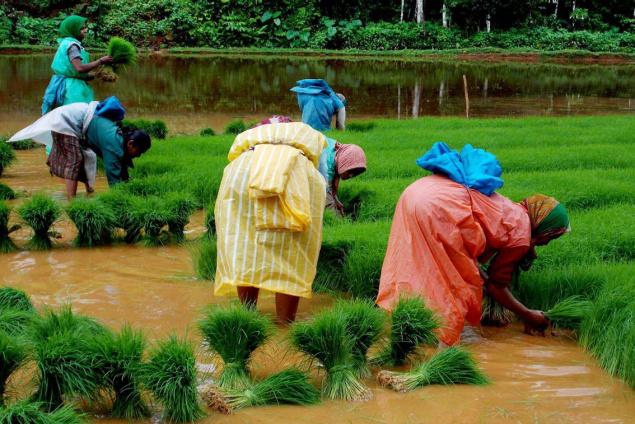
Women readying paddy seedlings at a nursery in Napoklu in Kodagu for transplantation./ The Hindu
Paddy transplantation has begun in the right earnest in Kodagu district, thanks to the copious rainfall which has far exceeded last year’s figures in the corresponding period.
Many farmers are steadfastly continuing the avocation against odds such as expensive labour, high input costs and irrational prices.
Transplantation has started in Napoklu and surrounding areas. Paddy seedlings are ready for plucking in the district and the works are expected to gather momentum in a couple of days, says Deputy Director of Agriculture, Kodagu, Ramakrishna. The target for paddy cultivation was 35,000 hectares of which 1,360 hectares had been covered till date, he told The Hindu.
Farmers in remote villages still depend on agriculture in Kodagu though it is not financially viable for most of them. However, the sheen associated with paddy transplantation where a large group of men and women sang to chorus to mask the tiredness of work cannot be seen any longer.
One would compete with the leader to match his speed of transplantation even if it rained hard. A big column in the middle of the paddy field would be left vacant to facilitate the ‘Nati Vota’, wetland sprint, in which youth would take part with great glee. It used to be the custom in the past. Not many indulge in ‘Nati Vota’ these days. The vacant column used to be covered up with seedlings after the sprint.
According to Monnanda Somaiah, a farmer from Napoklu, expensive labour costs, apart from the shortage of workers, had made many farmers give up agriculture in villages. Many of them had sold off cattle and some had converted fields into housing sites.
Farm mechanisation was a process yet to catch up in the district, though a few progressive farmers had discovered its utilities. Elephant attacks would result in destruction of paddy crops in the district in the recent years.
Fertilizer had replaced cow dung and other leafy manures that were organic, says Subbaiah, another farmer from the same region.
Paddy transplantation would pick up in Virajpet taluk, which had the largest areas in terms of coverage, in a few days as seedlings were ready for plucking, Mr. Ramakrishna said.
Not so long ago, the extent of paddy fields was considered a sign of high social status. Coorg mandarin (orange) cultivation had become popular enhancing one’s social status later onwards.
Coffee holding now symbolises the social status in Kodagu. Paddy crop is seen as goddess Lakshmi as the ‘Puttari’ of ‘Hutri’, the harvest festival for the people of Kodagu, is directly connected with it.
Cutting the paddy sheaves and taking home by chanting ‘Poli poli deva…’ meant appeasing goddess Lakshmi to give them a bountiful crop and abundance. Decrease in the paddy cultivation has robbed the harvest festival of its glory, says, Mr. Somaiah.
Kodagu received 1,602.1 mm of rainfall from January this year till 8 a.m. on July 18. It is more than last year’s figure of 732.89 mm.
Madikeri taluk received 2,372.24 mm, the highest among three taluks, in the same period this year. It was 1,049.2 mm last year. Virajpet taluk received 1,146.61 mm (622.19 mm) while Somwarpet taluk received 1,287.4 mm (527.27 mm).
source: http://www.thehindu.com / The Hindu / Home> News> National> Karnataka / by K. Jeevan Chinnappa / Mysore – July 21st, 2013
A blend of mythology, history and scenic locales, Madikeri is every traveller’s dream. Nothing like a weekend trip here to rejuvenate your tired soul, writes Swapna Dutta
It is a sluggish, cloudy morning. We are on our way to Madikeri, a place known for its calm, cool, peaceful and pollution free atmosphere. The very word Coorg spells wooded slopes and colourful scenery. Also, coffee and cardamom; black pepper and honey. The landscape is somewhat rugged but the misty mountain ranges that comprise ridge after ridge of lush, green forest reaching out to the bright blue sky is a sight to behold. The road is remarkably smooth and well-maintained and we are hardly aware that we have been climbing up steadily. It is easy to understand why Coorg was one of the places the British chose to settle down and continued to occupy it for over a hundred years; it was their ‘ Scotland of India’.
Madikeri, the charming capital of Coorg district, is located at an elevation of 1,525m above sea level. As we look around, breathing in the refreshing mountain air, we see the red-tiled bungalows that dot the hillside and a bustling market place at the heart of the city. There are acres and acres of tea and coffee plantations, orange groves, and undulating paths — all in all, a breathtaking view. The place also has a distinct old world charm about it.
Madikeri or Mercara, as it was called earlier, was founded in 1681 by Muddu Raja, a prince from the Haleri dynasty. It was originally called Muddurajakeri and was later shortened to Madikeri. Apart from being one of the most picturesque hill stations in South India, it is also the place from where the river Cauvery originates. It is generally believed that Coorg was ruled mainly by chieftains and local princes until the 17th Century. A number of inscriptions and copper plates found in different parts of the state denote that it was under different dynasties at different times; the Gangas, the Haleris, the Kadambas, the Cholas, the Kongalvas, the Changalvas, the Hoysalas and the Nayakatas being the most prominent ones among them.
The main sights of Madikeri town include the charming well-tended park in the heart of the city known as the Raja’s seat. It is said to be the place from where kings watched the setting sun along with their queens. The pavilion offers a gorgeous view of towering hills, green valleys full of paddy fields and forests and the road that looks like a curved ribbon lying way down below.
We next visit the Omkareshwara temple built by Lingarajendra Wodeyar II in 1820. The temple that has a beautiful tank in front is a mixture of Gothic and Islamic architecture. The Madikeri fort, an imposing structure that can be seen from almost the entire town, was originally built as a mud fort by Mudduraja along with a palace in the 17th Century. It was later rebuilt with granite by Tipu Sultan. When the British took over, they added a portico and a clock tower to the building. The fort building now houses a prison, a temple, a chapel, a museum and assorted government offices.
There are a number of tombs and memorials of historical importance in Madikeri. There is the Raja’s tomb which is a beautiful structure. The others comprise the tombs of Lingarajendra built in 1820 by his son, the tomb of a royal priest Rudrappa built in 1834 and the tombs of two brave soldiers who died fighting with Tipu Sultan.
The next day we make our way to the Talacauvery, located 44 km away from Madikeri on the slope of the Brahmagiri hills where the Cauvery originates. It is one of the important sacred places in Karnataka and is always full of pilgrims.
The place is marked by a tirtha kundike or a tank where the river emerges as a perennial spring and flows underground again, emerging a short distance away. From Talacauvery there are steps leading to the peak of the Brahmagiri from where one can get a panoramic view of the whole place.
How to get there
Madikeri does not have an airport; the nearest one is in Mangalore from where one can hire a taxi to get there. KSRTC runs a number of buses to and from Madikeri which are quite comfortable. Depending on where you live, hiring a taxi or going by car is also a good option as it is difficult to find local transport for sightseeing. From Bangalore it takes just under six hours to get there.
Stay is not a problem as there are a number of budget hotels, homestays, medium range and luxury hotels as well as resorts. But it is always advisable to book in advance as the place could well be full of tourists and pilgrims just when you plan to visit it.
source: http://www.deccanherald.com / Deccan Herald / Home> Supplements> Spectrum / by Swapna Dutta / July 16th, 2013
The guests from Nigeria have arrived in Kodagu. Its now their season to enjoy the mother nature, who are found aplenty in plantations, paddy fields and wherever you can see. It does not mean they are newcomers to Kodagu. They arrive here as guests on every monsoon since the past several decades.They will arrive in the future too. Now, you will wonder who these Nigerian guests are. If you want to see them, they are aplenty at Moornadu, Napoklu and Virajpet who fly in flocks between huge trees; they are none other than migratory birds from Nigeria or the locals call them as Bellakki, because they are white like snow.
If you go to see, its customary for the migratory birds to arrive in hilly range of Kodagu at the onset of monsoon, who take refuge from heavy gales and torrential rains. However, there have been a little changes in the recent past. It doesn’t rain like before here owing to which a few bird remain here. Moreover, no sooner monsoon sets in, these Nigerian migratory birds flock here and make nests in huge trees and busy themselves in procreation.
These birds that arrive in Kodagu take shelter in Napoklu, Moornadu and Virajpet. They are merrily made their nest in huge trees in towns and are least concerned of human activities on earth. These birds fly across blue sky, make nest and busy in laying eggs, a scenic sight indeed. If you view these migratory birds high on huge trees, it reminds of falcons of Mandya.
A few migratory birds were cited in the huge trees located at Napoklu.They returned to their bases after hatching and returned with newborn chicks.The number of migratory birds increased since then as the food was found aplenty and none troubled them. The flocks increased over the years and began settling in huge trees not only in Napoklu, but also in Hakattoor, that lies on Moornadu – Madikeri road. These birds shifted to localities of Moornadu, Napoklu and Virajpet as huge trees were felled in Hakattoor.
These migratory birds arrive in flocks during May – June at the onset of monsoon and settle in the huge trees of Napoklu, Moornadu, Virajpet (nearby KSRTC bus stand) in town.
These birds busy themselves in building nest from dry leaves and small bits of wild vegetation that they source from nearby coffee and cardamom estates. The female bird remains in the nest, lays eggs and hatches them, while the male bird brings food for them from fields nearby. The female bird feeds the newborn that shot is a cherished shot for any cameraman.
The birds get aplenty food such as worms, insects etc when the farmer tills the paddy field. The newborn learn to fly and collectively fly all over without bothering to the people and chaos in the city. These birds make their return journey along with the confident chicks to their homelands. They will only return during next monsoon. The city-folks do not bother these migratory birds in procreation that makes them to come back in next season.
source: http://www.newskarnataka.com / Home> Cities / by B M Lavakumar / July 18th, 2013
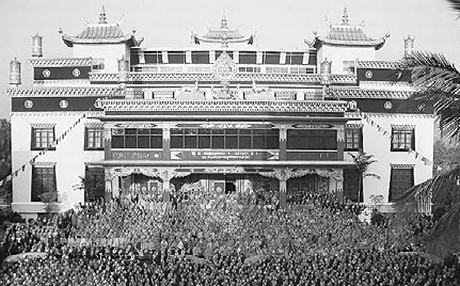
Namdroling Monastery.
Monsoon brings its share of troubles to the binge-traveller. But some of the travel destinations are best visited during the monsoon, one of these is Madikeri, ‘The Scotland Of India’. Among the most beautiful hill-stations in Southern India, Madikeri is a haven for nature lovers and trekkers. It is the capital of Coorg district, Karnataka. Formerly known as Muddurajakeri, Madikeri was named after the prominent Haleri king, Mudduraja who ruled Kodagu from 1633-1687. Poets have often referred to Madikeri as full of mystique on account of its unsurpassable beauty and romantic weather.
Madikeri lies on the Karnataka State Highway 88 that runs from Mysore to Mangalore. From Bangalore, this hill station is at a distance of 252 km. A hub of rich tradition and culture, Madikeri is one place that should be on your ‘must-visit’ list. The main tourist attractions are the Raja’s seat, Madikeri Fort, Omkareshwara temple, Abbey falls, Bhagamandala temple, Nisarga Dhama and Namdroling Buddhist Monastery.
Raja’s seat basically is a garden with a beautiful panoramic view of the Kodagu valley and offers you one of the best views of sunset and sunrise.
Madikeri Fort- A must visit: The famous Madikeri Fort was built by Mudduraja in the last quarter of the 17th century. He also built a palace inside the fort. It was eventually rebuilt in granite by Tipu Sultan who named the site as Jaffarabad. Two life size masonry elephants are located in the north-east corner of the entrance and a church is located in the south-east corner. The uniqueness of the Omkareshwara temple is that it is built according to the Mohammedan architecture and attracts a large number of devotees.
A landmark of sorts: Abbey falls, one of the most beautiful falls in India, is 7-9 kilometres from Madikeri. The falls are inside a coffee plantation. A hanging bridge has now been built across the gorge here offering a good view of the falls. The source of river Cauvery known as Talakaveri is found in Madikeri.
The Tibetan Golden Temple: Namdroling monastery also known as the Tibetan golden temple is a Tibetan Buddhist monastery. This monastery located around 6 kms from Kushalnagar is basically a Tibetan settlement at Bylukuppe and is the second largest Tibetan settlement outside Tibet. There are over 7,000 monks and students living at the monastery. The 40 ft tall golden Buddha statues are the major attractions here.
The walls of the temples are decorated with colourful paintings, depicting gods and demons from Tibetan Buddhist mythology.
The monastery not only attracts large number of young Tibetans seeking enlightenment and education, but also draws tourists from all over the world.
A trekker’s paradise: Madikeri is also a trekker’s paradise. Mountains such as Thadiyandamale, Pushpagiri and Kotebetta offer some of the best trekking experiences.Thadiyandamole is the highest peak here and should not be missed.Igguthappa Kundu, Brahmagiri and Nishanimotte are micro hotspots of bio-diversity in South India and are also amazing places for trekking.
Pork is a delicacy: Madikeri is famous for coffee and pork. It is one of the few places in India where pork is a delicacy.No matter what you do in Madikeri make sure that you pick up a bottle of authentic Coorg honey.
source: http://www.newindianexpress.com / The New Indian Express / Home> Cities> Bangalore / by Sandeep S – Bangalore / July 1th, 2013
WELCOME. If you like what you see "SUBSCRIBE via EMAIL" to receive FREE regular UPDATES.
Read More »