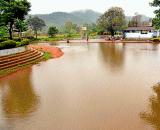
Heavy rain lashed Madikeri town on Saturday evening bringing traffic to a screeching halt in many areas. On the Sri Omkareshwara temple road, several vehicles were submerged. Girish, from Mallikarjunanar, who was in a Maruti Omni with his wife and son were forced to get out of their vehicle and brave the rain when water entered their vehicle. “We had no choice but to get out, as water had entered the car. Even inside the car we were shivering with cold.” he said.
Earlier, the town experienced light showers. But later in the day it was bright and pleasant, until evening.
The Pushpagiri hilly belt in north Kodagu comprising Mutlu, Hammiyala and Kumbaragadige villages received more than 100 inches of rain during rain star Aridra this year. Today, the rain star Punarvasu starts
Aridra rain this year has broken all previous records in these villages. In the last 20 years, Aridra rain record had not crossed 70 inches in these villages. In 1993, it was 51 inches. The heaviest rainfall was recorded in 1994 at 70 inches in these villages between tail-end of June and July first week.
C N Somesh, parpathehegar, in Sri Omkareshara temple, who hails from Mutlu village said that this is the first time that the villages have received such rain.
The averge rainfall in Kodagu so for reached has been 50 inches, 50% more compared to last year’s figure of 25 inches. In Somwarpet taluk it was 39 inches this year while last year it was 19 inches.
Water level in Harangi reservoir has touched 2855.95 out of 2849 feet. The inflow is 11,497 cusec and the outflow is 11,600 cusec.
source: http://www.articles.timesofindia.indiatimes.com / The Times of India / Home> City> Mysore> Kodagu / TNN / July 07th, 2013
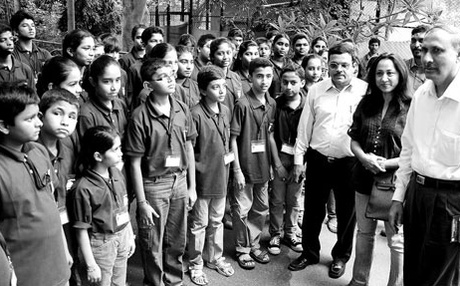
International athlete Ashwini Nachappa, Additional Principal Chief Conservator of Forest IFS Ajai Misra and Zoo directer B P Ravi look on.
International athlete Ashwini Nachappa stressed the need for Sri Chamarajendra Zoological Gardens extending its youth club activities to the schools outside Mysore city.
Addressing students after inaugurating a youth club at the Mysore Zoo Auditorium on Sunday, Ashwini asked the kids to grab the opportunities that come their way.
“People only talk about the death of people due to floods in Uttarakhand. No one is bothered about the loss of endangered species of animals, plants etc,” she regretted.
Additional Principal Chief Conservator of Forests (Wildlife) Ajai Misra asked parents to make their children aware of the need of conserving the environment, especially wildlife.
Pointing out the reasons for man-animal conflict, Misra said: “The population of elephants was one lakh when that of humans was 35 crore in undivided India before 1947. But now when the population of humans has touched 120 crore, the elephant population has reduced to about 25,000.”
But the decrease in the number of elephants has nothing to do with man-animal conflict. Wild animals are blamed for man-animal conflict despite human beings responsible for the same, he said.
He said that environment conservation was a complex issue.
Man is becoming selfish and indifferent by taking up development, he regretted.
source: http://www.newindianexpress.com / The New Indian Express / Home> States> Karnataka / by Express News Service – Mysore / July 08th, 2013
Rainfall abated further in all other places in Kodagu district except Madikeri on Sunday and the rivers that were in spate receded. The average rainfall in Kodagu district from 8 a.m. on Saturday and 8 a.m. on Sunday was 39.41 mm.
Madikeri city received 123 mm rainfall in the period between 8 a.m. on Saturday and 8 a.m. on Sunday.
Sampaje hobli in Madikeri taluk continued to receive heavy rainfall in the district with 140.8 mm. Bhagamandala hobli recorded 76 mm rainfall followed by Shantalli hobli receiving 51.2 mm rainfall.
HARANGI FULL
The inflow into the Harangi reservoir was at the rate of 11,600 cusecs on Sunday and the outflow was at the rate of 8,050 cusecs.
The water-level in the Harangi reservoir stood at 2,855.40 ft as against the maximum reservoir level of 2,859 ft. The water-level during the corresponding period last year was 2,820.06 ft.
AVERAGE RAINFALL
The average rainfall in Kodagu district from January 2013 till July 7 at 8 a.m. is 1,312.76 mm as against 643.47 mm rainfall during the same period last year.
Madikeri taluk received an average rainfall of 1,951.10 mm from January till July 7 at 8 a.m. It was 894.22 mm in the corresponding period last year.
Madikeri taluk recorded an average rainfall of 91.10 mm in the period between 8 a.m. on Saturday and 8 a.m. on Sunday.
Virajpet taluk recorded an average rainfall of 968.90 mm from January till July 7 as against 551.03 mm in the same period last year. Somwarpet taluk recorded an average rainfall of 1,017.07 mm from January till July 7 as against 485.16 mm rainfall in the corresponding period last year, according to meteorological department sources.
source: http://www.thehindu.com / The Hindu / Home> News> National> Karnataka / by Special Correspondent / Mysore – July 08th, 2013
The Harangi reservoir in the taluk is just two feet away from reaching its maximum level. On Monday, the level stood at 2,857.14 feet, against a maximum level of 2,859 feet.
A total of 400 cusecs of water is being released from the dam since morning. The inflow into the reservoir stood at 3,600 cusecs at 8.30 am. The present storage in the reservoir is 7.65 tmc feet against the total capacity of eight tmc feet.
The reservoir had reached its brim in August last year. But this time, the rainy season has begun a month early, facilitating good inflow into the dam. Engineers manning the dam said that the irrigation consultative committee would meet on July 15, after which water would be released to the canals for irrigation. Releasing water to the canals would irrigate 1.37 lakh acres of land.
source: http://www.deccanherald.com / Deccan Herald / Home> State / DHNS – Kushalnagar (Kodagu Dist.) / July 01st, 2013
Sudden depression in bay of Bengal coupled with intensified south west monsoon has brought cheers on the farmers and water resource officials as the region failed to receive much rain last week. On Monday suddenly the skies opened up and rain started pouring .
Meanwhile, Kodagu district administration has declared holiday for the schools and colleges on Tuesday in the wake of heavy rain being witnessed by the region. Even Mysore district received rain on Monday.
Along with the farmers , the engineers of the water resource department who were worried about the dwindled inflow into the dams are a relived lot with the inflow into all the four dams in the Cauvery delta increasing considerably.
Especially the inflow into KRS dam which slumped down to less than 3500 cusecs after a week of inflow ranging between 10000 and 15000 . This is expected to increase by tomorrow morning following heavy rain in Kodagu district , the core area of the Cauvery catchment . An engineer of the water resource department said the inflow into KRS dam was 3223 cusecs on Monday evening against an outflow of 1195 with the dam’s level standing at 79.96 ft against the maximum height 124.80 ft.
However inflow is anticipated to rise considerably by tomorrow afternoon with the rain lashing the Cauvery catchment area , the engineer added.. According to director state meteorology department Puttanna though the Kodagu is yet to record heavy rainfall, district is expected to receive more rain in the coming days. “Today, the rain is more due to low pressure in bay of Bengal and from tomorrow onwards the monsoon rain will continue to occur” he added .
Last year average rainfall in Kodagu in June was 375.6 mm, but this year it has recorded 498.4 mm rainfall and this has raised hopes of region receiving good rain this year . Even inflow into Kabini dam increased suddenly on Monday evening with inflow reaching 11968 cusecs with the water crossing 2275.50 ft mark against the dam’s maximum height of 2284. A dam engineer told TOI that the inflow may increase and cross 16000 cusecs by Tuesday morning due to reports of Kerala’s Waynad district receiving heavy rain in the last 12 hours. Even the water level in the Harangi dam is slowly inching towards it’s maximum height of 2859 ft with the level on Monday evening standing at 2831 .45 ft . with an inflow of 1095 cusecs . ” Water level in Kabini dam may reach it’s maximum level in next four five days if the inflow continues to remain at 16000 cusecs” the engineer added.
source: http://www.articles.timesofindia.indiatimes.com / The Times of India / Home> City> Mysore / by MB Maramkal, TNN / June 24th, 2013
The inflow of water into Harangi reservoir has increased following copious rainfall in various parts of the district on Tuesday.
Madikeri, Napoklu, Sampaje, Bhagamandala, Virajpet, Srimangala, Shanthalli recorded more than 100 mm rainfall.
The house belonging to M C Changappa was partially damaged in Kunjila village. Another house in Bellur village was also damaged in the rainfall. Cauvery, Lakshmanatheertha, Hemavathi, Harangi, Barapole, Chiklihole rivers are in spate following incessant rainfall in the region.
With rain water flowing on road, the movement of vehicles on Napoklu-Moornadu road has been disrupted. Flood water has inundated road at Bhagamandala. If the region continues to receive rainfall, then road will be cut off from the rest of the world. A minor bridge in Balamuri is inundated in flood water. Water has entered paddy fields in Balamuri.
In the last 24 hours, the district received an average of 91.91 mm rainfall. This includes Madikeri—121 mm, Virajpet—90.15 mm and Somwarpet taluk—64.75 mm.
Rains received in hobli centres are as follows: Madikeri kasaba—100 mm, Napoklu—110.8 mm, Sampaje—132.2 mm, Bhagamandala—150 mm, Virajpet kasaba—127.4 mm, Hudikeri—38.1 mm, Kodlipete—40 mm, Kushalnagar—24.4 mm, and Suntikoppa—62.3 mm rainfall.
Chikmagalur
With heavy rains lashing Mudigere, rain water has entered into fields in Kesavalalu and Uggehalli. If the region continues to get rainfall, then houses will also be inundated.
Paddy saplings kept ready for transplantation in the fields have been inundated at Banakal, Baggasagodu, Horatti, Mugrahalli, Kithlegandi, Bettadamane and Gonibeedu.
Work in the coffee estates have been suspended following heavy rainfall. With rains lashing catchment areas, Bhadra and Somavathi rivers are in spate in Kalasa.
source: http://www.deccanherald.com / Deccan Herald / Home> District / Madikeri – DHNS / June 25th, 2013
A Soliga man told Survival, ‘In my village, Hosapodu, we are very happy that we can continue with our work’.
The confiscation of honey was in direct violation of the 2006 Indian Forest Rights Act, which recognizes the rights of India’s tribal peoples, such as the Soliga, to live in and from their forests, and protect and manage their land.
Tribal peoples like the Soliga have been living with and protecting the wildlife in their forests for countless generations. However many forestry officials still believe that forest and tiger conservation requires the removal of all people from the forests. These prejudices often make foresters unwilling to respect tribal rights – especially the right to make a livelihood from the forest. The recent court victory exposes this injustice and the necessity for the rights of India’s tribes to be respected.
The Soliga tribe of Karnataka made history in 2011 when their rights to their forests were recognized, even though they lie inside a tiger reserve. The community has been caring for the forest and harvesting its produce – including honey – for countless generations. After their rights were recognized one village established a collective to get a fair price for their honey.
More Soliga villages are awaiting the recognition of their forest rights and local organizations Keystone, Atree and the Soliga Abhivriddhi Sangha (Soliga Peoples’ Collective) are supporting them in the process.
Despite severe constraints from forestry officials, the Soliga remain determined to manage, harvest and protect their forests sustainably for current and future generations.
source: http://www.survivalinternational.org / Survival / Home / June 19th, 2013
Landslides reported from various parts of the district The rains have intensified in Kodagu district. All taluks including Madikeri received heavy rainfall on Monday.
The overflowing ponds, streams and rivers have brought smiles on the faces of farmers. Rise in the water level in Kootuhole check dam, Chikli and Harangi reservoirs have helped to solve water crisis in the district. Vehicle users were put to hardship on water logged roads.
Landslides have been reported from different parts of the district. There has been disruption in power supply following damage to electric wires. Kodagu district recorded an average of 39.65 mm rainfall till 8 am on Monday, whereas that received on the same day last year was 25.65 mm. The district has received 560.28 mm rain from January till date, against 291.47 mm rain recorded last year. Madikeri taluk has received 56.40 mm rainfall in the last 24 hours, Virajpet taluk — 36.38 mm and Somwarpet taluk — 26.18 mm rainfall.
The water level at Harangi reservoir on Monday was 2817.31 ft as against the maximum level of 2859 ft.
Telemetric rain gauges
Kodagu district has 48 telemetric rain gauges, of which 38 rain guages are functioning. The gauges are located at Sudarshan guest house, Avandur, Bhagamandala, Galibeedu, Karada, Mundrotu, Napoklu, Naladi, Sampaje, Talacauvery, Moornadu and Dabbadka in Madikeri taluk, Somwarpetm Koodige, Kushalnagar, Madapura, Shanivarsanthe, Suntikoppa, Harangi, Shanthalli, Soorlabi, Koodlipet in Somwarpet taluk, Virajpet, Ammathi, Kurchi, Karmadu, Kallalla, Maldare, Mathigodu, Moorkallu, Nagarahole, Ponnampet IB, Srimangala, Thithimathi, Siddhapura in Virajpet taluk.
The telemetric centres at Karike, jail in Madikeri, Anekadu, Dubare, Huduguru, Kargodu in Somwarpet taluk, Balekovu, Devamachi, Makutta, Vatekolli in Virajpet taluk have been damaged.The State has proposed to install telemetric rain gauges in 98 gram panchayats in the district, of which 23 rain gauges have been already installed, said District Statistician Prameela.
In the backdrop of heavy rains forecast by the meteorological department, Additional Deputy Commissioner (In-charge) G Prabhu, in a press release has said that head teachers have been entrusted with the responsibility of declaring holidays to schools.
source: http://www.deccanherald.com / Deccan Herald / Home> District / DHNS – Madikeri, June 17th, 2013
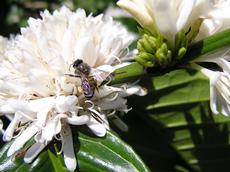
Bees of the Apis cerana (eastern honeybee) species pollinate coffee flowers. Farmers can increase the services of pollinating insects with particular cultivation methods. (Photo: J. Ghazoul / ETH Zurich)
By Peter Ruegg
No food for the human race without bees? It is not quite as straightforward as that. A case study by ecologists from ETH Zurich in a coffee-growing area in India reveals that pollinating insects are just one production factor among many. Farmers have several possibilities to increase their harvest.
All over the world, bees are dying and insect diversity is dwindling. Only recently, both the media and scientists expressed fears that insect pollination is in decline, which jeopardises food security. The (lack of) pollination has thus become a sound argument for the protection of species and natural habitats, and organic farming.
ETH-Zurich researchers from the group headed by Jaboury Ghazoul, professor of ecosystem management, set about investigating this argument by studying the influence of pollinator insects on coffee harvests in an agroforestry system at coffee plantations in the province of Kodagu in southern India. They also included soil and forest management, environmental factors such as water and soil fertility, and tree cover for the cultures in their study.
The research group thus obtained a different picture of the role of pollinators to the popular perception of this cultivation system of “no bees, no harvest”. According to their findings, pollinator bees are merely one production factor among many and to some extent coffee farmers can increase the productivity of their plantations independently of the insects. The results of the study have just been published in the journal PNAS.
Important but not the only factor
“Pollinators are important for coffee farmers,” stresses Ghazoul; “as far as effective coffee growing and increasing harvests are concerned, however, they are much less important than irrigation or liming, for instance.” This encapsulates one of the central findings from coffee farming in the Kodagu province.
Coffee is grown in a traditional agroforestry system in the region. As coffee plants must not be grown in direct sunlight, they are planted in the forest’s undergrowth or the shade of large, isolated trees. The coffee plants all bloom at the same time after heavy rains between February and March and three species of bee pollinate the flowers: the giant honeybee Apis dorsata, Apis cerana and the solitary wild bee Tetragonula iridipennis. The giant honeybee is the largest and most important pollinator, forming large colonies and needing the thick branches of tall trees to bear the weight of their nest.
Greater yield through irrigation and limestone
In order to harvest more coffee, however, the farmers have got other options than merely banking on the work of bees, as Ghazoul discovered. They can increase the yield through liming, irrespective of bee density. And instead of relying on rainfall, it is worth the farmers’ while to induce flowering with artificial irrigation. “It is particularly in a farmer’s interests to irrigate his plantations at a different time to other farmers in the vicinity,” says Ghazoul. After all, this will turn his plantations into bee magnets. This concentrated pollination increases the yield from the plantation enormously, the ETH-Zurich researchers reveal in their publication. It is a different story if the rain makes all the coffee plants in the region flower at the same time, however: the bees spread out over a wide area, the pollination is less effective and the harvest is poorer.
Trend towards deforestation
In an agroforestry system, the farmer also has another trick up his sleeve: felling trees or the forest to shed more light onto his coffee plants, which also increases the harvest. In doing so, however, he destroys the habitat of the giant honeybee (Apis dorsata).
A farmer who combines both courses of action is especially successful, initially unaffected by the disappearance of the large bees on his own plantation. Only when all farmers opt for this course of action do things take a turn for the worse. “From a plantation perspective, it makes sense to remove trees and increase yields,” says the ETH Zurich professor. “But if every farmer goes for the same option, they will all suffer the consequences of poor pollination because the giant honeybee will disappear.”
Sure enough, the researchers observed gradual deforestation in the Kodagu experiment area. Ghazoul is convinced that the farmers will lose Apis dorsata in the long run and thus – unless they take countermeasures – their valuable contribution towards coffee pollination. “It remains unclear whether the other two species of bee could compensate for this loss.” However, the farmers’ predicament is not hopeless, he says. They could domesticate Apis cerana, a very close relative of the European honeybee, and place beehives on the plantations, which would guarantee the pollination service without becoming dependent on Apis dorsata. The drawback: this absolves the farmers from their responsibility for the forest and trees. “The farmers are thus free to decide whether they want to have trees on their land or not,” stresses the ecologist, which spells bad news for nature conservation. “But good news for farmers. They have got possibilities to increase their harvest and sustain or even improve their existence.”
Unexpected threat from exotic tree species
The traditional forest trees face another danger. Farmers often replace felled local trees with the exotic Australian silver oak (Grevillea robusta), which provides the coffee plants with the shade they need. Moreover, it grows quickly and has a straight trunk, which farmers can use to grow pepper as the spice can be harvested more easily on the trunks. The sale of pepper and wood from the silver oaks is a way for the farmers to supplement their income.
However, the farmers are increasingly beginning to realise that the exotic tree also has its drawbacks. For one, its leaves barely decompose, covering the ground and coffee plants and thus becoming a breeding ground for harmful fungi and bacteria. It might also influence the nutrient cycle, which one of Ghazoul’s doctoral students is currently looking into. The silver oak leaves probably slows the nutrient cycle, preventing the coffee plants from receiving enough nitrogen in the long run, which eventually affects the harvest.
The example case of coffee growing in the province of Kodagu is interesting from a research perspective as it brings home how bees, farmers, their farming methods and natural occurrences influence and depend on each other. In this respect, the insects are not the sole influential factor in this agricultural system.
Ten principles for the reconciliation of nature and humankind
Teaming up with other scientists, ETH-Zurich professor Jaboury Ghazoul has defined ten principles that should help reconcile the conflicting interests of agriculture, nature conservation and other stakeholders with regard to a sustainable agricultural land use. The principles, which were published in the journal PNAS, include training farmers in cultivation methods that can be adapted to changing conditions. Another principle advocates taking different levels into consideration for a landscape approach, namely the landscape level itself and the individual farm level. In the example case in India, another principle is significant: the clarification of rights and responsibilities. For instance, the cultivated land belongs to the local farmers but not the trees, which belong to the state. This can cause conflicts. The principles should help to use an approach geared towards the landscape.
Further reading
Boreux V, Kushalappa CG, Vaast P, Ghazoul J. Interactive effects among ecosystem services and management practices on crop production: Pollination in coffee agroforestry systems. PNAS. 2013 May 21;110(21):8387-92. doi: 10.1073/pnas.1210590110. Epub 2013 May 13.
Sayer J, Sunderland T, Ghazoul J et al. Ten principles for a landscape approach to reconciling agriculture, conservation, and other competing land uses. PNAS 2013 110 (21) 8349-8356; published ahead of print May 21, 2013, doi:10.1073/pnas.1210595110.
source: http://www.ethlife.ethz.ch / ETH Life / Home> News Archive> Science / by Peter Ruegg / June 04th, 2013
Though agriculture was the main occupation in Kodagu district, the drastic decline in number of farmers have created a fearful situation.
According to 2011 census data there are 19,447 farmers (barring coffee estate owners). This account to 3.50 per cent of the total population in the district.
There were 38,838 farmers during 2001 census.
Paddy was the main crop in Kodagu district other than coffee. Maize, yard long beans, ground nuts, green chilly, and ginger are also grown in the district.
The district had 31.97 per cent of farmers in 1961. This slowly reduced to 23.55 pc in 1971, 23.31 pc in 1981, 19.91 pc in 1991, 7.08 pc in 2001 and 3.50 pc in 2011.
There has been drastic decline in number of farm labourers in the district. According to the latest census data, there are 12,546 farm labourers registering 2.26 per cent of the total population.
About 15.07 per cent of the total population were labourers in 1991. A total of 1,245 persons are engaged in self employment in the district. This account to 0.22 per cent of the total population.
Coffee growers have not been marked separately during the census. As a result, there is no correct figures on coffee growers. Coffee has been considered as plantation and is being included in ‘other’ category.
Other than agriculture, and coffee, there are no other sectors which generate employment in the district.
With the decline in rainfall, agriculture activities have been affected in the district. Many have deserted their farm land and have migrated to other districts in search of employment.
“There was no shortage of rainfall in Kodagu district. Inspite of having conducive atmosphere for growing crops, many have not been given priority to grow food crops.
The decline in number of farmers is a dangerous trend,” said in charge technical officer of agriculture department Ramesh.
He said “youth migrate to other districts in search of employment.
None are showing their interest in agriculture. Only aged persons are engaged in farming.
Having unable to take up farming activities, several paddy fields have remained unused in the district.”
source: http://www.deccanherald.com / Deccan Herald / Home> District / by Srikanth Kallammannavar, Madikeri / DHNS – May 29th, 2013
WELCOME. If you like what you see "SUBSCRIBE via EMAIL" to receive FREE regular UPDATES.
Read More »