As we set out for a darshan of Sri Omkareshwara from our forest lodge at Madikeri, gray hornbills are flapping out of Guler trees at dawn.
The birds live in sacred groves called Devakadu , which have been protected for centuries by the local Kodavas. Their belief in the power of the spirit world forbids them from taking even a single twig or berry from these jungle sanctuaries of the gods.
This might explain the presence of so many wild creatures in our vicinity, which are otherwise conspicuously absent in unprotected areas. In the Kodava pantheon, such an endlessly bountiful aspect of Nature is incarnated in the Great Spirit called Igguthappa. Igguthappa literally means “Giver of Grains” .
He also embodies a deep ecological irony of the sacred forest grove – and that is, Nature thrives best only when humans exploit it the least. Biodiversity, therefore, remains inversely proportional to intensity and scale of use.
The Great Spirit that supposedly fulfils all the desires of the devotees also teaches them the value of forbearance and curbing of wanton use of scarce resources. From base to top, the towering Ironwood trees in the sacred grove are covered with gorgeous bunches of electric blue flowers . Over several centuries, these have never been plucked!
In stark contrast, scores of majestic trees lining the old roads of Kodava coffee lands are being slaughtered to make way for wider lanes. The spindly green saplings lining the new roads can never hope to attain their full stature without watchful care and compassion provided by humans lasting several generations.
source: http://www.articles.economictimes.timesofindia.com / The Economic Times / Home> Opinion> Spiritual Atheist / by Vithal C. Nadkarni, ET Bureau / May 29th, 2013
‘The trick is to confuse the plant to think it is summer all along and make it bear apple through the year’
Though cheery and blithe in countenance, 74-year-old Chiranjit Parmar, a horticulture scientist from Himachal Pradesh, hopes to radically change the agricultural landscape of the region. After having observed the success of apple cultivation in Batu, Indonesia, Mr. Parmar wants to introduce the fruit, hitherto associated with cooler climes, in the tropical humidity of Karnataka.
“It is an experiment. And like all experiments, it can also fail,” he told the group of farmers who had assembled in the city on Saturday for his seminar on ‘Apple cultivation in Karnataka’.
The idea sounded incredulous to farmers who had travelled from as far away as Kodagu. Apple – whose mass cultivation is associated with regions on the foothills of the Himalayas such as Shimla and Kashmir — needs to have a chilly weather for it to bear fruit in the summer. How then was it supposed to survive in a region where temperatures rarely go below 12 degrees Celsius?
“The trick is to confuse the plant. The broad principle is that just after the sapling experiences chilling in Himachal or Kashmir, it is transported here. As there is not much of a temperature change here during winter, the plant thinks it is summer all along and bears fruit through the year,” Mr. Parmar told the befuddled farmers.
He illustrates this with a picture of cultivation in Indonesia, where, while half the apple orchard bears fruit, the other half is bare. “Crops can be regulated easily, as the leaves can be removed fully to stimulate winter. While in Himachal, we get six to seven tonnes of apple per hectare, in Indonesia, they get 65 tonnes and throughout the year,” he said.
So far, the experiment has seen small orchards set up in Tumkur, Somwarpet, Sringeri, and Uppinangadi – all through saplings sent by Mr. Parmar. In his first visit to the region, he said the results were encouraging, and in Tumkur, the plants were already bearing fruit within two years. “In Himachal, apple trees take five years to bear fruit. Here, it grows faster and incessantly into very tall trees as there is no crop fall or dormancy during winter,” he said.
Challenges
However, the tropical climate also brings with it a set of problems that is yet to be scientifically dealt with. For example, trees are susceptible to a variety of diseases and insect, while methods to reduce the tree height and grafting of trees needed to be worked out.
‘The trick is to confuse the apple tree to think it is always summer’
source: http://www.thehindu.com / The Hindu / Home> National> Karnataka / by Staff Correspondent / Mangalore – April 22nd, 2013
Agarwood trees grown in Dakshina Kannada | Express Photo
Plantation and coffee estate owners in Kodagu, Hassan, Chikmagalur and Dakshina Kannada finally have a reason to cheer despite the decreasing prices of their produce.
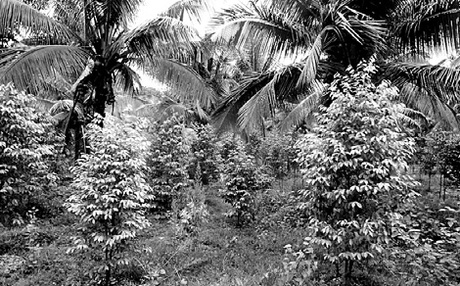
For the last five to six years, a wonder plant agarwood has replaced the conventional silver oak in many coffee estates bringing handsome dividends to growers.
Agarwood is a high value commercial crop which is in great demand in national and international markets.
The tree is used to make ittar (natural perfume oil) and perfume.
The outer part of the stem, which is of low quality is used to make incense sticks and in paper manufacturing industries.
An agarwood sapling is easy to grow as its maintenance is inexpensive and it gives yield in eight years.
Traditionally, almost all coffee growers in India plant silver oaks as an intercrop providing shade to other plants. Recently, coffee plantations in Western Ghats and Malnad region have started planting agarwood. The origin of the tree can be traced to the evergreen forests of Southeast Asia.
Agarwood was first introduced in South India by Vanadurgi Agarwood India Limited (VAIL) which was formed with its shares distributed among planters, promoters and Vanadurgi Flavours and Extracts (P) Limited.
The company is exclusively involved in the planting, processing and marketing of agarwood.
VAIL Managing Director K N Dharmendra Kumar told Express that the company has distributed more than one million agarwood saplings to 5,000 plus growers across eight districts in Malnad region.
The company has entered into a buy-back agreement with farmers to provide good seedlings, technical guidance, artificial inoculation, setting up of processing units and purchase of their inventories.
He said that 150 to 200 agarwood trees can be planted in one acre plot of coffee, arecanut or coconut plantation.
Anil Ponnappa, a progressive coffee planter in Madapura said he has planted 600 agarwood trees supplied by VAIL in his coffee estate. Another agarwood grower N Vishwanath in Sagar, Shimoga district said he has planted 15,000 saplings on his dry land a year ago. “Agarwood is a good alternative to other crops whose prices are falling these days,” he added.
Agarwood is costlier than sandalwood in the international market as it is in great demand in Gulf countries.
A sandalwood tree takes at least 25-30 years to fully grow while an agarwood takes tree takes only 8-15 years.
The inner stem (resinous) of agarwood is valued at `10,000 per kg while agarwood oil costs Rs 10 lakh per kg in the international market. Agarwood is priced according to the density of wood, resin, purity, aroma and colour.
source: http://www.newindianexpress.com / The New Indian Express / Home> States> Karnataka / by Coovercolly Indresh / ENS – Somwarpet / December 02nd, 2012
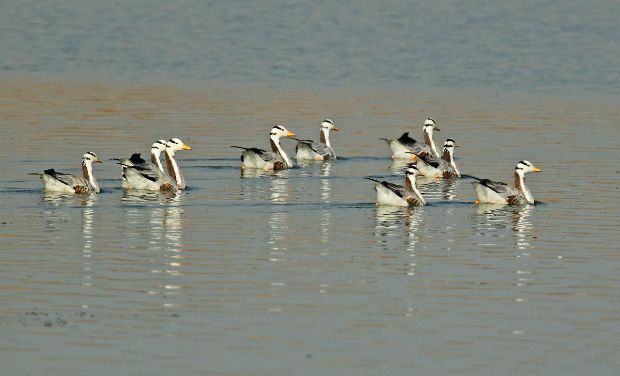
Bar-headed geese seen in a lake on the outskirts of the city —Clement Francis Bengaluru:
Bengaluru counted its birds on Sunday as part of International Bird Day and also to create a national data base on avi-fauna. Bird enthusiasts flocked to lakes, hills and grasslands to count the number and species of birds.
The concept of creating a national data base on avi-fauna was mooted by the Delhi Bird Watching Society (DBWS) which invited the bird watching community across the county to conduct a bird count in their areas on Sunday and submit the number of species they sighted till evening. The event was named Big Bird Day and about 200 teams and individual bird watchers took part in the counting.
“We had tremendous response from all over the country. The bird watching groups submitted their numbers till evening. We were flooded with 100 plus messages at 6 pm on Sunday from all over the country. We have team sightings of 100-120 birds on an average and we are still waiting for the counts from out-station. The report on the count will be ready in a week,” said writer and birdwatcher from New Delhi, Bikram Grewal.
In Karnataka, bird-watching enthusiasts took an early morning walk to count the birds in different parts of the state. A bird watching team in Kodagu, led by bird expert Dr Narasimhan, counted 120 species of birds in one single day.
Manjunath Prabhakar, a wildlife photographer who took part in the count, said the bird counting was a great opportunity to record research on bird diversity as many species that were not thought to exist in urban areas are being sighted. “We sighted close to 60 bird species atop Nadi Hill during the count and we managed to sight two birds from the Western Ghats,” Mr Prabhakar said.
Harish R Bhat, a bird expert and researcher from the Indian Institute of Science said that he was able to sight 110 bird species in Bijapur. “I happened to be in Bijapur for a lecture and I decided to count the birds here. Due to the presence of the Alamatti backwaters, the presence of birds is large around Bijapur city,” Mr Bhat said.
source: http://www.deccanchronicle.com / Deccan Chronicle / Home> News> Current Affairs / by Amit S. Upadhye, DC / February 25th, 2013
he Karnataka Forest Department is awaiting a response from its Madhya Pradesh counterpart on transfer of 11 tamed elephants from three state camps for ‘forest-related activities’.
Recently, while hearing a PIL filed by Compassion Unlimited Plus Action (CUPA) the High Court had refused to interfere in State government’s decision on transfer of pachyderms.
The CUPA in its petition had contended that the elephants might not to able to sustain the extreme weather in Madhya Pradesh.
Additional Principal Chief Conservator of Forests (Wildlife) Ajay Mishra told Express that three elephants from Dubare, two from Mattigodu and six from Bandipur elephant camps, are listed for translocation to MP. He said they are basically second line elephants and doing similar jobs here. Karnataka has 95 tamed elephants in its many camps.
Allaying fears that elephants will be used for non-forest activities in MP, he said they would be used only for patrolling and not for display or safaris.
There have been instances when elephants from one state have been translocated to another and the pachyderms have had no problem in adjusting to the new environment.
“It may take some time for them to acclimatise but it will not create any problems. The beauty of elephants is that they develop a bond with their caretakers very soon,” he said.
The Forest Department of Madhya Pradesh has to look out for arranging mahouts and kavadis since Karnataka cannot spare their services. As per the Forest Department manual, there should be a mahout and a kavadi for each, and Karnataka has enough staff to take care of all the 95 jumbos. Elephants are known for co-existence and the question of feeling alien does not arise, argued Mishra.
There is a standard food chart for tamed elephants in camps and the forest department of every state has to follow it strictly.
“The tamed jumbos are just like our employees and separate registers are maintained to record its health, food habits, behaviour and service. Once they attain superannuation, they are given rest in camps,” he said.
source: http://www.newindianexpress.com / The New Indian Express / Home> States> Karnataka / by Shyam Sundar Vattam / ENS – Bangalore / March 16th, 2013
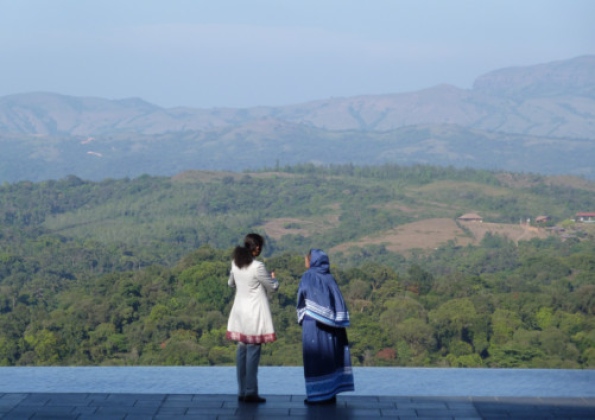
Panorama from reception area of Vivanta by Taj – Madikeri
Forget the big cities, Stephen McClarence discovers the charm of small-town India in the Coorg district.
You’ve almost certainly had a phone conversation – however brief – with someone in Bangalore, the boom city of South India.
Fifteen years ago, it was a sleepy old-worldly place, green and gracious. So many people went to retire there that it was called the Pensioners’ Paradise. Now, thanks to its burgeoning call centres, it’s the most dazzlingly modern of India’s cities, full of high-rise office blocks, shopping malls, and aspirational, high-spending young people.
The greenness is in shorter supply these days. “What used to be here?” I once asked a man showing me round a techno-park boasting IBM and Microsoft. “Nothing was here,” he said. “Only forest.”
In just such a forest, four hours’ drive to the west, naturalist Sanjeev Kumar is taking a wry view of Bangalore’s headlong development. “When I was a boy there, we used to have to wait an hour for a bus,” he says. “Now a bus comes every five minutes, and we have to wait an hour in the traffic.” Kunihit Aya, grocer in Bekal
Butterflies flutter past like floating tissue paper as Sanjeev leads my wife and I on a forest walk. “Maybe we will see a Malabar whistling thrush,” he whispers. “I was once playing the flute and as soon as I stopped, it carried on with the same tune.” A bird starts singing high in a nearby tree. “No, no, that’s a barbet.”
We’re a few miles outside the small town of Madikeri, far from the main tourist routes. Goa, to the north, is a familiar destination for Brits; so is Kerala, to the south. But Madikeri, capital of a district called Coorg, is unknown to many Indians, never mind foreigners.
That’s likely to change. High in the hills at nearly 3,500ft, and surrounded by rubber and coffee plantations, it has a new luxury resort: Vivanta by Taj, Madikeri. More than 60 cottages and villas are dotted down a hillside, with electric buggies ferrying guests from one spectacular viewpoint to another. Vast panoramas of rainforest and misty blue mountains stretch all around.
As a retreat, a scenic eyrie, it could hardly be bettered, but for us Madikeri itself turns out to be as great a lure. It’s a perfectly ordinary small Indian town, and that’s its charm. The wheel of life turns considerably slower than in the cities; people have time to talk to each other and to strangers; we have a delightful couple of days exploring it.
Some 40 years ago, the great travel writer Dervla Murphy chronicled her two-month stay here in the engaging On a Shoestring to Coorg. She likened the area, once British India’s smallest province, to the Garden of Eden, a place where “a civilised harmony still exists between landscape and people.”
She explored Madikeri’s library, where “earnest-looking young men were sitting around large tables studying fat tomes, or consulting yellowed newspaper files.” Similar young men – perhaps the originals’ grandsons – are still here, still studying and consulting. The dusty shelves behind them buckle under the weight of the fat tomes. Upstairs, string-tied bundles of monsoon-ravaged documents are stacked high, like slag heaps of bureaucracy.
Next door, a yellow-distempered British church has become a museum. Religious sculptures from the 12th-century share space with a portrait of George V, a watchful stuffed leopard and a Victorian portable typewriter. Also a rusty trunk, labelled “Trunk”. The walls are still lined with colonial monuments: “Molly, for over 30 years the dearly loved and loyal, faithful and devoted wife and pal of Lt Col Sir Richard Burke, late Resident of Mysore”.
We’ve caught the town’s Friday market. The streets are full of traders selling garlic, honey, trainers, chillies, wall clocks, dried fish by the barrelful, sachets of rat poison. The traders are courteous, and curious about us. Many have the characteristic caramel-coloured complexions and aquiline noses of Coorg people, said to be descended from Greeks who got lost.
We buy coffee and aniseed from Mr Shoukath Ali’s spice stall, piled high but neat with cardamom, cinnamon, cashew nuts, cloves. “Dates from Iran,” says Mr Ali. “Figs from Afghanistan.” A tiny old man joins us, his face lined like runes: Mr Yusoof, Mr Ali’s landlord, still working at 85. He sits watching, shrewdly, and, as I take a photograph he darts forward to be in the picture, giggling.
We need to change money. “Be seated,” says the bank clerk, and a zen-like hour of paperwork stretches ahead. Ledgers are entered, forms are filled in, and I take them to another clerk who gives me a metal token, numbered 87, to keep until the cashier calls me over.
Raju Shah, a businessman clutching Token No 86, sighs about the laboriousness of it all, but it gives us a chance to talk. He recommends a restaurant and guides us to it. His wife, Dimple, invites us to call round.
The whole town feels pleasantly suspended in a gentler time, nowhere more so than at the 130-year-old North Coorg Club, where retired coffee planters and army and air force officers gather in the evening to play bridge and billiards. Little seems to have changed since Indian independence in 1947, when decades of club presidents called Mr Frazer, Mr Pritchard and Mr Humphries made way for Mr Chengappa.
Madikeri is how Bangalore used to be, we reflect as we drive to the call-centre city to catch a train north. On the way we have lunch at a pleasant roadside cafe called Prashanti. “‘Prashant’ means ‘place of peace’,” the owner explains. A Bollywood soap opera blasts at full volume from a TV in the corner. We’re suddenly back in the 21st- century.
Getting there
Cox & Kings (0845 154 8941, www.coxandkings.co.uk) has seven-night breaks from £1,695pp, including three nights at Vivanta by Taj, Coorg and four at Vivanta by Taj, Bekal, a wonderfully relaxing garden-village resort 50 miles away in Kerala. The price includes breakfasts, private transfers and international flights with Emirates.
Visit www.tajhotels.com for more information on the hotels.
Stephen McClarence travelled to London (for his flight) with East Midlands Trains. 0845 712 5678, www.eastmidlandstrains.co.uk
source: http://www.yorkshirepost.com / Yorkshire Post / Home> Lifestyle> Outdoors> Travel / by Stephen McClarence / April 29th, 2013
“It is important to resolve water problems in the scenario of present climate change caused by huge carbon emissions. The important manifestations of climate change is global warming which causes global temperature to change,” said professor A Vittal Hegde from department of applied mechanics and Hydraulics, NITK.
He addressed the gathering after inaugurating the seminar of ‘water proofing and water harvesting’ organized by Kodagu Dakshina Kannada and Udupi Engineers Association (KDKUEA) at Hotel Ocean Pearl on Saturday April 6.
Addressing further, he said since the year 1700 after industrial revolution, climate change has been the cause of various issues. Due to regular changes in the level of carbon dioxide, there is a change in the atmosphere. The release of greenhouse gases leads to extreme events such as floods occur said the speaker giving an example of a recent flood that occured in Australia.
Considering the above problems, he said methodical support to local RWH should be provided to get a substantial amount of water. Briefing about rain water harvesting (RWH), he said it is accumulation and deposition of rain water for use before it reaches the aquifer.
In ancient India, people believed that forests were mother the of rivers; in fact a study from US indicated that 60% of fresh water comes from forest. The water bodies used to be maintained by the community around but after Independence, the government took full control over the water bodies and water supply.
Speaking about the benefits of RWH, Hegde said it improves water availability, improves quality of ground water, prevents soil erosion, flooding and more important is is that it saves water an dmoney for the future.
Concluding his talk, he said that every city/village should implement RWH for the benefit of the future generation. Unless it is been made mandatory, no one will implement it, thus government should support and take initiative, he added.
A Vishnu Bhat welcomed the gathering, Dr RG D’Souza compered while M Divakar Shetty delivered the vote of thanks.
HV Harish, president of KDKUEA, Hemanth K Jain, director, Kerakol India limited, DR S Srihari from the department of civil engineering in NITK Surathkal, Dr Lakshman Nandagiri, Dr Girish Kumar, U Nagendra Rao, Gajanana S Hegde among others were present.
source: http://www.daijiworld.com / Daiji World / Home / Daijiworld Media Network – Mangalore (VM) / Photographs: Spoorthi Ullal / Mangalore, April 06th, 2013
This summer, abandon the confines of the urban metropolis for the natural beauty of the rugged outdoors. Avantika Bhuyan lists a few challenging trails to get your adrenalin pumping
STOK KANGRI
Stok Kangri is one of the few places in the world where you can actually walk up to 6,000 metres. Stok, the highest peak in the Ladakh range, has been classified by the Indian Mountaineering Federation as a ‘trekking peak’, which means that no technical mountaineering skills are needed for the climb. However, don’t let this lull you into thinking that you can hop, skip and jump your way to the summit. The route offers a worthy challenge to experienced trekkers with great views of the Spartan mountainous desert. On day one, drive past the Leh airstrip, the Spituk Gompa and the Indus river to reach Zingchen where the trek begins. After an overnight halt at Rumbak, one reaches the base of the Stok La to start the steep climb up to the pass at 4,890 metres. Spend the night in the bustling Stok Kangri base camp, swapping adventure stories. On Summit Day, begin the ascent to Stok Kangri in the dead of night, walking for hours across frozen glaciers to reach the peak at sunrise. Nothing can prepare you for the sights that await you on the top of the summit – a 360° view of the Karakoram, a glimpse of the K2 and the Gasherbrums. Legend has it that if you have good karma, then you just might get a peek of Mount Kailash as well.
Info: July is the best time to undertake this six-day long trek. For details, visit www.aquaterra.in or www.geck-co.com
THE GOECHA LA TRAIL
A popular trek is through Lachen, a town in north Sikkim, where you can witness the annual yak race held in the summer. However, one of the most favoured hikes is to Goecha La, located at a height of 4,940 metres. The trek starts at Yuksom, a pretty village in west Sikkim where you can refresh yourself with the tongba, a fresh millet beer served in small eateries there. Most adventure tourism companies organise permits, but if you are on your own, then you need to make an entry at the police station, submit copies of your photo ID and pay permit fees at the forest check post. From about 1,100 metres, this trek takes you up to 5,000 metres through moist jungles, open meadows, dense rhododendron forests and rocky mountains to snow-clad peaks. Stay at the forest guest house at Bakhim or a little further away at Tshoka where tiny restaurants offer you a taste of the local yak cheese. From this moment on, you are trekking in the shadow of Mount Kanchenjunga and can gaze at its southeast face. The trail to Dzongri, at 4,200 meters, offers you a panoramic view of the mighty Singalila range and Kanchenjunga. Time your trek from the Dzongri trekkers’ hut to the top so that you can watch the Kanchenjunga’s golden hue as the first rays of the sun hit the peak.Goecha La is further away along a spare alpine rockscape.
Info: This trek can be completed in eight to ten days, depending on your fitness levels. Visit www.banjaracamps.com or www.geck-co.com
BHABHA PASS TREK
This popular route takes you through the lush Kinnaur valley and the stark landscapes of Spiti region all the way up to the Bhabha Pass, which at 4,640 metres remains snowbound all through the year. Visit Comic, the highest village in Asia and also the famous monasteries of Tabo and Ki. Spend a day with a family in Spiti, which still follows the extended family system, with its roots in the ancient polyandric practices. This six-day long trek starts from the village of Kafnu through thick Pine and Deodar forests all the way up to the tiny hamlet of Mulling at 3,840 metres. The climb is steep in some parts and first-time trekkers are advised to take their time to catch their breath. After spending the night in the camp at Mulling, make your way to Kara, a meadow dotted with alpine flowers. A walk along the Wanger River leads to Phustring, the base of the Bhabha Pass. At 4,200 metres, crisp cold air and icy mountain streams greet you and you are offered a fantastic view of the 5,840-metre high Hansbeshan peak. The trek leads you to Pin valley and the edge of the Great Himalayan National Park which is home to the snow leopard and the Himalayan brown bear. From here, one can drive down to Manali via Kunzum and Rohtang.
Info: The 60 km trek is best undertaken in June and July. For more information, contact Banjara Camps & Retreats at www.banjaracamps.com
HARISHCHANDRAGAD FORT TREK
The scenic trails zigzagging across the lush forests of Western Ghats offer challenges to appeal to the adrenalin junkie within you. One of the most popular jungle trails in this region happens to be the Harishchandragad trek which takes you through waterfalls and rock-cut caves to the mighty fort. Located in the Ahmednagar district, this fort can easily be accessed by bus from Pune or Mumbai. Trekkers believe that there are seven routes to the fort, ranging from easy to challenging. The simplest route is from Pachnai village which allows you to walk through the clouds, soaking in the magnificent views. However, most people start the trek from Khireshwar village, which offers a glimpse of the Nageshwar temple and the Shivling in the Kedareshwar rock-cut cave. However, the hardest route is from the Konkan Kada, a sheer 3,000-ft tall wall. Some use these walls for rappelling while the more daring trekkers climb straight up. The top of the Kada offers magnificent views of the Konkan and the Taramati peak. It is said that on a windy day if you throw an object into the deep chasm below, it flies right back to you.
Info: This two-day long moderate trek is best enjoyed in summer or even in the monsoon when the clouds cling to the mountains. Visit www.geck-co.com
THE KOPATTY TRAIL
The Kopatty trail in Coorg takes you on a whirlwind tour of plantations, dense forests and undulating grasslands – all in one day. The trek starts at Charambane, located 25 km from Madikeri. Start the day with a visit to the Maha Vishnu temple and then stroll through the paddy fields to reach the coffee plantations. The trail, covered in a rich undergrowth of shrubs, gains height to offer a bird’s-eye view of the Talacauvery region. Open meadows give way to dark and dense forests lined with brooks and streams. Clumps of bamboo mark the edge of the forest, giving way to lush grasslands. A walk through the hills offers a wonderful view of the Kopatty summit, which can be reached from the base after a steep ten-minute climb. From the top, you can see the Mandalpatti plateau to the north and the blue hills of Coorg to the south.
Info: Charambane can be reached by bus from Madikeri in an hour. It is also well-connected with Mysore and Bangalore. For more details, visit www.indiahikes.in
source: http://www.business-standard.com / Business Standard / Home> Beyond Business> Features> Features / by Avantika Bhuyan / New Delhi, April 13th, 2013
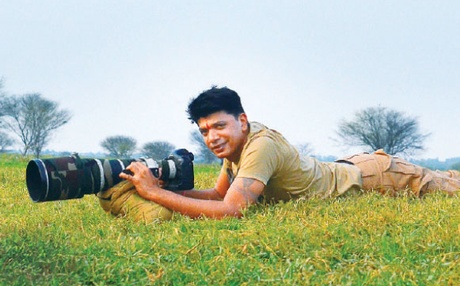
Kiran Pooncha.
From sketching to photography could be considered a natural transition, but switching from land acquisition to bird photography and conservation is a paradigm shift. Kiran Poonacha from Bangalore has not only made that shift but also crowned it with international laurels and appreciation from the world’s best bird photographers.
Known as the raptor man of India, Pooncha is a born conservationist, rescuing and carrying out documentation work on raptors, especially eagles in various corners of India. It also gives him an opportunity to capture the majestic birds in action. Says Pooncha, “I love their temperament, their style, their enormous power and majesticity. I want to share my moments with these powerful yet graceful birds with everybody.”
Unlike visualisation by other photographers, his image of the winged wonders stands out because they are captured when in action and that is what gives life to the pictures. The birds taking off, flying, diving, swooping, hunting, feeding, nurturing, he has caught all these with the right background and foreground, surreal lighting, great precision and artistic imagery. “Capturing birds in flight is technically very challenging but it is such rare movements that interest people and also stays in their memory. I’m also pursuing my passion in my hometown Coorg. This is a tribute to what I have been exposed to during my early years while growing up in Madikeri. I sincerely hope my photographs will help influence people conserve birds by restoring their natural habitat,” says Pooncha with a smile.
Hailing from a family of nature lovers and born and bred in the hill district of Coorg, a place abounding with rare and beautiful species of birds, Pooncha was inspired to start birding at the tender age of seven. Chikkaballapur, where he did his schooling and a nearby place called Gudibande with rocky terrain and scrub forests that support a variety of avians, played an important role in igniting his interest. Midway for 15 years, he missed nurturing these winged wonders in their habitat as he was busy with his education and professional duties but now nothing seems to stop him in his pursuit.
“I patiently bided for the time when I could go back to the world of birds. In 2006, Neeta, my wife and birding partner, gifted me a camera and that is when my passion for capturing my love for birds began. Coinciding with this, I met a couple of people through a social networking website who shared similar interests. These incidents gave me a second chance to pursue my passion to visualise birds in a permanent frame,” says Pooncha.
Pooncha became a member of India Nature Watch that supports well-known photographers from across the country for sharing their work on their website. This exposure played an important role in helping him to improve his photographic skills. He purchased his first DSLR camera in 2007 and his dear friend and boss Kumar Babu gifted a zoom lens and that is when he started concentrating on his chosen hobby, bird photography.
“I have done extensive studies on birds since childhood. I have raised pigeons, kites, parakeets, and sparrows, looked after injured birds, tending to their broken wings and spoon-fed them. Not all survived, however, one injured black kite would not part from me even after two years,” says the raptor man. Pooncha proudly adds, “I can tell you the spots where ea gles can be found, where they hunt, breed and Bangalore is filled with raptors—tawny eagles, snake eagles, boneless eagles, Indian spotted eagles and many more species.”
Now, every holiday and weekend is taken up by trips to scrub forests and wetlands around Bangalore in search of eagles. His favourite haunts on the outskirts of the city include Hessarghatta, T G Halli, Bannerghatta forests, Gudibande and Hoskote.
Over the years, his portfolio on raptors has attracted international attention and awards as some of the images are pretty rare, hitherto never captured on camera. Dedicated to studying these birds, Pooncha says, “My social life is a big zero as all my time is taken up either following them through thorny jungles or standing in slimy wetlands for days together, hoping for the best shot.”
Recollecting his experiences, he says, “Once I was following a Bar Headed Geese near Talkad near Mysore when a snake wound up around my leg. My position was so treacherous that neither could I leave my subject nor ignore the reptile. But fortunately, after two hours, the snake slinked away. Another time, I had to sit in the water for hours together to get a Little Grebe in action. Some images like two snakes fighting for territory at Hessarghatta, a snake eagle hovering between death and new life and falcons at Kolar for whom I waited for three years are still fresh in my mind.”
Pooncha’s dream project, a birding resort on a 30-acre land surrounded by Pushpagiri Hills near Madikeri will soon be a reality. He is hoping to bring renowned experts like Arthur Morris, popularly called “father of bird photography”, Doug Brown and others for workshops on bird photography apart from giving an opportunity to youngsters to know more about birds.
Decrying the nation’s obsession with big mammals, Pooncha appeals, “Birds need our help. They play a very important role in the food chain, pollination and of course, they are the natural scavengers of the earth. We have to look beyond tigers and elephants as India has thousands of species that needs protection at all levels. If I can convince hundred people to conserve nature in and around Bangalore, it will be a small beginning to save these helpless avians.”
source: http://www.newindianexpress.com / The New Indian Express / Home> Magazine / by Meera Bhardwaj / March 31st, 2013
Kodagu, which was once famous for honey, now produces just a few tonnes from what it used to produce annually nearly two decades ago. However, the apiculturists are facing several problems in the district.
There is ample opportunity for beekeeping in Bhagamandala. A few farmers are engaged in apiculture. However, in the recent years, farmers from Kerala keep the beehives in the coffee estates and collect honey and take it to their hometown for sale. This has become a headache from the local farmers.
Apiculture was taken on a large scale in Bhagamandala during 1990. The farmers started rearing malliferous bee brought from Kerala. The drastic decline in the production of honey was due to sacbrood disease affecting the honeybees.
Now, apiculture has started reviving in the district. Farmers from Kerala have started keeping beehives in the coffee plantations after taking permission from the owners. A few plantations have 100 to 150 beehives.
In Kerala, honey is produced only from rubber tree flowers. As there was no great demand for such honey, natural flowers are available in plenty in Bhagamandala region. Hence, growers from Kerala have started keeping their beehives in Kodagu.
A honeybee starts the honey making process by visiting a flower and gathering some of its nectar.
In the process of gathering nectar, the insect transfers pollen grains from one flower to another and pollinates the flower.
There is a great demand for ‘Coorg honey.’ The beehives from Kerala is kept in the plantations at Cherangala, Thannimani, Thavoor and others areas. In the past, the apiculturists were getting 25 kg honey from one beehive. However, now its has been reduced to three kg, said apiculturist.
At a time when apiculturists in Kodagu are getting ready to revive apiculture by availing loan from the banks and financial assistance from the government, honeybees and beehives from Kerala entering the district has become a headache. Gram panchayats should initiate suitable measures in this regard, said the farmers.
source: http://www.DeccanHerald.com / Home> District / Napoklu, DH News Service / April 04th, 2013
WELCOME. If you like what you see "SUBSCRIBE via EMAIL" to receive FREE regular UPDATES.
Read More »