Category Archives: Nature

Spending time with the tribals

Honey hives: In the forest
It was a day to remember when school kids danced with the Soliga tribals recently at the town hall.
A recent event in Mangalore brought school students closer to Soliga culture. Many of them joined the Soligas as they danced as part of a programme held in the city’s town hall recently.

The students were from Stds. VI and VII. There were 40 students from Government Higher Primary School, Parappade, and 70 students from Government Higher Primary School, Mullakadu.

Song and dance
Enjoying ethnic beats: With the Soliga tribe
The dance was part of a week-long celebration of dances organised by the Information Departments of all the 30 districts of the state.

Most of the students said that they were seeing the dances and songs of the Soligas for the first time.

The Soligas explained to the students about life in the forest. The students asked them several questions about their food, their way of worship and how they lived in the forest.

Telling time

Raghuvir, Std. VII, Government Higher Primary School, Parappade, said, “I liked the way they described how they collect honey and how they tell the time by looking at the blooming of a flower. They should be allowed to live in their forests.”

Nirmala, Std. VII, said, “Women in the tribe have freedom.” Hithesh, Std. VII was thrilled how they could detect a snake hidden in the foliage.

Dhanaraj, Std. VII admired the way they dressed, their views on animals, their ornaments made from what is available and the variety of their dances

Mamatha, honorary teacher, Government Higher Primary School, Parappade, was impressed by their marriage custom, where a girl can choose her life partner and the expense of the marriage came to only Rs.12.50.

The word Soliga means “people of the bamboo”, because they believed they originated from the bamboo. They live close to nature. This is seen in their local tribal laws. They harvest fruits and berries only from trees that has lots of flowers. They leave the overripe ones for the birds.

They cultivate land only for five to seven years. Then the land is left untouched for 50 to 75 years, so that the forest takes over again.

source: http://www.TheHindu.com / Life & Style> Kids / by Renuka Phadnis / April 02nd, 2012

‘Forest must to balance nature’

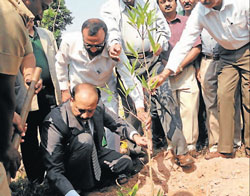
District and Sessions Judge Ashok G Nijagannavar said that the forests help in maintaining balance in nature.

Speaking at World Forest Day organised by forest department and Western Ghat Task Force at Aranya Bhavana in Madikeri, he said “at least 30 per cent of the land should be covered with forest in the country.

With the increase in the demand, the forests are getting vanished in the country. There is a need to protect at least the forests which are found at present.”

Zilla Panchayat President Ravi Kushalappa said 37 per cent of the land in Kodagu is covered with forest.

There is a need to grow trees in schools and colleges

Conservator of Forest Brijesh Kumar Deekshith, DCF K S Anand, Deputy Commissioner Dr N V Prasad, ZP CEO N Krishnappa and others were present.

source: http://www.DeccanHerald.com / Home> District / DHNS / Madikeri, March 21st, 2012

Tata Coffee Plantation Trails celebrates International Women’s Day

A woman efficiently plays the ever changing role of a daughter, wife, mother, entrepreneur, builder and moulder of a nation’s destiny. Plantation Trails is honoured to offer all lady guests a special treat on their special day.

It is the spirit of Womanhood that has inspired generations and we at Plantation Trails would like to celebrate this spirit on the occasion of International Women’s Day. A woman efficiently plays the ever changing role of a daughter, wife, mother, entrepreneur, builder and moulder of a nation’s destiny. Plantation Trails is honoured to offer all lady guests a special treat on their special day.

The celebration would begin from March 1 to March 31, 2012. Every group with at least one woman guest, who makes a booking at Plantation Trails calling on + 91 (080) 23560761 or E-mails: reach.plantationtrails@tatacoffee.com gets to enjoy a special package at Coorg & Chikamagalur.

Christine F. Jamal, Vice President Corporate, Tata Coffee Limited said, “ Woman have played a crucial role over the ages nurturing the social and functional ties of society thus being the real architects in building the strong pillars of human civilization. Their role and tireless contribution across the various stages of life is enormous and immeasurable. Plantation Trails respects women and there can be no better occasion to honour them than on International Women’s Day.”

source: http://www.IndiaInfoline.com / IndiaInfoline> Markets> News> Other News / March 06th, 2012

Fight against Central Empowered Committee: A K Subbaiah

Former MLC A K Subbaiah has called upon the people to fight unitedly against the report of the Central Empowered Committee (CEC) constituted by the Supreme Court, which has recommended acquisition of forest grown on private land.

Speaking to press persons, he said the people of Kodagu had grown coffee and forest in their private lands. The coffee plants were not grown in reserve forest.

Fight unitedly

He said: “The private lands may be coffee estates. The people of the district should unitedly fight against the CEC report, which has recommended acquiring private lands.”
“The Supreme Court had directed the CEC to look into the issue of Kadamakalla road. It had to raise the issue of forest in private land along with the road. Pseudo environmentalists were responsible for such a report of the CEC,” he said.

“The CEC report cannot be justified. It is an unilateral decision and is against the interest of the people of Kodagu. The committee has taken into account the statements of pseudo-environmentalists and not local residents.

Opinion

Even I had given my opinion before the committee. However, my opinion did not find a place in the report,” he added.

Coffee growers and the public should file a writ petition against the report in the Supreme Court and argue in favour of rejection of the report and state that there is no deemed forest in Kodagu, he suggested.

‘Need road’

Subbaiah said: “We need Kadamakalla road. The road will provide connectivity to the people of the region to the outside world. The government should provide basic facilities including road, water and electricity to the citizens. Why is there opposition when the government has decided to lay a road?” he asked.

“Elected representatives should respond to the needs of the people. Accordingly, Speaker K G Bopaiah, MLA M P Appacchu Ranjan and former MLA S G Medappa have rendered their duty, by supporting the cause of Kadamakalla road. There was nothing wrong in their action,” he added.

source: http://www.DeccanHerald.com / Home> District / DHNS / Madikeri, March 04th, 2012

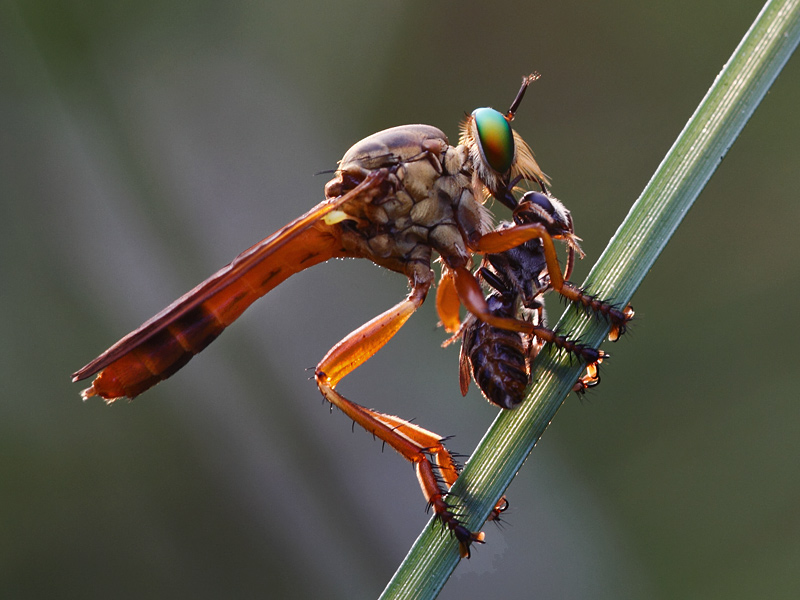
The Bearded Bandit of Coorg!

The Bearded Bandit of Coorg!

Robber Fly, Coorg / Photographed by: Samyak Kaninde
Being mugged is every traveller’s nightmare. Being mugged and then consumed as the main course in a mugger’s banquet, is the stuff that makes it to the horror movie hall of fame. But being killed and converted into a Smoothie to be slurped at leisure, takes the (dis)honours and is certainly not something you’d like on your resume. That, however, is exactly what happens to unwary air-travellers in Coorg if they don’t keep a lookout for the most feared bogeyman of the area – the Robber Fly. This bearded brigand perches quite innocuously on a twig, and when a beetle, dragonfly or wasp is spotted approaching incautiously, smacks his hirsute lips and takes off on a roundabout flight, before veering back suddenly and grabbing the unsuspecting insect, mid-flight, with his powerful legs. A short jab with his rapier-sharp beak injects venomous saliva that paralyses the prey while liquefying the body matter. From there on it’s a smooth return flight to the home perch, where the Robber proceeds to slurp up his Insect Smoothie. If he’s particularly peckish, and feels like a larger serving, the Robber Fly doesn’t balk at taking on prey much bigger than himself, trusting to his well-honed predatory skills and the power of his proboscis.

Talking of skill-sets, the predatory career of this successful bandit begins quite early: the larval baby brigand hides in the soil and in decaying wood, and learns the ropes by preying on the larvae, eggs and pupae of other insects around him. While this is bad news for some, a healthy Robber Fly population is good for humans, as it is our first line of defence against destructive and disease-carrying insects. Much like the legend of Robin Hood, the Robber of Coorg has shown that a bandit for some could well be a saviour for others.

We at Orange County have loved sharing this story with you, and shall bring you one every fortnight, as part of our Responsible Tourism Initiatives to raise awareness about the nature and culture of the environments we operate in.

source: http://www.lifescapes.org.in / LIFESCAPES by Orange County / Home> Lifescapes Gallery / January 11th, 2012

Book on Cauvery


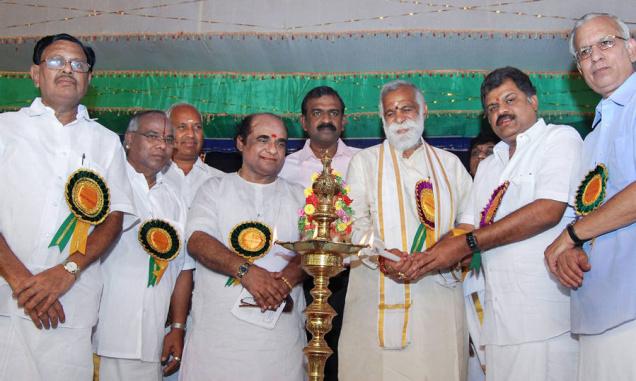
At the function: G.K.Vasan, Union minister of Shipping, (second right) and Kaumuri Bapi Raju, MP (third right), G. Rangaswamy Moopanar, president, Sri Thyagabrahma Mahotsava Sabha (left)and A.K. Palanivel at Thanjavur. Photo: B. Velankanni Raj


‘Mazhai,’ a book of verses on rain and Cauvery Delta, was released in Thanjavur recently.

The Union Minister for Shippping, G.K.Vasan, released a Tamil book titled ‘Mazhai,’ written by G. Srinivasan, at Thanjavur on Monday last (January 9). Kaumuri Babi Raju MP and chairman of Tirumala Tirupati Devasthanam received the first copy. Speaking on the occassion Vasan said that writing poetry is a difficult task.

“It is even more difficult to write poems that provide food for thought. When the poet makes people think and act with his poems, he achieves the goal.”

Quoting some poems from the book, Vasan said that one on Cauvery issue spoke of the reality on the issue. The poem says that the farmer of Cauvery delta wants rain to be copious in Coorg, so that his Kannada brethren can not store the water and open the dams. Thus the Delta farmer will get the rain. Vasan quipped by saying “It appears that only Lord Varuna can help the people in Tamil Nadu in the Cauvery issue.” He said that the book contained poems on spirituality, health, social issues like environment, poverty and poems on leaders like Mahatma Gandhi.

G. Rangaswamy Moopanar, president of the Thyagabrahma Mahotsava Sabha, presided over the function. Sintha Mohan, Tirupati MP, N.R. Rangarajan, Pattukottai MLA and S.P. Anthonisamy, chairman of Parisutham Institute of Science and Technology, received the copies of the book. A. Alagappan, former governor, Rotary Club, and director, Blossom School, Dr. Mohandos, Nephrologist, V. Jeevakumar from Tamil Nadu Murpokku Ezhuthalar and Kalaignargal Sangam and Kamaraj, Professor, Tamil University, offered felicitations. The book has been brought out by Mahavir Printers, Thanjavur.

source: http://www.TheHindu.com / Arts> Books / by G Srinivasan / January 12th, 2012

Govt. Mulling on Regularisation of Encroached Govt. Lands


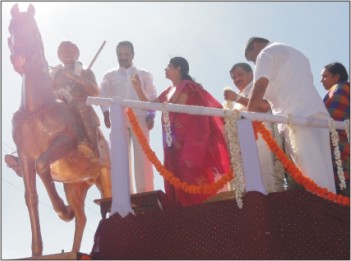
Caption: D.V. Sadananda Gowda is seen unveiling the statue of freedom fighter Guddemane Appayya Gowda in Madikeri yesterday. His wife Dotty Sadananda Gowda is seen offering floral tributes.

Madikeri, Jan. 3:
The Government is mulling on regularisation of encroached government lands by making amendments to Section 94(C) of the Karnataka Land Revenue Act, 1964, said Chief Minister D.V. Sadananda Gowda.

He was speaking at the launch of several works undertaken by various Departments at the Town’s Gandhi maidan after unveiling the statue of Freedom Fighter Guddemane Appayya Gowda here yesterday.

The government is contemplating on making amendments to the Revenue Act so as to give land rights to farmers who have taken up cultivation in C and D category lands in Kodagu district.

The Chief Minister also said the Services Guarantee Bill, which aimed at transparency in Governance, will be tabled before the Assembly in the coming session. As many as 152 functions under various departments will be brought under the purview of the Bill, he pointed out.

A medical college will be established in Kodagu, for which the funds will be earmarked in the forthcoming budget, he added.

Earlier, Madikeri MLA Appacchu Ranjan in his introductory address, said the State should submit Rs. 133 crore proposal to the Centre for checking Wild Elephant menace.

A medical college should be established in the district and ICU should be opened at District Hospital, Madikeri, he said.

Appachu Ranjan also urged the government to initiate measures for developing Talacauvery and Bhagamandala, construction of General Thimmaiah Memorial and KSRTC division for Kodagu.

Speaker K.G. Bopaiah said land has been identified for construction of DC office complex, Police Station at Suntikoppa, Ayurveda College at Virajpet and Medical College in Kodagu.

source: http://www.StarofMysore.com / General News / January 03rd, 2012

Walk, smell the coffee

Pushpanath ‘Push’ Krishnamurthy is tired. A campaigner with Oxfam, UK, he is just back from a fortnight-long, 540-km walk across Karnataka for what he calls “climate justice”. “After walking 30-40 km every day for half a month, it’s tiring to not walk anymore,” he says, leaning back in his chair at the office of the Centre for Social Markets, a Bangalore-based non-profit that promotes climate change dialogue and socially sustainable entrepreneurship, where he is currently on an externship.

In a white chikankari kurta and jeans, his face framed by a cloud of unruly salt-and-pepper hair, Krishnamurthy looks every bit the eccentric Gandhian. He is brimming with stories from his journey, timed to coincide with the UN climate conference in Durban, South Africa.

“I met 30,000 people in 16 days. Hordes of people joined me on various legs of the walk, welcomed me into their homes, shared their stories, fed me and garlanded me. I felt like Bono without the sunglasses,” he says, laughing. Krishnamurthy began his walk, backed by CSM and the Karnataka Growers’ Federation, on November 25 in the hills of Chikmagalur, descending two thousand feet in the next few days to pass through Hassan, Coorg and Hunsur and finally arrive at Mysore. Along the way, farmers and coffee growers filled him in on the climatic variance of the past few years and how it was affecting their crops. He visited villages ravaged by unseasonable bouts of rain and explained in chaste Kannada the correlation between human activity and climate change. He blogged every day and gave interviews to radio and local papers, attracting a posse of supporters aged seven to 80. “Most of them hadn’t heard of the Durban talks. They thought I was a crazy old man. Some called me a parisara vaadi, a climatologist. I told them I am just a regular guy with irregular hair,” he says, lightheartedly.

source: http://www.indianexpress.com / IE> Story / by V Shoba / December 18th, 2011

Coming in the line of hunters, he became a frontline warrior of forests

In Coorg, where men once loved hunting, K M Chinnappa broke the tradition by turning his gun to protect the forests. Anita Pratap captures the spirit of the man, and Mahesh Bhat his image

By Anita Pratap and Mahesh Bhat

Hunting was a way of life in the verdant forests and foothills of the Western Ghats in Karnataka’s Coorg area. It was an integral part of tradition, folklore, manhood, sport, food and commerce.

From poor, forest-dwelling tribesmen to the flamboyant royalty and courtiers in bustling Mysore, everyone loved hunting. But one man stood tall to end this way of life. His name is K.M.Chinnappa.
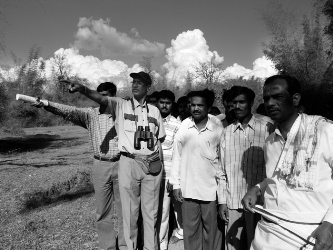
K M Chinnappa was the Range Forest Officer of Nagarahole for over two decades and was single-handedly responsible for making it one of the finest national Parks of India

Born in 1941 in Kumtur village near Nagarhole to a soldier who fought in the First World War, Chinnappa spent his youth roaming the forests of his ancestral land, listening to birds, watching the cavalcade of animals in their habitat, absorbing the every day miracles of the rich eco-system.

An enduring love for nature was thus born in him. Like his father, he too would become a mustachioed soldier. But with a difference. He would become a gun-toting, frontline warrior of the forests, dedicated to protecting wild life. Says he simply: “Wildlife is the purpose of my life.’

In 1967, he joined the Nagarhole National Park as a forester. The park was in ruins. Hunting had taken its toll. There were hardly any deer left, forget tigers and other big game. To cultivate rice, villagers had encroached on the swamps – the beloved play-ground of the elephants.

Tribesmen lived in clusters deep within the park to collect forest produce, ranging from honey to berries. Livestock herders grazed their cattle on the park’s grasslands. Hunters preyed on animals and birds.
Poachers hunted tigers for their skin; elephants for their tusks. Timber logging was a thriving mafia business. Sandalwood smugglers roamed with abandon.

The destroyers of Nagarhole’s environment used a range of weapons – hunters shotguns, tribesmen used snares and livestock herders used poison. Wild life protection laws were weak and the Forest Department concentrated on logging, misguidedly uprooting the diversity of natural vegetation to replace them with the monocultures of teak.

Rued Chinnappa: “If this devastation continued, I was dead certain that there would be no wild life left in Nagarhole in 30 years.”

He became a one-man army to reverse this process. And he succeeded. In less than a quarter of a century, Nagarhole revived, expanding from a 250 sq km part to 640 sq kms.

The poachers have retreated, the encroachers have gone and the hunters are virtually extinct, restoring Nagarhole to its rightful inhabitants – tigers, panthers, leopards, sloth bears, jackals, wild boars, porcupines, hares, langur and varieties of deer.

In the bad old days, tigers had to roam 200 sq kms before they could find prey. Now they can find it within 12 sq kms. The elephants are back where they belong: in the lush swamps and bamboo groves. The trick? Explains Chinnappa: “All you have to do is to stop human interference. Just leave the forests alone and they will regenerate themselves”.

Chinnappa was the right man at the right time. In 1972, in the wake of a groundswell of opinion generated by several leading Indian conservationists, then Prime Minister Indira Gandhi took a slew of measures to protect the environment.

Several laws were enacted and sanctuaries in Kanha, Corbett, Ranthambore, Bandipur and Nagarhole among others were pulled back from the brink of destruction.

Forest departments had new direction, muscle and teeth. Still, keeping the humans out of the forests was not easy. Chinnappa paid a high personal price to fulfil his mission to safeguard Nagarhole. He was arrested, jailed, transferred. His home was burned down. But he has no regrets. Says he with his characteristic robust optimism: “What’s the use of just going to office. I led a colourful life.”

To protect wild life, Chinnappa had to take on a range of human beings who lived on the wild side of life. He captured a large number of poachers and smugglers and filed court cases against them. But they were all acquitted in no time and were back to their wicked ways.

He realized he would have to terrorize them, make it really dangerous for them to hunt and poach. He took up the gun and did not hesitate to shoot. He recalls: “No body used high-calibre guns. I had only a 12 bore rifle. And I used only buckshot. But at that time, it was enough.”

He remembers the legend of a tribesman whom the locals nicknamed “parari Thimma” – vanishing Thimma. He was a notorious poacher who nimbly eluded forest guards. Chinnappa began tracking him and one day shot at him. And then he vanished forever!

Chinnappa became the local legend. Supporters hailed him as a hero, the phantom of the jungles. Poachers called him “The Devil” who stalked their hunting grounds.

Chinnappa used his immense knowledge of forest trails, tracking spoor, jungle craft, fabled night vision and stealth maneuvers to ambush the poachers and hunters. Guided by moonlight, he silently crept upon the forest brigands and opened fire. And the old way of life began to end.

But not without resistance. In no time, the threatened “vested interests” – profiteering poachers, unscrupulous smugglers, wealthy hunters, criminals, mafia operators and politicians all ganged up against Chinnappa.

In 1993 after voluntarily retiring from Karnataka Forest department, Chinnappa started Nagarahole Wildlife Conservation Education project reaching out to the local students, youth and the public.

Even the villagers rose in revolt. For Chinnappa, life took a curious turn. On the one hand, the regeneration of Nagarhole won high praise. He bagged the Karnataka Chief Minister’s Gold Medal in 1983, received an award from the Wildlife Conservation Society and foreign environmentalists showered glowing tributes in books and magazines.

His spartan way of life, incorruptibility and military discipline became legendary. Says Ullas Karanth, a leading wildlife biologist: “Chinnappa is a man of integrity. He is tough, efficient and incredibly courageous in the face of grave physical danger. His accomplishments in Nagarhole are undoubtedly a major milestone in the history of Indian wildlife conservation.”

He was admired and respected by his peers. But some of the locals feared and hated him. In 1988, one of Chinnappa’s guards publicly shot a local coffee planter who had killed and eaten his pet samba deer.

The dispute spun out of control and soon local poachers instigated a public agitation, accusing Chinnappa of masterminding the murder. Bowing to political pressure, Chinnappa was arrested and jailed for 12 days. Eventually he was cleared of all charges and reinstated

But vested interests continued to persecute him. He was implicated in the killing of a poacher in 1992 and a riot erupted. A frenzied mob ransacked the Forest Department’s buildings, burnt vehicles, assaulted staff, set fire to large swathes of forest land and set ablaze Chinnappa’s ancestral home.

Once again, he was cleared of all charges, but this time, Chinnappa decided to quit. He could understand why the poachers, smugglers and politicians ganged up against him. But the fact that they could enlist the support of villagers had a profound impact on him.

He realized he needed to move to another plane of conservation: education. He had to make the locals realize the practical and moral imperative to protect their environment. It was not merely the job of foresters. It was a collective responsibility.

And so in 1993 he retired prematurely from the Forest Department and started his NGO, the Nagarhole Wildlife Conservation Education Project to educate the local people and especially the children on the need to protect the environment.

His motto was simple: “Without humans, the forest will flourish. Without forests, we humans cannot flourish.” Through forest camps, discussions and slide shows, he opens the doors to a magical kingdom of flora and fauna, encouraging children to take delight in observing nature instead of hunting animals.

His mission also involves fighting legal cases. As President of Bangalore-based NGO, “Wildlife First”, Chinnappa and a group of conservationists documented the ecological devastation caused by the iron ore mine operators in Kudremukh. In retaliation, they were slapped with 12 criminal cases.

Says Bittu Sehgal, editor of environment magazine, ’Sanctuary’: “Law suits are filed by those who have money or power on their side to prevent public minded citizens from ‘interfering’.” The cases dragged on for years and wound up in the Supreme Court, which ordered the closure of the mines in December 2005.

Chinnappa’s accomplishments are all the more laudable because they were won against the stiffest odds. He endured setbacks, difficulties, threats, attacks, vilification, arrests and court cases.

But, remarkably, he has emerged unscathed, his innocence, courage, dedication, honour and optimism intact. He is completely devoid of bitterness. He chooses to forget the troublemakers who made life so difficult for him and his loyal wife Radha, but remembers fondly the senior officers and lowly guards who stood by him.

Through all his trials and tribulations, one thing remained undiminished: his sheer will to save the forests. With deep conviction he says: “If you have the will, you can do wonders.”

Today, Chinnappa derives enormous satisfaction from the guns – the yesteryear symbol of manhood – that lie rusting in many a Coorgi home. Cheering the end of that bygone era are the sights and sounds of a promising new life, symbolized by the swaying foliage and barking deer.

(Extract from the book ‘Unsung’ by Anita Pratap and Mahesh Bhat)

source: http://www.theweekender.com / Home> Causes> Gun Reversal /vol. 2, issue. 50 / 16-22 December, 2011
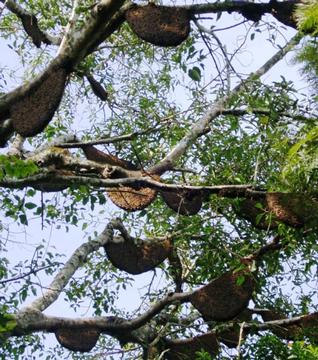
‘Nature walk in coffee land’ reaches Madikeri

Madikeri, Dec 4, DHNS:

The ‘nature walk in coffee land’ organised to create awareness on environment from Bababudangiri reached Madikeri on Sunday.

The jatha was led by Krishnamurthy Pushpanath. The jatha reached Sampigekatte at 9.30 am.

The jatha was welcomed by skating children with flowers. District Congress Committee President B T Pradeep, Jaya Karnataka district president Rabin Kuttappa, Kodagu Growers Federation member B T Dinesh, Madhu Bopanna and others were present.

The jatha passed through Gandhi Maidan in Madikeri. After garlanding the statue of Gandhi, Krishnamurthy said, “There is a need to protect Western Ghats and Malnad to check global warming. It is our duty to protect Western Ghats.

There is a need to create awareness among the public on the need to protect Western Ghats from destruction. With the global warming, there has been increase in temperature by one or two degree every year. The increase in temperature will affect coffee. If this continued, then coffee plants may not survive by 2030.”

Kodagu Growers Federation’s Dr Pradeep said “the coffee plantations absorb carbon dioxide. Hence, the coffee growers are protecting the nature. The Centre should support the coffee growers.” The jatha left for Bhagamandala from Madikeri.

source: http://www.deccanherald.com / Home> District / Monday, December 05th, 2011