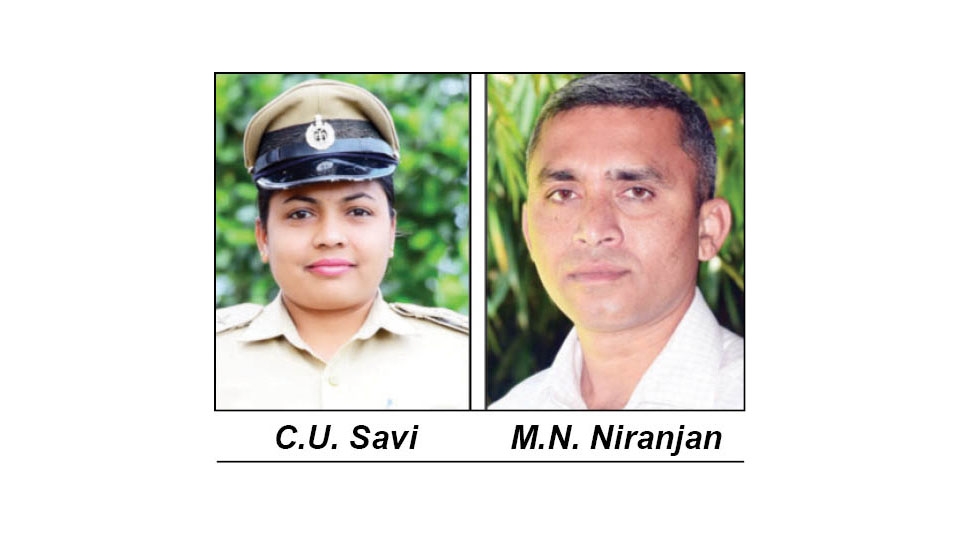
Two Police personnel from Kodagu have been selected for the Chief Minister’s Medal for their exemplary service in the Department.
They are Madikeri Division’s CID Forest Mobile Squad Sub-Inspector C.U. Savi and District Crime Detection Unit Head Constable M.N. Niranjan.
Savi has been serving in the Police Department since 13 years and has served at many places including Nanjangud and Bylakuppe and is presently serving in Madikeri Division. She is a native of Kolakeri.
M.N. Niranjan is a resident of Ashokapura in Madikeri and is serving in the Police Department since 22 years.
He had served in various Police Stations including Madikeri Rural Police Station and is presently serving at District Crime Detection Unit.
source: http://www.starofmysore.com / Star of Mysore / Home> News / April 03rd, 2023
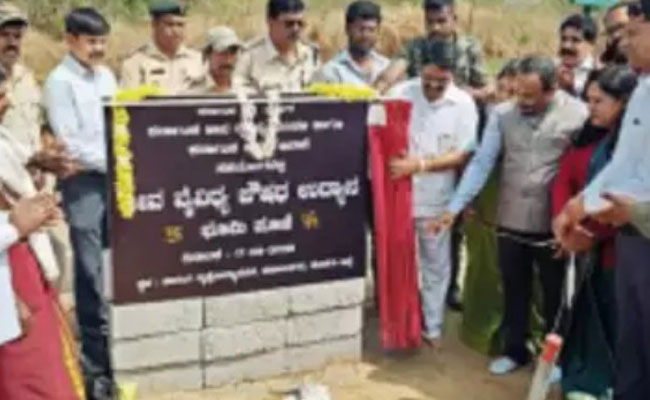
The work to develop the first biodiversity park of the state was launched in Harangi, by laying the foundation stone on Friday.
Legislator Appachu Ranjan, who conducted the ‘bhoomipooja’ for the biodiversity park work, said, “India is the biggest exporter of medicinal herbs. The new park will help us.”
He said that a medicinal herbal park will also be opened in Bhagamandala soon.
“Medicinal plants are needed to cure diseases. Also, the environment will be healthy if there is enough greenery,” he pointed out.
Karnataka Biodiversity Board chairperson Napanda Ravi Kalappa, who presided over the ceremony in Harangi, said that a master plan of building a model medicinal garden in the district was readied by the Board. The park is also being launch to conserve the richness of the flora of Kodagu, he added.
“The Karnataka Biodiversity Board intends to establish similar parks in every panchayat of Kodagu. The Coorg Mandarin used to be an exclusive plant to Kodagu, but is virtually not to be found anywhere now. Research is now being conducted to promote this species,” Kalappa said.
Conservationists hope to connect people and the dwindling fish species, to save streams, rivers and otters.
Volunteers conduct survey of the stream to look for signs of Koilemeen and Small Clawed Otters
Madikeri :
Food has a way of bringing people together. Raising awareness using a local delicacy to protect streams and the ecosystem of Kodagu is the unique ‘Koilemeen Project’ — an initiative by conservationist Gopakumar Menon. To understand the motto of the project, it is important to first understand that koilemeen is the Kodava name for freshwater fish, commonly known as Spiny Loach, with the scientific name ‘Lepidocephalichthys thermalis’.
A local variety found in streams and water-filled fields of Kodagu, the koilemeen used to be a popular delicacy in Kodava households during the monsoon. However, the numbers have dwindled over the years due to various reasons, and this is where the ‘Koilemeen Project’ comes into the picture.
The objective is to involve the local community in the conservation of streams and rivers, by connecting the people to their once-popular koilemeen dish, Gopakumar explains. “In the past two decades, there has been a precipitous drop in the availability of Koilemeen. We spoke to several coffee planters and a fish trader in Virajpet, who shared his worry due to the non-availability of koilemeen,” he said.
He explained that the use of chemicals in agriculture and horticulture has severely affected the koilemeen population, which also indicates that stream and river waters are being polluted by chemicals. “Increased use of weedicides, pesticides and other fertilisers have affected the koilemeen, and indicates that our water is polluted. The project addresses the loopholes and tries to bring awareness in the community,” he added. Illegal sand mining across the streams of Kodagu has also affected the koilemeen population.
These tiny fish breed on sand, and with sand illegally mined for commercial purpose, it has affected their numbers. “The fish spawn across paddy fields (during monsoon) and other shallow streams, and swim upstream post the monsoon. However, the use of chemicals, sand mining and deposits of plastic waste across the streams has affected the fish. The project is trying to sensitise locals and get them involved. For the community, koilemeen is an easy logo to enable the conservation process,” he shared.
The group is active across social media platforms, and wants youngsters from the district to get involved in the conservation project. The project team meets small groups of planters and raises awareness on the need to stop the extensive use of chemicals. “We tell planters and farmers about the correct method to use chemicals. We are creating awareness on the hazardous use of weedicide and urging them to use fewer chemicals, while ensuring there is at least a 20-ft gap from the chemical-sprayed area and water source,” he explained.
While the project’s main objective is to protect the streams of Kodagu, the focus is not just the tiny koilemeen fish. The bigger picture includes small clawed otters – a Schedule 1 species under the Wildlife Protection Act, whose habitat is found by freshwater streams of Kodagu.
Small beings in the ecosystem, like small clawed otters, have the same protection right as elephants or tigers, but are less talked about though their existence touches the level of endangerment. Since koilemeen are occasionally hunted, it is being used as a mascot to protect the small clawed otters in their natural habitat of freshwater streams and rivers.
The team — geared in gumboots and equipped with GPS — heads out to survey streams to find signs of small clawed otters. “The signs or presence of otters indicate good health of the ecosystem. We look for droppings or spraint of otters and are collecting data on their habitat,” explained Yashas S, a master’s student, a volunteer for the project. He stresses the need to conserve the riparian habitat to protect small clawed otters.
The project aims to collect research material on the otters, and find ways to protect them from being poached. “The diet of an otter includes crustaceans and koilemeen. Our aim is to protect the prey which will help conserve the predator. Protecting the prey also means protecting the streams,” explained Gopakumar.
Alongside the community conservation initiative, the project is conducting a baseline analysis on the otter habitat, which will help take an intelligent step towards their conservation.
Purpose of the project
To involve the community in conservation of fresh water streams, rivers of Kodagu. Enable conservation by connecting community to their once-favourite delicacy. Protect koilemeen, the prey, in freshwater streams.
Urge planters to opt for organic farming, stop use of harmful weedicides Protect, conserve vand conduct analysis on small clawed otters, the predator.
source: http://www.newindianexpress.com / The New Indian Express / Home> Good News / by Prajna GR, Express News Service / Februry 26th, 2023
She sits inside a cage, goes down 25-feet deep well to bring back the feline after darting
Mysore/Mysuru:
One of the most challenging and dramatic animal rescue missions has been accomplished by a Kodagu-born veterinarian Dr. Pandikanda Meghana Pemmaiah, now settled in Mangaluru.
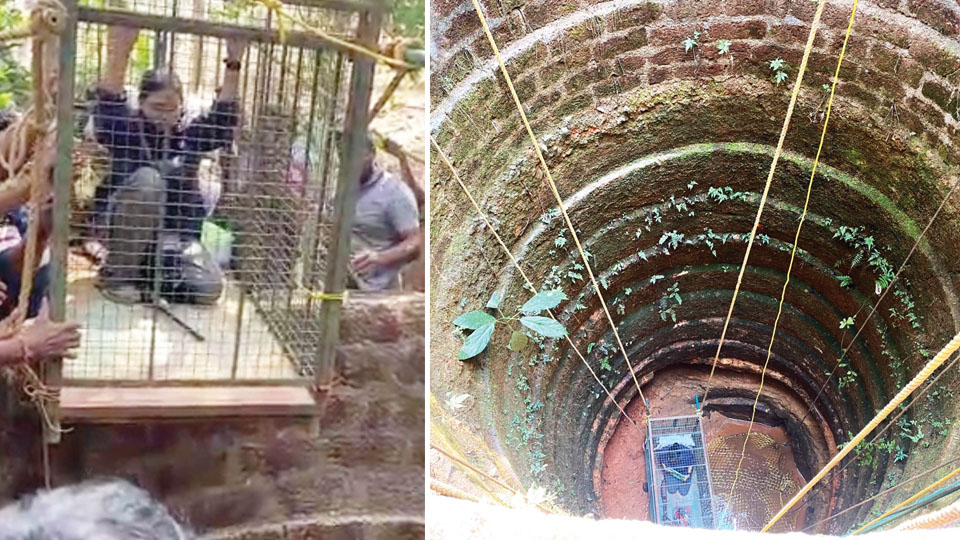
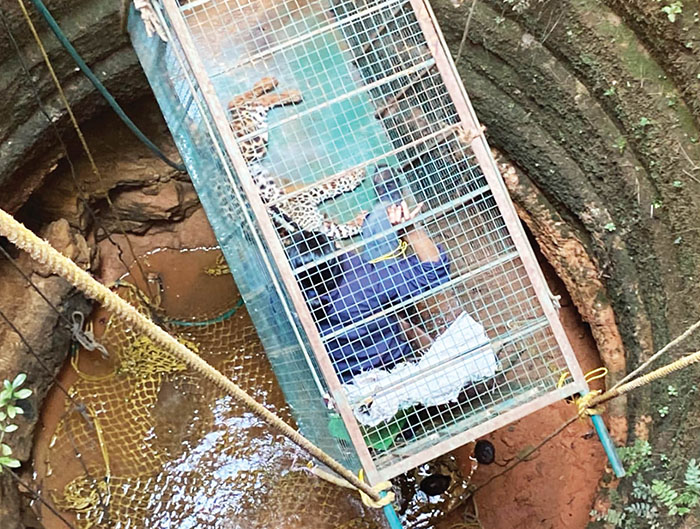
She recently saved a leopard that had fallen inside a 25-feet deep well and performed the act by sitting inside a cage that was lowered into the well to sedate the leopard that was stuck there and starving for 36 hours. She was able to pull the one-year-old feline into the same cage in a tense and dare-devil two-hour rescue operation. Her husband Dr. Yashaswi Naravi too was a part of the rescue mission.
In fact, it was 31-year-old Dr. Meghana, who volunteered to go down the well. She told Star of Mysore that though she was scared as it was deep inside the well and the leopard was not visible from the top, the adrenaline rush to save the starving and stuck animal overcame the fear.
The incident took place near a house in Niddodi near Kateel in Dakshina Kannada, about 35 km from Mangaluru. “We got a call at 9 am on Feb. 12 from the Forest Department. We are a team from Chitte Pilli, a Wildlife Rescue and Research Centre in Mangaluru and the team comprises me, my husband and experts Dr. Prithvi Salian and Dr. Nafisa Kousar. We reached the place at 11 am with some necessary equipment for the rescue,” she said.
After successfully tranquillising the big wild cat, Dr. Meghana being pulled up along with the tranquillised leopard inside the cage.
Failed attempts
The Forest Department had tried to rescue the feline with a ladder and a cage, as in other instances the trapped leopard had walked into the cage when it was lowered inside a well. However, this leopard was unwilling to move, she added.
The leopard was not visible from the top and it had taken shelter at a cosy spot that was shaped like a cave-like cavity — to avoid falling into the water — inside the sturdy well that was built with stones. The leopard was aggressive when attempts were made by the Department to drain the well water.
“Later, a different strategy was adopted and it was decided to lower a cage carrying a person to tranquillise the leopard and bring it back. We had no other choice and someone had to do it. I volunteered despite the dangers involved,” Dr. Meghana revealed.
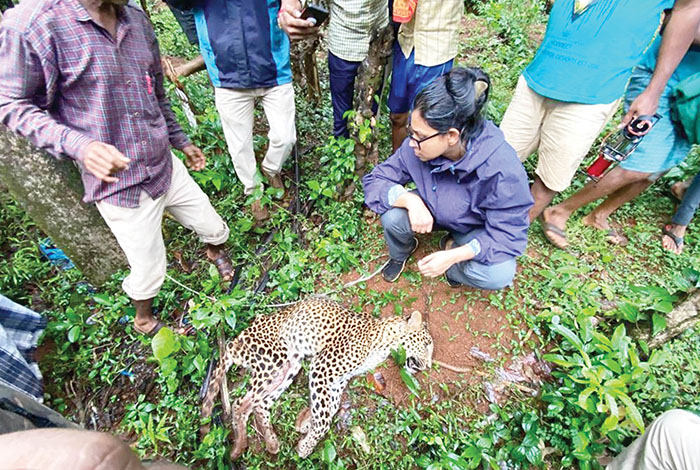
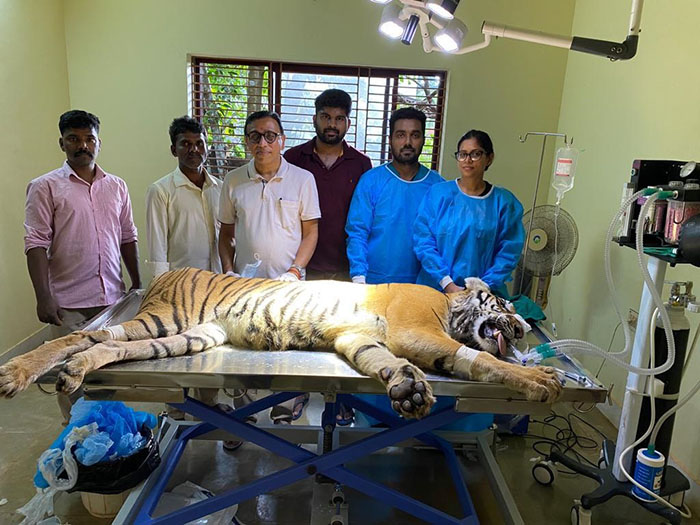
The leopard being treated after capturing in Mangaluru.
A risky mission
The cage was lowered by villagers, volunteers and the Forest Department staff in a coordinated action and with Dr. Meghana holding the tranquilliser gun. “We did not have a visual of the leopard and as such, it was a risky mission as no one had a clue as to how the leopard would react,” she said.
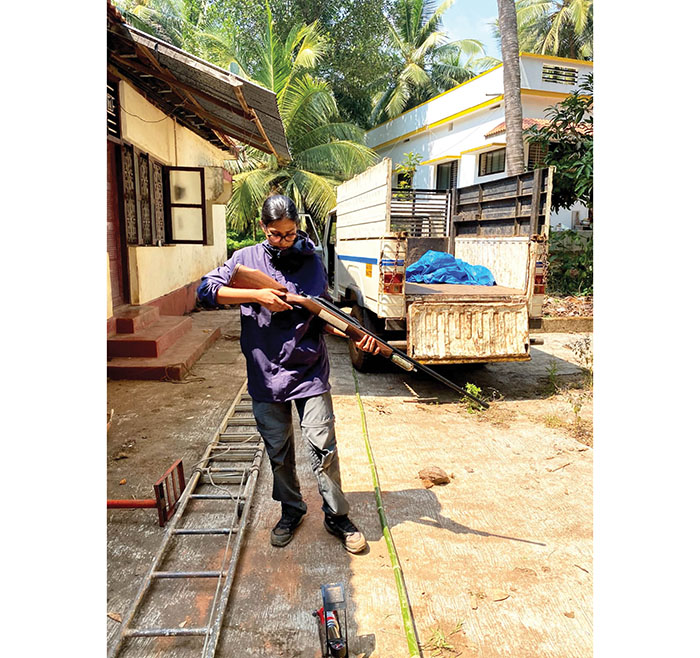
“I waited patiently for a sight of the leopard as the cage was lowered gradually and finally I could spot the animal around 10 to 15 feet inside the well and it was growling at me though it looked exhausted without food and water. I had very little time and hence aimed the dart at the animal and shot at it. Luckily, it was a precision shot and the dart hit the feline’s thigh in the first attempt itself,” Dr. Meghana said.
Meghana had carried about three to four syringes containing the sedating medicine as she did not know about its weight, size, health and other parameters for darting it. If she missed the aim the first time, she could well refill the tranquilliser gun with the second shot but the leopard could have moved away from the initial close proximity and there was more probability of her missing the shot.
Growling leopard
“In fact, I had to sit inside the cage for over 15 minutes for the dart to take effect and the leopard was right in front of me. It was growling and looking at me. Slowly, the sedation process began and I tried to pull it to the cage but could not. Another youth got inside the well and helped me and we both put the 25-kg leopard inside the cage. It was a leopardess. Now when I look back, sometimes I fear what could have happened if something had gone wrong,” she said.
So tense was the situation after the dart was fired that Dr. Meghana sat motionless inside the cage as any movement or noise would disturb the leopard and it would take a long time for the animal to get sedated. Finally, the feline fell unconscious after over 15 minutes. After the leopard was lifted back to the ground, it was checked and the vets found no external injury marks.
“It was a healthy leopard but was exhausted. After administering the required medicines for the feline to rejuvenate and get back its strength so that it has the capacity to hunt on its own, it was handed over to the Forest Department that released it back to the wild,” Dr. Meghana said.
Passion for wildlife keeps her going
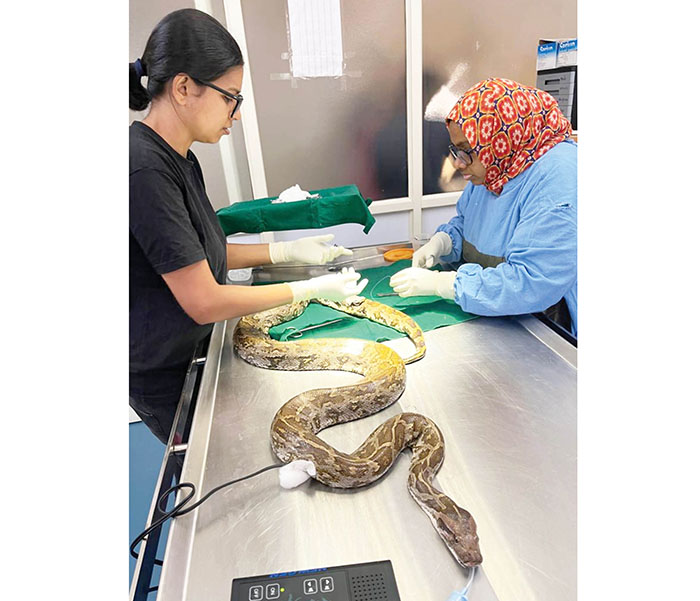
Wildlife rescue operations are nothing new for Meghana and she has been a part of many rescue operations in the last six years in Karnataka. She has been a part of many missions where she has rescued and treated tigers, owls, star tortoises, pariah kites, crows, pigeons, birds and even pythons.
“Passion about wildlife, increasing human-animal conflicts and the resulting rescue mission keeps me going. I dread to see an animal suffering due to injuries,” she said.
Every year, she does almost 10 darting procedures after following the scientific process and protocols. But this was the first time she had to get down into a well, sitting inside a cage to rescue a leopard. She hails from Halugunda village near Virajpet in Kodagu district and studied in Bengaluru.
Dr. Meghana treating a python.
After completing her PUC from Christ College, Dr. Meghana did her BVSc followed by MVSc in Wildlife and Surgery from Veterinary College, Bengaluru. The next four years, she worked in People For Animals (PFA) as a senior veterinarian and this gave her on-hand exposure to animal rescue and medication.
Her father late Pandikanda M. Pemmaiah was a retired Superintendent of Police and her mother P.P. Sarasu and rest of the family live in Bengaluru. She married veterinarian Dr. Yashaswi Naravi of Mangaluru and both have been working at Chitte Pilli — a Wildlife Rescue and Research Centre.
source: http://www.starofmysore.com / Star of Mysore / Home> News> Top Stories / February 21st, 2023
The villagers stated that they were not taken into confidence before sanctioning the project and said that these dams will severely affect the farmers and villagers living downstream of the Chiklihole.
The check dam project across Chikliholey Stream in Kodagu by the Minor Irrigation Department is under construction. (Photo | Special Arrangement)
Madikeri :
The check dam project across Chikliholey Stream in Kodagu by the Minor Irrigation Department has met with strong opposition from the villagers.
The department has now assured to call off the project as villagers alleged that the check dams are being constructed to help a private estate owner. The project is estimated to cost around Rs four crores.
The villagers of Horuru, Modur, Abhiyala, Attur and Nallur of Kedakal grama panchayat have strongly opposed the new check dam project upcoming across the Chikliholey stream.
The Minor Irrigation Department has taken up the task of building two check dams – within a span of 100 meters distance – across the Chikliholey stream near D Block of Kedakal Grama Panchayat.
However, the villagers stated that they were not taken into confidence before sanctioning the project and said that these dams will severely affect the farmers and villagers living downstream of the Chikliholey.
They claimed that the check dams also pose a risk of flash floods and landslides during monsoon.
As sources confirmed, a 128-acre private estate was recently bought by a person from outside the district at the D Block of the panchayat limits.
The villagers allege that due to vested interests, the minor irrigation department has sanctioned the construction of two check dams across the Chikliholey stream, which according to the villagers will only help the D block estate owner.
“The check dams are of no use to the farmers of the village. The planters who have plantations downstream of the Chikliholey will be severely affected by the check dam project as this will stop the free flow of the water stream. The entire Chikliholey dam will be of no use if these check dams are constructed as this will stop water flow from December to May – when people need water the most,” explained Sanju Ponappa MM, vice president of Kedakal Grama Panchayat.
The villagers on Monday called for an emergency meeting that witnessed participation from over 30 villagers alongside the Kedakal Grama Panchayat members. The stir against the construction of the check dams invited the attention of Minor Irrigation Department officials who visited the spot. Following the strong opposition from the villagers, the department has now handed over a letter to the Grama Panchayat assuring them to immediately stop the project.
The construction of the two check dams has been called off following opposition from villagers.
source: http://www.newindianexpress.com / The New Indian Express / Home> States> Karnataka / by Express News Service / February 20th, 2023
Two more cases have been booked against violators who were trying to shift garbage from Kerala.
Madikeri :
The forest and wildlife in Kodagu are facing serious threat due to illegal dumping of truckloads of waste arriving from Kerala. The forest fringes on NH-275 are also under threat from littering caused due to lack of public awareness and proper facilities for tourists.
The Makutta Reserve Forest and the Bramhagiri Wildlife Forest, which line the Karnataka-Kerala border, are gradually turning into an open dumping yard for waste.
Foresters during a cleanliness drive in Kodagu | Express
It was only after some alert residents from the district, including members of the Kodagu Seva Kendra, flagged the issue that the authorities started collecting waste from the forest fringes and burning it. The forest department has also increased checks at the Makutta check-post. Recently, a truck driver and a cleaner, who were allegedly transporting 15 sacks of plastic waste from Kerala, to dump in the Makutta forest area were nabbed by the foresters and booked under the Wildlife Protection Act. Two more cases have been booked against violators who were trying to shift garbage from Kerala.
“Foresters will conduct daily patrolling across the reserve forest area to prevent travellers from littering,” said Dechamma, Range Forest Officer (RFO) of Makutta forest.
Residents unhappy with burning of plastic waste
However, residents are unhappy with the foresters for their unscientific management of waste. They have voiced concern over burning of plastic waste inside the forest limits which can be hazardous to health. Further, hundreds of tourists take the Makutta route to reach Kannur International Airport and it has become difficult for the foresters to prevent littering, despite several awareness signboards being put up on the fringes.
Dechamma said that tree branches are being placed along the roadside to curb parking in the area. Meanwhile, the forest fringes lining the NH-275 on Kushalnagar-Madikeri Road are facing threat for which lack of public awareness is being cited as a reason. Foresters say they conduct cleanliness drives across the forest fringes once a month and collect truckloads of garbage.
source: http://www.newindianexpress.com / The New Indian Express / Home> States> Karnataka / by Express News Service / February 19th, 2023
Tourist footfall at Raja Seat in Madikeri has risen with the top tourist destination and one of the most visited sites in Kodagu hosting a flower show since Friday.
The flower show concludes on February 6.
Nearly 20 species of flowers and about 12,000 plants are part of the show with special floral decorations.
The highlights of the show include varieties of exhibits created in flowers, bonsai plants and others.
The Principal Secretary, Horticulture, Rajendra Kumar Kataria, visited the flower show with Deputy Commissioner B.C. Satish on Saturday.
source: http://www.thehindu.com / The Hindu / Home> India> Karnataka / by The Hindu Bureau / February 04th, 2023
The boards function as an early warning system for commuters and are automated with infrared signals. The infrared beams have been placed at an optimum height to detect the presence of elephants.
Madikeri :
The Kodagu division forest department is trying new techniques to address the increasing man-elephant conflict in the district. In a first-of-its-kind initiative, elephant signal boards have been erected in a few conflict zones erected by A Rocha India – a conservation research organization, with support from the Kodagu division forest department.
Boards with elephant signage have been placed at five conflict zones across Meenukolli and Anekadu forest limits. These sign boards are functional and signal commuters about the movement or presence of wild elephants.
“The elephant signal boards were first tested in Bannerghatta and over 50 detections of elephant movement have been recorded so far. Still, in its R&D stage, we have now extended this facility in Kodagu on request from the forest department,” shared Avinash Krishnan, CEO of A Rocha India.
An organization that is largely finding resolutions to the human-animal conflict in Bannerghatta and Hosuru areas, A Rocha India has erected five elephant signal boards in the district after availing details on the traditional elephant routes from the ground forest staff and the local community.
“The boards have been erected at strategic locations where elephants have been identified to move frequently – especially in coffee estates and other small patches of land,” he explained.
The Elephant Signal Boards alert commuters on elephant movement. (Photo | Special Arrangement)
The boards function as an early warning system for commuters and are automated with infrared signals. The infrared beams have been placed at an optimum height to detect the presence of elephants.
When the infrared detects the movement of wild elephants, the signal boards light up and warn the commuters to slow down or pause. The signal boards have been tested to make them foolproof.
Further, once the movement of the elephant is detected, the signals are pushed to the SMS server system and the local DRFOs can track and monitor the movement of the wild elephants. The solar-powered beams and signal boards can also be connected with Direct Current in case of the absence of sunlight. The units have been custom-made and are proven to be weatherproof.
“We are conducting a commuter survey across Bannerghatta to see if people are noticing and benefitting from the signal boards. The monitoring process is still ongoing and the data will be shared with the forest department to conceptualize the mitigation plans,” he added.
While the project has been implemented on a small scale in the district, A Rocha India looks forward to scaling it up following its successful implementation. The initiative is being tested in the district on request from the Kodagu division forest department CCF BN Murthy.
source: http://www.newindianexpress.com / The New Indian Express / Home> States> Karnataka / by Prajna GR, Express News Service / January 31st, 2023
The source of Cauvery is also among the most ideal locations to gaze at the sky.
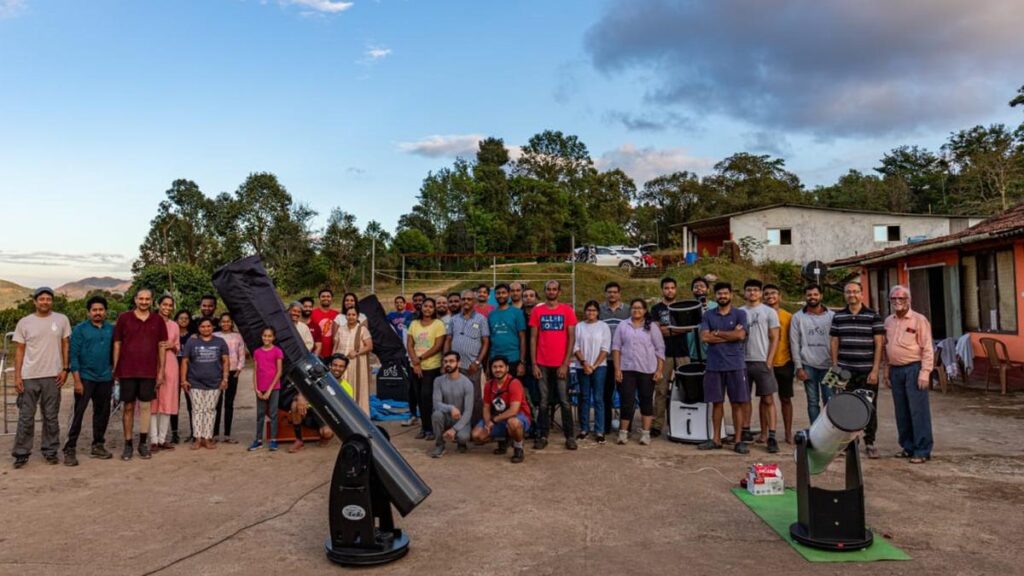
A “star party” organised by the Bangalore Astronomical Society recently at Talacauvery in Kodagu district of Karnataka. Photo: Special Arrangement
Talacauvery in Kodagu district, which is the source of Cauvery river, has emerged as South India’s Hanle, as astronomers have been hosting “star parties” there for some time now. Hanle, located in Ladakh, and known for its pristine skies and minimal light pollution, is also India’s first Dark Sky Reserve.
A Dark Sky Reserve is a designation given to a place that has policies in place to ensure that a tract of land or region has minimal artificial light interference.
In south India, most dark sky locations are in the Western Ghats or some hill ranges nearby, and according to astronomers, Talacauvery is the most ideal location to gaze at the sky and have a star party.
Voluntary work
The Bangalore Astronomical Society (BAS), a group of volunteers working for the promotion of astronomy as a hobby as well as a science, is now hosting star parties at Talacauvery. IT professionals Sudhash Natarajan, Vishwanath S.K. and Keerthi Kiran have been volunteering to conduct the star parties for BAS.
“We at BAS usually arrange star parties on New Moon weekends (Friday-Saturday-Sunday) format as it is the ideal time to observe the celestial objects which we are looking for. We inform people who are interested in joining us for the star party eight to days in advance. Members of the sky party after arriving at the dark sky location set up their equipment like telescopes, binacolours etc and the observation goes on until 4.45 am,” said Sudhash Natarajan.
Mr. Natarajan said that the group which attends the star parties are of all walks of life and that they are a mix of experienced astronomers as well as students and newbies to astronomy. He added that star parties have also been conducted in Koratagere, Hoshalli, Kavalur, and Yercaud in the past.
Less light pollution
“However, Talacauvery is possibly the best dark night location in south India due to less light pollution. In astronomy, there is something called the Bortle scale which measures the night sky’s brightness of a location on a nine level numerical scale. The lesser the numerical scale it qualifies for a better dark sky location. For example, Hanle skies would qualify as Bortle one skies, Talacauvery as Bortle two, and Bengaluru as Bortle nine,” he added.
The star parties are usually conducted in the winter months between December to March as the skies are clearer during these months which is very important for stargazing.
Mr. Natarajan said a star party was conducted between December 23 and 27, 2022, and the next one would be between January 20 and 24.
source: http://www.thehindu.com / The Hindu / Home> News> India> Karnataka / by Hemanth C S / January 04th, 2023





.jpg?w=640&dpr=1.0)