Commonwealth Games 2018: Inspired by Arjun Halappa, India’s SV Sunil looks to conquer Australia

Sportskeeda spoke exclusively to Indian forward SV Sunil about the team’s ascent, the overhaul in the system, and the road ahead for India.
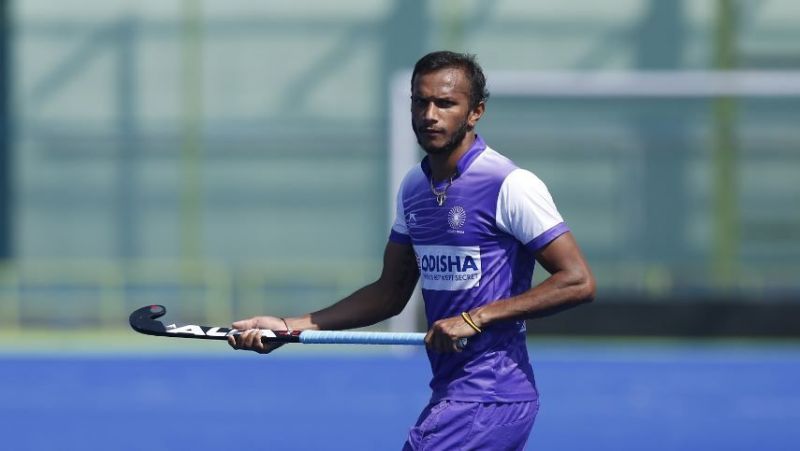
SV Sunil
SV Sunil

Speed is what personifies this Olympian and Arjuna awardee on the pitch and he is arguably one the fastest players in world hockey.

His guile and artistry comes to the fore inside the opposition 25-yard line where he dribbles, dodges and uses clever dummies. The effect is hypnotic and before the defenders can even decide whether to lunge, tackle, or shadow him with a grounded stick, the ball finds it’s way into the net.
The 28-year-old forward from Karnataka hails from a small village in picturesque Coorg, which has nurtured great hockey talent. Former Indian international Arjun Halappa and the legendary BP Govinda were born and bred here. The village is Sowmarpet.

A proud son of this village is Indian hockey international, Sowmarpet Vitalacharya Sunil.

It was indeed befitting that the entire Indian hockey team paid a visit to Kodagu recently, which is considered to be the nursery of hockey talent in South India. The occasion was Sunil’s wedding reception and needless to say, the hockey-loving residents soaked in the atmosphere with relish.

SV Sunil has been an integral part of the Indian team since 2007. He witnessed the dark days of Indian hockey early in his career with India failing to qualify for Beijing 2008. Several coaches were inducted into the system since, and left our shores in a short span of time, dejected and disillusioned.

The Karnataka forward weathered the storm, however, and through sheer hard work backed up by unmistakable talent survived the tumultuous changes. He has reaped the rewards by retaining his place in a resurgent team, now ranked sixth in the world.

As the team prepares for the Commonwealth Games, Sunil is a vital cog in India’s attack.

After he goes through his paces in the Bangalore camp, overseen by the coaching staff, the veteran sat down on the turf to share, with Sportskeeda, a wealth of information about the past and present of Indian hockey, as only he can.

‘Discipline off the field is just as important’
Sportskeeda: Firstly, congratulations and wish you a long and happy married life on behalf of Sportskeeda.

There are lots of juniors who have just made their transition into the senior side. You, on the other hand, have been there for a much longer time. It was in 2007 that you made your debut and Indian hockey was going through one of its worst phases. We failed to qualify for the Beijing Olympics in 2008. Now, India is ranked 6th in the world. What would you attribute the huge ascent to – better players or better coaches?

SV Sunil: Players were really good then. The players are good now as well. The system, however, has undergone a transformation since. It is not that Indian coaches aren’t good. Foreign coaches, however, have upgraded the level of the game for sure. They continued the Indian hockey style but took it a new level altogether.

We started following a daily routine under the foreign coaches. We have a systematic daily schedule to follow. There are things to do on the field and off the field as well. Training, massage, team meetings, rest, everything is scheduled. Team bonding activities also started. The results are there for all to see. We know now exactly what do when and what not to do.

SK: You have worked with more coaches than perhaps any other player. There was Jose Brasa, Micheal Nobbs, Terry Walsh, Roelant Oltmans, and now Sjoerd Marijne. How did you manage to adapt to all their varied styles?

SVS: If you wish to retain your position in the team, you have to fall in line with the coach’s instructions. Different coaches have different methods and training styles. For instance, Roelant Oltmans’ style was completely different from Sjoerd Marijne’s. It is difficult in the beginning to adapt to a new style.

We start changing our game slowly. If we don’t, we cannot retain our place in the side. You must know for sure, there is a core group of 33 (probables). That means for every available position, there are three or four players competing. Hard work is imperative. Hockey skills and fitness are equally essential.

Discipline is essential off the field just as it is essential on the field. It makes a huge difference for the team if you are not disciplined off the field. Adapting to change is a necessity.

‘Hanging on to the ball is dangerous’
SK: What is the single biggest difference, according to you, between Oltmans’ and Marijne’s coaching methods?

SVS: Marijne wants us to play very fast, one-touch hockey. We used to hang on to the ball a wee bit before. That is not something he likes. As soon as we get the ball, he wants us to release it to the player who has space in front. That player should also be able to anticipate that the ball is headed his way.

He also likes fast counter-attacks. We have some very quick forwards. Defence and mid-field too is good but he feels since speed is the forte of our forward-line, we should attack and score as many goals as we can (with one-touch hockey of course).

SK: Among all the speedy forwards, you are without doubt the fastest. You love long sizzling runs, dodging past multiple defenders. It is spectacular and exciting to watch. You look like you enjoy it thoroughly. Did you find it tough to curb your natural instincts and play one-touch hockey?

SVS: It is important to read the situation. One-touch hockey is good in the midfield. In counter-attacks, however, long runs are essential. In modern hockey, hanging on to the ball is dangerous. The game is so quick that before you realise it, the defender would have stolen the ball from you.

Marijne’s aversion to hanging on to the ball for too long is not without reason and is for the good of the team. We may feel we are smart and can dodge our way ahead but top teams like Australia and England indulge in group tackles and steal the ball which is bad for the team.

SK: Sunil, when you made your debut in 2007, you had stalwarts in the team like Prabhjot Singh and Rajpal Singh among others. Who helped you the most and made you feel comfortable?

SVS: Dileep bhai (Dileep Tirkey) was also there. The players who helped me the most were Tushar Khandker and Shivendra Singh. They were like brothers to me. I was close to the others too but the two of them were special. Raghunath was there too and so was Vikram Kanth.

My first tournament was the Asia Cup which was a big tournament. I was a bit nervous, but I was made to feel comfortable by the ones close to me in the team. I am in touch with them to this day. There were great players then. I was fortunate to play with Dileep bhai, Rajpal bhai, Sardar Singh was there too. Bimal Lakra was another good player then. I learned a lot from all of them.

‘It was my dream to be honoured in an open jeep like Arjun Halappa’
SK: At what stage in school did you feel that you had enough talent to pursue hockey as a career?

SVS: I don’t remember the year, but I started very early. I used to play with wooden sticks in school. Hockey is played a lot in Coorg and in my village, Sowmarpet. There is a club there called Blue Star Hockey Club where three or four tournaments are played every year. I was gifted a hockey stick once and I started playing seriously.

Arjun Halappa is from village. The first time he returned after playing for India, he was taken around the village in an open jeep. This is a tradition in our village. Any hockey player who returns after his first international tournament is honored in an open jeep and that was my dream too.

With the grace of God, the dream came true. When I returned after my first international (Asia Cup) I was taken around the village in a jeep with people cheering.

Govinda sir (BP Govinda) is also from my village. I wanted to become like him. So, I joined the hockey club. If I didn’t attend training even for a single day, the senior players used to come home and beat me. I was scared of them, but it is only because of them that I have reached where I have.

‘The system is transparent now’
SK: The Indian team which played in the Azlan Shah Cup was effectively India’s second team. This seems a positive move, but do players feel insecure about being selected for the next tournament with so much competition?

SVS: It is not about being insecure. Players, to an extent, do need to have some fear. I have to be fearful that there are three others waiting to take my place. That will make me perform better. If I know that even though I am not performing, I am irreplaceable because there is no one to take my place I will become complacent.

Competition is necessary to take your game to the next level. Junior players rarely used to get a chance to play in international tournaments. They used to be stuck in camps for three to four years with no chance to play for the national team. Now, that has completely changed.

If you play well, you will get a chance now. Practice sessions are filmed. Everything is clear and visible. The system is transparent. I feel it is a very positive step. Juniors need confidence.

SK: What do you feel about India’s prospects are this season? We are ranked 6th. Do you think we can reach the final of the Commonwealth Games?

SVS: Our target is clear and that is gold. Rankings are just a number. The team that plays better on the day will win. We recently beat Germany who are ranked higher than us. No matter which tournament, our aim is gold. You can ask anyone in the team. They will all tell you the same thing. Our aim is to be No. 1.

‘We can beat Australia in Australia’

SK: Since you mentioned gold, do you think we can beat Australia in Australia? (In the CWG?)

SVS: Definitely, we can. From the time I joined the team, we have been constantly improving against Australia. Before, we used to lose by huge margins, but the margins then reduced. We beat Australia in their backyard in the Test series in 2014.

We also beat Olympic champions Argentina in Rio. We were the only team to beat the eventual gold medalists. We can beat any team and will aim for medals. We need good wishes of the public and hockey fans. The team is a perfect balance of youth and experience.

SK: We heard that you had taken the players for your wedding reception to Coorg. What was the occasion like?

SVS: I took the permission of the coach, high-performance director, and Hockey India. For the first time, the entire Indian team was in Coorg. The people in my village were thrilled. They love hockey and the team has a huge fan following there.

SK: We also heard that you like watches and shoes and have a huge collection of both. When and how did you develop such an affinity for watches and shoes?

SVS: (Laughs) That is true. It started around seven to eight years ago. Before that, I was not in a financial position to purchase such items.

source: http://www.sportskeeda.com / SportsKeeda / Home> Field Hockey> Commonwealth Games 2018 / by Subhashish Majumdar, Analyst / March 25th, 2018

Prajwal Poovaiah goes to Tollywood

PrajwalPoovaiahKF24mar2018

Sandalwood actress Prajwal Poovaiah is making her Telugu debut with the movie Premam Antha Esee Kaadhu.

She will start shooting for the movie from Sunday which will be predominantly shot at Goa, Bangkok, Sri Lanka and Hyderabad.

Prajwal Poovaiah who had acted in movies like Bheema Theeradali, Ashithwa and Pattaragithi has now signed her first Telugu film for the kind of offer she got from the film team.

The actress is excited to be part of the movie which is helmed by Eshwar, who had worked as an assistant for Baahubali famed directed S S Rajamouli. The movie sees Rajesh Kumar in the lead role.

source: http://www.timesofindia.indiatimes.com / The Times of India / News> Entertainment> Kannada> Movies> News / TNN / May 22nd, 2018

New twist to KAA polls

The election date has been set for April 8 and Thursday was the last date for district associations to submit the names of their representatives to the KAA. DH file photo for representation.

The much-delayed Karnataka Athletics Association election process took another turn for the worse with its vice-president Sunil Kumar Shetty calling for polls on April 8, a move that came under fire from several of its members.

The election date has been set for April 8 and Thursday was the last date for district associations to submit the names of their representatives to the KAA.

But several district officials who turned up at the KAA office found that there was no one to receive their documents. “We have been waiting since afternoon but there is no one here. This is ridiculous. If today is the last day, someone should have been here to receive the documents. We got the letter informing of the elections only two days back (in a letter dated March 15). We have sent our details by post but since we were not sure it would reach on time, we decided to come here personally,” said an official.

Ashwini Nachappa, KAA vice-president, said it was against the bye-laws for the vice-president to call for elections. “It has to be either the president or the secretary,” she said. “Moreover, no meeting was called to discuss the dates. It is all a mess.”

KAA secretary Chandrasekhar Rai, strangely, said he wasn’t connected with the current election process. “If president or secretary is not available, vice president can call for elections,” he said.

An earlier attempt to hold the elections had met with a chaotic end in June last year. The district associations had approached the high court, which directed the KAA, on November 27 last year, to hold the elections within 90 days. In case they failed to do so, the registrar of societies had to conduct the polls, the court had said. KAA, obviously, has failed to meet that deadline.

As per the latest circular, March 31 is the last date for filing nominations. The scrutiny and publication of nominations will be on April 2, with April 3 being the day to withdraw the nominations. The final list of candidates will be published on April 3, with the elections scheduled for April 8.

source: http://www.deccanherald.com / Deccan Herald / Home> Sports / DH News Service, Bengaluru / March 22nd, 2018

Indira Canteen opened on Madikeri Race Course Road

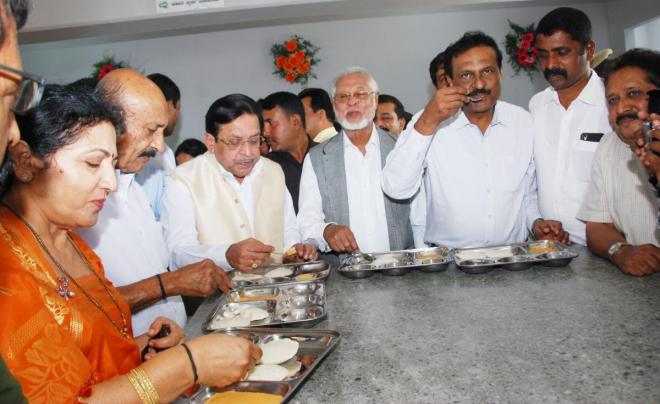
District In-charge Minister M R Seetharam and others have food at the new Indira Canteen on Race Course Road in Madikeri on Thursday.

District In-charge Minister M R Seetharam inaugurated the Indira canteen at Race Course Road in Madikeri on Thursday.

Minister Seetharam, MLC Veena Acchaiah, CMC president Kaveramma Somanna and others tasted the food at the canteen on the first day. The menu consisted of idly, pulao and kesari baath. The canteen evoked a good response on the first day.

Breakfast and meals will be available in the canteen on all seven days of the week. Breakfast is priced at Rs 5.

The breakfast menu will vary from day to day and is as follows: Monday: Idly – puliyogre, Tuesday: Idly – khara baath, Wednesday: Idly – pongal, Thursday: Idly – rava khichdi, Friday: Idly – chitranna, Saturday: Idly – Vaangi baath, Sunday: Idly – kesari baath. (One of the two dishes will be served)

The afternoon and evening meals cost Rs 10 per plate and will comprise of rice, sambhar and curds. Any one item out of tomato baath, chitranna, vaangi baath, bisi bele baath, menthe pulao, puliyogre and pulao will be served.

The minister, meanwhile, inaugurated the market in Mahdevpet and the mobile canteen.

source: http://www.deccanherald.com / Deccan Herald / Home> District / by DH News Service, Madikeri / March 22nd, 2018

Discover flavours of Kodagu

Ritwik Sarkar
Ritwik Sarkar

There was a lot of things I was sure of doing when I was growing up and that was not to become a chef. My dream was to become a pilot, but due to whatever circumstances, I couldn’t pursue my dream.

But now that I think about it, food has been the love of my life. I used to sit in my mother’s kitchen and watch her prepare something delicious. Being a Bengali, food was something we all took very seriously.

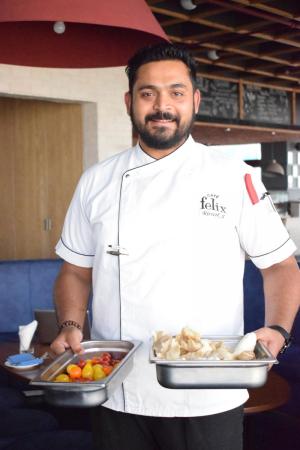
When I graduated high school, and when my palate finally had the ability to understand the different tastes, I joined a culinary school and specialised in food production. After working with multiple hotel chains for a few years, I now work in Cafe Felix as Chef de Cuisine.

Bengaluru is one of those places that has something for everybody. And I believe that the best way to experience a place is through food. There’s so much you can learn about the history and culture of the place just by its food. Having said that, I really need to find some time to get out of my kitchen and explore some local cuisine here.

But I did travel to Coorg and Kerala recently. I preferred to book homestays to experience the lifestyle of the people. I enjoyed peeping into their kitchens and learnt a lot from the elders.

The recipe I have shared today is from Coorg. It’s a classic dish prepared there and I knew that I had to add it in the series of ‘Chef Ritwik’s Travel Diaries’ that’s going on at the restaurant.

The homestay was located in the middle of a coffee and pepper plantation. What drew me to ‘Coorg Pandi’ was the way it was prepared. There are two things you have to remember when making this – the authentic masala for this is hard to come by. You mostly make it at home and is roasted before cooking. The second thing is the kachampuli which is a dark vinegar used to prepare the dish. These two make pandi curry what it is.

I’ve added my own twist to this without damaging the authentic flavours of it. It’s something everyone can make at home and enjoy to their heart’s content.

Ritwik Sarkar
Recipe
For black Coorg masala

Coriander powder, 25gm
Cumin powder, 15gm
Red chilli powder, 30gm
Turmeric powder, 10gm
Peppercorn powder,20gm

Method

Dry roast all the masalas separately in a heavy bottom pan.
Keep stirring all the time to avoid the masalas to burn. You should achieve a nice coffee brown colour once you have finished roasting them. Cool and reserve.

For pandi fry

Pork curry cut (shoulder and belly), 250 gm
Curry leaves, 15 gm
Onion sliced, 200 gm
Turmeric powder, 5 gm
Ginger julienne, 5 gm
Ginger paste, 25 gm
Garlic paste, 20 gm
Green chilli, 4
Black Coorg masala, 45gm
Kachampuli vinegar,25ml
Black pepper, 10 gm
Coriander chopped, 25gm

Method

In a pressure cooker, take pork curry cut. Add turmeric powder, ginger garlic paste, a little salt, crushed curry leaves (half of the total amount), half of the sliced onion and water. Put on a medium-high heat.

After the first whistle put on a medium-low heat, and wait for about 20 minutes. Let the pressure cooker sit for a while.

Then take the mixture out in a heavy bottom pan. Do not throw anything away, even the fat. We do not add any extra fat because this is what will cook the pork and keep it moist. Continue to cook.

Add slit green chilli, black masala and a teaspoon of black pepper.
About 15 minutes later, add kachampuli vinegar and cook.
The fat and all the liquid will slowly dry up.
Finish it off with another teaspoon of black pepper, rest of the curry leaves, julienne ginger and freshly chopped coriander.
Let the mixture cool and chop it up into small pieces with the masala.

For raw mango jaggery glaze

Raw mango, 500 gm
Jaggery, 100 gm
Tamarind pulp, 50 gm
Coriander chopped, 15gm
Cumin powder, 5 gm
Red chilli powder, 5 gm
Five-spice powder, 5 gm
Honey, 10 gm
Lime zest, 2

Method

Roast the raw mangos till soft. Cool the mangoes and take out the pulp.
Now, take the pulp in a pan and heat it. Add grated Jaggery, tamarind pulp, honey and cook for a while.

Finish by adding all the spices, chopped coriander and lime zest.
Bring the chutney to room temperature and reserve.

To assemble

Deep fry the sago crisps and smear the raw mango glaze on them.
Finally place a spoonful of the pandi mixture on the crisps and serve.

source: http://www.deccanherald.com / Deccan Herald / Home> Supplements> Metrolife / by Anila Kurien , DH News Service / March 21st, 2018

Gear up: First four contestants of Pyaate Hudgir Halli Life revealed

It seems like season 4 of Pyaate Hudugir Life is going to start with a bang! The first four contestants have now been revealed by the channel and, going by the promos, it seems like these women are all set to battle it out to win the title.

The first contestant is Mebiena Micheal, a 19-year-old from Coorg. A fun loving person who loves watching Korean movies, dancing, modeling, Yoga, and swimming.

The second contestant is a spunky 22 year old from Coorg who loves to ride bikes, work out , dance and model. Shahan Ponamma is all set to give other contestants a tough competition with her biker chic attitude.

Abhijna Bhat is the third contestant. A 19 year old from Udupi. The young lass loves to dance, party and act.

Last but not the least, is the fourth contestant who is a 21 year old from Shimoga. Spoorthi Gowda like any other young girl of today’s day and age loved to model, shop and party.

There are as many as 12 female contestants who have been picked through auditions and who will be eyeing the winners title. In the show, which will be held for over three months, contestants have to live without any luxuries which they enjoy in urban life.

The entire show will be shot at Gorur village near Hassan. On Sunday evening, the show will get off to a glitzy start with Sandalwood stars Rachita Ram, Hariprriya, Shivarajkumar, Dhananjaya and Manvitha Harish performing on stage. Shivarajkumar and Dhananjaya will re-enact a scene from their film Tagaru.

Pyaate Hudgir Halli Life will premiere on Sunday (March 26) at 9pm.

source: http://www.timesofindia.indiatimes.com / The Times of India / News> TV> News> Kannada / by Nivedhana Prabhu / TimesofIndia.com / March 21st, 2018

Brijesh Kalappa appointed Congress media convenor in Karnataka

BrijeshKF20mar2018
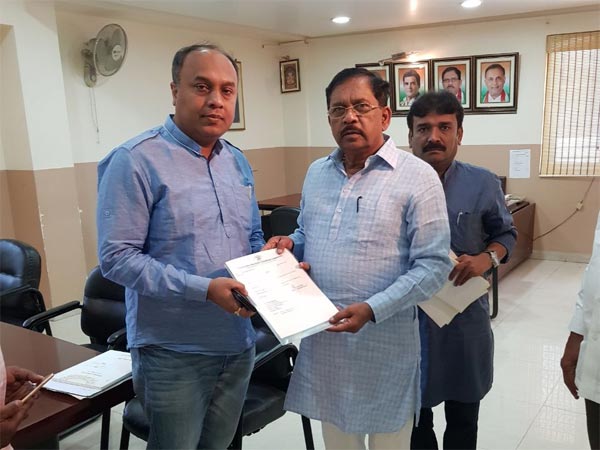
Brijesh Kalappa has been appointed as the media coordinator of the Congress in Karnataka. The appointment was made by Karnataka Pradesh Congress Committee President, Dr. G Parameshwar.

Brijesh Kalappa, an advocate in the Supreme Court was also the former legal advisor to the government of Karnataka. He was also the former additional advocate general, Haryana.

He is a former journalist and has a wide range of interests including reading and travelling.

On the professional front, he has worked with several legal luminaries on subjects of importance in civil, criminal, water and electoral laws and has individually represented governments, eminent individuals and major industrial houses.

source: http://www.oneindia.com / OneIndia.com / Home> News> India / by Oneindia Staff Writer / Sunday – March 04th, 2018

Joshna Chinappa and Velavan Senthilkumar figure in ASF Awards

JoshnaKF20mar2018

Chennai:

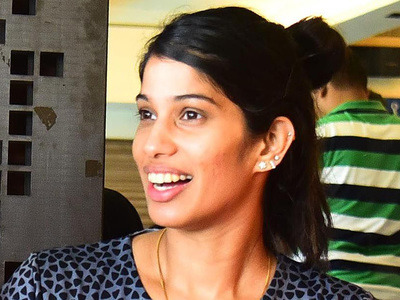
Leading lady of Indian squash Joshana Chinappa and a former junior star Velavan Senthilkumar figure in the Asian Squash Federation’s list of performance awards for the year 2017.

Another Indian to get noticed is Deepak Mishra, a former player who has become a coach at the Indian Squash Academy. Deepak is to be presented with the Certificate of Recognition by the ASF.

Joshna’s best moments last year came in the Asian Individual championship which was held in April here at the Express Avenue mall where she made history by becoming the first Indian to win the coveted championship honours. For her stupendous show the Asian body chose her for the Dato Alex Lee award (outstanding performance of the year – Senior). The award for the best male player in this category went to Max Lee of Hong Kong.

Velavan had the distinction of winning the British Junior Open U-19 title for the Drysdale Cup in January in what was an historic occasion for the country with three Indians taking the first three positions. Velavan won the gold, Abhay Singh the silver and Aditya Raghavan the bronze. Velavan also featured in the title-win over Malaysia in the Asian junior team championship held in Colombo in February. For his overall show of excellence, the ASF chose him for the Hassan Musa Award ( outstanding performance of the Year- junior). The award for the female player went to Satomi Watanabe of Japan.

In all there were seven categories of awards, including for Coaches. There were 12 nominations from four countries for the Performance awards and nine nominations from six countries for the Coaches awards. The awards are to be presented at the Asian Team Championships to be held this year in Cheongju in Korea.

source: http://www.timesofindia.indiatimes.com / The Times of India / News> Sports News> Others / by Damayanti Dasgupta / TNN / March 20th, 2018

Rashmika Mandanna in Nag, Nani multi-starrer

The actress, who will play one of the female leads in the comedy film directed by Sriram Aditya, is paired opposite Nani.

Rashmika Mandanna
Rashmika Mandanna

Looks like the dilly-dallying for the female lead of one of Tollywood’s most-awaited film has come to an end! According to reports, we have learnt that actress Rashmika Mandanna has been finalised as one of the female protagonists in the comic caper.

Apparently, the filmmakers scouted for the female lead extensively but had to eventually zero in on the Kannada actress. Rashmika will be paired opposite Nani in the film directed by Sriram Aditya.

A source informs, “It was very tough for the director to finalise the cast for the film since it involves two big heroes. So Sriram had to ensure that he roped in someone who perfectly complemented Nani. In due course, he finalised Rashmika.”

source: http://www.deccanchronicle.com / Deccan Chronicle / Home> Entertainment> Tollywood / by Sashidhar Adivi / March 18th, 2018

Cauvery: A time to pause

The role played by Kodagu, which has nourished and nurtured the Cauvery over time, needs to be recognised.

The Supreme Court of India has determined the manner in which the waters of the Cauvery river are to be shared among the beneficiary States. In its recent judgment on the long-pending issue, the court virtually pulled the proverbial rabbit out of the hat. The decision has received with muted acceptance, understandably, by all concerned, and some token opposition.

The Cauvery dispute has been a long-standing issue among the States, each one trying to tweak the 1924 Agreement forged during the British administration. Much water has flowed down the river since, and each State was trying to secure the best deal for itself.

A noteworthy aspect is that the matter has engaged some of the brightest minds, be it engineering, law, administration or politics, and the fortunes of many rose and fell at each turn of events. The din has for the present subsided. The bigger and immediate challenge now is to save the river to ensure lasting harmony and sustained development of the beneficiary States of Karnataka, Kerala, Puducherry and Tamil Nadu.

Amid all the arguments, the role played by Kodagu district in Karnataka, which has nourished, nurtured and nursed the river over time, has hardly been recognised or acknowledged.

Kodagu is part of the lower Western Ghats and at its highest point, is around 5,000 feet above sea level. Originally administered directly by the British from Madras, it became a Part ‘C’ State at the time of Independence, with its own legislature and Ministers. Subsequently, after the Reorganisation of States it became the smallest district, with a wealth of natural resources. It is in the Brahmagiri hills of Kodagu that the Cauvery rises and disappears, till it is seen again outside the boundaries of the district. The scenic beauty of the Brahmagiri range is a feast for any nature-lover. A mind-boggling phenomenon can be seen between October 14 to 17 every year unfailingly, when the Cauvery, which is nowhere to be seen, suddenly gushes forth from a spring and then swells into the river that bestows its bounty on millions of people along the way, till it reaches the Bay of Bengal in Thanjavur district of Tamil Nadu.

Kodagu has the largest acreage under coffee in the country, with one of the Tata companies owning approximately 40,000 acres. Trees of vintage growth, bamboo, pepper vines, spices, fruits and other agricultural produce make Kodagu a nature’s paradise. Kodagu hosts many species of wildlife, including the tiger, making it an attractive tourist destination.

Kodavas, the numerically small Hindu ethnic community, are different from neighbouring communities in their costume, language, and social practices. Suffice it to say that they have distinguished themselves in many fields and contributed to India significantly. This, however, is not about the Kodavas.

Journey to Tamil Nadu

Abundant green cover in Kodagu is of vital importance as this will ensure that the district receives sufficient rainfall to bring the river to life and flow in all its glory up to Tamil Nadu. Unlike Himalayan rivers, which are snow-fed, the Cauvery depends primarily on the Southwest monsoon. The river is impounded at the Krishnaraja Sagar dam, outside Mysore, conceived and constructed during the British period by the legendary engineer Sir M. Visvesvaraya. From here water is released, reaching Tamil Nadu, where it is stored in the Mettur Dam (Stanley Reservoir). Further release of water is dependent on the agricultural requirements of farmers downstream.

It would be facile to assume that the court decision has solved all problems and that the States concerned will live happily ever after. In a year when there is copious rainfall in Kodagu and the Cauvery is in spate, Karnataka releases water freely, making a virtue out of necessity. There is then no need for any water- sharing formula. It is only in years when rainfall in Kodagu and the catchment of the Cauvery is below par that the problem arises. This results in constant wrangling, and heated arguments between the States over the quantity of water released, the timing of the release and the manner of release, often resulting in violence. Matters get worse if the ‘deficit’ year happens to be an election year. This is the real issue and to date no satisfactory acceptable formula for sharing the distress has evolved, nor is a sound mechanism in place, for delivery in such situations.

It would be relevant to examine data for the decade 2007-2008 to 2017-2018 relating to release of water. Flows received from Karnataka were measured at the Mettur Reservoir up to 2012-13, and from 2013-14, at the Biligundlu gauging site maintained by the Central Water Commission. Against an annual 205 tmc ft (thousand million cubic feet) at Mettur, only 69.727 tmc ft was realised in 2012-13. At Biligundlu, against an annual figure of 192 tmc ft, the receipt in 2015-16 was 15.385 tmc ft. In 2016-17 the figure was 69.316 tmc ft and in 2017-18 it was 113.084 tmc ft. The statement shows that in the preceding decade there was deficit in four years. This is a matter of concern.

Reason for ‘deficit’

The main reason for deficit is reduced rainfall in the catchment area of the Cauvery in Kodagu district, mainly on account of loss of ‘green cover’. One needs to understand the reason for this loss. It is stated that construction of high tension power lines across Kodagu required felling of large number of mature trees, which reduced the ‘green cover’ substantially along the alignment. Perhaps that was the price to be paid for providing sustained power supply to areas beyond Kodagu. But who paid the price? The farmers in Karnataka and Tamil Nadu were the ones directly affected, along with all those areas that depend on assured water supply, such as Bengaluru which supports major industrial activity and large populations. In recognition of this need, the Supreme Court has specifically earmarked a certain quantity of water for Bengaluru.

Disturbing news

A matter of serious concern is news that certain infrastructure projects have been lined up for implementation in Kodagu. Two railway lines are planned: the Mysore-Kushalnagar-Madikeri (Makkandur) line and the Thalasssery-Kodagu-Mysore line. Four National Highways are planned. These are the Mysore-Kodlipet-Sunticoppa-Madikeri- Gonikoppal- Kutta-Mananthawadi; the Bangalore-Bantwal highway via Kushalnagar and Madikeri; Pannathur-Bhagamandala-Madikeri, and Mattanur-Gonikoppal- Thithimathi-Hunsur. This will connect the new Mattanur airport to Mysore and Bangalore at a cost of Rs. 1,000 crore. Additionally, existing roads are to be upgraded into four-lane highways.

These projects will undoubtedly result in the felling of a large number of trees, constant influx of persons transiting Kodagu without any concern or commitment for the local environment, increasing issues of waste disposal and management. Many other unacceptable activities will disturb the ethos of Kodagu and its natural environment.

The question to be asked is whether Kodagu, which is the major watershed and catchment for the Cauvery, requires these projects that are likely to cause more harm to the beneficiary States, while bringing only marginal and doubtful benefits. The ryots in the Thanjavur delta of Tamil Nadu that covers vast acreage, the farmers of Mandya in Karnataka, the drinking water supply needs of burgeoning cities such as Bengaluru and Chennai and many areas in the other States will be affected by any reduction in the flows of the Cauvery. There is no indication that the long-term impacts of these actions have been considered. No consultation with local communities appears to have been done. The impression at the ground level is that a very short-sighted view has been taken, and these projects have been mooted at the instance of local politicians as part of vote bank politics, in some cases backed by lobbies eager to monetise the natural wealth that will need to be extracted before implementation.

The way forward

It is clear that India needs to walk the ‘development path’. The right way is ‘sustainable development’, which does not appear to be the case in respect of the above-mentioned projects. The waters of the Cauvery have nourished downstream civilisations for centuries. It is the life blood of the States that now comprise the region. The time has come to save the river, bring back its glory as a provider and nourisher of humans, enabling them to live in peace, harmony, and rise to their full potential in every sphere of endeavour. There is no case for inter-State political one-upmanship or victory or loss for any group. The goal and cause are one…. save the Cauvery for the good of all, for all time to come, by taking a long-term view. Everyone needs to be on the same page.

The following steps need to be taken immediately.

1. Suspend all infrastructure projects, proposed or under implementation, for six months or a year. This short postponement will give time to study the issues necessary for saving the Cauvery.

2. Set up a competent neutral body to assess the real need for connectivity through Kodagu with contiguous areas and examine alternative options.

3. Identify the best option that will cause least damage to the environment and catchment of the Cauvery.

4. Having completed the above three tasks, arrange for a ‘carrying capacity study’ to be done by a credible professional body.

5. On the basis of the findings of this study, the implementation of projects should be supervised by an empowered body to be named the ‘Kodagu Sustainable Infrastructure Projects Board’, with the Deputy Commissioner of the district as Chairman, and the representatives of different agencies and local non-officials as members, to ensure timely implementation in accordance with project specifications.

6. Quarterly meetings of Chief Secretaries of the four States to be convened by the board to update them on the progress and the status of safeguards for the Cauvery.

The need of the hour is statesmanship, avoiding political short-sightedness. It should not become a case of winning the battle of sharing the Cauvery waters and losing the war of saving the river for posterity.

The author, who retired from the Indian Administrative Service, has written this as a concerned citizen. Email: sonnabel@gmail.com

source: http://www.thehindu.com / The Hindu / Home> Opinion> Open Page / by P.M. Belliappa / March 18th, 2018