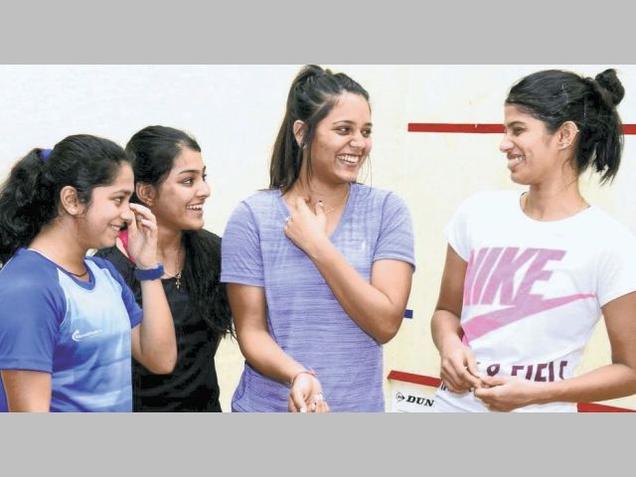
WARMING UP: Akansha Salunkhe, Sunayna Kuruvilla, Dipika Pallikal and Joshna Chinappa. Photo: M. Vedhan
After months of living out of a suitcase, Dipika Pallikal and Joshna Chinappa are back in the city, but they are not resting. The two are at the Indian Squash Academy (ISA) here for a three-week camp to get ready for the World women’s team championship to be held in Paris from November 28 to December 3.
“The (past) three months (playing in PSA World tour) have been crazy, playing week after week,” Dipika said to The Hindu here on Friday, after the training camp. “It’s nice to practice again with Joshna. When it comes to a team, we are at our best. We enjoy each other’s company,” she added.
With two of the country’s top under-19 players in Sunayna Kuruvilla and Akansha Salunkhe making up the four-member team to Paris, Joshna, the top-ranked Indian at 13 in the world, felt the team is looking to first enter the top eight, and then take it one step at a time. “It will be tough, no doubt, but we will do our best,” she said.
Acknowledging the competition, which includes top players from England, Egypt, France, Australia, Malaysia, The Netherlands and the USA, Coach Cyrus Poncha said a top-eight finish “is what we are aiming for”. Concurring with Poncha, India’s foreign coach Ashraf El Karargi, said it will be difficult to look beyond the quarterfinals.
For the two juniors, Sunayna and Akansha, it will be a learning experience and an opportunity to prove to one and all that they are here for the long haul. “It is a big honour. I have so much to learn,” said Sunayna, for whom this will be the third International (senior) event after World juniors (Poland) and South Asian Games (SAG, Guwahati). Akansha said her aim is to “improve myself” after having played in the SAG (Guwahati), Asian team championship in Taipei and the World juniors (Poland).
Ashraf revealed Egypt’s Zahed Mohamed (men’s World No. 25) and Shehab Essam (No. 92) will train at the ISA with the Indian junior players from January 15 next year for the Asian juniors (boys and girls) championship to be held in Hong Kong in February 2017. “They are experienced pros, and playing with them will certainly help our players improve,” he said.
source:http://www.thehindu.com / The Hindu / Home> Sport> Other Sports / by K. Keerthivasan / Chennai – November 05th, 2016
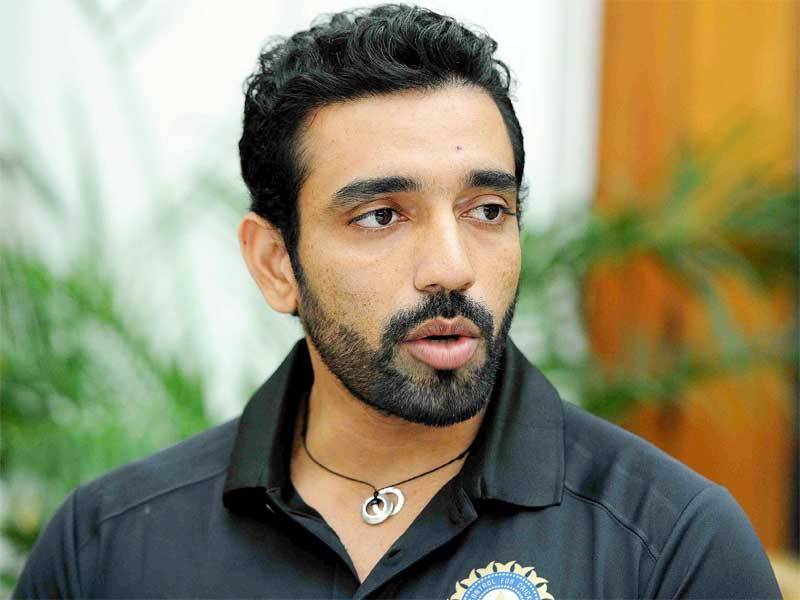
Attacking batsman Robin Uthappa is a proud Bengalurean. The 30-year-old India cricketer isn’t amused when called a ‘Madrasi’. “I make it a point to say I’m from Bengaluru,” he states pointedly. Uthappa is as passionate about the city he calls home as he is about cricket. Be it the chocolate fudge at Corner House or the steaming-hot idlis at Brahmin’s Cafe, Uthappa can’t get enough of the city. In a chat with STOI, the talented Kodava lists five things he loves about the city.
WEATHER
I love the weather in Bengaluru. The city has the best weather in the country. It has gotten a little warmer in the past few years, but still the weather here is incomparable.
SCENT
I love the scent of this city, it’s warm and comforting. It’s very different from anywhere else. Whenever I get off a flight, the first thing I do is to take a few deep breaths and I know I’m home. This is something you cannot experience anywhere else in the world.
PEOPLE
I love Bengalureans. I’m talking about those who are born and raised here. Our people are extremely hospitable and caring. You don’t get to see or much less interact with very many of them, because not only has the city grown physically and economically, it has also seen a huge influx of people from other parts of the country and even the world. Sadly, though, this has resulted in a change of temperament, which was once as cool as the weather. Still the people of Bengaluru are loving and giving, as we’ve seen on numerous occasions. That’s something I simply love about the people here.
FOOD
The range we have here is out of the world. My wife and I are both foodies and love trying new cuisines and restaurants. The city’s cosmopolitan fabric makes it a food hub. There are a lot of old hangouts which take me back in time. Among the places I visit regularly are Corner House, Hotel Airlines, Fanoos and Richie Rich. One place I visit a lot these days is Brahmin’s Cafe in Basavanagudi. When we plan a breakfast outing, our whole family is up early and we are there by 7 am. We get out there as often as we can.
Robin Uthappa
MY TIME
When I need my space, I get into the car and head in the direction of the airport. There are other connecting roads which have less traffic and I enjoy driving on them, too.
source: http://www.timesofindia.indiatimes.com / The Times of India /News Home> Sports> Off the field / by Manuja Veerappa / TNN / November 06th, 2016
In the northern part of the Mahadevpet quarter of Madikeri town lies a royal graveyard, unbeknownst to many. Gaddige is a set of three regal mausoleums built in the Indo-Saracenic style and enclosed within a compound. Upon each of these rectangular structures is a large dome and four turrets. Two kings of Kodagu (Dodda Vira Rajendra and Linga Rajendra) and their queens lay buried in the two larger identical structures and a third smaller one has the remains of the chief preceptor (Rudrappa) of the kings.
Beside these three tombs, at a little distance away but within the same enclosure, are the tombs of a father-son duo Biddanda Bopanna (Bopu) (1769-1807) and Biddanda Somayya (1800-1879). They had served Kodagu and its kings as sarva-karyakaras, or army generals. While Bopu was the general under Dodda Vira Rajendra (1789-1809), Somayya was the general under Chikka Vira Rajendra (1820-1834). Both tombs have the statue of a Nandi upon it.
Under the Kodagu kings, jamma ryots (farmers by inheritance) held their farmlands by military tenure. The word jamma came from the Sanskrit word for birth, janma. Every able-bodied male jamma ryot had to compulsorily serve in the king’s army. Known as chaudigaras, they worked for 15 days at a time. Around 10 to 100 soldiers served under an army chieftain called the jamedar and a number of jamedars served under an army officer called karyakara. The karyakaras worked under a sarva-karyakaras, or the general. The karyakaras and the sarva-karyakara wore a kombu toppi, a gold zari-bordered red turban with a kombu (horned emblem) in front.
A Kannada inscription states that Biddanda Bopu of Bavali village entered the Raja’s service through palace duties on the fifth day of the new moon of Magha month in the Keelaka year (1788). He worked for 19 years until the year Prabhava, bravely risking his life while fighting wars against Tipu Sultan of Mysore and hunting elephants, tigers and other wild animals, to ultimately become a sarva-karyakara. The Biddanda family originated in Kokeri village in Kodagu nearly three centuries ago. In this Kokeri house lived brothers Medappa and Poonacha. Medappa was a member of the local village panchayat and he married Chaniyapanda Subbavva in 1768. They had a son Bopu, who was born in 1769 on what was deemed to be an inauspicious day by the panchayat members. It was decreed that the son’s face was not to be seen by the father and that the mother was not to be allowed into the house. Hence, the mother and the son lived with the maternal family in Podavada village.
Chronicles of the pastUnfortunately, after some time, both Medappa and Subbavva passed away. The orphaned boy was then brought to the Kokeri Biddanda house by his uncle Poonacha. In 1788, at the age of 19, Bopu joined the king’s army. He worked hard and rose through the ranks to become a karyakara. Poonacha and his wife passed away and their two daughters were married into other families. In 1795, the king transferred Poonacha’s property, which was called ‘Mookanda Bane’ (pasture), to Bopu and his paternal relatives for the military services they had rendered.
Bopu moved from Kokeri to Bavali where he built a ‘Nalkett Mundmane’ — a traditional country house (mane) with four blocks (nalkett) built around an open central courtyard (mund). This became the ‘Biddanda Ainmane’, or ancestral home, in Bavali. One can find description of many events pertaining to Karyakara Biddanda Bopu in Reverend Hermann Moegling’s Coorg Memoirs.
In 1799, the Fourth Anglo-Mysore War broke out between Tipu Sultan and the British. When the British laid siege upon Srirangapatna, the erstwhile capital of Mysore kingdom, Dodda Vira Rajendra sent his treasurer Karnika Subbayya and his officer Karyakara Bopu to invade the Tulu region, which was then a part of the Mysore State. Bopu led the Kodagu army and defeated Sadri Behari and Mir Mohammed who held the Kodial (Mangalore) district. Soon, Kodagu occupied Mangalore, Barkur, Bantwal, Bellare, Viragamba, Udiavara and other regions. Karnika Subbayya came to hold and govern Kodial at that time.
Eventually, news came from Srirangapatna that Tipu Sultan was killed and that Mysore was taken over by the British. Later, Kodagu was made to evacuate the Tulu region and return it to Mysore. Karyakara Bopu was later made the sarva-karyakara of Kodagu. Biddanda Somayya was born in the year Roudri (1800) to Bopu and his wife Mayavva. Bopu died in 1807 at the young age of 38 years. In commemoration of his remarkable army tenure, the king of Kodagu ordered that Bopu be entombed near the royal tombs of Gaddige.
Somayya joined the Raja’s army in 1821. Like his father, he rose through the ranks to become a sarva-karyakara. In 1834, Kodagu got into a conflict with the British. Under him, the Kodagu army was able to inflict damage upon the British army initially. But Chikka Vira Rajendra, the last king of Kodagu, chose to surrender to the British. He was then exiled and the British took over Kodagu.
In those days, the British decreed that all the native officers would be retained in service. But Sarva-karyakara Somayya refused to be in the service of the new government and thus, retired early instead. After his retirement, Somayya lived in the Bavali Biddanda Ainmane and got involved in farming. But he did have one last wish. After his death, he wanted to be buried beside his father and before the rajas of Kodagu. The British allowed this and refused to have anybody else, including any surviving relatives of the rajas, to be buried in the Gaddige area. Somayya died on August 16, 1879. His tomb was erected in Gaddige with the permission of the Chief Commissioner of Coorg. There is a separate graveyard for other members of the Biddanda family in Bavali as well. While the tombs lie neglected today, their history and significance continue to throw light on the history of our people.
source: http://www.deccanherald.com / Deccan Herald / Home> Supplements> Spectrum / By Mookanda Kushalappa / November 08th, 2016
The famed Kodagu coffee estates are experimenting with bee farms to add to incomes so that the forested landscape of this biodiversity hotspot is better able to sequester carbon.
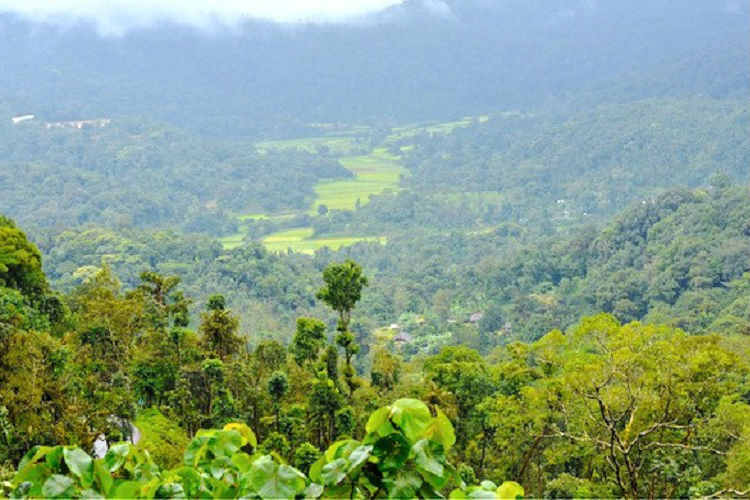
The forested landscape of Kodagu provides ecosystem services. (Photo by S Gopikrishna Warrier)
While honey can sweeten coffee for the drinker, coffee farmers of Kodagu district of Karnataka are realising that raising bees for honey in the farms can sweeten their economic returns. It is one of the innovative methods being tried out in the district to provide additional financial incentives to coffee farmers so that they conserve the landscape they have inherited.
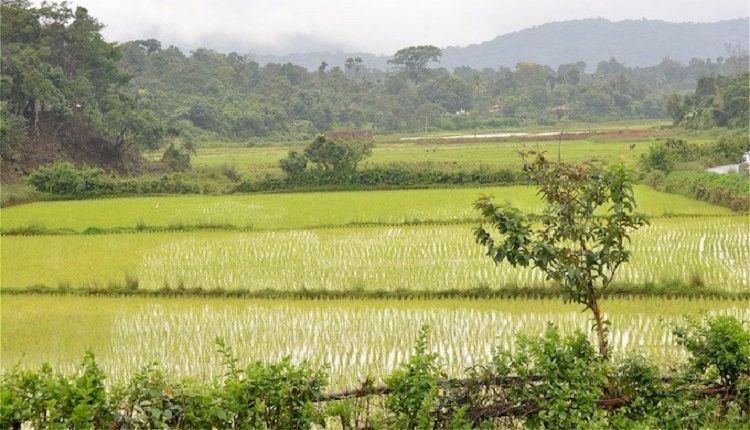
The concept of payment for ecosystem services (PES) is evolving from eco-certified coffee to that of landscape labelling of Kodagu. If the forests, coffee agro-forestry, rice fields, sacred groves, rivers and streams of Kodagu together provide ecosystem services and climate resilience to the communities living in the hills and the plains, why should not there be payment for sustaining these services?
According to a report on PES prepared by the College of Forestry at Ponnampet, Kodagu, the district has been identified as a micro-hotspot of biodiversity under the larger Western Ghats region. There is tree cover across as much as 81% of the district.
Natural forest ecosystems cover an area of 46% of the total area of the district. This includes evergreen, semi-evergreen, moist deciduous, dry deciduous and scrub forest types. Evergreen forests also include the high-altitude shola forests along with grasslands.
Key ecosystem services
Biodiversity, carbon sequestration and water regulation are the key ecosystem services from the Kodagu landscape. In addition to the economic benefit, there are also provisional, regulating, cultural and supporting services from the landscape. Thus, while eco-certification of coffee can help individual farmers, landscape labelling can benefit the district in its entirety, giving incentive to the communities to plan their development sustainably.
Charulata Somal, chief executive officer of the Kodagu Zilla Panchayat (district council), says that if PES can help channel money for the communities to conserve their landscape, there is a possibility of meeting the genuine aspirations of the people without compromising on the environment. “We plan to take the concept of PES through the elected representatives from the district.”
The PES report from the College of Forestry estimates the economic value of the various ecosystem services in Kodagu. The nutrient recycled has a value between INR 237 and INR 1167 per hectare, with a mean value of INR 700 per ha. The economic value of timber is between INR 530 and INR 8340 per ha. The recreational value of biodiversity is estimated as INR 27,000 per ha.
High sequestration
Carbon sequestration, according to the report, varies from 77 tonnes per ha to 207 tonnes per ha. Even at 90 tonnes per ha and an assumed price for carbon at USD 10 per tonne, the economic valuation is INR 40,500 per hectare.
The project for promoting bee farming (apiculture) in coffee estates was started after a study found the strong economic impact of pollination services of bees from sacred groves adjacent to the coffee farms. Kodagu has 1,214 sacred groves under community management, covering 2,550 hectares interspersed with coffee estates.
Rice paddies in Kodagu. (Photo by S Gopikrishna Warrier)
While Arabica coffee is self-pollinated, Robusta is cross-pollinated. “We researched the interaction between bees in the sacred groves and Robusta coffee to understand what the pollination impact is,” said C.G. Kushalappa, university head for forestry and environment sciences at the College of Forestry in Ponnampet. “Our research proved that in Robusta close to 31% of productivity could be increased if there is sufficient population of honeybees around the farm.”
This research, implemented by the College of Forestry under the Managing Trade-Offs in Coffee Agroforestry (MOCA) project in partnership with ETH University at Zurich, Switzerland, opened the possibility of increasing income for coffee farmers by integrating apiculture into coffee systems.
A premium for honey
“Kodagu honey has a premium in the market because it comes from the flowers of multiple species,” said R.N. Kencharaddi, assistant professor of agricultural entomology at the College of Forestry. “Honey collected from bee keeping in coffee agro-forestry system can get the premium price.”
The college introduced bee boxes in 40 farmers’ fields in 2015 at a density of four to five colonies (bee boxes) per acre, so that they can grow their own bees and produce honey. The team has been researching to select bee colonies that have the most desirable traits for propagation.
“We are looking for bees that do not abscond from their colonies and do not divide into new colonies before the hive is fully built,” said Kencharaddi. “We also check whether the bees are efficient at collecting honey and have disease resistance. Most important, we check on their ferocity, for we do not want the bees to attack the farmers.”
Apis cerana indica or the Indian honeybee is the species that the college is using for propagation. Though the college has not yet done any research on the subject, beehives have been successfully used in East Africa to protect farms from ravaging elephant herds. If this is experimented with and found successful then it could also serve as an additional benefit for Kodagu farmers, who are tired of elephant herds destroying their crops.
“There are elephant herds in Kodagu in which calves and young adults have not seen the forests,” explained M.C. Cushalappa, a coffee farmer from Siddhapura. “These herds have moved out of natural forests years ago and not returned since. They move from farms to villages, without returning to their natural habitat.”
The species of bees used in East Africa and that used in Kodagu are different, according to Kencharaddi. The specie of the African bees that scare elephants is Apis mellifera caucasica, which are more ferocious than their Indian counterparts. The African bees also come out during the night, whereas the ones that the college is working with are active only during daylight.
With bees feeding on the flowers of multiple trees to give premium quality honey, there would be a greater incentive for coffee farmers for protecting their landscape, according to Kushalappa. “This is how we are evolving into the concept of getting landscape labelling for produce from Kodagu’s coffee agro-forestry systems — coffee, honey, pepper and cardamom. Once we can get a brand presence for the Kodagu landscape, the farmers can market multiple produce. Depending on the prices the farmer can move the appropriate produce to the market.”
With the CEO of the Kodagu Zilla Panchayat committing to get elected representatives oriented to the concept of PES and landscape labelling, this method of promoting produce from Kodagu even while conserving the environment is likely to grow wings in near future. Honey with coffee could become the trigger for this.
(This piece was originally published on India Climate Dialogue and has been reproduced here with permission.)
source: http://www.thenewsminute.com / The News Minute / Home / by S. Gopikrishna Warrier / Monday -November 07th, 2016
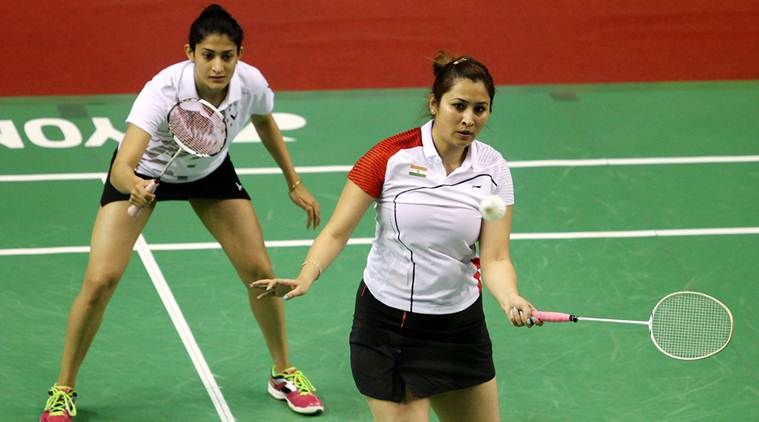
Jwala Gutta announced that she would be concentrating on mixed doubles while Ashwini Ponnappa will now partner N Sikki Reddy.
Jwalla Gutta and Ashwini Ponnappa first played together in 2010. (Source: Express Archive)
Jwalla Gutta and Ashwini Ponnappa have decided to part ways. The duo have been India’s most successful women’s double pair. Both have now decided to embark upon their own separate careers. While Jwala Gutta announced that she would be concentrating on mixed doubles, Ashwini Ponnappa has decided to partner N. Sikki Reddy.
Gutta said that she would stop appearing in women’s doubles and will partner Manu Attri while Ponnappa will be playing women’s doubles teaming up with N. Sikki Reddy. Gutta and Ponnappa played together for the first time in 2010. It was in the 2010 Commonwealth Games that they announced themselves where they the Gold medal in women’s doubles.
Ashwini Ponnapoa reportedly said, “Me and Jwala had a great partnership but it was time for us to look for a new beginning.
source: http://www.indianexpress.com / The Indian Express / Home> Express Sports / by Express Web Desk / November 08th, 2016
Are you a coffee lover who needs your cup of steaming, hot coffee as soon as you wake up? But the morning rush leaves you with just about enough time to grab a cup of instant coffee, and head out. There’s a solution to that. Meet true south and their life saving projuct, filter coffee in a pouch! Skeptical? We were too.
SKIM
Being true coffee lovers, we headed over to try some of the coffee at true south, and we were very surprised. The coffee is strong, aromatic, and tastes like it was just brewed!
TRUE SOUTH: FOR EVERY COFFEE LOVER
True south is ready-made coffee decoction available in pouches. All you’ve got to do to enjoy a cup of fresh authentic tasting filter coffee is empty the contents of the pouch, add milk and sugar, and stir! Voila, your hot cuppa is ready in minutes.
The idea started when the folks at True South, who are coffee planters, wanted to make good coffee available easily. The coffee comes from Coorg and Chikmagalur, so it’s from some of the best coffee-growing regions in India. The decoction comes in two varieties: classic and royal, which vary slightly in the percentage of coffee and chicory they contain {the classic blend has 80 per cent coffee and 20 per cent chicory, while the royal variety has 75 per cent coffee and 25 per cent chicory}. They advise that you add one part decoction to five parts hot milk for a typical cup of filter coffee.
WHERE CAN YOU GET YOUR HANDS ON SOME?
Whether you have no time to make decoction every morning, or are unable to find the perfect blend that works for you, True South coffee is the perfect solution. You can order the coffee pouches online, or pick them up from the store located on Richmond Road.
And the perfect part is that you can use them for 15 days after opened, or store them for upto five months!
Wake up and smell the coffee!
source: http://www.hungryforever.com / HungryForever.com / Home / by Aditi Sriprasad / October 31st, 2016
Two days before Karnataka’s Ranji Trophy Group B tie against Assam, Robin Uthappa hopped over to Shivaji Park after training with his team and had a session with his personal coach Praveen Amre at the nursery of Mumbai’s batsmanship. No wonder then that the duo was seen involved in a long chat after Uthappa ended the day unbeaten on 108 to bail Karnataka out of trouble.
“I came back to Mumbai from Kolkata and I told sir, “I wasn’t getting my swing. My feel wasn’t that great”. We practised at Shivaji Park for two days and he was confident in two days I’ll get my feel back,” says Uthappa. “I actually got it back and feel really good. I just want to capitalise on what I have done today and make it a big one.”
After being unable to come good in Karnataka’s first two games of the season, Uthappa has finally gotten into run-scoring mode.
Ever since he burst on to the domestic scene as a 17-year-old, you like to keep watching him bat. Similarly, as he has evolved into a mature cricketer and an individual, you feel like listening to him every time he talks.
Despite being on the fringes and having made several returns to India’s squad, Uthappa hasn’t really been able to cement his place in the team. Having crossed 30, one cannot help but wonder if he has given up on wearing the India jersey. Ask him if he has started entering into the “enjoying the game” phase, and he interrupts you right away.
“Absolutely not,” he says. “I love the game, I enjoy it but my dream is still very strong and I still believe I’ll play for India.
“That’s what drives me. If that doesn’t drive me, then I certainly won’t be playing cricket. I wouldn’t take up the spot of a youngster.
“I’ll keep trying. I genuinely think age is just a number and I just think I need to keep stacking up the runs. No more knocking on the doors, I need to break it down in a big way.”
source: http://www.thehindu.com / The Hindu / Home> Sport / by Amol Karhadkar / Mumbai – October 29th, 2016
The Slush round of Indian AWD Challenge took place in Coorg district of Karnataka with competitors driving in the Jeep, Gypsy and Open classes.
Over 30 participants in the three categories competed on September 10-11 on the mountains of Vanachal Village in Madikeri, covering two stages of 7.5 km with steep climb and boulders.
After the first day of scrutiny and recce along with drivers briefing, the action kick started on Day 2 with Stage 1 in the muddy terrains having steep climb and sharp turns in the forest.
Everyone bar one driver made it to the post-lunch Stage 2, which started under rain making it all the more difficult with poor visibility.
The flat stretch in the grasslands allowed drivers to push to the maximum towards the finish line with Bharath Kumar (co-driver Mahesh) taking win with a total time of 6m25s in the Jeep class.
It was a close fight as Ajay Shetty (co-driver Ashwin Das) ended mere 0.04s behind, while Bopanna MP (co-driver Mithun Mandepanda) were third.
Meanwhile, in the Gypsy class, Shetty took the win covering a time of 6m03s, as Nithin (co-driver Nischal) and Sachin Moorthy (co-driver Kumar KD) ended just 0.01s of each other’s time in second and third respectively.
Finally, Anush (co-driver Navnit) were declared winners in the Open class, ending 0.13s ahead of Nanaiah (co-driver Karumbaiah), with Chethan (co-driver Jagat Nanjappa) third.
“Society can develop only with clean thinking and fair-mindedness. Do not mix politics in Dasara celebrations. When I came during last Dasara celebrations, I was the president of Handicraft Corporation. I have come now as the president of the Parishat. The Almighty has bestowed high positions on me,” said member of vidhana parishat, Shantheyanda Veena Achaiah. She was speaking after inaugurating the third year’s women’s Dasara held in Mangala Vihara auditorium, Gonikoppal on Monday, October 10.
Meanwhile, member of the legislative council, Veena Achaiah, who is identified as the best women’s Dasara performer, felicitated the former grama panchayat president and president of the third year’s women’s Dasara , Kulletira Pravimonnappa.
Rekha Sridar and Sharina Sukumar sang the prayer song. Grama panchayat member, women’s Dasara treasurer Prabhavathi welcomed the gathering. Sheela Bopanna compered the programme and chief secretary M Manjula proposed the vote of thanks.
Gonikoppa, traditional attire, flower designing, mehendi competition, cooking without fire competition, group dances, janapada songs and pick and act competitions were held at the occasion.
Pravimonnappa, president of the programme, gave a keynote address.
Meals were served at the occasion.
source: http://www.daijiworld.com / DaijiWorld.com / Home> Karnataka / from Daijiworld Special Correspondent / Daijiworld Media Network – Madikeri (EP) / Madikeri – October 11th, 2016
Sandalwood actress Meghna Appaiah shares a recipe of Pandi Curry, rustled up in the traditional Coorg flavour.
Meghna Appaiah
Pandi Curry Ingredients
1 kg pork
1 tsp red chili powder
2 tsp turmeric powder
2 onions
5 to 6 green chilis
2 pods(18-20 cloves) garlic
About 8 cm long ginger
3 tsp cumin seeds
5 or 6 cloves whole
5 tsp coriander seeds
2 tsp black pepper balls
Salt to taste
1 cup (250 ml) Water
1 lemon (optional)
2 tsp black vinegar (Kachanpuli, prepared/available in stores).
Directions
Place the pork in a capacious bowl. Cut it to about 3 cm size and wash thoroughly. Now, drain the water completely. Set the pieces aside.
Add red chili powder, turmeric and salt. Mix well, until a thick paste is formed.
Now, prepare a mix by grinding onion, green chili, garlic, ginger, 1 tsp of cumin seeds, and 2 cloves to a coarse mixture. Do not add water.
Boil 1 cup of water in a thick bottomed vessel. Add the ground masala and continue boiling for a couple of minutes.
Add marinated pork and cook until tender. Ideally, this shouldn’t take more than 20 minutes.
In a griddle (bandli), roast together 2 tbsp cumin seeds, 5 tbsp coriander, 2 tbsp black pepper and cloves until a smokey fragrance wafts into the room.
Grind the roasted mixture to a very fine powder.
Add roasted and powdered mixture and black vinegar to the pork. Continue cooking on low flame until oil starts separating from the meat. Serve hot. You may additionally sprinkle some lemon juice for enhanced taste.