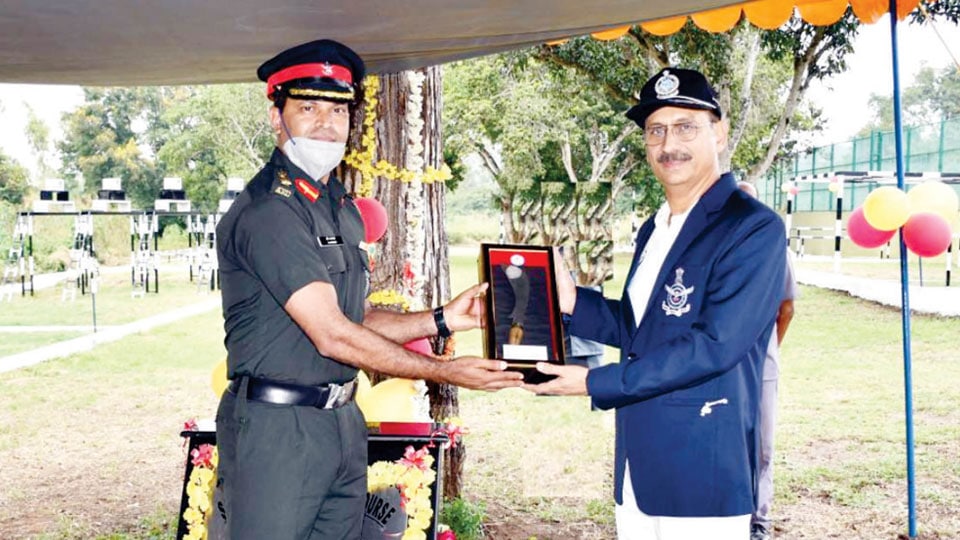
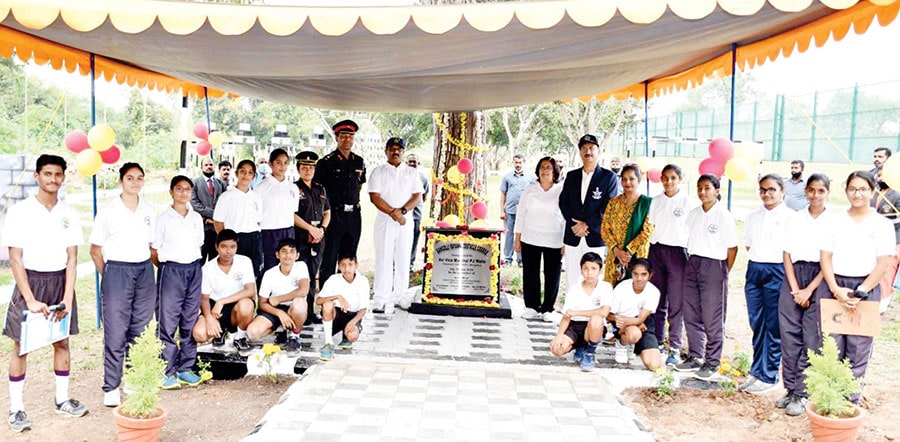
Air Vice Marshal P.J. Walia, Senior Officer-in-Charge Administration, Training Command, Indian Air Force, Bangalore and Chairman, Local Board of Administration, Sainik School Kodagu, chaired the 21st meeting of the Local Board of Administration of Sainik School here on Oct. 29.
The Chairman also inaugurated the Sangolli Rayanna Obstacle Course, which aims at training multiple fitness components of the cadets. This Obstacle Course will help in preparing them for SSB. In addition it will help in developing diversified skills and abilities like self-discipline, perseverance, courage, resourcefulness, self-reliance and teamwork among cadets.
The Local Board of Administration Meeting was attended by Gp. Capt. R.R. Lall, Command Education Officer, Bangalore, Lt. Col. Seema Tripathi, Chief Coordinator, Prof. Y. Sreekanth, Principal, Regional Institute of Education, Mysuru, Prof. R. Shivappa, Registrar, University of Mysore, Vijay Kumar Swarnkar, Executive Engineer, CPWD, Mysore Central Division and P.S. Machado, DDPI, Kodagu district.
Keeping in view the prevailing pandemic condition, Krishnaji S. Karichannavara, Director, Secondary Education, Karnataka State, Murthy, Under Secretary, Finance Department, Karnataka State and Dr. Jaibharat Madivaleppa Mangeshkar, Parent Member, attended the meeting online. Col. Kannan, Principal and Member-Secretary, briefed all the training and administrative aspects of the school and the progress made in the past nine months.
He said, ‘an obstacle course is a series of challenging physical obstacles cadets must navigate usually while being timed. Obstacle course can include running, climbing, jumping, crawling and balancing elements with the aim of testing speed and endurance.’ The members deliberated and arrived at various policy decisions for future development of the school.
source: http://www.starofmysore.com / Star of Mysore / Home> News / November 05th, 2020
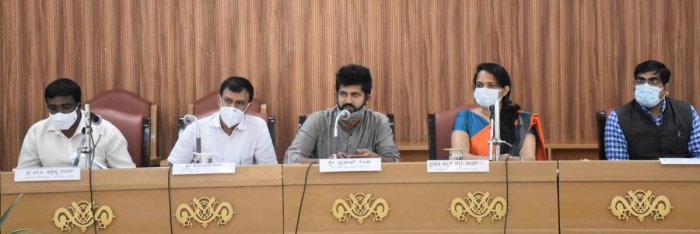
MP Pratap Simha speaks during a District Development Coordination and Monitoring Committee meeting in Madikeri.
MP Pratap Simha directed officials to ensure that each household is supplied with piped water connection under the Jal Jeevan Mission in rural areas.
Chairing a District Development Coordination and Monitoring Committee meeting at ZP Hall on Wednesday, he said Prime Minister Narendra Modi has envisaged piped water connection to every household in the country.
He sought information on how many families were supplied with water under the scheme. Replying to this, officials from ZP drinking water and sanitation department said that there are plans to supply water to 46,276 households.
The MP said that he has appealed to Jayadeva Hospital Director Dr Manjunath on the necessary facilities for the designated Covid hospital and medical college in the district.
He further directed officials to construct solid waste management units in Gram Panchayat jurisdiction and segregate wet and dry waste. The wet waste should be converted to manure.
All those who have registered under Mahatma Gandhi National Rural Employment Guarantee Scheme should be guaranteed with employment. The scheme should be used for the construction of toilets, sheep shed, concrete road and others, he said.
Stating that there is no shortage of funds under MGNREGS, he said that the scheme should benefit the rural people.
Measures should be initiated to improve the pass percentage in SSLC. When Dakshina Kannada district is in the second position in SSLC result, why is Kodagu in the 18th position? he asked.
DDPI Machado said that last year, the district was in 22nd position and this year it has reached 18th position.
The MP said that concrete roads should be laid under Pradhan Mantri Gram Sadak Yojana. A few works will be initiated by MLA K G Bopaiah in Virajpet on November 12.
Member Kolleera Gopi Chinnappa and Somwarpet Taluk Panchayat President Pushpa highlighted the issue of the pathetic condition of roads in Virajpet and Somwarpet taluk.
CESC engineer Somashekar said that electricity connections have been provided to 3,700 families under Saubhagya scheme in the district. The work on providing connections to 400 families is pending.
Member Kolleera Chinnappa alleged that Saubhagya scheme has not seen much progress in the district. The frequent disruption in power supply at Balele is inconveniencing the people.
Deputy Commissioner Annies Kanmani Joy, Zilla Panchayat President B A Harish and others were present.
source: http://www.deccanherald.com / Deccan Herald / Home> State> Mangaluru / by DHNS, Madikeri / November 04th, 2020
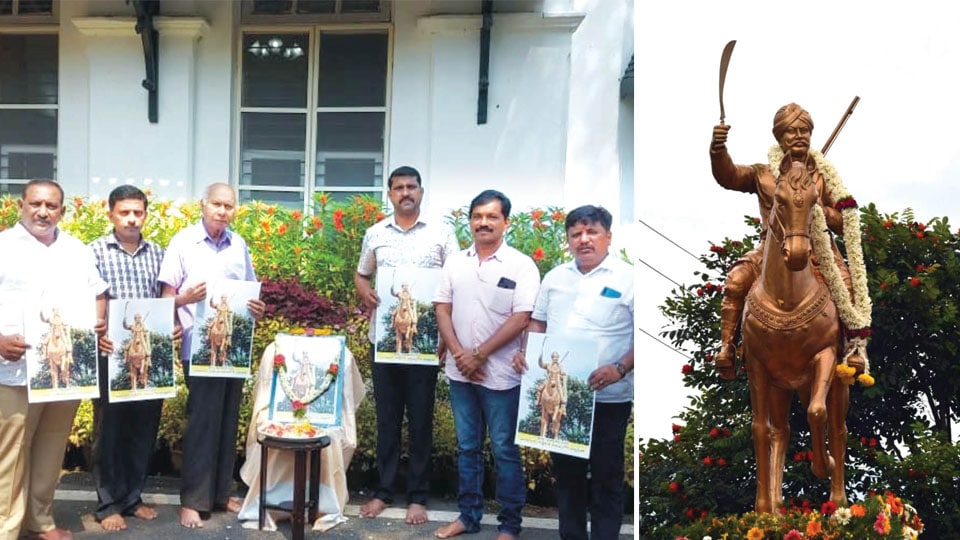
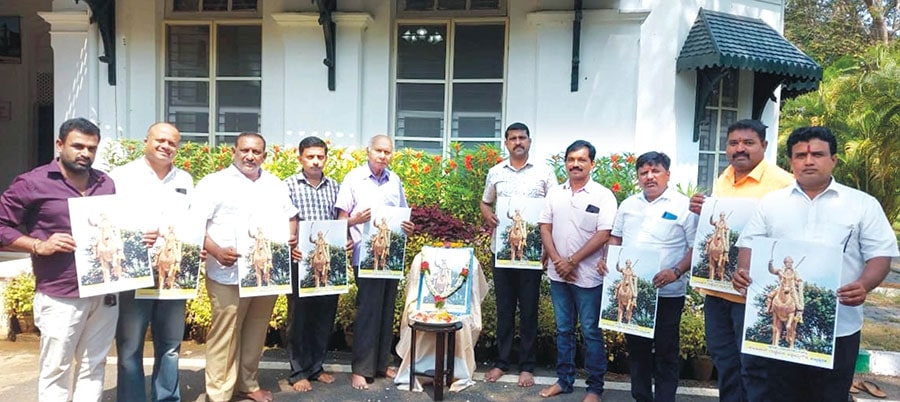
Nammuru Nammoru Samaja Seva Trust, Mysuru, observed Martyred Freedom Fighter SubedarGuddemane Appaiah Gowda Memorial Day at an event held at Jaladarshini Guest House recently.
Veteran writer Dr. C.P. Krishnakumar (CPK) inaugurated the programme by showering petals on the portrait of Appaiah Gowda.
Speaking on the occasion, CPK said that the year 1857 is a very significant year in the history of freedom struggle. Pointing out that the 1857 Sepoy Mutiny was the first major battle in the fight for the country’s independence from the Britishers, he said that we have read about great freedom warriors such as Mangal Pandey and Tatya Tope who laid down their lives.
Noting that the first independence revolution took place in 1837, 20 years before the sepoy mutiny of 1857, the veteran writer said that many great freedom fighters such as Tipu Sultan, Rani Chennamma, Sangolli Rayanna, Parampara of Kodagu, Kalyanaswamy, Guddemane Appaiah Gowda, Kedambadi Ramegowda and Kudiya brothers had laid down their lives much earlier fighting the Britishers.
Recalling that the people of Kodagu revolted when the Britishers divided the then Coorg State into Kasaragod, Puttur and Sullia and brought them under Madras Province, he said that warriors from Kodagu such as Nanjaiah, Kedambadi Ramegowda and Guddemane Appaiah Gowda are an inspiration for generations to come.
Noting that Appaiah Gowda led the ‘Katukai battle’ (Amara Sullia Dange) against the British in 1837, Dr. CPK said that he was one of the greatest heroes Kodagu has produced. Stating that Appaiah Gowda was a symbol of patriotism, self-respect and pride of Kodagu, he said that Appaiah Gowda, who was hanged by the British in front of Madikeri Fort in 1837 for leading protests against colonial power, did not want outsiders to have a say in the affairs of Kodagu.
He urged the Government to set up an Authority for sensitising the public on the sacrifices made by Appaiah Gowda and all other great freedom fighters of the times and on the significance of Amara Sullia Dange (Sullia rebellion).
Trust President Satish Gowda, Vice-President Kumar Gowda, Gen. Secretary A. Ravi, Dist. Vokkaliga Assn. Vice-President Gururaj, Director Ravi, Dentist Lokesh and others were present.
source: http://www.starofmysore.com / Star of Mysore / Home> News / November 03rd, 2020
Karan Kakkad, a disease reversal expert, & oncoplastic breast surgeon Poovamma C U jointly conduct a session on breast cancer awareness, below are the excerpts from the session.
On Friday October 30th, Reverse Factor, a company in India helping people reverse lifestyle diseases through the right kind of food, held a breast cancer seminar on Zoom. Founder of Reverse Factor, Karan Kakkad, along with oncologist and breast cancer surgeon, Dr. Poovamma C U, jointly held the session speaking to participants about being aware of any signs of malignancy.
Dr. Poovamma started the seminar saying it was important to detect cancers early, referring to the need for a routine mammogram once in a year or once in two years, after 40 years. “People land up reporting an abnormality late, perhaps when they don’t want to bother the family over something, they think is not important. If there is a lump in the breast, it may not always be cancer, however it needs to be examined. Doing self breast tests are important too. It’s also important that one doesn’t procrastinate addressing such concerns,” underlined Dr. Poovamma.
Dr. Poovamma also mentioned to attendees at the session when the best time for self tests are. She said the 7th day, counting the first day of one’s period as day one, should be the time to check your breasts. “One can start examining the breast from one point, using the surface of one’s fingers. What’s normal and what’s abnormal can be picked up at that time.”
The conversation thereafter moved towards discussing our lives and how they could breed disease. Dr. Poovamma spoke about obesity, lack of physical activity, an early menarche, being in a state of stress all the time, as well as “toxins from the environment” as being some causes for breast cancer. She also added that it was a complex set of circumstances that led to such cancers and it was also difficult to pin point the exact cause for their onset and growth. However, she revealed that “almost 95 % of breast cancers are curable…”
The next person to enter the conversation was Reverse Factor’s Founder Karan Kakkad. He spoke about diabetes and obesity being linked to the menace of breast cancer. However, he said the good news was that right nutrition can prevent these linked diseases. Kakkad referred specifically to fibre in one’s diet as that marvellous element in diet that could help fight cancers.
“Eat foods with fibre. Drumsticks have excellent immunity building properties. Eat green, leafy vegetables, and eat nuts and seeds such as walnuts, chia and pumpkin seeds.” Kakkad also spoke about onion and garlic as having stunning medicinal properties – they go a long way in beating lung and kidney related cancers he said.
Kakkad also added avoiding foods that give you a rush of sugar and for many are immediate go-to options when one wants to quench thirst or receive a boost of energy at the gym for example. “Avoid aerated drinks, colas, and energy drinks. They feed cancer cells.”
source: http://www.freepressjournal.in / The Free Press Journal / Home> Health / by Maithili Chakravarthy / November 01st, 2020
Alert ex-GP President in Kodagu makes Mysuru youths return to Madikeri to pick up their trash
Thanks the tourists for responding positively
Madikeri:
A vigilant Kodava has made the entire Kodagu District proud by making a group of tourists from Mysuru, who had thrown garbage on roadside, to come back and pick it up. His appeal through social media not only got a tremendous response from people but also sent a message loud and clear that ‘You cannot take everyone, everyplace and everything for granted.’
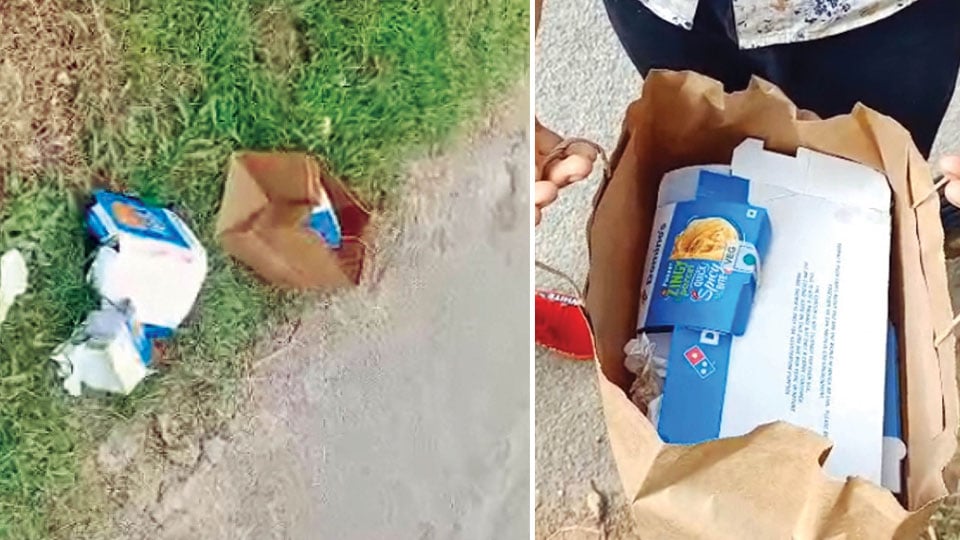
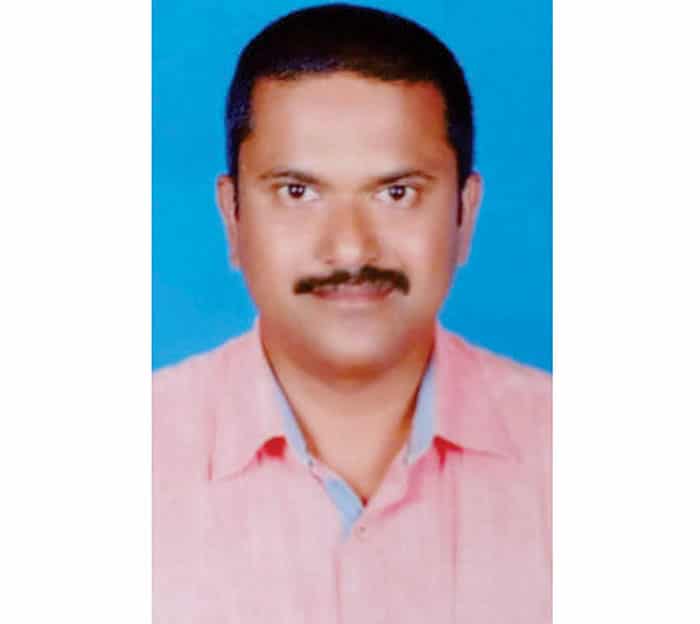
The ‘hero’ of this incident is Madetira Thimmaiah, a former President of Kadagadaalu Gram Panchayat in Madikeri taluk. On Friday, Thimmaiah while travelling in his four-wheeler saw the empty Pizza packets and the paper bag thrown on roadside near Kodagu Vidyalaya junction. He stopped his vehicle, checked the bag and found the bill which had the mobile number of the customer.
Without wasting time, he video-recorded the strewn garbage on his mobile phone and put it on the social media platform. When he called the mobile number mentioned in the bill, he was told that it was Chirag of Mysuru who along with his friends came to Madikeri.
Thimmaiah, ex-GP President
Chirag reportedly told Thimmaiah that he had bought the pizza from a Pizza Shop in Madikeri, and had disposed the trash on roadside. When Thimmaiah asked Chirag to come and pick up the garbage, the latter told him that he was almost near Mysuru and it would take another three hours for him to come back.
However, the former GP President did not budge and said he would wait for three hours failing which a Police complaint will be lodged.
Meanwhile, Thimmaiah appealed to the citizens of Kodagu to call up that mobile phone number to ask him to come back and collect the garbage, which received overwhelming response.
After three hours, Chirag and his friends, not only came back but also tendered an apology for their ‘negligence.’ However, the embarrassed youths appealed Thimmaiah not to film their faces to which the former obliged. The youths collected the empty packets and promised to dispose the same at their house bins.
Later, Thimmaiah put another video on social media of Chirag holding the empty packets in the paper bag and carrying with him. Thanking the people of Kodagu for supporting his campaign to keep the hilly district green and clean, Thimmaiah also appealed one and all to join hands in the Swachh Bharat Abhiyan.
source: http://www.starofmysore.com / Star of Mysore / Home> News / October 31st, 2020
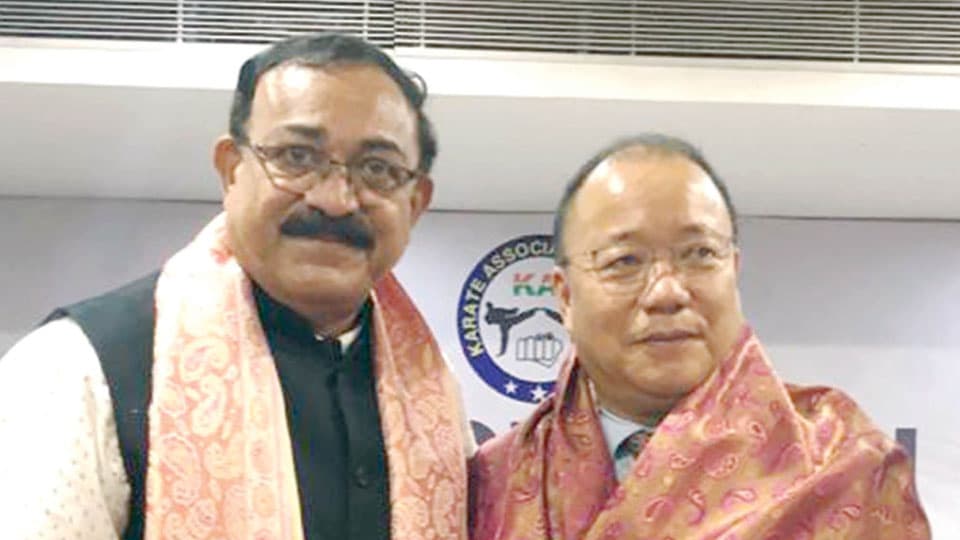
Noted Karate Master Cheppudira Arun Machaiah has been elected as the Vice-President of National Karate Association.
Arun Machaiah was declared elected in the presence of Retired Judge of Assam High Court Justice B.P. Borkotoki at the Association’s National Council Meeting held under the joint aegis of Union Ministry of Sports and Indian Olympic Association, at Guwahati in Assam recently.
Arun, who became the first national champion in 1977, did his higher training in Karate at Singapore. He has won medals in the heavy weight category in the World and Asian Karate Championships held between 1989 and 1993 at Indonesia, Japan, Malaysia, Australia, China, Mexico, Nepal etc.
A seventh degree Black Belt holder of World Karate Federation (WKF), he is an International Referee. He has won many awards, including the prestigious Best Sportsperson Award of the Government of Karnataka in 1994. His term of office as the Vice-President of the Association will end in 2024.
source: http://www.starofmysore.com / Star of Mysore / Home> Sports / October 29th, 2020
As COVID-19 raged across the globe, leading to lockdowns in key markets such as the European Union, coffee exports from the subcontinent were stymied. A smaller crop made it a double whammy.
TREND
Expectations of a larger crop in 2020-21 (Oct-Sep) and rising at-home consumption have, however, led to hope of a resurgence.
“Coffee exports are slowly returning to normal… exports were affected because during the lockdown, due to logistic constraints, we were unable to move coffee beans from estates to curing works as only cured coffee is exported,” said Karnataka Planters’ Association Secretary Anil Savor.
According to Cogencis data, India’s coffee exports since the beginning of this year are down 11% on year at 257,107 tn. But with favourable weather conditions ahead of the beginning of harvesting next month, exporters and planters expect a bigger crop and, in turn, higher overseas sales.
“It (exports) will improve from January… Pent-up demand is not visible yet, but there should be a 5-10% improvement during Jan-Mar… given the low prices that farmers are getting, there will be rush to sell since they need cash flow requirement,” said Coffee Exporters Association President Ramesh Rajah.
India’s coffee year begins in October and growers start harvesting during Nov-Dec. According to India Meteorological Department data, the country received 9% above-normal rainfall during Jun-Sep, a positive for coffee plantations.
“In coffee production, one year you have less output, then the next year you have a bigger one, as coffee is basically cyclic. So, going by that, we think this year we have a good output,” Bengaluru-based exporter Prashanth Nagaraj said.
The market estimates coffee output in the 2020-21 season at 300,000-320,000 tn, sharply higher than an estimated 270,000-280,000 tn in 2019-20. The Coffee Board of India’s final production estimate of 298,000 tn for 2019-20 is well above market estimates.
The pandemic has completely changed the trend of coffee consumption across the globe, with a shift away from consumption in cafes.
“The overall market is dull… but it will improve because during the pandemic, there was a sharp drop in offtake but now, we are seeing at-home-consumption is increasing, so a large part of out-of-home consumption is being taken over by at-home consumption,” Rajah said.
“…Italians (demand from Italy) will come back to us. Jan-Mar, we don’t see a very big increase but in Apr-Jun, we see much more improvement… Also, West Asia, Germany, and other traditional markets will also buy from India.”
India may, however, face some competition as it sells the standard arabica variety at a premium of 30 cents per pound in international markets because of its superior quality compared to coffee from other parts of the globe.
Brazilians sell their produce at a discount of 20 cents per pound, former Coffee Board of India member Jaya Prasad H.B. said.
Brazil is the world’s top producer and exporter of coffee, while India is the seventh-largest grower.
With several positives on the horizon, Indian coffee exporters are hoping for sunny days ahead. End
US$1 = 73.36 rupees
Edited by Subham Mitra
source: http://www.cogencis.com / Cogencis / by S. Anirudh Iyer and Preeti Bhagat / October 13th, 2020
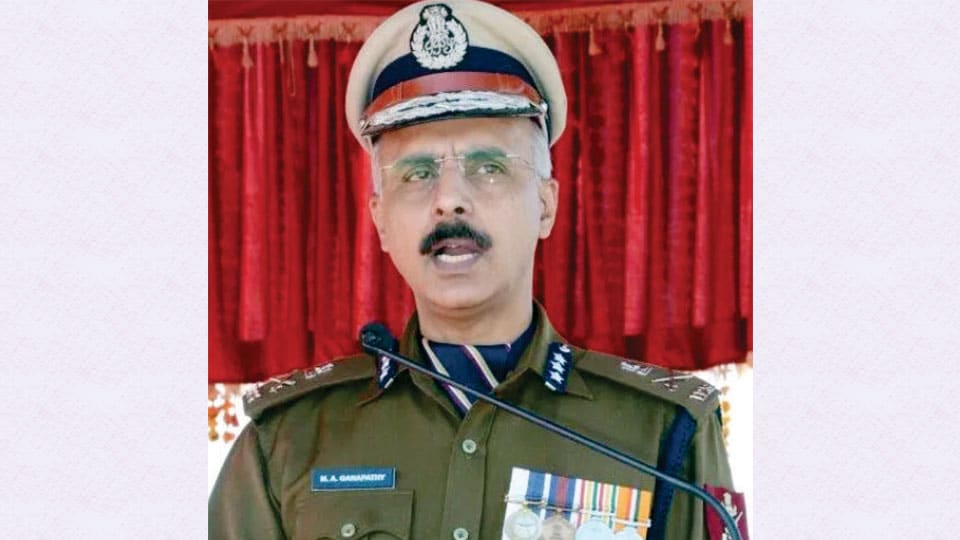
Kodagu-born Maneyapanda Appaiah Ganapathy, IPS, has been appointed as the Director General (DG) of the Bureau of Civil Aviation Security (BCAS).
The 1986 batch, Uttarakhand cadre IPS Officer, is currently CISF Special Director-General and Head of the Airport sector.
PM Modi-headed Appointments Committee of Cabinet recently approved the Aviation Ministry’s proposal to appoint Ganapathy as DG BCAS till his superannuation on Feb. 29, 2024, or until further orders, whichever earlier.
Ganapathy has been awarded the President’s Medal for meritorious service and he was later decorated with the President’s Medal for distinguished service.
He completed his primary and secondary education at Ponnampet in Kodagu and graduated from the Madras Christian College, Tambaram. He studied his Post-Graduation at JNU New Delhi.
He is the son of Maneyapanda Appaiah (Vittala lawyer) and Premalatha, retired teacher, of Kunda in Virajpet taluk. Ganapathy is married to Sandhya and they have a son.
“Given his experience as heading Aviation security sector of CISF, Ganapathy is the right person for the position of DG BCAS,” said a senior official.
The post of DG fell vacant after Rakesh Asthana, a Gujarat cadre 1984 batch IPS Officer, was appointed as the DG, Border Security Force (BSF) in August this year. Asthana is also holding additional charge of DG, Narcotics Control Bureau (NCB).
source: http://www.starofmysore.com / Star of Mysore / Home> News / October 15th, 2020
This year, Tulasankramana festival in Kodagu is likely to see fewer pilgrims due to the COVID-19 restrictions.
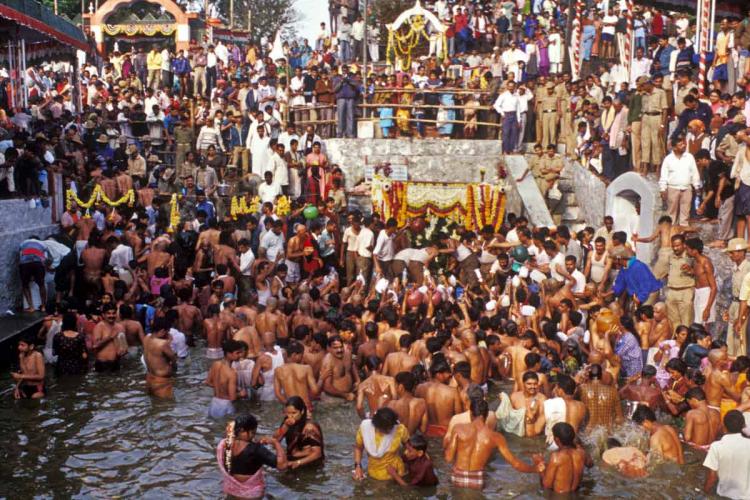
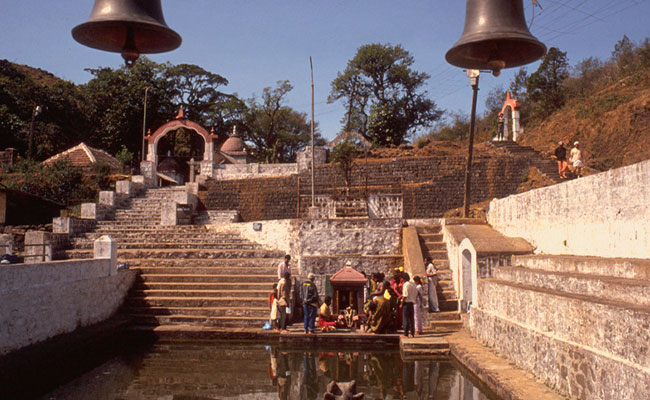
Come October and goddess Cauvery will appear in the form of a sudden upsurge of water in a small tank to give darshan to pilgrims who come to seek her blessings, bathe in her waters, and carry back bottles of holy water from Talacauvery, the source of the river in Kodagu district of Karnataka. Unlike the usual practice, this year, scores of devotees from Kodagu and places adjoining the state will not be able to throng the verdant slopes of Brahmagiri hills to participate in the annual celebrations of Tulasankramana. Due to COVID-19, there will be restricted entry of devotees besides the mandatory masks, physical distancing and COVID-19 test negative certificate. The district administration will have checkpoints 8 kilometres from the venue, where devotees would be screened for temperature and other symptoms.
It is believed that every year, on October 17, the river goddess renews herself with a fresh thirtha, signified by a gurgling sound in the brahmakundike, in the tiny two-and-a half-feet square of an enclosed area in the surrounding pool and then fills up the bigger tank or the pushkarni at the shrine. Known as theerthoudbhava (when water gushes from the spring), this event takes place with clock-like precision at a predetermined time, predicted precisely each year by priests on the basis of planetary configurations and astrological calculations. This year, theerthoudbhava (spouting of the holy spring) is scheduled at 07.03 am on October 17. Kodavas, an ethno-lingual tribe from Kodagu, believe that at that particular moment, all the wells in Coorg come to life.
How Tulasankramana is celebrated
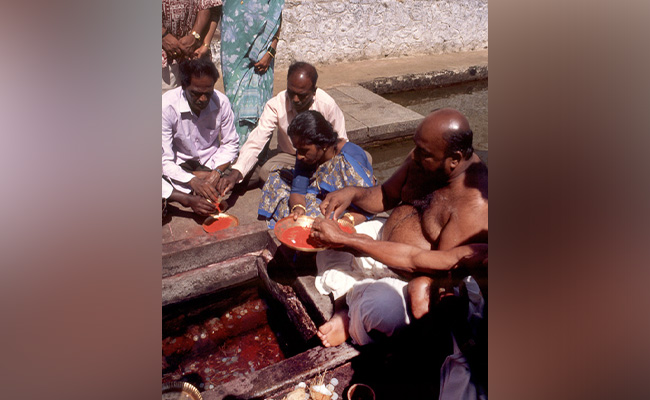
Tulasankramana festival is celebrated with much festivity and fervour all over Kodagu. A puja is offered to the river goddess at the tank as a prelude to the ushering in of the Cauvery. Coconuts adorned with jewels and flowers and small bowls of kumkum (vermillion) floating down the tank in memory of Cauvery, the presiding deity of the landscape, is an unforgettable sight.
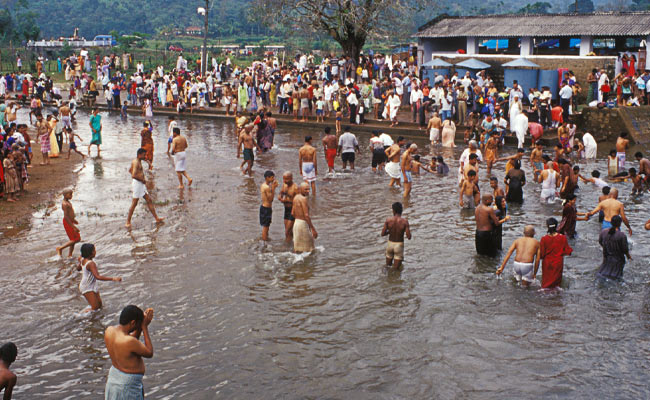
Besides this small tank, there is a large tank where the devotees take their holy dip amid the chanting of Sanskrit shlokas eulogising Cauvery. After the puja, they wade in knee-deep water for a grab of the tirtha (sacred water) – in cans and bottles. The initial spurt of water is strong and is said to possess curative powers. It is believed that it bequeaths life to a dying man and helps him attain moksha (emancipation). This sacred water forms part and parcel of every household in Coorg. After the puja, devotees visit the smaller shrines dedicated to Ishwara and Ganapathy, dotting the expanse of the hill above the pool.
Kundike, the small tank
Tulasankramana is a time for rejoicing for the Kodavas. Split bamboo is planted in cultivated lands and paddy fields, decorated by a garland of specified forest creeper to signify that they are devotees of Cauvery. Homes are all spruced up and sprinkled with holy water before sunrise, as the goddess is believed to visit every home during this period. Vegetable carvings of goddess Cauvery are decked with flowers and installed in each home for a period of three days. A small lamp is lit by its side and family prays with another offering of rice. A tray containing some rice, betel leaves and nuts is placed near it. The Kodavas venerate and worship river Cauvery and it continues to be a strong religious binding force.
The legends behind Tulasankramana
A number of legends are woven around the goddess. According to a popular legend, she was the daughter of Brahma, the god of creation, but was brought up by the great saint Kavera. Agasthya, the learned sage, was enamoured by her charm when he came to visit her foster father. He proposed to her and she agreed, on one condition. She pledged that if he were ever unfaithful to her, she would go away, become a river and serve her people. Once he broke the promise and she transformed into a river. Agasthya tried to stall her, grabbed her by the sari, pushing back the pleats in the process. (No wonder the women of Coorg wear the sari with pleats folded at the back!) She rushed away and disappeared underground for a while, surging again as the mighty river, gushing down a rocky mountainside.
At this site, a small shrine was built signifying the birth of the river. When the Kodavas, her devotees pleaded with her to remain her protective goddess, she assured them that she would continue to take care of them and would visit her birthplace, Talacauvery and regain her freshness every year during ‘Tulasankramana.’ The Cauvery is a venerable river, considered as one of the seven sacred ones — Sapta Sindhu — by the Hindus.
Bhagamandala, the confluence of three rivers
From Talacauvery, the river mysteriously disappears for a distance of seven kilometres, to re-emerge at Bhagamandala, a customary stop for all pilgrims proceeding to Talacauvery. To the people of Kodagu, the Talavauvery pilgrimage is not complete without a holy dip at the Triveni Sangama, the confluence where Cauvery meets river Kannike and the legendary underground river Sujyothi.
Larger pool at Talacauvery
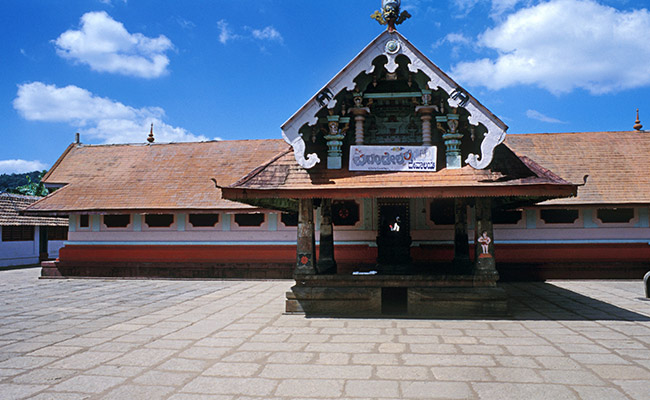
People bathe at this stunning spot and the Kodavas offer pindadana — an offering to ancestors after tonsuring their heads. A short distance away from the confluence is the cluster of three impressive temples, the main temple being that of the Kerala-style Bhagandeswara temple. Located in a central courtyard, the temples flaunt elegant, exquisitely carved pillars and wooden ceilings. There are also sloping red painted roofs supported by gilded snake-heads and a variety of musical instruments strung from the rafters around the courtyard.
Kerala style Bhagandeswara temple at Bhagamandala
Cauvery: Lifeline for Karnataka, Tamil Nadu
It is believed that the munificence of river Cauvery is venerated and revered as a mother, a life-giving force, symbolising the largesse and abundance of woman, of her spirit of grieving and nurturing, of struggle and survival. Right from its place of origin at the magnificent foothills of the Brahmagiri Hills in Kodagu, till it plunges into the Bay of Bengal at Poompuhar in Tamil Nadu, snaking its way for 765 km, it has no parallel. It serves as the lifeline of the states of Tamil Nadu and Karnataka. The Cauvery has remained a strong religious binding force and provides water for drinking, irrigation and hydroelectricity along its course. The presence of the river Cauvery is as endemic to Coorg as is coffee. Without it, life in the region would be difficult if not impossible.
Susheela Nair is an independent food, travel and lifestyle writer and a photographer.
source: http://www.thenewsminute.com / The News Minute / Home> Features> Festival / October 16th, 2020
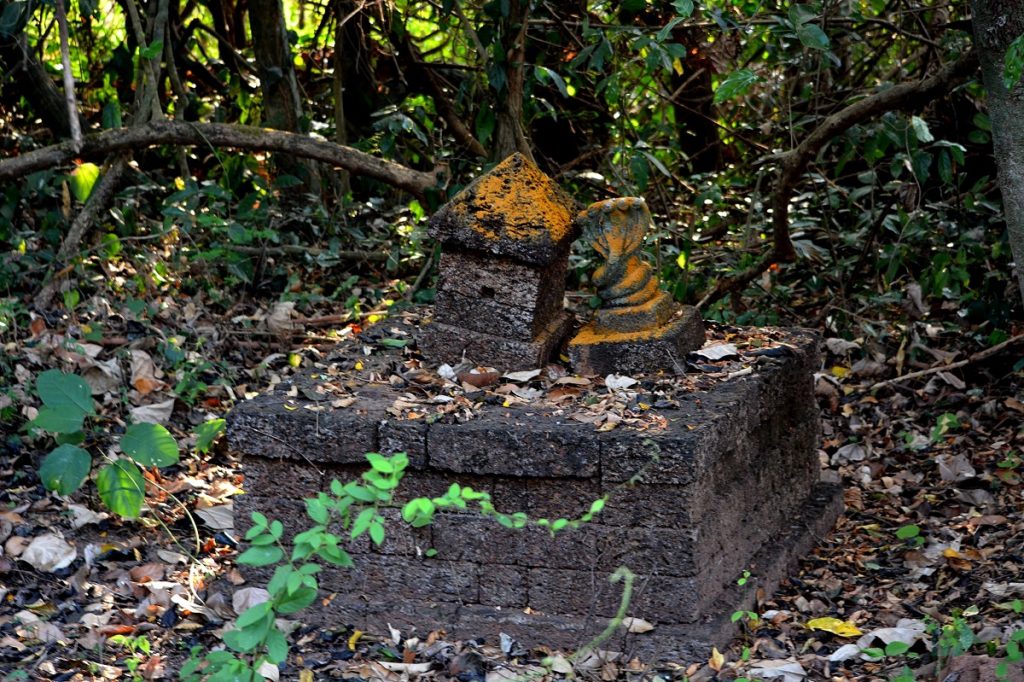
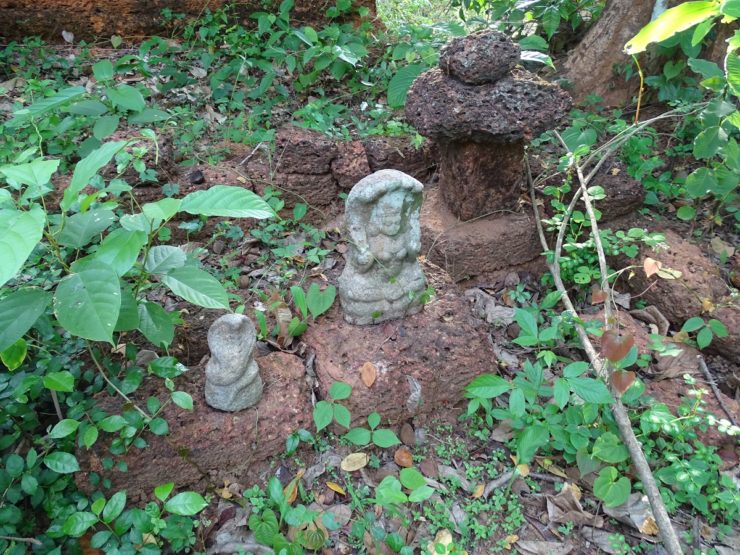
A sarpakaavu, or traditional sacred space for snakes, in Kerala. Photo: Manoj Karingamadathil/Wikimedia Commons CC BY SA 3.0
Underlying cultural and religious beliefs in serpent deities has played a role in protecting iconic animals such as snakes and other species dwelling inside the Western Ghats’ sacred groves. But these beliefs are eroding among youth and economic pressures are eating into the groves, threatening their very existence. Experts call for greater state government protection to preserve the groves’ legacy for the benefit of posterity.
For millennia, local communities in India have maintained sacred groves where they managed natural resources and many of these are tied to their cultural and religious beliefs. In the Western Ghats, such groves are relatively undisturbed patches of evergreen forests that sometimes have a pond, stream, or well that ensures perennial water supply. Often located outside of protected areas, sacred groves are rich in biodiversity, housing many threatened and endemic species of plants and animals. In many cases, these fragments are the only relict forests that remain outside the protected area system.
The mountain chain of the Western Ghats along the western coast of India is older than the Himalayan mountains; in 2012, 39 sites in the region were inscribed on the World Heritage Sites list by the United Nations Educational, Scientific and Cultural Organisation (UNESCO). While India boasts the highest number of sacred forests globally, with estimates suggesting at least 100,000, the Western Ghats is endowed with a large concentration. Although many are undocumented, Kodagu district in the southern state of Karnataka alone was estimated to have 1,200 sacred groves.
Many of these verdant groves are associated with gods and are named after deities. The worshipping of serpent gods known as nāga plays a central role in many groves in Kerala known as sarpakaavu in Malayalam (snake garden or grove), and often house idols of serpent deities.
Worshipping involves unique rituals that are performed in sarpakaavu and temples with serpent deities. One common ritual involves pouring a preparation of water, milk, rice powder, and turmeric on the deities and devotees call this offering as ‘Noorum palum’, said Dileepkumar R., director of Indriyam Biologics Pvt. Ltd., Jayakumari Kunjamma, senior research fellow at the University of Kerala who has also authored a book on snake worship in Kerala, and Divya S. chief scientific officer of Indriyam Biologics Pvt. Ltd.
Sacred groves: a refuge for snakes
In a study published last year, researchers surveyed visitors of 30 sacred groves in Kannur and Kasaragod districts in the state of Kerala and Kodagu (Coorg) in Karnataka. They found that visitors were less likely to harm snakes inside the groves than outside. And, a large proportion of visitors who did not harm snakes even outside of the groves worshipped snake deities.
Felix Yuan, the lead author of the study and doctoral student at the University of Hong Kong had expected a “fair number of people would not harm snakes inside the groves” given the role of snake deities in the region, but he was surprised by the results. An overwhelming 96% of the visitors surveyed showed pacifist attitudes towards snakes encountered inside the groves, whereas only 60% had the same reaction outside of the groves. The reverence towards snake deities and pacifism towards snakes pervaded all the sacred groves regardless of whether they had idols of snake deities present or not.
“The broader implications of this study lie in the intricacies of the relationships between sacred natural sites and local communities,” explained Yuan, “where the reverence for a specific plant or animal can potentially result in its protection despite the ongoing degradation of other ‘natural’ qualities of these sites.”
Visitors tend to live in harmony with snakes inside the groves (sarpakaavu). Dileepkumar, who frequently visited sarpakaavu in Kerala since childhood, said that if people spotted snakes, they would not touch the creatures, leaving them to slither around the groves freely.
V.C. Balakrishnan, who has also grown up in Kerala, had on some occasions, encountered snakes in the sarpakaavu. “I will just wait for them to pass by,” he said.
Serpent god worship and the role of taboos
At the heart of the conservation of snakes in the groves lie taboos, which are essentially an interplay of devotion and fear, according to U. Prashanth Ballullaya, co-author of the study and a doctoral student at the Central University of Kerala. Local communities believe that their ancestors created the sarpakaavus to provide shelter to snakes, he said, adding that snakes, especially cobras, were considered divine.
Fear also plays a prominent role. Harming snakes is a sin, Ballulaya gleaned from the surveys. If anyone harms snakes inside the groves, they will be cursed and more snakes will emerge, said some visitors. One of the repercussions of killing snakes according to traditional beliefs is that the family could be deprived of progeny and hence there is a cultural practice of worshipping the habitats of snakes among communities in the Western Ghats, explained T.V. Ramachandra, professor at the Indian Institute of Science (IISc), Bengaluru. “Later, gradual transitions to worshiping idols with snake inscriptions happened and eventually, temples with concrete structures replaced these,” he said.
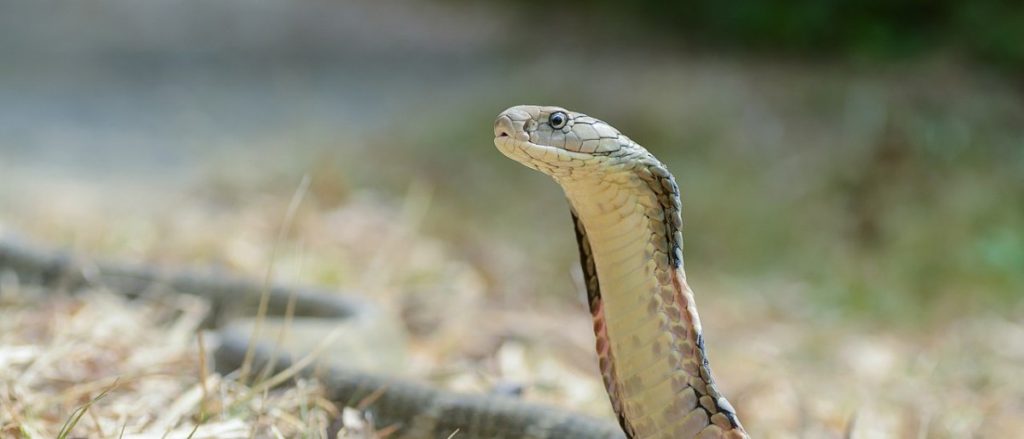
A king cobra. Credit: Rushenb/Wikimedia Commons, CC BY-SA 4.0
Shonil Bhagwat, professor at the Open University, United Kingdom, said “a ‘healthy’ fear of wild animals is good because that discourages people from going to parts of sacred groves, naturally creating ‘no go’ areas.” He believes that “these so-called ‘fences of fear’ can help protect biodiversity within sacred groves by simply keeping people out of the groves, or at least some parts of the groves.”
Communities in the rural highlands of the Western Ghats in Kodagu and adjoining urban lowlands in Kasaragod were surveyed and the results were published in 2019. Researchers found that both urban and rural communities did not abuse the groves by cutting trees, dumping waste, hunting small animals, taking soil and foliage, and damaging termite mounds. And those with nāga deities, who are not only highly revered but also feared, were rarely abused.
The protection of snakes was extended to other taxa as well. Palatty Allesh Sinu, assistant professor at the Central University of Kerala and co-author of the community perception study was surprised to learn that “even taking a leaf from the sacred groves is considered a taboo or abuse of the land.” Believers told him that “the organic matter is food for insects, which is food for frogs and snakes!” Because of this snake-centric food chain, Sinu and his team were forbidden from collecting insects from the groves.
Rural communities had stronger cultural and religious beliefs than their urban counterparts, who valued groves also for their environmental benefits. Although the reasons for this are difficult to answer, said Sinu, one farmer told him “our agriculture, economy and lives are bound to these forests around us … When there was no access to a temple, these forests and local deities living inside the forest were the resort for us. When the upper castes have direct access to Gods, the backward caste people did not have.”
Erosion of beliefs
Community-preserved sacred groves in the Western Ghats are facing mounting pressures over the past decades. Many are shrinking in size or have disappeared altogether. At the time of its formation in 1956, Kerala boasted more than 10,000 sacred groves, but in 2015, only around 1200 remained, according to a report prepared by the Kerala State Assembly Committee on Forest, Environment, and Tourism. A global Nature study published in May reported that reptilian phylogenetic diversity in the Western Ghats is under very high levels of human disturbance.
“Earlier thesarpakaavu was a symbol of divinity and sanctity and it was with only utmost reverence that one was allowed to enter its premises,” said Dileepkumar, Kunjamma and Divya. “People were afraid to touch the trees let alone cut them. But the scenario has almost completely changed with the term ‘sarpakaavu’ being reduced to a mere social terminology. The infuriating demand for more land to accommodate the growing population coupled with the placid attitude of today’s generation has diminished the values of biodiversity and conservation,” they rued, adding that most people view the groves as wastelands, which could be used for construction.
Researchers have observed that youths are losing interest in sacred grove traditions. The loss of oral traditions that narrated stories behind the groves has been cited as one factor. Bhagwat believes that awareness of sacred groves and nature conservation should start early. “If children are introduced to the creepy crawlies that live in sacred groves and maintain a healthy forest ecosystem, they will learn to like this real, everyday nature that is found in landscapes where people farm, live and work,” he said.
V.C. Balakrishnan, who is the secretary of the NGO Society for Environmental Education in Kerala (SEEK), also stresses the role of educating youth to ensure the protection of the groves. SEEK, he explains, holds many camps on the importance of the sacred groves and biodiversity.
On 25 September, Dileepkumar R. joined forces with a group of snake experts and developers and launched a mobile app called SnakeHub, which is dedicated to education and conservation. Currently, the app is a social responsibility initiative of Indriyam Biologics Pvt. Ltd., a Department of Scientific and Industrial Research recognised medical startup working on snakebite management and mitigation, but the group plan to register a society and keep it as an independently functioning body under the organisation. With 114 snake species, Kerala is the top three states in India in terms of species number (after Tamil Nadu, which has the highest, followed by West Bengal) and more than half of these are endemic to the Western Ghats, said Vivek Sharma, head of SnakeHub App.
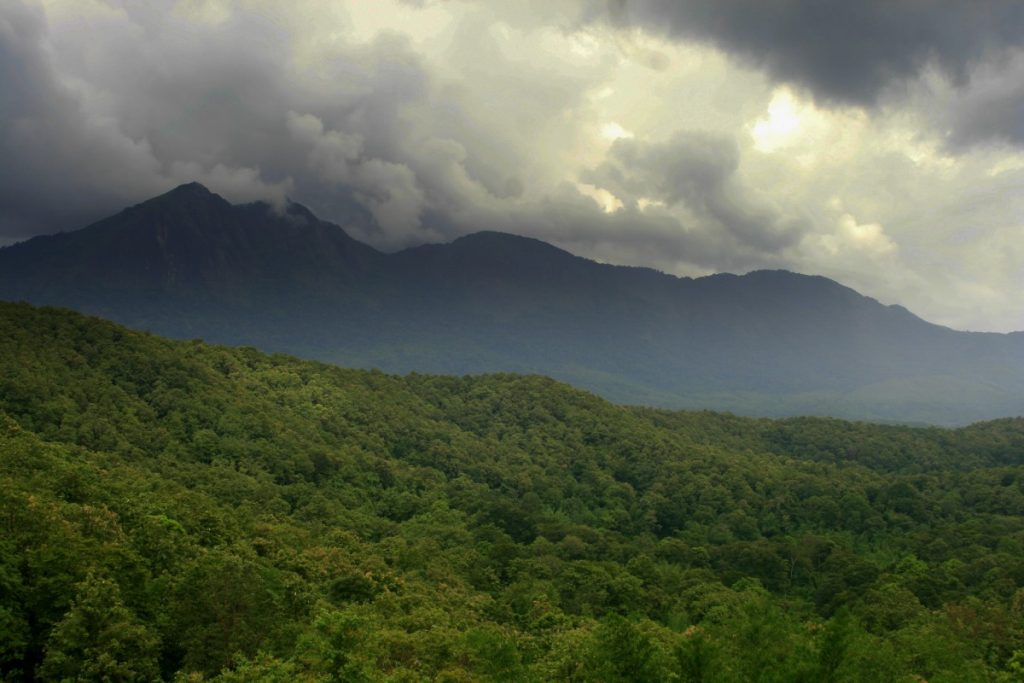
A part of the Western Ghats. dotcompals/Flickr, CC BY 2.0
In both English and Malayalam, the app is the first on snakes in the state of Kerala. Apart from providing biological and ecological information on all of the species, the app also covers snakebites including a list of hospitals equipped to treat bites. “Snakebite is an important objective in our work and based on requirements, we will add facilities to provide snakebite-related solutions and education materials,” said Sharma.
Their goal is to expand the scope of the app to the rest of India in other regional languages to cater to rural communities. India accounts for almost half of the total number of annual deaths from snake bites worldwide. Earlier this year, a study estimated that over the last 20 years, 1.2 million people died from snake bites nationwide. Most of the deaths occurred in rural areas and farmers were most at risk especially during the monsoon season.
“Sanskritisation” and commercialisation
Over the years, there has been a trend towards “Sankritisation” of the groves, which involves the conversion of animistic deities in the sacred groves to mainstream Hindu gods and goddesses, explained Bhagwat. This phenomenon, he said, paves the way for cement structures such as temples and other buildings to be constructed in the groves, which compromises the conservation value of the groves because natural features such as trees disappear. “The only way to solve this problem is to make the custodians of sacred groves aware that trees are important to protect biodiversity within the groves,” Bhagwat said.
“The sacred groves are losing their sanctity and some of the groves are becoming temples for commercial purposes,” said Balakrishnan, explaining that the owner can earn an income through money offered to the deities.
es are taking over in urban areas and even creeping into the hinterlands. According to Sinu, some sacred groves are under the direct control of the state while others are privately owned. “Sadly, both want to generate money out of it,” he lamented. “Selling the land is a way,” he said. “So, they first relocate the deities including snake god through a ceremonial ritual and free the land.” Many owners are in the process of relocating deities, noted Sinu, adding that the ceremony is a costly affair amounting to about Rs 4 lakh (Rs 400,000).
Ramachandra of IISc echoes these concerns. Cemented buildings have become commercial spots, he said, revealing that many sacred groves that are under the revenue department have undergone large-scale conversion to other land uses such as villas and resorts in Kodagu. He attributes these conversions to a lack of knowledge among the bureaucracy of the ecological and hydrological significance of the groves, which has sustained the livelihood of communities in the region for centuries.
Dileepkumar, Kunjamma and Divya believe that people fail to realise that their exploitation of the groves could pave the way for their own doom. “With the sacred groves being deconstructed, the snakes that were taking refuge in the grove vegetation enter into human colonies leading to a conflict between snakes and humans thereby posing a threat to both snakes and humans alike,” they warned.
A sarpakaavu in Kerala. Photo: Manoj K/Wikimedia Commons CC BY SA 3.0
How to protect the sacred groves?
Apart from cultural beliefs, the coexistence of snakes and humans hinges on the preservation of the ancient sacred groves of the Western Ghats.
Experts believe that state governments must play a greater role in protecting the sacred groves of the Western Ghats. Earlier this year, the Kerala state government launched a program “Pachathuruthu” to cultivate ‘green islands’ in degraded land in a bid to preserve biodiversity. For the initiative, “they are planting trees that can give shade, shelter, and food for birds and other animals,” Sinu said. “We have over 1500 sacred groves in Kerala along the west coast. Why not declare them as natural sanctuaries?”
Ramachandra proposes that the Karnataka and Kerala Forest Department should assign heritage status to all the sacred groves of the Western Ghats under section 37(1) of the Biological Diversity Act 2002. Such a move, he argues, will ensure the conservation of these ecologically fragile regions.
Conservation of the groves should be initiated at both the community and government level, according to Dileepkumar, Kunjamma and Divya. “Snake groves are an inherent part of Kerala culture and conserving them must be our obligation. For implementing the conservation strategies initiated by the government, a special task force must be employed to ensure the protection and maintaining the status quo of the snake groves.”
Balakrishnan said that the forest department had funded building fences around the sacred groves a few years ago. “These sacred groves are to be protected surely because they are rich in biodiversity and they are the wealth of our future generations.”
This article was first published on Mongabay India .
source: http://www.science.thewire.in / The Wire, Science / Home> Science> Environment / October 29th, 2020
WELCOME. If you like what you see "SUBSCRIBE via EMAIL" to receive FREE regular UPDATES.
Read More »