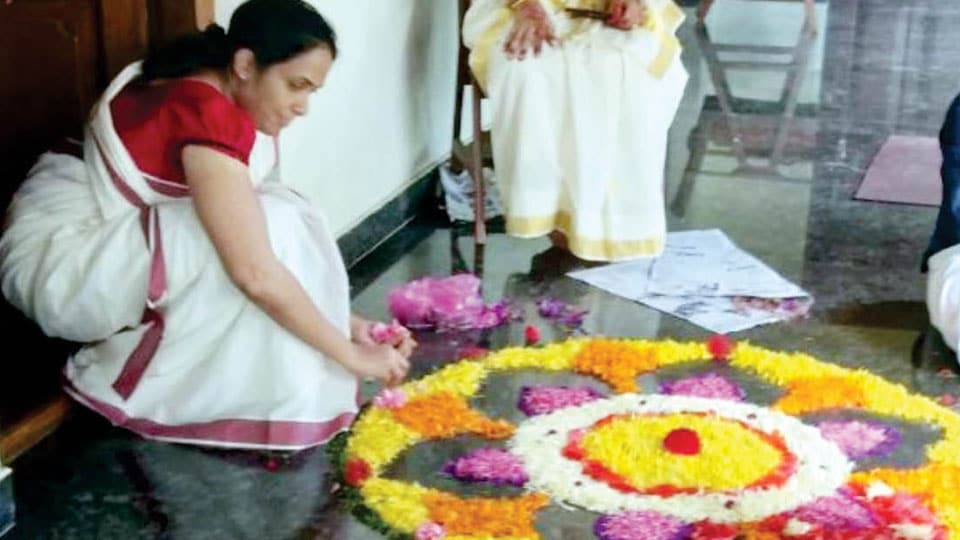
IAS Officer Annies Kanmani Joy, a native of Kerala, who is serving as the Deputy Commissioner (DC) of Kodagu district in Karnataka for the past two years, celebrated Onam, the harvest festival of her native State, at the DC Bungalow in Madikeri, Kodagu.
The DC, attired in traditional costume, is seen making Pookalam (‘poov’ meaning flower and ‘kalam’ means colour sketches — floral rangoli) in the portico of her house this morning as part of the celebrations.
source: http://www.starofmysore.com / Star of Mysore / Home> Photo News / August 31st, 2020
A befitting tribute to Indo-Pak War Hero on his 55th death anniversary
Madikeri:
The statue of Squadron Leader Ajjamada Bopayya Devayya will be unveiled at Madikeri in Kodagu District on Sept. 7.
The 6-feet-9-inch bronze statue installed at the Old Private Bus Stand Circle will be unveiled on the day Devayya was martyred. Incidentally, the Circle has also been named after him.
Sqn. Ldr. A.B. Devayya is the only Indian Air Force (IAF) Officer to be posthumously awarded the Maha Vir Chakra (MVC). During the 1965 India-Pakistan War, Devayya (called ‘Wings of Fire’) was part of a strike mission (on the Pakistani airbase Sargodha).
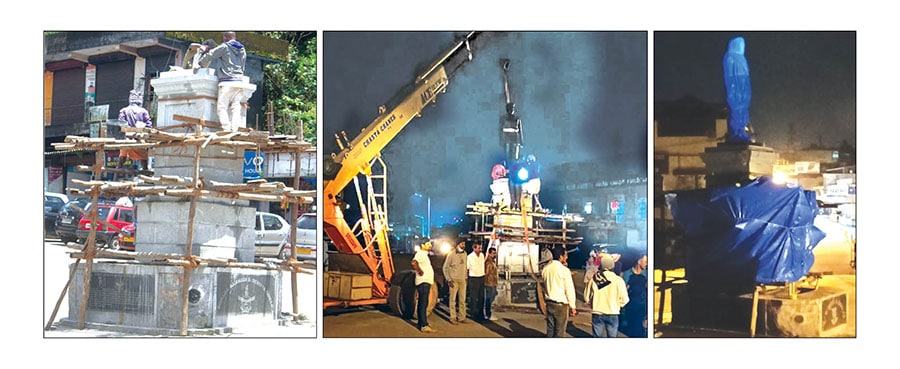
Works on installing the statue of Squadron Leader A.B. Devayya at Madikeri in Kodagu district is almost complete.
Works on installing the statue of Squadron Leader A.B. Devayya at Madikeri in Kodagu district is almost complete.
The work on the statue basement is almost complete and a giant crane was used to shift and mount the statue on the pedestal.
The bronze statue weighs 600 kg and Rs. 20 lakh has been spent on getting the statue carved at Kengeri near Bengaluru.
The statue installation work was spearheaded by Ajjamada family members, Squadron Leader Ajjamada Devayya Memorial Trust, Field Marshal K.M. Cariappa and General Thimayya Forum, Kodava Makkada Koota.
Wartime job
Sqn. Ldr. A.B. Devayya was born to Ajjamada Bopayya and Neelamma couple on Dec. 24, 1932 at Manchalli village near Kutta in South Kodagu. He joined the Indian Air Force as a pilot on Dec. 26, 1954. Devayya was married to Keethiyanda Sundari.
When the Indo-Pak war broke out in 1965, Devayya was an instructor at the Air Force Flying College. He was posted to No.1 ‘Tigers’ Squadron’ and flew the Mystere fighter bomber. During the war, Devayya shot down a US-made PAF (Pakistan Air Force) F-104 Starfighter while flying an inferior Mystere of French make. The dogfight between the Mystere and the Starfighter was recorded by British author John Fricker in his book ‘Battle for Pakistan’ published in 1979.
Action in the skies
John Fricker wrote, “On Sept. 7, 1965, Mystere pilot Squadron Leader A.B. Devayya showed commendable courage by staying in the fight, and despite being mortally wounded, he eventually scored several cannon strikes against the Starfighter, causing it to be abandoned. This was the first and only Starfighter to be lost through enemy action in the 1965 war.”
Devayya was part of an air strike mission on the PAF base at Sargodha, with the objective being to neutralise its air assets. He engaged in a dogfight with the Starfighter flown by Pakistani Flight Lieutenant Amjad Hussain at an altitude of 7,000 ft. The PAF fighter was faster and more modern, but Hussain made the mistake of reducing his speed in an attempt to out-turn Devayya.
Hussain failed to clear his tail during the dog-fight and suffered several cannon strikes. He was forced to eject since the Mystere had a limited range for action and did not have enough fuel reserves to return to India.
Posthumous award
The Mystere aircraft was destroyed and it was assumed that Devayya died on Pakistani soil. The IAF was not aware of what had happened to Devayya, first recording him missing and later declaring him dead. It was revealed much later by Pakistan that Devayya’s body was found almost intact by villagers not very far from Sargodha and buried.
For this feat in the 1965 conflict, 23 years later, in 1988 he was posthumously awarded the Maha Vir Chakra (MVC). He is the only Air Force Officer to have been awarded the MVC posthumously so far.
Two heroes from Kodagu receive ‘Maha Vir Chakra’
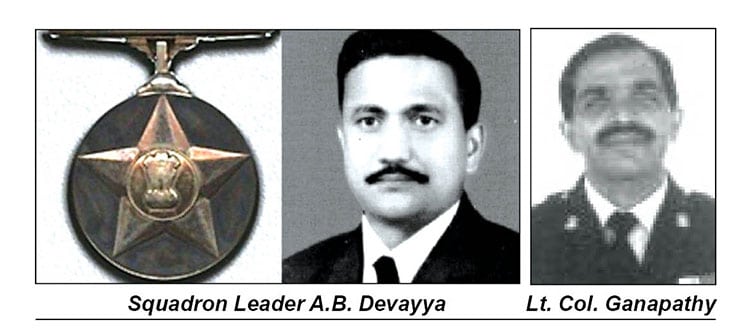
Two Defence personnel from Kodagu have so far received the honour of Maha Vir Chakra, next only to the supreme Defence award Param Vir Chakra. While Squadron Leader A.B. Devayya received the honour in 1988, the other officer is Major Puttichanda Somaiah Ganapathy (later promoted as Lieutenant Colonel) who is now leading a retired life in Bengaluru.
Major Ganapathy was awarded Maha Vir Chakra for his combat role in 1987 Operation Pawan in Sri Lanka (launched by Indian Peace Keeping Force) against the LTTE. His unit, located at Annakottai, was surrounded and repeatedly attacked by militants on Oct. 16, 1987. His Company had occupied this location to provide a firm base for the 41 Infantry Brigade to launch an offensive.
LTTE militants repeatedly attacked the position with very heavy fire, resulting in heavy casualties, and his unit required immediate replenishment of ammunition. Throughout the day, Major Ganapathy fought gallantly and kept the militants at bay.
When all efforts to drop ammunition by helicopter failed due to heavy fire, Major Ganapathy kept fighting, moving from trench to trench till 6 am on Oct. 17, 1987 when he was finally supplied with ammunition by a patrol. He displayed extreme devotion and held his position against heavy odds.
source: http://www.starofmysore.com / Star of Mysore / Home> News / by Prasad Sampigekatte / August 31st, 2020
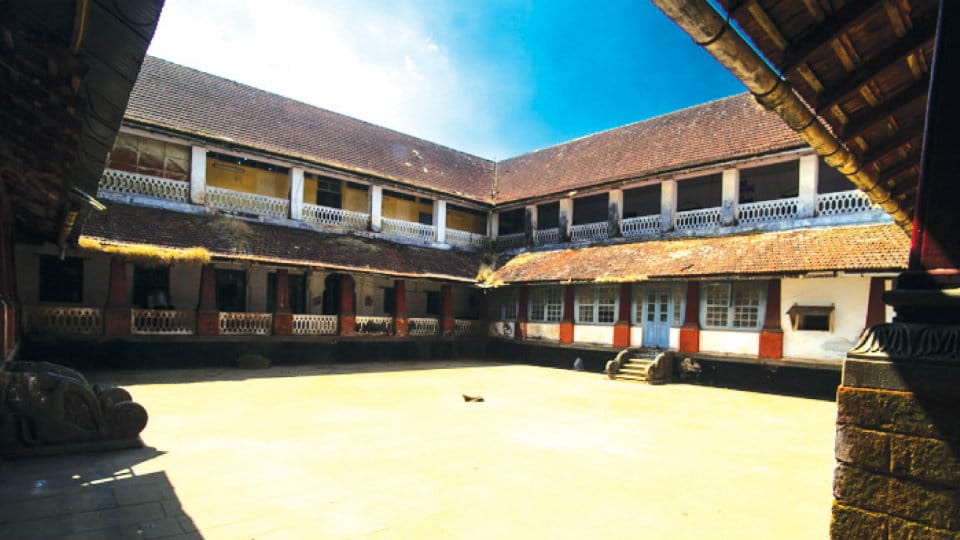
In a significant judgement regarding restoration work of monuments at Madikeri in Kodagu district, the Karnataka High Court on Monday directed the Archaeological Survey of India (ASI) to take up permanent restoration work of the ancient Fort, Palace premises and tombs (Gadduge) of Kodagu Kings at Madikeri town, the district headquarters of Kodagu, while also asking it not to levy service charge to the State Government for carrying out the work.
A Division Bench of the High Court, comprising Chief Justice Abhay Shreeniwas Oka and Justice Ashok S. Kinagi, which heard a PIL filed by J.S. Virupakshaiah, a retired IAS Officer and a resident of Kodlipet in Somwarpet taluk in Kodagu district in 2017, directed the Kodagu Deputy Commissioner to nominate an officer not below the rank of Assistant Commissioner to frequently visit the site of the monuments.
Instructing the officer to be designated to take up the issue with ASI if he/ she finds that the work is not carried out as per the DPR (Detailed Project Report), the bench also directed that the Assistant Commissioner shall submit a report as regards the status of the emergency work and also the status of major restoration or repair works.
Observing that it is a great deal of importance that the said work is carried out efficiently, properly and expeditiously as it is the duty of the ASI to ensure that the protected monuments are restored and maintained, the HC Bench directed the ASI to complete all emergency works within Oct. 14, 2020.
On the service charge issue, the Court directed the ASI, which had contemplated a 23.7 percent service charge on the State Government, not to levy the service charge for carrying out the restoration or repair work.
Noting that there is no justification at all for the ASI to levy service charge to the State Government, the Bench held that the ASI is not empowered and also not entitled to collect service charge from the State Govt.
The petitioner J.S. Virupakshaiah, in his PIL (Public Interest Litigation), had contended that instead of preserving the protected monuments, the State Government had been running its offices on the Palace premises.
However, during the course of the PIL hearing, the District Administration vacated the offices of Social Welfare Department, Land Records Department and District Library from the ancient Palace premises and had handed over the premises to ASI.
Also, following directions of the Court from time to time, the State Government has released Rs.10.76 crore for permanent works as per the DPR.
source: http://www.starofmysore.com / Star of Mysore / Home> News / August 26th, 2020
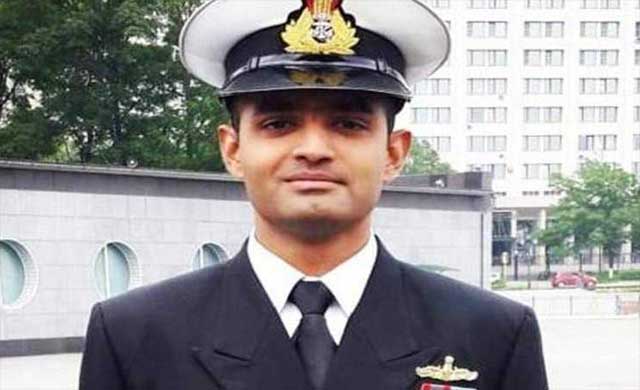
Lt Cdr Muckatira Suraj Aiyappa has been selected to represent India to undergo the prestigious staff course at the US warfare training college.
Suraj Aiyappa happens to be the son of Gonikoppal Arvathoklu Retd Lt Col M A Cariappa and Saraswathi Cariappa. He will be one of the representatives from 52 countries who will participate in the staff training course in the USA.
Aiyappa had attended the Rashtriya Indian Military College at Dehradun. He acquired a cadet captain degree from the Naval Academy. He was chosen as an officer of Indian Navy in the year 2010. He won the Chief of Naval Staff gold medal and best commanding officer of the navy in 2010. He has served as instructor at the Naval Academy.
At the programme held at Visakhapatnam in 2016, he had received the guard of honour presented by the President. His wife, Dr Yamuna, is a dental surgeon by profession.
source: http://www.daijiworld.com / Daijiworld.com / Home> Karnataka / by Daijiworld Media Network – Madikeri (SP) / August 27th, 2020
Captain Maletira S. Muthappa has been appointed as aide-de-camp (ADC) to Chief of Army Staff. Muthappa is at present serving in the Defence Ministry and joined as Commissioned Officer in the Indian Army in 2016.
He hails from Kedamulloor village near Virajpet and is the son of Maletira Rathna Subbaiah and Usha.
Muthappa is the fifth Army officer from Kodava community to serve as ADC to the Chief of Army Staff.
In 1953 Brigadier Codanda Cariappa, in 1973 Lieutenant General Buttiyanda Bopanna, in 1986 Lieutenant General Pattacheravanda C. Thimmaiah and in 2001, Maj. Muckatira C. Muthanna had occupied the post.
Maj. Muckatira C. Muthanna from 9 PARA (Special Force) served as ADC from 2001 to 2003 and had served two Army Chiefs — Gen. N.C. Vij (for a short time) and Gen. Padmanabhan (for full term). Muthanna is the son of Brigadier (Retd.) M.M. Ashok Cariappa, who was also from 9 PARA (SF) and later went on to command First Bihar Regiment.
What is ADC in Armed Forces?
An aide-de-camp (official position) in the Armed Forces primarily functions as a protocol officer, who looks after implementation of the protocols, and as an executive assistant.
An ADC is also responsible for carrying out liaison with the local military authorities and looks after the professional requirements of the Officer/Governor he is attached to.
An ADC should have five to seven years of experience in the Armed Forces. He is selected on the basis of his professional performance and an interview. Besides the Governors of States, aides-de-camp are authorised to senior officers in the Armed Forces and the President of India.
source: http://www.starofmysore.com / Star of Mysore / Home> News / August 28th, 2020
The management of Kodava Samaja, Mysuru, has decided not to hold the annual get-together function of Kailpoldh Festival-2020 in view of COVID-19 pandemic and has decided to convene the Annual General Body Meeting (AGM) of 2019-20 on Dec. 20, 2020, according to a press release from the Kodava Samaja Hon. Secretary M.M. Ponnappa.
source: http://www.starofmysore.com / Star of Mysore / Home> In Briefs / August 28th, 2020
By 1800, Dodda Veerarajendra had sat on the throne of Kodagu for more than ten years. He is well-remembered for making a daring escape from a prison in Periyapatna in 1788, where Tipu Sultan had incarcerated him, his wife, mother, his brothers: Lingarajendra and Appajiraja, along with other close members of the family. With the help of Kodava and Vokkaliga chieftains, he was successful in foiling Tipu Sultan’s schemes to rule Kodagu.
In this endeavour, he forged an alliance with the British East India Company in 1790, which was sealed with a lofty statement: ‘This treaty of friendship between the East India Company and the kingdom of Kodagu is signed with God, Sun and Moon as witness’.
The treaty soon came into play during the third Anglo-Mysore war when Dodda Veerarajendra gave strategic and logistic support to the British army. He also provided transport and provisions for the troops. Similar support was extended to the British during the fourth and the final Anglo-Mysore war which ended in 1799. Eventually, Dodda Veerarajendra was able to consolidate his position in Kodagu.
By 1805, the king had three daughters with his queens Nanjammaji and Mahadevammaji. But in his obsession for a male heir, the raja slipped into deep depression. He started having fits of rage. He increasingly became suspicious of people around him. He was surrounded by the ruthless Siddis, of African origin, as his anga-battas (bodyguards). One day, in paranoiac rage, he ordered the assassination of his brothers Lingarajendra and Appajiraja. While Appajiraja fell to the anga-battas, Lingarajendra barely escaped, and lived to succeed his brother.
Dodda Veerarajendra’s officials were highly concerned and feared for their lives. The court officials then figured that they should bring a hogalu-batta (professional flatterer) to lift the king’s spirits. The feisty hogalu-batta, brought from South Canara, praised the king sky-high with a song composed in his honour. Dodda Veerarajendra was much pleased when the hogalu-batta sang that the king was the valiant ‘Lion of Kodagu’ who vanquished the ‘Tiger of Mysore’. The hogalu-batta got a pouch that jingled with gold coins for his flattery.’
Since there were no lions in Kodagu, the king despatched a letter to Jonathan Duncan, the governor of Bombay Province, to help him get a lion. Duncan replied promptly and asked the king to send his men to transport a lion to Kodagu from a zoo in Bombay.
Dodda Veerarajendra deputed his trusted Jemedhar Monnaiah to head a posse of soldiers to Bombay to fetch the lion. It was an arduous task. The men loaded the cage with the lion on to a bullock cart and trudged along the west coast for a couple of months. Sometime in May, they reached Kodagu at the banks of River Cauvery near Bethari village. While they prepared to cross the river there was an unexpected pre-monsoon downpour. The lion, which had withstood the journey reasonably well, was in distress when it got drenched. Its condition deteriorated. The beast died a couple of days later. Jemedhar Monnaiah and his men were most disappointed and braced themselves for the worst reprisal from the king.
The body of the lion was brought to Madikeri. Jemedhar Monnaiah broke the news to the king. Surprisingly, the king received the bad news quite philosophically. He had the lion stuffed and displayed in his palace.
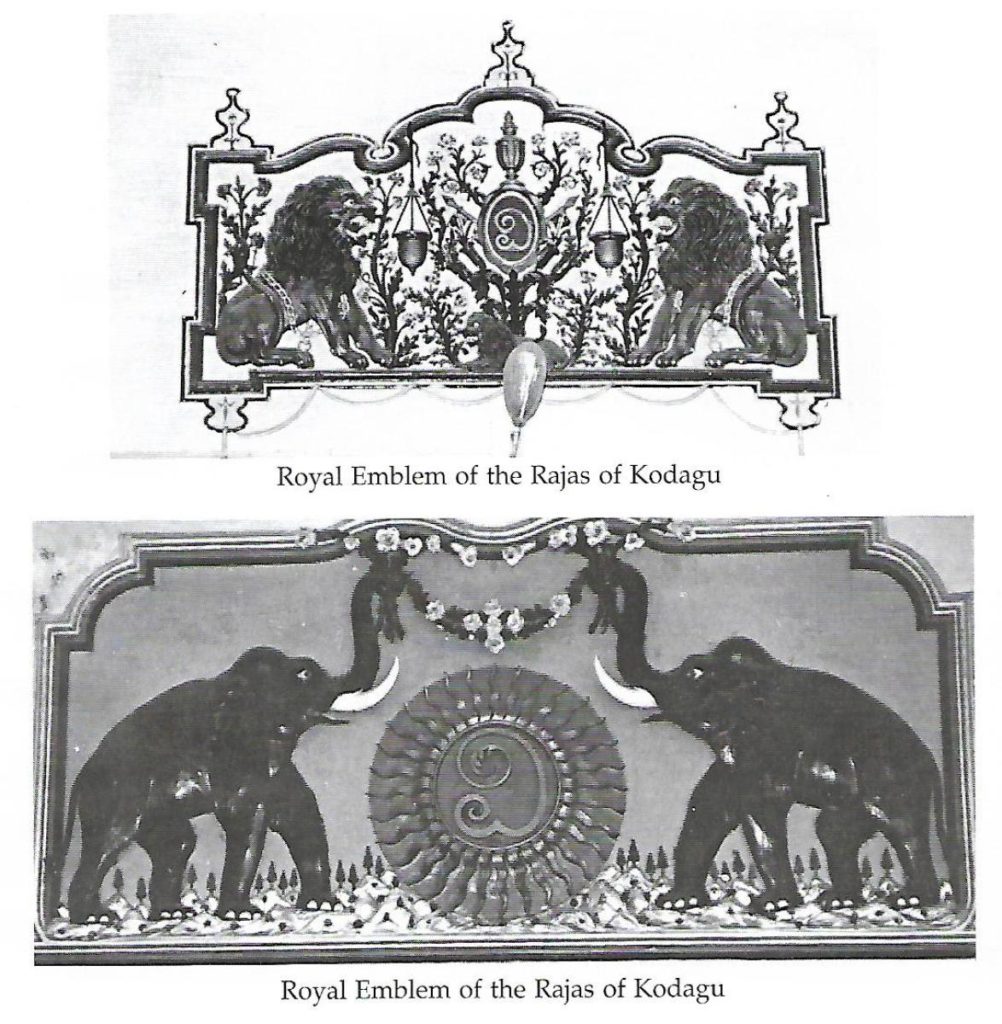
Emblem-of-DoddaVeerarajendra Photo courtesy: C P Belliappa
Subsequently, in 1806, the king even got his royal insignia redesigned by replacing the elephants with lions.
source: http://www.deccanherald.com / Deccan Herald / Home> Spectrum / by C P Belliappa / August 29th, 2020
Every year, lakhs of devotees visit Talacauvery and Bhagamandala to offer prayers to goddess Cauvery. (News18 Kannada)
The Deputy Commissioner of Kodagu, Anees Kanmani Joy has informed the Kodavas that she would discuss their demand at the highest level and would try to find a solution at the earliest.
The recent torrential rains and landslide resulted in the deaths of the chief priest and his family members at Talacauvery, the birthplace of river Cauvery. The Brahmin priest Narayana Achar, his wife and three other family members perished in a huge landslide, last week.
Now, the Kodava community, the natives of the hilly district, have demanded that the state government should return priestly duties to them from the Brahmins. Locals fear that if this issue is not dealt with carefully, it might lead to a legal battle which could take on a political colour.
Every year, lakhs of devotees visit Talacauvery and Bhagamandala to offer prayers to goddess Cauvery. Amma Kodavas, a priestly class among the Kodavas have made an official request to the Deputy Commissioner of the district in this regard.
According to them, the pooja and all other associated rituals at Talacauvery were handled by Amma Kodavas for centuries and the Brahmins had no role in Kodava religious traditions and rituals. About 150 years ago, after the annexation of princely state of Kodagu or Coorg by the British in mid-19th century, the priestly jobs were transferred to the Brahmins from the neighbouring Mysore kingdom.
Since then, the Brahmins have been conducting all religious activities at Talacauvery, which is a holy place for the Kodavas and other communities. According to Amma Kodava community leader Bananda N Prathyu, their community had transferred the rights of worship to Brahmins due to certain reasons. However, they argue that there are hundreds of historical records to prove their claims that Amma Kodavas have an ancient connection with river Cauvery and its origins.
“We are the original inhabitants of Kodagu district. We are nature worshippers. Cauvery is our goddess. We have the first right to worship at Talacauvery and Igguthappa temple”, he said.
After the tragic death of priest Narayana Achar and his wife, their two daughters who live in Australia, rushed back home to perform their parents’ last rites.
According to a report in the Kannada daily Vijayavani, when the local government officials issued a compensation in their names, they informed them that they are no longer Hindus and have converted to Christianity. This revelation has now created a furore among the devotees of Cauvery. Since the deceased priest was a leader of the Vishwa Hindu Parishat (VHP), this has now taken a political colour with opposition parties questioning BJP’s commitment to Hinduism.
The priest’s daughters have declined to comment on the conversion and have gone incommunicado. Local Tahasildar has confirmed that their given names and names on record don’t match.
The Deputy Commissioner of Kodagu, Anees Kanmani Joy has informed the Kodavas that she would discuss their demand at the highest level and would try to find a solution at the earliest.
However, some fringe groups are opposing the handing over of the temple to Kodavas, by calling it a violation of old tradition. Kodagu, Karnataka’s tiny district is known as the coffee bowl of India. With its deep forests, rivers, waterfalls and hills, Kodagu is also known as the Scotland of Karnataka.
It was ruled by the Lingayat Kings from the Haleri dynasty till 1830s. The last King Chikka Veera Rajendra was a despot and the British exploited the resentment among his subjects to annex Kodagu with British India. The deposed King was sent to Vellore in Tamil Nadu and later Benares, now Varanasi, to keep him away from his subjects.
Hoping to get his Kingdom back, Chikka Veera Rajendra travelled to England to lobby with Queen Victoria and the British Parliament. After his efforts to secure the Kingdom failed, a dejected King died in London and was buried there. His granddaughter Victoria Gowramma, whose only son died in the First World War, breathed her last in London in 1930s ending the line of succession.
The British ruled Coorg/Kodagu as a separate state for over a century till 1947. It was a separate state with an Assembly till 1956. In 1956, Kodagu was merged with Karnataka State. The martial race of Kodavas have produced two of India’s best Army Chiefs Field Marshal KM Cariappa and General KS Thimmaya. They have their own language Kodava Thakk.
source: http://www.news18.com / News18 India / Home> News18> India / by DP Satish / August 26th, 2020
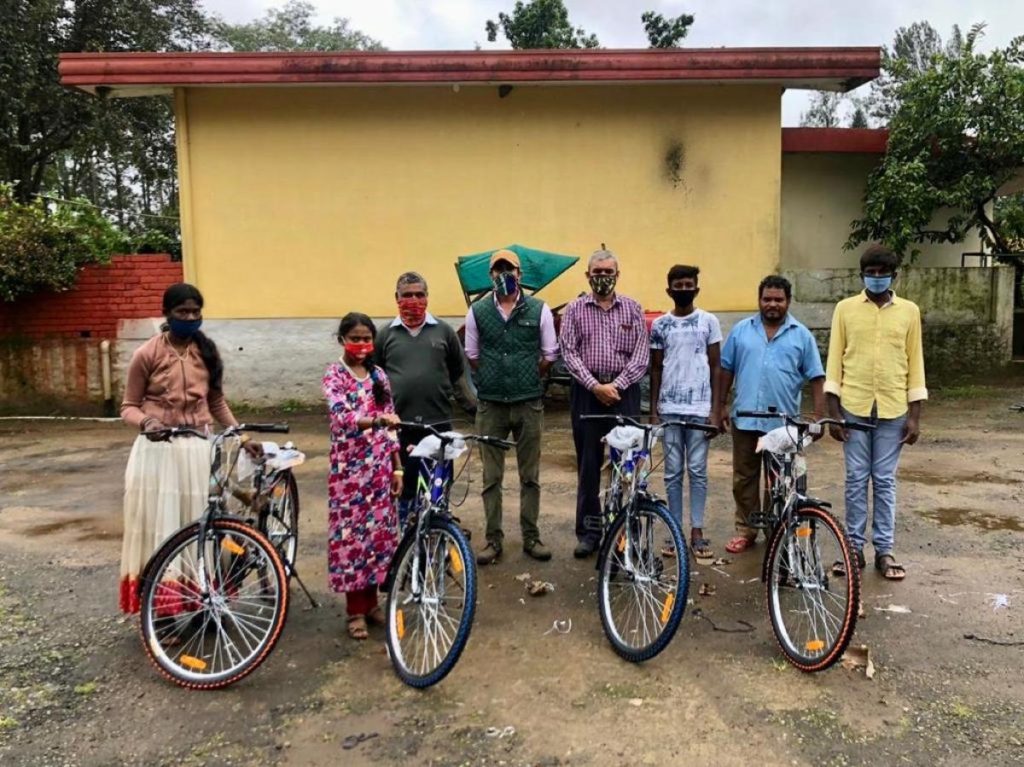
Planters and father-son duo Vinod Sivappa and Vishal Sivappa donated bicycles to the needy workers and students. DH Photo
Extending a helping hand to the needy students and agricultural labourers, a father-son duo from Suntikoppa have donated new bicycles to labourers and students to help them commute easily.
Planters and father-son duo Vinod Sivappa and Vishal Sivappa donated bicycles to the needy workers and students. DH Photo Extending a helping hand to the needy students and agricultural labourers to reach from one place to another. The livelihood of the labourers, who are dependent on plantation work, was affected due to the lack transportation facility.
Realising this Vishal Sivappa and his father Vinod Sivappa, planters from Suntikoppa, distributed bicycles to the needy workers and students.
Vishal said that his parents and grandparents were involved in social service. During the current situation, people are in need of assistance as their livelihood is affected.
“I see many students walking 5 km to 10 km to their schools and workers in various estates walk several kilometers on a daily basis. Donating bicycles would definitely help them reach their destination much faster. This is very small contribution and I am really happy to help them,” he added.
Vishal’s father Vinod is also engaged in farmer welfare programmes over the past few years. Vinod said that he felt proud to extend his support to his son’s initiatives directed towards the welfare of the needy labourers.
source: http://www.deccanherald.com / Deccan Herald / Home> State / by DHNS / August 12th, 2020
Out of 6,499 candidates who enrolled for 2019-20 SSLC exams, 6,255 attended the exams and 5,054 have passed.
Deputy Director of Public Instruction P S Machado said the district had achieved 81% results. The district stands in the 18th position in the state.
As per the new norms issued by the Education department, Kodagu has secured ‘B’ grade.
In Madikeri taluk, 1,808 students from 43 schools took the examination and 1,476 of them have passed, thereby bringing 81.64% results to the taluk.
As many as 22 schools have secured ‘A’ grade, seven schools have secured ‘B’ grade and 14 schools have received ‘C’ grade.
Somwarpet taluk has secured 78.68% results. As many as 2,482 students from 64 schools had attended the exam out of whom 1,953 have passed.
As many as 23 schools have received ‘A’ grade, 17 schools have secured ‘B’ grade and 24 schools have secured ‘C’ grade.
In Virajpet taluk, 1,965 students from 57 schools have attended SSLC exams and 1,625 have passed. The pass percentage of taluk is 82.70%.
As many as 21 schools have been awarded ‘A’ grade, 19 schools ‘B’ grade and 17 schools ‘C’ grade.
Top 10 students
The top 10 toppers in the distirct are: Jagath Poovaiah from Fatima Convent, Kushalnagar (620 marks); Gana from Sandeepani High School, Somwarpet (618 marks); Vijay M D, Morarji Desai School, Koodige (618); Anusha Ponnamma K S, Lions , Kalathmadu (617); Hritvika H S, Fatima Convent, Kushalnagar (616); Shrivatsa M K from Rajarajeshwari School, Kotturu (616) and Rasha Shareen, Sri Krishna Vidya Mandira, Siddapura (615 marks).
Supplementary exams will be held in the month of September for the students who could not make it to the exams and those who have not availed pass marks. Such students may contact the Headmasters of their respective schools for registrations, the DDPI said.
source: http://www.deccanherald.com / Deccan Herald / Home> State> Karnataka Districts / by DHNS / August 12th, 2020
WELCOME. If you like what you see "SUBSCRIBE via EMAIL" to receive FREE regular UPDATES.
Read More »