Have you explored Black Baza Coffee’s lineup, yet?
Very few coffee lovers actually research how ethical their go-to fair trade coffee brand really is, but Black Baza Coffee ‘s biodiversity-friendly, fair-trade coffee production is going the whole mile when it comes to ethically responsible community-building. The Bengaluru-based label is committed to the idea of ‘creating a local, participatory and meaningful movement for coffee.’ During her PhD in coffee and sustainability, Arshiya Bose, the founder of the label explored some functional biodiversity-friendly coffee farming practises which helped her get a better perspective on responsible production.
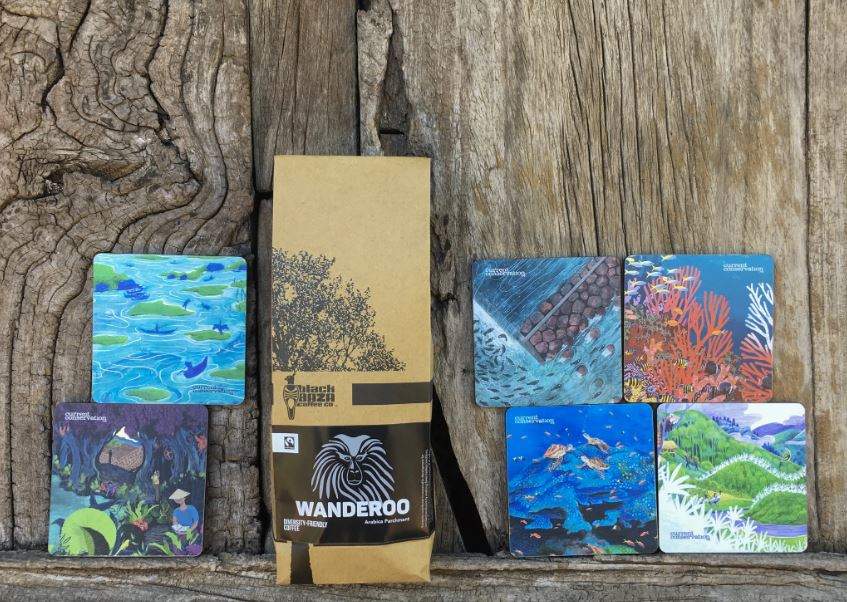
The rich and balanced Wanderoo
“Through my research I met several smallholder coffee producers, and the brand is committed to the idea of helping them grow. Black Baza Coffee is not just about eco-friendly practises but we focus on biodiversity conservation. We take a look at how various wildlife and plants make use of the coffee farms and how they can be conserved on these farms, which also includes changing the way we farm. So we go beyond organic, from looking and understanding habitats to sticking to our all-natural agenda,” Arshiya tells us. Not to mention Black Baza’s line-up is amazingly diverse, featuring coffees with layered flavour profiles, be it fermented Robusta with spicy flavour notes or washed Arabica with a balanced acidity.
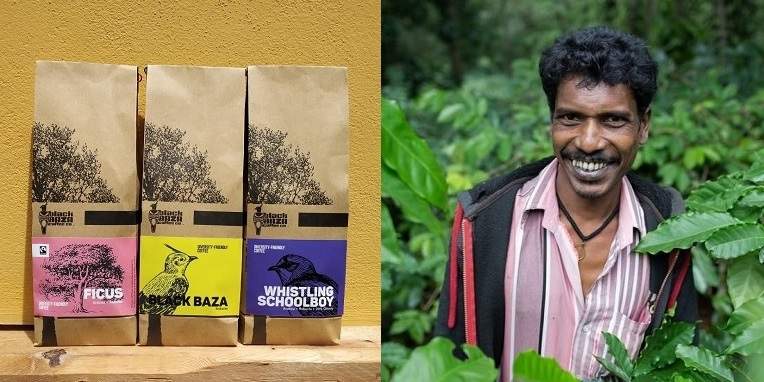
“Our Ficus coffee is named after this tree, our focus for conservation efforts in our farms,” the label writes on its Instagram page
In fact, you can even follow Black Baza’s Instagram page for their excellent fieldwork stories. We caught up with Arshiya to explore her vision further.
Black Baza Coffee has a focus on nurturing smallholders producers…
Yes, we do not work with coffee estates so we typically look at those coffee growing communities which are marginalised and vulnerable, particularly at a time like this and we work closely with them. We work with those who need our input and support the most and we are actually one of the few certified fair trade coffee brands in the country. We work with around 650 producers, we help set up coffee collectives and cooperatives. We source our coffee from The Biligirirangana Hills in Karnataka, Nilgiris, Coorg etc.
Tell us about your clientele. Do most of them share the label’s philosophy?
Yes, we have a really loyal base of customers who actively want to support communities which have suffered from the shutdown and the pandemic in general. We already had a steady base, but it has definitely grown since the pandemic started.
How has the label’s objective evolved in the four years since you started?
We are not a typical coffee brand, we function like a social enterprise, and we have definitely grown. We started out with four producers and we now work with 650, we have been able to reach so many communities who needed our support. We have also been able to source so many distinct varieties of coffees with varied flavour profiles, that’s been really interesting.
Tell us about how you’ve named each variant, like the ‘Otter,’ or the ‘Ficus’?
These coffees have been named depending on where they are grown, and represent the idea of conserving particular species of fauna which inhabit the region. The Luna coffee, for instance, is named after this interesting species of moth found in Indo-western ghats, we actively make observations of the luna moth on coffee farms, which tells us about their habitat or the vegetation around them. The names are also symbols of what we’re trying to achieve, it speaks to people about the kind of biodiversity which exists in our forests and why conserving them is so crucial.
source: http://www.indulgexpress.com / The New Indian Express – Indulge Express / by U. Roy / August 14th, 2020
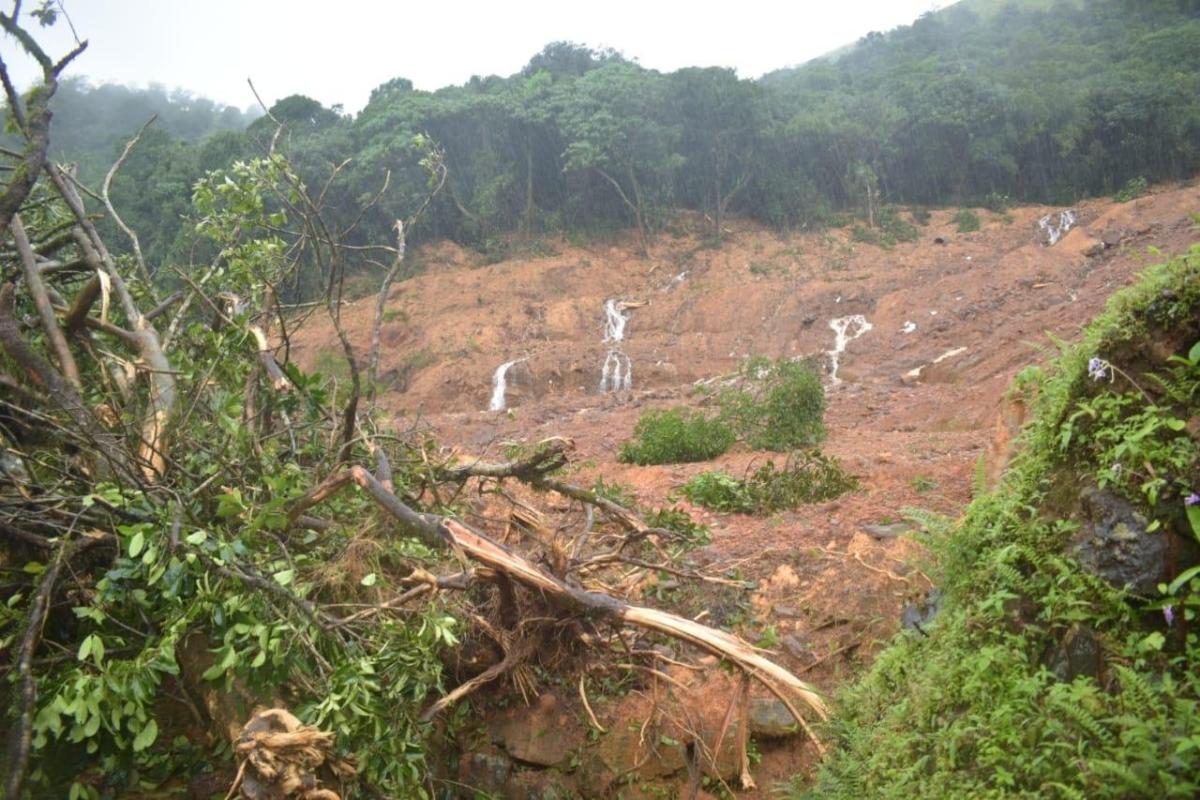
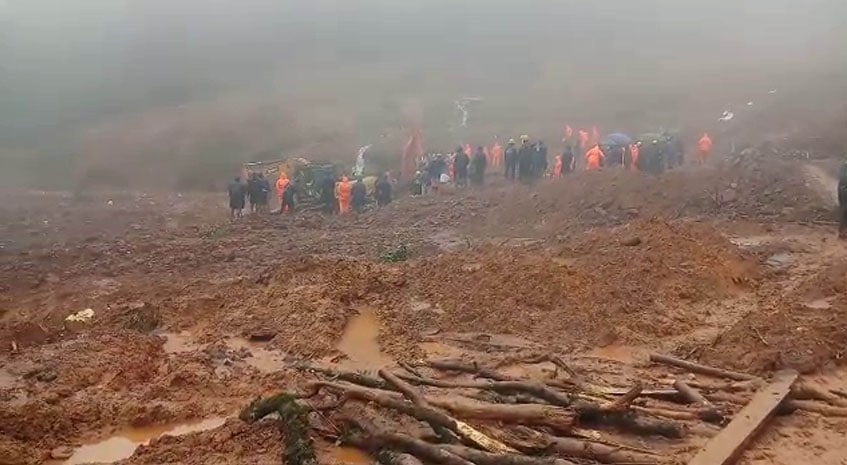
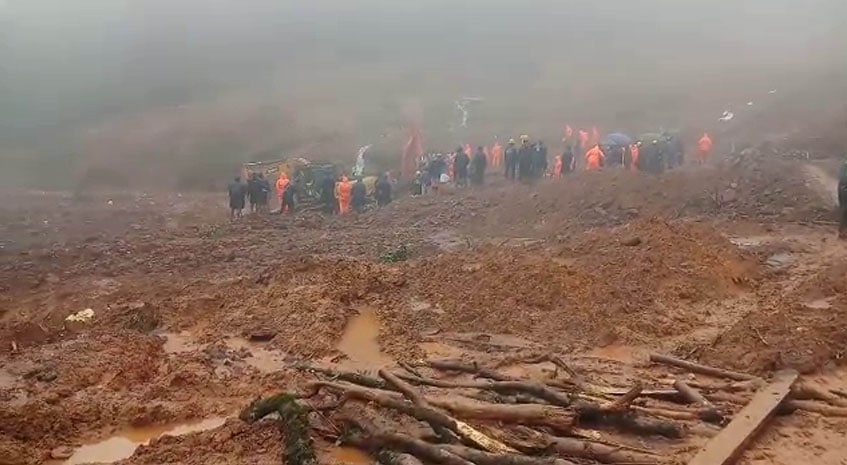
The site of landslide in the Brahmagiri range, Kodagu. DH Photo
The oft-cited maxim of the ecological sensitivity of the Western Ghats, repeated ad nauseam over the past two decades or so, has fallen on deaf ears. The failure to prevent the degradation of forests in the Sahyadris, along with the increasing instances of extreme rainfall over a short period of time — especially over the past three years — has wreaked havoc in this lifeline of South India.
The Karnataka government, which has improved its performance in terms of flood preparedness, relief work and rehabilitation measures, seems to have taken little action to prevent or mitigate future landslide hazards.
Despite the devastation, the government has either proposed or persisted with over 20 linear projects that could damage more than 25,000 hectares of forest in the region. These projects include Yettinahole River Diversion project, Kalasa-Banduri project, Sharavathy pumped storage power plant, Hubballi-Ankola railway line and many road construction and widening projects.
Worse, this year landslides have been reported in 80 locations between Mangaluru and Karwar, where highway construction work has been taken up.
Apart from infrastructure projects, change in land use norms, the lack of a long-term mitigation policy to address deterioration of green spaces and improve forest cover, and relentless expansion of plantations in the Malnad districts are just some aspects contributing to a looming environmental disaster in one of the world’s biodiversity hotspots.
Several activists, who relentlessly protested against projects in the Western Ghats, have hung up their boots, and lament the futility of their past efforts to ensure legal protection to the ecosystem.
There is no dearth of comprehensive reports on the cause of problems in the region and how to address them. In 2011, the report submitted by the Western Ghats Ecology Expert Panel, under the chairmanship of Prof Madhav Gadgil, had warned of impending natural disasters unless immediate and sustainable measures were taken to protect the ecosystem. The report sought to designate over 60% of the Western Ghats as highest-priority Ecologically Sensitive Zones.
All the states who are the custodians of the Western Ghats ignored this report. The states couldn’t come to a consensus on the subsequent Kasturirangan report even after four draft notifications, with Karnataka repeatedly rejecting the recommendations.
The Gadgil committee report was back in focus last year, as most of the places where the landslides took place were considered ecologically sensitive by the committee.
Now, the state government has set up another panel to study landslides in the region.
The benefit of commissioning a new report is still unclear. However, the government’s actions have made it evident that it is not keen on conserving the Western Ghats; experts say the degradation of forests here will have cascading effects, triggering landslides, choking streams and posing a flood threat for downstream areas, something we are witnessing today.
A scientific paper by Prof T V Ramachandra, Centre for Ecological Sciences, Indian Institute of Science and others shows that the extent of evergreen forests shrank by 16% in Kodagu between 1973 and 2018, from 40.47% to 24.17%; a loss of around 67,000 hectares of forest land. “The region had 32% of forest cover under interior or intact forests in 1973, whereas in 2018 it covers only 19% in various protected areas,” says the study.
“The expansion or construction of linear alignments would result in irreversible ecological degradation. The recent floods and landslides are certainly a warning to the decision makers of likely implications, with the drastic changes in the land cover eroding the native forest ecosystems. Further interventions will worsen the ecology and hydrology as well as livelihood, with increase in instances of human-induced calamities,” the paper warned. Yet, the state revenue department lifted a ban on the conversion of land use in Kodagu in February this year.
Degradation main cause
While environmental degradation triggering landslides is starkly evident in Kodagu, similar situations persist in all districts bordering Western Ghats – Hassan, Chikkamagaluru, Shivamogga, Dakshina Kannada, Uttara Kannada, Dharwad and Belagavi.
Conservation biologist Keshava H Korse pointed out that major landslides are being reported at core ridges of Western Ghats due to repeated disturbance of vegetation in such areas. “Bhagamandala, where major landslides were reported in the past two years, is one such area which has loose soil,” he said.
The area was classified as a highest-priority ecologically sensitive zone in the Gadgil committee report, where all development projects were expressly forbidden due to the fragility of the ecosystem. Yet, several projects were taken up here.
“The injuries to the Ghats cannot be healed in one go. Just to recover the natural vegetation where landslides have occurred, it will take four years,” Korse said.
Among the alarming incidents during the downpour in the first two weeks of August this year, were the landslides reported just six km from Linganamakki reservoir in Shivamogga district, pointed out Ananth Hegde Ashisara, Chairman of Biodiversity Board. He is heading a 10-member committee set up in February this year, to study the main causes for such landslides and to suggest an action plan to mitigate them.
Some of the places highly prone to landslides include the Kodagu DC office, villages near Jog Falls and settlements situated in the Western Ghats. “Our major challenge is to ensure people relocate from areas which are dangerous. It is a difficult task as people don’t want to move away from their homes or agricultural land,” Ashisara said.
Though reasons for landslides were varied across Malnad districts, he suspected that vegetation loss was one of the key triggers for extensive damages witnessed in Kodagu and Chikkamagaluru.
“Deforestation is high, non-agricultural use of land near the forests are prominent. The ecosystem can rejuvenate by reducing human interference in such regions. The ecosystem will revive on its own; this can be accelerated by planting flora indigenous to the region,” Ashisara said.
G S Sreenivasa Reddy, former chairman of Karnataka Natural Disaster Monitoring Cell and a member of the committee, said that there were observable changes in rainfall patterns that have triggered the crisis. “We will give recommendations on what each department should do to mitigate the problem,” he said.
According to him, the cascading effect of disturbing the Western Ghats will worsen fluctuations in the intensity of rainfall, affecting water security and crop cultivation patterns.
Col (rtd) C P Muthanna, former president of Coorg Wildlife Society, noted that Western Ghats are susceptible to even minute changes. “We are talking with the district administration to discuss measures to prevent such incidents. We are against converting land for commercial use as it causes degradation,” he said. Efforts are also being made to encourage planters to cultivate native trees inside plantations.
Sundar Rao Bantwal, who put an end to his environmental activism after the Yettinahole project was cleared, painted a gloomy picture on how environmental concerns were always sidelined over profits by politicians and contractors. “Despite a strong opposition, large projects are taken up in eco-sensitive zones. Even if we drag the cases to court, it will be of little consequence. Approaching the Green Tribunal too won’t help,” he said, citing the controversial project as an example. The project might fail in 10-15 years and neither those who approved it nor the ones constructed will take responsibility for the disaster, he added.
Ramachandra said despite recurring disasters, as many as 55% people in Kodagu are for ‘development’, while 40% are for conservation measures, with a small minority undecided. “After the last floods, we managed to convince the Deputy Commissioner to impose restrictions against resorts mushrooming in the district, which used to occupy natural courses of water. Recently, the restrictions were lifted after political interference,” he said.
Virajpet MLA K G Bopaiah was of the view that climate change was responsible for the widespread devastation. “Save for the last three years, receiving 20 inches or more rainfall in less than a week is unprecedented,” he said. Disputing that change of land use was the major cause for landslides, he said that landslides were reported where thick forests were present. “Nobody has even considered interfering in such dense forest areas,” he said.
Noting that several areas of the district were susceptible to landslides following heavy rainfall, he said that measures will be taken to address the same.
source: http://www.deccanherald.com / Deccan Herald / Home> Specials> Insight / by Akram Mohammed, DHNS, Bengaluru / August 15th, 2020
The doubles world No. 37 is the only Indian who will play the ATP 1000 Cincinnati Open, which marks the return of the men’s ATP Tour after a five-month break.
Rohan Bopanna will fly around 8,000 miles from India to the US before covering half of that distance next month to go from the US to Europe, touching down on three countries in a span of a month-and-a-half during a pandemic. All this to play just four tournaments.
It’s an unusual itinerary, for professional tennis players normally club together a bunch of tournaments in one continent in a season. But in the current scenario, Bopanna, India’s highest-ranked tennis pro, will partner Canadian rising star Denis Shapovalov to play the ATP Cincinnati Open (from August 22) and the US Open (August 31) in New York, the Rome Masters (September 14) and the French Open (September 27) in Paris before returning home.
The doubles world No. 37 is the only Indian who will play the ATP 1000 Cincinnati Open, which marks the return of the men’s ATP Tour after a five-month break while also acting as a curtain-raiser to the hard-court Grand Slam at the same venue.
“Mixed feelings about being back (on the Tour),” Bopanna said over phone before taking his flight from Bengaluru to New York early Saturday morning. “I have a daughter who is now going to be 15 months old, so it was special spending time with her and being with her at home.
“I love competing and am really happy to be back. Having said that, the tournaments will feel different with no people watching. There are so many restrictions with the US Open in terms of the (halved) doubles draw and no singles qualifying. So, yes, it’s a Grand Slam, but it’s kind of a closed Grand Slam. So I’m not really sure what to expect,” he added.
For a long time, the 40-year-old also wasn’t sure if he would make the journey to New York, with different travel and quarantine restrictions in place. But once India started limited flights to USA and the participating players at the US Open were promised a waiver of the quarantine period, Bopanna decided to give it a shot despite the reservations.
“Initially nobody was sure because we don’t have any firsthand information about how things are planned there. We are only reading and receiving information. But once they put in place the protocols and logistics of how everything was going to be carried out, it made it a little easier to make the decision to travel. The main thing was the flights had to open up in India,” he said.
Bopanna took a Covid-19 test on Wednesday – which returned negative – before his flight. He will be tested again once he checks into the designated hotel in Queens and enters the bio bubble before a range of regulations and restrictions kick in. “I’m going with an open mind. Once we get there I think we’ll have a better idea of how things are. But there will be no access to Manhattan or any restaurants or anything else. It’s just tennis courts and back. So I’ll kind of be in another lockdown, only this time in New York!” Bopanna said.
The US Open might be on but it will lack in flavor. A number of top-100 players, including the men’s and women’s singles defending champions, have pulled out while both the tournaments in New York will be played behind closed doors.
“Not at all surprised that some players have decided not to go,” the 2017 French Open mixed doubles champion said. “It’s a purely personal decision; I don’t think anybody can be held for that. Everyone has different thoughts on the situation. But that’s the beauty of our sport—you can make your own call.”
Bopanna was the first tennis pro to resume training in India, hitting the courts in Bengaluru in June before recurrences of the lockdown in the state disrupted his continuity. He feels his preparation after a long break has been adequate but is going to take it one game at a time.
“Physically I’m feeling great. I’ve been doing a lot of Iyengar Yoga, which has enhanced my physical strength. I’ve been practising in my academy for the past three weeks, both on clay and hard courts. So in terms of hitting the ball, I feel fine. Clearly, no one will be match-sharp. We just have to take things, literally and absolutely, one match at a time. There’s no point thinking too far ahead,” he said.
There sure isn’t. Tournaments continue to get cancelled and there is no certainty about how the Tour will shape up after the French Open ends in October. Bopanna thus wants to treat this two-month phase like the start of a fresh season wherein players play a tournament or two before heading straight into the year’s first Grand Slam, the Australian Open.
“It’s the same scenario here. It’s very difficult to say how it’s going to be and there’s no point pre-guessing it. All I know for a fact now is that once I leave, I won’t be coming back immediately. I’ll play all the four tournaments, return to India and get quarantined,” he said.
source: http://www.hindustantimes.com / Hindustan Times / Home> Tennis / by Rutvick Mehta, Mumbai / August 16th, 2020
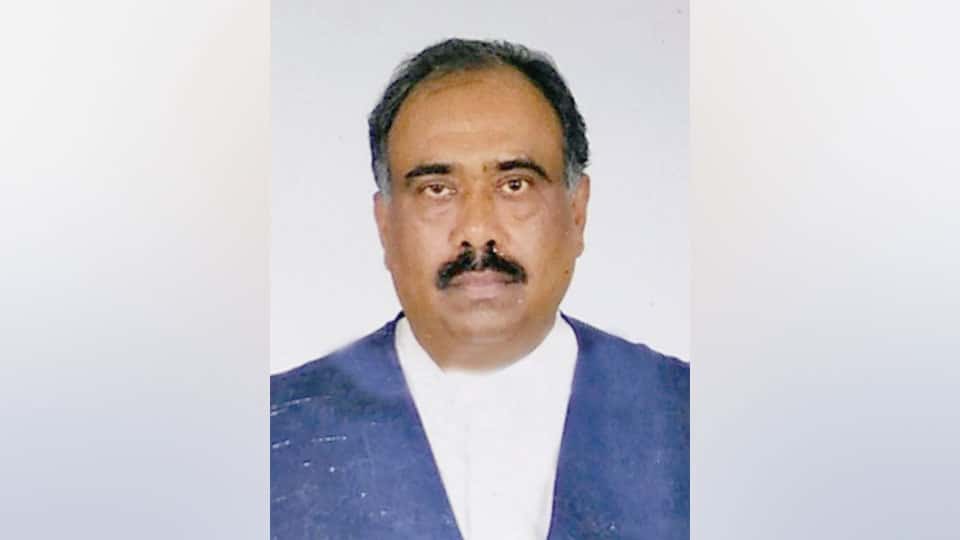
Berera Shambhu Aiyanna (73), former President of Bengaluru Kodava Samaja, a social worker and a resident of Vidyranyapura in Bengaluru, passed away early this morning at his residence.
He leaves behind his wife and two sons. Cremation was held this afternoon at Bengaluru.
source: http://www.starofmysore.com / Star of Mysore / Home> Obituary / August 18th, 2020
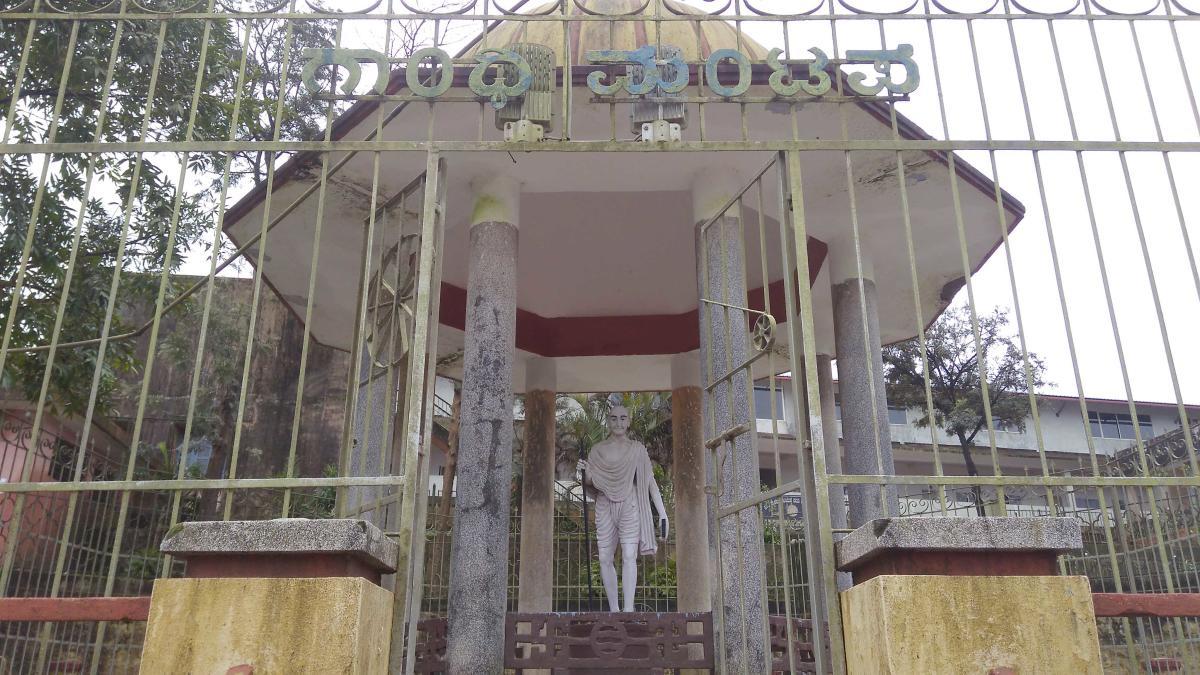
Gandhi Mantapa in Madikeri was built to commemorate Mahatma Gandhi’s visit to Kodagu in 1934. DH file photo
It was a cold February morning in 1934, when a young Seethamma, around 10 years old, woke up with excitement. After all, it was an important day and all she wanted was to catch a glimpse of Mahatma Gandhi, who happened to be in Kodagu.
Gandhi was set to address a gathering at Kakotuparambu grounds in Virajpet that day and Seethamma had to cover several miles on foot to reach the venue.
Her parents and cousins were already waiting outside and they all set out towards the venue immediately, only stopping to wash their faces in a small stream on the way. When they reached the ground, a large crowd had gathered and they saw the Mahatma from a distance.
“Gandhiji was sitting on the stage with his legs crossed to one side,” Seethamma would often tell her children and grandchildren, recalling that historic day. Just a glimpse of the great man was her most treasured memory.
A middle-aged Seethamma
The Mahatma, who was touring Tamil Nadu to mobilise funds for the upliftment of ‘Harijans’, was invited to Kodagu by Pandyanda I Belliappa and other freedom fighters of the district, which was then a Chief Commissioner’s Province.
On arriving at Kodagu, the Mahatma and his entourage first visited a Harijan colony in Gonicoppa, following which he addressed a meeting mostly attended by women. Though on a short visit, Gandhi also addressed gatherings at Ponnampet, Somwarpet and Madikeri among other places. He appealed to the people to donate generously to help the victims of an earthquake that had hit Bihar in January that year and also requested them to contribute to the Harijan Welfare Fund.
He asked the women to donate their gold jewellery and ornaments for the cause, while stating that, “The amount is not important to me because it is a token of tangible sympathy to the suffering. Thus, even a copper coin is valuable.”
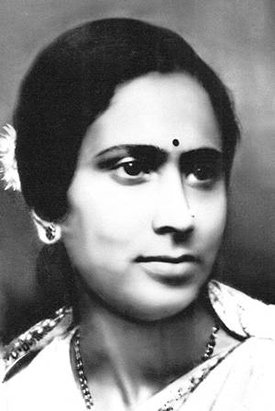
Moved by the appeal, writer Kodagina Gowramma, who was around 22 years at the time, famously donated all her gold ornaments to the Harijan Welfare Fund.
Kodagina Gowramma. Courtesy: Wikipedia
Seethamma and Gowramma, and several others like them knowingly or unknowingly became part of the national movement – which was as much about uniting the very diverse people of India as it was about fighting a foreign rule.
Such was Gandhi’s charisma that he inspired people, young and old; women and men; poor and rich. This made the freedom movement a mass movement.
source: http://www.deccanherald.com / Deccan Herald / Home> Spectrum > Spectrum Statescan / by Dhanyata M Poovaiah / August 15th, 2020
Twenty years before the First War of Independence in 1857, there was the ‘Amara Sullia Dange’ or Kodagu- Canara Mutiny against the British government. This fight, which was labelled ‘Kalyanappana Katakayi’ (Loot of Kalyanappa), to tone down its significance, received unprecedented support from people in today’s Kodagu, Dakshina Kannada districts of Karnataka and Kumble region in Kerala.
After Tipu Sultan’s death in 1799, South Canara (Dakshina Kannada) passed into British hands. Neighbouring Kodagu, however, still maintained a precarious independence.
In 1834, the East India Company resolved to invade Kodagu, which was ruled by King Chikkaveera Rajendra of Haleri dynasty. On April 11, 1834, the political agent of the British at Mercara (Madikeri), Lieutenant Colonel J S Fraser, issued a proclamation annexing Kodagu into the British administration. Fraser also resolved to respect the social and religious customs of the locals, but the promise remained on paper.
The British introduced major economic, social, and even territorial changes in Kodagu, for their administrative convenience. Amara Sullia was separated from Kodagu and made part of South Canara district, which was then part of the Madras province. What further incensed the people was a change in the mode of tax payment, which was now to be made entirely in cash. The farmers were used to giving part of their produce as the tax, but the new system only added to their burden. Now, many of them refused to pay the tax outright.
After Kodagu’s annexation, there was a resistance movement planned. In 1835, Swamy Aparampara, a Jangama saint, appeared in Manjarabad in Hassan district and claimed that he was a legal heir to the Haleri throne.
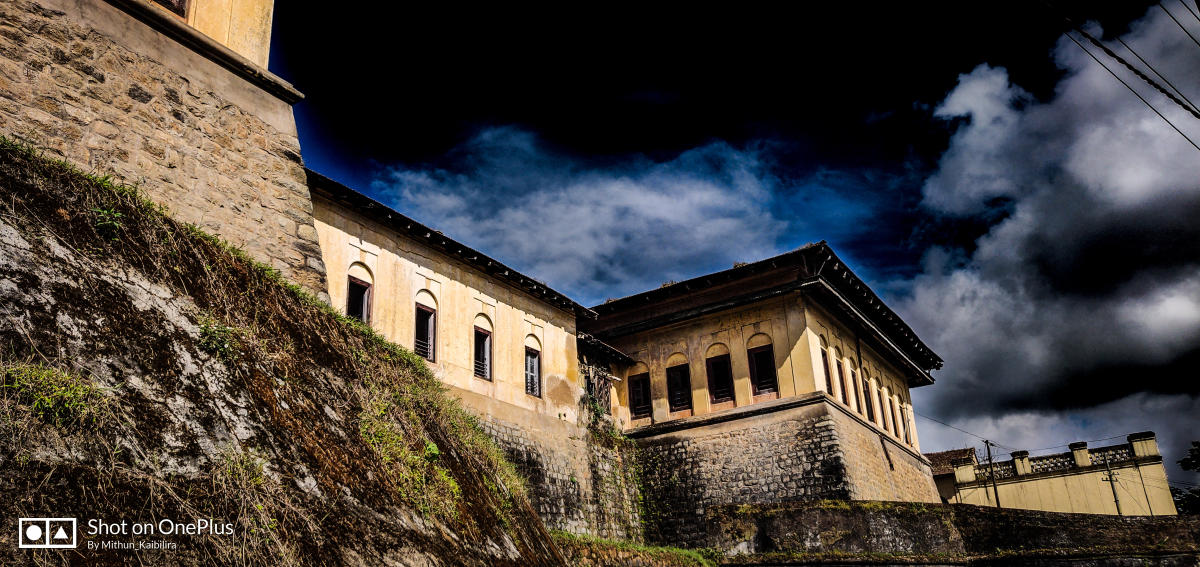
Madikeri Fort
His plan was to attack and occupy Madikeri Fort on December 5, 1836. The people of Kodagu believed him to be the son of Appaji, who was the uncle of Chikkaveera Rajendra. Aparampara planned a resistance movement with the help of other rebellions including Kalyanaswamy, Kedambadi Rame Gowda and Guddemane Appayya Gowda. Aparampara visited Subrahmanya and met Kujugodu Appayya Gowda and Mallappa Gowda, the representatives of the Ikkeri dynasty. From there, they marched towards Madikeri with a battalion.
The British got wind of the plan and imprisoned Aparampara, with the aid of Kodagu’s Dewan, Cheppudira Ponnappa.
Now, the responsibility of the movement shifted onto the shoulders of Kalyanaswamy. He claimed to be the second son of Appaji and therefore, a member of the Haleri dynasty. Declared a king by his men, he popularised the movement by proclaiming that if he became the king, he would stop collecting revenue for the first three years and abolish the duties on commodities.
Dewan Ponnappa proved that Kalyanaswamy didn’t belong to the Haleri dynasty. However, the rebel leader remained popular and enjoyed support from local leaders.
Kalyanaswamy slowly extended the movement to Sullia and other parts of South Canara. Kedambadi Ramegowda of Sullia was primarily responsible for the organisation of rebellion in South Canara. When Kalyanaswamy was travelling from Kodlipet to Wayanad, he was captured by the British forces, though his imprisonment was concealed. His friend Putta Basappa posed as Kalyanappa and continued the rebellion.
Meanwhile, the resentment against the new tax policy continued, and Kedambadi Ramegowda and Nanjayya decided to start a rebellion in Sullia. They killed Atlur Ramappaya, the Amaldar (Agent) of Sullia, who was loyal to the British.
The battalion, headed by Kalyanappa (Putta Basappa), Kedambadi Ramegowda and others reached Bellare and attacked the British treasury. The rebels then reached Mangalore and hoisted the Haleri flag in ‘Bavutagudda’ on April 5, 1837, to mark their victory over the British.
In response, the British brought in reinforcements from Kannanur, and attacked the rebels. Several leaders were captured and killed, while a few others escaped. Putta Basappa and Appayya Gowda were hanged.
The British Commissioner Cotton, who submitted a report on the Canara Insurrection to the government in 1839, mentioned the movement was a furtherance of the Nagar Peasants’ Revolt of 1830-32, in present-day Shivamogga. “The Amara Sullia insurrection has the features of primary resistance, as well as peasants’ movement; the main intention was to drive away the colonial intruders,” says K R Vidyadhara, a lawyer in Madikeri who has studied the uprising.
A few scholars have conducted extensive studies on the Amara Sullia mutiny, with the incident even being portrayed in a Yakshagana performance called ‘Kalyanappana Katakayi’.
source: http://www.deccanherald.com / Deccan Herald / Home> Spectrum> Spectrum Top Stories / by Charan Aivarnad / August 15th, 2020
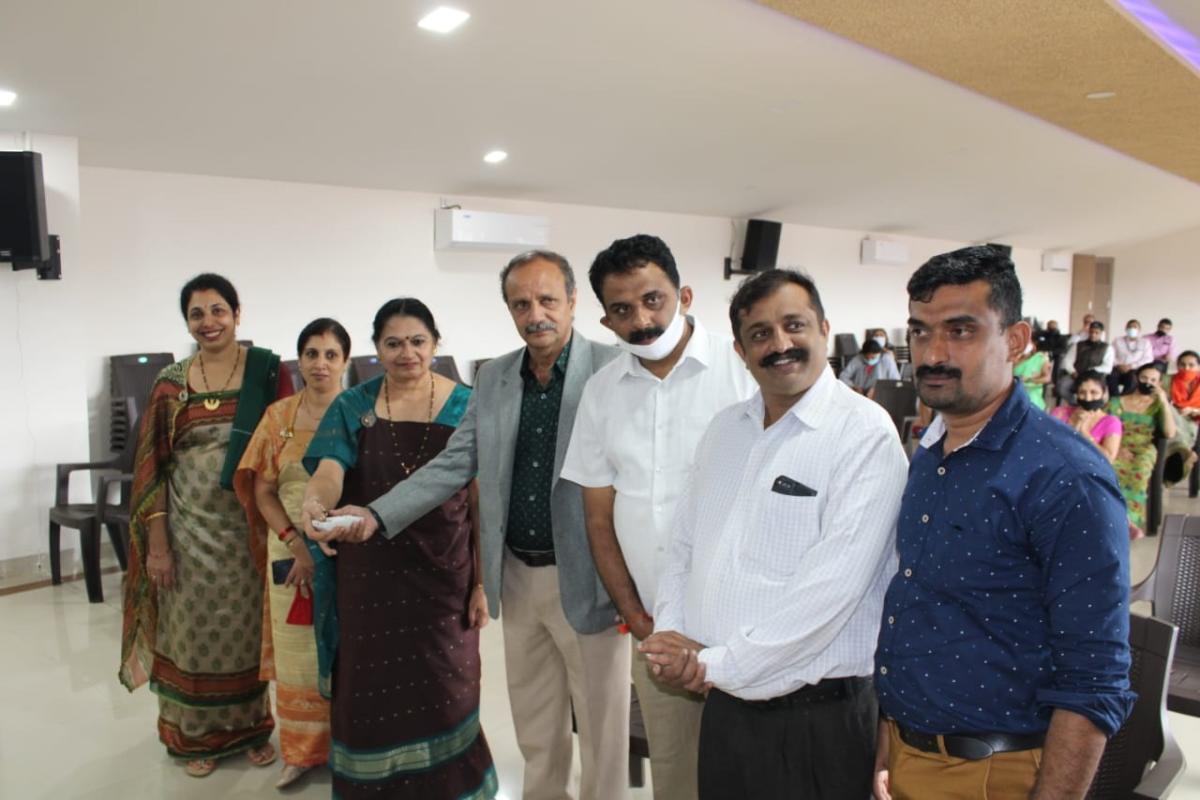
Kodava Education Society Joint Secretary Chiriyapanda Raja Nanjappa inaugurates ‘Kodavame Padipu’ programme at CIT PU College in Ponnampet on Wednesday. Karnataka Kodava Sahitya Academy Chairperson Dr Parvathi Appaiah, Academy member Dr Mullengada Revathi
People are busy in agricultural activities during the month of Kakkada and also it keeps raining during the month. Hence, our ancestors imposed restrictions on holding auspicious programmes during Kakkada month, opined Kodava Sahitya Academy member Dr Mullengada Revathi Poovaiah.
Speaking during ‘Kodavame Padipu’ programme, organised by Karnataka Kodava Sahitya Academy, at Coorg Institute of Technology (CIT) in Ponnampet on Wednesday, she said that the youth should understand the reasons behind the religious rituals. “Our elders gave a lot of importance to indigenous food and used them during the rainy season. They planned their food according to the seasons,” Revathi added.
Inaugurating the programme, Kodava Education Society Joint Secretary Chiriyapanda Raja Nanjappa said it is believed that the Kodava tribe was present during the origination of River Cauvery and called upon the present generation to get acquainted with the local tradition and culture.
He further said, “The Jamma land is not government land. It is inherited by Kodavas from generations. Also, the gun is used for religious rituals in Kodava culture. However, our ancestors did not use a gun for fighting. Gun rights of Kodavas should be preserved, he added.
During the programme, the resource persons spoke on the importance of ‘Kakkada Padinett’, ‘Kakkada Tingalra Pudume’, ‘Kodava Namme’ and ‘Kodava Takk.
Karnataka Kodava Sahitya Academy Chairperson Dr Ammatanda Parvathi Appaiah, member Padinjaranda Prabhukumar, CIT PU College Principal Dr Sannuvanda Rohini Thimmaiah, Thookbolak Kala Sahitya Vedike convener Madhosh Poovaiah and others were present.
Students of CIT PU College watched the programme online.
An erstwhile independent state, Coorg was merged with Mysore after the States Reorganisation Act was passed in 1956.
It was S Nijalingappa’s death anniversary on August 8 and I was reading about the unified Mysore state’s first Assembly elections in order to get some insights about the first and one of the longest serving Chief Ministers of our state. One article led to another and I found myself in the middle of several articles about Coorg’s merger with Mysore. It was such an interesting revelation that I kept hopping from one article to another and got deeper into the rabbit hole.
Since most of us outside of Kodagu are informed just in passing in our textbooks about how Coorg was an independent state before the unification, I thought this was a story worth telling.
After more than a century of direct British rule since its annexation from its last ruler Chikka Veera Rajendra (in 1834), Coorg became an independent (Type C) state within India along with other small, hilly, erstwhile princely states like Himachal Pradesh. Coorg had a strong Congress party presence and participated enthusiastically in the freedom struggle, with even stalwarts like Gandhi visiting the state on a few occasions to mobilise the immensely patriotic people from the land of coffee, commanders and Kaveri.
But the Congress leadership within Coorg was heavily divided over whether to remain an independent state or to join the larger neighbouring state of Mysore. While one faction led by the Gandhian CM Poonacha was more pragmatic in seeing the impracticality of a tiny state like Coorg being allowed to remain independent in a country as large as India and being open to the idea of merging with Mysore since Kannada was already the language broadly used in education and administration within Coorg, the other faction led by another Gandhian Pandiyanda Belliappa was , staunchly against the merger. The loyalty of both factions and leaders, however, lay with the Congress.
When the legislative assembly elections were announced in late 1951, to be held along with the first ever election to independent India’s parliament, the Pandiyanda Belliappa faction moved away from the Mysore-sympathetic Congress and formed the Thakkadi Party (weighing machine), contesting as independents on the plank of Coorg’s continuation as an independent state.
In what was a Brexit style election to decide the future of Coorg state, the Congress emerged victorious, winning 15 seats in the 24-member Coorg Assembly, while the Thakkadi Party won the remaining 9 seats. Questions were raised about the fairness of the elections as allegations surfaced that voters were sent from the neighbouring towns in Mysore to vote for the Congress, in effect for Coorg’s merger with Mysore. Poonacha, however, took oath as Coorg’s first and only elected Chief Minister and ruled till 1956 with a two-member Cabinet.
In 1956, the States Reorganisation Act was passed in the Parliament by the Nehru government, allowing Coorg’s merger with Mysore. Several efforts were made by key dignitaries from Coorg to secure an independent state status, including the decorated Field Marshal KM Cariappa, who was then serving as India’s High Commissioner to Australia and New Zealand. He wrote a letter to President Rajendra Prasad, making a case for Coorg to remain an independent state. But it proved too little, too late as the Nehru-led Congress government remained committed to the Act and reined in dissent within the party units across states.
When the bill was taken up to be voted by Coorg’s Assembly as it required ratification by state assemblies before becoming a legislation, 22 out of 24 legislators, including Pandiyanda Belliappa, voted for Coorg’s merger with Mysore. The first and only elected legislative assembly and government of Coorg was thus dissolved, paving the way for its integration with the unified Mysore state.
Poonacha went on to serve both the Mysore and central governments in various capacities as cabinet minister holding various important portfolios, and also served as the Governor of Odisha and Madhya Pradesh. He was also Coorg’s representative in the Constituent Assembly. Coorg also sent two members to independent India’s first elected Parliament. After its merger with Mysore, however, Coorg was clubbed with Mangalore earlier and Mysore later into a single parliamentary constituency. It sends two legislators to the 224-member state assembly of Karnataka.
Many people in Coorg are still divided and emotional over the issue of Coorg’s merger with Mysore. The Codava National Council, under the leadership of NU Nachappa, fought for the restoration of statehood for Coorg for several decades. But it has now toned down its demand to that of an autonomous development board exclusively for Coorg within Karnataka, with many other perks similar to those offered to other sparsely populated hilly regions and tribes in the Himalayas and the North East.
Kodagu, the official name of the district, is one of the most developed districts of Karnataka across most parameters of development. With an HDI of 0.817, it is only behind Bengaluru, Dakshina Kannada and Udupi in terms of human development. As it reels under another bout of floods this monsoon, let us keep the beautiful Coorg in our prayers and cherish its less known history.
Rakshith S Ponnathpur is a financial and economic policy researcher with a keen interest in Karnataka history and politics.
source: http://www.thenewsminute.com / The News Minute / Home> News> History / by Rakshith S Ponnathpur / August 12th, 2020
As rains have abated in Kodagu, rescue operations have been initiated in full swing and over 150 personnel from National Disaster Response Force (NDRF), State Disaster Response Force (SDRF) and Madras Engineering Group (MEG) are carrying out search for the priest family that was washed away at Talacauvery on Wednesday midnight.
Five persons of a family including the Chief Priest of Sri Cauvery Temple T.S. Narayanachar are buried alive as a portion of the Brahmagiri Hill collapsed on two houses where the priests lived. Along with Narayanachar, his wife Shantha Narayana, Narayanachar’s brother Anandathirtha Swamiji and relatives Ravikiran Bhat and Pavan Bhat are feared to be dead.
In the search carried out on Saturday, the body of Anandathirtha was found. Search is on to find other missing persons. Meanwhile, daughters of Narayanachar-Shantha couple Sharada and Namitha who are settled in Australia and New Zealand have reached Talacauvery and are discussing with the rescue personnel about the rescue operations.
Rains have abated in the hilly district but areas where River Cauvery flows are still deep under water. Flood situation at Balamuri and Kottamudi remains to be grim as water level has not receded. The connection between Murnad and Napoklu continues to be disrupted. Flood waters have receded in Kushalnagar and the residents have begun cleaning their houses to make them fit for living.
source: http://www.starofmysore.com / Star of Mysore / Home> News / August 10th, 2020
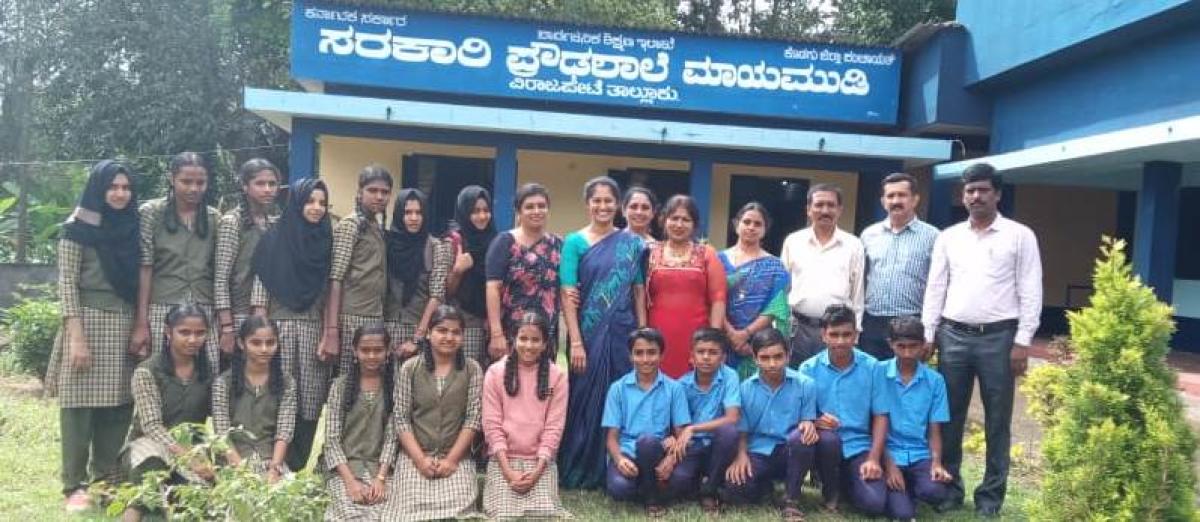
Students and teachers of Government High School in Mayamudi, which has achieved 100% results in SSLC examinations. DH Photo
Kodagu district stood at the 18th position in the state in the SSLC examination results announced on Monday.
The district has shown a lot of improvement as it was in the 22nd position last year.
This year, a total of 7,164 students took SSLC exams in 27 exam centres in the district. Among them, 74 candidates were from Covid-19 containment zones.
Jagath Poovaiah of Fathima Convent in Kushalnagar has emerged as the district topper while scoring 620 out of 625 marks.
Gana, a student of Sandeepani School in Somwarpet, has scored 618 marks and is the second topper from the district. She has scored 122 marks in first language Kannada, 97 in English and 100 each in Hindi, Mathematics, Science and Social Studies.
Other toppers
Vijaya M D from Morarji Desai Residential School and K S Anusha from Lions School, Gonikoppa, have secured 617 marks each and share the third place in the district.
H K Rahul from Vishwamanava Kuvempu High School of Chowdlu village has secured 607 marks.
OLV English Medium School student N K Shravani has secured 605 marks.
Government High School in Mayamudi has secured 100% results. The students have excelled in the examinations, despite the pandemic. Most of the students in the school are from economically backward families and therefore, their achievement is worth a praise, Headteacher Vani Nachappa said.
Other schools which have registered 100% results are: Morarji Desai Residential School in Basavanahalli, Cauvery School and Pragathi School in Virajpet, St Annamma High School and Bright School in Virajpet, Sandeepani English Medium School and Vishwamanava Kuvempu English Medium School in Somwarpet and Shantinikethana School, Kodagarahalli.
source: http://www.deccanherald.com / Deccan Herald / Home> State> Karnataka Districts / by DHNS / August 11th, 2020
WELCOME. If you like what you see "SUBSCRIBE via EMAIL" to receive FREE regular UPDATES.
Read More »