Ganesh and Daisy Bopanna are back

This Sunday, watch the famous Sandalwood film Gaalipatta starring Ganesh and Daisy Bopanna on Suvarna TV.

The film, which was released in 2008, was directed by Yogaraj Bhat and produced by Suryaprakash Rao and AM Rathnam. The plot is about three friends, Ganesh (Ganesh), Diganth (Diganth) and Kitty (Rajesh Krishnan) and their respective love stories.

The crux of the story is how Diganth and Kitty get a go ahead for their weddings, but how Ganesh’s love story takes a different twist.

Watch the film at 3 pm on Suvarna TV this Sunday.

source: http://www.timesofindia.indiatimes.com / The Times of India / Home> Entertainment> Kannada> TV / by TNN / March 02nd, 2014

‘Will Protect Plantations in Kodagu’

Revenue Minister V Srinivasa Prasad said he would visit Kodagu district to assess the misuse of sections 79(a) and (b) of the Karnataka Land Reforms Act.

The sale of plantation land to non-agriculturists to set up resorts and cottages would also be looked into, he said.

Replying to a calling attention motion from Janata Dal(S) floor leader M C Nanaiah in the Legislative Council on Thursday, the Minister said the government was committed to the protection of plantation land in Kodagu.

Nanaiah said plantations where coffee, cardamom and rubber are grown had been exempted from the purview of the Act.

“Revenue officials, deeming these plantations to be non-agricultural land, have been allowing its sale. According to the rules, such lands cannot be sold to non-agriculturists. The buyers plant saplings of coffee, banana and cardamom to show that they are using the land for agriculture and construct resorts,” Nanaiah said.

6,000 Acres Sold

The floor leader said the going price of an acre of plantation land was `40 lakh. Already, over 6,000 acres has been sold to non-agriculturists in Kodagu district and 3,000 applications to register properties were pending before the Revenue Department, Nanaiah alleged.

“The Kodavas are becoming aliens in their own homeland. Forest cover is being eroded due to mushrooming of resorts. There is danger in store if plantation land in catchment areas of the Cauvery is sold to non-agriculturists,” Nanaiah warned.Promise of ActionResponding to Nanaiah’s statements, the Minister declared that those revenue officials who were allegedly hand-in-glove with land sharks and fixing land deals would be dealt with an iron hand.

source: http://www.newindianexpress.com / The New Indian Express / Home> States> Karnataka / by Express News Service – Bangalore / February 21st, 2014

Indian coffee prices gain at weekly auction

Feb 21 (Reuters):

Coffee prices in India edged higher at a weekly auction due to strong overseas leads and robust export demand for the beans.

* Arabica Plantation PB grade price was higher by 1,925 rupees per 50 kg, A and AA grade prices were higher by 1,860- 1,990 per 50 kg, B grade price was higher by 1,970 rupees per 50 kg and C grade price rose by 1,500 rupees per 50 kg compared to the last sale date.

* Arabica Coffee price in New York for March was higher 30.70 cents per pound. Robusta coffee price in London for March was higher by $160 per tonne in the week to Jan. 20.

* About 71,000 kg of coffee from the total 186,897 kg on offer was sold.

Arabica accounted for 111,442 kg, while robusta made up 75,455 kg.* Coffee output in India may fall 10.23 percent to 311,500 tonnes in the crop year started October 2013 due to untimely rains in southern Karnataka state, the major producer, the government-run Coffee Board said in its post-monsoon crop forecast.

===============================

Price range per 50 kgs

New Season (2013-14 crop)
================================
Arabica Plantation

PB 12,
200A 12,
500-12,
600AA 12,
600B 12,
150-12,
200C 10,
250-10,
300BBB 7,
500-8,160

source: http://www.in.reuters.com / Home> Mumbai / Reporting by Siddesh Mayenkar , Editing by Prateek Chatterjee / February 21st, 2014

FARMER’S NOTEBOOK : A package of practices for profitable coffee, black pepper cultivation

EMPOWERED: Attending one of the seminars organised by IISR’s Cardamom Research Centre (CRC) at Appangala in Kodagu on spices cultivation was a turning point in Mrs. Prema Ganesh’s life./ Special Arrangement / The Hindu

Agriculture is no more a male dominated sector, as many women have shown that they are second to none in this field. “Women can be successful agriculturists, if they are supported with timely technological interventions by scientists and encouragement from family”, says Dr. M. Anandaraj, Director of the Indian Institute of Spices Research (IISR), Kozhikode.
Mrs. Prema Ganesh from Maragodu village, Kodagu District, Karnataka is a role model for other women in this field.

Several problems

When she ventured to take over her coffee and black pepper plantation in 10 hectares a decade ago, several problems started surfacing, especially the low productivity of crops, making agriculture a non profitable enterprise.Keen to overcome them, she happened to attend one of the seminars organised by IISR’s Cardamom Research Centre (CRC) at Appangala in Kodagu on spices cultivation.“It was a turning point in my life,” recollects Ms Ganesh.

The scientists at CRC assured full technological support to her ventures. A team from CRC visited her plantation and identified some major production constraints such as high plant density per unit area, prevalence of diseases and pests, problems like spike shedding in black pepper etc.They provided a complete package of practices to be followed including thinning of excess plant growth to maintain optimum spacing among them, adoption of basin management techniques like application of organic manures, micronutrient application, earthing up and mulching for various crops.“In the case of black pepper, special recommendations like basin irrigation at the rate of 40-50 litres of water at 4-5 times per vine at an interval of 5-7 days during May-June in case of delayed monsoon, regulation of shade by pruning the support trees to provide minimum 50-60 per cent exposure to sunlight were suggested,” says Dr. S J Ankegowda, Head, CRC, AppangalaFor diseases and pests, spraying of two rounds of Bordeaux during June and August/September and one round of drenching with 0.2 per cent Copper Oxy Chloride (COC), and need based application of insecticides were also recommended.Trees like balangi, palawan and silver oak were planted at a spacing of 15×15 feet (random) to provide adequate shade to the crops.In addition she readied several rainwater harvesting pits of 10 feet length, 1.5 feet width and 1.5 feet depth between the coffee plants.These pits also serve as compost pits where all the farm wastes are dumped for two years to decompose after which they are removed and applied as organic manure to coffee and pepper, substantially reducing the cost on purchase of farm yard manure.

Composed husks

Ms. Ganesh makes use of composed coffee cherry husk, a by-product of coffee pulping, after mixing with cow dung as an additional source of organic manure.Annually she spends Rs. 35,000 per acre as operational cost and gets about Rs. 25 lakhs a year as net income from both black pepper and coffee. Reducing manual labour was an important initiative by her.“First thing they did was to lay motorable roads inside the plantation. This has reduced the strain in carrying the harvested produce in bags by labourers.Before the roads were laid, a labourer would take about 30 minutes to carry the bag to the main road for loading it on the lorries.“The physical strain was quite heavy. But now this has considerably reduced since the vehicles can come into the plantation,” says Dr. Ankegowda.

Underground irrigation

Another initiative was the underground pipe-lining for irrigation. Today the entire plantation has well connected irrigation line ready for irrigation all through the year.For more details readers can contact Mrs. Prema Ganesh, Prema Estate, Maragodu Village, Madikeri, Kodagu district- 571 201, Ph: 08272-241555, or Dr. S. J. Ankegowda, Head, IISR Cardamom Research Centre, Appangala, Madikeri-571201, Karnataka, mobile: 09663069241 and phone: 08272-245451.

source: http://www.thehindu.com / The Hindu / Home> News> S & T> Science / Farmers Notebook> Karnataka / by M.J.Prabu / February 26th, 2014

People of Karnataka, T.N. urged to join Save Kodagu campaign

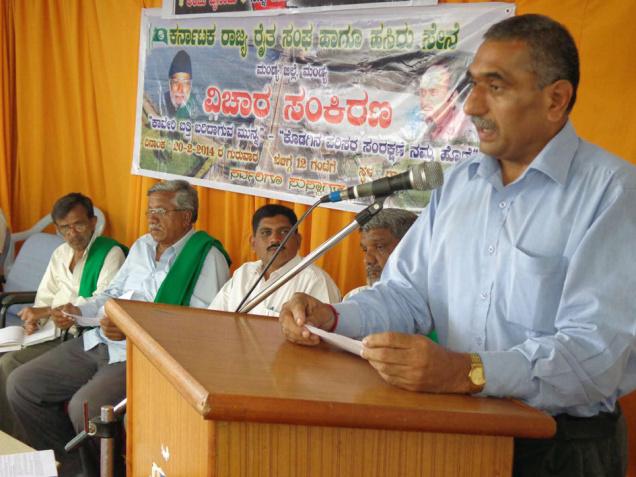
Making a point: Cauvery Sene leader B.C. Nanjappa speaking at a seminar in Mandya on Thursday./ The Hindu

K.A. Ravi Chengappa, principal convener of Cauvery Sene, was speaking at a seminar on ‘Save Cauvery’, organised by the Karnataka Rajya Raitha Sangha and Hasiru Sene at Gandhi Bhavan in Mandya.

Criticising Defence Minister A.K. Antony and State Home Minister K.J. George for their “anti-Kodagu” measures, K.A. Ravi Chengappa, principal convener of Cauvery Sene, on Thursday called upon the people of Karnataka and Tamil Nadu to participate in a Save Kodagu campaign, beginning on February 24.

He was speaking at a seminar on ‘Save Cauvery’, organised by the Karnataka Rajya Raitha Sangha and Hasiru Sene at Gandhi Bhavan here on Thursday.

Mr. Chengappa alleged that the two Ministers were supporting the 400 kV high-tension power line project from Mysore to Kozhikode in Kerala via Kodagu. He said that if work was taken up it would destroy the ecological system in Kodagu. Work had begun on the project amid protests. Nearly 1 lakh trees in the catchments of Lakshmanathirtha and a few rivulets of the Cauvery would have to be axed to make way for the transmission line. Already 50,000 trees worth Rs. 350 crore, around 150 years old, had been axed, he said.

The authorities could have considered the existing routes to reduce the damage to the forests, he said.

‘Disastrous’
Alleging that the timber and land mafia was destroying forests, Cauvery Sene leader B.C. Nanjappa, who inaugurated the seminar, said the project would be disastrous for the people and for Kodagu district.

Resorts, tourism projects, development projects and sand extraction along the Cauvery and its rivulets had had a devastating impact on the ecological system in Kodagu, he said.

KRRS leader K.S. Nanjunde Gowda also requested the authorities concerned to take measures to protect forests.

Sene activist Ravindra Karyappa, KRRS leaders Nandini Jayaram, Shanbhunahalli Suresh and Konasale Narasaraju and zilla panchayat member Kempoo Gowda were present.

source: http://www.thehindu.com / The Hindu / Home> News> National> Karnataka / by Staff Correspondent / Mandya – February 21st, 2014

Karnataka government to allocate Rs 20 crore as CDRP to coffee growers

The Karnataka government has earmarked a sum of Rs 20 crore to facilitate the implementation of a debt relief package for coffee growers (CDRP), and will work closely with the Centre and the Coffee Board of India.

At the inaugural session of the India International Coffee Festival’s 2014 essay, the southern state’s chief minister Siddaramaiah said that the Centre implemented CDRP 2010 through the coffee board to help the indebted coffee growers.

“As a part of the coffee debt relief package, the state government extended financial assistance to the coffee growers with regard to the loans that were offered by the cooperative banks,” he stated.

“Further, on the commerce ministry’s request, the state government waived off the interest and penalty dues payable by the coffee board, which amounted to Rs 230.47 crore,” Siddaramaiah added.

“India is an important player in the global coffee market. Presently, it is the sixth-largest producer and the fifth-largest exporter of coffee in the world. Karnataka occupies a prime position in India’s coffee production. The area under coffee cultivation is 55%, and it contributes to 72% of the national production,” he informed.

Siddaramaiah said the state government’s focus was on ensuring the well-being of the coffee growers. “There is a serious impact of the climate change on coffee cultivation and addressing this issue is a daunting task,” he stated.

“Going by the change in the rainfall pattern in the recent years, the issue is going to assume a still greater importance in the coming years. During the current period itself, the state has seen an unpredictable and erratic monsoon,” the chief minister added.

“At the coffee blossom stage, the crop production was exected to be high, but it was low owing to the hot and harsh climate, which lasted two months and was followed by incessant rainfall,” he said.

“In order to mitigate the crisis, the government’s rainfall insurance scheme for coffee growers a few years ago has seen us bear 25% of the premium on behalf of the small growers,” Siddaramaiah added.

“The support from our end has been over and above the Centre’s share of 50%. The growers must realise the risk of climate change and subscribe to the protection against the vagaries of rainfall,” he said.

“There is also the issue of pollution control. Coffee pulping activity has been categorised as red by Karnataka’s norms and orange category by the Central Pollution Control Board. All efforts have made to address these issues,” the chief minister added.

source: http://www.fnbnews.com / FnBnews.com / Home> Wide View> Top News / by Nandita Vijay, Bengaluru / Thursday – January 30th, 2014
Brazilian drought may make your cuppa costlier

ndia effect On Thursday, prices of key grades of coffee were up by ₹30-40 a kg,almost 20 per cent over the previous week.
India effect On Thursday, prices of key grades of coffee were up by ₹30-40 a kg,almost 20 per cent over the previous week.

Dry weather sets off price rally; global rates increase 45% in a month

New Delhi :

Your cup of coffee is set to cost more, courtesy, the drought in Brazil.

Reports of severe dry weather impacting this year’s Brazilian crop have sparked a sharp rally in coffee prices over the past few days and domestic raw coffee prices have moved up in tandem. Global prices — mainly of the Arabica variety — have risen by 45 per cent in the last one month.As a result, small and mid-sized domestic roasters, who sell roast and ground filter coffee powder, are thinking of passing on the burden to consumers by increasing prices. This is because of export demand for Arabicas driving up farm-gate prices. India exports two-thirds of nearly three lakh tonnes of coffee it produces every year.At the weekly auction on Thursday, prices of key grades of raw coffee were up by ₹30-40 a kg, an increase of almost 20 per cent over the previous week.

No option
“Roasters have to increase prices by 20-30 per cent, else quality will take a hit,” said BS Suryaprakash, CEO of Coorg Coffee Supplies, a Bangalore-based roaster and exporter.“It’s a tricky situation. If we increase the price, there is a chance of losing customers. If we don’t, we’ll have to incur losses as the rise in raw coffee prices has been pretty steep,” he said. Coorg Coffee, which retails powder and speciality blends under the same brand, has already effected a price hike of 20 per cent, he added.A little over a third of the 300,000 tonnes of coffee produced in India is consumed domestically. The annual growth in consumption is around six per cent, with coffee drinking becoming fashionable among the younger generation through the spread of the café culture.“This price rise is unprecedented. If the market stays at the current level, we don’t have any option but to increase prices. We will take a call on revising the prices over the next couple of days,” said Shrikant Rao, Director at Bayar’s Coffee.

Watching developments

However, large companies such as Tata Coffee are cautious in reacting to the price rally. “The market has gone up in the past four days. We have to study the market before taking a call on prices,” said Hameed Huq, MD of Tata Coffee Ltd, the country’s largest coffee grower.Moreover, the lower-than-expected crop size back home is seen supporting prices. The Coffee Board has lowered its estimates by about 10 per cent, pegging the current crop size at 3.1 lakh tonnes as untimely rains in Karnataka, the main producing state, has shrunk the crop. However, growers harvesting their produce said the crop is much lower than the Coffee Board’s estimates.source: http://www.thehindubusinessline.com / Business Line / Home> Markets> Commodities / by Vishwanath Kulkarni / New Delhi – February 21st, 2014

Harshika Poonacha’s memorable moment

HarshikaKF26feb2014
Harshika Poonacha turned paparazzi when she met her childhood idol, Anant Nag, in Hubli recently. She had always yearned to meet the yesteryear hearthrob.

Harshika got her moment under the sun during the state film awards ceremony. When the awardees were invited on stage she found herself standing next to Nag. It was definitely an ‘aha’ moment for the leggy lass.

It then got better:

The ever-charming Anant complimented Harshika on her dress (now here’s a man who knows how to treat a lady) and the fact that she was a qualified engineer.

Unfortunately, she couldn’t capture the moment for posterity. But not one to give up, she cornered Nag at breakfast the next day and got a photo clicked, which she promptly shared with all friends. Nice!

source: http://www.timesofindia.indiatimes.com / The Times of India / Home> Entertainment> Kannada> Movies / TNN / February 13th, 2014

Tribal padayatra reaches Kodagu district

The ‘padayatra’, being taken out by tribal activists, living inside forests, from North Karnataka region, arrived in the town, on Thursday.

Leaders and members of various tribal organisations in the district received the activists.The ‘padayatra’, named ‘Budakattu Samudhayagala Ulivigagi Namma Nade’ (walk for the survival of tribal communities), has been organised by Karnataka Aranyamula Budakattugala Okkuta.
TribalKF26feb2014
The activists, singing revolutionary songs in support of their demands, entered the town from Hassan district. They started the jatha from the APMC community hall in the town, and proceeded towards Guddehosuru, via Inspection Bungalow and Madikeri road.

The demands include, issue of community and individual title deeds as per the Forests Rights Act, 2006; withdrawal of plans to relocate tribal people living inside forests; formulation of an employment policy for the youth, suitable for tribal families; etc.

District convenor of the Okkuta Kalinga said, the State government was conspiring to dislocate tribal people from their original habitat, under the guise of rehabilitation.

District Soliga Sangha president Sannappa, convenor of Budakattu Sangha J R Indira, convenor of Yarava Sangha P A Mani, president of Budakattu Mahila Sangha P A Muthamma and convenor of the Okkuta Pushpa were present on the occasion.

source: http://www.deccanherald.com / Deccan Herald / Home> District> Kushalnagar – Kodagu District / DHNS – February 13th, 2014

Forest dept builds kraals to tame captured elephants

Four structures will be built at Dubare camp to accommodate eight jumbos.

Even as the forest department officials are preparing an action plan to capture 23 wild elephants that have turned out to be trouble makers in Kodagu-Hassan border area, preparations are made simultaneously for constructing kraal to tame elephants, at Dubare in Kodagu.

Dubare, surrounded by Cauvery river is well known for the elephant camp. Expert mahouts and kavadis tame and look after the elephants using the best of their abilities. As the land is surrounded by river, it is best suited for taming elephants.

The forest department has now planned to bring majority of the elephants that are captured in Kodagu-Hassan border areas, to Dubare for taming. Meanwhile, work on construction of kraal for taming elephants at Ranigate and Mathugodu camps are under progress and the department has plans to construct kraals at Bandipur in Mysore district and Sakrebail camp at Shimoga, said sources in the forest department.

Speaking to Deccan Herald mahout Dobi said that kraals are built using the tamed elephants in the camp. Wooden logs of eucalyptus available in Dubare forest are used in building the strong kraals, he said.

On the space availability at kraal, he said one kraal can accommodate two elephants, and the department has plans to construct four kraals in Dubare, enabling taming of eight elephants at a time. With expert mahouts and kavadis, a wild elephant can be tamed within four months.

Kodagu Circle Chief Conservator of Forest Brijesh Kumar Dixith said that people are largely facing problem from wild elephants at Shanivarasanthe in the border area of Kodagu district and Alur of Hassan district. The elephants which have at present taken shelter at Alur, might have created rampant in Shanivarasanthe. Therefore, officers from Kodagu circle too have been deployed in the operation to capture elephants, he said.

Speaking about the nature of elephants, he said elephants are emotional in nature. They share a strong bond between female, male and calves. They pass on the message to other elephants whenever they face danger. “As elephantas move in herds, there are all possibilities of one herd of elephants passing the message to other herds when they sense danger of humanbeings effort to catch them.

The department is studying all the possibilities and is planning to attack all the herds at a time in order to capture them. We are waiting for a right opportunity,” he said.

source: http://www.deccanherald.com / Deccan Herald / Home> District / by Srikanth Kallammanavar, Madikeri / DHNS – February 17th, 2014