Hearty, meaty meal

FoodKF24nov2013
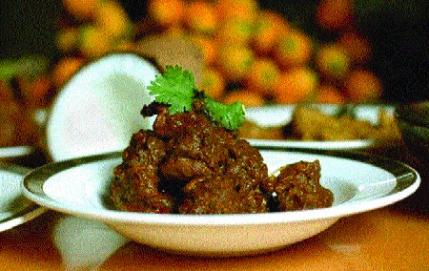
Coorg is the smallest district of Karnataka but the cuisine is considered to be one of the most delicious among the South Indian ones and the Kodavas (natives of the area), who claim to be descendants of Alexander the Great, are pure non-vegetarians. No wonder then that the cuisine is heavily dependent on pork, lamb and fish. The change in palate has also brought in chicken variations.

“Coorgi pork curry (pandi curry) is one of the most famous dishes from the area. The people there are a proud race and believe that nobody apart from them can make a good pork curry in the country,” says chef Prem Kumar of The Imperial that recently concluded a week-long Coorgi food festival at their restaurant, Daniell’s Tavern. Although, there aren’t many restaurants in the capital that serve it as a part of their standard menu, there are festivals organised from time to time.

Coorgi food is entirely different in taste, flavour and texture. Chef Velu Murugan P of Dakshin, WelcomHotel Sheraton says, “An elaborate dinner on Puththari (the harvest festival) is celebrated with pandi curry eaten with akki ooti (rice roti) or kadambuttu (rice dumplings). Another popular pork dish is chilkana pandi and is prepared using pork marinated in local spices, vinegar and tossed with onion and green chillies.”

For vegetarians, dishes are prepared using yam, pinto beans and even mushrooms. “Though not many people there like eating vegetarian food, they do cook yam, potato, beans and mushrooms. Yam fry with curry leaves and loads of pepper, red chilli and coriander tastes outstanding,” says chef Kumar. To this chef Murugan adds, “Koombu kanni is an interesting option for mushroom-lovers. The dish is prepared using mushroom infused with coconut milk and a tinge of spices. Koomu barthad is prepared using stir-fried whole mushrooms with finely chopped onions and loads of masala.”

Among spices cloves, mace and chillies in all forms are heavily used to induce heat since Coorg is relatively colder than other parts of South India. “A special souring agent called kachampuli, a local vinegar extracted from fruit is extensively used in Coorgi cooking. Tamarind is used in other parts of south as it is a cooling agent. But since Coorg is cold, people like eating hot and spicy food,” says chef KP Shivam of Kaustubh, DLF Place Saket, that soon plans to introduce the cuisine in their menu.

“Khaima unde or minced mutton balls cooked in spices, mutton chops marinated in coriander-chilli paste and freshly ground pepper, prawn curry in coconut milk and red hot chicken fry served with ghee bhaat (rice) are my other favourites from the region,” puts forth chef Kumar.

Although Coorgis do not like having desserts, they have options like mangai rasayana. “Mangai rasayana is like a mango kheer with freshly chopped mangoes and a big bang of cardamom. Dumroot halwa is also mouth-watering halwa prepared using white pumpkin simmered in pure ghee and milk,” says chef Murugan P.

The Coorgis’ fondness for good food (kadi) and liquor (kudi) is legendary. Go to their festivals and their weddings to see them enjoy their kadi and kudi while they regale themselves with their dance and songs. “For non-vegetarians, it is a cuisine not to be missed!” concludes chef Shivam.

source: http://www.asianage.com / The Asian Age / Home> Life and Style> Dining / by Papia Lahiri and Aditi Pancholi, Age Correspondent / November 21st, 2013
Amid the glitz, a glaring disparity among artistes

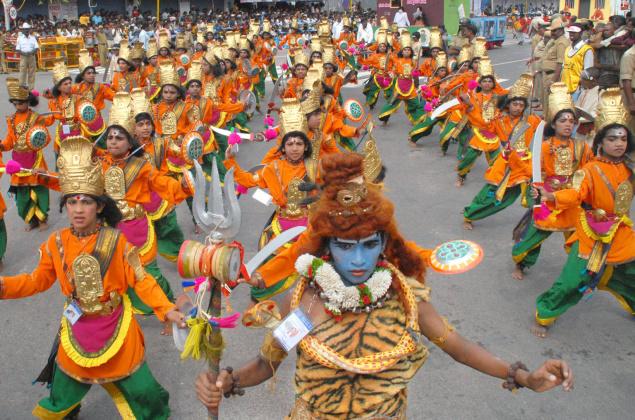
Dance and bear it: Dancers, percussionists and flautists who perform at the Dasara finale have traditionally got a raw deal in terms of the daily wage they receive. / File Photo: M.A. Sriram / The Hindu

Mysore’s folk artistes lament the ‘ínsulting’ wages they earn when compared to Bollywood stars
Behind the very luminous facade of Mysore’s glitzy cultural extravaganza is a disparity that is as old as it is stark. Every other artiste you meet will tell you they are forced to grin and bear it because an opportunity to perform at the prestigious Naada Habba (State festival) cannot be missed. But how long do they expect us to come and perform for this pittance, asks Siddappa, a percussion folk artiste from Madikeri.

He says dancers, percussionists and flautists who perform at the Dasara finale have traditionally got a raw deal. “It almost feels like on the festival day, we are being reminded that we are lesser mortals,” says Siddaraju. The daily wage of Rs. 750, hiked from Rs. 500 last year, is an “insult” to the very art and culture that this festival claims to celebrate and promote, artistes say. “They say Dasara is the most well-preserved tradition we have. What they have also managed to preserve is the disregard shown historically to us, mainly because we don’t belong to the privileged castes.”

Another dancer, who has been performing for 14 years in a row, pointed out that while their ancestors may have performed for free, the State cannot expect them to claim anything less than a fair wage for the work they put in. “What bothers me is that big artistes are brought to perform from around the world. We know they are paid in lakhs of rupees some times; can they not spare us a few thousands? This is not private money to be spent without a sense of right and wrong,” the 45-year-old dancer says. Earlier this month, a group of folk musicians and artistes had publicly threatened to boycott the Jamboo Savari, and walk backwards from Banimantap if their wages were not revised.

Other artistes too

Similar disparities exist also in the remuneration given to other artistes who perform at the cultural programmes held across the city for 10 days in the run-up to Dasara. While they get better accommodation and are given travel money, they feel there is clearly some sort of a ‘two-tumbler’ rule in place. While they are okay with ‘A-category’ performers being paid more, they say that the process of fixing pay is arbitrary and it is as if performing here itself is a reward.

Adivappa Kariyawar (63), a Janapada artiste from Haveri, says that the government must actively try to promote lesser-known artistes and art forms that are dying due to lack of exposure. “We are performing at a park here; so yes, naturally, the ones performing on the bigger stages will get better audience. While it is natural to categorise artistes, the larger picture, which is to promote lesser-known arts, must not be forgotten.”

Another Janapada artiste, who did not wish to be named, said that the government has no business spending money to bring Bollywood stars to perform, alluding to the concert by pop music artiste Mika Singh here. “We say that the real arts don’t have a young audience. But they are never going to see our performances because all the attention and money is where these big performers are.”

source: http://www.thehindu.com / The Hindu / Home> News> National> Karnataka / by Deepa Kurup / Mysore – October 13th, 2013

Fashion stakes differ for men

Where often battles must be waged to ensure better life opportunities for women, in the world of glamour, the high heels seem to be winning. Male models in Bangalore must often contend with fewer assignments and lower pays.

Fashion guru Prasad Bidapa who has groomed many a model’s career says, the inequality in the industry is known and accepted. “It’s just the way the market works. Only 10 per cent of designers work on men’s clothing, the rest focus on women as their target clientele. It’s only natural that female models will be in greater demand,” he says.

Where estimates place the remuneration for top female models at ` 20 to 25,000 per fashion show, the figures hinge at ` 15 to 18,000 for their male counterparts.

“Efforts put in by male and female models may be the same, but there’s a lot more that female models have to do during a show, starting from the long make-up sessions. They have about five changes (of clothes) but men average one or two. It’s only logical then that they are paid more,” says Zoheb Yusuf who started modelling in 2003 and now heads Prasad Bidapa Model Management.

Yusuf’s standing advise to aspiring male models has been to always keep another profession going. “Modelling has to be a hobby. Of course, there are those who made it bigger going on from their modelling days like Arjun Rampal, Dino Morea and John Abraham. But if you want to make it big just as a model, then it requires moving to Mumbai or working through an agency that pushes you ahead to bigger assignments even abroad. Even then it’s best to have something else to back you up, ” he says.

Bangalore boasts of more than 50 top women models, some full-time, but nearly all 35 to 40 top male models are either students or working.

That’s not to say the industry is all unforgiving to men. “Male models have a lot of work to look forward to in television and print ad campaigns and for well-established models the pay is on par,” says Roshan Issac who has been modelling for ten years now and works as a techie at Bosch.

Things are changing. Bidapa points to designers like Sanchita who give equal importance to their menswear line. Isaac feels there’s a lot to explore as actors for male models. He says, “Chennai offers a lot of work in TV for male models, especially with the rising number of grooming products aimed at men, there’s increasing scope there. There are movies that one can graduate to, a place where we know that the (fee) scale instantly reverses.”

source: http://www.newindianexpress.com / The New Indian Express / Home> Cities> Bangalore / by Aparna Chandra – Bangalore / October 15th, 2013

Andhra, Odisha too take up coffee cultivation

With the traditional coffee growing area in the country almost reaching its saturation point, new and non-traditional areas are coming up.

Currently, the three southern states Karnataka, Kerala and Tamil Nadu dominate coffee production. However, Andhra Pradesh and Odisha are also joining the group.

According to the Coffee Board of India, the three southern states account for about 92 per cent of the total coffee growing areas in the country.

While Karnataka leads the pack in terms of coffee growing with an area of about 53 per cent, Kerala accounts for 28 per cent followed by Tamil Nadu with 11 per cent. Now the governments in Andhra Pradesh and Odisha are showing keen interest to popularaise the coffee production.

“In both the states, coffee plantation is expected to come up in an additional area of over 10,000 hectares by the end of the 12th plan period,” a senior officer from Coffee Board told Express. People living in hilly areas like Munumuluru, Chintapalli (E), Chintapally (W) and Arakuvalley in Andhra Pradesh and Koraput in Odisha have taken to coffee plantation.

At present, the number of coffee producers in Andhra Pradesh stand at about 115,877 and about 45,715 in the neighbouring. According to the Coffee Board officials, the total post blossom estimate of coffee production for 2013-14 was pegged at about 3.47 lakh metric tonnes.

Both the states are expected to contribute about 6,230 metric tonnes. At present, the total planted area accounts for about 58,131 hectares in AP and about 3,835 hectares in Odisha. Vijayan Rajesh of United Planters Association of South India, however, said the attempt to popularaise coffee growing in AP and Odisha, was only of ‘social interest rather than any commercial interest.’

source: http://www.newindianexpress.com / The New Indian Express / Home> States> Karnataka / by M Venkatesh – ENS – Bangalore / October 17th, 2013

Apiculture park to come up in Kodagu

An apiculture park will be set up at Bhagamandala in Kodagu district to revive apiculture in Karnataka, Horticulture Minister Shamanur Shivashankarappa said on Thursday.

He told reporters here that the park would come up on six acres at Bhagamandala. The department would distribute 20,000 boxes to Jenu Kurubas, a tribe that has expertise in honey cultivation and extraction.

According to him, Rs. 60 lakh had been earmarked in the current fiscal to promote apiculture. “At present, the honey production is around 800 metric tonnes but it is possible to increase it to 8,000 metric tonnes per annum. Besides awareness, training would be imparted to the local tribe to promote apiculture. There is a lot of scope for promoting apiculture in Uttara Kannada, Dakshina Kannada and other Malnad districts,” he said.

Neera Policy

The minister said the department has submitted a proposal to the Finance Department to announce a policy on neera.

“An amendment to the State Excise Act is necessary to allow the tapping and selling of neera in the state. Already, steps have been taken to promote value-added products from the neera like palm syrup, palm jaggery and palm sugar. Now it is up to the Finance Department to table a bill in the State Legislature to pass the Neera Policy,” he said.

Proposal Submitted

He said the state government has submitted a proposal to the Union government seeking release of Rs. 100 crore to revive coconut plantations in several districts.

“Thirty per cent of the coconut plants have perished due to pests and failure of monsoon. The department is educating the farmers of rain-fed areas to go for alternative crops,” he said. According to him, the department has given Rs. 12,000 per acre to farmers for loss of coconut plants.

Auction Centres

Shamanur said two flower auction centres set up in Tumkur and Davangere would be inaugurated soon. The Department of Horticulture has provided the infrastructure but it would be managed by the Karnataka Agricultural Marketing Department.

“Floriculture is no longer a profitable venture following competitions from the African countries. In recent years, Kenya and Ethiopia have emerged as leading flower export countries after the European countries. Despite this, many flowers are being exported from Karnataka thanks to the department’s support. Fifty per cent subsidy is being given to entrepreneurs under the National Horticulture Mission to promote floriculture,” he said.

Census

He said the census of horticulture crops’ areas under cultivation and production were in progress in Bagalkot, Belgaum, Bellary, Chitradurga, Davangere, Gulbarga, Hassan, Kolar, Mysore, Shimoga and Tumkur districts. According to him, Rs. 5 crore had been earmarked for the purpose. “Nearly 50 per cent of the work has been completed,” he said.

source: http://www.newindianexpress.com / The New Indian Express / Home> States> Karnataka / by Express News Service – Bangalore / November 22nd, 2013

Uthappa targets a forceful return

Robin Uthappa is known for his aggressive acts at the crease with a hefty willow in hand, but what he showed last season for Karnataka was anything but that.

Under Praveen Amre’s tutoring, the opener opted to build his innings brick by brick rather than blast his way and in the process lost out on forcing the issue which had made him popular with his fans.

This season, however, the right-hander promises a return to his former self, having missed the first two of Karnataka’s Group ‘A’ Ranji Trophy encounters due a hamstring injury. “I had a hamstring in my leading leg. It was a problem that I have had to bear with since the beginning of IPL (Indian Premier League),” said the opener ahead of his first Ranji match this season. “I took cortisol injections three days before the match against New Zealand ‘A’ (where he scored a century) and I expected that to keep me going for a few months but because of the hot and humid conditions in Visakhapatnam, I was done at the end of that match. I needed to give my body the break it required.”

He further explained: “I am a lot more mature now and I realise that I need to listen to my body more. I am very disappointed that I had to go for the treatment when I was so close to making the Indian team once again but in retrospect, I had to get it done now before it became worse,” the 28-year-old remarked.

The return of Uthappa, while brilliant for the team’s chances of resuscitating their campaign, creates a few problems for Karnataka. His arrival forces Mayank Agarwal, who has been in good form, to play down the order. “I guess the team missed me,” Uthappa said in jest when asked about the teams batting performances so far.

Further explaining his state of mind last season, Uthappa said: “I was also low on confidence last season since I had changed my style and I think it was all very mental. After my injury (during the recovery period), I had time to work on the mental aspect of my game and now I can say that the Robin of the old is back. I am raring to go.”

Perhaps, Uthappa should consider adding a ‘HERE’ at the end of the ‘I AM’ tattoo he has inked on his right forearm.

source: http://www.deccanherald.com / Deccan Herald / Home> Sports / by DHNS / Nagpur – November 20th, 2013

Inter-university women’s hockey tourney begins

International Hockey Player Mallamaada Ponnamma inaugurated a five-day South Zone Inter-university Hockey Tournament 2013-14 for women, jointly organised by the Mangalore University and Field Marshal K M Cariappa College at Sai Stadium in Madikeri, on Tuesday.
HockeyKF22nov2013
Speaking on the occasion, MLA Appachu Ranjan said that students should show interest in sports, especially in ruaral sports like hockey and should try their level best to represent State and nation. There are good sportsmen in Kodagu, but they have to try to reach higher levels, he said. Mangalore University Physical Education Department Director Dr H Nagalingappa said that hockey players from 18 universities in five States of South India have participated in the tournament and four more teams are expected.

Comfortable win on day 1

Teams from Thiruchanapalli Bharathidasan University, Madras University, Kannur University and Calicut University have begun their journey with comfortable victories on day 1.

In the inaugural match, Thiruchanapalli Bharathidasan University registered a huge victory against Pondicherry University team by 7-0 goals. A Vijitra of Bharathidasan team achieved a hatrick by reaching the ball into goal post thrice at 11th, 12th and 29th minute of the match. She got good support from R Sridevi who hit 2 goals and from P Anita and M Malini with one goal each.

Madras University team proved better against Kerala University by 2-1 goals. For Madras University team, S Kansimezi shined with 2 goals- in 18th and 41st minute of the match.

Mexina T Mathew hit the lone goal for Kerala team. The first day of the tourney witnessed another one-sided match where Kannur University beat Ananthpur GNT University by 6-0. N K Princi of Kannur team achieved second hatrick by hitting goals at 4th, 36th and 38th minutes of the match. V Shalini, C V Varsha and P Neeta hit one goal each.

Calicut University pulled Thirunelveli University team into floors as it registered an easy victory by 5-0 goals. For Calicut, Meghana hit 2 goals and Nimmi Rajendra and T J Siji registered one goal each, while another goal was through goal group.

source: http://www.deccanherald.com / Deccan Herald / Home> District / Madikeri – DHNS / November 19th, 2013

Robin Uthappa returns, Gautam named Karnataka captain

Bangalore :

Fit-again Robin Uthappa will return to the Karnataka Ranji Trophy squad for their away matches against Vidharba (at Nagpur from Nov 21-24) and Odisha (at Cuttack, Nov 28 to Dec 1).

The opening batsman, who missed Karnataka’s first two outings owing to a tender hamstring injury, comes in for Stuart Binny, who injured his right knee during the game against Gujarat last week at the Chinnaswamy stadium.

The all-rounder is expected to be out for two games. Also missing from the squad is original skipper Vinay Kumar, who has been called up for India duty.

Wicketkeeper-batsman CM Gautam will lead the squad in Vinay’s absence. Medium-pacer Ronit More has been selected as Vinay’s replacement.

The squad: CM Gautam (captain & wk), Mayank Agarwal, Robin Uthappa, Rahul KL, Kunal Kapoor, Manish Pandey, Ganesh Satish, A Mithun, Sharath HS, S Aravind, Appanna KP, Karun Nair, Samarth R, Abrar Kazi, Ronit More.

Batting coach: J Arun Kumar. Bowling coach: Mansur Ali Khan.

source: http://www.articles.timesofindia.indiatimes.com / The Times of India / Home> Sports> Domestic Cricket> Kunal Kapoor / by Sunil Subbaiah, TNN / November 18th, 2013

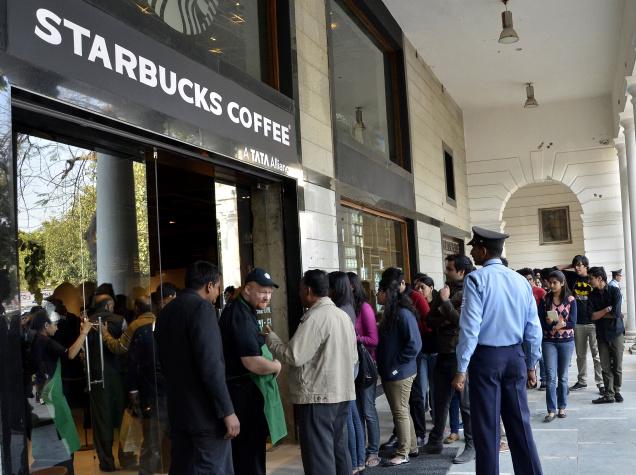
Starbucks CEO: Ratan Tata’s grace, wisdom moved me

India is the only major market in the world where Starbucks has been able to source and roast coffee beans locally.

New York :
Starbucks CEO Howard Schultz has voiced his admiration for industrialist Ratan Tata’s “grace” and wisdom, saying he was moved by the business icon’s words during the launch of the coffee chain’s flagship store in Mumbai last year.

“At the celebratory dinner the night of the Mumbai (store’s) opening, Ratan Tata offered a toast that really moved me,” Schultz writes in an essay in the book ‘Reimagining India: Unlocking The Potential of Asia’s Next Superpower’, edited by global consulting firm McKinsey.

Schultz recalls that while describing Starbucks’ India launch and Tata’s remarks at the celebrations later to a gathering of his company officials in the US, he even began to cry and was overpowered by emotion.

“A few weeks after returning from the opening of our Mumbai store, we held one of our big open forum meetings where we get the entire company together. And as I tried to describe that moment for everyone, something came over me. I started to cry. It just hit me emotionally.

“In India, we’d had a chance to do something extraordinary, something truly world class. And I am excited that we have a chance to grow and give back in a land where so much opportunity lies ahead and to contribute to making it a little better place than the one we found,” Schultz said.

Tata’s remarks on the night of the Mumbai opening were “perfect and so heartfelt,” Schultz said in the essay, adding that he considers Tata to be a “man with so much grace.

“I could sit and listen to Ratan Tata for days on end. He has so much wisdom and insight not only about India but about the world,” he said.

The book is a compilation of over 60 essays on India’s challenges and opportunities written by CEOs, academicians, economists and historians, including Wipro chief Azim Premji, Microsoft founder Bill Gates and India’s chess legend Viswanathan Anand.

In his toast, Tata had said in his “dry, understated way” that the Tata group has had a bit of success in the various endeavours it has undertaken over the years.

“We have partnered with some good global companies. But I have never had the kind of recognition I have received from this relationship with Starbucks. People I have never met stop me on the street just to congratulate me.

“And what I have learnt from this relationship is that Starbucks is far more than just a company that sells coffee,” Tata had said.

Schultz said his company has developed an “incredible relationship” with the Tata organisation and he cannot imagine bringing Starbucks to India without the assistance it has received from Tata.

Schultz also said India is the only major market in the world where Starbucks has been able to source and roast coffee beans locally.

The company worked with Tata officials on an India-only espresso roast designed specifically for the Indian market.

Schultz said people in Starbucks’ coffee department were not “exactly thrilled” when he told them he was looking at a different approach to sourcing coffee and roasting process under the partnership with Tata for India.

“They were more sceptical when I said we want to create a different blend of coffee for India,” he said, adding that his team was incredulous when he said the India blend was not going to be roasted by the Starbucks team, a first in Starbucks’ 42-year history.

Schultz said to get the blend he wanted for India, “we’d have to share with Tata some of the family jewels — roasting secrets we’ve perfected over four decades and guarded very closely.

“It was a real test of our trust in our new partner,” he said, adding that teaming with Tata to come up with an Indian roast was a huge step for Starbucks.

source: http://www.thehindubusinessline.com / Business Line / Home> Companies / by PTI / New York – November 19th, 2013

Govindappa Jayaram elected Karnataka Planters’ Association chairman

Bangalore :

Govindappa Jayaram from Kodagu district has been elected as Chairman and K Kurian from Chikmagalur district as Vice Chairman of Karnataka Planters’ Association.

Jayaram and Kurian got elected at the 55th Annual General Meeting of the Karnataka Planters’ Association.

The following have been elected to executive committee of KPA: Chikmagalur District – H.T. Pramod, Shirish Vijayendra, Mahesh Shashidhar.

Kodagu District – A.A. Ponappa, N. Bose Mandanna, M.A. Sampath (Corporate Seat).

Hassan District – V. Murali (Corporate Seat) and Baba P.S. Bedi.

Small Growers seat – Kodagu District – Dr M.M.Chengappa.

source: http://www.thehindubusinessline.com / Business Line / Home> Industry> Agri-Biz / by Anil Urs anil.u@thehindu.co.in / Bangalore – November 17th, 2013