Pollination merely one production factor

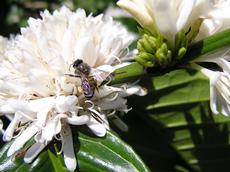
Bees of the Apis cerana (eastern honeybee) species pollinate coffee flowers. Farmers can increase the services of pollinating insects with particular cultivation methods. (Photo: J. Ghazoul / ETH Zurich)

By Peter Ruegg

No food for the human race without bees? It is not quite as straightforward as that. A case study by ecologists from ETH Zurich in a coffee-growing area in India reveals that pollinating insects are just one production factor among many. Farmers have several possibilities to increase their harvest.

All over the world, bees are dying and insect diversity is dwindling. Only recently, both the media and scientists expressed fears that insect pollination is in decline, which jeopardises food security. The (lack of) pollination has thus become a sound argument for the protection of species and natural habitats, and organic farming.

ETH-Zurich researchers from the group headed by Jaboury Ghazoul, professor of ecosystem management, set about investigating this argument by studying the influence of pollinator insects on coffee harvests in an agroforestry system at coffee plantations in the province of Kodagu in southern India. They also included soil and forest management, environmental factors such as water and soil fertility, and tree cover for the cultures in their study.

The research group thus obtained a different picture of the role of pollinators to the popular perception of this cultivation system of “no bees, no harvest”. According to their findings, pollinator bees are merely one production factor among many and to some extent coffee farmers can increase the productivity of their plantations independently of the insects. The results of the study have just been published in the journal PNAS.

Important but not the only factor
“Pollinators are important for coffee farmers,” stresses Ghazoul; “as far as effective coffee growing and increasing harvests are concerned, however, they are much less important than irrigation or liming, for instance.” This encapsulates one of the central findings from coffee farming in the Kodagu province.

Coffee is grown in a traditional agroforestry system in the region. As coffee plants must not be grown in direct sunlight, they are planted in the forest’s undergrowth or the shade of large, isolated trees. The coffee plants all bloom at the same time after heavy rains between February and March and three species of bee pollinate the flowers: the giant honeybee Apis dorsata, Apis cerana and the solitary wild bee Tetragonula iridipennis. The giant honeybee is the largest and most important pollinator, forming large colonies and needing the thick branches of tall trees to bear the weight of their nest.

Greater yield through irrigation and limestone
In order to harvest more coffee, however, the farmers have got other options than merely banking on the work of bees, as Ghazoul discovered. They can increase the yield through liming, irrespective of bee density. And instead of relying on rainfall, it is worth the farmers’ while to induce flowering with artificial irrigation. “It is particularly in a farmer’s interests to irrigate his plantations at a different time to other farmers in the vicinity,” says Ghazoul. After all, this will turn his plantations into bee magnets. This concentrated pollination increases the yield from the plantation enormously, the ETH-Zurich researchers reveal in their publication. It is a different story if the rain makes all the coffee plants in the region flower at the same time, however: the bees spread out over a wide area, the pollination is less effective and the harvest is poorer.

Trend towards deforestation
In an agroforestry system, the farmer also has another trick up his sleeve: felling trees or the forest to shed more light onto his coffee plants, which also increases the harvest. In doing so, however, he destroys the habitat of the giant honeybee (Apis dorsata).

A farmer who combines both courses of action is especially successful, initially unaffected by the disappearance of the large bees on his own plantation. Only when all farmers opt for this course of action do things take a turn for the worse. “From a plantation perspective, it makes sense to remove trees and increase yields,” says the ETH Zurich professor. “But if every farmer goes for the same option, they will all suffer the consequences of poor pollination because the giant honeybee will disappear.”

Sure enough, the researchers observed gradual deforestation in the Kodagu experiment area. Ghazoul is convinced that the farmers will lose Apis dorsata in the long run and thus – unless they take countermeasures – their valuable contribution towards coffee pollination. “It remains unclear whether the other two species of bee could compensate for this loss.” However, the farmers’ predicament is not hopeless, he says. They could domesticate Apis cerana, a very close relative of the European honeybee, and place beehives on the plantations, which would guarantee the pollination service without becoming dependent on Apis dorsata. The drawback: this absolves the farmers from their responsibility for the forest and trees. “The farmers are thus free to decide whether they want to have trees on their land or not,” stresses the ecologist, which spells bad news for nature conservation. “But good news for farmers. They have got possibilities to increase their harvest and sustain or even improve their existence.”

Unexpected threat from exotic tree species
The traditional forest trees face another danger. Farmers often replace felled local trees with the exotic Australian silver oak (Grevillea robusta), which provides the coffee plants with the shade they need. Moreover, it grows quickly and has a straight trunk, which farmers can use to grow pepper as the spice can be harvested more easily on the trunks. The sale of pepper and wood from the silver oaks is a way for the farmers to supplement their income.

However, the farmers are increasingly beginning to realise that the exotic tree also has its drawbacks. For one, its leaves barely decompose, covering the ground and coffee plants and thus becoming a breeding ground for harmful fungi and bacteria. It might also influence the nutrient cycle, which one of Ghazoul’s doctoral students is currently looking into. The silver oak leaves probably slows the nutrient cycle, preventing the coffee plants from receiving enough nitrogen in the long run, which eventually affects the harvest.

The example case of coffee growing in the province of Kodagu is interesting from a research perspective as it brings home how bees, farmers, their farming methods and natural occurrences influence and depend on each other. In this respect, the insects are not the sole influential factor in this agricultural system.

Ten principles for the reconciliation of nature and humankind
Teaming up with other scientists, ETH-Zurich professor Jaboury Ghazoul has defined ten principles that should help reconcile the conflicting interests of agriculture, nature conservation and other stakeholders with regard to a sustainable agricultural land use. The principles, which were published in the journal PNAS, include training farmers in cultivation methods that can be adapted to changing conditions. Another principle advocates taking different levels into consideration for a landscape approach, namely the landscape level itself and the individual farm level. In the example case in India, another principle is significant: the clarification of rights and responsibilities. For instance, the cultivated land belongs to the local farmers but not the trees, which belong to the state. This can cause conflicts. The principles should help to use an approach geared towards the landscape.

Further reading
Boreux V, Kushalappa CG, Vaast P, Ghazoul J. Interactive effects among ecosystem services and management practices on crop production: Pollination in coffee agroforestry systems. PNAS. 2013 May 21;110(21):8387-92. doi: 10.1073/pnas.1210590110. Epub 2013 May 13.

Sayer J, Sunderland T, Ghazoul J et al. Ten principles for a landscape approach to reconciling agriculture, conservation, and other competing land uses. PNAS 2013 110 (21) 8349-8356; published ahead of print May 21, 2013, doi:10.1073/pnas.1210595110.

source: http://www.ethlife.ethz.ch / ETH Life / Home> News Archive> Science / by Peter Ruegg / June 04th, 2013

Halappa makes history of sorts, named national selector

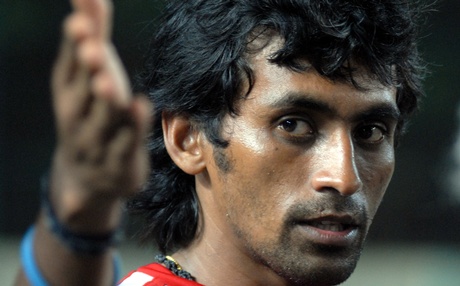
Arjun Halappa | EPS/File

Arjun Halappa, who led India in the Sultan Azlan Shah Cup hockey tournament in Malaysia in 2011, has made history of sorts by becoming the first sportsperson to be named as a national selector while still being a very active player.

Hockey India (HI) announced a panel to be headed by former star B P Govinda and which includes Arjun Halappa’s name. Arjun is still a very active player turning out for Air India in the ongoing HI nationals at Pune. Arjun made his debut for India in 2001 against Egypt in the Prime Minister’s Gold Cup. He represented the country in the 2004 Olympic Games in Athens. He was also in the 2010 Commonwealth Games team in New Delhi where India were the runners-up and also picked up the Asiad bronze the same year in Guangzhou, China.

“I’m not going to hang up my boots. I will continue to represent my employers Air India. Playing will help me keep up with the latest trends in the game,” Arjun said.

“This is a very big surprise and I’m very excited. I’ve been a player and captain and this is a new challenge for me. It’s just early days and I don’t want to comment much,” he added. “As a player I will be able to provide inputs to the coaching staff,” said Arjun.

So the scenario now is that a player-cum-selector will also work as an advisor to the coaches. This is the first time in the history of Indian sport that something like this has happened. Players becoming coaches once they give up playing is an accepted norm. Players taking to umpiring is also welcome. But an active player also functioning as a selector? The move has, indeed, raised eyebrows.

The closest a player has come to also being a part of the selection process is in Indian cricket. The captain is part of the selection committee’s deliberations and gives his inputs. But he is not actually on the selection committee as in the case of Arjun.

What happens if Arjun strikes great form and has to decide on his own inclusion? He has still not announced his international retirement. At 34, he may not be in contention for a place. But what if the others want him in the team? Even if he is there on sheer merit, aspersions will be cast. Should a selector select or even drop himself only because he is a selector?

“It is too early to induct someone like Arjun into the selection committee. Yes, he surely deserves to be a selector but this is not the right time for him to be on the panel as he is still a very active player,” said former India skipper, coach and selector M P Ganesh.

“I became a selector only after 26 years of playing hockey. In fact I had even given up coaching the Indian team and only then I was part of the selection process. Young people are needed but not so young and not for the job of selection,” Ganesh added.

source: http://www.newindianexpress.com / The New Indian Express / Home> The Sunday Standard / by S S Shreekumar / ENS – Bangalore / June 02nd, 2013

Vikramkant to lead K’taka in National Hockey C’ship

Bangalore (PTI):

Vikarmkant will lead the 19-member men’s Karnataka hockey squad for the third Senior National Championship to be held at Pune from May 28 to June 10.

S K Uthappa, adjudged the best player in 2011 Senior Nationals in Bhopal where Karnataka had finished runners-up, will be the vice-captain of the state side.

The team is being coached by 1994 World Cupper K K Poonacha.

source: http://www.ptinews.com / Press Trust of India / Home> Sports / by Staff Writer / May 30th, 2013

Harshika promotes girl power

Sandalwood actress Harshika Poonacha, who was last seen in the film Crazy Loka, claims to be supporting girl power. “On my way to Ravindra Kalakshethra to inaugurate zee Kannada ladies club and to promote Gal power 🙂 #womanhood ,” tweeted the actress.
HarshikaKF03jun2013

Harshika, who has been been posting pictures of herself on her micro-blogging page for her fans, will soon be seen in a number of Kannada films. Her upcoming Sandalwood projects are Advaitha, Ale, B3, Meetru, Beet, Crazy Krishna, Managana Kaili Maanikya and a cameo in the film Case No 18/9.

The actress will also be seen in her first Tamil flick Anandha Thollai. Harshika, though has not had any release this year, seems to be busy signing offers. She is also said to be considering two Telugu films.

source: http://www.articles.timesofindia.indiatimes.com / The Times of India / Home> Entetainment> Regional> Kannada> Sandalwood / by Parinatha Sampath / TNN / May 31st, 2013

Badminton League to start school talent hunt

New Delhi :

The newly formed Indian Badminton League and its commercial partner, Sporty Solutionz, have launched the Indian Badminton League School Programme (IBLSP) to promote badminton across India.

Under the programme, players such as Saina Nehwal, Pullela Gopichand, Jwala Gutta, Ashwini Ponnappa, Parupalli Kashyap and PV Sindhu will be visiting 120 schools across India in six cities. The programme, called ‘Shuttle Express’, will offer an incentive of Rs 10 lakh in prize money to the winners in both boys and girls single events, which will be held in Delhi, Mumbai, Hyderabad, Bangalore, Lucknow and Pune, it stated in a release. The finalists will also get the opportunity to train at the Pullela Gopichand Academy in Hyderabad.

The League officials said the programme will take place in three phases to scout talent through intra-school competition in July, while the national finals will be held in Mumbai in August. The IBL School Partners include Genesis Global School, Expressway (Delhi NCR), Indus World School (Hyderabad), La Martiniere Boys (Lucknow), Jamnabai Narsee, Juhu Parle (Mumbai), Symbiosis Primary & Secondary School (Pune) and Jain International School (Bangalore).

Akhilesh Das Gupta, President, Badminton Association of India and Chairman IBL Governing Council, said, “As a former player who benefited enormously from an active school environment for badminton, I’m confident that Shuttle Express will provide a great platform and opportunity to thousands of badminton-loving children to fulfil their aspirations and motivate them to take the sport as a career.”

IBL will be held in six cities from August 14 to August 31 and will feature top players in the world. The League will be telecast live in more than 100 countries.

source: http://www.thehindubusinessline.com / Business Line / Home> News> Sports / by Meenakshi.v@thehindu.co.in / May 31st, 2013

Kodagu has only 19,447 farmers!

Though agriculture was the main occupation in Kodagu district, the drastic decline in number of farmers have created a fearful situation.

According to 2011 census data there are 19,447 farmers (barring coffee estate owners). This account to 3.50 per cent of the total population in the district.

There were 38,838 farmers during 2001 census.

Paddy was the main crop in Kodagu district other than coffee. Maize, yard long beans, ground nuts, green chilly, and ginger are also grown in the district.

The district had 31.97 per cent of farmers in 1961. This slowly reduced to 23.55 pc in 1971, 23.31 pc in 1981, 19.91 pc in 1991, 7.08 pc in 2001 and 3.50 pc in 2011.

There has been drastic decline in number of farm labourers in the district. According to the latest census data, there are 12,546 farm labourers registering 2.26 per cent of the total population.

About 15.07 per cent of the total population were labourers in 1991. A total of 1,245 persons are engaged in self employment in the district. This account to 0.22 per cent of the total population.

Coffee growers have not been marked separately during the census. As a result, there is no correct figures on coffee growers. Coffee has been considered as plantation and is being included in ‘other’ category.

Other than agriculture, and coffee, there are no other sectors which generate employment in the district.

With the decline in rainfall, agriculture activities have been affected in the district. Many have deserted their farm land and have migrated to other districts in search of employment.

“There was no shortage of rainfall in Kodagu district. Inspite of having conducive atmosphere for growing crops, many have not been given priority to grow food crops.

The decline in number of farmers is a dangerous trend,” said in charge technical officer of agriculture department Ramesh.

He said “youth migrate to other districts in search of employment.

None are showing their interest in agriculture. Only aged persons are engaged in farming.

Having unable to take up farming activities, several paddy fields have remained unused in the district.”

source: http://www.deccanherald.com / Deccan Herald / Home> District / by Srikanth Kallammannavar, Madikeri / DHNS – May 29th, 2013

Decline in literacy rate in Kodagu district

About 1.13 per cent population growth is registered in 10 years

Though the Centre and the state governments have been initiating several programmes to increase the literacy rate, the programmes have not been successful in increasing the literacy rate in the district.

According to the census report of 2011, there has been decline in literacy rate by 3.55 per cent. About 74.45 per cent of the population are literate.

Out of the total population of 5,54,519, atleast 4,12,877 are literates. This includes 2,15,302 (78.04 per cent) males and 1,97,575 (70.58 per cent) females.

The literacy rate in 2001 census was 78 per cent.

Compared to three taluks, Virajpet taluk has registered low literacy rate. The literacy rate in each taluk are Madikeri (79.61 pc), Somwarpet (73.62 pc) and Virajpet taluk (71.55 pc).
Distribution of free textbooks, uniforms, concession in fee, cycles and mid day meals programmes have not had any impact on the literacy rate.

As Kodagu is a hilly region, several forest dwellers have remained away from school portal. At the same time, those who complete their primary education move out of the district for higher education. This might be the reason for decline in literacy rate.

BEO K V Suresh said “decline in literacy rate is a serious issue. The government or the education department alone can not increase the literacy rate. Teachers, parents and community as a whole have a greater responsibility.”

Population

Kodagu district’s population has grown to 5,54,519 in 2011 from 5,48,561 in 2001. According to data from the census 2011 report, the district has 2,74,608 males and 2,79,911 females. Female out number male in the district. The district has registered 1.13 per cent growth in population in the last 10 years.

The sex ratio is 1019 women to 1,000 men in the district.

The number of male population was more in 1961, 1971, 1981, 1991 and 2001.

The population of the district in 1961 was 3,22,829 and the sex ratio was 862 women to 1,000 men. This gradually increased to 910 women to 1,000 men (1971), 933 women to 1000 men (in 1981), 979 women to 1,000 men (1991) and 996 women to 1000 men (2001). The population in Madikeri taluk has increased by 4,517 while there was decline in the growth of population in Somwarpet.

The total population in Madikeri taluk was 1,46,583. This includes 72,966 males and 73,617 females. The total population of the taluk was 1,42,012 in 2001.

Virajpet taluk has a population of 2,01,431 with 99,754 males and 1,01,677 females. Somwarpet taluk has population of 2,06,505 with 1,01,888 males. About 85.39 per cent of the population resides in rural areas.

source: http://www.deccanherald.com / Deccan Herald / Home> District / by Srikanth Kallammanavar, Madikeri / DHNS – May 28th, 2013

Plants of plenty

As we set out for a darshan of Sri Omkareshwara from our forest lodge at Madikeri, gray hornbills are flapping out of Guler trees at dawn.

The birds live in sacred groves called Devakadu , which have been protected for centuries by the local Kodavas. Their belief in the power of the spirit world forbids them from taking even a single twig or berry from these jungle sanctuaries of the gods.

This might explain the presence of so many wild creatures in our vicinity, which are otherwise conspicuously absent in unprotected areas. In the Kodava pantheon, such an endlessly bountiful aspect of Nature is incarnated in the Great Spirit called Igguthappa. Igguthappa literally means “Giver of Grains” .

He also embodies a deep ecological irony of the sacred forest grove – and that is, Nature thrives best only when humans exploit it the least. Biodiversity, therefore, remains inversely proportional to intensity and scale of use.

The Great Spirit that supposedly fulfils all the desires of the devotees also teaches them the value of forbearance and curbing of wanton use of scarce resources. From base to top, the towering Ironwood trees in the sacred grove are covered with gorgeous bunches of electric blue flowers . Over several centuries, these have never been plucked!

In stark contrast, scores of majestic trees lining the old roads of Kodava coffee lands are being slaughtered to make way for wider lanes. The spindly green saplings lining the new roads can never hope to attain their full stature without watchful care and compassion provided by humans lasting several generations.

source: http://www.articles.economictimes.timesofindia.com / The Economic Times / Home> Opinion> Spiritual Atheist / by Vithal C. Nadkarni, ET Bureau / May 29th, 2013

Nikhil Chinappa to represent India at ‘International Music Summit’

AssociationKF29may2013
The well established brand, label and worldwide dance music empire Ministry Of Sound has recently joined forces with commercial house giant Defected to create the Association for Electronic Music (AFEM). A pretty colossus partnership.

The 51-strong international board of advisors will meet during this week’s International Music Summit in the global ‘party’ capital of Ibiza to discuss a range of issues covering marketing, health, safety and piracy. It brings together representatives from across the industry covering 15 countries, with an eventual aim of creating a “worldwide voice for electronic dance music”. Representing India is of course our ‘EDM poster boy’ Nikhil Chinapa.

Nice idea but we’re not quite sure what this will actually achieve other than being a glorified networking holiday, but who’s going to say no to a free holiday in the sun.

Home_V3


Association For Electronic Music Website

source: http://www.thewildcity.com / Wild City / Home

District In-charge ministers appointed

Chief Minister Siddaramaiah, who had inducted as many as 29 ministers to his Cabinet recently, appointed ministers for various districts on Monday. Most of them represent their home districts.

Siddaramaiah appointed his close aide PWD Minister Dr H C Mahadevappa for two districts -Hassan and Kodagu. But unlike his predecessors, the CM did not appoint himself as minister of any district.

Health Minister U T Khader was assigned charge of Kolar, the most parched district. Khader hails from Dakshina Kannada district where several environmental organisations are opposing the implementation of the controversial Yettinahole river diversion project.

He may have to defend the state government stand regarding Yettinahole project and strive to fulfil the aspirations of the people of Kolar and other parched districts.

The estimated cost of implementing the Yettinahole project is `8,329 crore to get 24.01 tmcft water and to cater to the needs of Tumkur, Chikkaballapur and Kolar districts.

The district ministers are: Ramalingareddy (Bangalore Urban), K G George (Bangalore Rural), H Anjaneya (Chitradurga), Dinesh Gundurao (Chikkaballapur), Shamanur Shivashankarappa (Davanagere), U T Khader (Kolar), Krishna Byregowda (Ramanagaram), T B Jayachandra (Tumkur), Kimmane Rathnakar (Shimoga), Satish Jarkiholi (Belgaum), S R Patil (Bhagalkot), H K Patil (Gadag), M B Patil (Bijapur), Santhosh Lad (Dharwad), Prakash B Hukkeri (Haveri), R V Deshapande (Uttara Kannada), Qamar Ul Islam (Gulbarga), Dr Sharana Prakash R Patil (Bidar), P T Parameshwar Naik (Bellary), Umashree (Raichur), Shivaraj Tangadagi (Koppal), Babu Rao Chinchansur (Yadgir), V Srinivas Prasad (Mysore), H S Mahadeva Prasad (Chamarajanagar), Abhaya Chandra Jain (Chikmagalur), B Ramanatha Rai (Dakshina Kannada), Ambareesh (Mandya) and Vinay Kumar Sorake (Udupi). The district ministers are authorised to chair Karnnataka Development Programme once in three months at district-level as well as hoist national flag on Independence Day and Republic Day.

source: http://www.newindianexpress.com / The New Indian Express / Home> States> Karnataka / by Express News Service – Bangalore / May 28th, 2013