Kodagu has recorded 80.82 pass percentage in the II PU examination, finishing fourth in the State, according to information received here on Tuesday. Of the total 4,955 students who wrote the examination, 4005 have passed.
In the Arts section, V.R. Shalini from the government junior college, Ponnampet, finished first in the district scoring 544 marks (90.66 per cent) followed by P.L. Poojitha from the same college with 538 marks (89.66 per cent) and S.I. Noufia of the Vigneshwara PU College in Shanivarasante with 534 marks (89 per cent). In the Commerce section, N.N. Sonia from the St. Annes PU College Virajpet and K.M. Prema from the St. Michaels PU College in Madikeri emerged joint toppers scoring 581 marks at 96.83 per cent. K.R. Poojitha from the Coorg PU College in Gonicoppa scored 580 marks (96.66 per cent) followed by S.E. Anjali from St. Joseph’s PU College in Madikeri with 576 marks (96 per cent).
Science stream
In the Science category, C.B. Subbaiah from the Coorg PU College in Gonicoppa and B.K. Hemavathy from the Vidyaniketana PU College, also in Gonicoppa, scored 584 marks (97.33 per cent) to share the top place. B.D. Riya of the Vidyaniketana PU College and J.J. Spandana of the St. Joseph’s PU College in Madikeri scored 577 marks each (96.16 per cent) to become joint second. A.P. Ponnanna from the Vidyaniketana PU College in Gonicoppa scored 571 marks (95.16 per cent) to finish third.
100 per cent results
St. Joseph’s PU College in Madikeri, Aishwarya PU College in Kushalnagar, Sampaje PU College in Sampaje and Bharati PU College in Maragodu secured 100 per cent results.
source: http://www.thehindu.com / The Hindu / Home> National> Karnataka / by Special Correspondent / Madikeri – May 08th, 2013
www.yaatrika.com
“We must not cease from exploration. And the end of all our exploring will be to arrive where we began and to know the place for the first time.”
~ T. S. Eliot
Exploring to enrich ourselves and experiencing something new like you never have before. The next few places are known best for their greenery.
Kumarakom
Kumarakom is a tourist village situated in Kerala. It is a cluster of small islands on the Vembanad backwaters. What I did like most when I visited was the lush greenery that the place had. It was pleasant and not overwhelming. I would say that one drives down to the place so as to enjoy the best of nature.
Kumarakom enjoys a well-balanced tropical climate with temperatures ranging from 16 and 37.7 Celsius. These temperatures would mean having a cool, quiet vacation. The Monsoon season is from early June to early August and I say that it is a lovely time to visit. However slight drizzles do persist until early November.
You can get to this place by air, road or train. By air, you would have to take a flight to Cochin and from there travel either by car, bus, or train (75 Kms). By car from Cochin International Airport is around 2 hours. Buses are easily available from Kottayam and Cochin as well. By train it is around 16 Kms from Kottayam. When in Kumarakom, you could visit the Bird Sanctuary and the Bay Isalnd Driftwood Museum. Or you could always take a backwater boat ride or even hire a Boathouse to stay in. While there, I advise you to take a stroll around when not drizzling or raining to enjoy Kumarakom at its best.
Coorg
Also known as Kodagu, Coorg is known for its hospitality and the beautiful scenery. Tourists often visit Coorg for its picturesque natue and the mountain ranges that attract a lot of tourists every year.
When you are at Coorg, visit the Raja’s Seat (it is said that the kings of the yore used seat here and it also offeres fantastic views of the valley), Bagamandala (a temple is situated here; this is where Cauvery River confluences), Talakaveri / Talacauvery, Madikeri Fort, Mandalpatti- View point, Iruppu Falls and Dubare Elephant Camp. While there, you could also trek and walk around to catch a glimpse of local life as well the nature.
If you travelling by plane, you will have to fly in to Bangalore or Mangalore and then rent a cab or take a bus ride to Coorg. When you arrive at Coorg, you can hire a cab or retain the one that you travelled in to travel in to visit all the tourist hotspots.
Manali
Manali is a beautiful, quaint Hill Station located at the Northern end of Kullu Valley in Himachal Pradesh. It is a beautiful place to visit during the summer as well as in the winter (although it will be very cold). Manali is a popular tourist spot for Indians during Summer and in winter it becomes a beautiful snow-capped hill-station.
When in Manali, you could visit the Rohtang Pass which is at an altitude of 13,050 feet above sea level, Bes Kund – an igloo shaped temple, Hot water springs, Monasteries and temples of Tibetan Buddhist lineages which is located between old and new Manali. You could also walk into the town to experience life there and also try out some of the local food there.
One can reach Manali by Bus or car on the road from the Delhi or Bhuntar (Kullu) if you are coming in by plane; by train, Ambala Cantonment (200 km) or Chandigarh (250 km) from Indian Capital New Delhi.
While you are at these places, it is best that everyone sticks with their group or family – safety in numbers after all. Ensure that you are equipped with appropriate clothes according to the weather and time of visit to the place and more importantly dress according to the place that you would be visiting (for example – although it may seem conservative, you can’t visit a temple while wearing shorts and sleeveless). Pack just enough clothes and ensure that you keep your money and cards safe.
Like Francis Bacon said, “Travel, in the younger sort, is a part of education; in the elder, a part of experience.” So, what are you waiting for? Pack your bags and travel to these places!
source: http://www.coolage.in / Cool Age / Home> Lifestyle / by Pooja Svathi Mahesh, Jyoti Nivas College – Bangalore / May 07th, 2013
If 2012 saw more of Ramya, Radhika Pandit, Ragini Dwivedi and Sindhu Lokanth, the year 2013 will see a host of ‘relatively’ new stars who will make a splash with a lineup of films. BT first put together a list of Bangalore-based actresses who have debuted over the last year or so, and shortlisted that to the top five (based on their hits, projects that they have signed up for, their popularity and of course, their looks). We then got filmmaker Indrajit Lankesh, fashion guru Prasad Bidapa and photographer Waseem Khan to comment and rate the top five on a scale of five. Here’s a look at the results…
Deepika Kamaiah
After a five-year-stint as a model, Deepika Kamaiah won several beauty contests before taking the plunge into Sandalwood. She made her debut opposite Darshan in Chingari. After a six month break, the actress signed her second film Neene Bari Neene, and also replaced actress Chaitra in Auto Raja. This year, will mark Deepika’s Bollywood debut, as she’s done a cameo as a village belle in the Shahid Kapur-Ileana D’cruz-starrer Phata Poster Nikla Hero. Indrajit: I’ve seen some of her clippings and I am surprised by the confidence the actress portrays. She’s one south actress, who has the potential to make it big in Bollywood. 4/5 Prasad: She’s got a pan Indian look, which will work for south as well as north. If she works more on her Hindi, she can make a cut in Bollywood too. 4/5 Waseem: Suave, sophisticated, articulate and not a cliche’d dumb starlet. Deepika has a lot of potential and I believe she will be the girl who will outlast most of the film stars of the south film industry. 4.5/5
Total: 83.3%
Shwetha Srivatsav
Shwetha Srivatsav comes from a theatre background and getting into films was a natural progress. After working for a television serial, the actress made her Kannada debut with Cyber Yugadol Nava Yuva Madhura Prema Kavyam. Even before her debut hit the screens, Shwetha signed her second project Simplag Ond Love Story opposite Rakshit Shetty. The film that saw a release recently is doing well at the BO. Indrajit: I’ve seen some of the promos from her recent release and I must admit that she is a good actress. In fact, she’s a better actress than the rest. She’s very expressive and has a lively face. 3.5/5 Prasad: Shwetha has got lovely features and it will work well for south Indian films. Her expressive face also makes her a good actress. 3/5 Waseem: I haven’t seen much of her work. I am waiting to see her take up more projects. 3/5
Total: 63.3%
Kavya Shetty
The former Femina Miss India contestant made her entry into Sandalwood with a small budget film I Am in Love. But the actress has got lucky with a Tamil-Telugu thriller Shivani. She also plays one of the lead roles in Preetham Gubbi’s youth flick, Nam Duniya Nam Style. Indrajit: Though I’ve not seen much of her work, as a model she looks stunning. Kavya’s got great height and good body and we need such actresses in our industry. 3.5/5 Prasad: Kavya has worked with me on a couple of shows and I’ve trained her for the pageant as well. She’s well-groomed and her westernized looks will work well in the south film industry. 4/5 Waseem: Sweet personality, but probably a bit too sweet for the big bad world of filmdom. She will make it big if she plays her cards right. Nevertheless, she works the camera superbly and shoots like a dream. 4/5
Total: 76.6%
Kriti Kharbanda
Bangalore girl Kriti Kharbanda made her debut in a Telugu film Boni, opposite Sumanth. She took up her next project in Kannada with Chirru, which marked the Sandalwood debut for both Chiranjeevi Sarja and herself. He next break was Prem Adda opposite Prem, which got her more yet-to-be-released films like Googly opposite Yash and Sakhatagawne opposite newbie Karthik. She’s also worked on Telugu films like Ongole Githa with Ram Pothineni and Theenmaar with Pawan Kalyan. Indrajit: I find Kriti pretty, off the camera. She’s got a face like Bhavana Ramanna, where she’s more lively off screen than on screen. Nevertheless, choosing the right scripts will help her get to a better place. 4/5 Prasad: She’s got a very sweet and innocent face. She has the girl-next-door looks that will work wonders for her at the BO. 4/5 Waseem: She’s another smart girl who surprised many, including me, when she joined the south film brigade. She has the potential to score some mega hits. 3.75/5
Total: 78%
Soundarya Jayamala
Daughter of former actress Jayamala, Soundarya’s entry into films was predictable. While there were many speculated debuts, the actress made entered showbiz with Godfather, opposite Upendra. After several months of her debut, the actress took time to zero in on her second film, Paru w/o Devdas opposite Srinagara Kitty. Indrajit: Being a famous actress’s daughter, Soundarya has got everything it takes to make a mark. However, her debut saw mixed responses. She needs to prepare herself better for upcoming films. 2.5/5 Prasad: She comes from a good lineage and has a lot of potential to make it big in the film industry. In fact, she’s promising as an actress when compared to the rest. 4.5/5 Waseem: She’s got tremendous oomph, sex appeal, charisma and has that X factor. In my opinion, Soundarya is the next superstar in the south. 5/5
Total: 80%
Debutants to look forward to this year
Here’s a list of promising Bangalore-based actresses who’ll be making their debuts this year
Milana Nagaraj: Brindavana and Nam Duniya Nam Style (Kannada)
Rajshri Ponnappa: Paru w/o Devdas (Kannada), Pithavinum, Puthranum, Parishuddhathmavinum (Malayalam), Aram (Tamil-Malayalam)
Nikki Galrani: Ajith (Kannada), Yagavarayinum Naa Kakka (Tamil)
Rachita Ram: Bul Bul (Kannada)
Jahanvi Kamath: Parari (Kannada)
source: http://www.timesofindia.indiatimes.com / The Times of India / Home> Entertainment> Regional> Kannada / by Sharanya CR, TNN / March 14th, 2013
Indian athletes continued their impressive performance in the Asian Grand Prix series by grabbing 10 medals, including four gold, in the second leg on Wednesday.
M R Poovamma (women’s 400m), Rajiv Arokai (men’s 400m), Jithin Thomas (men’s high jump) and Nitin Rawat (men’s 3000m) bagged a gold each while Krishna Poonia (women’s discus), Kheta Ram (men’s 5000m) and Renjith Maheswary (men’s triple jump) grabbed a silver apiece.
Siddhanth Thingalaya (men’s 110m hurdles), Anu Mariam Jose (women’s 400m) and Arpinder Singh (men’s triple jump) won a bronze each at the IPE Chonburi Campus Stadium.
Poonia, who had finished fourth in the first leg, missed the Moscow World Championships ‘B’ standard of 59.50m by seven centimetres.
India had won 12 medals (four gold, five silver and three bronze) in the first leg in Bangkok on May 4.
M R Poovamma won his second gold of the series in women’s 400m race in 53.57sec. She had won the race in the first leg in Bangkok in 52.97sec.
Another Indian, Anu Mariam Jose finished third in 54.86sec, well below her bronze-winning effort of 53.95sec in Bangkok.
Rajiv Arokia changed the colour of the medal from the silver he had won in Bangkok in the first leg to gold here in men’s 400m race as he set new personal best timing of 46.54sec. He had finished second in Bangkok in 46.91sec.
Jithin Thomas also defended the title he won in Bangkok by clearing 2.21m, three centimetre more than his gold-winning effort in the first leg. Compatriot Nikhil Chitarasu, who was second in Bangkok, finished sixth with 2.18m.
India dominated men’s 3000m race as Nitin Rawat won gold with a timing of 8:18.25s with compatriot Kheta Ram taking second place with 8:18.74s. Rawat and Ram had won gold and silver respectively in the 5000m race in the first leg.
Siddhanth Thingalaya moved down one place from the second place he finished in the first leg to third here in men’s 110m hurdles with a timing of 13.90sec. Almandeel Abdulazia of Kuwait remained unbeaten in 13.69sec while Rittidet Jamras of Thailand grabbed second place in 13.88sec.
In wen’s triple jump, national record holder Renjith Maheswary settled for the silver for the second time behind Roman Valiyev of Kazakhstan. Maheswary had a leapt of 16.68m while Valiyev managed 16.69m. Another Indian, Arpinder Singh took the bronze with 16.53m.
In women’s discus throw, Poonia came up with season’s best of 59.43m. Her personal and national record stands at 64.76m. Su Xinyue of China won the gold with a throw of 61.67m.
In women’s high jump, first leg winner Sahana Kumari disappointed as she finished fifth with a modest 1.79m. Nadiya Dusanova of Uzbekistan won the gold with an effort of 1.86m. Sahana had cleared 1.86m in the first leg.
In men’s shot put, national record holder Om Prakash Karhana disappointed again by finishing sixth with a below-par 17.64m throw. Wang Li Ke of China won the event with a throw of 18.86m.
The third and final leg of the Asian Grand Prix will be held in Colombo on May 12
source: http://www.timesofindia.indiatimes.com / The Times of India / Home> Sports> More Sports> Athletics / PTI / May 08th, 2013
‘It will place advertisement inviting applications to fill 70 posts’
Meritorious postgraduates looking for a career in teaching at Mangalore University and its two constituent colleges will have to wait only for five days for an opportunity opening up for them. It is because the university will publish an advertisement for mass recruitment of teachers next week, according to sources in the university.
Sources told The Hindu that the university would publish an advertisement either on Monday or Tuesday for recruiting as many as 70 teachers. The mass recruitment of teachers would be done after a decade.
Those teachers would have to teach postgraduate students on the university campus at Mangalagangotri and at the university’s two constituent colleges – University College at Hampankatta and at Field Marshal K. M. Cariappa College at Madikeri.
BACKLOG POSTS
The 70 posts of teachers would include 13 “backlog posts” reserved for Scheduled Caste and Scheduled Tribe candidates.
The total posts include that of assistant professors, associate professors and professors, sources said.
In addition to about 70 teachers, the university would recruit two principals for its two constituent colleges which do not have full time principals. An advertisement to this effect would also be out next week.
Sources said that the university was ready to publish an advertisement to this effect a month ago. As the model code of conduct came into force after the Election Commission announced elections to the State Legislative Assembly the university sought the clarification from the commission whether it could publish the advertisement or not. The commission asked the university not to go ahead with the advertisement till the process of election completed on May 10.
They said the university would publish an internal advertisement (next week) meant for only its serving teachers inviting applications from them for their promotions. This process is technically called career advancement scheme. The promotions are from assistant professor to associate professor and from associate professor to professor.
PROMOTIONS
About 80 teachers in the university are eligible for promotions. But they have to apply for it in the prescribed format of the University Grants Commission. The promotions would be based on academic performance indicator points prescribed and obtained by teachers, sources said.
source: http://www.thehindu.com / The Hindu / Home> News> Cities> Mangalore / by Special Correspondent / Mangalore, May 08th, 2013
Preserving ones’ customs and traditions in the tangle of cross-cultural globalisation
It takes little to spark an inferno when it comes to community, beliefs and opinions. A seemingly innocent query into the relevance of old culture in our fast evolving modern day, turned foul when the enquirer stated his own sentiment. While he was happy to be associated with the community on its dedicated social networking forum, his views strongly suggested abandoning all traditional customs. Naturally, all hell broke loose and while the moderates tempered the situation, a question loomed: “Who are we, without our traditions?”
Far from our land of origin, far from the security of the familiar and most things we can call our own, this question becomes paramount to our sense of identity. At work, on campus and in cosmopolitan company, we don the culture of our residence to the best of our ability. But behind our private doors, we centre on preserving that identity — that single thing which is us, that which is unchallenged and that which no document can list otherwise.
For some, it is effortless. Others must adapt for the sake of survival. It is this duality that makes us versatile. And it is in a foreign land that the sweet smell of boiling rice becomes sweeter and that piece of ancestry, locked away unseen for years, becomes the most prized possession.
Because, it is when we are away that we realise just how close we are to our roots. How much they make us who we are. And how much we really love where we come from. When I relocated to London, I was young and brought up to be a well-rounded Indian. We celebrated all festivals and ate anything. Revelries were taken for granted. Time was an entity to be acutely aware of, not counted. Very quickly, the clinical regimentation of western routine made every little breath, matter. Birthday celebrations were postponed to the next official holiday. Festivals became organised events to be collectively enjoyed. Traditional practices had to be consciously performed, lest they be forgotten, in the rush to beat time.
I appreciated, more and more, all the things that I had taken-for-granted all my life. I was very happy. But something else mattered more. In a multinational gathering, being Indian, was great. But in the midst of other Indians, I needed my own, even more distinct identity. I had one. And proud as I was of it, I, now, felt the need to urgently learn the threads of preserving this heritage.
And so I observed all the rituals that I, until then, had only merrily enjoyed. I started speaking more in our language so that my child would gain fair exposure to it. I cooked traditional food in the house, often. We attended every community get-together. I made sure that I made the community ‘familiar’ to my child, to ensure that he was as natural in being who he was, as his roots were natural to his being. Traditions define us. Customs identify us. Beliefs set us apart. But in a foreign land, these very things bring us together and keep us so. That’s why, consciously or sub-consciously, we find every means to protect them. To make the future so secure, that no generation yet to come, will ever lose its way in the tangle of cross cultural globalisation. And so, we survive. Microcosmically. Wholesomely.
source: http://www.starofmysore.com / Star of Mysore / Home> Feature Articles / by Tejaswi Uthappa / May 06th, 2013
Out of 4,955 students who appeared for the examination, 4,005 students have passed.
A total of 1,854 students had appeared for examinations in Arts stream out of which 1,394 students have passed. Percentage of results in arts stream was 75.18.
In Commerce stream, out of the 2181 students, 1,875 students have passed with a pass percentage of 85.96 pc . In science stream 736 students out of 920 students have passed the examination. The pass percentage in science stream was 80.
The pass percentage in PUC examination has seen steady increase in the last three years. It was 73.11 pc in 2012 and 72.14 per cent in 2011. The results of 2013 show an increase of 8.68 per cent.
Top scorers
V R Shalini, a student of Ponnampet Government PU College scored 544 (95.64 pc) and topped the arts stream. P L Poojitha who scored 538(94.68 pc) and S I Naufia, student of Vigneshwara PU College, Shanivarasanthe who scored 534 (94 pc) came second and third respectively.
In commerce stream St Annamma PU College student N N Sonia and Madikeri St Michael PU College student K M Prema scored 581 out of 600 and topped the district. Gonikoppa Coorg PU College’s Poojitha K R scored 580/600 and St Joseph PU College’s Anjali S E Kudthekar scored 576 and came second and third in the district respectively.
In Science stream Gonikoppa Coorg PU College’s C B Subbaiah scored 584, Gonikoppa Vidyanikethan PU College’s B K Hemavathi, Riya B D and St Joseph PU College’s Spandana P J scored 577 marks and secured joint second place in the district.
Cent pc colleges
Four colleges have secured 100 per cent results in PUC examinations. They are St Joseph PU College in Madikeri, Aishwarya PU College in Kushalnagar, Sampaje PU College and Maragodu Bharathi PU College. Students from rural areas have outshone their counterparts in cities.
source: http://www.deccanherald.com / Deccan Herald / Home> District / Madikeri, DHNS – May 07th, 2013
he Karnataka Forest Department is awaiting a response from its Madhya Pradesh counterpart on transfer of 11 tamed elephants from three state camps for ‘forest-related activities’.
Recently, while hearing a PIL filed by Compassion Unlimited Plus Action (CUPA) the High Court had refused to interfere in State government’s decision on transfer of pachyderms.
The CUPA in its petition had contended that the elephants might not to able to sustain the extreme weather in Madhya Pradesh.
Additional Principal Chief Conservator of Forests (Wildlife) Ajay Mishra told Express that three elephants from Dubare, two from Mattigodu and six from Bandipur elephant camps, are listed for translocation to MP. He said they are basically second line elephants and doing similar jobs here. Karnataka has 95 tamed elephants in its many camps.
Allaying fears that elephants will be used for non-forest activities in MP, he said they would be used only for patrolling and not for display or safaris.
There have been instances when elephants from one state have been translocated to another and the pachyderms have had no problem in adjusting to the new environment.
“It may take some time for them to acclimatise but it will not create any problems. The beauty of elephants is that they develop a bond with their caretakers very soon,” he said.
The Forest Department of Madhya Pradesh has to look out for arranging mahouts and kavadis since Karnataka cannot spare their services. As per the Forest Department manual, there should be a mahout and a kavadi for each, and Karnataka has enough staff to take care of all the 95 jumbos. Elephants are known for co-existence and the question of feeling alien does not arise, argued Mishra.
There is a standard food chart for tamed elephants in camps and the forest department of every state has to follow it strictly.
“The tamed jumbos are just like our employees and separate registers are maintained to record its health, food habits, behaviour and service. Once they attain superannuation, they are given rest in camps,” he said.
source: http://www.newindianexpress.com / The New Indian Express / Home> States> Karnataka / by Shyam Sundar Vattam / ENS – Bangalore / March 16th, 2013
With a pass percentage of 79.46 in SSLC, the position of Kodagu district has slipped to the 25th place in the state.
Out of 7,633 students, who had appeared for the examination, as many as 6,065 students have passed. The pass percentage has plummeted to 79.46 from 82.52 per cent last year. The district was in the 13th position last year. It was in 12th position in 2011 and seventh position in 2010.
As many as 297 students have passed with distinction and 2,013 students have secured first class. A total of 21 schools, including three government schools and 18 unaided schools have registered cent per cent results.
Girls shine
Like previous years, girl students have shown remarkable performance, this year also. Out of 3,973 girls who appeared, 3,273 have passed, with a percentage of 82.38 per cent. Last year, it was 86.25 per cent.
Out of 3,660 boys, 2,792 have passed with a pass percentage of 76.28 per cent. Students have performed poorly in mathematics and English, according to sources.
source: http://www.deccanherald.com / Deccan Herald / Home> District / DHNS, Madikeri – May 06th, 2013
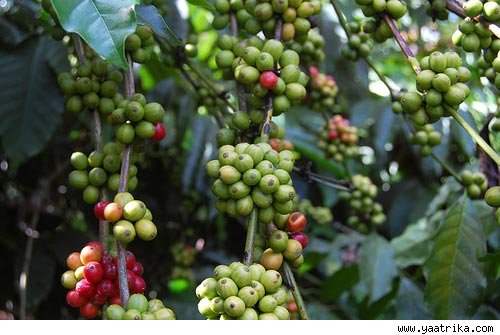
Coffee-lovers take note; climate change could put an end to your daily Starbucks, a new study has found.
The latest research from scientists at London’s Royal Botanic Gardens, Kew, suggests that climate change could wipe out wild populations of Arabica coffee (Coffea arabica) within the next 70 years.
The scientists used data from museum records and current populations of wild Arabica in Ethiopia to map its distribution until 2080 under different climate scenarios.
They found that the predicted changes in climate, in line with what’s expected over the coming decades, would have a devastating impact on wild Arabica populations, decreasing their number and extent. The study, published in the open-access journal PLOS ONE, also confirmed that the Arabica species is sensitive to climate change.
Along with Robusta coffee (Coffea canephora), Arabica is one of the two most important species of coffee economically, accounting for over 60 percent of world production.
Justin Moat, head of spatial information science at the Royal Botanic Gardens, Kew, says:
“The worst case scenario, as drawn from our analyses, is that wild Arabica could be extinct by 2080. This should alert decision makers to the fragility of the species.”
Commercially grown Arabica has a very limited genetic stock – which means your morning latte relies on conserving healthy populations of wild plants in Ethiopia, the largest producer of coffee in Africa.
“Coffee plays an important role in supporting livelihoods and generating income, and has become part of our modern society and culture. The extinction of Arabica coffee is a startling and worrying prospect,” says Aaron Davis, head of coffee research at the RBG.
“However, the objective of the study was not to provide scaremonger predictions for the demise of Arabica in the wild. The scale of the predictions is certainly cause for concern, but should be seen more as a baseline, from which we can more fully assess what actions are required.”
source: http://www.tgdaily.com / TG Daily / Home / by Flora Malein / November 08th, 2013
WELCOME. If you like what you see "SUBSCRIBE via EMAIL" to receive FREE regular UPDATES.
Read More »