Grounds for hope: Coffee could make our soil, planet healthier, says Mridula Ramesh

Agricultural soils, under better management, could store up to 1.2 gigatonnes of carbon each year. That’s substantial – and coffee is showing the way.
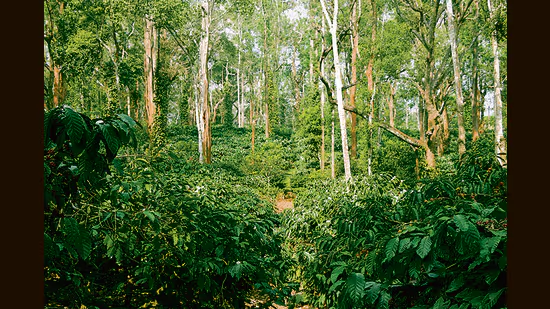
Shade trees protect a plantation in Coorg. It turns out that shade can help soil store far more carbon, slashing the footprint of the crop. (Shutterstock)

Dappled sunlight filtered through the broad leaves of a jackfruit tree, before trickling through the waxy canopy of an avocado, casting a cool shade over my feet, which were sinking into the brown, mulchy soil as my fingers squeezed two creamy seeds out of a bright shiny cherry and onto my palm.

That was when it hit me: Origins matter: How you were shaped determines where you will thrive.

Here, in the Palani Hills, Coffea arabica was thriving in a cool, humid forested nook much like its ancient home in the Ethiopian highlands. Old and planted forests sheltered it from heat and wind, while the humus-rich soil supplied year-round moisture without drought or waterlogging.

Shaker Nagarajan, the owner of this plantation, tells me farms like his have been increasingly caught between elephants, labour-scarcity and storms, in recent years. He’s mindful of what trees he plants, because some, like the banana, draw the elephants that migrate seasonally to these slopes. “The calves really cause havoc,” he adds, running amok like toddlers do.

Coffee harvests fall between October and February, a season of festivals and rains in these parts, making labour expensive and hard to retain. A giant storm a few years ago knocked over a number of large trees (most of them non-natives with less-deep roots). That year, Nagarajan says, he was only able to salvage 25% of his crop.

Such storms may become more common as the planet warms.

As I mentioned in my last column, Part 1 of this two-part series on coffee, a 2015 study found that, based on current climate projections, about half the land currently used for coffee production would no longer be suitable for the crop, by the 2050s. Brazil, the world’s largest producer, will be especially hard-hit. Any gains at higher elevations will carry a steep deforestation cost.

For a world that consumes two billion cups of coffee a day, this is terrible news. But there is a way forward. I even saw it in action here: forests and soil, working together.

In the early afternoon, it was cool at the plantation and a light drizzle fell. “I used to maintain 40 trees to provide shade to the 1,200 coffee plants on every acre of land,” Nagarajan said. “Now, with temperatures rising, I have increased the number of shade-providing trees to 100 per acre.”

David Hogg, chief agriculture advisor at Naandi Foundation, which supports Araku Coffee, the makers of award-winning coffee produced in collaboration with over 10,000 tribal families, agreed. “I measured surface ground temperatures both inside coffee farms and outside and consistently found the shaded coffee farms were 4 degrees Celsius to 7 degrees Celsius cooler,” Hogg said. “Forests were a natural buffer. So I was able to assure our trustees that Arabica coffee would remain resilient (here) for the next 50 to 100 years, provided the ecosystem was maintained.”
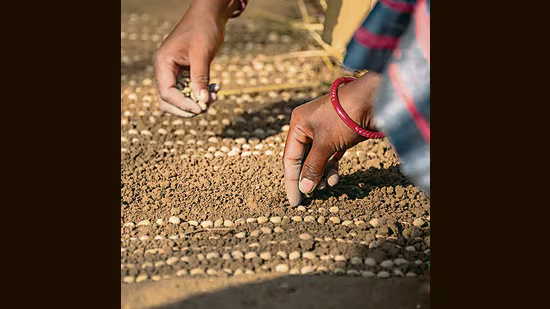
Araku uses a hybrid seed that is a cross between arabica and robusta.

Rattan Lal, distinguished university professor of soil science at Ohio State University and a global authority on soils, told me, “When it’s about 27 degrees Celsius outside, the soil temperature may be 40 degrees Celsius, but under the forest canopy, it is only about 27 or 28 degrees Celsius. So, there’s a big difference.”

That’s temperature taken care of, for now. Forests also help intercept the heavy downpour, and maintain humidity in dry months.

The other adaptation is soil.

Plants, like us, need water to maintain structure, move nutrients around, fuel photosynthesis and cool themselves. Most plants draw almost all their water through their roots from the soil. So, when water content in soil falls, yields suffer.

Soil is a dynamic matrix of mineral particles, organic matter, water, air and microorganisms. Healthy soil strikes a Goldilocks balance: enough large pores to let rainwater soak in and, during heavy downpours, drain away; and enough medium pores to hold onto water against gravity, yet release it when plants need it. Humus (the organic-litter component of soil) helps keep this pore ratio just right. It also acts as a sponge. Soils rich in organic matter can store far more water — anywhere from roughly one part water per part humus to eight parts water per part humus.

Organic matter reengineers the soil’s plumbing. Vitally, it also contains microbiota that can break organic matter down into a form of nitrogen that can be absorbed by plants.

***

In India, we have destroyed our soil.

Lal tells me tropical soils should ideally contain 1% to 1.5% organic carbon, but in many Indian farms, especially in the northwest, it is now 0.1% to 0.2%, because “we take away the crop residue and either burn it or convert it into feed where the dung doesn’t return. So, Indian soils are really depleted.”

That’s a problem. In 1937, in the aftermath of the Dust Bowl crisis, US President Franklin D Roosevelt wrote: “The dust storms and floods of the last few years have underscored the importance [of programmes to] control soil erosion… The Nation that destroys its soil destroys itself.”

Farmers try to compensate for falling soil health by adding more fertiliser or more water. “But that causes its own problem,” Lal says. “The efficiency of nitrogen fertiliser in India, under ideal conditions, is only about 30%. The remaining nitrogen, which is not absorbed, [leaches] into groundwater as nitrates, which harms the health of people who drink it, or escapes into the atmosphere as nitrous oxide, a greenhouse gas 200 to 300 times stronger than carbon dioxide.”

Yikes.

The interesting thing, Hogg found, is that tribal farmers didn’t want to use chemical fertilisers. When they applied the urea the government gave them, they told him, “all the earthworms ran away”. This gave him the confidence to build an organic programme in the Araku Valley in Andhra Pradesh.

“Because coffee in Araku is surrounded by biomass, we integrated composting and microbial inoculants to restore soil health. Over the years, soil life returned, coffee quality improved, and Araku coffee began earning international recognition,” Hogg says. “Coffee thrives in a beautiful symbiosis with the forest, in which trees feed the soil with dissolved organic carbon. Organic carbon levels have doubled or tripled in five years, as soils once depleted by slash-and-burn practices began to regenerate. Levels rose from about 0.4% organic carbon to 1.6%, sometimes even higher. Some farms have even gone up to 6% organic carbon, so the sky is the limit.”

***

Carbon here is not just about climate; it is also about soil health.

Soil carbon supports microbial life, modulates structure, improves aeration and, most importantly, holds water. This water-holding capacity reduces stress on coffee plants during dry periods, making them healthier and less vulnerable to disease.

“For me,” Hogg says, “this is the essence of regenerative agriculture: restoring soil life and protecting the environment for future generations.”

Interestingly, “as soil organic carbon levels rose, sweetness and flavour depth improved too,” says Hogg. Nagarajan echoes this.

For the longest time, Indian coffee growers didn’t have an incentive to focus on quality. They had to sell everything to the coffee board, and a small payment to the chief inspector ensured it would be certified as fair average quality, or FAQ.

With liberalisation, the focus on quality began.

And there’s more. The world is realising that coffee, blessed with a rich array of polyphenols, particularly chlorogenic acids, can be a health food. A seven-year study of 36,758 adults, published in the journal Current Developments in Nutrition in 2020, found that even modest daily coffee intake was linked to a lower risk of death. These polyphenols act as antioxidants, modulate the gut microbiome and slow glucose absorption in the intestine, reducing post-meal blood-sugar spikes.

What’s fascinating is this: researchers have found that shade-grown arabica in Thailand contained roughly twice the levels of chlorogenic acids and markedly greater antioxidant activity than beans grown in full sunlight.

There’s even more: Shade changes coffee’s carbon math. A new accounting method that recognises shade’s impact on soil and biomass carbon, and on erosion protection, developed by Lal and his colleagues, shows that shaded systems store significantly more carbon than unshaded plots. This serves to lower the carbon footprint of shade-grown coffee by 22%.

Lal told me he believes that soil, globally, could sequester about 2.5 gigatonnes of carbon each year (or nearly a quarter of what humanity emits annually). Agricultural soils, under better management, could store up to 1.2 gigatonnes of carbon each year. That’s substantial.

Climate resilience, less carbon pollution, health. Those are worthy goals. Araku’s experience shows that the methods can be scalable, fair (the company’s practices have raised farmer incomes) and aspirational. Araku has won the Epicure d’Or award for taste, and the Rockefeller Foundation’s Food System Vision Prize for sustainability.

To actually scale this across India, and around the world, needs more action. “India needs a Soil Health Act,” Lal says, “to incentivise farmers to grow carbon in their soils.” While there are new schemes to wean farmers away from fertiliser abuse, when one compares the ₹1.2 lakh crore budgeted in 2024-25 for urea subsidy to the ₹45 crore for the Policy on Promotion of Organic Fertilizers, one wonders how much the needle will shift.

But shift it must, for good coffee and so much more.

(Mridula Ramesh is a climate-tech investor and author of The Climate Solution and Watershed. She can be reached on tradeoffs@climaction.net. The views expressed are personal)

source: http://www.hindustantimes.com / Hindustan Times / Home / by Mridula Ramesh / September 05th, 2025
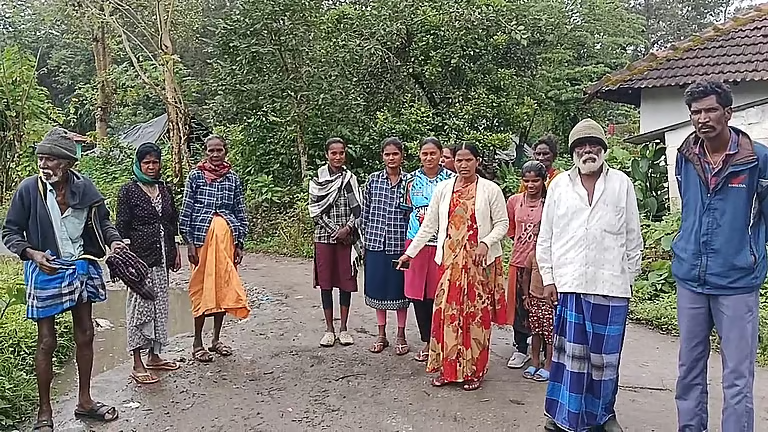
Tribal families in South Kodagu go without nutritious food for three months amid contract delays

Over 150 families of tribes living within the Maldare Panchayat limits stated that they are unable to make ends meet as they are deprived of government facilities.

Over 500 tribes have not been supplied with nutritious food from ITDP for the past three months. (Photo | Express)

Madikeri :

The tribes settled across various settlements in South Kodagu have expressed anguish over the non-supply of nutritious food from the ITDP department for the past three months. They have demanded that the concerned officials take immediate action and resume the supply of the food items.

Over 150 families of tribes living within the Maldare Panchayat limits stated that they are unable to make ends meet as they are deprived of government facilities.

“The government used to provide nutritious food to the tribal settlements. The food items were helpful as most of the time we are unemployed and suffering from poverty. But no items have been received for the last three months,” shared Indira, a resident of the tribal settlement.

She explained that the tender for supplying food to the tribal settlements has allegedly been given to a contractor from outside the district and opined, “If the government gives the tender for supplying food to the district contractors, this will ensure timely supply of food items.”

She further stated that the tribal community living in the forest is deprived of all basic facilities. “We at least made sure that we did not stay hungry. But for the past three months, we are finding it tough to satiate our hunger,” she added.

Meanwhile, the tribes complained that their livelihood has been severely affected due to the increasing number of migrant workers from North Eastern states allegedly taking over their jobs as estate labourers.

“Migrant workers mostly live in the coffee plantations and work for low wages. In this context, several tribes have been rendered jobless. Alongside unemployment, the lack of facilities, including the absence of nutritious food supply, is affecting us,” she said.

When questioned, ITDP department district director Honnegowda said, “The supply of nutritious food was delayed due to technical issues. We had sent the sample of oil (supplied under the nutritious food scheme) for FSSAI testing in Mysuru over quality issues. The quality check report was delayed. Nevertheless, we have resumed the supply of food items for the past two days.” He added that the department has ordered the contractor to supply food before the 20th of every month.

source: http://www.newindianexpress.com / The New Indian Express / Home> Karnataka / by Express News Service / September 05th, 2025

Kodava Samaja to celebrate Kail-Poldh Festival on Sept. 7

The Annual Kail-Poldh Festival get-together will be held on Sept. 7 (Sunday) at Kodava Samaja premises in Vijayanagar 1st Stage here.

The day-long programme from 10 am to 5 pm comprises Ayudha Puja, Sports and Games, Lucky Dip, honouring eminent Kodavas and distribution of Scholarship to meritorious children.

Dr. Kottangada Pemmaiah, Deputy Director, Enforcement Directorate (ED), New Delhi, will be the chief guest.

Ponjanda A. Ganapathy, President of Mysuru Kodava Samaja, will preside.

Samaja Vice-President Machimada P. Nanaiah, Secretary Ketolira A. Belliappa, Joint Secretary Ajjikuttira Diana Poovaiah and Hon. Treasurer Ittira G. Kashiappa will be present.

source: http://www.starofmysore.com / Star of Mysore / Home> In Briefs / September 01st, 2025

Berry Borer Pest Threatens Andhra’s Coffee Heartland

The Central Coffee Board has confirmed the presence of this pest in four villages of the Araku Valley, located in the Alluri Sitarama Raju district.

Visakhapatnam:

For the first time in the history of coffee cultivation in Andhra Pradesh, a threat from the Coffee Berry Borer pest has raised alarm among planters.

The Central Coffee Board has confirmed the presence of this pest in four villages of the Araku Valley, located in the Alluri Sitarama Raju district. Fears are that this has the potential to cause widespread damage to tribal coffee gardens.

The Coffee Board has initiated an urgent containment operation, with its chairman MJ Dinesh overseeing the efforts on-site.

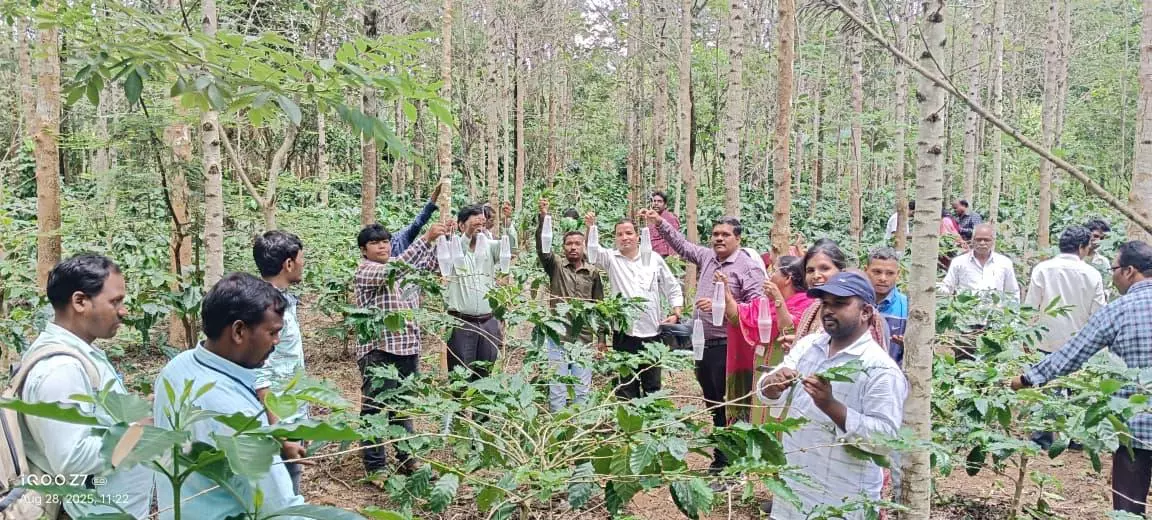
He said a special survey is currently underway across 11 mandals to track the spread of the pest-infliction. Teams of scientists and coffee board officials are working closely with tribal farmers, urging them to remain vigilant and report signs of an outbreak.

Field visits have confirmed active destruction in infected zones, prompting the launch of awareness campaigns to help farmers identify and respond to the pest early. The Integrated Tribal Development Agency (ITDA) is supporting this survey through its field officers.

The first confirmed outbreak of the Coffee Berry Borer was traced to Pakanakudi village in the Chinalabudu panchayat, under the Paderu revenue division.

Officials have begun collecting infected beans from the coffee plantations and are using hot water immersion techniques to eliminate the insects. Quarantine measures have been implemented in five villages: Pakanakudi, Malisingaram, Malivalasa, Thurraiguda and Manjaguda.

As a precaution, the export and import of coffee beans from these areas have been banned. Beans harvested in these regions will be processed locally into parchment to prevent the spread of the disease.

Attempts are on to contain the outbreak. Scientists from the Coffee Research Institute (CCRI), the RV Nagar Research Station, and the Central Coffee Board are conducting intensive field surveys in GK Veedhi, Chintapalli and G Madugula mandals. Their observations would guide the next phase of containment and support for farmers.

The scale of coffee cultivation in the ASR district highlights the urgency of the situation. Over 245,000 tribal farmers cultivate coffee on 258,000 acres, while the state Forest Development Corporation manages an additional 10,025 acres.

During a recent visit to Paderu, chief minister Chandrababu Naidu asked district officials to expand coffee cultivation by 100,000 acres.

source: http://www.deccanchronicle.com / Deccan Chronicle / Home> Southern States> Andhra Pradesh / by Aruna / September 02nd, 2025

‘Dhwani Kotta Dhani’ award conferred on six achievers

Mysuru:

“It is literally true that former Chief Minister late D. Devaraj Urs lent voice to voiceless and marginalised sections of the society during his tenure as the CM,” said MLC Dr. D. Thimmaiah.

He was speaking after inaugurating ‘Dhwani Kotta Dhani’ award ceremony organised jointly by Anveshana Seva Trust and Ursu Jagruti Academy Charitable Trust, at Institution of Engineers-India (IEI) on JLB Road here on Friday, marking the 110th birth anniversary of late former CM D. Devaraj Urs.

“Devaraj Urs always stood with the marginalised, micro, downtrodden and other voiceless communities, when it came to extending rights, benefits and facilities. Urs is still remembered for his outstanding  and exemplary service to the society while in power. Most of the politicians these days have homes in big cities like Bengaluru and Mysuru. But Urs did not have any house in the State capital or other big cities. However, his memory is etched in the minds of everyone and it still stands fresh,” Dr. Thimmaiah noted.

Highlighting the revolutionary  decisions taken by Urs while in power such as elimination of bonded labour, ban on manual scavenging and introduction of  ‘Uluvavane Bhumi Odeya’ Act (the tiller is the actual land  owner), the MLC said it was D.D. Urs who gave land to the landless and provided shelter to the shelterless. His contributions and achievements are memorable at the National-level even today, he added.

Educationist Bhramara Bahaddur from Bengaluru, Karnataka Karavali Samskrutika Okkuta Founder Dr. Jagannatha Shetty from Mandya, senior yoga teacher Jagadish Shettar from Dakshina Kannada, Star of Mysore and Mysuru Mithra Photographer M.N. Lakshminarayana Yadav from Mysuru, Goa Liberation Movement fighter Girija Shankar Patil from Koppal and Kodagu Institute of Medical Sciences (Madikeri) Associate Professor Dr. Anand from Kodagu were conferred ‘Dhwani Kotta Dhani’ awards on the occasion.

Charitable Trust Vice-President H.A. Venkatesh, Hon. Secretary Dr. MGR Urs, former Tumkur University VC Dr. Y.S. Siddegowda, Anveshana Seva Trust Founder-President Amarnath Raje Urs, former Bengaluru Kanteerava Studios Chairperson Vijayalakshmi Urs and others were present.

source: http://www.starofmysore.com / Star of Mysore / Home> News / August 31st, 2025

Silver Jubilee Celebration of Ramakrishnanagar ‘I’ Block Kodava Welfare Assn.

Mysore/Mysuru:

The annual get-together and silver jubilee celebration of Ramakrishnanagar ‘I’ Block Kodava Welfare Association, Mysuru, was  held recently at Kodagu Sahakara Sangha in Jayalakshmipuram.

Association President Kodandera Puspha Machaiah presided. The event  commenced with a formal inauguration by lighting  the lamp followed by  invocation  by Mundiyolanda Nanda. Secretary Kenjangada Kariappa welcomed.

Condolences were offered to the departed members during the last one year and community extended their heartfelt condolence to the Founder-Editor of Star of Mysore K.B. Ganapathy, in recognition of his exemplary service to journalism and the Kodava  community as well as valuable contributions to the society at large. Top scorers in X standard CBSE and II PUC students of 2025 examinations were felicitated with cash prizes.

The Founder Executive Committee Members were felicitated on the occasion for their service rendered for the community.

Annual Report was presented by Treasurer Kotrangada Appanna while  Kattera A. Nanaiah, Advisor, highlighted the Association’s milestones over the last 25 years.

Maletira Ganapathy, Vice-President, proposed the vote of thanks. Codanda Swagath, Joint Secretary and all other Committee Members were present. Kotrangada Shruthy Ashwath compered.

source: http://www.starofmysore.com / Star of Mysore / Home> News / August 28th, 2025

BRIC Superbike Championship – 2025 City’s Tasmai Cariappa wins Round 2

Mysore/Mysuru:

Tasmai Cariappa, city’s motorsport enthusiast, taking part in the recently held BRIC Superbikes Championship held at Chang International Circuit in Thailand, won the Round 2 of the Championship in the 400 CC category.

A resident of Kuvempunagar in Mysuru, Tasmai is the son of Dr. Monnanda Nalini Somaiah, Professor, Department of Studies in Botany, Manasagangothri, University of Mysore.

source: http://www.starofmysore.com / Star of Mysore / Home> Sports / August 28th, 2025

Kail-Poldh Fest at Balugodu

Federation of Kodava Samajas, Balugodu, Virajpet and its Women’s Wing have jointly organised Kail-Poldh Festival  on Sept. 13 (Saturday) at 10 am at the Samaja premises in Balugodu.

Ayudha Puja will be held at 10 am.

On the occasion, coconut shooting and various competitions will be conducted, according to a press release.

source: http://www.starofmysore.com / Star of Mysore / Home> In Briefs / August 26th, 2025

US Open: Bhambri, Bopanna to lead India’s challenge in men’s doubles

Yuki Bhambri has teamed up with New Zealand’s Michael Venus, while Rohan Bopanna has joined forces with Monaco’s Romain Arneodo.

Rohan Bopanna. File | Photo Credit: AP

Yuki Bhambri, India’s number one doubles player, and veteran Rohan Bopanna will lead the country’s challenge at the US Open, season’s last Grand Slam.

Bhambri has teamed up with New Zealand’s Michael Venus, while Bopanna, India’s number two doubles player, has joined forces with Monaco’s Romain Arneodo.

Bhambri and Venus, seeded 14th, are facing solid singles players in Marcos Giron and Learner Tien, who have joined as a team.

File picture of Yuki Bhambri | Photo Credit: Getty Images

Bopanna and Arneodo open their campaign against the American team of Robert Cash and JJ Tracy.

Arjun Kadhe has partnered with Ecuador’s Diego Hidalgo and they are up against second seeded team of Marcelo Arevalo from El Salvador and Mate Pavic from Croatia.

There will be an Indian team of N Sriram Balaj and Rithvik Bollipalli, who face the American-Dutch combine of Vasil Kirkov and Bart Stevens.

source: http://www.thehindu.com / The Hindu / Home> Sports> Tennis / by PTI / August 28th, 2025

Narayan Jagadeesan credits Robin Uthappa for guidance

Jagadeesan (PC: X)

Narayan Jagadeesan, the Tamil Nadu wicketkeeper-batter, has opened up about the impact of his former Chennai Super Kings (CSK) teammate Robin Uthappa on his career. Jagadeesan and Uthappa shared the CSK dressing room between 2020 and 2022, playing under MS Dhoni alongside Ravindra Jadeja.

Speaking to ESPNcricinfo, Jagadeesan revealed how Uthappa influenced his approach as both a cricketer and an individual.

“Robin has instilled more discipline in me regarding how to approach each session,”

Jagadeesan said. “He has taught me many things, making me calm and secure, not just as a cricketer but as an individual, and to stay present.”

On the technical side, Jagadeesan credited his Tamil Nadu coaches for shaping his batting. “When it comes to batting, Guru sir [AG Guruswamy] and Narasimha [both coaches in Tamil Nadu] have helped me,” he added.

Jagadeesan also lived his father’s dream earlier this year when he was named a reserve player in India’s squad for the fifth and final Test against England at The Oval. Though he did not make the playing XI, being part of India’s thrilling six-run victory was a moment of pride for him.

“The India jersey is now going into the frame, and I hope to add many more,” he said. “Being part of such an intense and thrilling match made it even more special. Winning the game from an unexpected situation was truly remarkable and gave me goosebumps.”

Most recently, Jagadeesan represented Chepauk Super Gillies in the Tamil Nadu Premier League (TNPL) 2025. It turned out to be a mixed campaign for him. He scored 180 runs in seven innings at a strike rate of 179.07, including two half-centuries.

source: http://www.revsportz.in / Revsportz / Home> Breaking News > Cricket / by Staff Reporter / August 28th, 2025