Meet Brijesh Kalappa-The Man behind Karnataka’s Victory in the Cauvery Case

BrijeshKF28feb2018

The Supreme Court delivered its historic verdict on Friday that the state of Karnataka will get 14.75 TMC or thousand million cubic feet more water, in addition to the 270 TMC awarded by the Cauvery Water Disputes Tribunal (CWDT) in 2007. The Cauvery water sharing dispute has been a bone of contention between Karnataka and Tamil Nadu since the time of the British Raj.

This verdict is a clear victory for the poll bound Karnataka. However, Karnataka’s victory is mainly credited to Brijesh Kalappa who quit his cabinet rank post for the case.

Brijesh Kalappa is an advocate in the Supreme Court and Former Additional Advocate General, Haryana. He is an alumnus of the National Law School of India University and has also been a Legal Advisor to the Government of Karnataka (with the rank of Minister of State.) He has a sustained interest in public affairs even from his student years. He is a former journalist and has a wide range of interests including reading and travelling. On the professional front, he has worked with several legal luminaries on subjects of importance in civil, criminal, water and electoral laws and has individually represented governments, eminent individuals and major industrial houses. He is gifted with the prowess for distinctive sharp-edged analysis and has the advantage of surmounting well accepted beliefs by his inquiring nature. He is also the spokesperson of the Indian National Congress.

As a Legal Adviser, Kalappa could not appear on behalf of the State of Karnataka. The Cauvery Water Dispute had been very close to his heart, more so since he hailed from Kodagu. Thus he expressed his desire to re-join legal practice in order to continue to appear for the State of Karnataka when the prospect of the final hearing in the Cauvery Dispute before the Supreme Court loomed. The Chief Minister Siddaramaiah understood its significance, since he belonged to the basin area of the Cauvery River and thereby consented. Kalappa therefore resigned from the position of Legal Adviser to the Government of Karnataka/Chief Minister and re-entered the legal team that he was a part of for a decade and a half.

Kalappa had written a detailed post sharing his experience of appearing in the Cauvery case

In this interview, Kalappa has an exclusive chat with The Indian Jurist regarding the latest victory of Karnataka in Cauvery River dispute and his all over experience throughout the case.

The Indian Jurist: Sir, First of all Congratulations for the victory in the Cauvery Judgment. To begin with- you quit your position as the cabinet minister to concentrate on this case. So what exactly gave you the courage and the motivation to do so?

Brijesh Kalappa: In 2007, when the Cauvery Water Dispute Tribunal award has come, at that time I was very much a lawyer and then I had also prepared the SLP and had worked in regard to the Cauvery case. From 2007 onwards we kept waiting that the Supreme Court will hear the matter and finally when the Supreme Court actually decided to hear the matter on a day-to-day basis in 2017, ten years later, I had been by then appointed as legal advisor to the Chief Minister of Karnataka and Mr.Siddaramaiah was kind enough to have conferred me the rank of minister so at that time my first instinct was that we should succeed in Cauvery just like we had succeeded in Krishna earlier. I was the Advocate on Record for the State of Karnataka in the Krishna Water Disputes, where Karnataka was the beneficiary of the greatest possible award of 524.256 m for the Almatti Dam and enhanced share of the share of Karnataka from 734 to 910 Tmc.

TIJ: Though there has been a reduction in the share of Tamil Nadu but now Karnataka is obligated to release a monthly share. So this in turn does benefit Tamil Nadu and is not complete loss for the state?

BK: No, certainly it is not a loss for Tamil Nadu and I would actually look at it this way that as far as Tamil Nadu is concerned, it is important only if they have a workable order- doesn’t matter if they receive 500 TMC from Karnataka every year. But if Karnataka has refused to give them 500Tmc and they are running to Court every year then what is the joy of having an order like that. It should be a workable order. If it doesn’t work then there is no point. Tamil Nadu will also not enjoy the sweet success of having an order which isn’t going to be implemented. The thing which is important is to have something which is implementable.

TIJ: In one of the media interactions with the reporters at Vidhan Soudha, Karnataka Chief Minister Mr.Siddaramaiah stated that the verdict was not in full accordance with the plea and only some relief had been sought. So are you satisfied with the judgment?

BK: As far as the complete requirements are concerned they are certainly not fulfilled. One can see straight off that Karnataka people could have had much more. But I think there has to be a sense of give and take. We also have a sense that this is final because after the Supreme Court where else can you appeal? You can only go to God next.

TIJ: The major grouse of Karnataka was that the farmers in the Cauvery basin were restricted by curbs on the water usage. So how far this judgment would be beneficial for the farmers now?

BK: The victory is straightaway for farmers. About a lakh and half farmers are going to be benefitted straightaway and as far as the Bengaluru city is concerned, I think the needs of Bengaluru city, which was considered as of the most unlivable city after Cape Town (South Africa), that will finally be resolved.

TIJ: So how has been your experience throughout the entire case these years? You might have been receiving both brickbats and bouquets as well in the case?

BK: See, when you appear in a case like this, a daily assessment is made about your performance. The Cauvery Case is not about the final order, like as if it were to happen in a single day, For instance whenever there is distress, fate is ours to release say maybe 15 cu ft or 20 cu ft of water, many people don’t understand the outcome or implications of this, they would immediately say that the legal team have totally failed us and then there will be burning of effigies and people sending us very vicious WhatsApp messages and people making very horrible comments and mainly these people have lived of the state for so long but what they forget that this is an ongoing case and it is going on, at least as far as I am concerned, for a decade and a half. Suppose they say look Rs 1 Crore has been given to “X” lawyer then public says ‘look at this lawyer they have received such a huge amount’. But 1 Crore rupees over 15 years is nothing or 2 crore rupees a year means nothing because once you are living in Delhi, the living standards are very high there and how much a lawyer earns is very high. So in comparison to all of that what you are actually earning is probably less than a techie who is working in a top software firm. But people will say, “No-No Look at the kind of money these guys are making”. So this is the kind of campaign which really hurts you. But the overall point is that there must be satisfaction in what you do and satisfaction comes from within. So once you understand that this all blaming is just people’s frustration then you are okay with it. Even the normal client, when fails to get justice, he will always blame the lawyer and he will not say anything against the judge or anyone else. So we think of it in that sense. I have personally received both brickbats and bouquets during these years. I have endeavored to treat both with equanimity. This is actually what Lord Buddha says. There is much more to do, miles to go before we sleep. Threats to our environment ought to be thwarted, greater concern for water usage implemented and selfish concerns repelled.

TIJ: So finally this landmark judgment has held that a river is no one’s exclusive property; it is a national property and not a state owned. Will this judgment become a basis for all the other water disputes as well?

BK: This is indeed a wonderful law which has been laid down by the Supreme Court because the previous law had always been laid down under a reference for under such circumstances. So this is a particular law in regard to equitable apportionment which has been now laid down and it’s of course a high point as far as the law in regard to equitable apportionment is concerned. And further, everybody will certainly look at this judgment for all times to come.

source: http://www.theindianjurist.com / The Indian Jurist / Home / by Naazish Fatima / February 19th, 2018
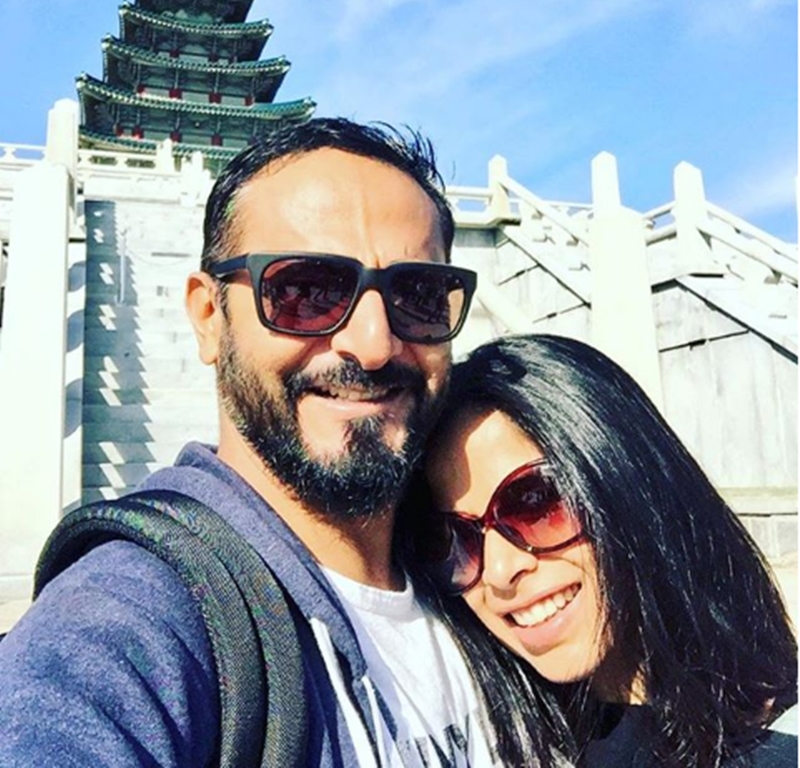
It’s a girl! VJ Nikhil Chinapa and wife DJ Pearl blessed with daughter

NikhilKF28feb2018

VJ Nikhil Chinapa, who is right now judging MTV Roadies Xtreme, has become a proud father. Nikhil Chinapa and his wife DJ Pearl were blessed with a baby girl on February 24. Nikhil took to Instagram to announce this beautiful news. He captioned the snap, “She’s fully Coorg + fully Sardarni. #wahecoorg .#Repost @pearls.world”

Pearl too shared a beautiful picture on Instagram and captioned it as, “Our princess is here! Daddy got away easy with just one whack during labour! Baby and Mama are having a giggle watching him recover @nikhilchinapa.”

Well, earlier, Nikhil had told Mumbai Mirror, “I kept thinking about it all these months, wondering how I would react. When it finally happened, it was overwhelming. My friends who are already parents tell me about how your life changes completely but nothing can prepare you for this!”

He further said, “My job gives me freedom in terms of when I can work. Every time I look at my daughter I want to pick her up and play, I’m making the most of these moments.”

Nikhil and DJ Pearl got married in 2006 after dating for 6 years. Congrats to both!

source: http://www.freepressjournal.in / The Free Press Journal / Home> Entertainment / by Sumit Rajguru / February 27th, 2018

Works of Bharatisuta termed ‘encyclopaedia’ of Kodagu

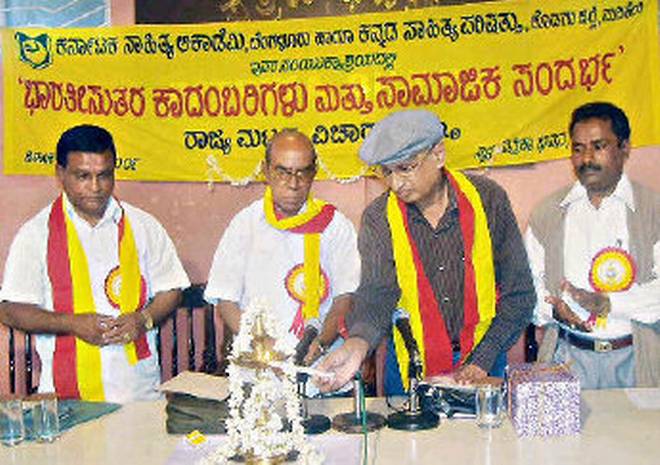
Traditional: Critic Narahalli Balasubramanya inaugurating a seminar on ‘Bharatisutara kadambarigalu mathu samajika sandarbha’ in Madikeri on Friday.

Reprint of Bharatisuta’s Edakallu Guddada Mele released

Madikeri:

Critic Narahalli Balasubramanya on Friday stressed the need for re-writing the “literary history” of Kannada works and authors, stating that debates on them confined to a few writers.

He was speaking after inaugurating a State-level seminar on “Bharatisutara kadambarigalu mathu samajika sandarbha” at the Kodagu Patrika Bhavan hall here organised under the auspices of the Kodagu District Kannada Sahitya Parishat and the Karnataka Sahitya Parishat, Bangalore.

Works of many Kannada writers had been neglected. Bharatisuta, who had to his credit 61 works, including novels, was one of them, Mr. Balasubramanya said.

He said most of the “navya” writers hailed from the academic background. A writer had to self-analyse his work instead of waiting for someone to view it critically. Bharatisuta was a Gandhian, but leftist ideals had profound influence on him.

Mr. Balasubramanya said that Bharatisuta’s works reflected the flavour of Waynad in Kerala and Kodagu where he lived. The relationship between man and nature, his penchant for the proletariat class, and man-woman relations were the highlights in the works of Bharatisuta. The candid views of the writer on “instinct and nature” were relevant to all times, Mr. Balasubramanya said.

He released the reprint of Edakallu Guddada Mele, one of the novels of Bharatisuta, on the occasion

M.H. Krishnaiah, president of the Karnataka Sahitya Academy, who presided over the function, termed the works of Bharatisuta the “encyclopaedia” of Kodagu. Bharatisuta reflected the culture of Kodagu in his own inimitable ways. He started writing on the themes of progress much earlier than a movement for progressive writing in Kannada started in the 1940s. Only a few writers wrote about the tribal people and Bharatisuta was one of them.

Mr. Krishnaiah offered to bring out one of the two unpublished works of Bharatisuta on the occasion. The Kannada Book Authority could be approached for publishing the other works, he said. The academy was prepared to associate with the Karnataka Kodava Sahitya Academy with a view to unveil the multi-faceted aspects of Kannada literature through comparative studies, Mr. Krishnaiah said.

President of the Koadgu District Kannada Sahitya Parishat T.P. Ramesh recounted the arduous path Bharatisuta had to tread during his 61 years of illustrious life as a teacher, writer and novelist. Bharatisuta’s son Vijayashankar received a memento. V.N. Mallikarjunaswamy, Registrar of the Karnataka Sahitya Academy, welcomed the gathering. Papers were presented by K.P. Balasubramanya Kanjarpane, Kavita Rai, Thithitra Rekha Vasant and Anil H.T.

source: http://www.thehindu.com / The Hindu / Home> National> Karnataka / October 17th, 2009

B’lore Eagles crowned BDFA A-division champ

B’lore Eagles defeated ADE FC 3-0 to take an unassailable lead atop the BDFA A-division league and was thus crowned champion here on Saturday.

Eagles, which became a BDFA affiliated club in 2011, has steadily risen through the ranks earning promotions from as low as the C-division and will ply its trade next season in the Super Division.

The results: A-div: B’lore Eagles FC 3 (K. Manivanan 48, M. Sujikumar 58, 70) bt ADE FC 0. Super div: Students Union FC 5 (Amoes 11, 36, 75,Sunil 28, Samanth 33) bt RWF FC 2 (Rajesh 37, Nandakumar 85) .

Chengappa stars for Kodava Samaja
P.S. Chengappa starred with a 67th minute winner as Kodava Samaja beat Canara Bank 3-2 to clinch the Field Marshal K.M. Cariappa Memorial hockey tournament here on Saturday.

The result: Final: Kodava Samaja 3 (Abhinav Ganapathy 20, M.B. Aiyappa 35, P.S. Chengappa 67) bt Canara Bank 2 (Pradhan Somanna 13, Nikkin Thimmaiah 39).

Special awards: Best goalkeeper: H.T. Sanjay (DYES); Best defender: V.R. Raghunath (Kodava Samaja); Best midfielder: P.S. Guria (ASC & Centre); Best forward: Nikkin Thimmaiah (Canara Bank); Player of the tournament: K.P. Somaiah (Canara Bank) .

RBI advances with hard-fought win
RBI men notched up a hard-fought 3-1 win over ESIC to enter the semifinals of the all India Public Sector badminton tournament at the Padukone Dravid Centre for Sports Excellence here on Saturday.

Tremendous comeback

After RBI had taken a 2-1 lead, Kritesh looked set to seal the deal after he won the first game against Anmol in the fourth match. But Anmol made a tremendous comeback and won the second game 24-22.

In the third, Anmol clawed his way back from 11-16 courtesy some thundering smashes.

But at 17-17, he suffered a lapse in concentration, as Kritesh won four points in a row and closed the contest.

The results:

Quarterfinals: Men: HPCL bt LIC 3-0 (Ansal bt Kiran 21-2, 21-5; Laa Tanwar bt Siddharth 21-13, 16-21, 21-18; Ansal & Laa bt Siddharth & Jarson 22-20, 21-11).

FCI bt Coal India 3-0 (Kaushik bt Abhishek 21-3, 21-5; Srujan bt Ansuman 21-13, 21-7; Mayank & Dayinder bt Ansuman & Ankit 21-7, 21-15).

RBI bt ESIC 3-1 (Shovik bt Shubham 21-19, 23-21, Anjan & Ranjan bt Firoz & Viplav 22-20, 21-6; Bhaskar lost to Viplav 21-13, 21-8; Kritesh bt Anmol 21-13, 22-24, 21-17).

Women: Air India bt CWC 2-0 (Shikha bt Deepshika 18-21, 21-11, 21-19; Prajakta & Sanyogita bt Deepshika & Sanya 21-8, 21-7).

RBI bt BSNL 2-0 (Rasika bt Jyoti 21-4, 21-8; Meghna & Poorvinha bt Nanditta & Bipasha 21-8, 21-5).

AAI bt LIC 2-0 (Mahima & Karishma bt Tharranve & Yaishali 11-4 (retd.); Aditi bt Lalitha 21-9, 21-3).

FCI bt ESIC 2-0 (Utsava bt Hena 21-11, 21-10; Namita & Anamika bt Hena & Vindu 21-15, 21-13).

source: http://www.thehindu.com / The Hindu / Home> Sport / February 25th, 2018

Towards fostering Kodava culture

Madikeri :

There are 21 Kodava-speaking communities in Kodagu against the 18 mentioned in a book, Kodava Bhashika Moola Nivasiya, published by the Karnataka Kodava Sahitya Academy here.

These communities speak Kodava and follow the same dress code and food habits, celebrate festivals in a similar manner and consider the “Guru Karona” (ancestor) as their god. They also worship Nature. Each community has a family name. Most of the communities have “Ain Mane” (ancestral house). Though they speak Kodava, they have remained scattered in different groups.

Kodava is the predominant community among them. Kodavas are in the forefront in all spheres. Though there are several attributes to the origin of Kodavas, it is an established fact they have been the principal tribe of Kodagu. There are over 800 Kodava families with a population of two lakh.

Kodava Bhashika Moola Nivasiya mentions about the “Heggade” community, which has 57 families with a population of 11,000. The “Amma Kodava” community has a small population in the district. “Amma Kodavas” are believed to be once the principal “archaks” of Kodagu. “Airi” is the other Kodava-speaking community. “Airis” are known for making Kodava ornaments such as “peechekatti” worn by men. “Kaniyas”, who speak Kodava, are believed to have migrated from Kerala, who specialise in astrology. There are minor differences between Kodavas and Kaniyas in terms of observing rituals. “Kapalas” are the poorest of the Kodava-speaking communities with a population of 300. They do not have family names, but have “Ain Mane”.

There are “Poomale Kudiyas” who have made the hilly areas of the district their homes. The “Kembatti” community comes under the Scheduled Caste category in Kodagu. Though “Kembattis” follow the Kodava culture, they have remained backward. The “Koyuva”; “Koleya”; “Golla”; “Nayar”; “Nayinda” (barbar); “Panika”; “Banna”, which has two groups – “Aat Banna” and “Alak Banna”; “Baaniya”; “Boonepatta”; “Madivala”; “Maliya”, which specialises in herbal medicine; “Marangi”; and “Meda” are the other communities that have adopted the Kodava custom in true spirit.

There have been talks of bringing these Kodava-speaking communities under one umbrella.

The president of the Akhila Kodava Samaja, Matanda C. Monnappa, said the idea was still there and it only had to be expedited. Members of the “Koyuva” community with “Chokira” family name at Srimangala in South Kodagu were taken into the Kodava fold in the 1980s. Similarly, there were applications pending with the samaja from “Airis” and “Bannas” to take them into the Kodava fold, he added.

The idea is to foster the unique Kodava culture followed by these communities. There are instances where Kodava girls marrying non-Kodavas taken into the Kodava fold by giving them new family names.

source: http://www.thehindu.com / The Hindu / The Online Edition / Home> Karnataka / by Jeevan Chinnappa / May 23rd, 2004

Raghunath ’tricks for Kodava Samaja

V.R. Raghunath scored a hat-trick as Kodava Samaja defeated MEG 4-1 to enter the final of the Field Marshal K.M. Cariappa Memorial hockey tournament here on Thursday. In Saturday’s final, it will take on Canara Bank which beat ASC 3-1.

The results: Canara Bank 3 (Ronald Kiran 15, K.P. Somaiah 33, K.M. Somanna 43) bt ASC 1 (Serin 56); Kodava Samaja 4 (V.R. Raghunath 6, 41, 47, K.K. Bharath 43) bt MEG (Shakthi 16).

Surana College emerges champion
Surana College won the Bangalore University South Zone inter-collegiate volleyball tournament beating host RJSIMS College 25-16, 25-20 in the final.

Rajkumar, Kishan shine in NCC’s win
Inspiring batting by opener S.M. Rajkumar (47 & 116) and good mediumpace bowling by Kishan S. Bedare (seven for 26) helped National Cricket Club register a 39-run win over Mysore CC in the two-day KSCA Mysore Zonal first division league tie recently.

The scores: National CC 180 in 55.1 overs (A.M. Kiran 53, S.M. Rajkumar 47, Sandeep four 33, K.M. Sharath three for 16) & 215 for six in 39 overs (S.M. Rajkumar 116, Thushar Harikrishna 34, M. Naveen four for 105) bt Mysore CC 89 in 25.5 overs (M. Naveen 32, K.M. Sharath 34 n.o., Kishan S. Bedare seven for 26) & 267 in 73.5 overs (S. Suprith 66, K.M. Sharath 34, Ayush Shetty 31, M. Naveen 25, M.S. Vinay three for 50, J. Madhu Prasad three for 49). Points: National CC: 5 points, MCC minus 1.

Yodhan, Darshan
star for Mahajana
A six-wicket haul by mediumpacer G.S. Yodhan Hrudhay (six for 19) and an all-round performance by M.B. Darshan (59 & four for 24) helped SBRR Mahajana FGC score a 74-run win over Sharada Vilas College and enter the semifinals in the KSCA Inter-collegiate tournament on Thursday.

The scores:

SBRR Mahajana FGC 126 in 12 overs (M.B. Darshan 59, Vatsa three for 34, Lohith three for 26) bt Sharada Vilas College 52 in 12.2 overs (G.S. Yodhan Hrudhay six for 19, M.B. Darshan four for 24).

MES FGC 45 in 17.4 overs (Goutham seven for 13) lost to Maharaja’s College 49 for two in 14 overs.

source: http://www.thehindu.com / The Hindu / Home> Sport / Bengaluru – February 23rd, 2018

Retain sanctity of traditional dance, experts urge Kodavas

Kodava Sahitya Academy makes suggestions on `Ummathat’

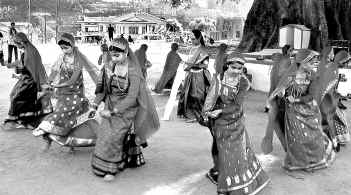
Traditional glory : Dancers performing a traditional dance of Kodagu.

Madikeri :

Kodavas have a unique culture and their folklore too is distinct from others. “Ummathat”, a special dance, a mixture of folklore with a dainty touch of medieval and modernity, performed by Kodava women, is a case in point.

Kodava women lag behind in variety of dances vis-a-vis men. Men attired in traditional costumes perform “Bolakkat”, “Peeliyat”, “Chowriyat”, “Kappeyat”, “Pareyakali”, “Kolatt”, and “Kombatt” whereas women dressed in colourful saris perform “Ummathat”.

There was a debate whether these dances should be performed in public or only at Kodava religious and cultural ceremonies.

The Karnataka Kodava Sahitya Academy, which had organised a seminar on “Ummathat” at Devanageri in Virajpet taluk recently, has come up with some suggestions concerning “Ummathat”. A decision was taken to maintain a uniform pattern of “Ummathat” in future.

Some of the suggestions are: Ummathat should not be performed in open or public functions or in front of the tableux as it loses sanctity. The dance shall be performed only in venerable places. Dancers shall remove footwear, wear traditional “bottu podiya” (a grand sari with rich brocade) while performing the dance.

The songs, an assortment of over 12 songs, sung in different tunes, will be retained without giving it a touch of modernity, was another decision taken at the seminar.

The “taleyatakki bolakk”, a brass plate containing a burning lamp sprinkled with rice, will replace the woman dressed up as Goddess Cauvery in the middle. The seminar arrived at a decision to formulate enough programmes in future to foster “Ummathat”.

Pace and rhythm

Akhila Kodava Samaja president Matanda C.Monnappa agrees with most of the suggestions that “Ummathat” must be nurtured. There ought to be a touch of modernity to go with it, he says. Increasing the pace of songs to match the rhythm will make it more attractive. At the same time, changes should not dilute the original nor affect the decorum of the dance. It should not portray women in poor light.

No one is sure of the origin of the songs or the nuances of “Ummathat”. Most people believe the songs were compiled by the late Haradasa Appacha Kavi several decades ago. Certain songs are contained in the book written by Kavishishya Haridasa Mukkatira S. Poovaiah. Late Puggera Karumbaiah, who was instrumental in reviving the “Ummathat” in the early Seventies, too had contributed to the dance form.

Origin of Ummathat

According to Puggera Aiyappa, a senior citizen from Devanageri, Ummathat was practised centuries ago though there are no records available to prove it. Mr. Monnappa says his 95-year-old mother (who passed away recently) used to sing “Ummathat” songs.

Other dances performed by men such as “Bolakkat” have religious sanctity. Bolakkat is offered to the deity unlike “Ummathat”, Mr. Monnappa said.

Similarly, dances such as “Peeliyat”, “Chowriyat” and “Kombatt” are performed at the religious places where the deities are worshipped. “Ummathat” and “Bolakkat” were performed in public in the past even in New Delhi. It had drawn criticism.

source: http://www.thehindu.com / The Hindu / Home> Karnataka> Madikeri / by Staff Correspondent / July 20th, 2005

Mani Ratnam ropes in Miss India contestant Dayana Erappa for Chekka Chivantha Vaanam

Miss India 2011 contestant Dayana Erappa is set to make her acting debut with filmmaker Mani Ratnam’s upcoming Hindi film Nawab, which is also made in Tamil as Chekka Chivantha Vaanam.

Dayana Erappa
Dayana Erappa

Mani Ratnam has roped in Miss India 2011 contestant Dayana Erappa to play a crucial role in his upcoming Hindi film Nawab, which is simultaneously made in Tamil as Chekka Chivantha Vaanam.

Dayana Erappa, who was born in Coorg and brought up in Bangalore, wanted to join the armed forces but ended up becoming a model after her principal encouraged her to pursue modeling. She was trained under fashion guru Prasad Bidappa from Bangalore. Then, she moved to Mumbai to take part in Miss India in 2011. Now, she is all set to make her acting debut with the bilingual movie.

The model is all thrilled to be a part of Nawab. “I was called for an audition by Mani Ratnam’s team. Initially, I thought it was a prank call, but later, I realized that it was genuine and sent my pictures. I even gave two rounds of auditions. But after a couple of months, the team called and told me that I was on board. I just couldn’t believe it,” Dayana Erappa told Deccan Chronicle.

The Miss India contestant feels that getting the chance to work with Mani Ratnam is a dream-come-true moment for her. “I never thought I’d get into films; so the offer means a lot to me. It would be a dream debut and I could not have asked for more,” added Dayana Erappa.

Like every other newbie, Dayana Erappa was also a bit nervous about meeting Mani Ratnam, but the latter kept her at ease by lauding her performance in the audition. Now she is busy preparing for her debut role in Nawab. “I am currently doing workshops with theatre actors to get my expressions right. I have several Tamil films in mind that I will watch to get the role right,” she told Deccan Chronicle.

Chekka Chivantha Vaanam is an action-thriller, which is co-written, directed and co-produced by Mani Ratnam under the banners Madras Talkies and Lyca Productions. The film features an ensemble cast of Arvind Swami, Silambarasan, Vijay Sethupathi, Arun Vijay, Jyothika, Aditi Rao Hydari and Aishwarya Rajesh.

source: http://www.ibtimes.co.in / International Business Times / Home> Entertainment> Movies / by Shekhar H Hooli / February 22nd, 2018

‘Balopat’, ‘Ummathat’ and much more

bonding: The president of Mysore Kodava Samaja, Kattera A. Cariappa, inaugurating the Kodava cultural convention in Mysore recently; (right) Kodava men performing a folk dance at the convention

There was not much of an activity or even talk in public relating to preserving and nurturing the unique Kodava customs before the advent of the Karnataka Kodava Sahitya Academy in the early 1990s. Cultural observations essentially remained within the domains of the Kodava Samaja bodies or during the festivals and feasts. A new epoch had begun almost simultaneously with the coming into being of Kodava news weeklies. And, Kodava literary activities and cultural displays came into the limelight. Identifying those who had achieved laurels in various fields too began, thanks to the activities of the Academy, not just in Kodagu but also outside the district.

The two-day State-level Kodava Sahitya Samskritika Sangama (literary and cultural convention), held in Mysore here on March 1 and 2 was one such programme aimed at taking the Kodava culture to its people spread across the length ad breadth of the State and the country. It provided a platform for various speakers to give a clarion call for preserving and nurturing the Kodava culture for posterity.

The first day of the convention featured competitions involving different Kodava folk dances while on the second day selected speakers presented papers in a seminar with emphasis on arresting the trend of cultural degeneration. Speakers expressed concern at the erosion of Kodava culture and suggested various ways and means to stem the rot of Kodava language, literature and folklore. Traditional ‘Ummathat’ by women, and ‘Bolakkat’, ‘Kathiyat’, ‘Pareyakali’ and ‘Kolat’ by men stole the show.

Special drive

The president of the Mysore Kodava Samaja, Kattera A. Cariappa, observed that all-out efforts were needed to maintain the rich cultural practices of the Kodavas. There was a need to maintain unity among the members of the community. The president of the Karnataka Kodava Sahitya Academy, Rani Machaiah, said the Academy had embarked on a special drive to popularise ‘Kodavaism’ by taking up various programmes. The Academy had also invited three dance troupes from the Karnataka Janapada Academy — ‘Dollu Kunita’, ‘Pattada Kunita’ and ‘Puja Kunita’ — to perform as part of the exchange programme.

The Kodava Academy had organised programmes earlier in collaboration with the Karnataka Beary Academy and Karnataka Tulu Academy as part of the exchange programmes. This move was aimed at enhancing the camaraderie among the different communities. Ms. Machaiah, at the Mysore convention, expressed concern at the migration of Kodava people, particularly youth, from the district in search of greener pastures. Of late, many farmers had sold their land to move out of the district, she said, adding such a development could jeopardise the culture and growth of the Kodava language in Kodagu.

Efforts made by the Academy bodies in the past too are worthy of a mention here. For instance, the Academy took the learning of ‘Balopat’, the traditional folksong of the Kodavas, even to schools under the “Aat-Pat” (Dance and Song) programme. Cultural conventions across Kodagu have turned out to be crowd pullers.

Organising programmes in the rural parts of the district generated more awareness on the need to arrest the decline or dilution in Kodava culture.

Controversies

However, the Academy was not without controversies. Allegations of financial irregularities against certain office-bearers of the Academy had come as a slur on the fair name of the body. Moves to organise a World Kodava Conference in Madikeri had come to a naught as a result. There were controversies over the appointment of members to the Academy. Some were vociferous in demanding nominations to all Kodava-speaking groups and some were against it.

It happened that the political party in power on the day would have the final say in choosing the members to the Academy. At times, political party workers who owed allegiance to the party in power were comfortably accommodated.

A section of the Kodava-speaking groups felt that the Academy remained confined to organising cultural activities. There were more of displays relating to Kodava folk dances and cultural practices rather than literary activities, some still feel.

The talk that literary research works in Kodava should have come about, is also doing the rounds.

The efforts being made by the Kodava Elthkarada Koota, a body of Kodava writers, which had been bringing out books in Kodava every month, needs a mention here. Thanks to the advent of the Kodava weeklies, a number of budding Kodava writers have come to the fore.

This has indeed helped the spread of the Kodava language, though it has adopted the medium of Kannada for the script.

Jeevan Chinnappa

Vigorous efforts are on to preserve and nurture Kodava culture

source: http://www.thehindu.com / The Hindu / Home> Features> District Plus / by Jeevan Cariappa / March 12th, 2011

‘Karnataka to have six more mobile digital planetariums’

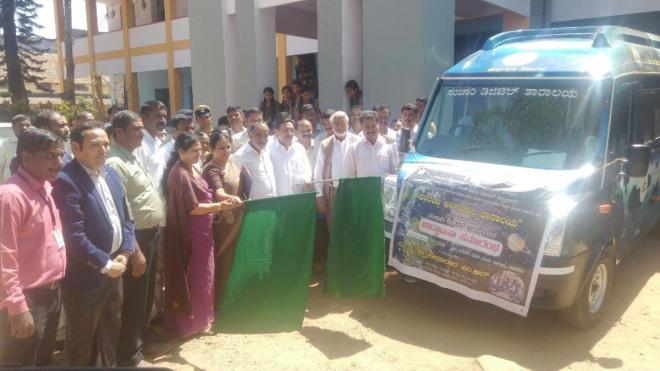
District-in-charge Minister M R Seetharam, MLC Veena Acchaiah inaugurate the mobile digital planetarium at Government PU College premises in Madikeri on Sunday.

District-in-charge minister M R Seetharam flagged off the mobile digital planetarium at Government PU College premises in Madikeri on Sunday.

Speaking on the occasion, he said it would help school students in rural areas get the planetarium experience and will guide them in astronomy and science-related issues. The planetarium will have screenings based on the high school syllabus.

Under the banner of “planetarium for school premises,” it will visit a few government schools in the district. Teachers and students should make use of the facilities, added Seetharam.

He said that the government had purchased five vehicles for mobile planetarium at a cost of Rs 6 crore last August. This has benefited 1.50 lakh government schoolchildren. Now, in accordance with the budget announcement, six more such mobile planetariums will be purchased.

The planetariums provide an immersive, digital experience of space for students. Visuals of planets in our solar system are projected on a dome. Each show will last 20 minutes. It has details on astronomy, rocket launch, and others.

source: http://www.deccanherald.com / Deccan Herald / Home> District / DH News Service, Madkeri / February 18th, 2018