From seed to cart: fifth-generation entrepreneur puts Karnataka coffee on the world map

With coffee gaining widespread acceptance across India, Classic Group is experimenting to create offerings that appeal to the Indian palate.

ClassicCoffee01KF07sept2017

Legend has it that centuries ago, a Sufi Saint – Baba Budan – planted seven coffee beans in the hills of Chikmagalur, introducing coffee to India.

Now called Baba Budan Giri Hills, the birthplace of Indian coffee is where 150-year-old Classic Group grows its coffee brand. Apart from coffee, the group also has dealings in real estate, hospitality, retail and distribution. But they want the world to wake up and smell the coffee!

For about 25 years now, the Classic Group has been exporting coffee beans around the world to micro roasteries, bigger roasteries and cafes, roasting them according to their clients’ needs. Over the last few months, the group’s horizons have widened.

India may still be a nation of tea lovers, but the popularity enjoyed by Gloria Jean’s and Starbucks shows that at least the younger generation is warming up to the bitter sweetness of coffee. In a tête-à-tête with YourStory, Tapaswini Purnesh, 30, a fifth-generation entrepreneur from the Classic family, speaks about how she combines culinary knowledge and understanding of flavour patterns with her expertise in brewing techniques to craft coffee that appeals to the Indian palate.

ClassicCoffee02KF07sept2017

A mechanical engineer and diploma holder from Le Cordon Bleu, Paris, the most prestigious culinary school in the world, Tapaswini is now Director of Marketing and Promotions at Classic Coffees.

Changing consumer behaviour

Europeans end every meal with coffee, but in India, coffee is yet to gain that scale of popularity. In South India, coffee still refers to filter coffee. Chains like Café Coffee Day have succeeded in popularising Western tastes like Cappuccino and Espresso. Yet, there was no deep knowledge on pure coffee; chicory coffee was the norm and most youngsters didn’t drink a lot of coffee.

Around 2010, Tapaswini had started a café next to Orion Mall, in Bengaluru, as a micro roastery.

“We were roasting coffee and selling it fresh. But it was too early for the concept. The coffee culture was yet to grow here,” she recollects.

Things, she says, have changed in the last eight years.

“Now a lot more micro roasteries are opening up. Youngsters who travel abroad for work or study are familiar with pour-over coffee and nitro coffee. Coffee is super cool and hip. We are targeting that audience,” she tells YourStory. She adds that although Classic Coffee’s target is the 30-45 age group, people who are 60 years old and above are also open to experiments in coffee these days.


Creating excitement around coffee

India is the sixth largest producer and fifth largest exporter of coffee in the world. In fact, according to IBEF data, about 70 percent of coffee produced in the country is exported. Varieties like Bru’s different African flavours and Nestle’s instant cappuccino mixes have reached the masses in India over the last few years.On the branded side, as opposed to the traditional one, Cafe Coffee Day and Starbucks have made a mark too. But Classic Coffees aims to get people to drink more coffee every day, and “in a more exciting fashion”.

About eight years ago, India’s most famous coffee connoisseur Sunalini Menon did two coffee blends for Classic Coffees. It started off as a pet project as Tapaswini wanted Indian coffee lovers to enjoy coffee of export quality. Her next strategy was to come up with coffee for different times of the day. In May 2017, Classic Coffees launched four new blends with pure Arabica beans. Interestingly, they were named after the times of the day they were meant to be consumed – Blaze in the morning, Matinee for afternoons, Sundowner in the evening, and Afterhours after dinner. Each 250gm packet was priced at Rs 300.
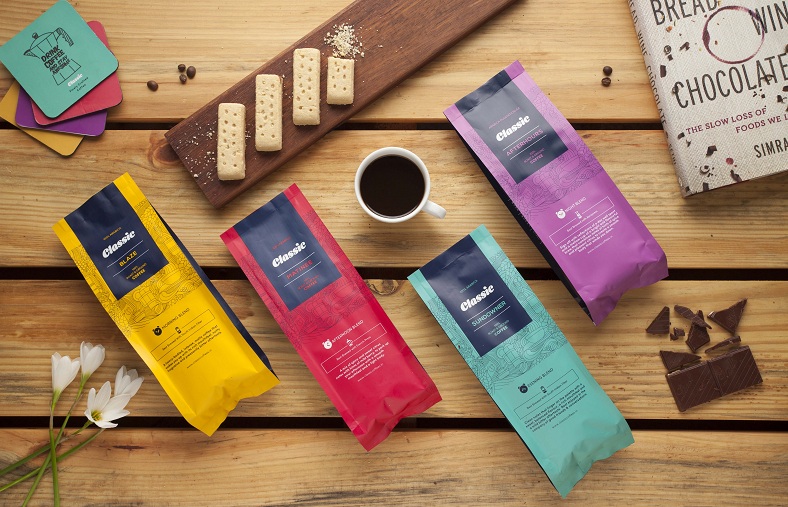
ClassicCoffee03KF07sept2017

But do Indians drink coffee late night? Tapaswini says this is where she found a surprising change in consumer behaviour.

“AfterHours is not decaf, it is not mixed with any flavours. While the others are extremely smooth and fruity, this is more like a dessert. It has maximum movement as people are intrigued by the concept,” she says, adding that north Indians warmed up to them more easily as they don’t have any preconceived notions of coffee.

Science behind the coffee

The Classic Coffees comes from an ancestral estate in Sakleshpur, where they also grow Robusta. In Baba Budan Giri, the altitude and weather conditions are just right for Arabica.

The wisdom behind each kind of coffee is deep. For instance, instant coffee comprises broken bean (all neighbourhood roasters use it), but Classic offers only filter coffee.

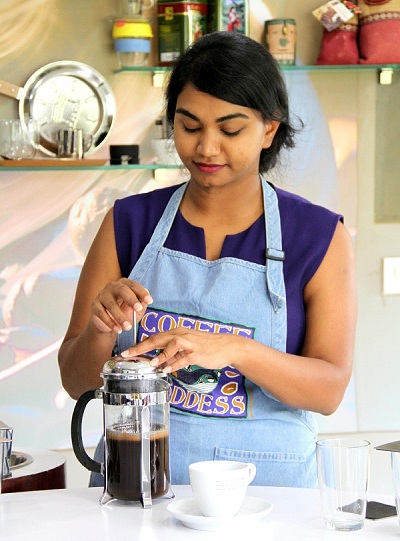
Tapaswini believes that the same coffee brewed in different equipment will have different flavours.

She says, “We have Indian filter, French press, aero press etc. For the four blends, we recommend the best equipment for each on the cover itself. We also mention the flavour, and whether it is best had with milk or not.”

Tapaswini conducts coffee-tasting sessions with accompaniments such as lemon tarts, cheese, apple slices and other goodies to ensure coffee drinkers derive complete enjoyment of the flavour.
ClassicCoffee04KF07sept2017

Taking the name overseas

Synergy coffee is exported – but not in packaged form – to the US, Europe, Korea, Japan, Australia, and New Zealand among other countries.

Tapaswini travels a lot for festivals of international bodies like Specialty Coffee Association, and attends events by coffee associations in the US and Europe. Micro roasteries and equipment manufacturers from across the world participate in these events.

“We are not just a brand like you see in stores. We are one of the few who do seed-to-cart. We grow it from sapling, pick and pack. Except the roasting bit, which we outsource, we do everything including processing after plucking. We do small batches for sellers if they want it customised, say fermented in milk. But it will all be sold under our name,” Tapaswini says.

Classic Coffees also has international blends such as Kenyan and Ethiopian through partners in those countries.

Currently, Classic Coffees is sold on online platforms such as BigBasket, and offline stores, including Westside Gourmet, Namdhari, and Nature’s Basket, and at airports in Delhi and Bengaluru. The company gets monthly orders of about one tonne now, and is targeting 8-10 tonnes by March 2018.

Classic Coffees has more surprises coming up for coffee lovers – a combination of alcohol and coffee is one of them. And the coffee and tea market, estimated to be worth Rs 41,800 crore, has plenty of space for more flavours and more players.

In fact, while FMCG brands and coffee market leaders like Nescafe have shown no keenness to promote premium coffee in the country, quite a few startups have exploited the opportunity – Bonhomia, which sells capsules for coffee machines, and Blue Tokai, which has branded itself through premium restaurants and cafes.

Another prominent player, Flying Squirrel, which aims to transform coffee into an artisinal food item, offers seven variants, but does not sell offline as they want to deliver coffee beans that are freshly roasted after an order is placed. Indian Bean and Seven Beans are also competing in the same space.

It looks like coffee lovers have found their cup of paradise on earth, thanks to a new generation of entrepreneurs who think outside the box.

source: http://www.yourstory.com / Your Story / Home> Stories / by Athira A Nair
Bengalureans plant groves to save Ghats

GrovesKF07sept2017

Bengaluru :

The Western Ghats has been plundered over the years, resulting also in progressively hotter summers in Bengaluru. While afforestation efforts to save the Ghats have been on for years, a team of passionate and dedicated Bengalureans is trying a different approach to save the many tree species. They are planting acres-wide groves in private and public lands that fall in the range, for now focussing on Coorg and Wayanad.

Meera, Rajesh, Sheshadri Ramaswamy, Uma, Anil Panolil Chirikandoth and Dhandapany collectively form Forest First Samithi (FFS) – a society that aims to engage and empower local communities in ecological conservation by educating them about endangered and endemic plant species. What started off as a team of four has today grown into a family with ten permanent members and over 30 volunteers.”FFS is trying to conserve endangered tree species by creating an eco-system where birds, small mammals and insects can also thrive,” says Meera, one of the founders of FFS, adding that the organization was started in 2008, and that most of their early years were spent on learning.

FFS’ vision for degraded lands in Kodagu started this May, and they have already spoken to local organizations and communities to get them on board. “Since we started work in Kodagu, we have already managed to add 35 species of endangered plants into the groves we worked on, and plan to touch 100 species,” she says, adding that the lands they are focusing on are public spaces ranging between 5 acres and 30 acres.

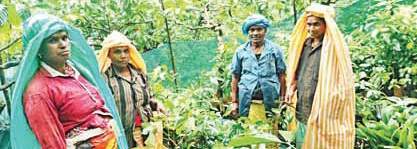
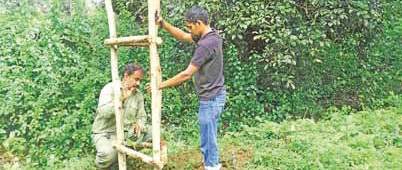
Workers in Wayanad grove  Pics courtesy: Meera Rajesh

How it all started

FFS started work in the biological hotspot that is Wayanad, where a lot of native tree species have been chopped to give way to silver oak, coffee and teak plantations. Meera says that unless one ventures deep into the forest, it is unlikely you’ll come across any traditional species. “During the summer months, we noticed how trees in Wayanad were being chopped at an alarming rate for timber. That’s when we decided to do something about it. We got involved in a lot of discussions with research organizations and experts on how to go about it, and also spoke to locals to get them involved,” she says.

Years of hard work and research resulted in the complete transformation of a private farm land in Wayanad, where a section of it was partitioned to create what is called a ‘farm grove’. This grove comprises endemic, endangered tree species, while the rest of the land can be used for economic purposes. By getting farmers and land owners involved in understanding how these endangered species will actually better their crops in terms of soil quality, water retention and pollination, FFS has managed to conserve 100 species of trees in Wayanad.

source: http://www.newindianexpress.com / The New Indian Express / Home> Cities> Bengaluru / by M Shriya Sharma / Express News Service / September 06th, 2017

SIIMA awards ceremony to be aired on Sunday

SIIMAawardsKF05sept2017

The awards ceremony of the sixth edition of South Indian International Movie Awards, which was held at Dubai, will go on air on Sunday on Udaya tv at 6pm.

Sandalwood actresses Shubra Aiyappa and Shraddha Srinath, have performed in the glittering ceremony.

Actors Shivarajkumar, Rakshit Shetty, Nikhil Kumaraswamy, Chandan Achar, Radhika Chetan. Vasishta Simha, Rashmika Mandanna and Samyukth Hornad have graced the occasion.

The awards are given in different categories like best actor, best director, best singer, best debutant actor, best supporting actor and in several other category.

source: http://www.timesofindia.indiatimes.com / The Times of India / News> TV> News> Kannada / TNN / September 01st, 2017

Annual Kail Pold celebrations in Kodagu

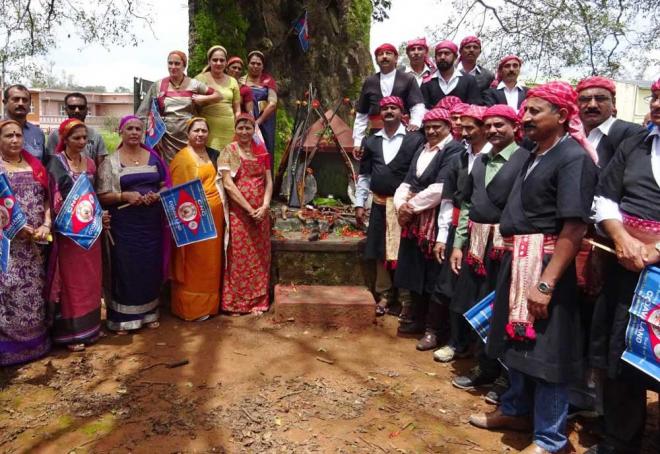
Codava National Council members celebrate 'Kail Pold' festival, near Madikeri Junior College on Friday. dh photo
Codava National Council members celebrate ‘Kail Pold’ festival, near Madikeri Junior College on Friday. dh photo

The annual Kail Pold festival was celebrated in different parts of Kodagu with traditional fervour and gaiety on Friday.

The Codava National Council (CNC) members observed Kail Pold in the city. The festival will also be celebrated in a few parts of the district on Saturday and Sunday.

As part of its 22nd year of celebrations, the CNC organised a vehicle rally, held prayers for agricultural implements and firearms and also shooting at coconut competitions.

Agricultural equipment like plough, yoke, ‘Tami Taave,’ ‘Bollangi,’ burnished firearms, ‘Odi Kathi,’ ‘Peeche Kathi,’ were worshipped at a mand near Junior College in Madikeri.

Speaking on the occasion, CNC president N U Nachappa said, “Kodavas should be accorded tribal status. The district is known for its rich legacy. By celebrating the folk games and festivals in Kodagu, we have to pass on the tradition to the future generation.”

source: http://www.deccanherald.com / Deccan Herald / Home> District / by DH News Service, Madikeri / September 01st, 2017

Joshna Chinappa moves up to 12th in squash world rankings

Chinappa made the main draw of the China Open earlier this week. (TOI Photo)

New Delhi :

India’s highest ranked squash player, Joshna Chinappa, has gained two places to be 12th in the latest PSA rankings.

Chinappa made the main draw of the China Open earlier this week before losing in the opening round.

Her teammate Dipika Pallikal moved up a place to be 21st. Pallikal had lost to Chinappa in the China Open qualifiers.

Both Pallikal and Chinappa will be seen in action at the HKFC International in Hong Kong next week.

Among the male players, Saurav Ghosal dropped a place to be 28th while Vikram Malhotra was on 62, Harinder Pal Sandhu on 66 and Mahesh Mangaonkar on 67.

source: http://www.timesofindia.indiatimes.com / The Times of India / Home> Sports> News / PTI / September 01st, 2017

Definitely Coorg!

Tucked in the western ghats in Karnataka, Coorg is best known for its coffee and people. There is something for everyone in this picturesque locale

BylekuppeKF05sept2017

Last week a friend asked me for travel advice on Coorg — when to go, what to see and buy and so on. It triggered many memories of the place and of the many trips I had made to it over the years.

Coorg’s lesser-known name is Kodagu. A rural district in Karnataka. It has been a popular holiday destination for long and especially for people of the state and surrounding ones. There are many things that draw people to Coorg – coffee plantations, homestays, which offer a slice of local life, an exotic Tibetan settlement, the wild western ghats, scrumptious local delicacies and wildlife sighting too.

The picturesque coffee plantations of Coorg are great to drive around. They are a photographer’s delight and are nowadays featuring in many south Indian films too. It is not only their scenic beauty which fascinates; Many plantations offer guided tours so you can see the various stages of coffee-making from the seeds to the powder and you can see carpets of coffee seeds laid out to dry in the sun as also piles of soap nut before houses.

Among the best trekking options in south India are contained in the Western Ghats which are now part of the UNESCO World Heritage List for their rich biodiversity. Waterfalls add to the scenic beauty. Some treks require permission from the forest department. Given its location on the eastern slopes of the Western Ghats. Coorg is a paradise for naturalists and even the lay nature lover will discern a vast range of flowers, birds and butterflies.

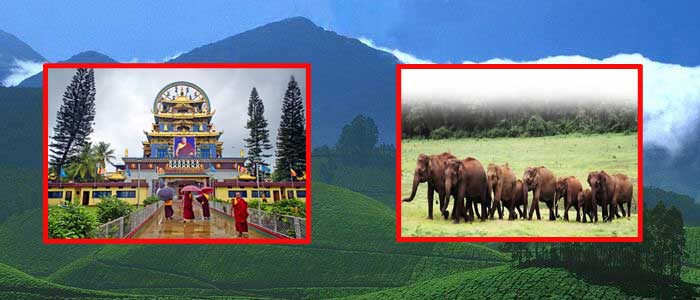
About 40 km south of Madikeri, is the Tibetan settlement at Bylakuppe built on land donated to Tibetan refugees by the Union Government. Here is the beautiful Namdroling monastery—once I entered, it felt like I was in Bhutan or Thailand’s monasteries; so authentically have the Tibetans recreated the Buddhist ethos. Stores here sell authentic handicrafts and hand-woven items though they are relatively expensive.

You can get up close and personal with elephants at the Dubare Elephant camp at the Cauvery river. Watching them bathe in the river and even helping in their scrubbing is a special delight for visiting urbanites and children particularly.

For sighting wildlife in more natural habitats, you can visit the Nagarhole National Park. A wide variety of safaris are on offer here. The tiger is a big draw—this park was part of Project Tiger. Bison, bear, leopards, reptiles, and hundreds of species of birds, etc are the other inhabitants.

Homestays have caught on in a great way in Coorg. I had never experienced a homestay in this area but had a close look at a few. Provided you find a really good one they are a great way to enjoy a slice of local life. From their food and architecture to their songs, marriage customs and attire including the way they drape their sarees. there is a fascinating Kodava culture to discover.

Coorg is a foodie’s delight too with its varied cuisine. Being a vegetarian, I have never tasted its most famous dish–Pandi Curry but have heard my carnivore friends rave about it. This is pork in a sour and spicy gravy made from Kachampuli, a black vinegar made from black kokum fruit. My favourites are the bamboo-shoot curry, Puttu or steamed rice dishes like Nooputtu which is a bit like Kerala’s idiyappam, Paaputtu and Akki roti with pumpkin curry or Kaad mango curry made from wild mangoes which give it a delightful tartness.

Rice and coconut are integral to the local cuisine and non-vegetarian dishes like mutton and chicken are popular. You will also find on the table local honey, chutneys of smoked or dried meat and fish, and pickles of mushroom, gooseberries and tender bamboo.

For my friend’s shopping list, I recommended the local wines (made from local fruits) knowing she and her husband were wine connoisseurs. The gooseberry wine generally tops that list of wines for such people. The honey is among the best in the country and coffee seeds and powder are favourite purchases of visitors. You can carry back spices and locally made jams and pickles. The artefacts at Bylakuppe and items from discarded wood from plantations are other options.

source: http://www.thehansindia.com / The Hans India / Home> Sunday Herald / September 02nd, 2017

‘Development projects will harm Kodagu’s ecology’

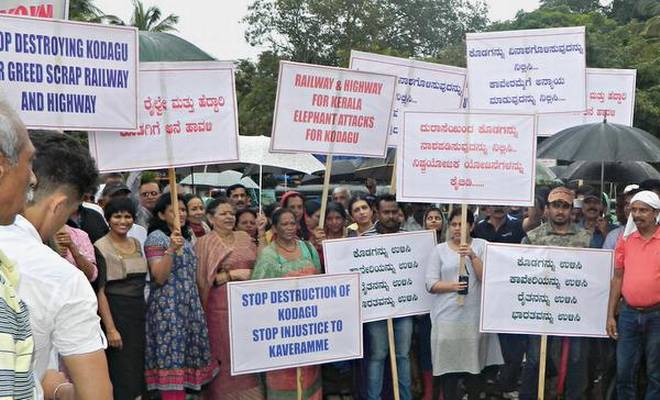
Up in arms:Activists protesting as part of the ‘Save Kodagu, Save Cauvery’ campaign at Kutta in Kodagu on Saturday.Special Arrangement

Activists from nearly 30 organisations hold Save Kodagu, Save Cauvery rally

To draw public attention to the rapid ecological devastation of Kodagu brought about by development projects, scores of people staged a protest at Kutta as part of the ‘Save Kodagu, Save Cauvery’ campaign on Saturday.

Activists and citizens from nearly 30 organisations and NGOs participated in it to stem the tide of what they described as the growing ecological destruction of Kodagu district, which is also the catchment area for the Cauvery.

The activists assembled first at Ponnampet and were joined by others at Kutta, bordering Karnataka and Kerala where a rally was taken out. The highway was blocked for nearly an hour.

The campaign had its share of critics who questioned the motives and rationale of the conclusions of the activists but the latter described them as misguided by vested interest groups.

The crux of the issue revolves around new projects such as two railway lines that will link Kodagu or cut across the district, besides national highways.

The rapid urbanisation of the region, besides indiscriminate tree felling under the guise of “development” has reduced the green cover of the district over the years, according to the activists.

They have objected to the Mysuru-Kushalnagar railway line which is being bandied about as a market link for coffee growers of the district with the rest of India while the other railway line is the proposed link between Mysuru and Thalassery in Kerala which passes through some of the dense forests and elephant habitat. Col. C.P. Muthanna (retd) of Coorg Wildlife Society said such projects would only escalate human-animal conflict in Kodagu as these so-called development works would lead to habitat fragmentation, disturbance and destruction.

The Save Kodagu, Save Cauvery campaign also highlighted the vanishing green cover in the district and linked to it depleting rainfall in the region since the last few years which has affected local agriculture.

Being the catchment area for the Cauvery the forest cover had to be protected and if the river and its ecosystem was not saved, then nothing would survive, said the activists, pointing out that the river served as a source of drinking water to people in south Karnataka region, including Mysuru and Bengaluru.

Reiterating that every hectare of land acquired for development projects in Kodagu would result in the felling of nearly 350 fully grown and mature trees, the activists said the extent of tree-felling and damage to the ecology could only be imagined as large swathes of land extending to hundreds of hectares were needed for such projects.

source: http://www.thehindu.com / The Hindu / Home> National> Karnataka / by Special Correspondent / Mysuru – August 27th, 2017

Bengaluru Cup hockey kick-starts today

Nithin Thimmaiah and Komala BM will lead the State sides in the 3rd All-India invitational hockey tournament for the Bengaluru Cup which gets underway at the hockey stadium on Tuesday.

A tournament that started in 2014 but was not held last year due to unavailability of turf, returns to the fold this time with six of the top men’s and women’s teams from the country vying for top honours.

In the men’s section, the State side will be joined by Indian Oil Corporation Limited (IOCL), Punjab National Bank (PNB), Oil and Natural Gas Corporation (ONGC), South Central Railway and Army XI while in the women’s battle, the State side will have to fight it out against defending champions Hockey Haryana, Madhya Pradesh Hockey Academy (MPHA), Hockey Odisha, Eastern Railways and Hockey Maharashtra.

The tournament will be played on a round-robin cum knock-out format with top four teams from the group qualifying for the semifinals on September 7. The final is scheduled for September 8.

In the men’s section, Karnataka begin their campaign against a red-hot PNB side while the women’s side will face Eastern Railway in the opener on Tuesday.

Karanataka squad: Men: Jagdeep Dayal (GK), Mahan Gowda(GK), Appachu SK, Cariappa KT, Veeranna Gowda SP, MB Aiyappa, Rathan Muthanna VT, Abhishek HS, Rajendra, Naeemuddin, Somaiah KP, Raheel, Pradhan Somanna, MB Cariappa, Nithin Thimmaiah (C), Darshan DS, Bharath KR, Pruthvi Raj; Verghese (coach); Sampath (manager).

Women: Shravya GB (GK), Sandhya MG (GK), Chaithra N, Bhagyashree, Cheluvamba P, Pooja MD, Komala BM (C), Kruthika SP, Kaveramma AH, Sowmyashree, Anjali HR, Swapna NR, Leelavathy MJ, Nisha PC, Ramya, Reshma BB, Avinashree SR, Shalini U; Ganapathy KS (coach); Ankita (manager).

source: http://www.deccanherald.com / Deccan Herald / Home> Sports> DH News Service, Bengaluru / August 29th, 2017

I still believe I will play Test cricket: Robin Uthappa

Robin Uthappa is switching to Saurashtra from Karnataka in the coming domestic season.

Having played all his cricket from Karnataka, discarded India limited-overs batsman and Kolkata Knight Riders star, Robin Uthappa is all set to play for Saurashtra in the coming domestic season. He feels he is stagnating in Karnataka and wanted a shift in his career. He is ready for all the challenges that the move brings and is also dreaming of playing Test cricket for India.

In this exclusive chat with DNA, the 2007 ICC World T20 victorious Indian team member tells G Krishnan that he wants to win Test matches for India overseas:

How did the Saurashtra deal come about?

I wanted a different challenge in my career. As far as Karnataka was concerned, we did well, I contributed to a couple of trebles, which is special. I felt the time is right for me to challenge myself in a different way because I want to constantly keep growing as a cricketer and as a human being. I thought taking myself out of the comfort zone is the way to do that. I love to challenge myself in different ways but given my limitations of not being allowed to go abroad and playing cricket in different leagues in the world, I had to find different ways to challenge myself and grow as a person, as a batsman and as a cricketer.

But why Saurashtra? There were reports of you playing for Kerala…

Yes, there were reports of me going to Kerala. I was in discussions with them. I had told them I would get back to them at a certain point, but got back to them four days after the date that I told them. In that window, they had signed somebody else. So, I had to seek another side and I had a few options, put my name out there. Saurashtra came back to me and I very happily took that. I am happy to be a part of that team. It presents different challenges to me, different opportunities for me to grow as a person, just embracing that culture, getting to know them, it is going to be very different from the culture in Karnataka. They are a pretty good side. They are a side that has gone to the tournament knock-outs quite often. I believe I have the right kind of value to take them all the way.

What are those challenges?

By challenges, I mean being out of my comfort zone. Back in Karnataka, everything has been the same for me for the last 15 years. I will be uprooting myself from one culture and immersing myself in another culture where I have to be a thorough professional. There is nothing that I can take for granted, just getting along with them, not understanding the language they speak. Those are the kinds of challenges I would face. Just to understand the boys, their nature, to bring them together, I have been able to do that successfully in Karnataka. To be able to do that with a new bunch of boys is a whole different ballgame altogether. That is something I am really looking forward to.

As a cricketer, to step outside my comfort zone and put myself in a completely different territory, find my little space within that team and take that team forward. I believe that adding value to whichever team I play is very critical for me. I play to win, I don’t play to just compete. If I am able to contribute to their victories, I will be extremely happy. These are the challenges I am looking at.

Looking beyond Saurashtra, where do you see yourself as far as international career is concerned?

Of course, I give myself a better chance (of India comeback) because I am actually putting myself out of my comfort zone. If am able to win championships there, that will be nice. When you win championships is when people grow and when you go to the next level. We did that in Karnataka and today, there are six-seven players in the reckoning all the time. If I can create that same kind of atmosphere where I can take Saurashtra forward, we can have four or five boys in the reckoning. There are two who are already in the Test side. But there can be a few more. If I can contribute to the team in a massive way and win championships, I give myself an even better chance.

Could things have gone better with your international career?

Certainly, things could have been different. I don’t regret the way things have gone for me. Essentially as a human being, I have grown a lot, thanks to the sport, thanks to the kind of exposure I have had, learning to deal with the ups and downs of sport. One thing I am extremely proud of is that irrespective of the runs, or the lack of them, I got when I was playing international cricket, it never affected the way I am and the kind of person I am within the team. I always placed the team ahead of me. That is something that is always critical for me. In spite of everything I have been through, I have been at the receiving end. That has not changed about me.

What brings me joy about playing this game is the fact that it is a team game and 15-20 people get together to achieve one goal. I am a part of that team and to help the team move forward and achieve the goals it has set. For me, essentially, this journey in the past 11 years of being in and out of the side, has been a mixed bag from all perspective. But, if I look at the larger perspective of life, it has taught me a lot of things, taught me a lot of value that I have got, as a cricketer it has taught me how much to fight.

I have not given up. I am still fighting, I am still hungry. I still believe I will play for the country again, I still believe I will play Test cricket. I am still working to improve. As long as I am playing cricket, I will keep going. I won’t stop. I won’t stop even after I play Test cricket. The dream is to make India win Test matches abroad, win Test series abroad. I believe I have the game and the technique to do that. I just feel I need to get the right opportunities at the right time. I need to just keep pegging away. I don’t think I need to knock on the door. I need to break it down with the runs.

Where do you think you can fit in the current Indian team, which is packed already? What should you be doing more to get there?

The team is doing fantastically well and I am extremely proud of that. The kind of culture Virat (Kohli) has created has been fantastic. As far as I am concerned, I need to keep scoring big runs and winning matches for my team, keep putting myself out there like I do every time the IPL turns around or like I have done in the last five years in the domestic seasons, just keep performing and hopefully, something will open up for me. I don’t know when and how. What I can control is the fact that I can score runs and win tournaments. I think the more I do that, the more I give myself a chance to represent my country again.

You can also take confidence from the fact that Parthiv Patel made a Test comeback after eight years and Dinesh Karthik returned to ODI side after two years…

Not just them. There have been a lot of domestic cricketers and senior cricketers getting their due. Even Gauti (Gautam Gambhir) made a comeback last year. He was given his due after he scored in domestic season. I believe in that. Today, when you look at cricket the world over, age is just a number. It is about how fit you are, how much you can sustain the workload. I think cricket is a sport that can be played for a long time if you look after yourself well. Sachin paaji (Tendulkar) is a huge example of that. Anil Kumble is a massive example of that. For me, it is just about putting in the work, taking one step at a time and making my performance speak for itself.

Normally, we associate players moving out of their home state to be towards the end of their careers. You are only 31. How do you look at this?

When I hired a personal batting coach (Pravin Amre), people were laughing at me. We were mocked at. Today, you see that is the norm. I have been one of those guys who has been really honest with himself, I have not really gone by the norms of the world. I have made my own road. That is what I am doing right now. I want to experience and grow more as a cricketer and that can only happen when I have challenges ahead of me. That’s why I get pumped up and excited about playing in IPL because for me that is when I am exposed to international cricket. I thrive on that. I love the challenges, love what I am able to do there, and winning matches for my team. I don’t get that for the rest of the year. I have to try to find different ways to create that challenge.

Unfortunately, we are in a stage right now where we are not allowed to go outside and play cricket. We are not given the opportunity to go out and expose ourselves to different culture, different conditions like the rest of the world do when they come here for the IPL. They come into the IPL, they get exposed to the conditions. To give an example, Chris Lynn came here initially, with all due respect, struggling against spin. Today, he has figured out a way to get successful in India. Unless we cricketers are exposed to different conditions, we are not going to grow. For me, life, cricket is about growth, about moving forward, adding value. If I am going to get stuck in one place, I am not growing, I am stagnated. I want to keep growing, keep trying to find different ways of growing as a cricketer. Winning the treble for Karnataka once was joyful. But winning again was a challenge and we did it again. Similarly, I find myself in a place where I want to challenge myself again. I am uprooting myself and putting myself in a new culture, definitely Indian culture but different from how it is in Karnataka, how it is in South India. For me to get in there, figure out my way there, that is the extent of pushing myself out of the comfort zone. It is the only option I have got right now. I am not looking at this as finishing my career. I am just trying to challenge myself and grow and still pursue my dream and get better. If you are not growing, you are wasting yourself away.

Will we see something new when you play for Saurashtra?

I think anyone who has noticed me closely in IPL would have seen a shift in my game. I shifted to being more free-flowing than a circumspect that I used to be. The way I hit most sixes in the last three or four years, there is a lot of confidence gained to fast bowling and spin bowling. I think that is what you will continue to see from my side. What I want to win tournaments with Saurashtra and truly believe that Saurashtra will be one of the dark horses in the coming domestic season. It is a funny thing what belief can do to a team and I believe have the ability to bring that out it in the cricketers. That is also a challenge for me. I was able to do it in Karnataka. I want to do it with a different bunch of boys that I don’t know at all. I am looking forward to it.

Do you feel sad or happy to be leaving your home state and going to a new place?

I leave Karnataka with no hard feelings but with a lot of love. I would like to thank Brijesh Patel (former KSCA secretary and India batsman) for all the help he has done for me. He has been a massive influence in my life, he has been a mentor, guide and a huge support in my life. He has disciplined me, he has guided me. I have been his pupil ever since I started playing cricket. I am extremely grateful for what he and Karnataka State Cricket Association have done for me. Karnataka will always be my home. They challenged me, pushed me, they motivated me, they cheered me, they made my dreams come true and I am extremely grateful for them and to all the team-mates who accepted me for who I am, for allowing me to be the person that I am and allowing me to express myself as a human being.

source: http://www.dnaindia.com / DNA (Daily News & Analysis) / Home> News> Sports News> Cricket News / by G. Krishnan / August 29th, 2017

I have plenty more left to achieve for India: Joshna Chinappa

Joshna Chinappa with her Asian Squash Championship title which she won in April (Twitter image)

HIGHLIGHTS

Joshna won the National Squash Championship a few days back and the Asian Champinship in April

She recovered from a career-threatening knee injury sutained in 2011 and hasn’t looked back since

Joshna was recently appointed a senior sports officer with the Tamil Nadu Generation and Distribution Corporation

New Delhi :

“I’m not thinking of stopping anytime soon. I have a lot more to achieve.” Being appointed a senior sports officer with the Tamil Nadu Generation and Distribution Corporation does not mean that Joshna Chinappa, India’s highest-ranked squash player, is contemplating life beyond the sport already. Her decision to make a direct appointment under the sports quota was made after she put in a request. And as Joshna puts it, the post is a back-up so that she can work towards the promotion of sport when she is done as a professional squash player.

That thought however, should be put away for a long while because Joshna is going strong. Over the weekend, she won the 74th National Squash Championship as many expected, and even though she did not have it easy in the title round, it all went according to the presumed script. Joshna notched up her 15th national title by beating Lakshya Ravendran 11-6, 8-11, 11-2, 11-4 in the final, which leaves her just one shy of equalling Bhuvneshwari Kumari’s record of 16 titles.

That wasn’t even her best though. In April, Joshna became only the second Indian in 21 years to make the final of the Asian Squash Championship. This time she would go one up on Misha Grewal – who had claimed silver in 1996 – and clinch gold. The Asian crown is a big shot in the arm for the 30-year-old ahead of the Commonwealth and Asian Games next year.

Speaking to TOI Sports , she elaborates: “The Asian Championship is one of our prestigious events in squash and I’ve been playing the Women’s Championship since I was 12. When I played it the first time, I won the consolation prize; I don’t think many people know this. I’m just really glad that I could win it this season. It was a long season last year and it was a nice way to cap it off. I’m happy to have won it in Chennai in front of my home crowd.”

One could almost sense it coming. There were a few quarter-final and semi-final finishes in between since she broke into the top 10 in November 2016, and one of them included the World Championship in Egypt. Joshna, seeded 12th, lost 6-11, 12-10, 7-11, 11-8, 3-11 to second seed and World No. 3 Camille Serme of France. Then there was also a second-round elimination at the British Open Squash Championship in London – just a month before the Asian Championship – where she lost to Egyptian World No. 3 Raneem El Welily. It was a frustrating period.

“Absolutely; especially last year in Mumbai when I lost the final of the $ 35,000 event. I’d come that close to ending my drought of lifting a title. Of course it was heartbreaking but as an athlete you keep going back, keep working harder, keep fighting. Eventually it will come together. It’s frustrating as an athlete to figure when it’ll come together but that’s what being professional is about, and I love it,” says Joshna.

“I enjoy training much more than I enjoy playing the actual matches. I love the work that goes into being a professional squash player. It is so physical and I really like that part. The playing part is not so exciting because there is nerves, pressure of winning matches. I’m the most relieved when the game is over; irrespective of a win or a loss.”

Beyond that immense training lies Joshna’s gritty determination and steely resolve. To clinch the Asian title, she beat none other than Dipika Pallikal, her compatriot and at the same time one of her biggest opponents. She had lost to Dipika the last few times – including the final of the National Championship last year – but come the All-India final, where both were assured of a medal, Joshna had come prepared and eventually prevailed in a tight five-game encounter 13-15, 12-10, 11-13, 11-4, 11-4. The two go way back; to a time when Dipika was a 10-year-old who had just started playing and had front bands falling on her forehead. Growing up training together, they know each other’s games inside out, and as time passed, evidently, the two became each other’s competition.

Joshna: We're at a stage where Dipika and I have each other's back "
Joshna: We’re at a stage where Dipika and I have each other’s back “

“We have this unique case where even though we have to compete against each other, at the same time the next moment if we have to play for India, we are on the same page,” Joshna says. “Of course we have our ups and downs in the game but today we are at a place where we both have each other’s back. We really want to do well for India and win medals for the country together. We had a great time at the World’s doubles Championship where we won a bronze medal and we have great team work going on right now. We train with the same coach, who has been a real positive influence on both of us.”

Despite training with different coaches, for a major part of her career, Joshna travelled to tournaments without a coach before the Squash Rackets Federation of India roped in Achraf El Karagui as the consultant coach midway through last year. A native of Egypt, a country that is a force to reckon with in squash, Achraf has been a positive influence not just on Joshna, but also the likes of Dipika, Saurav Ghosal and many budding players.

“I work with Achraf pretty much all the time, and he has helped be bring order and structure to my game. I know what I have to work on everyday and I’m constantly reinforcing the physical aspect, skill aspect, mental aspect day in and day out. That I believe is going to help me become a more complete player when I’m competing with the top girls,” Joshna says.

“Achraf has been part of that Egyptian culture so he brings a lot of that with his coaching when he’s working with me or Dipika or anyone else for that matter. So I know how these girls are working. Also I went and spent some time in Egypt during the summer; I was training over there so I worked with one of their top fitness trainers. I really got to know the type of work a world champion is doing and tried to put those elements in my game. I felt a lot stronger and understood the game better. I owe a major chunk of my success to him.”

And to think that all this almost didn’t happen. In 2011, during the semi-final of the Hamptons Open, Joshna tore a ligament on her knee and was stretchered off midway. The scans suggested that Joshna’s injury was almost a career-threatening one and the doctors’ flat-out verdict of her being out for at least year was almost “coup de grace”. It was so bad that all Joshna wanted to do was to be able to walk again.

“It was very heart-breaking but then again, it allowed me to begin a process. I moved to Mumbai to basically get away from everything, do my rehab there and come back stronger,” Joshna says. “It gave me the opportunity to start from scratch and do things right. So I really worked on my physical strength, getting my legs stronger; I worked with Ritwik Bhattacharya (ex-national champion and Joshna’s coach for four years). I just think I became a very different athlete and person altogether from that injury.

source: http://www.timesofindia.indiatimes.com / The Times of India / News / by Aditya Bhattacharya / timesofindia.com / August 29th, 2017