Robin Uthappa and wife Sheetal welcomed their first child and both announced it on their social media handles.
Robin Uthappa announced the arrival of his first child ‘Neale Nolan Uthappa’ on Wednesday on his official social media account, thanking his fans and followers for all the love and support. Robin also shared the picture of his first kid along with his wife Sheethal Goutham.
In a tweet, Robin, who called their relationship ‘batman and joker’, wrote, “Our bundle of joy has arrived!! NEALE NOLAN UTHAPPA! thank you for all the love and support!! #whentwobecomethree #batmenandjoker.”
The India discard got hitched with long time girlfriend Sheethal, who is a former tennis player, in March last year.
Uthappa, who played for Karntaka for 15 years, made a change of teams when he joined Saurashtra ahead of the 84th season of Ranji Trophy. Uthappa had been one of the key players for Karnataka in the domestic circuit.
Uthappa has also represented India in ODIs and T20Is. On his ODI debut, he scored 86 runs against England before being run out. This was record individual score by an Indian batsman on debut, a record which he kept until fellow Karnataka batsman KL Rahul broke it last year with a century.
Uthappa has been part of Kolkata Knight Riders team in the Indian Premier League. He has won two IPL titles with KKR.
source: http://www.indianexpress.com / The Indian Express / Home> Sports> Cricket / by Express Web Desk / October 11th, 2017
It has been a series of serendipitous discoveries ever since I started researching about the story of Princess Victoria Gowramma of Coorg. I stumbled upon on several hitherto unknown details of the period that Chikka Veerarajendra and his daughter spent in the Victorian England. Princess Gowramma had the unique privilege of being Queen Victoria’s goddaughter. She was baptised as an 11-year-old in the presence of the queen, who lent her own name to the Indian princess.
In my book, Victoria Gowramma: The Lost Princess of Coorg, I wrote that Gowramma and her husband Colonel John Campbell had a daughter named Edith Victoria, who married Captain Henry Edward Yardley in 1882. Their only son, Henry Victor Yardley, emigrated to Australia. Henry Victor died in a motorbike accident in 1936. I concluded that there were no further descendants of Gowramma.
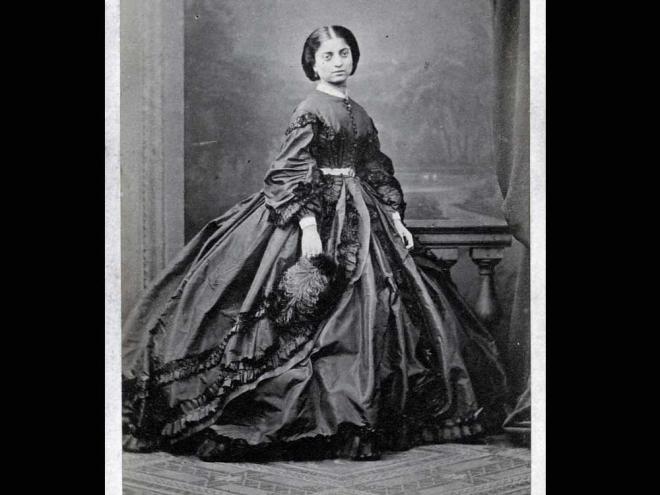
However, I was wrong. It was while releasing my book at Nehru Centre in London that I met Anne Phillips — a direct descendant of Colonel John Campbell from his first wife, Margaret Mathew. Colonel John Campbell had served in India. He was an officer in the 38th Madras Native Infantry. One of his postings was in Bellary. She told me that Henry Victor Yardley married Ethel May Field in 1910 and they had three children. Anne also gave me some rare photographs of Gowramma and her daughter Edith, from her private collection.
Anne’s late mother had recollections of having met Edith, and had preserved the photographs and other memorabilia. Anne is now in possession of a bracelet along with a handwritten letter from Queen Victoria, presented to Lady Lena Login (sister of Colonel John Campbell), for having looked after her goddaughter who had a troubled but eventful life in England. Princess Gowramma died in 1864, aged 23.
Anne Phillips and I collaborated in tracking the descendants of Victoria Gowramma in Australia. Using the Australian registry of births, deaths and marriages, we were able to gather information and draw the family tree of Gowramma’s descendants. However, we could not get in touch with the family. This however changed when Robert Yardley, a great-great-grandson of Victoria Gowramma, read my book and left a message for me on one of the blogs. The family lives in New South Wales in Australia.
Robert’s daughter Natashya Yardley got in touch with me a few months ago and informed me of her visit to Coorg. Natashya is Gowramma’s great-great-great granddaughter. I was excited at the prospect of meeting a direct descendant Princess Victoria Gowramma.
I took Natashya to various places of interest connected with the Haleri dynasty in Coorg, including the royal tombs of her ancestors at Gaddige in Madikeri. Natashya was intrigued that the Indian branch of her ancestry could be traced back to Veeraraja.
Natashya sent me a rare photograph of her great-grandfather, Henry Victor Rajendra Yardley, the grandson of Princess Gowramma.
It was a singular experience for me to meet and interact with a direct descendant of Princess Gowramma. After meeting Natashya, I feel that I have connected with my muse, Princess Gowramma, by ‘six degrees of separation’!
source: http://www.deccanherald.com / Deccan Herald / Home> Supplements> Spectrum / by C.P. Belliappa / October 10th, 2017
It is said that in order to see birds, it is necessary to become a part of the silence. But the silence these days is deafening. The avian population is leaving the city in droves and so are the birdwatchers, who are running off to the outskirts in search of the now-elusive chirps.
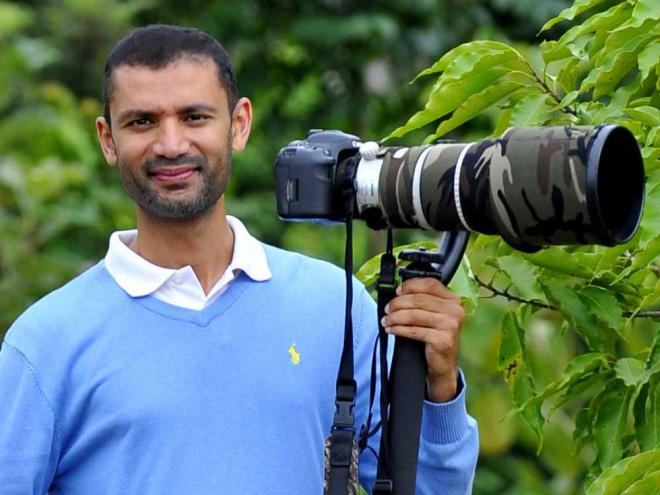
“I usually head to the outskirts of the city now, to areas like Nandi Hills, Kanakapura Road, Tumkur Road, Sarjapur and so on,” says Sudhir Shivaram, director and founder of ‘Sudhir Shivaram Photography’ and an avid bird watcher for the last 15 years. “Any area which is a good habitat for birds and has limited human activity is a good option for bird watching. And such areas are only on the city’s outskirts now.”
There are plenty of reasons why the feathered community is giving the city a miss. “The decline of water bodies and their beautification is a big reason. The bunds on the lakesides are making way for stones and concrete for aesthetic appeal but this is not favourable for birds,” points out Sudhir. Bopanna Pattada DP
“Apart from biological factors, like crows and pigeons edging out other species that feed on grains, external reasons like use of kite ‘manja’ and pigeon netting as well as an increase in the domestic cat population, has resulted in a decrease in the bird population in the city,” lists out Bopanna Pattada, who heads ‘Bangalore Birding Adventures’.
Like everyone else, he also prefers to head out of the city for bird-watching expeditions now and says places like Bannerghatta National Park and Rishi Valley School are good options. “So is Hoskote Lake which has regained its water level in the last 5-6 years and now attracts a wide variety of birds.”
But while enthusiastic birders and photographers don’t mind going the extra mile, the growing crowds around avian havens are becoming a cause for concern for many. “Even places like Nandi Hills are seeing huge crowds now. There is a lot of noise and garbage and thus the previously large numbers of birds is coming down,” says Punith Suvarna, a data analyst and bird photographer.
“A lot of offroading is happening now and vehicles are going very close to water bodies and green areas. We need to give birds some space. So intense is the desire and competition for unique clicks, that people are resorting to means like destroying the nests so that others can’t get the same shots,” he adds.
The birds are on their way out. Pretty soon we will only be left with their pictures on social media then.
source: http://www.deccanherald.com / Deccan Herald / Home> Supplements> MetroLife / by Rajitha Menon, DH News Service / October 05th, 2017
The elected representatives directed the officials to make necessary arrangements for Cauvery Theerthodbhava, scheduled to be held on October 17, at Talacauvery.
Speaking at a meeting convened to discuss preparations for the annual programme on Saturday, MLA K G Bopaiah said that the Theerthodbhava will occur at 12.33 pm.
He said a large number of devotees are likely to attend it. Hence, additional bus facility should be made. The pothole-filled road from Madikeri to Talacauvery should be repaired. Also, suitable arrangements should be made for the parking of vehicles. The district administration should ensure that no inconvenience is met by the devotees, he added.
Bopaiah said temporary toilets should be constructed. Arrangements should be made for the supply of drinking water too, he added.
Congress leader Biddatanda S Thammaiah said that a bridge near Thavoor on Madikeri-Bhagamandala has collapsed a few years ago and it has not been repaired so far.
Hosooru Ramesh Joyappa said the density of vehicles to Talacauvery and Bhagamandala is on the rise. There is a need to check the density of vehicles, he added.
Pushkara ritual
Some people in the meeting opposed Pushkara ritual at Talacauvery and Bhagamandala stating that it is against the sanctity of the place.
MLA K G Bopaiah, MLC Sunil Subramani and Veena Achaiah questioned the ritual, where the Theertha kundike is made impure by taking bath.
source: http://www.deccanherald.com / Deccan Herald / Home> District / DH News Service, Madikeri / October 07th, 2017
In the recently held district-level Inter-Collegiate Science lecture competition in Kannada, four students from Kodagu got selected for the state level.
The competition was organised by the Department of Collegiate Education.
The district-level competition meant for Science degree students was held at Field Marshal K M Cariappa College.
Winners
The events were held in various Science subjects of Physics, Chemistry, Biology and Mathematics. Students of Field Marshal K M Cariappa College, T V Prithvish, G Shimla, Sherol Ammanna and M N Ben Bopaiah won in the district-level competition and will represent the college in the state-level competition to be held in Bidar in the second week of October.
Giving away prizes to the winning students, Cariappa College Principal Dr Parvathi Appaiah called upon degree students to take interest in the research of basic sciences.
source: http://www.deccanherald.com / Deccan Herald / Home> District / Madikeri – DH News Service / October 06th, 2017
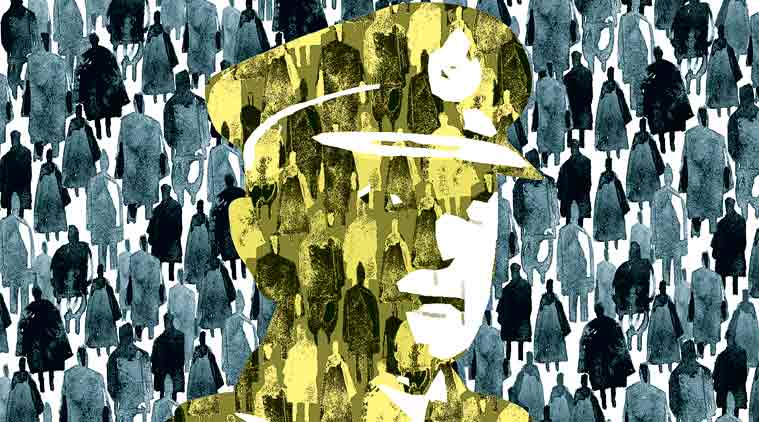
The field marshal’s military philosophy is a useful pointer and guide at this critical juncture in the Valley.
He knew that they were warm and hospitable if treated with respect and as equals. (Illustration: C R Sasikumar)
An interesting anecdote about a great Indian soldier, Field Marshal K.M. Cariappa, is lodged in my memory since childhood. As a habit, I keep asking questions. I had asked a question about Cariappa Park during my school days. Nobody had an answer till the senior political leader from Baramulla, Sheikh Mohammad Akbar, told me a fascinating story of how he had fulfilled the desire of the people of Baramulla, as chairman of the Town Area Committee, to commemorate Cariappa.
Once, after chasing the raiders beyond Uri, Cariappa was stopped by a group of people at Baramulla and told that they had suffered a lot due to the absence of food supplies, including salt. It was a puzzling question for the general, as no stocks were available with the army. But he fulfilled his assurance the next day when he visited the old town and distributed flour, rice and salt to the most needy families. He followed this gesture in many ways in various parts of Kashmir. K.S. Thimayya, whom he had put in command of the 19th Infantry Division at Baramulla, followed Cariappa in this regard. Grateful Baramullians named a park after Cariappa and the park exists even today.
My quest to learn more about Cariappa was deepened when I heard some commanders in Kashmir asserting during the recent turmoil that “yes”, stones would be answered through bullets and pellets. The people of Kashmir feel this attitude has been encouraged after Major Nitin Leetul Gogoi was awarded for using a civilian as a “human shield” in Budgam.
The Indian army’s history tells us that Cariappa showed great valour as a commander and the success he obtained was squarely his own. But many people in India may not know that apart from his military valour, he employed another natural tool as a workable mechanism to deal with the people all around including the enemy. Reading authors like B.C. Khanduri, J.S. Bindra, S.K. Sinha, L.P. Sen, K.C. Cariappa and others, I came to know of many interesting stories woven around the personality of that great soldier. When I came to know of Cariappa’s Waziristan experience, I was flabbergasted.
In June 1939, Cariappa was transferred to the 1st Battalion of the Rajput Regiment which became his parent unit. The battalion moved to Waziristan and he had to spend three years there. He was posted Waziristan in 1922 as well.
In November 1945, Cariappa was finally given command of a brigade. He was posted as commander of the Bannu Frontier Brigade in Waziristan.
Having served in the NWFP as a young officer, Cariappa was conversant with the terrain as well as the habits of the Pathan tribesmen who lived in the area. He had seen that the British policy of trying to keep them under control by force had not succeeded and he resolved to try a different method. He decided to win the hearts and minds of the tribesmen by extending a hand of friendship. He knew that they were warm and hospitable if treated with respect and as equals.
One day, while passing through a village, he saw a group of Pathan women carrying pitchers of water. When he found out that they had to fetch water daily from another village, four miles away, he immediately ordered a well to be dug near their own village. He followed this gesture with many similar deeds. The Pathans were overwhelmed and started calling him “Khalifa”. Later, when the region was torn by communal strife, Bannu remained a haven of peace thanks to the goodwill generated by Cariappa. When Jawaharlal Nehru visited Bannu in 1945 as head of the Interim Government, Cariappa organised a public meeting which was attended by all tribal leaders. The next day, when he visited Razmak where another brigade was stationed, Nehru was fired upon by the tribesmen and the visit had to be called off. Nehru was impressed by Cariappa’s leadership qualities and rapport with the tribesmen.
Veekay’s History Book (Victory of Knowledge Global Publications) tells us an interesting story about Cariappa. “In February 1946, he was appointed Presiding Officer of one of the General Court Martials constituted to try members of the Indian National Army (INA). Before the trial, he visited some of the detention camps, where the prisoners were lodged. He found them full of rancour and hatred against the British for treating them badly and holding them without trial. Cariappa was pained by their plight and wrote to the Adjutant General, requesting him to expedite the trials. He also recommended that some of them such as Shah Nawaz Khan, G.S. Dhillon and P.K. Sehgal should be pardoned. But, when as Chief of the Armed Forces he was to consider the recommendation to accommodate Indian National Army (INA) personnel including Shahnawaz, Dhillon and Sehgal and he refused to take them into the Indian Army, particularly for the reason that they would bring politics into the Army. There was a lot of pressure on him for this and Nehru relented only after Cariappa threatened to resign on this issue.”
I invested some more time to understand both sides of Cariappa’s character. He was a very tough general when it came to leading the armed forces, as was required by military ethics, and he never compromised his principles.
B.C. Khanduri, who worked with him as operations staff officer, says in his book Field Marshal K.M. Cariappa; His life and Times that, “Once between Mahura and Uri, he was snipped at from close quarters. He showed no signs of fear while his staff officers perspired.”
Lt. Col. J.S. Bindra, as intelligence and liaison officer with Cariappa recalls in his book an incident at Srinagar. He says: “The 268 Infantry Brigade was without a commander for a few days. Cariappa informed Army Headquarters to post Brigadier Bikram Singh. He (Bikram Singh) represented to the army that his relations with Bakshi Ghulam Mohammad, the then Deputy PM of J&K, were not too friendly and that Bakshi might create problems for him in his command.Cariappa asked him what else? Then, he told Bikram to put his ego in his pocket and do what he desired him to do. Bikram was in Tithwal by the same night and on the job”.
The other side of his character is described in Veekay’s History Book: “While Cariappa admonished Thimayya for lighting a cigarette while travelling in an Army vehicle, he asked the driver to stop to allow Thimayya to smoke.”
Lt. General Sen in his book, Slender was the Thread: Kashmir Confrontation 1947-48, describes another quality which Cariappa possessed and it was his broad-mindedness. He says, “He treated all troops the same and was utterly free of any parochial feelings.” He was best known for his love for the Indian soldier. Troops not only loved him, they worshipped him. But then, he never pardoned if anybody indulged in a crime.
Cariappa is no more but his philosophy of military leadership is available to us. Many retired and serving generals have emphasised again and again that there is no military solution to the Kashmir dispute. It has to be resolved through methods other than force. I am confident that the spirit of Cariappa’s soldiery would be a better guide at this critical juncture of the Union’s relationship with Kashmir.
The writer is a senior Congress leader and former Union minister.
source: http://www.indianexpress.com / The Indian Express / Home> Opinion> Columns / by Saifuddin Soz / October 05th, 2017
The best coffee growers of the country were awarded at the India Coffee Awards ceremony organised by the Coffee Board of India on Wednesday.
The awards were divided into national and regional categories.
The best coffee growers for Arabica and Robusta types of coffee and their specialities were awarded the ‘Flavour of India Fine Cup Award for the years 2016 and 2017. The award ceremony also witnessed the recognition of small coffee growers for the first time.
The winners were selected by a national and international jury of expert cuppers or coffee tasters as part of the ‘Favour of India Fine Cup Award – Cupping Competition’.
“We faced difficulties with regard to lack of water availability but we did our best to maintain our quality by using dedicated good practices that helped us achieve a good quality yield,” said Gowri Pandyanathan, a coffee grower from Yercaud and owner of Gowri Estate who won the national award for the best robusta coffee.
“The coffee growers are facing a tough time with lack of water, change in policies and non-assured income. In spite of this, they are doing their best to continue the practice. The coffee awards are an effort to recognise the same,” said Dr M M Chengappa, chairman of Karnataka Planters Association.
source: http://www.deccanherald.com / Deccan Herald / Home> State / DH News Service / Bengaluru – October 05th, 2017
Rise in bearing area of the bean attributed to the bumper crop
Bengaluru :
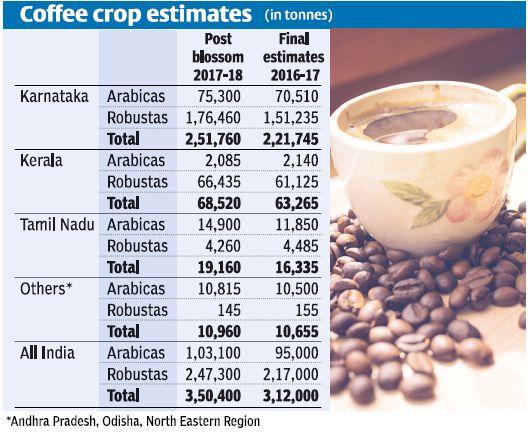
India is heading for yet another record coffee crop in the year 2017-18 starting October 1 on increase in the bearing area under the bean crop. State-run Coffee Board, which released the post-blossom or the initial estimates on Tuesday, has placed the 2017-18 crop at 3.5 lakh tonnes (lt) — an increase of 12.31 per cent over 2016-17’s final output of 3.12 lt.
Rise in acreage
The crop size of arabicas, the mild and premium bean variety, is seen rising by around 8.53 per cent in 2017-18 over the previous year, while the production of robustas is seen growing by around 14 per cent.
The projected growth in 2017-18 post blossom output is mainly on account on increase in bearing area of about 13,500 hectares in the traditional growing States of Karnataka, Kerala and Tamil Nadu. Though the Coffee Board had assessed the 2017-18 post-blossom crop size during May 2017, the estimates were released on Tuesday.
Crop losses, if any, after May 2017, will be taken into account at the time of post-monsoon estimation, the Board said in a statement.
India is the fifth largest producer of coffee and Karnataka accounts for about two-thirds of the coffee produced in the country.
State-wise crop size
The post-blossom estimate for Karnataka is placed at 251,760 tonnes comprising 75,300 tonnes of arabica and 176,460 tonnes of robusta. The post-blossom forecast represents a 13.5 per cent increase over last year. All the three main growing regions of Kodagu, Chikamagalur and Hassan districts are seen registering an increase in output over last year.
In Kerala, mainly a robusta producer, the post-blossom estimates for the year 2017-18 are placed at 68,520 tonnes, an increase of 8.31 per cent over the previous year’s final estimate of 63,265 tonnes. In Tamil Nadu, the post blossom forecast for 2017-18 is placed at 19,160 tonnes, up 17.29 per cent over last year’s 16,335 tonnes.
In the non-traditional areas of Andhra Pradesh and Odisha as well as in North Eastern Region, the post-blossom forecast is placed at 10,960 tonnes as against previous final estimate of 10,655 tonnes. The higher forecast has come mainly from Andhra Pradesh due to increase in bearing area.
The Board also said that the 2016-17 crop size had shrunk by around 10.34 per cent over the previous year to 3.12 lt mainly on account of poor rains last year.
In 2015-16, India had produced a record crop of 3.48 lakh tonnes.
(This article was published on October 3, 2017)
source: http://www.thehindubusinessline.com / Business Line / Home> Economy> AgriBusiness / The Hindu Bureau / October 03rd, 2017
Standing tall: Government Archaeology Museum in Madikeri.
Two doormen, embellished with silver jewellery and adorning red dhotis welcome visitors while standing guard at the entrance of the Government Archaeology Museum in Madikeri. The museum has been set-up inside a 150-year-old intrinsic church, which is located at the southeast entrance of Madikeri Fort. With Roman Gothic architecture, the 19th century church invites the art connoisseurs into the world of forepassed artefacts. As one crosses the glass-painted windows, sky-reaching arch, limestoned blue walls, and the dwarapalakas at the entrance, one is introduced to Kubera, the Lord of Wealth, revived from the ruins of a temple in Bettageri.
Artefacts from every era
While statues of folk deities stand firm on wooden stands, two horns pop out from behind the 18th century Ganesha statue. And they are the horns of a 1922 aurochs, which is now preserved to perfection. Adjacent to the aurochs stands a stuffed life-size leopard, “given to the museum by Mysore Archaeological Society,” explains, Renuka, the curator.
Inscriptions from the Ganga dynasty, seals from the Lingayat kingdom of Haleri, statues of Jain tirthankaras, 3D paintings of the kings and queens of Kodagu, terracotta and brass kitchenware from 12 century, and beautiful lintel that has been carved from limestone are a few objects that decorate the inner linings of the museum. However, it is the cultural folk deities and the traditional weapons that steal the show here. “People want to see and learn more about the uniqueness of the culture of Kodagu. And they ask for cultural, tale-telling artefacts of the district,” explains Renuka.
The 18th century swords and daggers from the historical reminiscence of British rule are arranged neatly in a glass case. “The collection also includes the swords used by King Veera Rajendra,” she explains. The cult weapons — odi kathi, peechakathi — synonymous with dagger and sheath knives, tell the tales of the warrior clans of Kodagu. There is also a section of armouries that bring light to the heroic deeds of Kodavas in the army. One of the highlights among these armouries is a heavy bronze cannon of the 17th century.
The Kodavas also hold special reverence to cult deities that were worshipped in the then extensive, now diminishing, devara kadus or the sacred groves. And the museum is home for many such cult deities revived from 11th and 12th century. Naga idols, masks of boar headed folk gods, idols of the Sun God, Goddess Kali, Shiva-Parvathi idol and Uma Maheshwari idol are just a few to mention among the immense bronze idol collection.
“Most of them are harake shilpas (ex-voto offerings), which were recovered from the ruins of many temples, and some gifted by the temples for preservation,” she confirms. The museum sheds light on the Jain heritage in the region too. Stone and pot inscriptions and intricately carved statues of Jain tirthankaras — they take one back to between the 11th and 14th century, when the Kongalvas (subordinates of Cholas) were the prominent rulers in the district.
There is also a section in the museum dedicated to Field Marshall KM Cariappa, who donated many worthy artefacts of the past. While an ornamental chair of the Field Marshall sits at the centre of this section, it is surrounded by various mementos won by him and a few other age-old statues collected by him as an art connoisseur. “They have been exhibited in the gallery in memory of his parents,” Renuka explains.
The art of preserving
While the staff of the museum is actively involved in reviving historical artefacts, they have also faced hurdles in preserving some historical objects. Renuka explains, “We make sure that none of the ruins of historical idols are immersed in the rivers and immediately fall into action in collecting them. However, sometimes the beliefs of people work against our actions. One such incident took place in Bhagamandala, where the locals refused to hand over the ruins of elephant sculptures in the area due to religious beliefs. However, learning its importance, they are now preserving the sculptures.” Renuka, as a curator of this museum, has revived over 250 artefacts; the recent one being the painting of King Chikka Veera Rajendra, the last ruler of the kingdom of Kodagu.
A State-funded museum, the museum attracts a lot tourists during the weekends who also tour the historic fort located in the area. “We are looking at further improving the museum by including a detailed story of the heritage value and revival process of these historical objects,” concludes Renuka. The museum is open to visitors from 09.00 am to 5.00 pm except on Mondays and general holidays.
source: http://www.deccanherald.com / Deccan Herald / Home> Supplements> Spectrum / by Prajna G R / October 03rd, 2017
The 48th Kendriya Vidyalaya Sangathan National Sports Meet (Girls) will be held at Kanteerava Stadium for four days, starting Tuesday. Around 3,387 girls under-17 and under-19 representing 25 regions of Kendriya Vidyalaya Sangathan from different parts of the country will participate in 20 competitive sports. On winning, these girls will represent central schools in the School Games Federation of India (SGFI). Athlete and Arjuna Awardee Ashwini Nachappa will attend the opening ceremony.
The girls will compete in badminton, lawn tennis, volleyball, basketball, chess, handball, hockey, archery, judo, kabaddi, kho kho, shooting, skating, swimming, table tennis, taekwondo, yoga and rope skipping. This year, taekwondo will see the largest participation with 306 girls competing in it.
Neelam Raidurg, coordinator for the national sports meet, said, “More and more parents want their daughters to be trained in self-defence. Hence the increased participation. In previous SGFI competitions, girls who have been selected from the national sports meet have won gold medals in skating, badminton and taekwondo.”
U Vimal Kumar, Arjuna Awardee, former badminton player and chief national coach, will attend the closing ceremony on Saturday.
source: http://www.newindianexpress.com / The New Indian Express / Home> Cities> Bengaluru / by Express News Service / Ocotber 01st, 2017
WELCOME. If you like what you see "SUBSCRIBE via EMAIL" to receive FREE regular UPDATES.
Read More »