How wildlife-friendly is your brew?

WildKaapi01KF03jun2017 Wild Kaapi, your morning coffee comes from certified estates that support gaurs, elephants and monkeys, along with Arabica beans

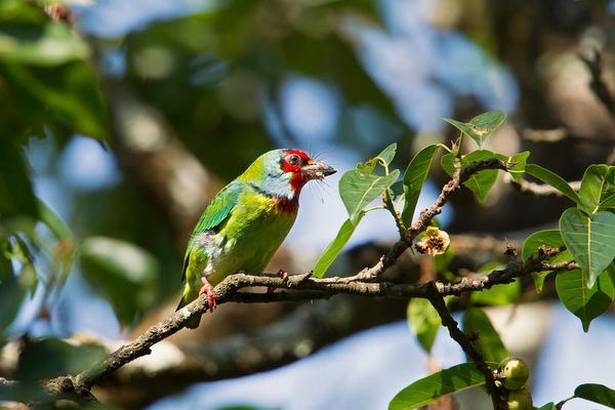
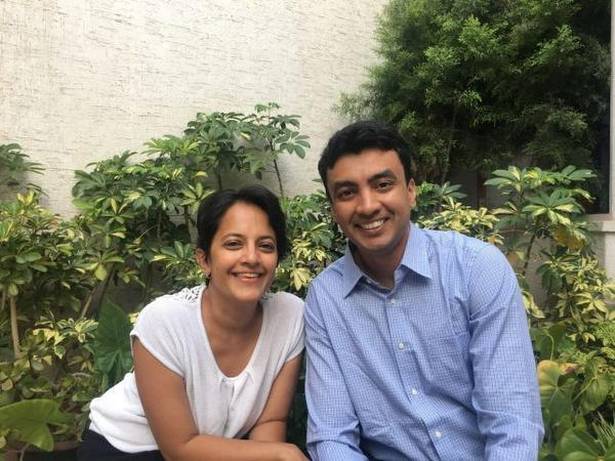
Under the cool canopy of native trees in the Western Ghats, coffee bushes spread out, gleaming with red berries. In the early morning hours, if you are lucky, you may spot rare species like the Malabar grey hornbill, water snow flat butterfly or the Asian fairy bluebird among these shade-loving plants. And now, thanks to the efforts of Wild Kaapi — the world’s first ‘certified wildlife-friendly’ coffee brand — you can ensure your morning brew comes from plantations that foster fauna on their lands. Started by wildlife conservationist, Krithi K Karanth — who has has been working in the Western Ghats, a biodiversity hotspot, for the last 19 years — and her husband, Avinash Sosale, the coffee brand got its certification this April and opened its doors to buyers last month.
(photo credit: Ramki Sreenivasan)

Live and let live

Wild Kaapi started as an offshoot of a three-year research project (part of a grant by the National Science Foundation to study coffee, areca and rubber plantations in the Western Ghats). Karanth, of the Centre for Wildlife Studies — with Paul Robbins of the University of Wisconsin-Madison and Dr Ashwini Chhatre of University of Illinois — measured biodiversity, and studied labour practices and market dynamics of the farming areas.

During the project, she interacted with over 1,000 planters in the three coffee growing areas of Karnataka — Kodagu, Chikmagalur, and Hassan — and realised how frustrated they were “because they weren’t getting value for their coffee due to the middlemen involved”. That’s when the idea for Wild Kaapi originated, and the duo is now exploring new ways to get a premium price for products that support wildlife. “This includes social enterprises that can contribute to conservation action. (After all) traditional wildlife conservation relies heavily on donors,” says Sosale, who quit a career in automotive business to be a part of the venture. “At this stage we have two commitments: we have told coffee growers we will pay them the highest price, and, with the profit we generate, we will build a conservation fund to award grants to young conservationists,” he adds.
WildKaapi03KF03jun2017

Animal tales

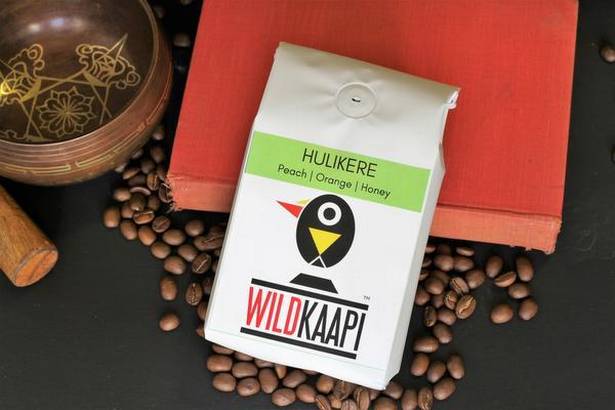
Millennials are more discerning towards coffee, observes Sosale. “Today’s consumer is informed. Ethical and conscious consumption is what we want to tap into.” To qualify for certification, the coffee not only had to have a good cupping (tasting) score, but the plantation had to support a vast biodiversity. Of the more than 187 farms they audited (recording the species of birds, butterflies, mammals, amphibians and trees), only four made the cut: Agora (with 124 species), Bindiga (137), Hulikere (119) and Cornerstone (120). Wild Kaapi has named their single-origin Arabicas after the plantations they are sourced from.
WildKaapi04KF03jun2017

Shreedev Hulikere, a third-generation coffee grower with 60 acres in Chikmagalur, who is partnering with Wild Kaapi, says he wasn’t aware of the numerous wildlife species on their estate till now. “While my ancestors traditionally hunted, I’m a conservationist. I tell my labourers not to destroy any bird nests. I know that barbets nest here and they eat the borer worms that destroy coffee. Similarly, I’m not going to chase away the monkeys and civets that eat my coffee because I’m being compensated elsewhere. Just because a porcupine destroys a pepper creeper, I’m not going to hunt it down,” he says.

Love thy neighbour

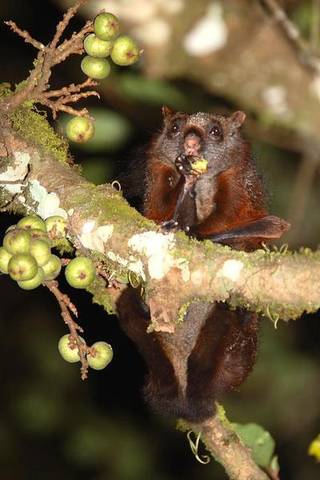
The audit also revealed a few surprises. “We found frogs listed as endangered or threatened in the IUCN Red List (the world’s most comprehensive inventory of global conservation status) at these plantations,” says Karanth. The certification not only places their coffee in a premium space, but also paves the way for a new movement. “If you have wildlife-friendly practices, you can promote sustainable agriculture. We are trying to establish a new model — a profitable enterprise that also enables better livelihoods. This hasn’t been tried before; it’s a new way of thinking,” says Karanth.
(photo credit: Ramki Sreenivasan)

While their immediate goal is to prove that such a model is sustainable, Sosale is also mulling introducing coffee scrubs, soaps, candles and flavourings — all huge product lines in the international space. Moving into pepper and cardamom, which grow hand-in-hand with coffee, also holds much promise.

Prices start at ₹390 for 250 gms.

To know more, and buy the coffee, check out wildkaapi.com.

source: http://www.thehindu.com / The Hindu / Home> Life & Style> Homes and Gardens / by Bhumika K / June 02nd, 2017
Boosting domestic offtake is the key: new chief of Coffee Board

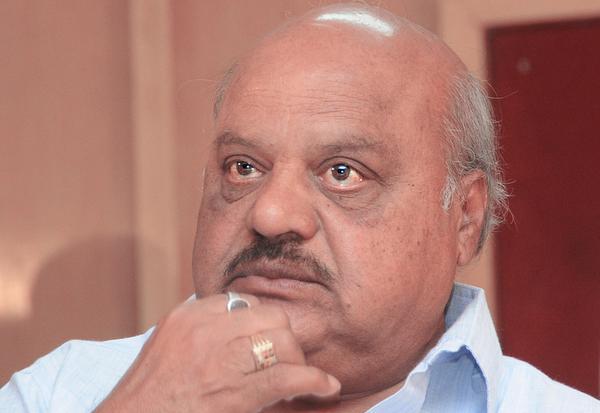
Coffee Board chairman M S Boje Gowda, at a function in Bengaluru on Wednesday. Somashekar GRN

Boje Gowda rues India’s low 200-g consumption compared to 7-8 kg in the West

Bengaluru :

Boosting domestic consumption is crucial to protecting the interests of coffee growers, according to MS Boje Gowda, the newly-appointed coffee Board Chairman.

After 70 years, the Coffee Board has a grower as its chief in Boje Gowda, who is third generation planter. Till recently, bureaucrats headed the apex decision-making body for the coffee sector, under the Ministry of Commerce.

Gowda, of Krishnagiri Estate in Chikmagalur, takes over at a time when growers are grappling with volatile prices, fluctuating output that’s largely being influenced by a changing climatic pattern on account of erratic rainfall, and pest issues such as the white stem borer.

Addressing growers after assuming office, Gowda said the annual per capita coffee consumption in India is not even 200 grams, while in the western world it is 7-8 kg, thereby leaving tremendous scope to boost the domestic offtake. He said there was a need to boost consumption beyond the traditional consuming States of Karnataka, Tamil Nadu, Andhra Pradesh and Kerala. “It would become a difficult situation for the growers unless the domestic consumption expands,” he said.

Gowda, a large planter, said Prime Minister Narendra Modi has set a target of doubling coffee output from the current 3 lakh tonnes to 6 lakh tonnes. India consumes merely a third of the coffee produced in the country as over two-thirds of the output is exported, mainly to Europe and Russia.

Karnataka, the main growing region that accounts for about two-thirds of the country’s coffee output, has been reeling under a drought for the past three years. Gowda said he would focus on improving the water storage facilities and take up the growers’demand for higher subsidy for increasing the coverage of drip irrigation.

Coffee growers gets only 25 per cent subsidy on the equipment cost for taking up drip irrigation, while for other plantation products such as rubber and cardamom, the subsidy component is around 80 per cent, Gowda said.

Drones to forecast crop
Addressing growers, Coffee Board Secretary Srivatsa Krishna said the body was exploring the option of using drones for better crop forecasting. Krishna said the current crop estimation was not right and the Board was looking at ways to improve the crop estimate. The Board has been in talks with 7-8 start-ups on deployment of drones for improving the accuracy of crop forecast.

Krishna said the Board is also working on creating water harvesting solutions and is exploring options such as cloud seeding. On the issue of white stem borer, a pest that attacks plants of arabica coffee, Krishna said the board has reached out to biotech firms to evolve a solution and that pilots are being carried out in some plantations.

Highlighting the importance of branding, Krishna said the growers should come out with region-specific brands such as Chikmagalur and Mysuru.

source: http://www.thehindubusinessline.com / Business Line / Home> Agri Business / by The Hindu Business Line Bureau / Bengaluru – May 17th, 2017

Tata Coffee appoints P.G. Chengappa as an additional director

We would like to inform you that the Board of Directors of the Company at their meeting held today, the 18th May 2017 and appointment of Dr. P.G. Chengappa as an Additional Director with effect from 18th May, 2017.

We would like to inform you that the Board of Directors of the Company at their meeting held today, the 18th May 2017, have considered and approved the following: a.Appointment of Dr. P.G. Chengappa as an Additional Director (Non-executive, Independent) with effect from 18th May, 2017.

A brief profile of Dr. Chengappa is enclosed herewith. Dr. Chengappa is not related to any of the Directors of the Company. b.Re-appointment of Mr. K. Venkataramanan as an Executive Director – Finance and CFO of the Company for a period of 3 years with effect from 25th October, 2017.

This disclosure is made in terms of the requirements of Regulation 30 of SEBI (Listing Obligations & Disclosure Requirements) Regulations, 2015.Source : BSE

source: http://www.moneycontrol.com / Moneycontrol.com / Home> News> Business> Announcements / May 18th, 2017

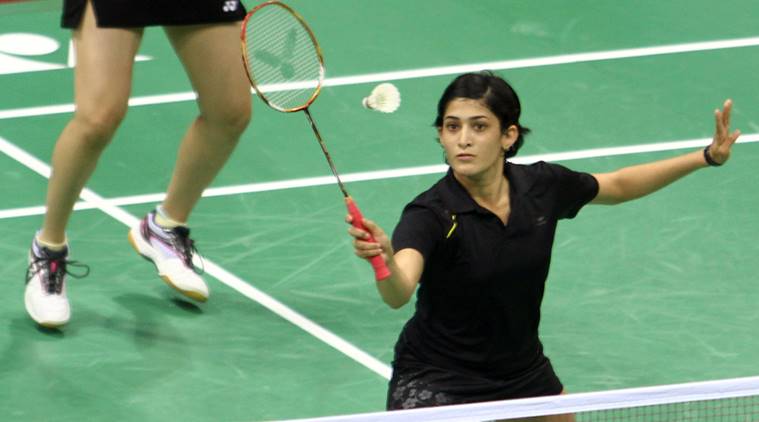
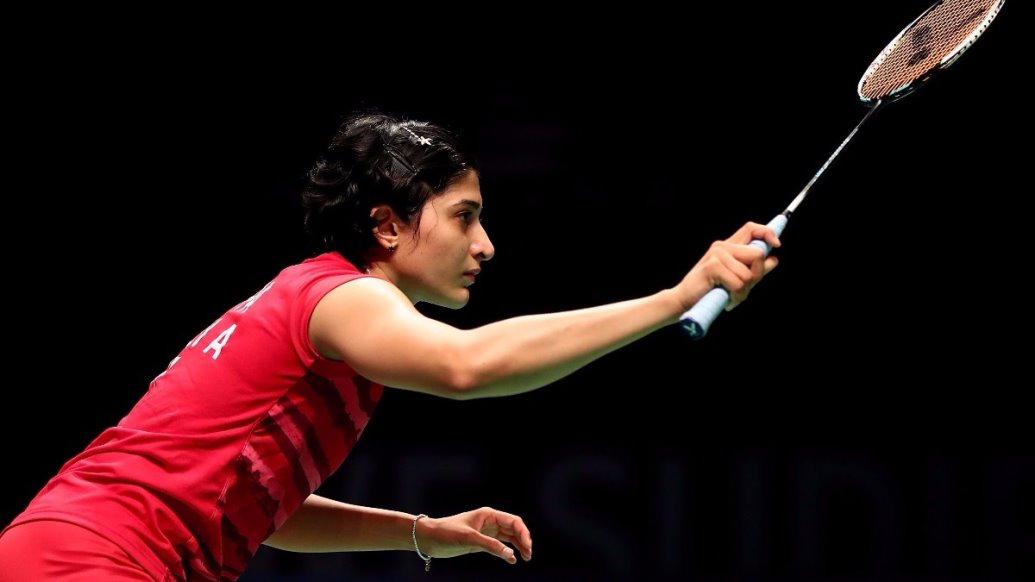
“Opponents don’t give you a chance, you have to take it.” Ashwini Ponnappa speaks on what it takes at the highest level

Getty Images
Getty Images

Ashwini Ponnappa needs no introduction. With an extra spring in her step and an extra sting in her smashes, Ashwini had been a stand-out shuttler right through her teens and continued to make waves on the Indian circuit, winning everything that came along her way and never shying away from a challenge. From being a child prodigy who won National Championships consistently to winning a gold medal at the Commonwealth Games, Ashwini has walked down a long road…..and continues to do so unflinchingly….

Records have come and gone for Ashwini as fast as her smash. The fastest smash in Women’s badminton history recorded so far at 260 km/hr belongs to Ashwini. Also, became the first Indian along with Jwala Gutta to win a gold medal at the Commonwealth Games in 2010 but nothing stops Ashwini Ponnappa from moving to the next court, her next challenge. From being the child prodigy who gave it all in her sport, she sometimes dons the mentorship role in guiding upcoming young prodigies. One of them happens to be 16-year old Satwiksairaj Rankireddy, who Ashwini Ponnappa played mixed doubles with.

In the recently concluded Sudirman Cup in Gold Coast, Australia, the mixed doubles team of Ashwini Ponnappa and Satwiksairaj Rankireddy put up a fantastic show against Indonesia before eventually losing to 10-time World Champion, China. Sportswallah caught up with Ashwini Ponnappa after a tough fight against China and how does she find them mentor role.

Tarun Raman: Hi Ashwini. Firstly, commiserations for the loss against 10-time champions, China at the Sudirman Cup. After winning the first set emphatically, must have been difficult to come out on the losing side?

Ashwini Ponnappa – It was disappointing, but I am glad we gave them a good fight. Players at that level know how to bounce back after losing a set. They don’t give you a chance, you have to take it.

TR: To be frank, nobody gave India a chance against China who are the top seeds and 10-time champions. How would you rate yours and Satwik’s performance?

Ashwini – I would rate out performance quite good, especially considering the fact that this was a first tournament partnering each other.I am happy with the way we played and I know we are capable of playing and performing even better.

TR: Anything strategy you would have wanted to employ differently against the world No. 2 pair of Lu Kai and Huang Yaqiong?

Ashwini – Strategy-wise I think we did have a good plan.But towards the end, it’s about holding your nerves and hanging in there.Which I sure we will get with more match practice and experience.

TR: On a slightly different note, when did you realise you had to pick hockey over Badminton, given that your father was a national hockey player?

Ashwini – I never really had to choose. Though my dad was a hockey player I was not put into hockey.It was badminton from the beginning.

TR: You were one-half of India’s most successful women’s doubles badminton team. How difficult was it, ending a successful partnership with Jwala Gutta?

Ashwini – It’s always tough to end a partnership, never easy. But the nice part is that wonderful memories and performances together and a lot of positives to take forward. I’ve learnt a lot and I’m thankful to Jwala for that.

TR: There has been a steady rise of talented female athletes in Badminton. What do you think is the reason for that?

Ashwini – Not too sure really. Probably cause a lot of us are fighters and want to prove ourselves at the biggest stage.

TR: Apart from dogs and music, any hobby of Ashwini the world doesn’t know about?

Ashwini – Not really. Music and books are my go to the source to unwind and relax.I love dogs and being around them always makes me happy.

TR: What next for Ashwini Ponnappa after this tournament?

Ashwini – Next up is the Indonesian Open in two weeks time, followed by the Australian Open.

source: http://www.sportswall.com / Sportswallah / Home / by Tarun Raman / May 29th, 2017

Tribe and Prejudice : Every last Thursday of May, Tribals congregate in Karnataka’s Virajpet to celebrate

KundehabbaKF31may2017

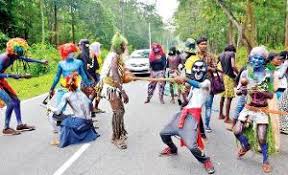
Tribals congregate to celebrate, make music and some harmless ribbing. Body painting, cross-dressing and ‘abusing’ passersby are all part of the one-of-a-kind festivities

Kunde” “Kunde” “Kunde”.. they shout, howl and whistle all day long, walking in the streets of Thithimathi and Devarapura in Virajpet taluk of Kodagu. If you have seen the pictures, you will understand that this is a festival that is as colorful and lively as any other celebration.

Cross-dressed men who adorn any attire irrespective of whether it is fashionable or not, is the idea behind this theme. Personalities that are chosen for aping are deities, young girls, demons and anything under the sun.

The most funny part of the festival is the music. They use drums made of buckets which are used to store water, as well as metals and Dish TV antenna receivers, adding to the noise of the parade.

Kunde Habba or the Bodu Habba has been a century-old tradition in Kodagu celebrated by tribals. A tribal man who was dressed up like a fierce deity said, “This is a festival where we abuse gods and the divine power. Our forefathers have told us that Lord Aiyappa who was living in this region betrayed our tribal clan and from that day, once in a year, and especially on the last Thursday of May, we celebrate this festival.”

All these men are not from one place. They come from various places marching along, shouting Kunde…Kunde..Kunde to meet at the Aiyappa Temple at Devarapura by afternoon. All the sects and clans of tribal men reached the place where the “Bhandara Takka” or the keepers of the temple wealth, the Sannuvanda family members, were present.

The festivities come to a close when all of them dance around the temple and meet and greet each other. There were close to a thousand people who participated in this festival, which was held under police vigil.

source: http://www.bangaloremirror.indiatimes.com / Bangalore Mirror / Home> News> State / by Kaushik JN, Bangalore Mirror Bureau / May 28th, 2017

Now on the web — Kodava, Konkani and Tulu radio

Nammaradio starts services in dialects of Karnataka

Among the unique characteristics of Karnataka are the distinctness of its regions and the tongues spoken within the State. Yet, for long, what people heard on the radio were Kannada, Hindi and English. In contrast, one radio channel — Nammaradio, the state’s first Kannada radio station on the internet launched in February 2016 — has started airing programmes in eight languages and dialects of the State. It’s likely the only web radio in India to air programmes in Kodava, Konkani and Tulu, and some of the lesser known dialects of Karnataka. These include Byari and Nawayathi, spoken by sub-sects of the Muslim community bearing the same names in coastal Karnataka, and Sankethi and Havyaka, spoken by Brahmin subsects.

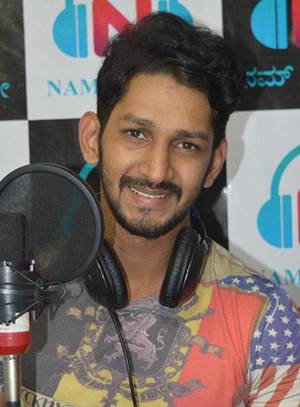
Making waves: Pavan Bhat anchors programmes in Tulu

Avnidhar Hawaldar, CEO, Nammradio.com, said that the target audience are Kannadigas living outside the state, and extensive interaction with them revealed that while there were avenues for Kannada content, there was nothing for people speaking the dialects. “It’s a true embracing of Kannada in all its diversity,” said Mr. Hawaldar.

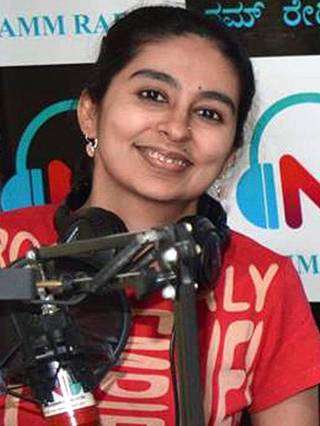
Making waves: Varsha anchors programmes in  Havyaka .
Making waves: Varsha anchors programmes in Havyaka .

In February 2017, at the Nammaradio studios in Bengaluru, in-house radio jockey Varsha started the first such show in Havyaka, a dialect spoken by Havyaka Brahmins. “The response was huge, and our listeners were elated when they heard a show in their mother tongue. That set the tone for the rest,” said Raj Malleswaram, programming head of the channel.

Since there is no history of radio programming in these languages and dialects, trained jockeys are hard to come by. So housewives, students and working professionals fill the need. Ashutosh Dikshit who works as senior innovations manager with a leading firm in the UK has a second career now, hosting a weekly radio show in Sankethi language from his house in London. “Our community may be less than 30,000 across the world and we are very concerned about our language, which is a large part of our heritage. The radio show has been welcomed widely in our community,” Mr. Dikshit said. He added that the channel viewed dialects like Sankethi or Nawayathi as not community linked, but as a linguistic heritage to be preserved.

When it comes to film songs, however, the one-hour radio shows through the weekend play Kannada songs. Except for Tulu, no films have been made in the other tongues. The Tulu show will soon start playing Tulu film songs.

source: http://www.thehindu.com / The Hindu / Home> News> Cities> Bangalore / by K.V.Aditya Bharadwaj / Bengaluru – May 29th, 2017

In Kodagu, once a soldier, always a soldier

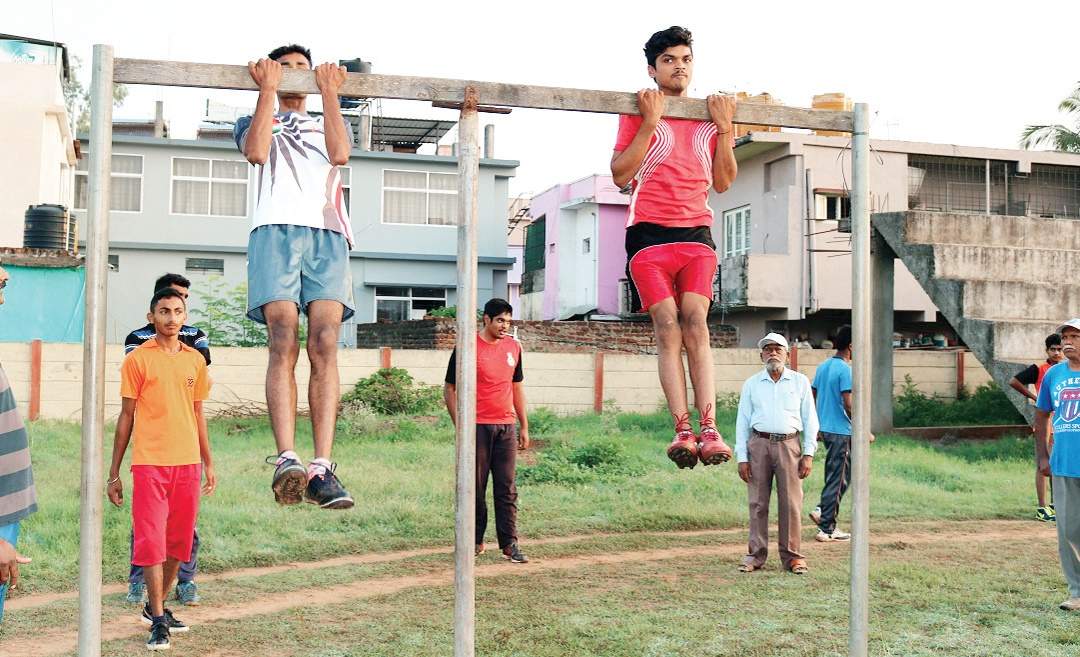
Youths being trained for defence forces in Kushalnagar | Express

Madikeri :

Service to the nation appears to be in the DNA of Kodagu people. In the district known for brave warriors, some servicemen continue to serve the defence forces after their retirement too — by grooming prospective soldiers.

The Kushalnagar Ex-servicemen’s Association has been providing rigorous training to youths aspiring to join the defence forces for the last 10 years.

To join military, youngsters of Kodagu may not need a greater motivation than the profile of the district which has produced a field marshal, a general, many lieutenant generals and thousands of soldiers. A number of villages of the district have more than 10 serving or retired servicemen. Often, one can see 2-3 brothers serving the defence forces.

Ironically, Kodagu lacks a training institute to help youths join the military.

In 2007, the Kushalnagar association decided to fill the void. It started training sessions at government primary schools for those keen on joining the Army. Since then it has trained at least 2,000 youngsters.

The rigorous exercises include 2-km running, zigzag running, long jump, high jump, push-ups, yoga and meditation.

The training also means hard work for association president M N Monnappa and other office-bearers like A Janardhana, N S Suresh Kumar, Bojappa and Somanna.

As the exercises have to be completed before school hours, they have to be at the venues by 5.30 am. They spend at least two hours, till 7.30 am, with military-aspiring youths.

But physical fitness alone is not enough to join the defence forces. They have to pass written tests too which many aspirants find difficult. The association has addressed the need and holds coaching.

Janardhana says the training is free of cost and “we never expected a penny from the youths.

“The number of trainees sees a spike during job openings in defence, police, CRPF and other forces,” he observes.

According to trainer Naresh Kumar, the association provides information to youths when recruitments take place. “Hundreds have joined defence forces after training here,” says Naresh. He can be contacted on 9480640924.

source: http://www.newindianexpress.com / The New Indian Express / Home> States> Karnataka / by Coovercolly Indresh / Express News Service / May 28th, 2017

Bopanna spurs Friends Unions to win

Rishi Bopanna shone with the ball for Friends Union Cricket Club as they notched a comfortable seven-wicket victory over The Bangalore Cricketers in the KSCA Group I, Division I league tournament for the Sir Mirza Ismail Shield here.

In what turned out to be a low-scoring affair, Bangalore Cricketers posted 175 all out in their first hit. Akarsh MA top scored, while Adarsh (7/73) and Rishi (2/14) were destructive with the ball.

Bangalore’s bowlers though gave their side a slim 20-run first innings lead after Koushik V (4/44), Kempraj V Gowda (3/53) and Naveen Patil (2/22) put the brakes on Friends Union. Kunal Kapoor stood out for the batting side with a knock of 50.

The turning point of the match was the second innings, where Bangalore crumbled to 66 all out in 52.2 overs thanks to Rishi’s six for 17, leaving their opponents with a target of 87. Kunal led the chase with 41 not out as Friends Union overhauled the target in just 13 overs to bag five points.

Brief scores:

The Bangalore Cricketers: 175 all out in 73 overs (Akarsh MA 67; Adarsh HS 7-73, Rishi Bopanna SA 2-14) and 66 all out in 52.2 overs (Nitish PD 2-10, Rishi Bopanna SA 6-17) lt to Friends Union CC (1): 155 all out in 61.1 overs (Kunal Kapoor 50; Koushik V 4-44, Kempraj V Gowda 3-53) and 89/3 in 13 overs (Kunal Kapoor 41 n.o.; Koushik V 2-24).

Friends Union CC (1): 5 points; The Bangalore Cricketers: -1 point.

Cambridge CC: 114 all out in 41.2 overs (Ritesh Bhatkal 5-45, Prithviraj 3-28) and 165 all out in 43.1 overs (Anurag Bajpai 83; Ritesh Bhatkal 3-62, Prithviraj 3-51) lt to Social Cricketers: 338/7 decl in 66.2 overs (Rakshith S 154, Prithviraj 116) by an innings & 59 runs. Social Cricketers: 5; Cambridge CC: -1.

Vultures CC: 462/6 in 90 overs (Prateeksh R 123, Pavan Deshpande 200, Anirudh A Joshi 71; Prashanth S 3-142) drew Bangalore Occasionals: 305 all out in 65.5 overs (Jeswanth Acharya 53, Abhishek Reddy 86; Punith S 4-75). Vultures CC: 3; Bangalore Occasionals: 1.

Herons CC: 390 all out in 89.1 overs (Arjun Hoysala 65, Vishwanathan M 149, Rohith Gowda 64; Raunak Shah 2-44) drew Bangalore United Cricket Club (1): 258/6 in 90 overs (Shivam Mishra 110, Raunak Shah 79; Nithin Naidu 2-63). Herons CC: 3; Bangalore United CC (1): 1.

Mount Joy CC: 288/9 in 90 overs (Kiran AM 75, Sharan Gouda 47; Bhavesh Gulechha 5-55) and 29/1 in 6 overs drew Jawans CC: 318/8 in 90 overs (Shubhang Hegde 106, Dinesh Borawankar 67; Sharan Gouda 3-58, Rishabh Singh 2-34). Jawans CC: 3; Mount Joy CC: 1.

Swastic Union CC (1): 340 all out in 87.2 overs (Samarth R 107, Akshay Kodoth 60; Mitrakant Singh Yadav 5-139, Amit Verma 4-72) drew Swastic Union CC (2): 219 all out in 65.4 overs (Ankith Udupa 35, Amit Verma 52, Bhareth Narayan Prasad 80 n.o.; Saishiv Narayan L 7-44). Swastic Union CC (1): 3; Swastic Union CC (2): 1.

source: http://www.deccanherald.com / Deccan Herald / Home> Sports / DH News Service / Bengaluru – May 16th, 2017

Sudirman Cup: Ashwini Ponnappa seals 4-1 win for India

On Tuesday, Ashwini Ponnappa smiled all the way to securing for India one of its most memorable wins at the Sudirman Cup.

Ashwini teamed up with Sikki Reddy to win the women’s doubles and with Satwiksairaj Rankireddy to clinch the mixed doubles against Indonesia. File

In her early years on the international circuit, a coach had once taken umbrage at Ashwini Ponnappa’s smiling countenance on court, and told her she lacked seriousness to compete. It had made the ace doubles player, with a Commonwealth Games gold and a World Championship bronze already, furious, that her naturally joyous ways on court could be miscontrued as lack of commitment to winning.
Not that she changed how she went about things — Why couldn’t one smile and still hit the hardest smash in women’s badminton, she wondered. On Tuesday, Ashwini Ponnappa smiled all the way to securing for India one of its most memorable wins at shuttle’s team championship — the Sudirman Cup.

Opening with a sensational mixed doubles win alongside Satwiksairaj Rankireddy against Indonesian mixed doubles Olympic champ Tontowi Ahmad (in a scratch pairing with junior world champ Gloria Widjaja), Ashwini bookended the famous 4-1 tie win against Sudirman giants Indonesia, sealing a straight sets women’s doubles win with Sikki Reddy against Della Haris-Rosyita Eka Putri Sari.

It’s badminton’s jolly luck that women’s singles player Tai Tzu Ying brings a refreshing, goofy persona to the court even while she works her deceptive magic on opponents with a disarming charm as she sits atop World No 1.

There’s little of the screwed-eyed intensity or scowling fist pumping in Ashwini Ponnappa, that’s so common to this predominantly Asian sport where players can appear as highly strung as their racquet tensions. She goes about the mighty difficult task of winning, while looking like she might actually be enjoying the game.

Not that her game is diminished when she affords herself a wry smile or two, after missing a shot, or even grins mid-rally as she brightens up gleefully in anticipation of a winner she’s setting up for her partner to finish. Against Tontowi-Gloria — a thrilling 66 minute joust against doubles mammoths Indonesia, a country with a proud tradition in the paired event — the 27-year-old Indian doubles ace had eclectic options in her serves, showed an improving low defense that’s so crucial to doubles, and a rhythmic game sense where the duo playing their first match ever at this big a stage, combined to win 20-22, 21-17, 19-21 in a shock upset.

Ashwini is known for her doubles partnership with Jwala Gutta and has metamorphosed into an equally deft player as her former senior partner, revelling in the responsibility of being the senior to Sikki Reddy and Satwiksairaj now. It was her reassured, relaxed stance on the court though — that rubbed off on teenaged Satwiksairaj, who too settled into the brutal pace of the rallies, making it look like two cool cats enjoying a breezy bout though.

“We didn’t think too much about opponent being Olympic champ or anything. We just wanted to play to our strategy. Neither of us took any pressure and we played freely. I enjoyed a lot in fact playing against the Olympic winner, and we were not afraid to play him,” he would say a couple of hours after his cross drive winner ended the Indonesian misery that had been building up for a while.

Rare sight
It was a rare sight in international badminton — an Indonesian bonafide champ reduced to nervousness, after the Indians peppered them with some hard hits but importantly refused to blink or be commanded in a rally throughout the encounter. Tontowi would botch his serves, miss his returns, smash into the net and fall under the heap of immense pressure that he seemed to have brought upon himself as the reputed player of the pairing.

It didn’t help that Ashwini was moving like a dream on the court, Satwiksairaj in lyrical tandem, working angles to breach defenses and thwack into empty spaces the Indians were creating galore. India’s foreign coaches Malaysian Tan and Indonesian Mulyo Handoyo, sat back and watched with admiration as the inexperienced Indian pairing went about their decimation, flying free as birds. There’s a little secret to Ashwini’s smashes — when she is truly relaxed on court (not tight, as the shuttle speak goes), her muscles tend to relax as well, and that invariably makes her smashes shoot faster than when she’s subdued and circumspect.

When she’s smiling, the rocketing smashes usually follow. It’s taken Ashwini Ponnappa almost 9 months to own that smile. She was felled by a nasty diagnosis of dengue before the Rio Olympics, which not only ruined her quadrennial but also creaked her bones like never before.

A Coorgi who prided herself in her fitness and strength, she would spend months after the Games staring at uncertainty — after her body remained weak as residual after-effects of Dengue lingered. “My body just wildly fell apart and I struggled to perform basic tasks. For an athlete you can imagine what that must feel like! For me, I doubted even that I would be able to even smash again. I had the will power, but the body just wouldn’t cooperate,” she says, recalling the physical anguish. It would be a long recovery, demanding patience and meticulousness that are hallmarks of her personality. She’d slowly regain strength, and three weeks ago when she was paired with Indian badminton’s most exciting doubles talent, there was renewed purpose. Against Denmark on Monday, India had bungled a tad.

“Today I just told Satwik we can beat them. We really wanted to win and played our heart out. We both hit hard, and we enjoyed ourselves I think,” she says. Ashwini Ponappa, chatty, talking lively eyes on court, serving up shuttles that whizzed. She kept smiling through the pressure points, and Olympic champ Tontowi Ahmad just didn’t know what hit him.

source: http://www.indianexpress.com / The Indian Express / Home> Sports> Badminton / by Shivani Naik / Mumbai – May 25th, 2017

State plans country’s 1st all-women trekking guides team in Kodagu

Women will be drawn from local villages and tribal hamlets as they know the terrain better. The women are being identified and shortlisted by local forest officials and panchayat members. dh file photo

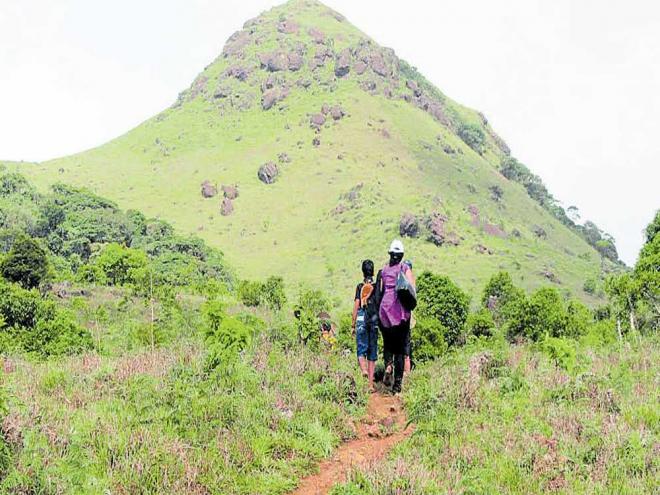
The Forest department is planning to set up an all-women trekking guides group. Said to be the first such initiative in India, these women groups will help trekkers on the dedicated trekking trails identified by the Forest department. To start with, women guides will be introduced on three eco-trails of Kodagu district. Women will be drawn from local villages and tribal hamlets as they know the terrain better. Such women will be trained and recruited by Karnataka Eco-Tourism Development Board (KETDB).

Vinay Lutra, Chairman of KETDB told DH that they had received a special request from Kodagu CEO and Chief Conservator of Forests to have all-women trained trek guides.

“The demand for trekking trails is very high and so is the demand for women guides. Based on the response and success rate, more such teams will be formed in the coming days,” he said.

The idea of involving them is to make the women of this section and region employed and independent. The women are being identified and shortlisted by the local forest officials and panchayat members. The KETDB is only training the women.

Vijay Mohan Raj, Chief Conservator of Forests, Chikkamagalur, and member of KETDB, said that earlier 70 women were trained to be a part of the certified women volunteer programme.

These are women from various civil societies. But, this will be for the first time where 30 women will be trained to be trekking guides.

“The difference is that the volunteers are not paid, but these guides will be given permanent employment and a monthly salary. Guides will be trained professionals,” Raj said.

Though dates of the training and their recruitment is not yet decided, board members hinted that it is most likely to start from June. Guides will undergo a week-long training on the trekking routes, the dos and dont’s in the forest, identification of the birds, plants, insects and animals and health safety.

After this, KETDB is also planning to introduce a mixed group of trained guides in Dakshina Kannada and Hassan districts.

source: http://www.deccanherald.com / Deccan Herald / Home> State / by Bosky Khanna / DH News Service / Bengaluru – May 26th, 2017