Honey with coffee reinforces climate resilience: Kodagu coffee estates’ bee farms

The famed Kodagu coffee estates are experimenting with bee farms to add to incomes so that the forested landscape of this biodiversity hotspot is better able to sequester carbon.
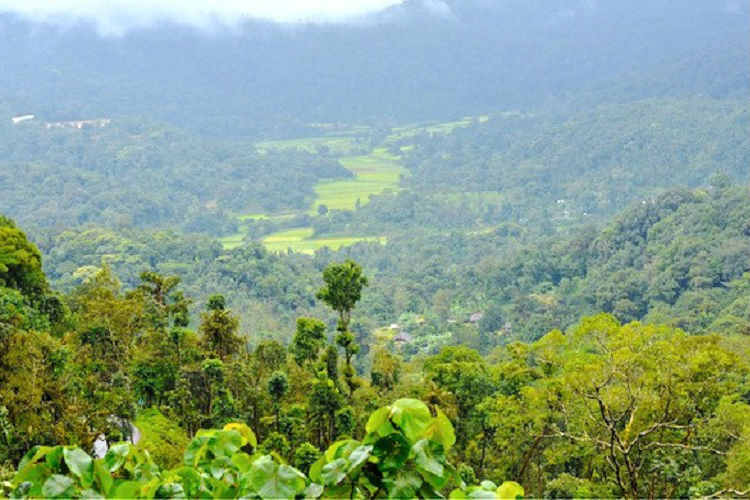
The forested landscape of Kodagu provides ecosystem services. (Photo by S Gopikrishna Warrier)

While honey can sweeten coffee for the drinker, coffee farmers of Kodagu district of Karnataka are realising that raising bees for honey in the farms can sweeten their economic returns. It is one of the innovative methods being tried out in the district to provide additional financial incentives to coffee farmers so that they conserve the landscape they have inherited.

The concept of payment for ecosystem services (PES) is evolving from eco-certified coffee to that of landscape labelling of Kodagu. If the forests, coffee agro-forestry, rice fields, sacred groves, rivers and streams of Kodagu together provide ecosystem services and climate resilience to the communities living in the hills and the plains, why should not there be payment for sustaining these services?

According to a report on PES prepared by the College of Forestry at Ponnampet, Kodagu, the district has been identified as a micro-hotspot of biodiversity under the larger Western Ghats region. There is tree cover across as much as 81% of the district.

Natural forest ecosystems cover an area of 46% of the total area of the district. This includes evergreen, semi-evergreen, moist deciduous, dry deciduous and scrub forest types. Evergreen forests also include the high-altitude shola forests along with grasslands.

Key ecosystem services

Biodiversity, carbon sequestration and water regulation are the key ecosystem services from the Kodagu landscape. In addition to the economic benefit, there are also provisional, regulating, cultural and supporting services from the landscape. Thus, while eco-certification of coffee can help individual farmers, landscape labelling can benefit the district in its entirety, giving incentive to the communities to plan their development sustainably.

Charulata Somal, chief executive officer of the Kodagu Zilla Panchayat (district council), says that if PES can help channel money for the communities to conserve their landscape, there is a possibility of meeting the genuine aspirations of the people without compromising on the environment. “We plan to take the concept of PES through the elected representatives from the district.”

The PES report from the College of Forestry estimates the economic value of the various ecosystem services in Kodagu. The nutrient recycled has a value between INR 237 and INR 1167 per hectare, with a mean value of INR 700 per ha. The economic value of timber is between INR 530 and INR 8340 per ha. The recreational value of biodiversity is estimated as INR 27,000 per ha.

High sequestration

Carbon sequestration, according to the report, varies from 77 tonnes per ha to 207 tonnes per ha. Even at 90 tonnes per ha and an assumed price for carbon at USD 10 per tonne, the economic valuation is INR 40,500 per hectare.

The project for promoting bee farming (apiculture) in coffee estates was started after a study found the strong economic impact of pollination services of bees from sacred groves adjacent to the coffee farms. Kodagu has 1,214 sacred groves under community management, covering 2,550 hectares interspersed with coffee estates.
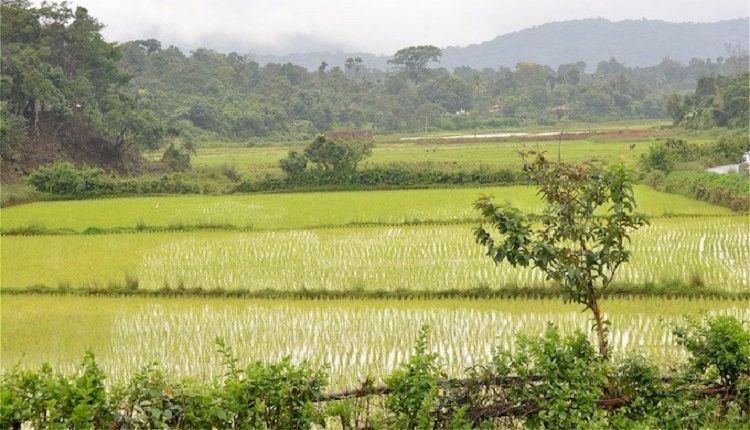
Rice paddies in Kodagu. (Photo by S Gopikrishna Warrier)

While Arabica coffee is self-pollinated, Robusta is cross-pollinated. “We researched the interaction between bees in the sacred groves and Robusta coffee to understand what the pollination impact is,” said C.G. Kushalappa, university head for forestry and environment sciences at the College of Forestry in Ponnampet. “Our research proved that in Robusta close to 31% of productivity could be increased if there is sufficient population of honeybees around the farm.”

This research, implemented by the College of Forestry under the Managing Trade-Offs in Coffee Agroforestry (MOCA) project in partnership with ETH University at Zurich, Switzerland, opened the possibility of increasing income for coffee farmers by integrating apiculture into coffee systems.

A premium for honey

“Kodagu honey has a premium in the market because it comes from the flowers of multiple species,” said R.N. Kencharaddi, assistant professor of agricultural entomology at the College of Forestry. “Honey collected from bee keeping in coffee agro-forestry system can get the premium price.”

The college introduced bee boxes in 40 farmers’ fields in 2015 at a density of four to five colonies (bee boxes) per acre, so that they can grow their own bees and produce honey. The team has been researching to select bee colonies that have the most desirable traits for propagation.

“We are looking for bees that do not abscond from their colonies and do not divide into new colonies before the hive is fully built,” said Kencharaddi. “We also check whether the bees are efficient at collecting honey and have disease resistance. Most important, we check on their ferocity, for we do not want the bees to attack the farmers.”

Apis cerana indica or the Indian honeybee is the species that the college is using for propagation. Though the college has not yet done any research on the subject, beehives have been successfully used in East Africa to protect farms from ravaging elephant herds. If this is experimented with and found successful then it could also serve as an additional benefit for Kodagu farmers, who are tired of elephant herds destroying their crops.

“There are elephant herds in Kodagu in which calves and young adults have not seen the forests,” explained M.C. Cushalappa, a coffee farmer from Siddhapura. “These herds have moved out of natural forests years ago and not returned since. They move from farms to villages, without returning to their natural habitat.”

The species of bees used in East Africa and that used in Kodagu are different, according to Kencharaddi. The specie of the African bees that scare elephants is Apis mellifera caucasica, which are more ferocious than their Indian counterparts. The African bees also come out during the night, whereas the ones that the college is working with are active only during daylight.

With bees feeding on the flowers of multiple trees to give premium quality honey, there would be a greater incentive for coffee farmers for protecting their landscape, according to Kushalappa. “This is how we are evolving into the concept of getting landscape labelling for produce from Kodagu’s coffee agro-forestry systems — coffee, honey, pepper and cardamom. Once we can get a brand presence for the Kodagu landscape, the farmers can market multiple produce. Depending on the prices the farmer can move the appropriate produce to the market.”

With the CEO of the Kodagu Zilla Panchayat committing to get elected representatives oriented to the concept of PES and landscape labelling, this method of promoting produce from Kodagu even while conserving the environment is likely to grow wings in near future. Honey with coffee could become the trigger for this.

(This piece was originally published on India Climate Dialogue and has been reproduced here with permission.)

source: http://www.thenewsminute.com / The News Minute / Home / by S. Gopikrishna Warrier / Monday -November 07th, 2016


Jwala Gutta-Ashwini Ponnappa part ways, pair says ‘time to look for a new beginning’

Jwala Gutta announced that she would be concentrating on mixed doubles while Ashwini Ponnappa will now partner N Sikki Reddy.

Jwalla Gutta and Ashwini Ponnappa first played together in 2010. (Source: Express Archive)

Jwalla Gutta and Ashwini Ponnappa have decided to part ways. The duo have been India’s most successful women’s double pair. Both have now decided to embark upon their own separate careers. While Jwala Gutta announced that she would be concentrating on mixed doubles, Ashwini Ponnappa has decided to partner N. Sikki Reddy.

Gutta said that she would stop appearing in women’s doubles and will partner Manu Attri while Ponnappa will be playing women’s doubles teaming up with N. Sikki Reddy. Gutta and Ponnappa played together for the first time in 2010. It was in the 2010 Commonwealth Games that they announced themselves where they the Gold medal in women’s doubles.

Ashwini Ponnapoa reportedly said, “Me and Jwala had a great partnership but it was time for us to look for a new beginning.

source: http://www.indianexpress.com / The Indian Express / Home> Express Sports / by Express Web Desk / November 08th, 2016

True South: Filter Coffee WIth A Twist

true-southkf01nov16

Are you a coffee lover who needs your cup of steaming, hot coffee as soon as you wake up? But the morning rush leaves you with just about enough time to grab a cup of instant coffee, and head out. There’s a solution to that. Meet true south and their life saving projuct, filter coffee in a pouch! Skeptical? We were too.

truesouth01kf01nov2016

SKIM

Being true coffee lovers, we headed over to try some of the coffee at true south, and we were very surprised. The coffee is strong, aromatic, and tastes like it was just brewed!

TRUE SOUTH: FOR EVERY COFFEE LOVER

True south is ready-made coffee decoction available in pouches. All you’ve got to do to enjoy a cup of fresh authentic tasting filter coffee is empty the contents of the pouch, add milk and sugar, and stir! Voila, your hot cuppa is ready in minutes.

The idea started when the folks at True South, who are coffee planters, wanted to make good coffee available easily. The coffee comes from Coorg and Chikmagalur, so it’s from some of the best coffee-growing regions in India. The decoction comes in two varieties: classic and royal, which vary slightly in the percentage of coffee and chicory they contain {the classic blend has 80 per cent coffee and 20 per cent chicory, while the royal variety has 75 per cent coffee and 25 per cent chicory}. They advise that you add one part decoction to five parts hot milk for a typical cup of filter coffee.

truesouth02kf01nov2016


WHERE CAN YOU GET YOUR HANDS ON SOME?

Whether you have no time to make decoction every morning, or are unable to find the perfect blend that works for you, True South coffee is the perfect solution. You can order the coffee pouches online, or pick them up from the store located on Richmond Road.

And the perfect part is that you can use them for 15 days after opened, or store them for upto five months!

Wake up and smell the coffee!

source: http://www.hungryforever.com / HungryForever.com / Home / by Aditi Sriprasad / October 31st, 2016

No more knocking, I need to break the door down, says Uthappa

Two days before Karnataka’s Ranji Trophy Group B tie against Assam, Robin Uthappa hopped over to Shivaji Park after training with his team and had a session with his personal coach Praveen Amre at the nursery of Mumbai’s batsmanship. No wonder then that the duo was seen involved in a long chat after Uthappa ended the day unbeaten on 108 to bail Karnataka out of trouble.

“I came back to Mumbai from Kolkata and I told sir, “I wasn’t getting my swing. My feel wasn’t that great”. We practised at Shivaji Park for two days and he was confident in two days I’ll get my feel back,” says Uthappa. “I actually got it back and feel really good. I just want to capitalise on what I have done today and make it a big one.”

After being unable to come good in Karnataka’s first two games of the season, Uthappa has finally gotten into run-scoring mode.

Ever since he burst on to the domestic scene as a 17-year-old, you like to keep watching him bat. Similarly, as he has evolved into a mature cricketer and an individual, you feel like listening to him every time he talks.

Despite being on the fringes and having made several returns to India’s squad, Uthappa hasn’t really been able to cement his place in the team. Having crossed 30, one cannot help but wonder if he has given up on wearing the India jersey. Ask him if he has started entering into the “enjoying the game” phase, and he interrupts you right away.

“Absolutely not,” he says. “I love the game, I enjoy it but my dream is still very strong and I still believe I’ll play for India.

“That’s what drives me. If that doesn’t drive me, then I certainly won’t be playing cricket. I wouldn’t take up the spot of a youngster.

“I’ll keep trying. I genuinely think age is just a number and I just think I need to keep stacking up the runs. No more knocking on the doors, I need to break it down in a big way.”

source: http://www.thehindu.com / The Hindu / Home> Sport / by Amol Karhadkar / Mumbai – October 29th, 2016

Kumar, Shetty and Anush take wins in AWD Challenge’s Coorg round

The Slush round of Indian AWD Challenge took place in Coorg district of Karnataka with competitors driving in the Jeep, Gypsy and Open classes.

Over 30 participants in the three categories competed on September 10-11 on the mountains of Vanachal Village in Madikeri, covering two stages of 7.5 km with steep climb and boulders.

After the first day of scrutiny and recce along with drivers briefing, the action kick started on Day 2 with Stage 1 in the muddy terrains having steep climb and sharp turns in the forest.

Everyone bar one driver made it to the post-lunch Stage 2, which started under rain making it all the more difficult with poor visibility.

The flat stretch in the grasslands allowed drivers to push to the maximum towards the finish line with Bharath Kumar (co-driver Mahesh) taking win with a total time of 6m25s in the Jeep class.

It was a close fight as Ajay Shetty (co-driver Ashwin Das) ended mere 0.04s behind, while Bopanna MP (co-driver Mithun Mandepanda) were third.

Meanwhile, in the Gypsy class, Shetty took the win covering a time of 6m03s, as Nithin (co-driver Nischal) and Sachin Moorthy (co-driver Kumar KD) ended just 0.01s of each other’s time in second and third respectively.

Finally, Anush (co-driver Navnit) were declared winners in the Open class, ending 0.13s ahead of Nanaiah (co-driver Karumbaiah), with Chethan (co-driver Jagat Nanjappa) third.

source: http://www.motorsport.com / Motorsport.com / Home> Offroad/ 4WD Challenge:Coorg / Race Report / September 29th, 2016

Madikeri: Women’s Dasara celebrated with enthusiasm in Gonikoppal

Madikeri :

“Society can develop only with clean thinking and fair-mindedness. Do not mix politics in Dasara celebrations. When I came during last Dasara celebrations, I was the president of Handicraft Corporation. I have come now as the president of the Parishat. The Almighty has bestowed high positions on me,” said member of vidhana parishat, Shantheyanda Veena Achaiah. She was speaking after inaugurating the third year’s women’s Dasara held in Mangala Vihara auditorium, Gonikoppal on Monday, October 10.

Meanwhile, member of the legislative council, Veena Achaiah, who is identified as the best women’s Dasara performer, felicitated the former grama panchayat president and president of the third year’s women’s Dasara , Kulletira Pravimonnappa.

Rekha Sridar and Sharina Sukumar sang the prayer song. Grama panchayat member, women’s Dasara treasurer Prabhavathi welcomed the gathering. Sheela Bopanna compered the programme and chief secretary M Manjula proposed the vote of thanks.

Gonikoppa, traditional attire, flower designing, mehendi competition, cooking without fire competition, group dances, janapada songs and pick and act competitions were held at the occasion.

Pravimonnappa, president of the programme, gave a keynote address.

Meals were served at the occasion.

source: http://www.daijiworld.com / DaijiWorld.com / Home> Karnataka / from Daijiworld Special Correspondent / Daijiworld Media Network – Madikeri (EP) / Madikeri – October 11th, 2016

A Pandi monium!

Sandalwood actress Meghna Appaiah shares a recipe of Pandi Curry, rustled up in the traditional Coorg flavour.

Meghna Appaiah
Meghna Appaiah

Pandi Curry
Ingredients
1 kg pork
1 tsp red chili powder
2 tsp turmeric powder
2 onions
5 to 6 green chilis
2 pods(18-20 cloves) garlic
About 8 cm long ginger
3 tsp cumin seeds
5 or 6 cloves whole
5 tsp coriander seeds
2 tsp black pepper balls
Salt to taste
1 cup (250 ml) Water
1 lemon (optional)
2 tsp black vinegar (Kachanpuli, prepared/available in stores).

Directions
Place the pork in a capacious bowl. Cut it to about 3 cm size and wash thoroughly. Now, drain the water completely. Set the pieces aside.
Add red chili powder, turmeric and salt. Mix well, until a thick paste is formed.
Now, prepare a mix by grinding onion, green chili, garlic, ginger, 1 tsp of cumin seeds, and 2 cloves to a coarse mixture. Do not add water.
Boil 1 cup of water in a thick bottomed vessel. Add the ground masala and continue boiling for a couple of minutes.
Add marinated pork and cook until tender. Ideally, this shouldn’t take more than 20 minutes.
In a griddle (bandli), roast together 2 tbsp cumin seeds, 5 tbsp coriander, 2 tbsp black pepper and cloves until a smokey fragrance wafts into the room.
Grind the roasted mixture to a very fine powder.
Add roasted and powdered mixture and black vinegar to the pork. Continue cooking on low flame until oil starts separating from the meat. Serve hot. You may additionally sprinkle some lemon juice for enhanced taste.

— as told to Pooja Prabhan

source: http://www.deccanchronicle.com / Deccan Chronicle / Home> Entertainment> Sandalwood / Deccan Chronicle / October 30th, 2016

Ranji Trophy: Uthappa, Nair script Karnataka’s dominance

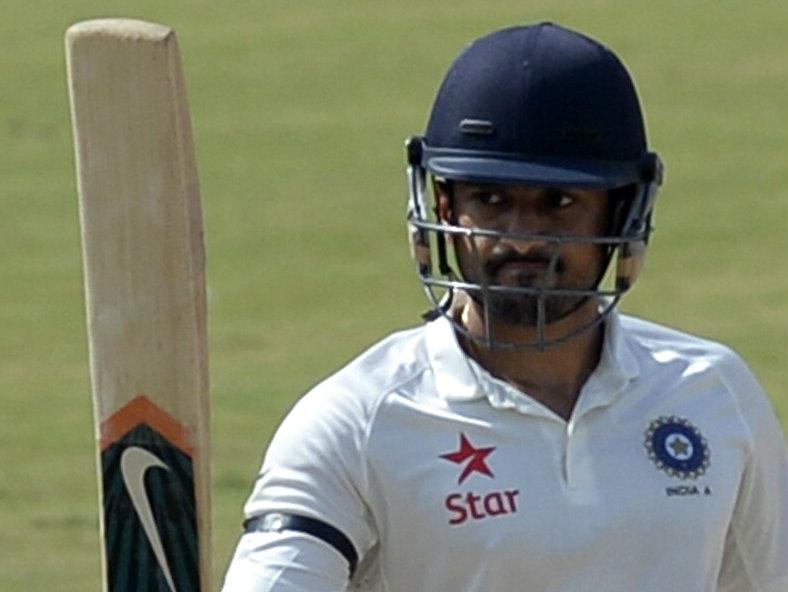
Karun Nair's strike rate was marginally higher than Robin Uthappa as the two ended the day having scored an unbeaten 108 each.  – B. JOTHI RAMALINGAM
Karun Nair’s strike rate was marginally higher than Robin Uthappa as the two ended the day having scored an unbeaten 108 each. – B. JOTHI RAMALINGAM

Assam’s first-innings century-maker Amit Verma seems to have passed the run-feast baton on to the Karnataka batsmen.

Seasoned Robin Uthappa and Karnataka’s stand-in captain Karun Nair made full use of the chances offered by the Assam fielders to pile on hundreds on Day Two in the Ranji Trophy Group B tie at the Mumbai Cricket Association’s Bandra-Kurla Complex facility. It helped Karnataka snatch the advantage in the contest.

Scorecard
At stumps, Karnataka – after restricting Assam to 325 in the morning with Verma running out of partners – was comfortably placed at 223 for two. If the unbeaten pair sees off the second new ball, due in 11 overs, on a wicket that still offers decent carry for pacers, then it would be interesting to see if Karnataka presses for an outright victory to mark the festivities.

The conditions were not at all threatening for Uthappa and Nair. But the situation in which they scored hundreds was remarkable. Pacerts Arup Das and Krishna Das had removed openers Mayank Agarwal and R. Samarth in the first three overs. Had wicket-keeper K. B. Arun Karthick latched on to a sharp chance down the leg side off the second ball Nair faced, Karnataka would have been three down with nothing much on the board.

But Nair survived, and thereafter, looked in little trouble. Uthappa played cautiously at the start but soon started playing his trademark drives. All four of his scoring strokes before lunch were boundaries, with a straight punch off Krishna Das the highlight among them.

On the first ball after lunch, Uthappa had a slice of luck. He nicked one from Abu Nechim Ahmed that pitched in the off-stump channel to Karthick, but the umpire consulted the television umpire to check if Ahmed had overstepped. The bowler didn’t have any part of his foot behind the crease. Uthappa, then, concentrated harder and preferred to go after the loose balls bowled by the spinners.

Nair survived another chance when he was dropped by Assam captain Gokul Sharma off leggie Amit Verma on 85, before he was outdone by Uthappa in the race for the hundred. While Uthappa steered Ahmed for his twelfth four to celebrate his 21st first-class century, Nair soon joined him in a similar fashion – a late cut off Verma that sped for a four.

source: http://www.sportstarlive.com / Sports Star Live.com / Home> Cricket / by Amol Karhadkar, Mumbai / October 28th, 2016

Crimson Cup Expands Friend2Farmer® Direct Trade Relationships with Peruvian Coffee Farmers

Columbus, Ohio coffee roaster Crimson Cup Coffee & Tea recently traveled into Peru’s Andes Mountains to expand relationships with coffee farmers. During the trip. licensed Q Grader Brandon Bir led judging for a coffee competition in the Junin region.

Columbus, Ohio :

Brandon Bir, coffee sourcing and education manager for Columbus coffee roaster Crimson Cup Coffee & Tea recently traveled into Peru’s Andes Mountains to expand relationships with coffee farmers, agronomists, and others dedicated to improving the quality of the country’s coffee. While there, the licensed coffee Q Grader led judging for a coffee competition in the Junín region.

Bir’s trip originated in Lima. While visiting the capital city, he shared samples of Crimson Cup’s Ethiopian Kossa Kebena and 1991 Blend coffees with local coffee houses and coffee cuppers.

“We had some great discussions about Peruvian coffees, Lima’s coffee culture and how things are evolving,” he said. “They have some well-put-together cafés, and everyone’s competing for exceptional coffees.”

“Local coffees are getting better every year, with better coffees scoring in the mid-80s on the 100-point coffee quality scale,” he added. “In the past, they were known for their chocolatey flavors but were not extremely nuanced.”

From Lima, Bir traveled into the Andes Mountain jungle to La Merced, a town in the Junín region. There, he visited with Don Julio Arevalo Tello, founder of private co-op NARSA (NEGOCIACIONES AGROINDUSTRIAL AREVALO S.A.) Since 1988, NARSA has focused on helping small coffee and cacao farmers in Peru’s Central Highlands and Amazon regions with achieving market access throughout Peru and beyond.

“NARSA has been instrumental in coffee development in the Junín region,” Bir said. “We’ve been extremely impressed with the way they live their principles of integrity, eco-efficiency and transparency and their focus on inclusion of indigenous families.”

For the next four days, he visited local coffee farms and prepared for the upcoming coffee competition sponsored by NARSA. “The competition is just one of the ways NARSA is involved in improving local coffee quality,” he said.

One of the farms he stayed at was Finca Santa Rosa near the small town of Villa Rica. This farm is owned by third-generation grower Selena Contreras Obregon. Established by Contreras’ grandfather in 1927, the 104-acre, Rain Forrest Alliance-certified farm grows catuai, caturra, bourbon, typica and geisha varietals under a canopy of indigenous trees at an elevation of 1,600 meters.

“This is the third year we’ve visited Selena, her family and her farm,” Bir said. “They continue to impress us with their passion for quality coffee and dedication to progress in every aspect of operations. Over this past year, Selena’s coffee professionals created a new coffee lab to evaluate coffee quality.”

On his final day at NARSA, he coordinated a quality competition among more than 25 local coffee farmers. In addition to friendly competition, a goal was to help farmers understand the qualities that are more prized in coffee beans and that command a higher price. Bir and three other Q Graders cupped coffee samples from morning until the competition ended at 10 p.m.

“Our winner was an 89-point coffee from Damien Conde in Alto Palomar,” Bir said. It stood out from the typical coffees of the region with its flavor profile more similar to that of a high grown Kenyan coffee.”

Crimson Cup will evaluate the purchase of coffee from this crop through its Friend2Farmer direct trade program in the future. The roaster developed its Friend2Farmer direct trade program to ensure that farmers receive a fairer share of proceeds from coffee sales. The company pays a premium to farmers, who can then invest in agricultural and community improvements. Crimson Cup coffee experts also collaborate with farmers on ways to improve the quality of the coffee and quality of live for farmers, workers and their communities. In addition, the roaster invests in projects such as solar dryers to help improve coffee quality.

About Crimson Cup Coffee & Tea

Since 1991, Crimson Cup Coffee & Tea has hand-roasted specialty coffee in Columbus, Ohio and taught independent business owners to succeed through its coffee shop franchise alternative program. Sustainably sourced Crimson Cup coffee is available through a network of more than 350 independent coffee houses, grocers, college and universities, restaurants and food service operations across 28 states, as well as the company’s own Crimson Cup Coffee House in the Columbus suburb of Clintonville.

For more information, visit crimsoncup.com.

For the original version on PRWeb visit: http://www.prweb.com/releases/2016/10/prweb13805703.htm

source: http://www.benzinga.com / Benzinga / Home> PR Web – Columbus, Ohio / October 28th, 2016

Madikeri : Rs 125 crores for development of Catholic community – MLA Lobo

Madikeri :

“An amount of Rs 125 crores is set aside for the development of Catholic communities, and they must make the best use of it, ” said Vidhana Mandala Backward Class and Minorities’ Committee president, MLA J R Lobo.

He was speaking during a discussion held with the Catholic community leaders, at St Michael School in the city, on Thursday, October 27.

“The government has announced several programmes for the development of society and a special grant in the budget. The amount of Rs 125 crores can be used for several pro community programmes,” he said.

“The government has created Catholic Development Committee for community development. It has appointed Bengaluru urban development minister K J George as the president and me as the vice president of the committee. It has also formed a subcommittee and appointed me as its president. Petitions for renovation or repairs of churches, cemetery, boundary wall, skills training and other development work in the community can be submitted,” he said.

“Christians comprise 3.6% of the population in the state. The government has given special importance to their development, but the community lags behind in making use of government released funds,” MLA Lobo said.

“Special camps should be held in various districts to make information on government programmes reach the people. Fund up to Rs one crore in the city and Rs 50 lac in towns is being provided for community halls. An amount is also paid for maintenance of old age homes,” he said.

Community representative, K T Baby Mathew, requested for additional funds for repairs of churches, and donations to poor people and for the district level committee, like in the state. Requests for reservation for Catholics could also be heard in the meeting.

K E Mathew said, extensive details of the government facilities such as scholarships, caste certificates, etc are required.

Committee assistant secretary Amba, additional deputy commissioner M Sathish Kumar, zilla panchayat assistant secretary Vishwanatha Poojary, assistant director of the department of public instruction G R Basavaraju, backward class and minority welfare department district officer K V Suresh, minority development corporation manager Nagendra Prasad, district employment exchange officer C Jagannath Virajpete, St Anns school’s Fr Muthuswamy, and others were present.

source: http://www.daijiworld.com / DaijiWorld.com / Home> Karnataka / by DaijiWorld Media Network – Madikeri (EP) / Madikeri – October 28th, 2016