Parliamentary delegation visits spices research station in Kodagu

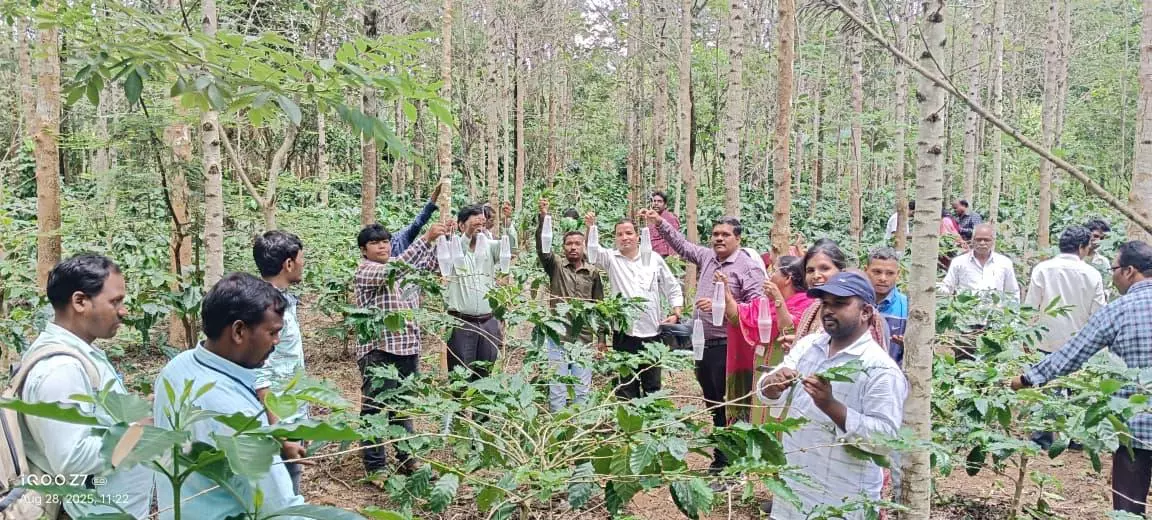
The Parliamentary Standing Committee on Agriculture, Animal Husbandry, and Food Processing, headed by Charanjit Singh Channi, a member of the Lok Sabha, visited the ICAR-Indian Institute of Spices Research (IISR), Regional Station, at Appangala in Kodagu on Friday.

The delegation comprised 12 members of the Lok Sabha, four members of the Rajya Sabha, and officials from the Lok Sabha Secretariat. During the visit, the institute organised an exhibition highlighting the latest varieties and technologies in spice cultivation developed by the ICAR-IISR. Mr. Channi, the chairman of the committee, inaugurated the exhibition.

A meeting was convened, where R. Dinesh, Director of ICAR-IISR, Kozhikode, presented a comprehensive overview of the activities and achievements of the institute.

The committee had discussions with the scientists and officials from the ICAR-IISR. Officials present at the event included Sudhakar Pandey, ADG (FVS&MP), ICAR, New Delhi, S.J. Ankegowda, principal scientist and head, ICAR-IISR, Regional Station, Appangala, and senior officials and staff from the ICAR-IISR and its regional station.

The event also featured an insightful interaction with Prema Ganesh, a progressive farmer from Maragodu, who shared her experiences regarding spice farming in Kodagu.

source: http://www.thehindu.com / The Hindu / Home> News> India> Karnataka / by The Hindu Bureau / May 24th, 2025

Deepa Bhasthi felicitated in Madikeri

Writer Deepa Bhasthi, whose English translation of Banu Mushtaq’s Kannada work Edeya Hanate (Heart Lamp) won the prestigious International Booker Prize 2025, was felicitated in Madikeri by her alma mater and local leaders on Saturday.

The Old Students’ Association of Field Marshal K.M. Cariappa College, where Ms. Bhasthi pursued her education, college principal, lecturers, and office-bearers of the association visited her residence to honour her remarkable literary achievement.

B. Raghav, principal of the college, extolled Ms. Bhasthi for her literary accomplishment and noted that the international recognition has brought immense pride to the institution.

“The achievement of one of our old students was a matter of pride for the college,” he added.

The association president B.B. Aiyappa highlighted the difficulty of translating regional literature without losing its emotional depth, commending Ms. Bhasthi’s masterful rendering that resonated with a global audience.

MLA for Madikeri Mantar Gowda also felicitated Ms. Bhasthi at her home on Saturday. Commending her contribution to literature, he said her accomplishment had placed Kodagu on the global literary map. He said the government would support her future literary initiatives and described her as an inspiration for students and young writers.

Mr. Gowda also remarked that it was heartening to see literature of such calibre emerge from the serene surroundings of Kodagu. Plans are under way to organise interactions between Ms. Bhasthi and students from local institutions to foster interest in literature and translation, he added.

Ms. Bhasthi said the translation took nearly three years of dedicated work and she is now preparing for literary engagements in London and other cities. Ms. Bhasthi’s husband Chettira Nanaiah, her parents Prakash and Sudha Bhasthi, were among those present.

source: http://www.thehindu.com / The Hindu / Home> News> India> Karnataka / by The Hindu Bureau / May 31st, 2025

This Kodagu girl aims to create badminton history

Shuttle badminton has emerged as one of the fastest-growing sports in the country, with a growing number of young players taking it up professionally. What began as a recreational pastime among British expatriates in the 1860s has steadily evolved into a mainstream sport embraced by the younger generation. Pioneers like Prakash Padukone, the first Indian to win the All England Badminton Championship in 1980, played a key role in bringing national recognition to the sport. He was followed by Pullela Gopichand, who also won the prestigious All England title, Olympic medallists like Saina Nehwal — India’s first Olympic badminton medal winner — and P.V. Sindhu, a double Olympic medallist and BWF World Champion, who helped place India firmly on the global badminton map.

Kodagu, a region renowned for producing hockey legends, has also made its mark in badminton through players like Ashwini Ponnappa, who has won multiple medals in international competitions. Now joining the list of Kodagu’s badminton achievers is 17-year-old Boppanda Diya Bheemaiah.

Coming from a family of sports people, Diya has made significant strides in national and international badminton. She was part of the Indian women’s team that participated in the Asian U-17 Badminton Championship held in Chengdu, China, last year, where she competed in the doubles event.

Her achievements include: Bronze in singles and silver in doubles at the Nepal Junior International Series held in Tripureswar in December 2024; Silver in singles and bronze in mixed doubles at the 36th Sub-Junior Badminton Tournament held in Tamil Nadu in 2024; and Winner of the U-19 All India Krishna Khaitan Badminton Tournament – 2024, held in Panchkula, Haryana, among other accolades.

A II PUC student at Vidyaashram College in Mysuru, Diya trains under coach Arun Pemmaiah at Sports Park, Mysuru. Her father, Boppanda B. Bheemaiah, is also a badminton coach, while her mother, K.K. Kusuma (Kambiranda), a former international athlete, now works as a fitness coach. Diya’s younger brother, B.B. Vishal Uthappa, is also a budding badminton player.

Star of Mysore caught up with Diya Bheemaiah for an interview as she prepares for the upcoming National Junior Championship to be held in Bengaluru. Following this, she will head to Guwahati, Assam, to train at the National Centre of Excellence — a facility where only a select few players are offered the opportunity to train. Excerpts…

Star of Mysore (SOM): What inspired you to take up badminton?

Diya Bheemaiah: I used to watch my father play when I was a kid. Initially, I picked it up just for fun, but I gradually developed a deep interest in the sport. I’ve been playing professionally for the past eight years now.

SOM: Why did you shift your base  from Madikeri in Kodagu to Mysuru?

Diya Bheemaiah: It was purely for badminton. I moved here when I was in the 6th standard and stayed in a PG accommodation. After the COVID-19 pandemic, my family shifted to Mysuru. It had become difficult to practice in Madikeri, my hometown, especially during the rainy season when we could barely step out of the house. That’s when we decided to move to Mysuru permanently.

SOM: Can you tell us about your daily routine and diet?

Diya Bheemaiah: I wake up around 5 am and attend my fitness session from 5.45 am to 7.15 am. After a short break, I have my on-court session from 9.30 am to 12 noon, where I focus on strokes and technique. Then there’s a lunch break, followed by another session from 1.30 pm. After that, I take a two-hour break before heading to the gym from 6 pm to 7.15 pm. That’s my daily routine for now.

As for my diet, my mother is particular about it. She prepares nutritious meals every day. Of course, to achieve anything great in sports, you have to sacrifice your cravings. It’s been a couple of years since I’ve had ice cream and junk food is completely off my list.

SOM: How have your parents supported you in your badminton endeavours?

Diya Bheemaiah: They’ve been extremely supportive. My mother takes care of my diet and fitness, while my father helps me improve my game. One of them always accompanies me during tournaments to ensure I stay focused and eat healthy.

SOM: You play in all three categories — singles, doubles & mixed doubles. How do you manage different techniques and mindsets required?

Diya Bheemaiah: In singles, the player is solely responsible for his/her performance and has to give the best. In doubles, it’s all about trust and coordination with your partner. When things aren’t going well, it’s also about encouraging each other and making a strong comeback together.

SOM: Badminton is an expensive sport. How have you been managing?

Diya Bheemaiah: Right now, my parents and coaches are supporting me financially. But there is a need for sponsorship. Even though many of us perform well, we often don’t receive any sponsorship. Players end up spending from their own pockets for racquets, training and travel. The State Government has not been very supportive either. The Karnataka Badminton Association only covers our travel and stay during the national championships. I feel that society should come forward and support sportspersons who are consistently performing.

Diya Bheemaiah seen with her father Boppanda B. Bheemaiah, mother K.K. Kusuma and younger brother B.B. Vishal Uthappa.

SOM: Being a Science student, how are you managing your studies along with badminton?

Diya Bheemaiah: Thankfully, my college has been supportive. They not only consider my attendance but also send me daily online class recordings, which help me stay updated academically. Besides, my teachers are always available. I can call them anytime to clarify my doubts.

SOM: Your plans after II PUC?

Diya Bheemaiah: Professional badminton will always be my priority. However, I also intend to specialise in Sports Psychology. But for now, my focus is on badminton and completing my II PUC with good marks. As for my dream — I aspire to become the World No. 1 and make history by winning three Olympic medals for the country.

source: http://www.starofmysore.com / Star of Mysore / Home> Feature Articles / by S N Venkatanag Sobers / May 31st, 2025

Alumni of a government school in Kodagu reunite to renovate the age-old institution

Funds adding to over Rs 10 lakh are being collected to enable the renovation and revival process of the school building.

The institution did not even record a centenary celebration due to financial issues. However, the alumni of the institution became active recently and are now involved in the revival process of the institution.

Madikeri :

As several government schools are struggling to see the light of the day due to non-maintenance, an alumni association of a government school in Kodagu is striving towards renovating the institution.

Funds adding to over Rs 10 lakh are being collected to enable the renovation and revival process of the school building.

The Suntikoppa Government Primary School, established 108 years ago, has educated lakhs of students. The institution was expanded with high school education 44 years ago. However, the lack of funds for development works had remained a challenge.

The institution did not even record a centenary celebration due to financial issues. However, the alumni of the institution became active recently and are now involved in the revival process of the institution.

Recently, a group of alumni organised a reunion event as a Guru Vandhana programme, which witnessed participation from the former teaching staff.

The Alumni Association was launched as plans took shape to renovate the school building, which is in a vulnerable condition.

Funds adding up to Rs 10 lakh were collected by the alumni association. The school classrooms are being renovated and upgraded even as the alumni will initiate plans to increase admissions to the institution.

Key alumni members KH Sharif, Harish, Anil Kumar, C Mahendra, Razak, Abdul Aziz, Arun Kumar, Dhanu Kaverappa, Vincent, Shashikumar, and Kamalahasan, alongside local donors from Suntikoppa and neighbouring areas, have committed themselves to elevating the school’s standards to match private institutions.

The alumni association has members from all walks of life, some who have reached reputable posts following their primary education at the institution. “We cannot be more grateful to the alumni for taking up the renovation project,” shared Geetha, headmistress of the government school.

“This renovation represents our modest contribution to the institution that shaped our lives. Some of our alumni have become High Court judges, and under their guidance, along with support from other alumni, we are undertaking this renovation. We are ensuring minimal disruption to current students’ education,” shared RH Sharif, the VP of the alumni association.

source: http://www.newindianexpress.com / The New Indian Express / Home> Karnataka / by Express News Service / June 04th, 2025

Kodagu rains: Over 1,400 electricity poles damaged; restoration work on

To speed up the restoration of the electricity network, the Madikeri division of the CESC has deployed 231 personnel. | Photo Credit: Special arrangement

Relentless rain and strong winds have impaired the power infrastructure in Kodagu, damaging a total of 1,442 electricity poles, 11 transformers, and 13.105 km of power lines.

Despite the current adverse weather, power supply restoration efforts are under way. The authorities of Chamundeshwari Electricity Supply Corporation (CESC) have so far replaced or repaired 1,091 poles and nine transformers. On average, about 100 poles are being replaced every day. However, the continuous downpour and gusty winds are hampering progress and causing further damage, a release issued by Executive Engineer (Operations and Maintenance Division), CESC, M. Ramachandra said.

To speed up the restoration of the electricity network, the Madikeri division of the CESC has deployed 231 personnel. In addition, 52 staff members have been brought in from other divisions, along with 75 outsourced workers and 124 contract staff — all equipped with tools and equipment. The teams are working on a warfooting to restore normalcy, the release added.

Officials have acknowledged that the past 10 days of incessant rain have slowed down repair work and caused repeated disruptions to the power supply. Therefore, they have urged the public to cooperate as the restoration work is in progress in the district.

Field officers and technical staff remain engaged in power restoration efforts. Because of the workload, section officers may not be able to respond to customer calls promptly. Instead, the authorities have set up a dedicated toll-free helpline for the Madikeri division to handle consumer complaints. Consumers can report power-related issues by calling the toll-free number: 1800-599-0061.

The executive engineer has assured the public that every effort is being made to restore power supply at the earliest.

source: http://www.thehindu.com / The Hindu / Home> News> India> Karnataka / by The Hindu Bureau / June 03rd, 2025

Three from Kodagu commissioned as Sub Lieutenants in Indian Navy

Mysuru:

Kodagu, a region renowned for its extraordinary contribution to the Indian Armed Forces, has added another proud chapter to its legacy as three of its youth have been commissioned as Sub Lieutenants in the Indian Navy.

Kadiyamada Rea Achaiah

Sub Lieutenant Kadiyamada Rea Achaiah, a Mysuru-based native of Kodagu, has been commissioned into the Indian Navy and is currently serving aboard INS Sujata, a frontline patrol vessel.

Rea, an alumna of Vidyavardhaka College of Engineering (VVCE), Mysuru, completed her degree in Information Science. Inspired by a long-standing dream to serve the Armed Forces, she cleared the Services Selection Board (SSB) exams and joined the Indian Naval Academy at Payyannur, Kerala, on July 1, 2024. She was formally commissioned on May 31, 2025.

Rea had the distinction of being selected for both the Indian Army and the Indian Navy, ultimately choosing the latter. A multi-talented achiever, she is a former international Roller Speed Skater and has represented India in three World and Asian Championships.

She made history by becoming the first Indian female skater to win an individual medal in an international competition, claiming two bronze medals at the 18th Asian Championship in South Korea (2018). She has a medal tally of 155 golds, 28 silvers and 11 bronzes across various competitions.

Apart from roller skating, Rea is also a national-level ice skater and sailor. She recently won gold in the Indian Navy Laser Sailing Championship held at Karwar and secured gold and bronze medals in the Biangular Sailing Regatta at the Indian Naval Academy.  She is the daughter of Kadiyamada Arun Achaiah and Priya Achaiah of Athur village, Gonikoppal and residents of Vijayanagar 1st Stage, Mysuru.

Chiriapanda Atul Somayya

Sub Lieutenant Chiriapanda Atul Somayya, son of Lt. Col. (Retd.) Chiriapanda Vivek Muthanna and Asha, hails from Kanoor, Kodagu.

An alumnus of PES Institute of Technology, Bengaluru, where he earned a degree in Civil Engineering with distinction, Atul was inspired from an early age to join the Armed Forces. He was commissioned into the Indian Navy on May 31, 2025.

Areyada Chaman Poovana

Sub Lieutenant Areyada Chaman Poovana, son of Areyada Kiran Ganapathy and Beena, has also been commissioned into Indian Navy on May 31, 2025.

His achievement marks a proud milestone for his family and community and highlights the continued tradition of military service in Kodagu. Known for his dedication and discipline, Chaman looks ahead to a promising career in naval service.

source: http://www.starofmysore.com / Star of Mysore / Home> News / June 03rd, 2025

Kodava Samaja Youth Wing Mysuru to host Kodava Hockey Premier League 2025

10 Teams. 3 Days. 1 Legacy

Mysuru:

In a celebration of heritage, athleticism and community spirit, the Kodava Samaja Youth Wing Mysuru (KSYWM) is set to host the Kodava Hockey Premier League (KHPL 2025) in association with Kodava Samaja Mysuru and under the aegis of Hockey Mysuru. The much-anticipated tournament will take place on June 27, 28 and 29 at the Chamundi Vihar Stadium, Mysuru.

KHPL 2025 will feature ten dynamic franchises — Coorg United, Kodavu Warriors, Pale Taluk, South Side Rangers, Team Kodava Tribe, Connecting Kodavas, Anjigeri Naad, Coorg Titans, Kakot Strikers and MTB Royals — who will compete in what promises to be three days of thrilling hockey action.

The grand player auction is scheduled for June 1 at ibis Styles Mysuru, the official hospitality partner for   KHPL 2025.

Office-bearers and Working Committee Members of Kodava Samaja Youth Wing Mysuru — President: Kotera Vedith Uthaiah, Vice-President: Pebbatira Dimple Danny, Secretary: Battira Bojanna, Joint Secretary: Appaneravanda Viharika Mandappa, Treasurer: Hanchettira Varun Nanjappa, Joint Treasurer: Kademada Shreyas Muthanna — seen during the KHPL 2025 logo launch.

Lending prestige and vision to the league is a distinguished panel of advisors including Anjaparvanda B. Subbaiah, Honorary Secretary of Hockey Karnataka and former Olympian; Konganda Dilip Biddappa, President of Hockey Mysore; Pandanda Bopanna, President of Kodava Hockey Academy and Kotera Muddaiah, Vice-President of Hockey Mysore. Mentoring the young talents are two accomplished hockey personalities — Bolliyapanda J. Cariappa, Coach of Indian Junior Hockey Team, and Karineravanda Somanna, a former Indian hockey player.

In a historic first for Kodava hockey, KHPL 2025 mandates each team to include one female player and two emerging players under 18. This progressive step brings gender inclusivity and youth empowerment to the forefront, ensuring 10 women and 20 young talents shine on the Kodava hockey stage.

For details, contact KSYWM

President Kotera Vedith Uthaiah on Mob: 88804-01206.

source: http://www.starofmysore.com / Star of Mysore / Home> Sports / May31st, 2025

The forest feeds a taste of Kodagu

Sunday mid-day explores the diverse, ancestral culinary traditions of the Kodava community, deeply rooted in Coorg’s forests, fields, and culture

Balekkai Kootu, Anabe Barthad, Tarkari Gasi, Ney Choru, Koli Saaru, Semiya Payasam, Neer More, Coorgi Mutton Curry, Hagalakayi Palya and Soppu Charu

At 7 AM, we set out on a walk through Makkandur Forest in Madikeri, Coorg. Mist-covered hills and sprawling coffee plantations framed our path, with the gentle songs of birds accompanying us on this immersive journey into the rich biodiversity of the Western Ghats — a UNESCO World Heritage Site. Makkandur is home to rare trees and bird species, offering sweeping views of Coorg’s countryside dotted with tropical evergreens, wild ferns, and medicinal plants. The region is home to hundreds of unique species, including over 350 types of birds, reptiles, insects, and amphibians. Among them are vividly coloured cobras and vipers, striking turquoise butterflies, and palm-sized crimson snails with gleaming black shells. Larger inhabitants include elephants, bison, barking deer, wild boar, and the rare, elusive tiger. Along the trail, black pepper — though cultivated — thrives naturally in the forest’s microclimate alongside cardamom and vanilla vines, which are occasionally found growing wild. Tree trunks, often cloaked in moss, lichens, and ferns during the monsoon, host blooming epiphytic orchids clinging to misty branches. This is Kodagu’s wilder side: untamed, meditative, and deeply intertwined with nature — a place where you can still hear the forest breathe.

Here, we plucked four avocados hanging from the tree.

Our guide, Naturalist Abilash Puliyeri Ravi at Coorg Marriott Resort and Spa, recalls growing up with avocado—what locals call a butter fruit—mashed with jaggery or sugar, and sometimes a splash of milk, for a quick snack or breakfast. While not part of traditional Kodava cuisine, avocados are finding their way into modern Coorg kitchens, adding a creamy richness to salads, smoothies, and chutneys. The fruit thrives in Coorg’s cool climate and well-drained soils, often grown in homestead gardens or intercropped with coffee and pepper. Although not native, it has been cultivated here for decades and is now gaining commercial traction. The ICAR-developed ‘Arka Coorg Ravi’ variety, prized for its high yield and pulp recovery, is leading this shift. Westfalia, an avocado-focused agricultural company, also operates a nursery in Coorg, supplying premium cultivars such as Hass. Butter fruit has a thin green skin and a larger pit. It also does not ripen consistently and tastes less sweet. The Hass has more flesh, a longer shelf life, is creamier and sweeter, and has a dark, black exterior. These also have a fat content of around 12 per cent, making them tastier. Initially, Westfalia attempted to cultivate the indigenous variety, but it proved unsuitable for long-distance transportation and exports. Hence, they decided to go with Hass. With rising urban demand and a growing market, Coorg is quietly becoming an emerging hub for avocado cultivation. 

While pandi curry is Coorg’s most iconic dish, Kodava cuisine is far more diverse — deeply rooted in seasonal produce, forest foraging, and ancestral traditions that reflect the community’s bond with the land Abhilash also shared how oranges in Coorg — locally known as Coorg mandarins — were once as iconic to the region as coffee and pepper. These small, juicy, and sweet citrus fruits flourished in the region’s cool, hilly climate and well-drained soils. Traditionally grown alongside coffee in shade-grown plantations, they added biodiversity and provided farmers with a valuable secondary income. However, since the early 2000s, orange production in Coorg has declined sharply due to the widespread occurrence of fungal diseases such as citrus dieback and greening, poor replanting practices, shifting weather patterns, and depleted soil fertility. Today, revival efforts are underway, led by the Indian Institute of Horticultural Research (IIHR) and the Kodagu Orange Growers’ Associations, which are introducing disease-resistant varieties and training farmers in improved orchard management.

While pandi curry is Coorg’s most iconic dish, Kodava cuisine is far more diverse — deeply rooted in seasonal produce, forest foraging, and ancestral traditions that reflect the community’s bond with the land

That night, we enjoyed a hearty meal of Kodava cuisine at the Madikeri Kitchen at the hotel, minus the iconic pandi curry, prepared by the hotel’s Executive Chef Anirudh Deshpande. It gave us an insight into the cuisine’s nuanced culinary tradition shaped by the forests, fields, and festivals of Coorg. Seasonal ingredients like Balekkai Kootu (raw banana with dal),  Anabe Barthad (wild mushroom with fennel, crushed black pepper),  Tarkari Gasi (mixed veg with coconut, coriander seed, jeera and tamarind), Hagalakayi Palya (bitter gourd with mustard seed, onion and grated coconut), Coorgi Mutton Curry, Koli Saaru (chicken with roasted coconut, fennel and local spices) reflect the community’s deep connection to the land. The Soppu Charu was our favourite, so was the Mango Curry—both had distinct flavours, laced with simplicity.

Spices are minimal but meaningful—pepper, bird’s eye chilli and kachampuli (a tart vinegar made from brindle berry fruit) give Kodava food its distinctive, tangy kick. Chef Deshpande believes it’s not just about what’s on the plate—it’s about preserving identity, seasonality, and storytelling through food.

Bella Coffee

We found it interesting that a passion fruit drink is also a part of the thali. Locally known as passimara juice, it’s made from passion fruit puree and is lightly  spiced with a hint of salt or green chilli­—perfect for sipping between the rich, spicy flavours of the meal. Passion fruit has gained popularity in Coorg over the past couple of decades, driven by growing interest in exotic fruits. A tropical climate, ample rainfall and fertile red soil make Coorg ideal for this climbing vine to flourish. It’s mostly grown on trellises, often as a companion crop alongside coffee or on field margins. Over the years, passion fruit farming has been expanding, supported by agri-entrepreneurs and local processing units.

Steamed matta rice cakes, cooked with milk and coconut, are often paired with spiced curries — a comforting taste of traditional Coorg

The next evening, during bonfire storytelling sessions organised by the hotel, we learnt about the Kodava community and the deep yet complex bond with the elephants. Traditionally, forest dwellers, agriculturists, and the Kodavas revered elephants as symbols of strength, often featuring them in local lore and rituals. But as forests shrink and farms expand, wild elephants increasingly raid coffee estates and fruit crops, turning sacred animals into a threat to livelihoods. The following day, we crossed the Cauvery on foot—a memorable experience, especially during the dry season when the river’s water level recedes enough to expose shallow stretches and natural stepping stones to reach Dubare Elephant Reserve. Feeding tamed wild elephants in a serene setting was a simple, almost meditative act. Coming back to the elegantly furnished villa, we sipped on coffee, taking in the breathtaking views of the surrounding lands before heading for a relaxing therapy at the hotel’s Quan Spa.

Homemade fruit wines are crafted from local produce

Coorg’s coffee plantations flourish in its cool climate, generous rainfall, and fertile soil, producing shade-grown Arabica and Robusta beans prized for their rich aroma and complex flavours. Often intercropped with spices such as pepper and cardamom, these plantations blend traditional and sustainable farming practices, making Coorg one of India’s most renowned coffee-growing regions since 1854.

Dubare Elephant Reserve in Coorg is a forest camp where visitors can observe, feed, and learn about elephants, many of whom were once part of Karnataka’s logging and festival processions

The Riverside Coffee Estate, founded in 1898, stands true to this heritage. Nestled in a vibrant ecosystem, it combines ecological balance with century-old cultivation methods. Beyond farming, Riverside offers immersive tours and homestays that invite visitors to experience the heart of Coorg’s coffee culture firsthand.

Founder Rishwin Devaya champions the belief that no two Coorg coffees are alike. The Coffees of Coorg project partners with eight planters across varied altitudes and farming styles to showcase eight unique coffees—each telling its own story.  He has brought together Nadikeriyanda Vikram Appaiah (Karadigod Estate, Siddapur), Palecanda Anita Aiyanna and Vishal Ponnappa (Devi Villa Estate, Kutta), Paruvangada Chirag Bopaiah and Poonacha (Akankshe Estate), Ashish Rao (Skia Coffee, Nelaji), Codanda Adip Bopaiah (Sree Ram Estate, Thora), Bolacaranda Uma and Dr. Kariappa (Karkukaad Estate), Priamvada Gajaraj (Abeos Estate, Kadagadal)  and Appanervanda Anita Nanda and Muddu (Surya Kiran Estate, Hattihole) to retail through his platform for special edition batches. “Over the last few years, we at Riverside have set up facilities to market and sell our coffees directly to consumers. Now, we want to use our platform to empower planters from the region to get their coffee directly to the consumers. More than a product line, it’s a tribute to the planters whose innovations and dedication elevate Coorg coffee into an unforgettable experience,” says Devaya.

An interesting addiction we acquired from the hotel is the Bella kapi, a traditional Coorg coffee made with jaggery (bella), often enjoyed with breakfast dishes like akki rotis and ellu pajji. The coffee is typically brewed with a strong, dark-roasted coffee powder. Cardamom and crushed ginger are added for additional flavour, and jaggery, instead of sugar, contributes to its distinctive flavour. 

The simplicity of the region grows on you. Once a favourite of colonial administrators, Coorg or Kodagu, takes its name from the indigenous Kodava people. It is also called the ‘Scotland of India,’ as the region’s misty hills, lush valleys, dense forests, and cool climate evoke a landscape reminiscent of the Scottish Highlands but Coorg also carries the fragrance of its plantations. We returned with scents of the land, with the aromas of fresh green pepper, cardamom pods, and vanilla still lingering in our suitcases.

Momos are a local favourite

Tibetans of Coorg and their influence on the Kodava cuisine

In 1959, following the Chinese invasion of Tibet, the Indian government resettled thousands of Tibetan refugees in Coorg, primarily in Bylakuppe — one of the largest Tibetan settlements in India. Though culturally distinct, the Tibetan and Kodava communities have coexisted peacefully for decades, contributing to the region’s rich cultural mosaic. The influence of Tibetan cuisine on traditional Kodava food has been subtle yet noticeable, with Tibetan dishes such as momos, thukpa (noodle soup), and tingmo (steamed bread) now commonly found in local markets and food stalls. The coexistence reflects more of a culinary coexistence than a blending — two parallel food cultures thriving in the same geographical area. In fact, in Coorg, the harmonious coexistence of different faiths is beautifully symbolised in a rare sight: a church, temple, and mosque situated adjacent to one another in the town of Virajpet. While the Kodavas themselves are primarily ancestor worshippers and follow their own indigenous practices, the region as a whole has long embraced a multi-religious identity without conflict.

Origins of the clan
Although the origin of the Kodavas in Karnataka remains a mystery, researchers believe they are the descendants of pre-Islamic Kurds, originating from the present-day Turkey, Iran, and Iraq region.

1854
Commercial coffee growing began in Coorg. Now, Arabica and Robusta are grown here

350
Types of birds, reptiles, insects and amphibians are found in the forests of Coorg

1959
When the Indian government resettled thousands of Tibetan refugees in Coorg

source: http://www.mid-day.com / Mid-Day / Home> Sunday Mid-Day News / by Nasrin Modak Siddiqui / June 01st, 2025

Rain, gusty winds continue to batter Kodagu, coast

And there is no respite from inclement weather as the IMD has forecast heavy showers for next two days and sounded red alert for three coastal districts and as many Malnad districts.

Scores of visitors flock to Abbey Falls in Kodagu district following heavy rain. Credit: Dh photo

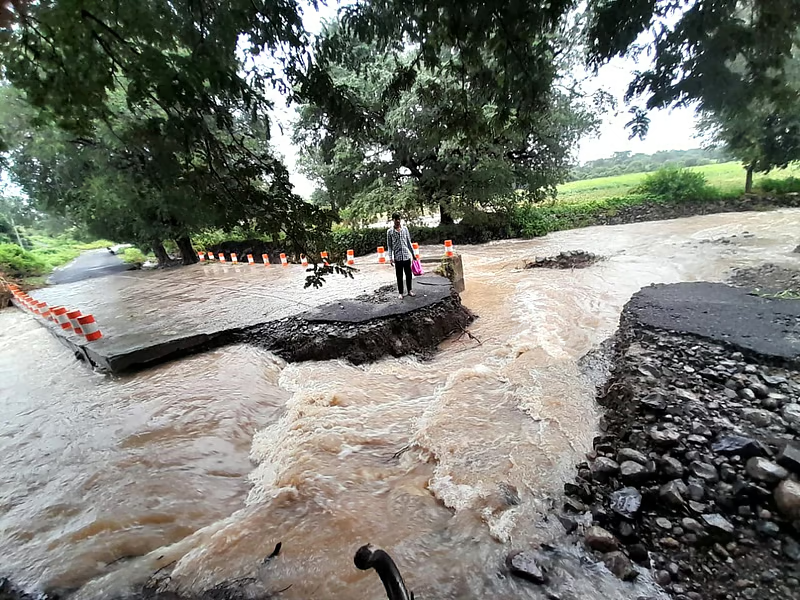
Heavy rain continued unabated, damaging houses, roads and power infrastructure and triggering flash floods in  coastal districts and Malnad region.

And there is no respite from inclement weather as the IMD has forecast heavy showers for next two days and sounded red alert for three coastal districts and as many Malnad districts.

Two people died in rain-related incidents in Dakshina Kannada. Lily D’Souza (52), a native of Iruvailu near Moodbidri, was electrocuted when she stepped on to an electric wire snapped due to gusty winds, near her house on Wednesday morning.

Suryanarayan (49), a professional photographer from Kasargod, died after his car plunged into an overflowing stormwater drain at Kodikal in Mangaluru.

Three people travelling in a car escaped with minor injuries after a tree fell on the vehicle at Mulki.

Two houses were completely destroyed while several of them suffered a partial damage in the incessant rain that’s lashing Dakshina Kannada for the past few days. As many as 225 electricity poles were uprooted while 13 transformers and eight bridges suffered damages.

In Udupi and Karwar, intense erosion along the coast is posing a threat to people living close to it. At several places, boulders dumped to prevent sea erosion have been washed away due to strong currents. Udupi district, including Udupi town, continued to see heavy rainfall on Wednesday.

Kodagu is shivering under heavy downpour, coupled with strong winds. Several residential areas in Madikeri are forced to spend nights in darkness due to power outages.

The Kodagu administration has declared holiday for schools and colleges for next two days. With Cauvery river flowing in full steam, the forest department has barred visitors to Dubare elephant camp.

However, hundreds of tourists and locals, braving chill weather, visited the Abbey Falls near Madikeri to catch the glimpse of the cascading waterfall.

The water level in Harangi reservoir has reached 2,841.93 feet, just 15 feet short of reaching its maximum level. Meanwhile, Hemavathi dam at Goruru in Hassan clocked 22,000 cusec inflow on Wednesday. It is only 18 feet short of reaching full reservoir level. Yagachi dam in Belur taluk is full to the brim. Excess water is being released downstream.

Vehicular movement to Kukke Subrahmanya was hit following a tree fall on Bisle ghat road in Sakleshpur taluk.

Relentless showers have left the paddy growers in Shivamogga worried. Ready to harvest paddy cultivated on vast tracts lying on farms due to inclement weather even as the grains are sprouting.

Agumbe in Thirthahalli taluk has recorded 150 mm of rain in the last 24 hours while Maani in Hosanagar taluk registered 130 mm.

Up north, Manjra and Bhima rivers are flowing above the danger mark in Bidar and Kalaburagi districts, courtesy heavy rain in Kalyana Karnataka districts and upstream in Maharashtra. Kamalnagar (Bidar), Shahpur (Yadgir) and Raichur city experienced heavy rain intermittently on Wednesday, posing hardships to the people living in low-lying areas.

In the last 24 hours (ending 8.30 am), Almatti dam in Bagalkot district received a massive 4.88 tmcft of water. The reservoir has been receiving heavy inflows due to unyielding showers in the Western Ghats of Maharashtra. The dam, as on May 28,has 40.787 tmcft of water.

Many parts of north and south interior Karnataka received light to moderate spells of rain on Wednesday. The weather department has predicted more widespread rain for the state in the next few days.  

source: http://www.deccanherald.com / Deccan Herald / Home> India> Karnataka / by DHNS / May 29th, 2025

No respite from rains in Kodagu

The southwest monsoon continued in Kodagu on Wednesday, though the intensity and quantum of rainfall were less compared to the previous three days.

The district received a cumulative rainfall of 62.67 mm during the 24 hour period ending at 8.30 a.m. on Wednesday against 76.82 mm recorded during the previous 24 hour period. However, there were parts of the district where the rainfall was torrential as in Shanthalli in Somwarpet taluk which received 175 mm of rainfall between Tuesday and Wednesday.

Bhagamandala in Madikeri received 103 mm while Hudikeri in Ponnampet taluk received 66 mm and Srimangala recorded 61 mm of rainfall. The cumulative rainfall in Kodagu since January 1, 2025, till date is 806.21 mm against 447.77 mm of rainfall recorded during the same period last year.

Meanwhile, the district officials, led by Deputy Commissioner Venkataraja, visited Banangala village, where a person lost his life when a tree collapsed on him on Tuesday. The district administration handed over a cheque of ₹5 lakh as relief to the family members of the deceased.

Consequent to continuing rains in and around Bhagamandala in Kodagu, the rate of inflow of water into the Krishnaraja Sagar (KRS) dam was 26,424 cusecs at 8 a.m. on Wednesday against 19,129 cusecs at the same time on Tuesday. The reservoir level has increased from 92 feet to 95.35 feet during the same period. Similarly, the inflow into Kabini reservoir was 23,407 cusecs on Wednesday compared to 21,946 on Tuesday.

source: http://www.thehindu.com / The Hindu / Home> News> India> Karnataka / by The Hindu Bureau / May 28th, 2025