INTERVIEW: Chikkarangappa S: Winner, PGTI Kashmir Master

‘Hospitality of Kashmiris will drive me to visit this place again and again’

ChikkarangappaKODAGU24jul2014

Chikkarangappa S could well be mistaken for a literature student. He talks with a poised fluency that matches his play on a golf course. The Bangalorean isn’t bad either with what has turned to be his ultimate career option.

At 24, he has teed off himself to be one of the most sought after professional golfer in Indian circuit, having already pocketed three Professional Golf Tour of India (PGTI) titles. His latest triumph came at the scenic Royal Springs Golf Course Srinagar, ensconced in the lap of picturesque Zabarwan Hills. His PGTI-Kashmir Masters victory was all skill, stamina and steady progress that has seen Chikka-as he is fondly known among his contemporaries- surge ahead of the established golfers in Jyoti Randhawa and Rashid Khan. Such was Chikka’s dominance; he was at the top of the leaderboard three times in the four-day event.

Chikka caught up Kashmir Reader Sports Editor after his winning show to talk about his victory, overall scenario of the sport in the valley and how Kashmir treated him.

KR: First things first, it must be one of your most cherished victories? Piping the likes of Jyoti Randhawa and Rashid Khan isn’t all that easy?

Chikka: There is no doubt the PGTI-Kashmir Masters title is something I will cherish whole life. To win the event where your opponents are some great golfers of India is very special. I grew up watching Jyoti Randhawa and to win the tourney he was participating in will be something I remember my whole life.

What made the win sweeter was the way I held my own for all of four days. I didn’t let others to have better off me.

KR: Going into the tournament, did you expect dominating show like the one you exhibited during the course of four days?

Chikka: Honestly, winning the tournament wasn’t in my mind. I didn’t have encouraging stint at the Pahalgam tourney, but found some form in the later stages of the event.

I had set certain goals for myself. I wanted to hit under-4 at least, but as the tournament progressed, I got better and better and even shot under-seven.

KR: It is your second trip to the Royal Springs Golf Course, Srinagar, you must have noticed a huge improvement in the overall quality of the venue.

Chikka: I came here in 2012 as an amateur and did well at that time as well. The facilities were excellent then and now things have improved to another level.

The greenness of the grass here is excellent. The natural beauty brings calmness and freshness in the overall setup. And, temperature here is fantastic to play in.

KR: You have played in Delhi, Bangalore and other leading venues of India, it must be refreshing to play here with temperatures always under 35 Degree Celsius?

Chikka: Obviously, it is fantastic to play in this part of the world. The temperatures aren’t that energy sapping as we see in Delhi or other venues. Players remain fresh throughout the day and mental and physical tiredness is taken care of by the lovely breeze that goes across the Royal Springs all the time.

The very location of the venue is soothing to the eyes and natural arrangement of the things here is something that will make you visit this place again and again.

KR: Lot is read in the Delhi based media about the dicey situation of the Valley, how did Kashmir treat you?

Chikka: I didn’t find any problem in walking around here in Srinagar. I could walk here as I do in any state of India. People here are loveable and hospitality here is something that will drive me to visit this place again and again.

KR: You coming back to Kashmir to visit and compete again?

Chikka: Most definitely, yes. I am looking forward to visit this place again and compete at one of the most beautiful golf courses in Asia.

KR: Kashmir is yet to produce a top professional golfer, how would that trend change?

Chikka: I feel there are lots of amateurs in Kashmir. They need to play with the professional more and more. Talent is definitely there but needs a proper coaching and direction.

Young golfers should come to watch the professionals play to pick up their mind and skill level from them. I am sure things will be better in coming years.

source: http://www.kashmirreader.com / Kashmir Reader / Home> Sports / Thursday – July 24th, 2014

Undivided we Stand!

Udaka Mandala is Karnataka’s other place by the waters that became more famous as Ooty, or Ootacamund thanks to the Brits. Elsewhere, the denizens of John Bull’s Island changed Mumbai to Bombay and Beijing to Peking.

However, like the refreshing confluences of rivers, the close encounters of the cultural kind led to enriching mergers and acquisitions. A fine example is the Omkareshwara Temple at Madikeri, which is not far from the sacred confluence. King Lingarajendra built it in 1820 around a central pool using a mix of Islamic and Gothic styles.

The golden-domed shrine with its whitewashed walls and red borders is dedicated to Shiva in the form of a Linga brought from Benares. Both Lingarajendra and his predecessor Virarajendra are buried in a compound north of Madikeri.

Outwardly, these domed tombs with their short minarets look like Islamic monuments but they are richly embellished inside with Shaivite symbols and imagery. The syncretism that led to the creation of these memorials was definitely ahead of its times.

The revival of Indo-Saracenic style in Bombay, Madras, Calcutta and Delhi came later.

This required a spirit of amity and cultural convergence. This is best summed up in a quote from the Panchatantra engraved on the lintels of the Parliament building designed by Sir Edwin Lutyens and Herbert Baker some 20 years before Independence: “That one is mine and the other a stranger is the concept of little minds . But to the large-hearted , the world itself is their family.”

source: http://www.articles.economictimes.com / The Economic Times / Home> Collections> Bombay / by Vithal C. Nadkarni, ET Bureau / May 31st, 2013

Coffee waste may fuel your car now

Scientists have created a new biofuel to get the cars running using ground coffee. The study by University of Bath found that different varieties of coffee, including Robusta and Arabica, have reasonably standard composition and relevant physical properties of fuel, suggesting that all coffee waste could be a “viable” way of producing biodiesel.

Chris Chuck, a research fellow at the university, said that around eight million tonnes of coffee are produced globally each year, and ground waste coffee contains up to 20% oil per unit weight. This oil also has similar properties to current feedstocks used to make biofuels. Spent coffee grounds are waste and there’s a real potential to produce a truly sustainable biofuel using these, he added.

source: http://www.timesofindia.indiatimes.com / The Times of India / Home> Science / Agencies / June 18th, 2014

Soon, astronauts to enjoy freshly brewed coffee at ISS

The ISS will soon get an espresso machine, allowing astronauts to enjoy hot, freshly brewed coffee in space. A pair of Italian companies in cooperation with the Italian Space Agency have announced plans to send an espresso machine to the ISS by November, which they are calling the ISSpresso machine.

Lavazza has joined forces with Italian aerospace engineering company to design an espresso machine.

The new machine will use a capsule system instead of a full ground system and will be capable of making not just espresso, but several other hot beverages. The plastic tube that usually conveys hot water inside a normal espresso machine has been replaced by steel tube, making the unit capable of withstanding very high pressure. They also added multiple redundant systems to ensure continued service for many years to come. The liquid product made by the machine is dispensed into a plastic bag.

source: http://www.timesofindia.indiatimes.com / The Times of India / Home> Science / PTI / June 18th, 2014

George promises all-woman police stations in 10 more districts

Home Minister K.J. George said in Madikeri on Saturday that the State government was serious about curbing atrocities against women.

All-woman police stations will be established this year in 10 districts of the State, he said. Addressing a press conference, he said already 10 districts had all-woman police stations. While 10 new all-woman police stations would be established this year, 10 more will come up next year.

In addition to this, the State government had introduced 20 per cent reservation for women for recruitment to the Police Department, he said. The government plans to constitute a panel which will submit a report on how to curb atrocities against women, he said.

source: http://www.thehindu.com / The Hindu / Home> News> National> Karnataka / by Special Correspondent / Mysore – July 19th, 2014

Tata Coffee receives accolades at the Golden Peacock Awards 2014

Tata Coffee Limited, India’s coffee producer and exporter of gourmet coffee, announced its win at the Golden Peacock Awards 2014, for excellence in ‘Environment Management’ in the ‘Beverages’ category. Golden Peacock Environment Management Award (GPEMA) is the coveted recognition that organisations across India strive to achieve for environment management.

The award was presented as part of the two-day ‘ 16th World Congress on Environment Management’ in New Delhi on July 11 and 12, 2014. Tata Coffee was declared the winner amidst a distinguished gathering of business leaders, jurists, academics, environmentalists, economists, legislators and policy makers. Present as Guest of Honour was Atul Chaturvedi (IAS), Chairman – Public Enterprises Selection Board.

Hameed Huq, Managing Director, Tata Coffee Limited said, “It is a proud moment for the company to be applauded on a national platform such as the Golden Peacock Awards 2014. Tata Coffee has consistently been committed to environment protection and we rely and coexist with nature at our coffee plantations. We promote eco-tourism and sustainability. We are constantly improving the quality of coffee through sustainable practices and agronomy solutions.”

Tata Coffee has been revered for excellence in ‘Environment Management’ based on its system by conservation of water and energy resources and effective utilisation of renewable energy resources. Tata Coffee is also known as a carbon-negative company as it upholds its biodiversity conservation practices.

Tata Coffee has 19 coffee estates in India which produce varieties of Arabica and Robusta coffees. The plantations adopt sustainable practices in irrigation, water management, and pest control. The plantations have set up bee hives to increase the dwindling bee population and bee activity, which, in turn, will serve the purpose of cross pollination, especially for the Robusta coffee.

Sustainable practices have their benefits, including important certifications: among these, the Utz Kapeh certification, which validates that coffees from the Tata Coffee plantations have not been exposed to harmful chemicals and processes, and the Rainforest Alliance certification, which validates the company’s sourcing and growing practices. Tata Coffee was also the first plantation company in the world to get SA 8000 certification, which recognises a company’s fair employment practices.

This year’s awards were declared by the Awards Jury under the Chairmanship of Justice P. N. Bhagwati, former Chief Justice of India and Co-Chairmanship of Justice and UN Human Rights Commission and co-chaired by Justice (Dr.) Arijit Pasayat, Chairman, Authority for Advance Ruling (Customs, Central Excise and Service Tax) and former Judge, Supreme Court of India & former Chairman, Competition Appellate Tribunal of India & Authority for Advance Ruling (Customs, Central Excise & Service Tax) and Lt Gen J S Ahluwalia, PVSM (retd), President, Institute of Directors.The award for the Environment Management System (EMS) is a powerful tool to evaluate oneself in an ecological sphere.

source: http://www.hospitalitybizindia.com / Hospitality Biz India.com / Home> F&B Overview> F&B / by HBI Staff, Mumbai / Wednesday – July 16th, 2014

Shirin in a horror film

Actress Shirin will be seen next in a lead role in a horror film titled Dhigil, directed by Santosh Kodenkeri, an ad filmmaker who is making his feature film debut. Ashok of Pidichirukku fame plays the male lead.

ShirinKF18jul2014

Says Santhosh, “The entire film happens in one night. Shirin plays a TV script writer who is travelling from Chennai to Coorg. She stays in a home stay in Coorg for the night as she wants to surprise her boyfriend, played by Ashok, on his birthday the next morning.
The mysterious happenings that occur during her stay and her ordeal through the night form the plot.” He adds that though there will be a few supernatural ele ments, the film is basically a psychological thriller.

Interestingly, Santhosh is making the film in Kannada as well. “Since the subject is universal, I decided to make this as a bilingual. While Ashok reprises his role, Sayali Bhagat plays the female lead in the Kannada version,” he reveals.

source: http://www.timesofindia.indiatimes.com / The Times of India / Home> Entertainment> Tamil> Movies / M. Suganth, TNN / July 15th, 2014

From coffee forest to a coffee museum

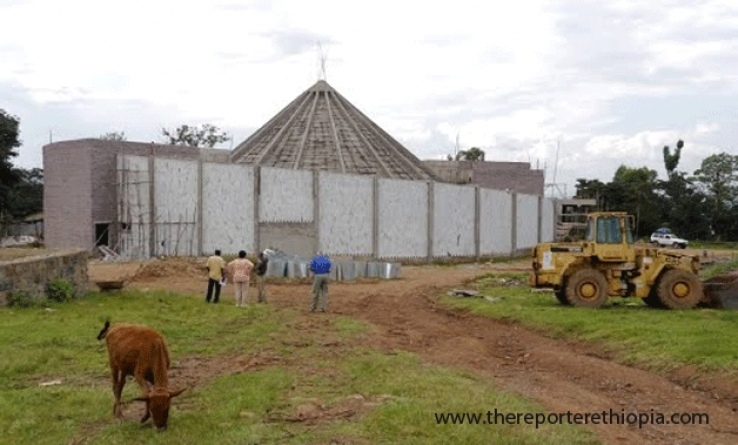
Coffee museum under construction

In the breathtaking experience of traveling across the remote highlands and lowlands of the south-western part of Ethiopia, one can, really, admire the country’s future in building a green economy.

The densely planted indigenous trees on both sides of the road seem to be the gate to a wonderful savanna land. A small town, Bonga, some 420 km south-west of Addis, provides a world-class center for research. The town hosts the first coffee museum of its kind, which many hope will unravel the mystery behind the birthplace of the mysterious green beans.

A goatherd named Kalid is linked with the story of coffee. Back then, Kalid saw his goats climbing the hills easily after eating what seemed to be a special leaf – a leaf that made them so spirited. His discovery encouraged him to be a guinea-pig to test the beans, which proved to be a source of great excitement. This is said to be the compelling story of the beans whose name reached out to every corner of the world.

Coffee has always been associated with Ethiopia’s longstanding tradition and hospitality. Indeed, it became a popular culture among many to grab coffee while discussing matters on the table. A few historians and anthropologists have also embarked on the task to find the birthplace of coffee.

The Kaffa people, located in the south-west of Ethiopia, have persisted with the strong argument that the name “coffee” is derived from their tribal name. They have kept their persuasive journey through historical and legendary accounts. They are, of course, known for their ancient history of self-governing dynasty that goes back thousands of years. They elected kings to ascend the throne, in which their dynasty structure is composed of defense, foreign affairs, justice and another four divisions that typify the modern government system. The last king of Kaffa, Akigo Shokru, was defeated in 1898 and arrested by the then powerful king, Menelik II, after a protracted conflict and several wars intended to include the region under a central administration. His crown is still kept in the Institute of Ethiopian Studies at Addis Ababa University.

In fact, coffee was found to be a treasure for the region some years ago when anthropologists dug out some of the materials that were supposed to have been used for drinking coffee. Moreover, the mother coffee tree in the so-called birthplace of coffee is still erected and preserved for tourists. Mankira, where a coffee bean was first discovered, has been a tourist attraction in the region. There is still a coffee forest in a wonderful natural setting which is placed to produce an organic wild forest honey that adds further fame for the area.

However, there is little to be said in favor of promoting the area or the entire nation as an original place of coffee due to several problems. Nevertheless, the man who is now becoming an icon for the area and has played a significant role in forwarding the idea of portraying the coffee bean as a trademark of the Ethiopian millennium, celebrated five years ago and also laid the foundation for the museum. Hassen Said (Ph.d.), from the Institute of Ethiopian Studies at Addis Ababa University, took the initiative to realize the construction of the museum when he found interesting and strong evidence about the association between coffee and the people of Kaffa.

The museum, which is on the verge of completion, rests on 2,800 sq.m. of land and hosted World Museum Day for the third time last May. “It has been quite an impressive journey to reach here,” he said. From the design of the complex to the construction cost, his insightful vision for the museum was the one guiding everything until it became a reality. “It is a simple love; a love that paid for my little involvement,” he said, describing its prominence among the people. Apart from a 10 million birr contribution from the wealthy businessman Sheik Mahamud Ali Alamoudin, the entire cost of the building was borne by the local people who have paid with the last cent from their pocket. “It feels like a blood-built heritage for the people,” he says.

The museum is expected to have rooms for laboratory purpose, research and documentation. Moreover, it will have a coffee park that brings all types of coffee beans from other parts of the country. “The most important role of the museum will be to promote the area as the original birthplace of coffee, in that we failed to do so thus far,” Kifle Hilemariam, chief administrator of the zone noted. In addition to this, it will also have a bigger impact in the promotion of other tourist sites found in the surrounding areas.

With the kind of personality in which Hassen has built, the realization of having a classy museum that promotes the area’s precious treasure to the rest of the world will indeed be an asset. The zone that comprises 30 percent of the country’s forest is on the verge of being registered as a world heritage site by the United Nations Education, Science and Culture Organization (UNESCO). “This will, of course, boost the country’s image,” Mamait Yilma, director of the national museum, argued.

Aseffa Hailemariam, who is in charge of the museum, notes that it is intended to promote coffee and will also accommodate a number of heritage pieces and artifacts of the people that have been preserved for centuries. “Quite soon the world will confirm Kaffa as a place where coffee was born,” he concluded. The people that realized the importance of environmental conservation a thousand years ago, and kept themselves in the forest planting coffee and hiving bees want to be recognized as “a coffee people”, and this seems be the time to reach out for that.

source: http://www.thereporterethiopia.com / The Reporter / Home> Living & the Arts / by Henok Reta / June 15th, 2013

Record coffee bean output likely

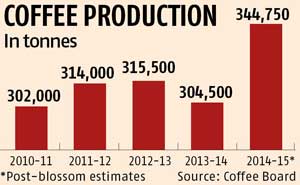
Despite widespread attack of the White Stem Borer (WSB) pest in all growing regions, the Coffee Board, a estimates India’s coffee production for 2014-15 at a record 344,750 tonnes – an increase of 13.2 per cent over the final estimate for 2013-14.

Although the Board projected an all-time high output of 347,000 tonnes for 2013-14, the final production came down to 304,500 tonnes, with 102,200 tonnes of Arabica and 202,300 tonnes of Robusta beans. Compared to 315,500 tonnes in 2012-13, the production was down by 3.5 per cent. For the current year, the pest has already affected 50 per cent of the Arabica plantations and the production loss could be the worst ever, if the monsoon continues to play truant. The Board has projected Arabica output at 105,500 tonnes and Robusta at 239,250 tonnes for 2014-15 crop.

“Our estimates are based on the conditions that prevailed during post-blossom period in April. The blossom showers were adequate this year, though the distribution was not uniform and there was a slight delay in receiving the backing showers in certain pockets. This year is an “on-year” for Robusta crop and the conditions are very good for the crop presently. The pest could come under control if there is a very good shower in the remaining months of monsoon. However, it will be known only in September, when we come out with post-monsoon estimates,” Jawaid Akhtar, chairman, Coffee Board, told Business Standard. He said last year, the Robusta crop suffered losses due to a heavy monsoon between July and September, after two months of drought earlier in the year. However, this year, the conditions might change with the monsoon rains in July and August.

CoffeeProductionkf17jul2014

Akhtar said coffee areas were facing long dry spell, followed by blossom showers. Agreeing with the Board, Ramesh Rajah, president, Coffee Exporters’ Association, said the Robusta crop has in excellent condition and depending on how the rains continue in the remaining days, the final production would vary. As WSB is rampant this year, the production of Arabica could come down by 10,000-15,000 tonnes, he said.

Planters have expressed surprise over the estimates for the current year. “Last year was an ‘on-year’ for Arabica and still it suffered losses due to WSB initially and later with heavy monsoons. This year, it is an ‘on-year’ for Robusta. With WSB surfacing, the Arabica production at the most could be in the range of 60,000 tonnes,” said Nishant R Gurjer, former chairman, Karnataka Planters Association.

source: http://www.business-standard.com / Business Standard / Home> Markets> Commodities> Food & Edible Oils / Mahesh Kulkarni / Bangalore – July 14th, 2014

World population day today

The district administration, Kodagu Zilla Panchayat, Department of Health and Family Welfare, Government First Grade Women’s College, Government PU College, District Legal Services Authority, in association with various non government organisations, will observe World Population Day on July 11.

An awareness rally will be carried out from the Government P U College in the city at 10 am.

District and Sessions Judge Chandrashekhara B Hipparagi, Deputy Commissioner Anurag Tiwari and others will participate.

The district level programme of World Population Day will be held in Kaveri Kalakshetra at 11 am. Home Minister K J George, MLAs M P Appacchu Ranjan, K G Bopaih, T John, Capt Ganesh Karnik, Kodagu – Mysore MP Prathap Simha, Zilla Panchayat President S N Raja Rao and others will take part.

source: http://www.deccanherald.com / Deccan Herald / Home> District> Madikeri, DHNS – July 11th, 2014