Madikeri Farmer Eyes Record With 41-ft Cane

Madikeri :

B Hoovaiah is a happy man. A stalk of sugarcane grown by Hoovaiah in Madikeri is all set to enter the Guinness Records as the tallest in the world. The earlier record, set in 2001, was held by Venkatesh Gowda of Kolar.

Hoovaiah, a BSNL tower operator in Convent Junction in Madikeri, has been protecting the cane for three years now. All the required inspections have been completed by expert committees and a team from Guinness is expected to arrive shortly, before an official announcement can be made.

Hoovaiah told Express that an expert team inspected the stalk and measured it at 41.1 feet.

He then formally approached the Guinness authorities, asking them to consider it for a world record.

Later, he received an acknowledgement from Guinness records in-charge, Era Norroy.

Hoovaiah, who served in the Indian Army for 26 years, lives at Bettathoor in Madikeri taluk and has served as a tower operator for 11 years.

He expressed happiness that the cane had been grown organically.

source: http://www.newindianexpress.com / The New Indian Express / home> States> Karnataka / by B C Dinesh / July 10th, 2014

M.C. Nanaiah, as I know him

NanaiahKF14jul2014

by K.B. Ganapathy
Former Law Minister and JD(S) leader M.C. Nanaiah, Merianda Chengappa Nanaiah to give him his full Kodava name, bid adieu to Karnataka Legislative Council when his six-year term ended on June 30, 2014. Many MLCs have spoken in the past when their terms in the House had ended. In keeping with that tradition, M.C. Nanaiah too made his oration; but that was a class apart from what I have heard others speak before. In Nanaiah’s speech there was much food for thought for all those who swear by Democracy and Secularism.

If Democracy works best ONLY where there are checks and balances, where there is synthesis of various shades of opinions, where there is dialectical debate and discussion, then there also must be a House in the form of a Rajya Sabha (Upper House) at the Centre and a Vidhana Parishat (Legislative Council) in the States to act as a sieve to further filter what is processed in the Parliament or the Legislative Assembly. After all, law-makers are not Solomons, nor above reproach in their thinking and conduct. It is obvious Nanaiah has realised this deficiency, lack of maturity and haste on matters of Bills deliberated in the Parliament or the Assembly and therefore, in his farewell speech, he devoted much time on the need for making the institution of Legislative Council mandatory by amending the Constitution.

At present, the Constitution allows only Rajya Sabha to be a permanent house but not the Vidhana Parishat. As a result some States have abolished the Council. Hence Nanaiah’s concern. He may also have apprehended that such a doomsday may overtake Karnataka Legislative Council too at a future date and hence his appeal to the Speaker to take up the issue as an amendment to the Constitution to make the Legislative Council mandatory for all States. Tamil Nadu for example had a Legislative Council for many years. However, it was abolished by M.G. Ramachandran Government on Nov. 1, 1986.

In his impassioned oratorical flourish, as is his wont whenever on his feet to deliver a speech, he said the existence of the Legislative Council is imperative in view of the seriousness with which Bills have to be debated before passing them into Law.

In order to corroborate his point, he gave the example of the system prevalent in the United States where the US Congress (their Lower House equivalent to our Lok Sabha) always appreciated the role of the US Senate. Nanaiah said that in US the members of the Congress used to say that the Senators “Pour the Legislation into the Senatorial saucer for cooling.” And the Legislations (Bills) vetted by the Senators were the only ones that could be considered as Law. Let us hope our politicians heed Nanaiah’s words of wisdom distilled after over 40 years in State politics.

M.C. Nanaiah is Mr. Clean politician of Karnataka who survived in the “cesspool of corruption” without blemish, like a lotus in the murky waters. I know him since 1956. He was one year senior to me in the then Government First Grade College in Madikeri, Kodagu, now Field Marshal K.M. Cariappa College and in law college at Bangalore. Loud with a silver tongue, he would stand out in any group of students. He was assertive and daring in speech but some students thought that he was a master manipulator. I had no occasion to test this allegation which I thought was made by those who envied his dash and drive.

A.K. Subbaiah, Ajjikuttira Kariappa Subbaiah to give him his full Kodava name, who also became famous as a politician like Nanaiah, was one year junior to Nanaiah like I was. I don’t know about the age though. I remember Nanaiah defeating Subbaiah in the 1957-58 college elections. Later in life as both marched like knights-in-arms to fight the political battle, it was Nanaiah who made it once to the Legislative Assembly, then as MLC and finally to the State Cabinet. He was Forest Minister and then, many years later, Law and Parliamentary Affairs Minister for five years with the additional charge of Information Ministry.

In contrast, Subbaiah only made news, acquiring the epithet in Kannada as “suddi maduva Subbaiah,” which means “Subbaiah who makes news.” Some even called him as “Five day Lawyer, weekend Crusader.” If ego and hubris destroyed Subbaiah’s political opportunities (of which he had so many as a BJP Leader), as for Nanaiah it was the gift of the gab and indeed the intelligent persuasive ability and manipulative skills that took him to the acme of State Political Office via Legislative Council as he was not able to win Assembly elections except once.

After Kodagu got integrated with the then Mysore State, (now Karnataka) following the State reorganisation (1956), two persons who came on the political horizon of Kodagu are M.C. Nanaiah and A.K. Subbaiah, separated in their political ideologies as sharply as oil and water. If Nanaiah was a leftist, Subbaiah was a rightist. Nanaiah was into Congress, a change over from his Communist beliefs and Subbaiah was into Jan Sangh. Nanaiah then switched to JD(S) and became an achiever; but in contrast, Subbaiah followed his saffron brothers into BJP and almost came out as an achiever, but no. Soon he committed political harakiri because of hubris after winning some 18 Assembly seats under his leadership in the year 1983. It was a case of the time-tested maxim “pride goes before the fall.” Subbaiah was so presumptuous he thought without him BJP in Karnataka could not survive. He was unable to grasp the importance of a national political party in a democracy where individuals come and go but the party goes on. He was unceremoniously ousted from the BJP and despite changing political parties thereafter, rather shamelessly, he became a political pariah. His political career was doomed once and for all. In contrast, Nanaiah played his political cards well even when he was dealt with bad cards. Once he joined the JD(S), he became its loyal worker, nay soldier. Naturally, he rose to the rank of a General – Minister !

When Nanaiah was in Congress, political churning was taking place in Karnataka’s Congress Government led by D. Devaraj Urs, following the defeat of Indira Gandhi in the post-Emergency election. Nanaiah was inducted into Devaraj Urs ministry as Forest Minister. R. Gundu Rao, who had by then moved too close to Indira Gandhi and Sanjay Gandhi derisively called Nanaiah as a “Peppermint Minister.” Soon Devaraj Urs was dethroned, dumped from Congress and Gundu Rao became the Chief Minister. Thanks to Sanjay Gandhi. Being old friends, Gundu Rao urged Nanaiah to join Congress. But Nanaiah’s loyalty to Urs did not allow him to renege. For a time he was in political doldrums, but soon found himself a place in Janata Party and then the JD(S). If politics is the “art of possibilities,” Nanaiah indeed has mastered that art. It was a case of discovering the truth of the Kannada proverb “thaalidavanu baaliyanu.” He who has patience will survive. Speaking to media recently, Nanaiah has said, “politics is a strange coincidence of incidents.” Indeed true in this game of ‘snake and ladder’ which is politics.

Yesterday morning, I was speaking to Nanaiah to express my appreciation for his “hurrah” speech in the Legislative Council and mentioned of what the former Chief Minister and JD(S) State President H.D. Kumaraswamy has brought upon himself unwittingly, by demanding Rs. 40 crores for a MLC seat etc. Of course, those who know how these “tickets” are given by all political parties were not surprised but Kumaraswamy was caught on tape and got huge negative publicity. Responding, Nanaiah recalled his friendly talks with MLAs on the subject some six years ago. Indeed, some MLAs opined that they being the voters in the MLC election, they must get a share in the money collected from the candidate by the party. After all, these MLAs claimed that they too have spent a fortune to get elected as MLAs.

However, Nanaiah asked them what if a candidate like him who has no money to pay to the party and is given the ticket on merit. The good MLAs told Nanaiah, “Then there is no problem. We don’t make any demand.” Nanaiah got smart and told the MLAs: “Well then, go and tell Deve Gowda and Kumaraswamy that you would not ask for money if the ticket is given to me” and Nanaiah became the JD(S) MLC six years ago to retire on June 30, 2014.

e-mail: kbg@starofmysore.com

source: http://www.starofmysore.com / Star of Mysore / Home> Abracadabra….Abracadabra .. / by K.B. Ganapathy / July 09th, 2014

Datty Sadananda Gowda ‘s pressure helped get Mysore-Kushalnagar rail link : MP

Mysore-Kushalnagar rail line may extend till Madikeri

Mysore :

Mysore-Kodagu Lok Sabha MP Pratap Simha has expressed happiness over the announcement of Mysore-Kushalnagar-Madikeri railway link in yesterday’s railway budget.

Speaking to SOM yesterday, Pratap Simha said the Mysore-Madikeri railway link was a long standing demand of the people of Kodagu. He had promised the railway link during his campaign for the Lok Sabha, which has now been fulfilled with the announcement, he remarked. Pointing out that he had met railway Minister D.V. Sadananda Gowda thrice and PM Narendra Modi for fulfilment of the railway needs of the region, Pratap Simha thanked the Railway Minister for making the announcement.

Asserting that the Railway Minister had promised execution of the Mysore-Madikeri rail link soon after the completion of Kushalnagar-Madikeri stretch survey, the MP said Sadananda Gowda’s wife Dattay Sadananda Gowda too had exerted pressure on her husband for the rail link.

City BJP President Maruti Rao Pawar has expressed delight over the maiden Railway Budget presented by Railway Minister D.V. Sadananda Gowda yesterday.

Addressing a press-meet here yesterday, Pawar said that the BJP as promised is promoting tourism in Mysore region by providing a new Mysore-Kushalnagar train which is bound to boost tourism in Mysore and Kodagu districts.

Stating that the State has got 10 new trains in the budget, the City BJP President said the Railway Minister taking into consideration MP Pratap Simha’s appeal has promised to complete the Mysore-Bangalore track doubling within a year.

source: http://www.starofmysore.com / Star of Mysore / Home> General News / July 09th, 2014

Coffee Board projects record crop next season

ChartKF13jul2014

Growers sceptical due to prolonged dry period, borer menace

Chennai :
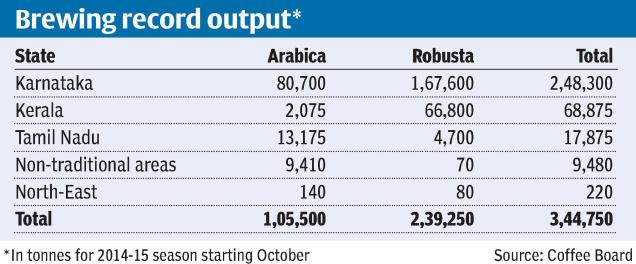
The Coffee Board has projected a record crop of 3.44 lakh tonnes (lt) for the new season beginning October, but growers are sceptical about the estimates.

According to the Coffee Board’s post-blossom estimate, Arabica output will be 1.05 lt and Robusta 2.34 lt. (The estimate of crop made after the coffee plant blossoms and spikes develop on the plant is the post-blossom estimate.)

This is against a revised estimate of 3.04 lt this season ending September (1.02 lt Arabica and 2.02 lt Robusta).

“I think this output could be difficult to achieve, especially with regard to Arabica. This is because even in best-maintained plantations, there is heavy infestation of the white stem borer,” said Anil K Bhandari, former president of the United Planters’ Association of Southern India, and an exporter.

Other opinions
“Such levels of production cannot come from the original area under coffee in the country. This year, most planters are complaining that their output will be down by at least 40 per cent as far as Arabica is concerned. In my own estates, the output will drop to 10 tonnes from 40 tonnes,” said Bose Mandanna, former Coffee Board Vice-Chairman and a planter in Kodagu, Karnataka.

Due to a prolonged dry season, the menace of the white stem borer, which has been wreaking havoc in coffee plantations over the past decade, is a serious threat this year.

“Maybe, the estimate put out by the Coffee Board was the situation prevalent during blossom. After that, there has been a tremendous loss in the estates due to the borer menace,” said Bhandari.

This year, coffee estates are reported to have received timely showers for blossoming of the coffee flower. Follow-up showers, required for growth of the plant, were also good before the borer menace spread panic.

According to the Board estimate, Karnataka will contribute 72 per cent of the coffee production next season, up from nearly 70 per cent this season. Output in Karnataka will be 2.48 lt (80,700 tonnes Arabica and 1.67 lt robusta) against 2.11 lt this season (78,440 tonnes Arabica and 1.32 lt Robusta).

Kodagu’s contribution will be 43 per cent with 20,150 tonnes of Arabica and 1.13 lt of Robusta (21,040 tonnes Arabica and 90,820 tonnes of Robusta). Last year, its contribution to the country’s coffee production was 36 per cent.

Fears of drought

“It is almost like a drought situation in Kodagu. It is unlikely that the district will provide so much coffee this year,” Mandanna said.

“It is likely that the Coffee Board could revise the estimate downwards after taking into account the effect of monsoon and other things. It should carry out another estimate later and put it out during October-November. That could perhaps reflect a correct picture,” Bhandari said.

According to plantation industry sources, for the last few years, the Coffee Board has been putting out a higher projection of the crop in its post-blossom estimate.

“This has been happening for sometime now. They come out with a higher figure and then revise it. Who gains from such estimates,?” a source wondered.

Last year, the Coffee Board initially estimated the crop at a record 3.47 lakh tonnes before pegging it finally at 3.04 lakh tonnes.

This season’s production estimate was lowered after heavy rains in the growing areas led to wet feet in coffee plants resulting in the roots growth freezing. This led to coffee berries falling off the plant, leading to loss.

“The Board has to revise its methodology in estimating the crop. Then, perhaps it could be nearer to reality,” the source said.

source: http://ww.thehindubusinessline.com / Business Line / Home> Markets> Commodities / by MR Subramani / Chennai – July 08th, 2014

Kodagu inches closer to rail connectivity

Mysore :

A train to Kodagu could now be possible, which could sell tourism potential of the hill station to both domestic and foreign tourists and be the driver of economy.

Thanks to railway minister D V Sadananda Gowda, the only district in Karnataka without railway connectivity is inching closer to get on the rail map of India.

Gowda, whose wife Datty is from Kodagu district, on Tuesday approved the survey of new line that will connect Mysore to Madikeri, the district headquarters. He said: “I am happy to announce that the survey for Mysore-Kushalnagar portion of Mysore-Kushalnagar-Madikeri new line has been completed and the state government has agreed to share cost of the project. This will provide rail connectivity to important tourist destinations in Kodagu (Coorg). I propose to pursue this project for obtaining requisite approvals after completion of remaining survey up to Madikeri.”

Sources in the Mysore division of the South Western Railway said that the survey between Mysore and Kushalnagar has been completed in 2011. The preliminary survey between Kushalnagar and Madikeri is completed t the final location survey is not taken up. With the approval from the railway minister, the project is back on track, they told The Times of India. The Mysore-Kushalnagar section is estimated to be 89 kms long and is planned to have over five stations including one at Peripayapatna. But the estimate for this section is not prepared, they added. As the minister has said if the state government funds its share, the project can be taken up, they explained adding the survey for the remaining portion can be completed within an year.

The Mysore Industries Association welcomed the move and said it will help in the development of the area.

Besides, the track doubling works between Mysore and Bangalore is expected to completed year end, which will improve connectivity to the city. Gowda has said that they plan to open the double track by February 2015 and operate trains. Inclusion of Mysore-Bangalore-Chennai corridor for high speed train connectivity is also welcomed by the MIA.

Connectivity to Shimoga set to improve

Gowda has also announced new survey between Talguppa and Siddapura in Uttara Kannada, which could help link the costal Karnataka to the Malnad region. It was long pending demand of the public to extend railway connectivity from Talguppa near Jog Falls in Shimoga district and link it to Konkan Railway. Shimoga, represented by former CM B S Yeddyurappa in the Lok Sabha, has also got lucky with a new survey ordered between Shimoga and Mangalore via Sringeri. Shimoga has also got a bi-weekly train to Bangalore.

source: http://www.timesofindia.indiatimes.com / The Times of India / Home> City> Msore / by H M Aravind, TNN / July 08th, 2014

Coffee Board finds a way to tackle arabica stem borer

Kochi :

Coffee Board has achieved a breakthrough in its research to combat white stem borer attack, which has become the single largest threat to the survival of arabica coffee cultivation in India.

Management of this devastating pest has been increasingly difficult due to the vagaries of Nature and shortage of skilled work force. It has threatened to bring down arabica crop to 65,000 tonne this year.

Among the various control measures currently available, pheromone technology is the latest one which can be adopted easily. The Central Coffee Research Institute (CCRI) has been working on the refinement of the pheromone technology and had identified the existence of female sex pheromones and some attractants known as kairomones, within the plant itself. Kairomones are the chemicals released by host plants that attract the pests towards them.

Earlier, Coffee Board through a tie up with Bio Control Research Laboratories (BCRL) succeeded on the production of the male pheromone compound. The Board is now providing traps baited with this pheromone at 50% subsidised rates to the coffee growers. The traps help the growers to monitor the borer emergence and assess the spread of the flight season which are crucial to initiate the control measures.

Coffee Board had launched a collaborative research programme with BCRL in 2012 to identify the role of female sex pheromones and kairomones in mating and infestation process.

The studies conducted by BCRL scientists revealed the existence a female sex pheromone compound. A plant volatile from attacked plants, which attracted the stem borer, was also identified.
Preliminary field studies using combinations of these two in traps attracted maximum beetles when compared to the male pheromone alone.

These findings offer scope for improving the pheromone technology, which could form the basis for a breakthrough in eco-friendly stem borer management. Further field trials to arrive at the optimal and cost effective combinations are under way, according to an official statement from Coffee Board.

Source: http://www.articles.economictimes.indiatimes.com / The Economic Times / Home> News> Economy> Agriculture / by ET Bureau / July 08th, 2014

Saving Kodagu

Kodira A Kushalapa writes why there is an urgent and dire need to protect the natural landscape of Kodagu, the “Scotland of India”.

The erstwhile state of Kodagu is now a district in Karnataka with nature and culture, that require immediate efforts to conserve, not only for the present, but also for the future generations to survive.

The district is partly located on the Western Ghats with a portion on the east.

The Western Ghats is considered an ecologically sensitive area and requires careful scientific approach in its development and management, failing which, it will have adverse impacts on the entire southern part of India.

Under Article 48A of the constitution, the government is under an obligation to protect and improve the environment and to safeguard the forests and wildlife of the country.

Under Article 51A(g), likewise, each one of us as citizens, has the obligation to “protect and improve the natural environment including forests, lakes, rivers and wildlife and to have compassion for living creatures.” There are several issues that require careful and urgent handling.

Paddy cultivation
The district, on an average, receives over 2500 mm of rainfall annually and is ideally suited for rain-fed paddy cultivation.
People were cultivating only paddy till the British invasion in 1834 and took up coffee cultivation subsequently.

Now, only 10 to 12 per cent of its total area is under paddy. It is been discovered recently that paddy cultivation is not economical and farmers are diverting their paddy fields for cultivating cash crops or for construction, without any concern and forethought.
This has increased the run-off during the rainy season, resulting in flash floods, damaging the lands by accelerated soil erosion. Paddy cultivation was impounding rainwater for about 100 in paddy fields, allowing slow infiltration enriching the subsoil groundwater.

This would be beneficial to us later, due to slow release of the groundwater, to maintain continuous flow in rivers.

Now the rivers are almost dry during summer, indicating that there is a need for encouraging paddy cultivation all over Kodagu district by introducing incentives, subsidy and support price.

The government should immediately prohibit conversion and use of paddy fields for any other purpose, like it has been done in Kerala and Dakshina Kannada.

Another issue which needs immediate attention is reduction of crop damage by wild animals, which has forced many farmers to abandon paddy cultivation.

Forest conservation

Nearly 31 per cent of the geographical area of Kodagu is under forests managed by the government. Tropical evergreen forests dot this landscape.

Any disturbance to them will make the area barren, like we see around Talacauvery, where the once dense forests have now been reduced to grasslands due to continuous use of wood by pilgrims.

These lands are so degraded with poor nutrient top soils, that reforestation has become a hard task.

The forests have to be protected to facilitate infiltration of rainwater and to prevent accelerated soil erosion.

Natural forests once destroyed cannot be recreated and reforestation can only create plantations.

The various forest and wildlife acts should be strictly implemented and the persons who violate them should be suitably punished.

Relocation

There are a number of cases of encroachment in the forests. Even high forests like Devarakadu and national parks have been encroached upon, where wildlife need relocation and rehabilitation, outside the forests and possibly even out of Kodagu district to drier areas suitable for agriculture.

The Forest Rights Act envisages the issue of khatha to all tribals and others, residing inside forests for 2 to 3 generations, not to continue there only inside the forests, but as an important document to get equal areas outside forests during relocation.

The union government is committed to grant Rs 10 lakh per family during the relocation to bigger and compact blocks.

Fodder development is another important activity to contain wild animals inside government forests. The flowering of bamboos has left only dried clumps and have become hazardous to forest fires.

Grass and other fodder species have been destroyed and invaded by lantana and other weeds as ground flora, preventing natural regeneration of native species.

It is impossible to raise any fodder plants now in government forests unless large blocks or compartments are properly fenced and protected and then planted with tall seedlings of fodder species annually to cover the entire forests.

In addition, profuse aerial seeding of treated bamboo and other miscellaneous seeds should be taken up with the onset of monsoon all over the forests.

The old plantations of teak covering over 7000 ha in Nagarhole National Park and other areas should be harvested and liquidated in a phased manner (with special permission of the Central government) and followed by planting of bamboo seedlings to develop fodder resources to wild animals.

The forest department should give priority for creating barriers along the boundaries of government forests and develop fodder resources for herbivores inside such forests.

Development of tourism

Kodagu has attracted tourists from all over the world, creating irreparable damage to the landscape.

The presence of numerous resorts and homestays all over the district has attracted more tourists resulting in landslides, water scarcity, waste management problems, bad roads, felling of trees for constructing houses, influx of outsiders for business and settlement and high cost of living.

There is no proper guidance and control for activities like registration of homestays and resorts, study of environmental impact assessment and carrying capacity of every activity.

The building and house constructions have been taken up on steep terrains as seen in Madikeri and Virajpet landscapes, making the hills barren.

The riverside areas are all occupied unauthorisedly, polluting river water.

There is a need to control and restrict the tourists coming to Kodagu, by studying the carrying capacity of land involved in every activity and their impact on environment and framing suitable guidelines.

Management of private forests

Nearly 75 per cent of the area in the district is covered by trees.
Coffee estates maintain sufficient shade trees per ha in which silver oak gets precedence due to its faster rate of growth, straightness of bole, multiple use of wood for planks, furniture, peeling, plywood etc and exempted from felling and transit permits and fetches revenue returns in about 30 years.

However, its cultivation should be restricted to allow other indigenous species to maintain biodiversity, to facilitate birds and bees to control pests and increase pollination.

Jamma malai and Jamma bane land holders who have also maintained trees in their land should be given tree rights as an incentive to grow more trees to supplement their income when necessary.

There is, however, a section in the Karnataka Forest Act with a provision to take over the management of private forests by forest department, if the owners violate the provisions of the Act and management principles. This would be binding on the owners to protect the standing trees.

Under the provisions of Karnataka Protection of Trees Act, if a tree is felled, double the number of seedlings should be planted by the owners and this would ensure the sustainability of tree cover.
Therefore the ownership rights of the trees should be with the owners.


Land ownership

Jamma land holder
s have been enjoying the land tenure even before the rule of Lingayat Rajas, who surveyed, documented and levied necessary land tax.

The Bane lands attached to paddy fields called Jamma Bane, in many families, have been converted into coffee and other plantations and by paying necessary tax, are now the property of those families.
The Jamma malai owners have been negotiating with the government to surrender their privileges for a reasonable compensation, which should be accepted as these malais are situated on the ecologically sensitive hill ranges and the composition is similar to natural evergreen forest types.

Compensatory Afforestation Fund Management and Planning Authority (CAMPA) funds could be utilised to pay compensation. Necessary amendments to the KF Act should be introduced to make the families of Jamma holders as the rightful owners of Jamma lands.

However, to safeguard the unique culture of natives of Kodagu, the sale of their Jamma property should be prohibited, except for other Jamma holders only.

High Tension 400 kV line

The proposal to draw a 400 kV line, partly along the reserve forest, private wetlands and coffee estates was met with stiff opposition from local people.

There are several alternate routes available, such as, along the Mysore-Kodagu forest boundary line, or by upgrading the older available 220 kV line or taking through an underground tunnel (not feasible here) without clearing much forest growth.

Amendment 4.4 to the FC Act issued by Ministry of Environment & Forests (MoEF) on January 7, 2013, indicates that for linear projects, alternate routes, if available should be indicated and availed of, so that forest lands are saved.

This linear project should be aligned outside the protected area without any consideration of increased cost and accordingly the MoEF may be appraised to allow the HT line through alternate non-forest areas.

source: http://www.deccanherald.com / Deccan Herald / Home> Supplements> Environment / by Kodira A. Kushalapa / DHNS – July 08th, 2014
DK drenched, but rain plays truant in Kodagu

Monsoon gained momentum in Dakshina Kannada with the region receiving intermittent rains on Monday. In the last 24 hours, Sullia received the highest of 43.4 mm rainfall, followed by Mangalore—15.2 mm, Moodbidri—13.2 mm Bantwal—14.8 mm, Puttur—11.4 mm.

The rain brought the much-needed relief from the scorching heat for the people.
“If the region continues to receive rain, we can start agriculture activities,” said a farmer. The roof of a house collapsed at Kumpala Hanuman Nagara in Someshwara Gram Panchayat limits, following rain on Monday. The house belongs to Pushpa.

To invoke the blessings of rain god, seers from Karnataka, Tamil Nadu and Kerala conducted ‘parjanya japayajna,’ at Talacauvery (the birthplace of River Cauvery) in Kodagu district on Monday.

There was drizzling in Talacauvery, Madikeri, Napoklu, Gonikoppa, Virajpet and Kutta. The inflow of water to the Harangi reservoir was 221 cusecs. It was 8050 cusecs during the corresponding period last year.

In Shimoga

Parts of Shimoga district received moderate rain on Monday. In the past 24 hours, Shimoga received 2.2 mm of rain followed by Bhadravathi (1.8 mm), Thirthahalli (1.6 mm) and Sagar (0.6 mm).
DH News Service

source: http://www.deccanherald.com / Deccan Herald / Home> State / Mangalore – Madikeri, DHNS – July 08th, 2014

Ganapathy , IPS from Kodagu is PS to Union Home Minister

GanapathyKF08jul2014
Mysore :

M.A. Ganapathy, a 1986 IPS batch officer, has been appointed the Personal Secretary (PS) to Union Home Minister Rajnath Singh.

Ganapathy, who had won the President’s Medal twice, had earlier served as the Spokesperson for the Union Home Ministry. He had also served as the Secretary to the Sectoral Magistrate. Ganapathy, son of Maneyapanda Appaiah and Premalatha, hails from Eachoor near Kunda in Kodagu.

source: http://www.starofmysore.com / Star of Mysore / Home> General News / July 03rd, 2014

Water from Kundamestri to flow to three water bodies

The ambitious Kundamestri drinking water project is all set to supply water to three keres (streams) in Madikeri. Deputy Commissioner Anurag Tiwari has given his nod for the laying of pipelines at an estimated cost of Rs 20 lakh to flow water Roshanara kere, Pampina kere and Kannandabane open well.

KundamestriKF07jul2014

There were no pipelines to flow water to these water bodies. Hence, barring these areas, water from Kundamestri was supplied to other areas. If the work on laying pipelines are complete, then water from Kundamestri project will reach entire Madikeri town.

Following delay in completion of work on Kundamestri project, the water was flowed to Kootuhole and later to filter house to be supplied to the residents.

Once the work on pipelines are complete, then water can be supplied to the residents directly from Kundamestri.

Normally, Kannandabane kere, Roshanara kere and Pampinakere goes dry during peak summer. The CMC was depending on tankers to supply water to the residents. If the project on supplying water from Kundamestri is success, then the CMC can save money.

The DC has given nod for an action plan of Rs 32.80 lakh for taking up 14 different works under second phase of SFC grant during 2013-14.

Kannandabane, Chaingate and surrounding areas, Raghavendra temple, Tyagaraja colony, Azad Nagara and Putani Nagar will be covered under Kundamestri water project.

The remaining 11 works include cleaning of borewells, installing pumps for borewells at Mangaladevi Nagara and Sudarshana Circle, deepening a borewell at Azad Nagara, drilling borewells at Dasavala Jayanagara and Chamundeshwari Nagara, sources said.

source: http://www.deccanherald.com / Deccan Herald / Home> District / by Srikanth Kallammanavar / DHNS-Madikeri, July 07th, 2014