Calendar boys – Here come the pin-up boys!

The last bastion of the all-female club is broken as photographer Sharvee Chaturvedi zooms her lens on Bollywood’s first all-male pin-up calendar! She’s got the girlie eyeballs rolling.

Varun Sharma (L), Gulshan Deviah

Photographer Chaturvedi’s lens has captured actors playing out different in front of a still camera for the sea dot. The lenswoman brings to life actor Varun Sharma’s inner child by keeping alive his playfulness whereas a topless Jitin Gulati tries to spot Arjuna’s eye. Actor Gulshan Deviah practises patience and waits in anticipation lying in a two-piece suit as television host Shiv Pandit balances his inner and outer voice. Twelve men, 12 months and 12 inner challenges that’s part of an actor’s life – that’s what Chaturvedi camera captures.

NAKED EMOTIONS

The visual stories frame a particular human emotion that’s part and parcel of a man’s struggle in La la Land. Says Chaturvedi,”The idea was to create stories involving human emotions and spirituality. Men, too, have their demons to deal with, and the sad part is that they do not talk about issues bothering them or bogging them down. At the end of the day, we all want to be accepted. I wanted to see men beyond the prism of gender and capture their self strength.”

The idea of masculinity may have not changed all that much despite the giant strides in the last few decades, but looking at these actors playing out their inner desires, anxieties, sadness and demons, you get to see a side to them that’s not been exposed to the world before. These men are far more comfortable in their own skin. They may not be naked or in a swimsuit on the beach, but you cannot miss the naked emotions running through their faces and body language. Adds Chaturvedi, “The men I shot with didn’t for once focus or talk about a woman shooting them. The focus was on creating something worthwhile.” The idea was to break a barrier as a photographer, which women directors, writers, cinematographers have been doing over the past few years.

It’s been a while since the glamour industry woke up to the potential of a man’s body. What’s a movie today without the chatter and gossip of a superstar’s abs? The trials and tribulations of the mind in the glittery and ephemeral nature of B-town have for long been ignored, or not talked about enough. Chaturvedi’s calendar has now made them a talking point.

MALE PIN-UPS ACROSS THE WORLD

There’s a rise in male pin-up calendars all over the world.

Celebrity photographer Mike Ruiz shot his 2015 calendar – ‘Hunks and Hounds’, featuring topless men with their dogs. To entice women to buy the calendar, he also disclosed the men in the calendar were all single! Last year, English TV presenter Mark Wright went shirtless to show off his impressive physique as he posed for a calendar in his underwear.

source: http://www.timesofindia.indiatimes.com / The Times of India / Home / by Nona Walia, TNN / February 15th, 2015


Indian coffee turns costly for the world, exports down 20%

India’s coffee exports have declined 20% since the beginning of 2015 as high prices have made shipments uncompetitive in the global market.

The Arabica coffee shipments plummeted by as much as 50%, pulling down the overall coffee exports of India.

Widespread rains in the largest Arabica-producing nation Brazil have led to a 14% decline in global Arabica prices in the past two months.

The May futures at ICE New York closed at $1.48 per pound on Monday , down 3% from the previous close.

“At the current domestic prices, the exports are not viable. Arabica from Brazil and other origins is much cheaper,” said MP Devaiah, general manager of Allanasons, a major exporter.

The raw coffee prices of Arabi ca parchment in India are about . 10,300 per 50 kg.` Between January 1 and February 23, the Arabica parchment exports fell to 6,617 tonne, down by as much as 50% compared to the year-ago period. The Robusta cherry , which accounts for a major share of coffee exports from India, fell 15% to 16,012 tonne during the period of January-February .

CoffeeCupKF25feb2015

According to local growers, the Arabica crop has been lower than expected due to poor weather conditions and the attack of white stem borer pest. “The harvest is over and the output should be between 55,000 and 60,000 tonne,” said K Kurian, chairman of Karnataka Planters’ Association.

The growers earlier predicted 65,000 to 70,000 tonne of Arabica while the estimate of Coffee Board was much higher at 1,05,000 tonne.

But exporters said the drop in production is not as much as it is made out to be.

“The growers are holding the stock in anticipation of better prices. As a result, exporters are unable to enter new commitments,” said Ramesh Rajah, president of Coffee Exporters’ Association of India.

However, he added since the Robusta crop is predicted to be good, the current decline in exports could be made good in the next quarter.

Coffee Board’s forecast for Robusta is 2.39 lakh tonne and the growers’ estimate is only slightly less.

The production in Vietnam, the top producer of Robusta, is expected to be around 29 million bags (each bag of 60 kg), slightly lower than in the previous year.Therefore, Vietnam may not be able to lower the prices of what it has to offer globally.

source: http://www.economictimes.indiatimes.com / The Times of India / ET Home> Industry> Cons. Products> Food / by KrishnaKumar PK / TNN / February 25th, 2015

Personal Best: Robin Uthappa : Ice, ice, baby

RobinKF24feb2015

His fitness routine can put anyone to shame and his penchant for ice cream and baked goodies can make your jaws drop in surprise

At 21 he was part of the World Cup winning team. He felt invincible. He possessed a winner’s technical precision. The rest didn’t matter. Including a deliberate fitness regimen. That’s where Robin Uthappa faltered. He became a victim of a series of failures with the willow and worst — battle of bulge. At 26, his weight ballooned to 96 kilos. The fall from grace — from a swashbuckling Indian batsman to a domestic cricketer — was instant. But Uthappa had much to offer. Understandably, the downward slide was hard to handle — he became moody and impatient.
But after an intervention Uthappa got onto the straight and narrow. “I became aware of the importance of a nutritionist in my career and the need to battle my issues with weight. It’s been three years hence and I have followed a constant routine with utmost discipline,” he says.
Hard work pays. Uthappa has found his mojo again —cracked many a tons, lifted the desirable Ranji Trophy (his childhood dream), scored highest runs in the IPL for Kolkata Knight Riders and is in top form ahead of the knockout stage this Ranji season. He shares his secrets and daily routine which has helped him fall in love with the game all over again.

Meal plan
Breakfast: I have fruits for breakfast — mostly a combo of pineapples and papayas and sometimes only water melons. If I am still hungry after a bowl of fruits then I make myself an omelette. I also have a mug of black coffee without sugar.

Snack: At about 11 am, I have a handful of dry fruits and in the evening at about 5 or 5:30 pm I have fresh fruit juice, dry fruits with a multigrain sandwich.

Lunch: Between 12:30 pm and 1:30 pm I eat fresh veggie salad. I get my protein fix through chicken, fish or beef and carbs through chapatis, rice or pasta (Olio pasta tossed in olive oil, without any sauce).

Dinner: It is usually at 7.30 pm and consists of veggies again, chicken/fish and my favourite arugula, which is rich in iron. In case I feel hungry later in the night, then I have a bowl of curds or carrots and cucumber.

Cheat meal
Once a week I eat what I am craving for at that moment — it could be pizzas, biryani or hot chocolate fudge.

Pantry Secret
At times, I bake my own version of healthy brownie (with not much sugar) and binge on it.


Guilty pleasures

Ice creams and chocolates. I also absolutely love Joy ice cream’s mango and raspberry flavour ice candy. Every time I play in Mysore, I ensure I have Joy ice cream since their factory is there. If I am struck by an ice-cream craving when in Mumbai (or any other place) I hold on to it till I reach Bengaluru. Once I am here, I head to Corner House to have my favourite ice cream — brownie fudge or the classic hot chocolate fudge.

Skin splurges
I go to the spa regularly and get clean-ups and facials done. Since we play a lot in the sun, I face a massive challenge dealing with sun tan/ sun burn. I alternate between two sun protection creams, La Shield and Lotus sun protection, everyday.

Tricks of the trade
Small meals every couple of hours. That’s been my mantra for the past three years. This helps me sustain good metabolism. I also get a blood test done every six months to see where I stand in terms of physical fitness.


De-stress strategies

I watch movies, read non-fiction books or listen to music. If this doesn’t help in distressing, then I go on long drives in the middle of the night. When I am in Mumbai I drive my BMW and if I am in Bengaluru then I borrow or steal my friend Sheetal Goutham’s Honda Amaze.

In the fridge
You will find fresh fruits, cold water and milk at all times.

Advice
Stay healthy, train right and eat right. If you are already doing this then please credit yourself with a cheat meal once every week.

Down time
Off late it’s been baking!

Secret weapon
My discipline.

Drink menu
I have protein shakes before and after each of my training schedule. I also have something called the Casein at night which helps in slow-releasing of proteins and recovery of muscles from wear and tear through the night.

Fitness
I train two hours, five days a week, focusing on endurance and speed since my game demands it. In the last few years, I have cultivated a routine which I follow before warming up or batting in the nets. These are technique-related drills which are very important for me and works for me. Nothing in the world can stop me from following this routine.

source: http://www.bangaloremirror.com / Bangalore Mirror / Home> Columns> You / by Nandini Kumar, Bangalore Mirror Bureau / February 15th, 2015

Green Tribunal order a boost for Kodagu

Orders stoppage of tree-felling until MoEF approval

Protestors against the illegal felling of more than 50,000 trees in Kodagu for the sake of a power transmission line have a reason to smile. Ahead of their hearing by the Karnataka High Court, the National Green Tribunal’s order on Friday in a separate case seems to have revived their hopes of protecting the trees.

Order on activist’s PIL

The National Green Tribunal (NGT), on Friday, ordered all agencies to refrain from felling trees while executing linear projects in forest areas, unless an approval under the Forest (Conservation) Act 1980 was obtained. The NGT ruling was a response to a petition filed by Maharashtra-based activist Milind Pariwakam who objected to the National Highway Authority of India (NHAI)’s project of widening of NH-6 and NH-7 in the Vidarbha region. This would involve felling trees and diverting forest land through the fragile Tadoba Tiger Reserve in Maharashtra. The NGT ruling is likely to have a nationwide impact in preventing diversion of forest land for non-forest purposes.

The NGT clearly stated that all linear projects like railway lines, development of roads, canals and laying of transmission lines through forests must obtain permission from the MoEF under FCA -1980. Although the Chennai Bench of NGT had refused to stall the project last year, activists hope that the latest order will have an impact.

Speaking to Bangalore Mirror, Sajan Aiyappa, coordinator of the Save Cauvery Campaign, said, “Previously, when we approached the NGT’s Southern Bench, it had dismissed the petition on technical grounds and so we approached the High Court. The case has been posted for hearing on Monday. However, we welcome the order by the NGT in Maharashtra. We hope that the order will force authorities to take note of the seriousness of the issue and safeguard the fragile eco-system of Kodagu.”

The activists clarified that they were not against the project, but only concerned about the felling of 50,000 trees which would have a catastrophic impact on the rainfall of Kodagu. This, they say, would adversely affect the flow of water to the Cauvery and in turn affect the availability of potable water in Mysuru and Bengaluru.


Felling continues

“Despite the case being posted for hearing before the High Court, the authorities, a few days ago, cleared many trees within the limits of coffee estates. We have submitted scientific reports on the variety of species of trees in plantation areas. The court must take note of this and help us in safeguarding the eco-system,” yet another activist said.

source: http://www.bangaloremirror.com / Bangalore Mirror / Home> Bangalore> Others / by Niranjan Kaggere, Bangalore Mirror Bureau / February 23rd, 2015

Shah Rukh Khan invites Yuvraj Singh, Robin Uthappa and Harbhajan Singh on India Poochega-Sabse Shaana Kaun!

ShahrukhKF24feb2015

After a long hiatus, SRK is making a comeback on television!

Shah Rukh Khan will soon be seen hosting a quiz show on &TV called India Poochega: Sabse Shaana Kaun. The actor is super-excited for his stint as a host. We hear that the show is not based on academic questions and contestants from various walks of life will be pitted against each other.

At the latest taping of the show SRK invited cricketers Yuvraj Singh, Harbhajan Singh, Robin Uthappa and Manish Pandey (of Kolkata Knight Riders) The cricketing sensations were called upon to play the game of Sabse Shaana Kaun and they all had a blast. SRK tweeted, “Good fun time with the boys. Played for charity on SSK. Thank you for coming.”

King Khan prepped up for the quiz show at his home Mannat and put in a lot of late nights into the rehearsals of the show. He is quite excited for the audience to watch the show and he tweeted, “Shooting sabse shaana kaun….meeting so many wonderful ppl with common issues but special grit & determination. So special to be ordinary.” The actor also shared with his fans that he is “learning life” while shooting for SSK.

source: http://www.bollywoodlife.com / BollywoodLife.com / Home> Shahrukh Khan> India Poochega / by Shristi Dixit / Monday – February 16th, 2015

Instant coffee definitely a Kiwi brew

http://www.3news.co.nz/nznews/instant-coffee-definitely-a-kiwi-brew-2015011518#axzz3ThL3V3wq

As the debate over who invented the flat white rumbles on, it’s a good time to highlight that instant coffee was actually invented in Invercargill.

For over a decade a Japanese scientist was credited with the invention, but just recently it’s been revealed that Southland spice and coffee merchant David Strang was actually the first to develop a powdered form of coffee in the 1800s.

“His claim to fame is the invention of instant coffee, an invention he patented in 1890, and that’s the earliest recorded patent for instant coffee in the world,” says Tracey Wedge of Southland Museum.

But Mr Strang’s role in coffee history was basically forgotten, until memories were reignited a few years ago when the Historic Places Trust registered his son James’ house.

Since then the Southland Museum has built an exhibition around Strang memorabilia, including some very old tins of some of the first ever instant soluble powdered coffee.

“It revolutionised coffee consumption around the world. Instant coffee became a household product,” says Ms Wedge.

Mr Strang is believed to have invented the powder by blowing hot, dry air over liquid coffee until it reduced.

While he admits Mr Strang’s invention was ground-breaking, coffee connoisseur Arjun Haszard doubts it would have tasted any good.

“By using heat on that coffee you’d see a lot of flavour deterioration, a lot of over-extraction and very horrible flavours coming out,” says Mr Haszard.

But even so, Invercargill locals were surprised to hear their town had a new claim to fame.

“Wow, there you go, you learn something new every day, don’t you,” said one local.
“It’s very clever, isn’t it,” said another.

While Southlanders have produced a handful of inventions, instant coffee is the only one to have gone completely global.

3 News
source: http://www.3news.co.nz / 3 News / by Kloe Palmer, Reporter / Thursday – January 15th, 2015

Coffee Board to conduct National Barista Championship in Bangalore on Feb. 27

12 finalists to be selected from regional competitions; National champion to represent India at WBC at Seattle in April 2015

Coffee Board of India will organise the National Barista Championship (NBC) in Bangalore on February 27. Twelve finalists selected from the preliminary rounds from regional championships will compete for NBC. For the first time, Coffee Board of India organised two regional competitions for selection of finalists for the NBC. The first preliminary round of the NBC 2015 was conducted on February 12 and 13 at Delhi Institute of Hotel Management in New Delhi for participants from North and Western India. From 20 contestants, six were shortlisted for the NBC 2015 by jury. The preliminary round for the South and Eastern region will be held on 25th and 26th in Bangalore, one day prior to the National Barista Championship. The national champion will represent India at the World Barista Championship (WBC) happening at Seattle on April 9, 2015.

Coffee Board of India has taken the onus of organizing the NBC since last year. Prior to that the annual event was organised by Speciality Coffee Association of India (SCAI). India has been sending representative to the global event since 2003. Speaking on the occasion, Dr VR Gudde Gowda, Dy Director, Coffee Board of India said that the objective of the competition was to promote coffee culture and also to identify technically skilled Baristas. The competitions are conducted as per the guidelines and rules and regulations of WBC.

The participating Baristas has to prepare four espressos, four cappuccinos and four signature drinks within 15 minutes to four savoury judges. The competitions are judged upon four criteria – taste evaluation, beverage presentation, barista technique and personal presentation.

source: http://www.hospitalitybizindia.com / Hospitality Biz India / Home> News Track / by HBI Staff, New Delhi / Monday – February 16th, 2015

Report on ways to offset eco impact of power line in Kodagu taking shape

The State Forest department is preparing a report on ways to mitigate the impact on the environment in Kodagu, when the 400 KV high tension power line is laid.

The report on the environment mitigation plan comprises short-term and long-term measures.

The measures are being listed keeping in mind development and protection of green cover.

It will be sent to the government by the end of this week, which will then be forwarded to the Power Grid Corporation and the Union government for funds and approval, Principal Chief Conservator of Forests (wildlife) Vinay Luthra told Deccan Herald.

Some of the listed measures include organising anti-depredation camps, building better barriers, not disrupting the existing waterholes, providing natural fodder spaces for animals, not using weapons against animals and if carrying weapons, getting them registered with the Forest department to ensure that animals are not harmed, not coming in contact with animals, not indulging in afforestation activities, not camping inside forest areas, reducing loss of green cover as much as possible and in regard to work in forest areas, ensuring that all permissions have been obtained and following rules like no-stay inside the forest during night hours, not hunting, not entering restricted forest area without permission and so on.

The report plans to ensure that no human or animal casualty is reported, but in the last 30 days two people have died due to man-elephant conflict and one person sustained injuries while working near coffee estates.

The power line from Mysuru to Kozhikode will pass through Kodagu. Of the 210-km line, 50 km will pass through coffee and paddy fields in Kodagu and the rest is through pristine Western Ghats regions – touching borders of Nagarahole Tiger Reserve, Dubare and Devamachi Reserve Forests.

This line is part of the central power grid project and will supply power to many southern regions, including Bengaluru.

Due to protests, this project been delayed by over five years. Lines have already been laid till Mysuru and Kerala, except some patches in Wyanad. It was to be completed in 2007, but was stalled. Work started again in November 2014.

During a meeting of agitators from Kodagu and power corporation companies last week, Energy Minister D K Shivakumar affirmed that the project would not be held back or delayed further. Shivakumar said that the project was important for Bengaluru and industries, to ensure 22-hour power supply daily, especially during summers. But agitators from Kodagu said that it was a scam. C P Muthanna, a retired colonel in the Army and president of the Coorg Wildlife Society, pointed out that there was already a 220-KV line in the region, which can be upgraded to 400 KV and used, instead of occupying fresh land and axing over 50,000 trees for the new line.
DH News Service

source: http://www.deccanherald.com / Deccan Herald / Home> State / by Bosky Khanna, Bengaluru / DHNS – February 17th, 2015

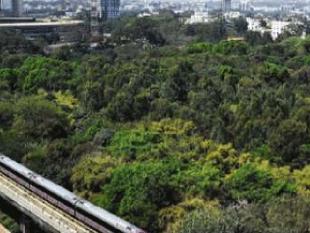
Whose garden is this in the heart of our city?

Bengaluru :

Brigadier who carved the 22-acre Cariappa park out of defence land near MG Road slams colleagues for barring entry to public The man who opened the Army’s doors to Bengalureans has slammed his colleagues for barring the city’s residents from entering the Cariappa Memorial Park in the heart of the city.

(The 22-acre park was meant…)

The 22-acre park was meant to be the Army’s gift to the city but has been closed since 1998, two years after it was inaugurated. A board next to the now-abandoned park’s gate reads: `Restricted area’. The present Army establishment in the state says the park area, categorized as A1 defence land, cannot be made available to the public under Ministry of Defense guidelines.

Brigadier (Retd) Ashok Nagpaul, who established the park on defence land to foster closer interaction between the Army and public, said the Army cannot block entry into the park. “The land not only belongs to the defence but also to the people of Bengaluru,” said the former Commanding Officer for Karnataka and Kerala.

“There was 57 acres of land lying wasted. There were illegal activities like prostitution and other things that used to happen in that area, so I decided to build a parade ground and the park,” Nagpaul, 72, said over the phone from Pune.

A top Army official said that with defence land being rampantly encroached on, the Army cannot afford to give its land for public use.”In 1994 maybe people were not conscious about utilization of defence land, but consequent to which in lots of places we started losing defence land, and … very stringent guidelines were framed that you cannot use defence land for public purposes,” the official told ET, declining to be identified.

Until 1994, the park area was part of a larger parcel of land between Cubbon Road and MG Road.

source:http://www.articles.economictimes.indiatimes.com / The Economic Times / Home> Collection> MG Road / by ET Bureau / February 17th, 2015

Move over coffee, Kodagu now looking at high-value vegetables

IIHR is targeting 35,000 hectares of paddy land mostly left fallow for 6 months to grow vegetables

If things go according to plan, Kodagu, the land of coffee and pepper, may turn into one of the major destinations for high-value vegetable cultivation a few years from now.

A survey conducted by the Indian Institute of Horticultural Research (IIHR) showed that paddy was being cultivated on about 35,000 hectares of plain land in the hilly district of Kodagu. Most of this is being left fallow for six months from October to March after the monsoon. Vegetable experts in the IIHR want to make best use of the land during the “off- season” by motivating people to take up vegetable cultivation.

“It is possible to cultivate vegetables during the off-season as their water requirement is not as huge as paddy,” says A.T. Sadashiva, Principal Scientist in the IIHR’s vegetable Crops’ Division. Also, the weather in Kodagu is similar to that of Ooty, where vegetables are in high demand, he said. Above all, vegetable farming fetches at least one-and-a-half times more returns than paddy, he says.

Preliminary work towards promotion of vegetable cultivation has already begun. The IIHR has developed model farms on about 50 hectares in different areas of Kodagu where high-value hybrid varieties developed by it are being cultivated. “We have also held four field days since 2012 in different areas such as Suntikoppa, where cultivation of different vegetables at the model farms has been showcased. Observing the overwhelming response to such events, we plan to have two more such field days shortly,” he says, while expressing confidence that it may be possible to encourage farmers to take up vegetable cultivation on a minimum of 100 hectares this year.

At present, vegetables like okra, tomato, beans, yard-long beans and chillies are being promoted, while other vegetables such as carrot will be introduced in the next phase, he says. Onion cultivation has also been introduced on an experimental basis.

The marketing network for the vegetables in Kodagu is not advanced. The IIHR is in talks with the State Horticulture Department, which has promised to provide facilities for sale of vegetables in different parts of the district, Mr. Sadashiva says, adding that plans are also afoot to sell the vegetables to other districts and States as and when the production increases.

It is possible to cultivate vegetables during the off-season as their water requirement is not as huge as paddy

A.T. Sadashiva Principal Scientist, IIHR

source: http://www.thehindu.com / The Hindu / Home> News> Cities> Bengaluru / by B.S. Satish Kumar / Bengaluru – February 22nd, 2015