Kodava Champion Hockey League : Bidding of players completed

Mukkatira Poonacha and Pradhan Somanna selected for Rs. 1 lakh each

Virajpet :

The bidding of players for the proposed Kodava Champion Hockey League to be held from Mar. 6 at Ammatti was held at the premises of Kodava Samaj here on Friday. The promoters, coaches and captains of 16 teams including Kaliyanda, Kootanda, Anjaparavanda, Cheranda, Karineravanda, Itteera, Mandepanda, Nellamakkada, Kambeyanda, Kuttanda (Ammatti), Katamada, Chendira, Areyada, Baleyada and Kolera reportedly participated in the bidding process.

Each team was said to have selected six players through bidding — three professionals and three amateurs thus contributing to a total of 96 players.

The bidding process commenced at 10.30 am and was completed by 5.30 pm.

Mukkatira Poonacha, who is in the training camp of Indian Hockey team, was bid for Rs. 1 lakh by Kootanda, Pudiyokkada Pradhan Somanna for Rs. 1 lakh by Areyada, Ajjakuteera Nirmal Chinnappa for Rs. 92,000 by Kootanda, amateur players Somanda Appaiah for Rs. 44,000 by Kartamanda, Kadanda Appanna for Rs. 36,000 by Kaliyanda and Booperanda Muthanna for Rs. 44,000 by Anjaparavanda, according to sources.

source: http://www.starofmysore.com / Star of Mysore / Home> Sports News / February 08th, 2015

‘Coorg’s Burma bamboo shoot is non-poisonous, good to eat’

Though bitter in taste if eaten raw, Dendrocalamus brandisii in Coorg has been since slowly making it to the local menu

Till recently, it was like any other species of bamboo that dotted the vegetation. The locals have for long a fair penchant for the edible varieties of bamboo shoots but no liking for the abundantly available Burma bamboo. Nobody dared to give the bamboo shoot a try for fear of it being poisonous.

The turning point, however, came when a team of scientists from Institute of Wood Science and Technology (IWST) in Bangaluru visited Coorg to propagate the vegetarian properties of Dendrocalamus brandisii. Based on their over a decade long research on the Burma bamboo species, for the first time it was disclosed that bamboo shoot eschewed by the people of Coorg and adjoining areas for over a century in fact is considered among one of the top 10 edible bamboo species in the world.

Unlike the Chinese species, although bitter in taste if eaten raw, Dendrocalamus brandisii in Coorg has been since slowly making it to the local menu list.

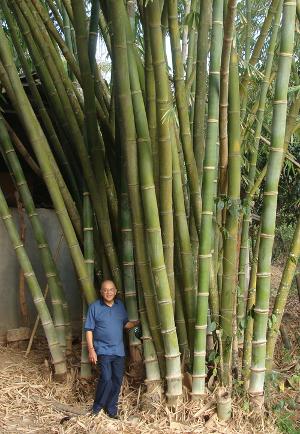
“It is surprising that in Coorg, where this species was first introduced nearly a century back in 1913, the shoots have not been commercially exploited even though shoots of other species like B. bambos and D. strictus found in natural forests in Coorg have been utilised in some form or other. Pickles made from B. bambos are traditionally an important delicacy in Kogadu cuisine,” says senior scientist Dr Syam Viswanath (in pic), spearheading the research at IWST.

BambooKF11feb2015

Much of the ignorance about the high level of edible properties of Burma bamboo has to do with the fact that its value as an edible material has never been recognised in Coorg. The common perception has been that the shoots of the bamboo species are poisonous. Further, absence of any information about the nutritional benefits, processing and consumption of the bamboo shoot have been the main reason for underutilisation of D. brandisii or Burma bamboo.

In China, D. brandisii bamboo shoots species is cultivated in Hangzhou province. The emerging shoots are harvested and after removal of the sheath, it is sliced into thin pieces and consumed raw like salad. In case of D. brandisii in Coorg, the shoots are bitter due to higher content of cyanogenic glucosides and need to be processed before they are ready for consumption.

Sowmya C , Ph.D scholar working on edible bamboo shoots in Tree Improvement and Genetics Division at IWST has found out that the nutritional composition of some of the common bamboo species exploited for edible shoots like B. balcooa, B. nutans, B. polymorpha, Melocanna baccifera found in North-eastern states is on-par with D. brandisii grown in Coorg.

The protein and carbohydrates contents in 100 gm of fresh bamboo shoot are about 2.31gm and 4.90 gm, respectively. Consumption of 100 gm of fresh shoots will supply adequate amount of protein essential for the body. The D. brandisii shoots are also rich in dietary fibre, 4.03 gm/100gm, higher than other commonly available vegetables. Dietary fibres are proven to have beneficial effects on lipid profile. It also helps in management of hypertension and obesity.

Culinary experiments with the Burma bamboo shoots have revealed that simple cooking techniques like pressure cooking and steaming can remove the bitterness in the bamboo shoots in comparatively lesser time than traditional methods like 48-72 hours of soaking in water.

Besides, the newly found edible properties of Burma bamboo by people of Coorg, the culms ofthe bamboo species have long been used in construction works, making of furniture, farm implements, baskets, handicrafts and for making ‘chandraki’ in sericulture industry. The bamboo has also the potential of making incense sticks by the agarbatti industry.

Due to its good physical and mechanical properties and thorn less character, it can be introduced in suitable agro-climatic zones like Coorg for raising compact plantations, in landscaping and in homesteads. Moreover the vegetative propagation of this species using rhizomatous side branches from culms is a simple cost effective multiplication technique according to Dr T.S. Rathore, Head, Tree Improvement and Genetics Division, IWST, Bangalore. IWST has also developed techniques for macro and micro propagation of this species for large scale commercial exploitation.

Director IWST Dr Ramakanth says, “Dendrocalamus brandisii is among the 19 commercially viable bamboo species identified by the National Mission on Bamboo Application (NMBA). This is based on assessment of inherent characteristics of the bamboo found suitable for end users.”

The very fact that it is fast growing, makes Burma bamboo ideal for exploitation in farm forestry and agro forestry in humid tropics. Its good physical and mechanical properties makes it a much sought after species by locals for farm construction, making ladders, fencing, small furniture, basket making and sericulture industry.

“Though National Bamboo Mission (NBM) and NMBA have rightly prioritized Dendrocalamus brandisii, it is essential to ack-nowledge the commercial potential of this underexploited species and aspects of value addition to effectively utilize and popularise this natural bio-resource in other suitable agroclimatic zones of India,” underlines Dr Sunder Naik, retired Indian Forest Service officer and President of Bamboo Society of India.

source: http://www.bangaloremirror.com / Bangalore Mirror / Home> Others> Sci-Tech / by Agencies / February 11th, 2015

Harshika Poonacha to participate on Dancing Star season 2

After Anirudha, Harshika Poonacha, is the latest Sandalwood actress who will participate on a dance reality show, Dancing Star season 2, which will go on air from February 7 on Suvarna. The promo of Harshika Poonacha participating has already been aired on Suvarna.

HarshikaKF10feb2015

The success of the first season of the reality show has made the channel authorities to start the second season which will kick start from this weekend. Actress Rakshita, who was the judge of the first season of the Dancing Star, has decided to not to judge in the second season. The remaining contestants of Dancing Star season 2 is yet to be known.

source: http://www.timesofindia.indiatimes.com / The Times of India / Home> TV> News> Kannada / TNN / February 02nd, 2015

Coorg girl and Kashmiri Boy win Clean & Clear Times Fresh Face 2014 in Mumbai

In a nail-biting national finale, MM Rashmika from MS Ramaiah College of Arts, Science and Commerce, and Zaid Shaikh from Ness Wadia College of Commerce were chosen the winners.

Akshay Kumar with winners

With the handsome Akshay and Rana in their midst and Ankit Tiwari closing the evening with a soulful show, the audience were in for a memorable evening. For the contest, the girls were dressed in creations by designer Masaba Gupta and Nisha Sainani, while the boys sported designer Kunal Rawal’s dapper outfits.

source: http://www.timesofindia.indiatimes.com / The Times of India / Home> Entertainment> Events / by Garima Sharma, TNN / January 28th, 2015

Himachal apples grow well in warm south

Mangaluru :

Can a temperate fruit like the apple be tamed to grow in the tropics?

That it’s a distinct possibility has been shown by Mandi-based senior fruit scientist Chiranjit Parmar, with help from a few farmers in the state. Though experimentation is still at the trial stage without reaching commercial production, it has opened up new possibilities to challenge the dominance of Jammu & Kashmir and Himachal Pradesh over this fruit.

But what’s interesting is that Himachal apple saplings planted here are in a confused state! While apple trees bear fruit in five or six years in Kashmir and Himachal Pradesh, they’ve started flowering and bearing fruit within two years of planting, in Bengaluru and Somwarpet in North Kodagu.

In Dakshina Kannada, retired banker Krishna Shetty is still waiting to savour the fruits of his labour. “They’ve started flowering. I should be able to harvest apples next year,” he says. The prolonged monsoon and pest attack here have stopped them from yielding the desired results, he adds. Shetty planted 50 saplings at his farm in Hirebandady, near Uppinangady.

He said the plant can be grown in regions where the temperature ranges between 10 degree Celsius and 30 degree Celsius. “In Indonesia, growers prune leaves and get about 60 tonnes of apples per hectare. In our country, pruning is not done and the yield is limited to 6 tonnes per hectare. After three years, the yield is still limited. I need further guidance from scientists,” he said.

Calistha D’Silva from Abburkatte, Somwarpet, who planted seven trees three years ago, says one of them bore fruit within the second year, and without much care. “If I’d taken care, they may have yielded better results,” he said. “The fruits were small, but tasty. Parmar, who visited my farm, said the trees have achieved tremendous growth, which would take six years in Himachal.” This year, he’s planting eight trees in his garden.

Nagananda K from Mahalakshmi Layout, Bengaluru, has three apple trees in his terrace garden. “I’ve planted a few on my farm at Basavanahalli, Ramanagaram. The trees here have shown better results with good care, whereas at my farm, it isn’t so encouraging, probably due to lack of care,” said Nagananda. His trees also bore fruit within two years.

What started this experimentation was Parmar’s visit to Batu, Indonesia, situated almost at the Equator. This area has now acquired the reputation of an apple-producing region. After getting inputs from farmers there about this “horticultural wonder”, Parmar started thinking of the possibilities of repeating this in some parts of South India — where there is no winter season.

Shetty says the absence of winter helps growers here get two crops a year, unlike in Kashmir and Himachal Pradesh, since there’s no dormancy due to winter.

During his visit to the United Kingdom in 2010, Shetty saw apple trees in house yards. “I started thinking, why not at my home, but couldn’t get much ahead. Then I saw an article on Parmar in Adike Patrike. That started the whole process,” said Shetty.

Shetty gets his supply of plants from Himachal Pradesh, and a consignment of 2,500 saplings of five varieties reached him on Monday. “Earlier, there were takers for about 500 saplings, and the numbers are growing. Unfortunately, those who take saplings don’t give me feedback,” he said.

As of now, in Karnataka, apples are being grown on a trial basis in Dakshina Kannada, Kodagu, Tumkur, Bengaluru, Tarikere, Vijayapura and Chamarajanagar.

“The experiment has been a success. We’ve sought inputs from the University of Agricultural Sciences, horticulture department, to find out which variety is suitable for commercial cropping. But there’s been no response,” adds Shetty.

With Kodagu, a major coffee growing district, welcoming the entry of apple cultivation, success has been partial in some villages in Somwarpet taluk. Horticulture department senior assistant director Sudheendra Rao told TOI that officially, Kodagu is not an apple zone, but some growers cultivate them out of interest.

TP Sandesh, agricultural standing committee chairman of Kodagu Zilla Panchayat, got a few planted in his farm at Madapur village. As did Shashikala Raj of Masagodu village in Somwarpet. They claim the plants are flowering but the blossoms are falling without yielding fruit. Other small farmers, like Kushalappa of Kamballi village and Puttaraju of Sulimalthe, say the yield is poor.

“If the department takes interest, apples could become a good support crop in Kodagu,” the farmers say.

source: http://www.timesofindia.indiatimes.com / The Times of India / Home> City> Mangaluru / by Stanley Pinto, TNN / February 04th, 2015

Kashmiri apples flourish in the warmth of Karnataka

Mangaluru / Madikeri :

Can a temperate fruit like the apple be tamed to grow in the tropics?

That it’s a distinct possibility has been shown by Mandi-based senior fruit scientist Chiranjit Parmar, with help from a few farmers in the state. Though experimentation is still at the trial stage without reaching commercial production, it has opened up new possibilities to challenge the dominance of Jammu & Kashmir and Himachal Pradesh over this fruit.

But what’s interesting is that Himachal apple saplings planted here are in a confused state! While apple trees bear fruit in five or six years in Kashmir and Himachal Pradesh, they’ve started flowering and bearing fruit within two years of planting, in Bengaluru and Somwarpet in North Kodagu.

In Dakshina Kannada, retired banker Krishna Shetty is still waiting to savour the fruits of his labour. “They’ve started flowering. I should be able to harvest apples next year,” he says. The prolonged monsoon and pest attack here have stopped them from yielding the desired results, he adds. Shetty planted 50 saplings at his farm in Hirebandady, near Uppinangady.

He said the plant can be grown in regions where the temperature ranges between 10 degree Celsius and 30 degree Celsius. “In Indonesia, growers prune leaves and get about 60 tonnes of apples per hectare. In our country, pruning is not done and the yield is limited to 6 tonnes per hectare. After three years, the yield is still limited. I need further guidance from scientists,” he said.

Calistha D’Silva from Abburkatte, Somwarpet, who planted seven trees three years ago, says one of them bore fruit within the second year, and without much care. “If I’d taken care, they may have yielded better results,” he said. “The fruits were small, but tasty. Parmar, who visited my farm, said the trees have achieved tremendous growth, which would take six years in Himachal.” This year, he’s planting eight trees in his garden.

Nagananda K from Mahalakshmi Layout, Bengaluru, has three apple trees in his terrace garden. “I’ve planted a few on my farm at Basavanahalli, Ramanagaram. The trees here have shown better results with good care, whereas at my farm, it isn’t so encouraging, probably due to lack of care,” said Nagananda. His trees also bore fruit within two years.

What started this experimentation was Parmar’s visit to Batu, Indonesia, situated almost at the Equator. This area has now acquired the reputation of an apple-producing region. After getting inputs from farmers there about this “horticultural wonder”, Parmar started thinking of the possibilities of repeating this in some parts of South India — where there is no winter season.

Shetty says the absence of winter helps growers here get two crops a year, unlike in Kashmir and Himachal Pradesh, since there’s no dormancy due to winter.

During his visit to the United Kingdom in 2010, Shetty saw apple trees in house yards. “I started thinking, why not at my home, but couldn’t get much ahead. Then I saw an article on Parmar in Adike Patrike. That started the whole process,” said Shetty.

Shetty gets his supply of plants from Himachal Pradesh, and a consignment of 2,500 saplings of five varieties reached him on Monday. “Earlier, there were takers for about 500 saplings, and the numbers are growing. Unfortunately, those who take saplings don’t give me feedback,” he said.

As of now, in Karnataka, apples are being grown on a trial basis in Dakshina Kannada, Kodagu, Tumkur, Bengaluru, Tarikere, Vijayapura and Chamarajanagar.

“The experiment has been a success. We’ve sought inputs from the University of Agricultural Sciences, horticulture department, to find out which variety is suitable for commercial cropping. But there’s been no response,” adds Shetty.

With Kodagu, a major coffee growing district, welcoming the entry of apple cultivation, success has been partial in some villages in Somwarpet taluk. Horticulture department senior assistant director Sudheendra Rao told TOI that officially, Kodagu is not an apple zone, but some growers cultivate them out of interest.

TP Sandesh, agricultural standing committee chairman of Kodagu Zilla Panchayat, got a few planted in his farm at Madapur village. As did Shashikala Raj of Masagodu village in Somwarpet. They claim the plants are flowering but the blossoms are falling without yielding fruit. Other small farmers, like Kushalappa of Kamballi village and Puttaraju of Sulimalthe, say the yield is poor.

“If the department takes interest, apples could become a good support crop in Kodagu,” the farmers say.

source: http://www.timesofindia.indiatimes.com / The Times of India / Home> City> Bengaluru / by Stanley Pinto, TNN / February 04th, 2015

Air India, PSPB triumph

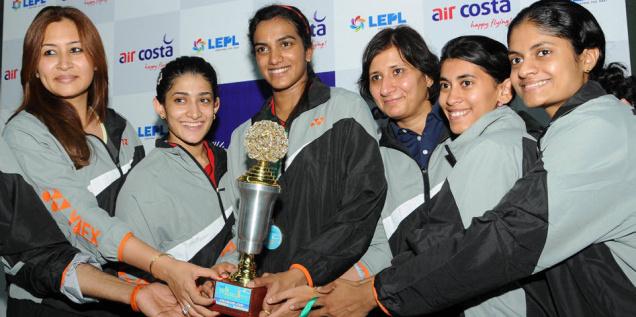
ALL SMILES: The PSPB women, led by World No. 10 P.V. Sindhu (third from left), clinched the Chadha Cup for the 15th consecutive time. Photo: Ch. Vijaya Bhaskar / The Hindu

Air India finally ended the winning streak of Petroleum Sports Promotion Board (PSPB) in the national team championship for men, scoring a 3-2 victory in the Air Costa 70th inter-State, inter-zonal team championship here on Sunday.

Harsheel Dani, fighting a back injury, suffered a slight wobble before ejecting Grand Prix gold medal winner H.S. Prannoy 18-21, 21-17, 21-12. Sameer Verma, who lost the first game, bounced back to defeat B. Sai Praneeth 18-21, 21-11, 21-17.

Stunned by two back-to-back losses, Srikanth joined hands with Pranaav Jerry Chopra to quell Shlok Ramachandran and Sanyam Shukla’s challenge 21-15, 21-17, and later got the better of Aditya Joshi 21-15, 21-12 to make the scoreline 2-all.

PSPB women, led by World No. 10 P.V. Sindhu, wrested the title for the 15th consecutive time, getting the better of Telangana, which was making its maiden entry into the final.

Sindhu scored a 21-15, 21-16 victory over Rithvika Shivani and later, partnering Ashwini Ponnappa, tamed J. Meghana and Rituparna Das 21-14, 5-21, 21-11. Doubles specialist G. Jwala did not participate in the final owing to a stiff neck.

The results: Team championship: Rahimtoola Cup: Final: Men: Air India bt PSPB 3-2 (Harsheel Dani bt H.S. Prannoy 18-21, 21-17, 21-12; Sameer Verma bt Sai Praneeth 18-21, 21-11, 21-17; Shlok Ramachandran & Sanyam Shukla lost to Pranaav Jerry Chopra & K. Srikanth 15-21, 17-21; Aditya Joshi lost to K. Srikanth 15-21, 12-21; Akshay Dewalkar & G. Gopi Raju bt K. Tarun & B. Sai Praneeth 18-21, 21-19, 21-14). Semifinals: PSPB bt Kerala 3-1 (H.S. Prannoy bt Alwin Francis 21-15, 21-16; B. Sai Praneeth bt Shyam Prasad 21-7, 15-21, 21-6; K. Tarun & Arun Vishnu lost to Sanave Thomas & K.T. Rupesh Kumar 12-21, 25-27; K. Srikanth bt K. Dilshad 21-14, 21-14).

Air India bt Maharashtra 3-1 (Harsheel Dani lost to Subhankar Dey 21-18, 17-21, 19-21; Sameer Verma bt Kabir Kanzarkar 21-9, 21-9; Shlok Ramachandran & Sanyam Shukla bt Kabir Kanzarkar & Akshay Raut 21-18, 21-8; Aditya Joshi bt Nigel D’Sa 21-17, 21-9).

Chadha Cup: Final: Women: PSPB bt Telangana 2-0 (P.V. Sindhu bt G. Ruthvika Shivani 21-15, 21-16; Ashwini Ponnappa & Sindhu bt J. Meghana & Rituparna Das 21-14, 5-21, 21-11). Semifinals: PSPB bt Airports Authority of India 2-1 (P.V. Sindhu bt Rasika Raje 21-11, 21-4; G. Jwala & Ashwini Ponnappa lost to Pradnya Gadre & N. Sikki Reddy 16-21, 20-22; P.C. Thulasi bt N. Sikki Reddy 4-3 retd).

Telangana bt Maharashtra 2-0 (Rituparna Das bt Neha Pandit 21-19, 21-17; J. Meghana & Rituparna Das bt Mudra Dhainje & Shruti Mundada 21-16, 21-19).

source: http://www.thehindu.com / The Hindu / Home> Sport> Other Sports / by J.R. Shridharan / Vijayawada – February 01st, 2015

Radhika Apte in Anurag Kashyap and Phantom films’ Hunterrr

Radhika Apte did Hunterr for its edgy script. She’s paired opposite Gulshan Devaiah and the film is produced by Anurag Kashyap and Phantom films.

Rdhika Apte is one actress who for sure loves to do challenging roles. She is keenly awaiting the release of Badlapur and will also soon be seen opposite Gulshan Devaiah in a film titled Hunterrr which releases on March 20.

Radhika Apte
Radhika Apte

While the film deals with a lot of sex, Radhika feels that is where the humour of the film lies subtly. Speaking on the occasion of the trailer being launched yesterday digitally, Radhika said, “When I read the script of Hunterrr, I had my mouth open in shock through the time. But I think was the best part of if. The edginess of the movie brings out some great and not on the face humour.

The unapologetic approach of the movie’s story is something that really appealed to me and I am excited to see what people think of it. It’s definitely one of those really crazy films one will see”.

source: http://www.timesofindia.indiatimes.com / The Times of India / Home> Entertainment> Hindi> Bollywood / TNN / February 02nd, 2015

Gonimaroor school gets Parisara Mitra award

GonimarurKF02feb2015.jp

Gonimarur school has bagged the district level Parisara Mitra award given by Karnataka State Pollution Control Board, Kodagu district administration, Bharath Scouts and Guides and Karnataka State Legal Services Authority, for the year 2014-15.

One hundred eighty one schools, across the district, had applied for the award. 21 schools have been selected among them.

10 schools will be identified as yellow schools and will be awarded Rs one thousand cash prize, certificate and shield, 10 schools will be known as green schools and will get Rs two thousand cash prize and shield and Gonimaroor school will be recognised as Parisara Mitra school with Rs ten thousand cash prize, certificate and shield. The school which started in 1968, has 68 students from first to seventh standard.

Around 50 variety of flower bearing plants have been grown in the school garden. Each students has been given responsibility of a plant and the plant is named after the student, with a tag on it.

The students look after the plant and water the plant every day. The vegetables required for the mid-day meals are grown by the students themselves. There are more than 101 trees including mango, jack fruit, gooseberry and neem trees, all planted and grown by students. The dry leaves are collected by students to prepare organic manure. Also, there are medicinal plants. The toilets at the school are well maintained.

The natural wind are light are utilised at its best and also, the water management is efficiently done. Last year, the school had won the second place in the district level.

The school has also bagged district level awards twice in science modeling. The school has a library which is managed by students themselves.

The school development and management committee comprises 13 members as is presided by Siddalingappa. The committee has provided sports equipment to the students.

S P Mareena is working as the Headmistress of the school and there are four teachers including H R Sunitha and Nagaveni. School teacher H S Rajappa said that the Parisara Mitra award is the outcome of the contributions and hard work of students, teachers and the school development and management committee.

source:http://www.deccanherald.com / Deccan Herald / Home> District / Somvarpet – DHNS, January 31st, 2015

116th birth anniversary of Field Marshal K.M. Cariappa in city

CariappaKF01feb2015

Mysuru :

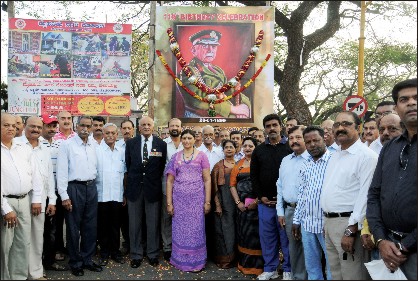
Marking the 116th birth anniversary of Field Marshal K.M. Cariappa, the Mysuru Kodava Samaja had organised a function at Field Marshal K.M. Cariappa Circle (Metropole Circle) here this morning.

Earlier, the gathering offered floral tributes to the portrait of the Field Marshal.

Speaking on the occasion, Maj. Gen. (retired) C.K. Karumbaya said that Field Marshal Cariappa was an epitome of discipline and hard work, who should be taken as a role model by the youth.

Corporator M.J. Ravi Kumar sought a war memorial and a statue of the great soldier in city.

Kodava Samaja President M.M. Karumbaiah, office-bearers and members of the Samaja and also of the Kodava Samaja Cultural and Sports Club were present at the programme along with some public. On the occasion, sweets were distributed.

source: http://www.starofmysore.com / Star of Mysore / Home> General News / January 28th, 2015