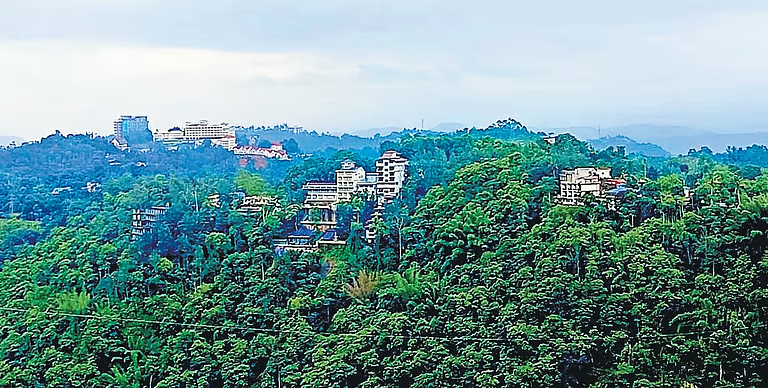
Kodagu SP K Bindu Mani convened a meeting with owners of hotels, resorts, homestays, and travel agencies to reinforce safety protocols for tourists.
Image used for representational purposes only.
Madikeri :
Homestay owners in Kodagu have called on the state government to take immediate action against more than 2,000 illegal homestays operating in the district.
The demand comes in the wake of a sexual assault on a US tourist at a registered homestay in Kutta, which has raised serious concerns about tourist safety.
Speaking at a press conference in Madikeri, members of the Kodagu District Homestay Association also urged the government to fill the vacant post of Deputy Director of the Tourism Department.
Association president Monthi Ganesh said the lack of proper oversight has left many tourism operators without guidance and contributed to illegal activities in the sector.
“The district is a major tourist hub, with thousands of homestays and numerous resorts. Yet, the post of Deputy Director has been vacant for several months, which hampers proper regulation,” Ganesh said.
She emphasised that strict enforcement against illegal homestays is essential, including police action to ensure visitor safety.
Association member KM Karumbaiah revealed that while 2,470 homestays are officially registered, over 2,000 others are operating without authorisation. Members also raised concerns about tourists being misled by brokers near bus stands and other public spaces, who direct them to illegal accommodations.
Condemning the recent assault at Devi Villa homestay in Kutta, Ganesh noted that the facility was registered with the tourism department. She argued that the Deputy Commissioner could have suspended the license instead of cancelling it outright, given that the case is still under investigation.
Police Strengthen Tourist Safety Measures
Kodagu SP K Bindu Mani convened a meeting with owners of hotels, resorts, homestays, and travel agencies to reinforce safety protocols for tourists.
The SP instructed owners to comply with the law and warned that they would be held accountable for any illegal or criminal activity on their premises.
Facility owners were instructed to submit complete staff details and, in the case of foreign guests, file a C Form at the nearest police station.
Similar meetings were held across the district by local police stations, focusing on the implementation of safety measures for visitors to the region.
source: http://www.newindianexpress.com / The New Indian Express / Home> Karnataka / by Express News Service / April 26th,2026
Forest Minister Eshwar B Khandre said the SOP has been issued to ensure trekkers’ safety.
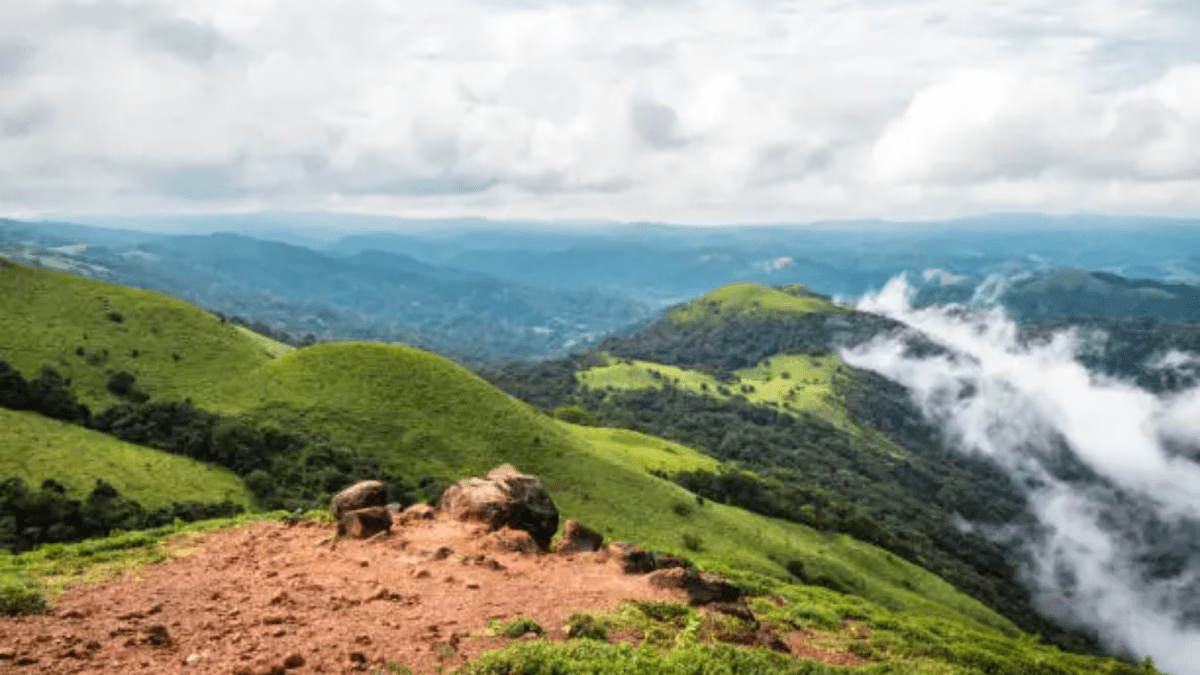
A rainforest trail through the Western Ghats in Kudremukh, Karnataka. (File Photo)
Following a series of recent safety incidents in forested trekking routes, the Karnataka government recently introduced a comprehensive Standard Operating Procedure (SOP) mandating that no individual can trek on notified forest trails without a certified nature guide. Trekking in forest areas will now be fully regulated and allowed only with a permit.
Forest Minister Eshwar B Khandre said the SOP has been issued to ensure trekkers’ safety, improve monitoring, and enable faster emergency response in case of accidents or missing persons. The directive comes close on the heels of a Kerala woman surviving three days after losing her way during a trek to Tadiyandamol in Kodagu.
Under the new framework, trekking without a guide will not be permitted under any circumstances. Each group will be accompanied by a certified nature guide, with a fixed ratio of one guide for every 10 trekkers. Authorities have also capped the number of trekkers at 150 per trail per day, while making prior online registration compulsory. The minister clarified that even if a single person registers for a trek on a given day, a guide will be assigned, but solo trekking will not be allowed.
Technology-based monitoring and safety measures
Trekkers will be required to install a temporary mobile tracking application for real-time location monitoring by forest officials. Guides will be equipped with GPS-enabled walkie-talkies and instructed to maintain regular communication with base camps.
Guides will be responsible for keeping the group together, ensuring no trekker moves ahead or falls behind. Mandatory headcounts will be conducted at checkpoints and rest points, while base camp staff will follow up in case of communication delays.
In case of emergencies, a forest officer said, “The group will immediately halt, and a headcount will be taken. The guide will alert the base camp with the exact location and situation report, following which rescue teams will be mobilised.” The Range Forest Officer (RFO) will then coordinate with district administration and the police, deploying drones, thermal cameras, and additional manpower if required.
Officials said all trekking routes will now be clearly marked with colour-coded signs, while hazardous stretches such as cliffs, steep slopes, and water crossings will be marked in red. Route maps, including details of mobile network dead zones, will also be made available online and through a mobile application. Trekkers will additionally be provided with designated rest points along clearly marked trails.
Minors will require parental consent, while senior citizens must submit fitness certificates before undertaking treks. All approved trekking routes under the Forest Department will be integrated into a central online booking platform to streamline access and regulate visitor flow. Group insurance for trekkers is also being considered, along with mandatory first-aid kits for guides.
The SOP also prohibits carrying loud devices, weapons, sharp objects, and single-use plastics. Campfires and flash photography will not be allowed, and trekkers must carry back all waste for disposal at base camps.
source: http://www.indianexpress.com / The Indian Express / Home> News> Cities> Bangalore / by Express News Service / April 18th, 2026
The book is rich with vivid details and engaging snippets from history and mythology.
The War Elephants of Trigarta By: Sarita Mandanna Publisher: Aleph Pages: 192 Price: Rs499
The War Elephants of Trigarta by Sarita Mandanna is part of the Bold Chronicles series, which aims to awaken a love of history and storytelling among the next generation. Inspired by fascinating moments from India’s rich and layered past, as well as world history, the series uses engaging storytelling to capture the attention of youngsters who are often absorbed in gadgets and reluctant to engage with anything beyond reels or apps. It is an uphill task, but Mandanna manages it with dexterity and humour, delivering a rich and enjoyable narrative that plants seeds of curiosity about history while also offering insight into the present.
At the heart of the story is the delightful Mili, the daughter of Raja Puru’s general, who is in charge of training and caring for the war elephants that are the pride of Trigarta. She forms a bond with a rare white elephant, whom she names Nathu. Over time, Mili becomes an unlikely but important player in the looming war led by the formidable Alexander the Great, culminating in the legendary Battle of the Hydaspes. As her father often says, and Mili repeats, “Never too old, and never too young!”
The book is rich with vivid details and engaging snippets from history and mythology. Readers encounter the fate of beautiful Parsa, or modern-day Persepolis, and the well-known story of how Alexander tamed the wild horse Bucephalus, who became his trusted companion. There are also references to Supratika and Sangram, the elephant heroes of mythology and history. In contrast, Nathu proves difficult to train and is a constant source of frustration. Even the general calls him a “donkey of a stubborn elephant,” much to Mili’s annoyance.
There is also a hilarious episode involving Nathu, a basket of stolen turnips, and an unfortunate bout of flatulence at the worst possible moment. At the end of it, Mili asks her father a question that is both innocent and amusing: “The royal family. Do they fart—I mean, do they pass wind too?”
However, the story is not all light-hearted. Given the subject, and Alexander’s well-known ruthlessness, the narrative does not shy away from darker realities. Mandanna presents these events in a way that is accessible to younger readers without losing their seriousness. As news arrives of Alexander sacking yet another rebel city, Mili repeatedly asks her father, “What happened to the children in the mercenary camp, Baba?”
The danger and horror of war feel immediate and real for Mili and those around her, as the Macedonian army advances. Yet, her courage stands strong. Like the great figures of history, she uses her intelligence and resilience to make a real difference in a world torn apart by conflict and ambition.
This is an irresistible story that will appeal not only to young readers but to anyone who enjoys a gripping and well-told tale.
source: http://www.newindianexpress.com / The New Indian Express / Home> Books / by Anuja Chandramouli / April 19th,2026
While trekking up mountains is a passion for many, a youth from Kodagu has taken that passion to an extraordinary level by climbing the district’s highest peak a hundred times.
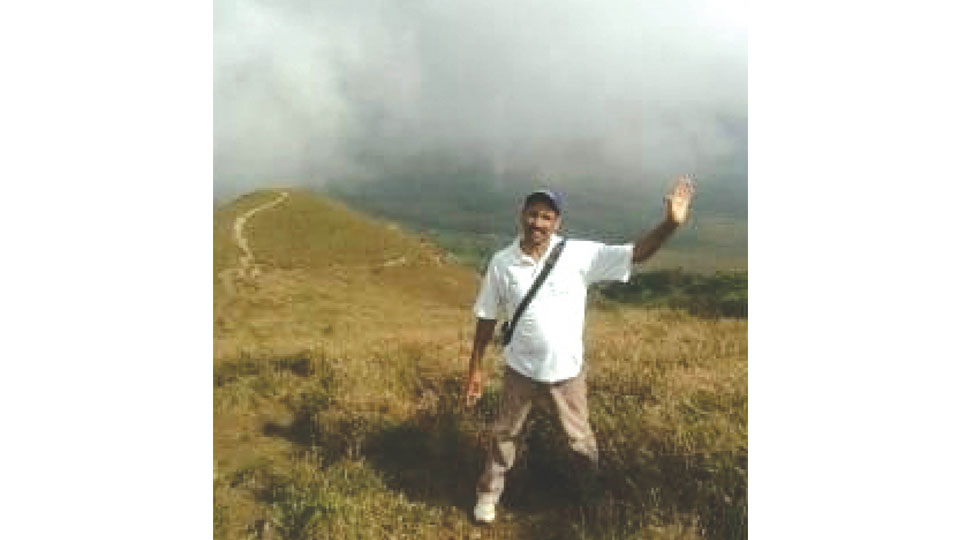
Areyada Girish Thimmaiah from Paadi village near Napoklu has achieved the rare feat of scaling Thadiyandamol, the tallest mountain in Kodagu, 100 times.
Rising to a height of 1,748 metres above sea level in the Western Ghats, Thadiyandamol is considered one of the most challenging treks in the region. Climbing it even once requires endurance and determination. Doing it a hundred times is a remarkable accomplishment.
Girish’s fascination with the mountain dates back to the early 1990s. Around 1994, when foreign tourists frequently visited Kodagu to trek to Thadiyandamol, their enthusiasm inspired him to take up the challenge. What began as curiosity soon turned into a lifelong passion.
However, the journey was not without setbacks. A few years ago, Girish had to stop trekking altogether after undergoing spinal surgery.
“Climbing up is easier, but descending is far more difficult. Perhaps the strain during the descent worsened my back pain,” he recalled.
The trek to Thadiyandamol is also known for its wildlife encounters. Trekkers often come across herds of elephants, darting deer, tiger tracks and droppings, and the forest’s sharp scent.
“To keep wild animals away, we shout, clap and make noise while trekking. At times, it feels like life itself is at risk, but that is what makes the experience so thrilling,” Girish said.
Girish is the son of Areyada Ponnappa Ganapathi and Lakshmi Subbavva. He completed his education at Maharaja’s Junior College under the University of Mysore.
source: http://www.starofmysore.com / Star of Mysore / Home> News / April 03rd, 2026
Across Coorg, estate owners are opening up their beautiful homes to guests. A local shares her favourite stays.
Early mornings are the busiest hours on the plantations across Coorg. Through the year plantation activities like coffee, pepper and cardamom picking carry on, followed by drying, pulping and roasting that mark the end of the crop harvest. As I walk through the estate, the pulped coffee bean emits a peculiar fermented smell. It eventually grows on you. Soon, with the season of sprinkling and irrigation will deliver a beautiful coffee blossom, and scents of mogra and jasmine will fill the air. It is at times like this when I feel prosperous and grateful for this abundance as a farmer on my estate.
Indian robusta coffee in Coorg / Pixeled moments/Adobe Stock
There is nothing more fulfilling than enjoying the fruits and crops of your own land. My grandmother would make marmalade from the kaipuli (bitter oranges) on our estate, butterfruit (avocado) with sugar was dessert in the monsoon, rice from our paddy fields made for putts and for tea time she made the best baalé nurk (banana fritters).
By sunset, we’d have to return home from a long day’s work; the fear of wild animals kept us and continues to keep us indoors after dark. The fire is lit to bathe in the traditional bath areas called gudda (with firewood heated water) and cooking for the night commences. Sights of fireflies in the summer and the sounds of crickets in the monsoon are the alarms to finally call it a night on the plantation.
Amni / The Avocado Cows
Most plantation homes are secretly tucked away in the middle of coffee estates and wild foliage. Over here, our nearest neighbour is kilometres away, and roads can be inaccessible. Jeeps and heavy vehicles are our means of transport, gumboots and leeches are our friends, and dogs on the estate are our protectors from wildlife attacking our crops. Over time, plantation owners in Coorg have gone from entertaining friends, relatives and neighbours to extending their hospitality to guests. Homes have expanded, there’s often an annexe, and guests are invited to stay and experience the traditional ‘Coorg life’. Those who used to cook up a storm and have a heaving table for friends and family are now creating food and immersive experiences for guests. Most of these homes, built in Kodava-colonial or traditional styles, have recently become my benchmark for the old ways of Coorg hospitality, and are among my favourite plantation stays in Coorg.
Amni
Amni / The Avocado Cows
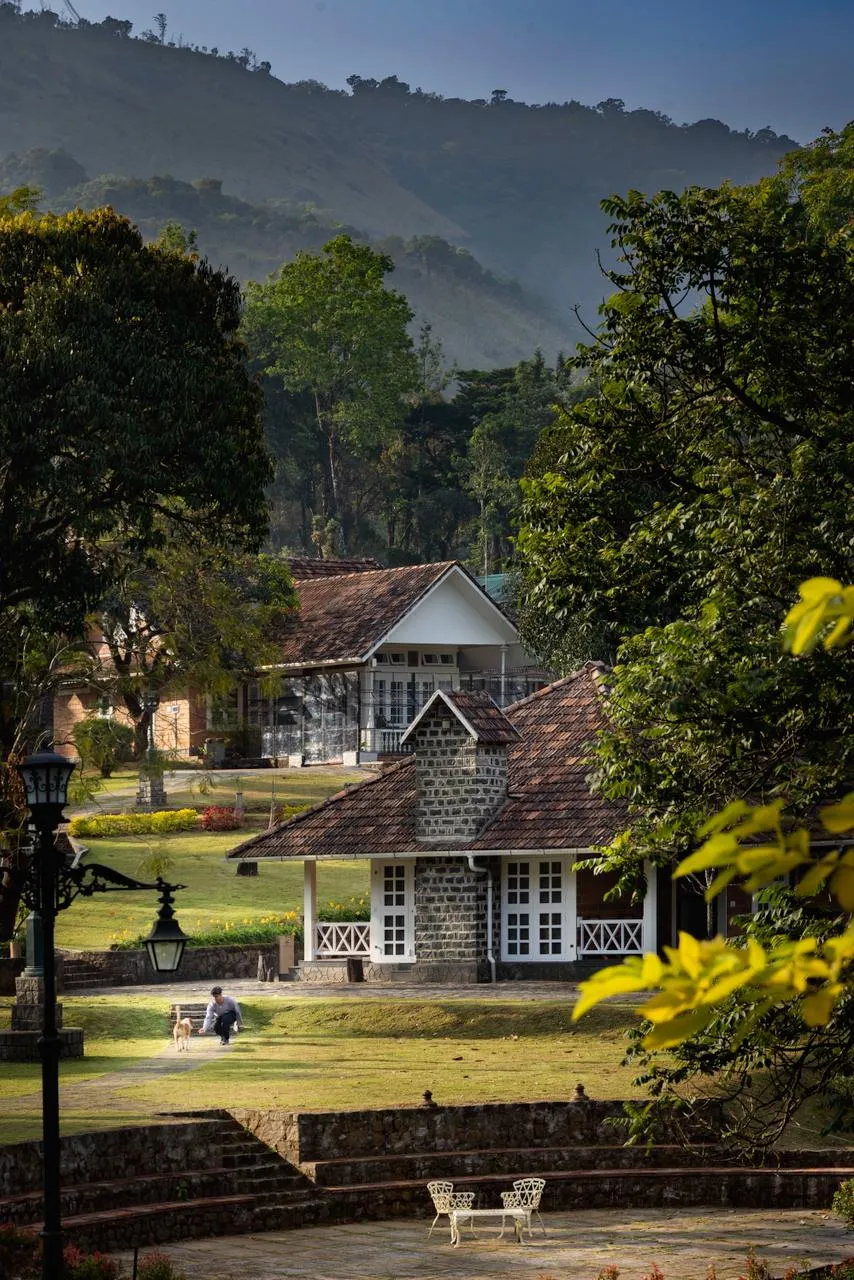
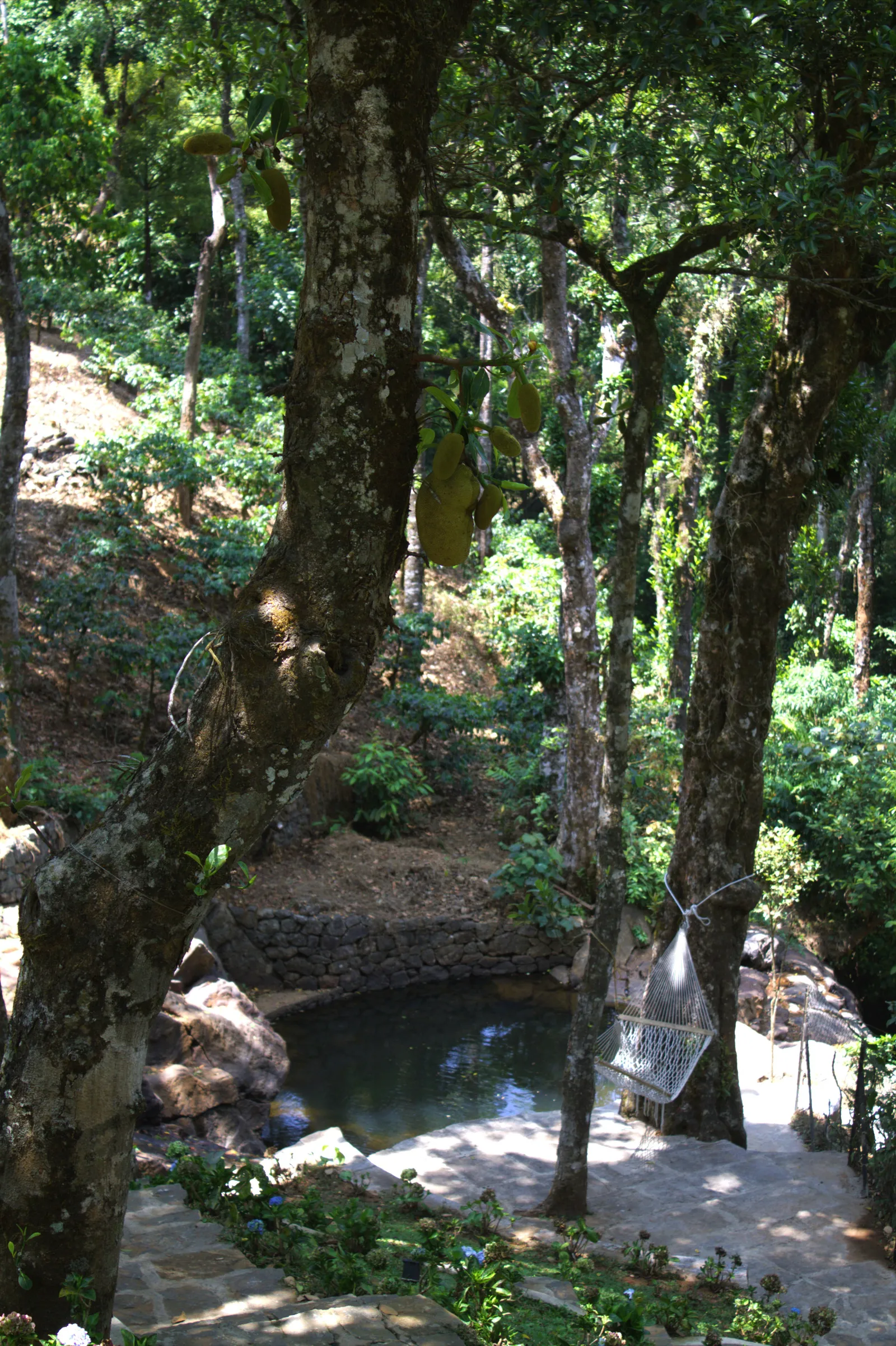
When I first drove towards Amni, Abraham Jose picked me up in his jeep half way. I soon realized the road was not fit for my vehicle. The drive was rocky, and along the way we spoke about all the dishes his mother was preparing for me. Enroute, I was also asked to keep the location of his stay discreet, probably the real reason why he insisted on picking me up, so I would forget the route more easily. The Amni estate is stunning: a charming view of stone cottages across pearl grass, built across multiple levels that look like small grass mounds, where chimneys peep out between the foliage against the backdrop of the Balyaatra range, like something straight out of a Jane Austen novel. Abraham, his parents Rosy and Jose, his two brothers Joseph and Mathew, his wife, Ria, and their grandmother whom they fondly call Ammini, live here. Twenty five years of collecting stone and cast iron antiques like a fountain-mouthed gargoyle, Victorian lamp posts and railway sleepers for a table base add to Amni’s personality. This is a two bedroom stay, equipped with extra beds for a total of five to six members. Overlooking a stone amphitheatre and the Thatacherry estate hills cladded with Arabica and Robusta plantations, the homestay is 30 meters away from the family’s own cottage. A tiled porch with a picket fence offers independent entrances to both rooms. Rooms unfold in a palette of jade frost, pastels, and floral prints. A fireplace in the common room is the cosiest nook for you to curl up in the monsoon and winter months.
Room details / Sitara Cariappa
Stone pool at Amni / Sitara Cariappa
The Paati Polé river flows through the check dam in front of their home, with bridges across it leading up to a stone pool at a lower level of the estate. When Rosie Aunty called us back up for lunch, Zeiss, their dog, accompanied us as we walked up the stone pathway. Under the shade of a pine tree is an antique white stone washbasin with floral tiles and brass fittings. Next to it, a heavy wooden table and iron-carved chairs under the dancing branches of a mango tree is the setting for our meal. The spread includes Surmai fry, Prawn gassi, Kaaké Thopp paliya (black nightshade), Rasam and Rice–a typical Syrian Christian spread, inspired from their roots near Kottayam. I ate three servings. As we ate fresh strawberries from their farm behind the house, served with cream, the Jose family told me of their journey from Kannur to Coorg, their love for fishing and cooking; and fulfilment in life with four generations living together in this beautiful estate. Doubles from Rs 12,000 per night for two (includes all meals, BBQ, immersive experiences like treks, birdwatching, stargazing and jam making, all led by the Jose family) Location On request; Contact: Abraham Jose, +91 85475 86562; IG: @amni.coorg
School Thota
The homestay and host Saraswathi / Sitara Cariappa
My friend Kelapanda Kushalappa, whom I fondly call Sajan, and his mother Saraswathi Aiyappa, have been custodians of the homestay culture in Coorg for the past 15 years. Generations of this family have lived in the Robusta plantation’s home for almost 150 years. This plantation was initially run by the East India Company, who organized coffee cultivation in Coorg and sent the proceeds from these estates or thota to British-run schools in Coorg, hence the name School Thota. Originally the home of Rev. Georg Richter in 1855, the property was bought by Kushalappa’s great grandfather in 1908. Today a portion of the estate is where mother and son reside and continue to manage the plantation operations and run this homestay.
I entered School Thota through the small town of Guyya, crossing multiple TATA-consolidated plantations and arrive at a large bungalow overlooking a garden with a bird bath, an elevated gazebo surrounded by hydrangea, fern and hedge roses, and beyond, the Kelapanda family’s prosperous estate. On a clear day the hills of Mercara are visible too.
The upstairs bedroom space / Sitara Cariappa
Bedroom School Thota
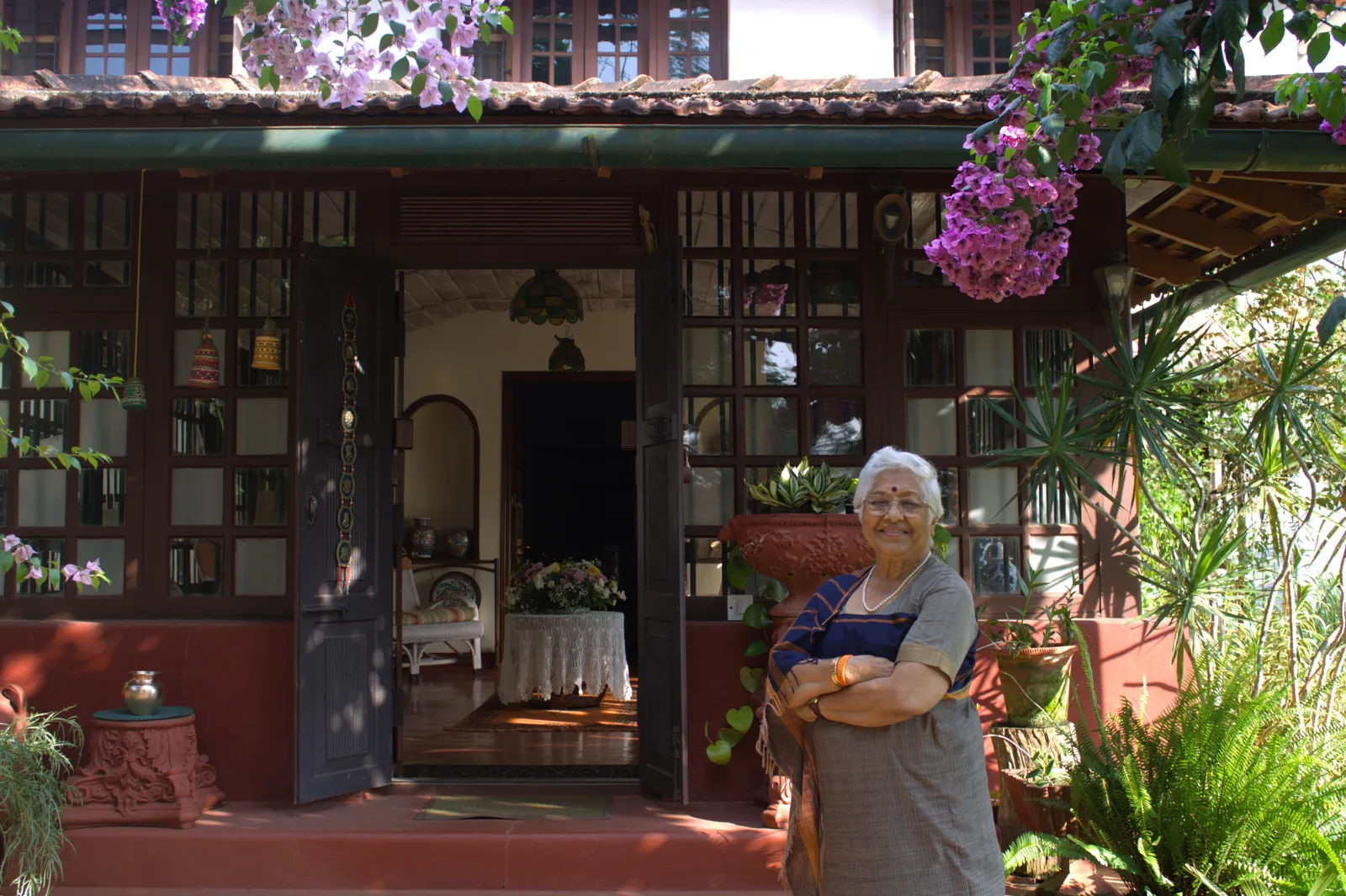
School Thota is a charming home with three guestrooms (excluding the owner’s space), five bathrooms, an attic and two kitchens. A sun room with square windows is a standout section in this home, at its entrance the bougainvillea trees is where Saraswathi Aunty welcomed me, wearing a Kodava podiya (a Coorg-style draped saree).
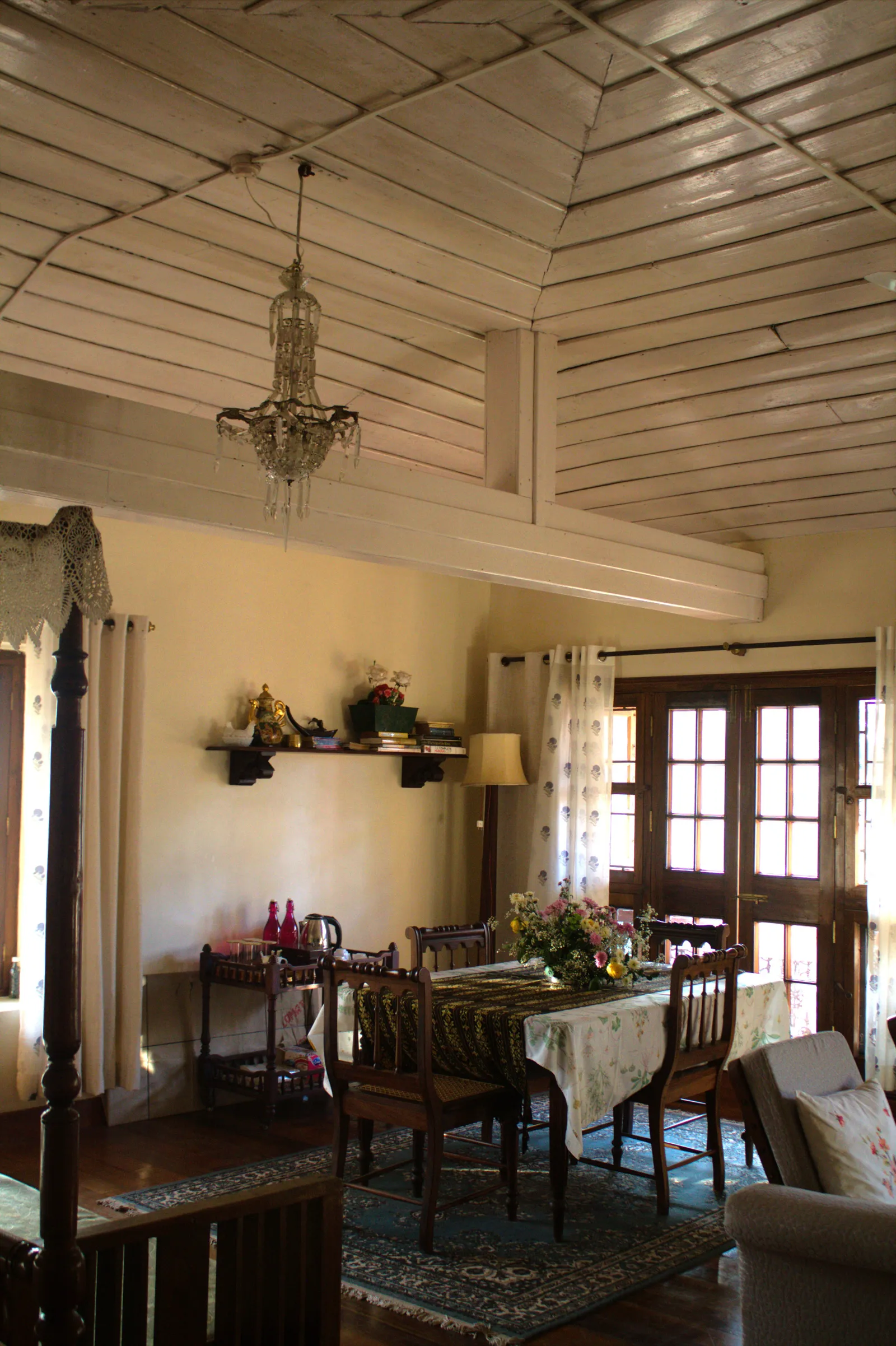
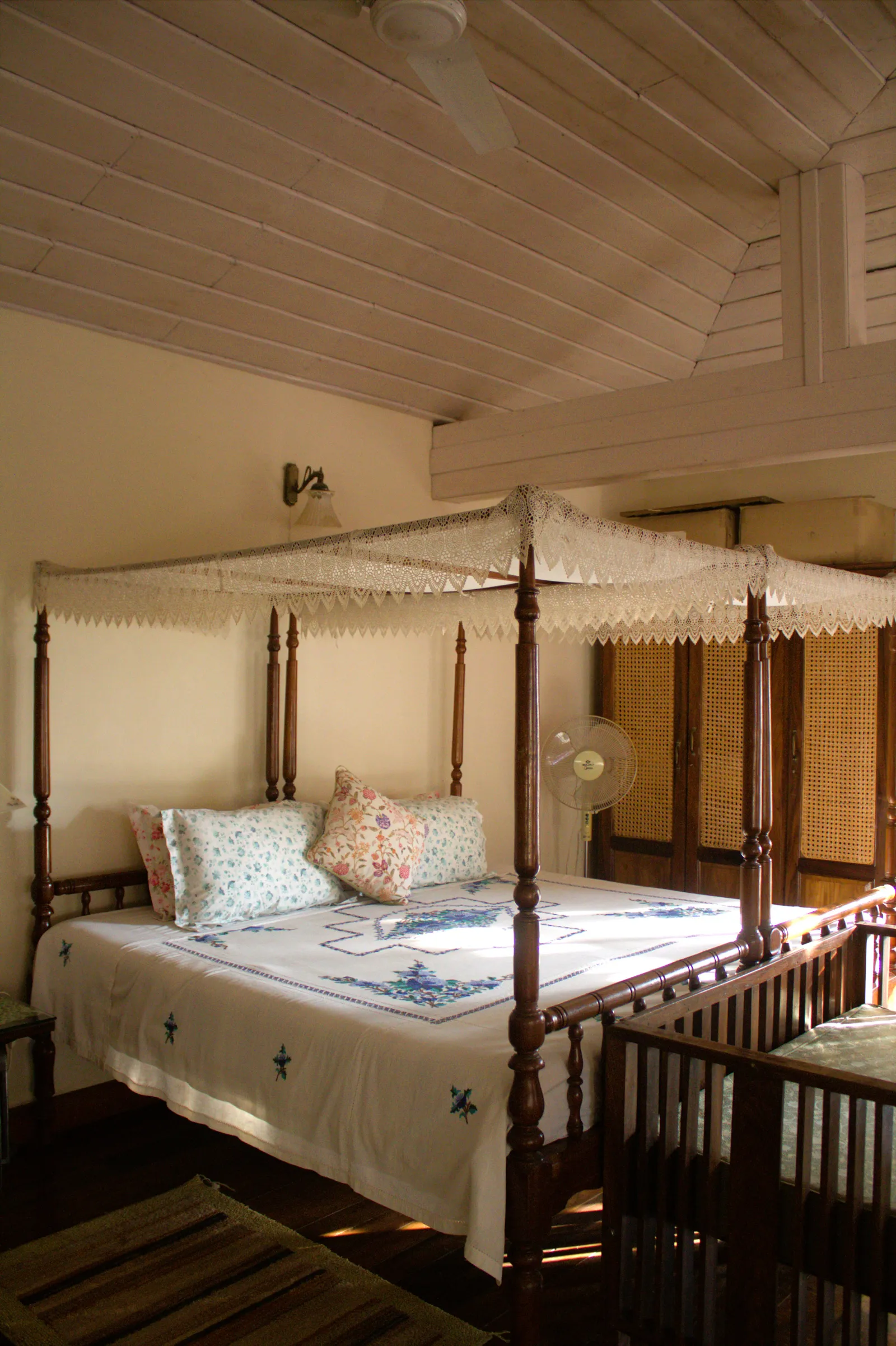
This home is studded with antiques, art work by the family, crochet and lace on tables made by Saraswathi Aunty, vintage hat racks and tapestry on the walls. There’s a large fireplace in the drawing room with a mantlepiece lined with family photos, and each room thereafter has height-adjustable chandeliers and pulley lamps. Each guestroom has a four poster bed, dressing table, pull out vintage writing desk, and ceramic animal figurines in the bathrooms.
Kooléputt with Ghee / Sitara Cariappa
Kadambutt with Pandhi Curry / Sitara Cariappa
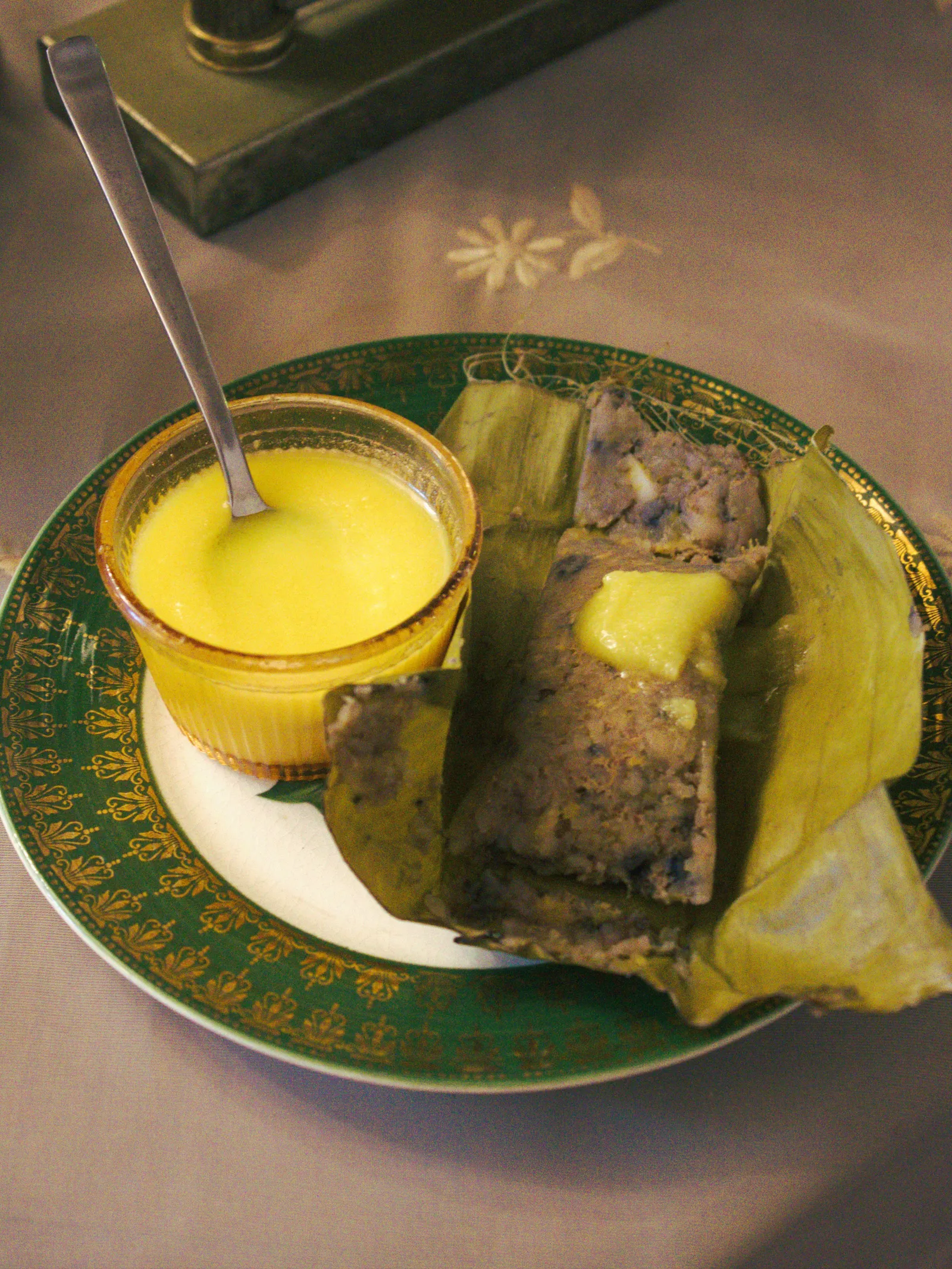
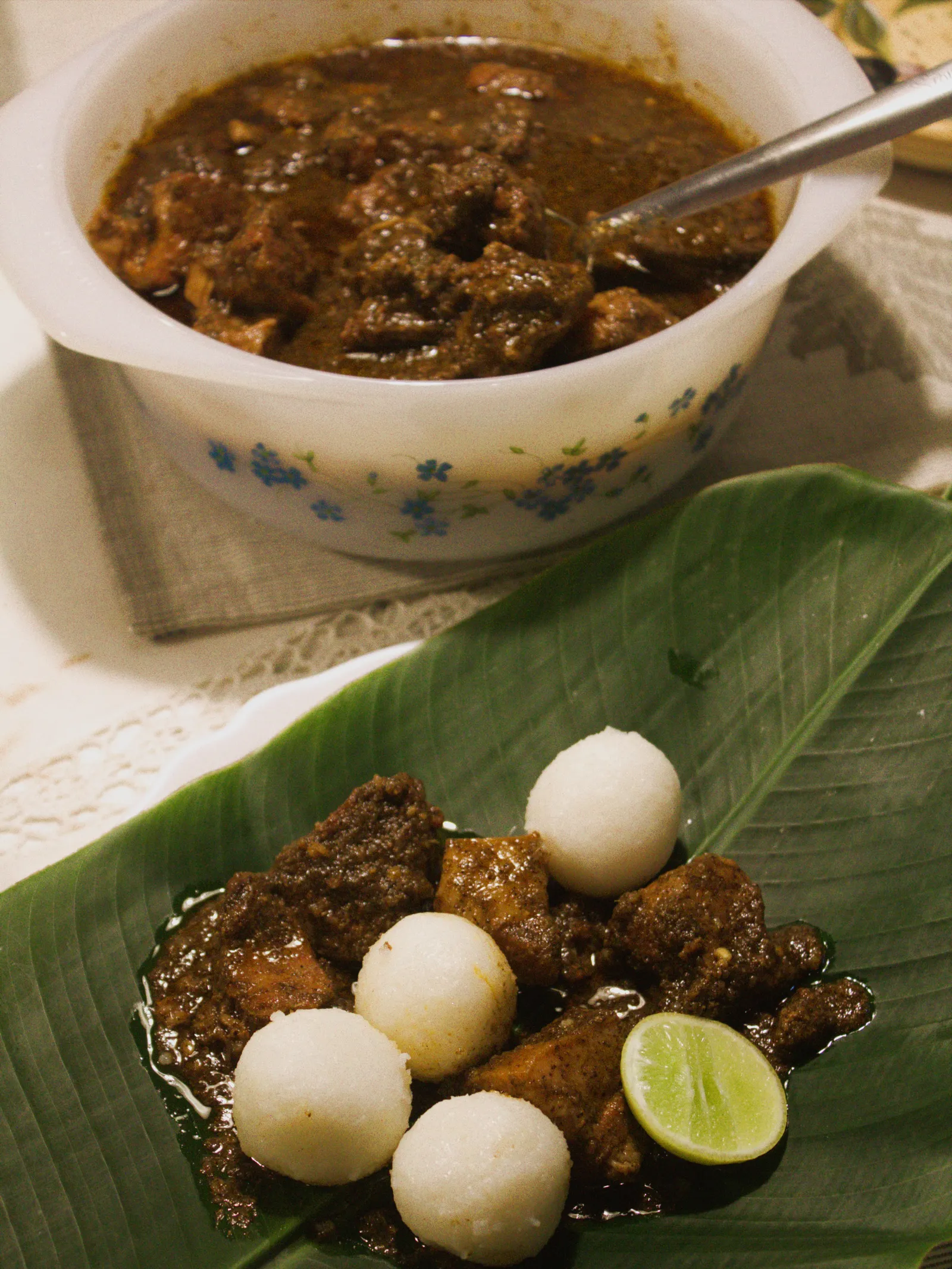
At 4.30pm, with murukus and tea, I was served Kadambutt (steamed rice balls) with Pandhi curry (Kodava style pork curry), a very common high tea meal in Coorg. While I moved on to Kooléputt (steamed bananas or jackfruit cakes in banana leaves) Saraswathi aunty started lowering the dining table lamps with a stick before the sun set. The rear of the house has a sunken open courtyard–a green corner that leads to the owner’s living space. This is a homestay for those who want to listen to stories of the old days, the plantation life in Coorg, to admire the architectural transitions between European and Kodava styles, and to cook authentic Kodava cuisine with a legendary grandmother. Rooms from Rs 9,000 per night per room (includes breakfast & dinner) (extra charges for lunch picnics by the river and cooking session with Saraswathi Aunty) Location: Ammathi Post, Guyya, South Coorg; Contact: Sajan Kushalappa, +91 9841023770, +91 9481723770 (landline: +91 8274298115); IG: @st571211
Captain K’s Getaway
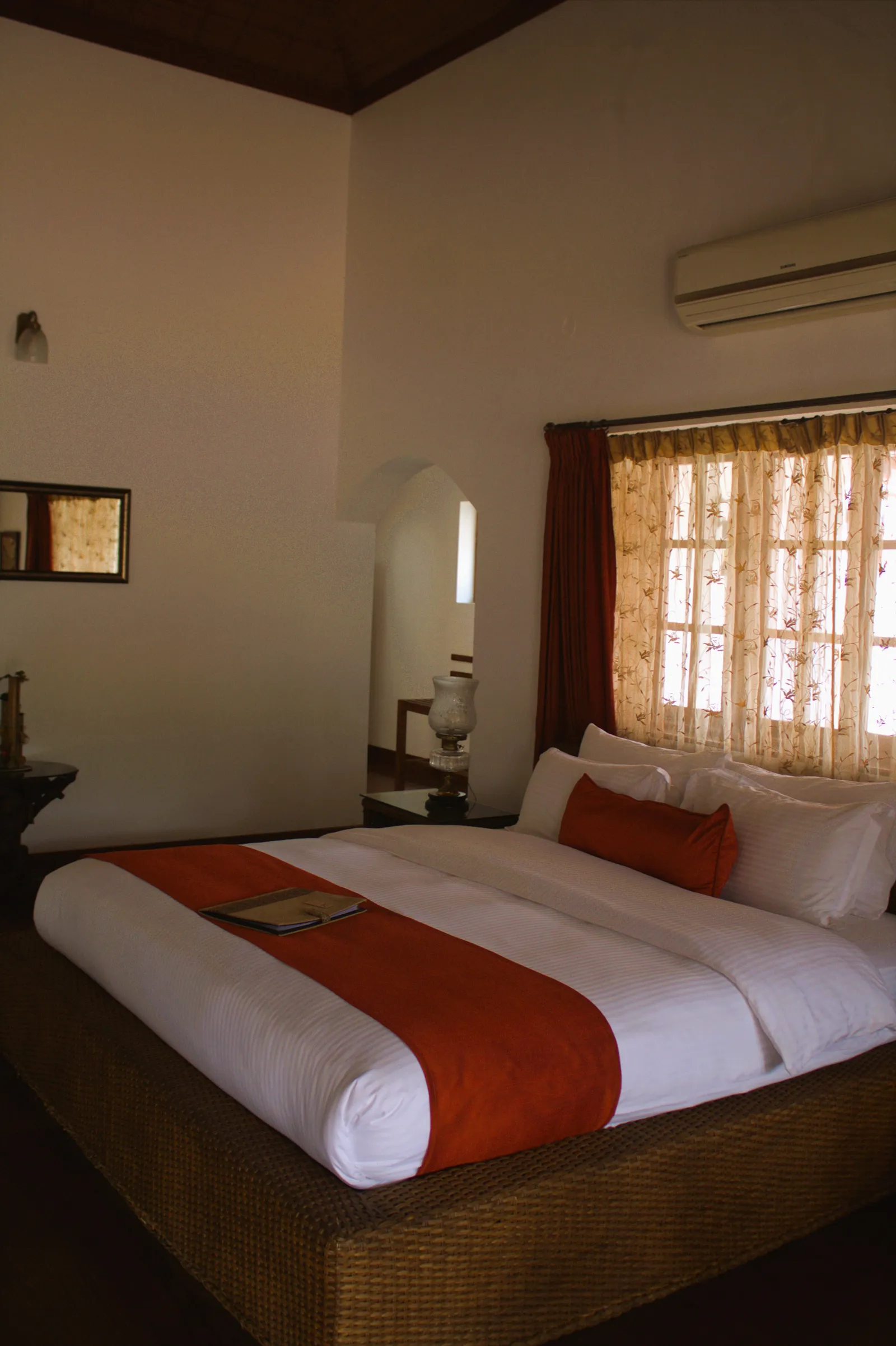
Bedroom / Sitara Cariappa
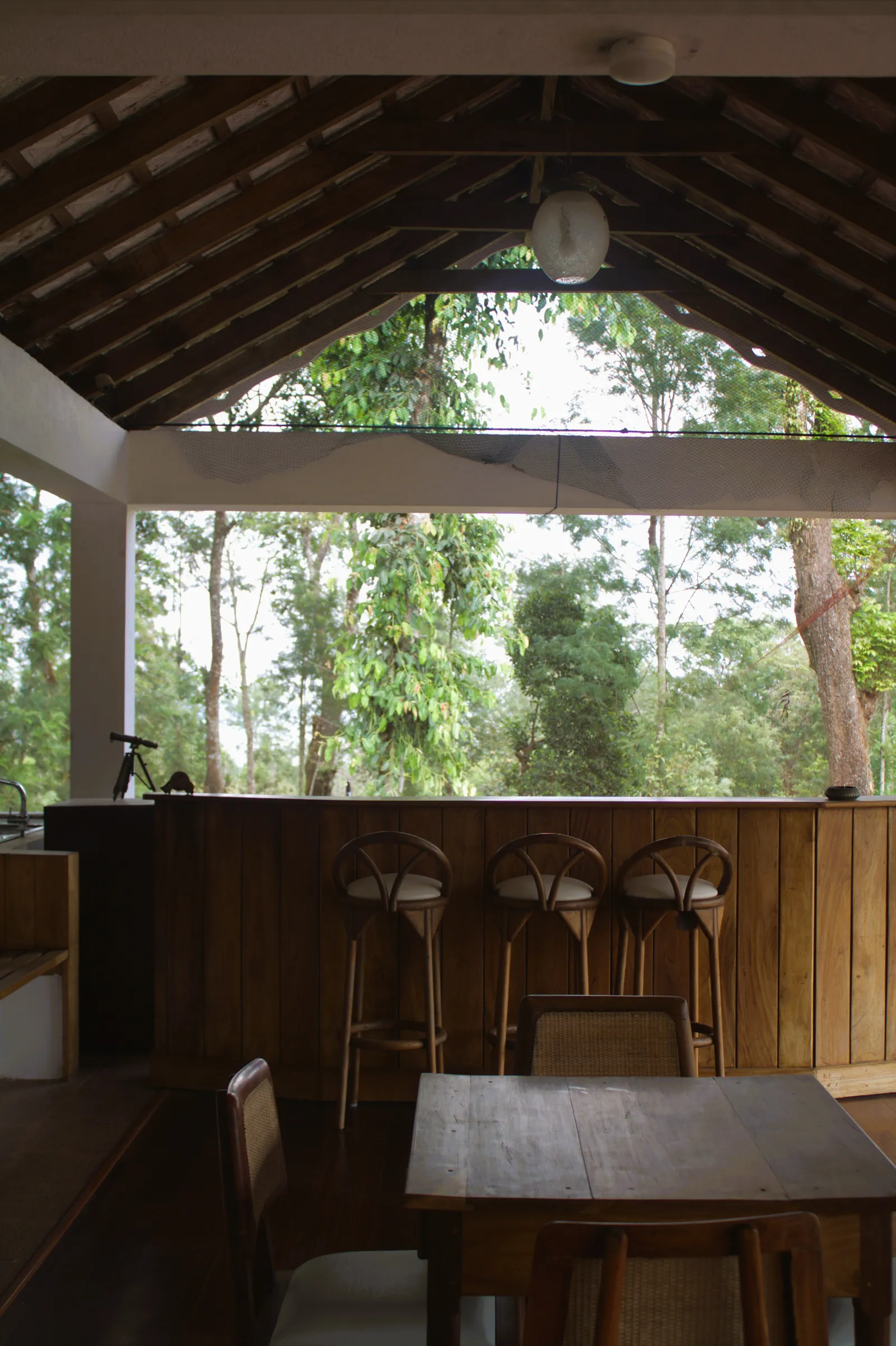
Outdoors bar / Sitara Cariappa
Leila Alvares’s homestay Captain K’s Getaway was named after her late father, Captain Kieren Alvares. He and his wife Lavinia Alvares built a cottage on this 75-acre property and named it Glendale. A few kilometers from the town of Mercara, this is where Lavinia planted a lychee tree 40 years ago that today provides shade to the fine courtyard at the front of their now renovated bungalow that’s cut into the hill.
Food at Captain K’s Getaway / Sitara Cariappa
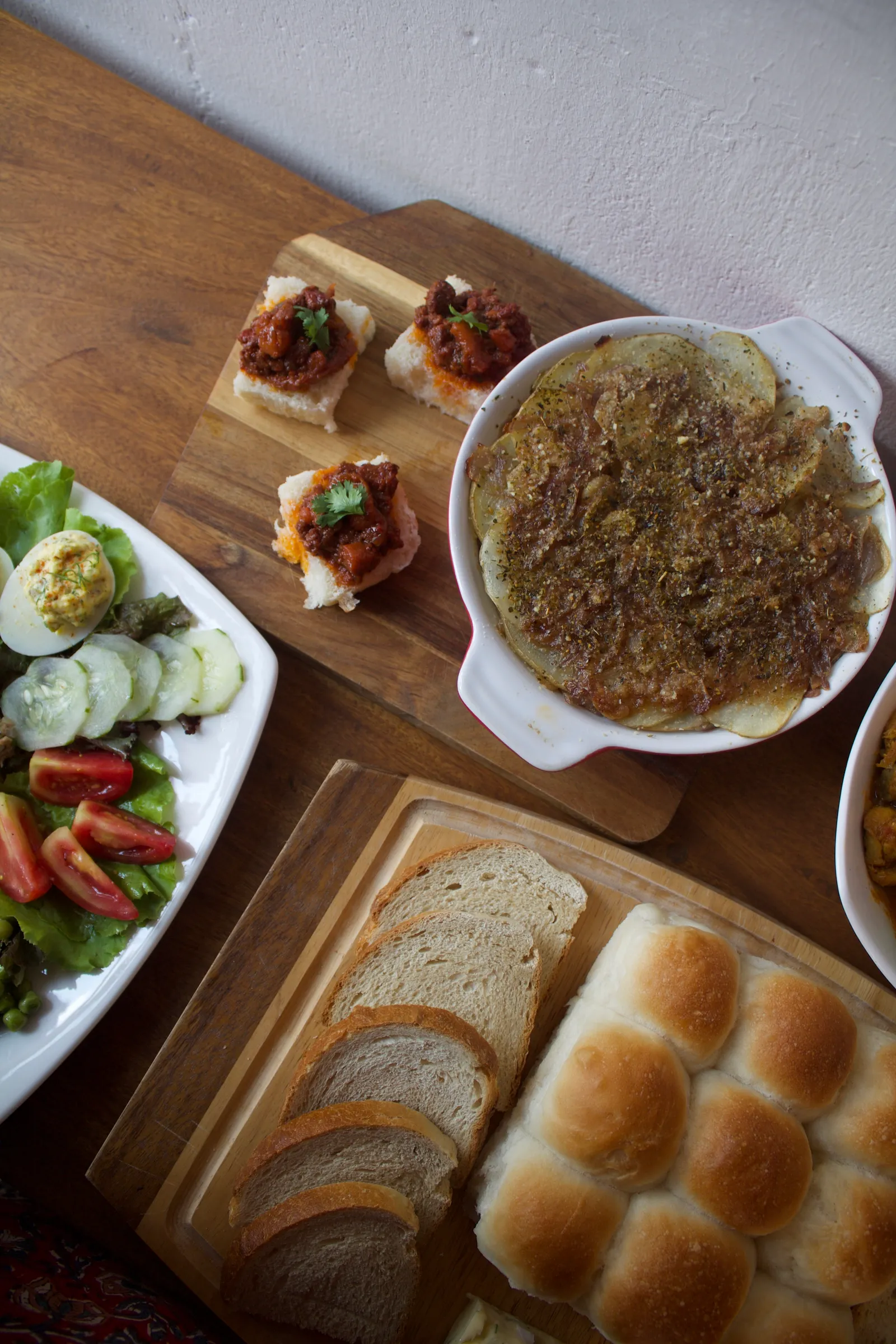
Some years ago, when I met Leila at Captain K, she hosted some of my friends for a grand BBQ evening – pork spare ribs, barbeque chicken legs, creamy corn, potato salad with bacon, fresh salad sourced from the organic garden and chocolate fudge cake with home-made ice cream. After 10 years, nothing has changed. Leila and her children Kieren and Keira continue to cook one of the most lavish spreads from scratch. This time I ate Mangalorean pork baffat, chorizo pork on pav made by Keira and a chocolate mousse by Kieren. Given their Goan-Mangalorean roots and Anglo-Indian exposure, Leila is an exceptional cook specialised in those respective cuisines in addition to Kodava and Mediterranean. Her beautiful kitchen space is always the warmest and always in full swing, especially with her fondest sleeping in this space – Cookie, Sox, Charlie, Julie and Fuzzy.
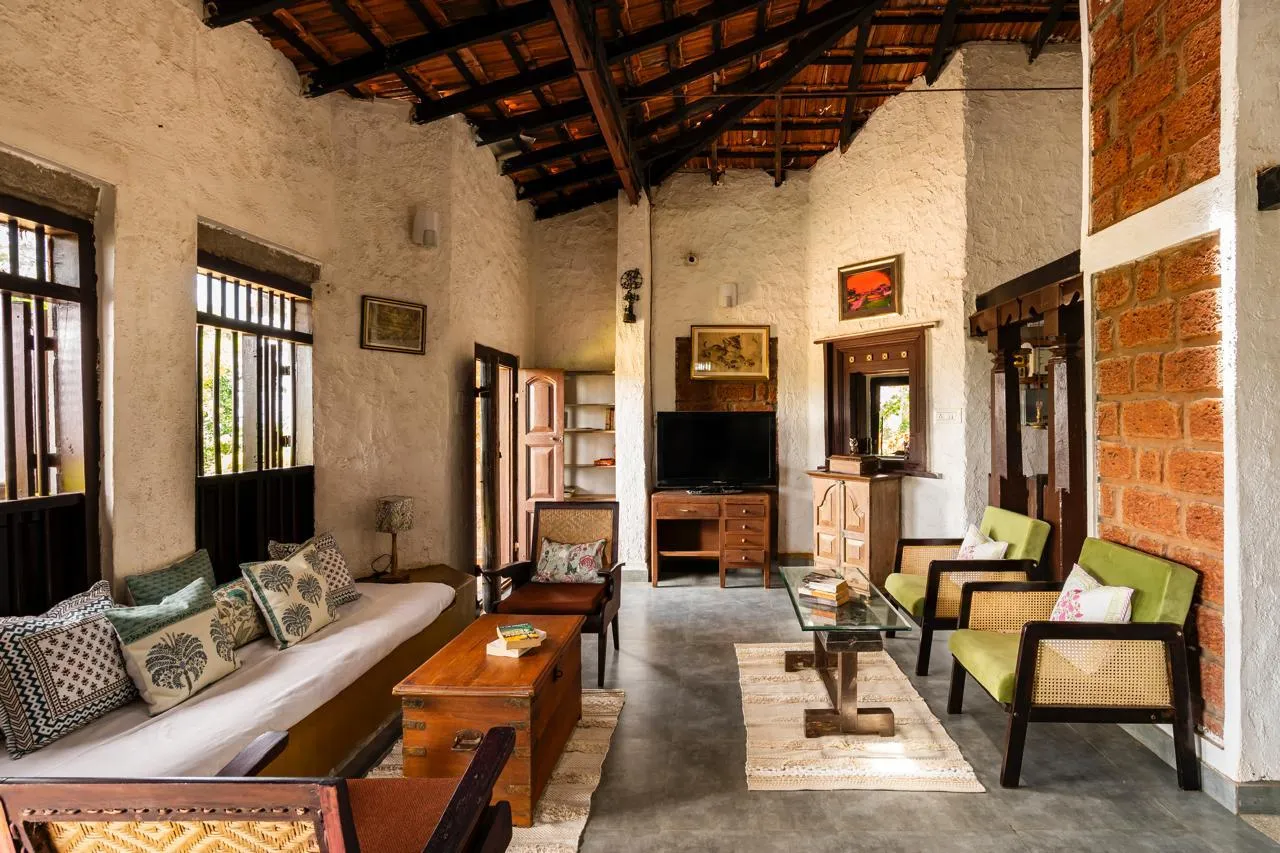
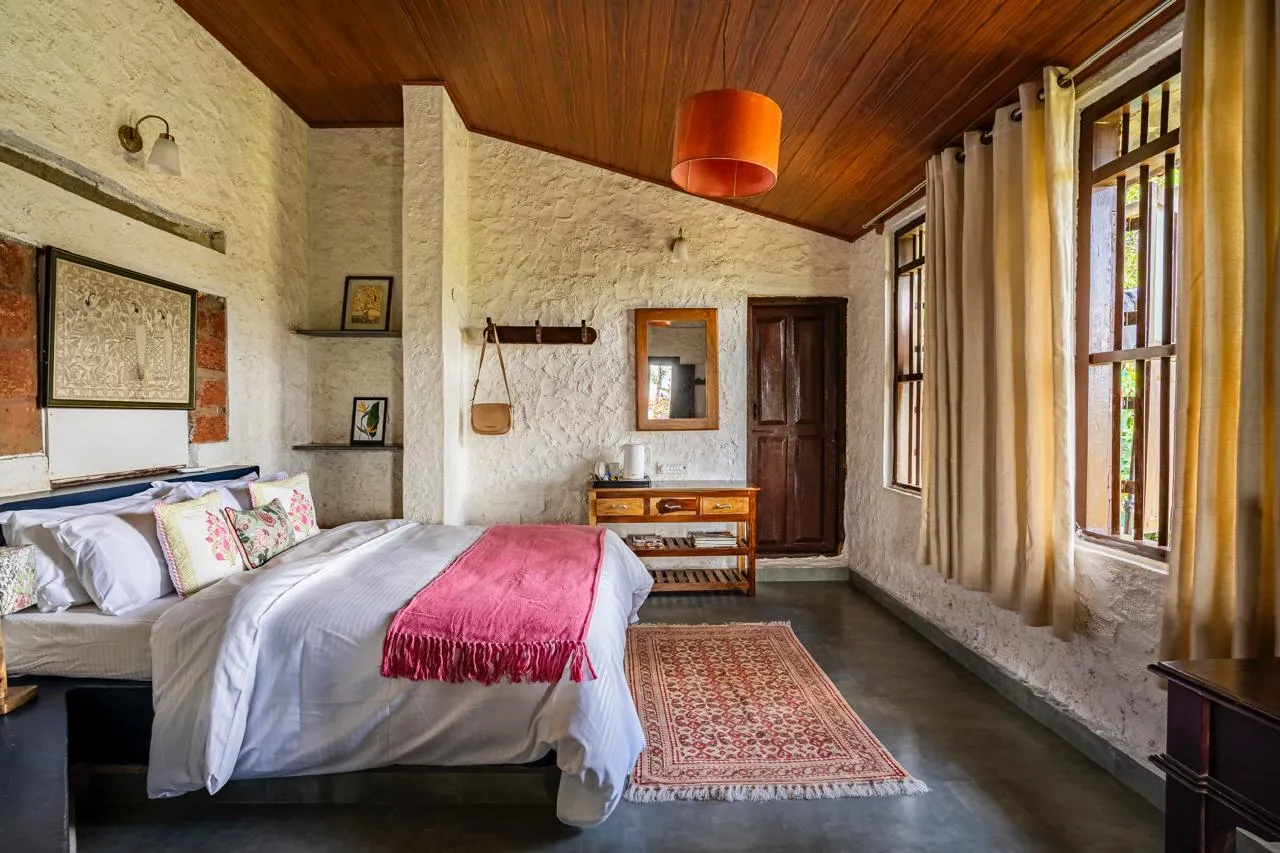
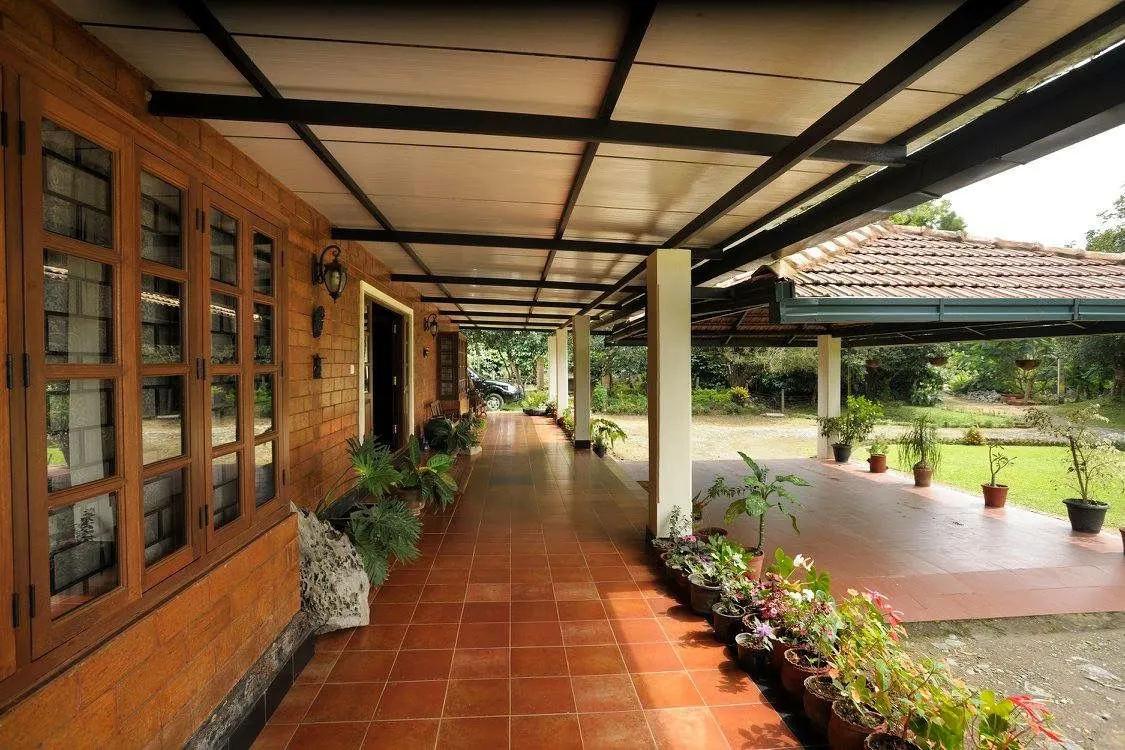
Her home is grand with fine teak woodwork, beside which is a two-bedroom homestay in an annexe. In this space, each room has a fireplace and overlooks the courtyard in the front, and a majestic coffee estate beyond the vast swimming pool and BBQ deck. Leila’s home and Kieren’s outhouse is wood-paneled on the inside and flooded with books. Her home reminds me of a large country barn, luxurious and well lit, with hidden entrances and exits, sky roofs, marine and beach inspired fixtures and knotted bouquets of paddy around the roof rim to keep bats away. An organic garden stands below the elevated home, next to it a coffee pulper and dryer. Kieren roasts the processed coffee from the estate in his unit next to his living space. Here, I got to try a hot cup of pure Arabica from Glendale estate’s first harvest batch (aero pressed) while he continued to tell me about the coffee tasting experience he provides to guests. Rooms at Rs 7,500 and Rs 10,000 per night per room (includes breakfast, jeep ride around the estate, a home theatre experience, swimming pool access, coffee tasting) (extra charges for dinner and massages at the deck)
Location: C/o of Glendale Estate, Kadagadal Village & Post, Sidapur Road via Chettalli, Madikeri 571248, Coorg; Contact: Leila Alvares, +91 98860 55868; Website
Jade Hills
Drawing Room / Ajay Devasia
When I worked at the Taj Hotels in Gaalibeedu, I would look at the distant hills across the lobby and wonder who lived in the beautiful cottages there. I finally met their occupants this month. Kavya Thimmaiah and Prasanna live on a hillock in the most picturesque part of Coorg. Kavya’s mother Jaji named their estate Jade Hills as an ode to the evergreen ranges all around, and that is what their home and homestay is called today.
Designed by father-daughter duo HC Thimmaiah and Kavya, both architects, this five-bedroom cottage in Gaalibeedu is accessed by a steep winding climb, followed by a clear landing and a dramatic view of the southern Western Ghats and deep valleys. Red clay tiles run through the verandah and the plantation chairs in the sit out overlooks a stone-pillared gazebo at the front and a lawn with a bonfire pit to the left. Porous red brick walls, repurposed and salvaged furniture, and laterite pillars add a raw and earthy feel to the space.
Room at Jade Hills / Ajay Devasia
The owners live in the main cottage in one of the bedrooms and the other four rooms (two at the main house level and another two are built 15ft below the main cottage). Prasanna and Kavya shuttle between Bengaluru and Coorg, but Prasanna is always here to welcome guests. At this altitude, the weather always remains cooler and during the summer months, witnessing the swarm of fireflies is a gift. Rich with Shola forest, this property has been developed with eucalyptus, jackfruit and silver oak trees, a traditional home with a local family who cook up the most delicious Kodava meals. Along with local guides, Prasanna organizes treks, chasing fireflies and picnics. Jade Hills is probably the one place I would go to take refuge in the monsoon months in Coorg. Here the bonfires, pink skies and silhouettes of fig and fern trees sway to the ‘gaali’ (wind) of Gaalibeedu. Rooms at Rs 10,500 per night per room (includes breakfast) (extra charges for dinner, treks and seasonal firefly chasing) Location: Kaloor Road Galibeedu, village, District, Madikeri, Karnataka 571202; Contact: Prasanna, +91 98450 04668; IG: @jadehillsmercara
Chengappa Estate Homestead
Exterior view / Sudeep Gurtu
Spending time with Vinoo (KC Aiyappa) involves listening to LPs of Frank Zappa as he narrates stories of the forgotten ways of our Kodava ancestors in the fields of food and hospitality. His 10-acre plantation home and homestay, Chengappa Estate, is a Robusta plantation interspersed with pepper vines and arecanut groves. The house overlooks paddy fields, a water body, and the Kunda betta (hill) beyond. A picket fence and a stone porch lend a storybook feel. A tall Yecchi tree stretches over the house, built in 2014 but peppered with antiques, tools and utensils that are 80 years old. Three guest bedrooms are within the main house and the fourth bedroom is the host’s. So as not to disturb the undulating land, the home is built across three levels, without using cement or plaster, only interlocking laterite blocks. Interiors are warm and cosy, with a wood varnish finish and the three colours of Athangudi tiles–green, ochre and red.
Exterior view / K.C.Aiyappa
Meenakshi, his oldest staff and cook, prepared the tastiest Kodava meal, a khaima (kheema) curry, mutton chops and nei kul (ghee rice). I am told that for breakfast, akki otti (rice flatbread) is served with euhl pajji (sesame seed chutney)–my grandmother’s favourite. Rice comes from the paddy fields in the front of the homestay.
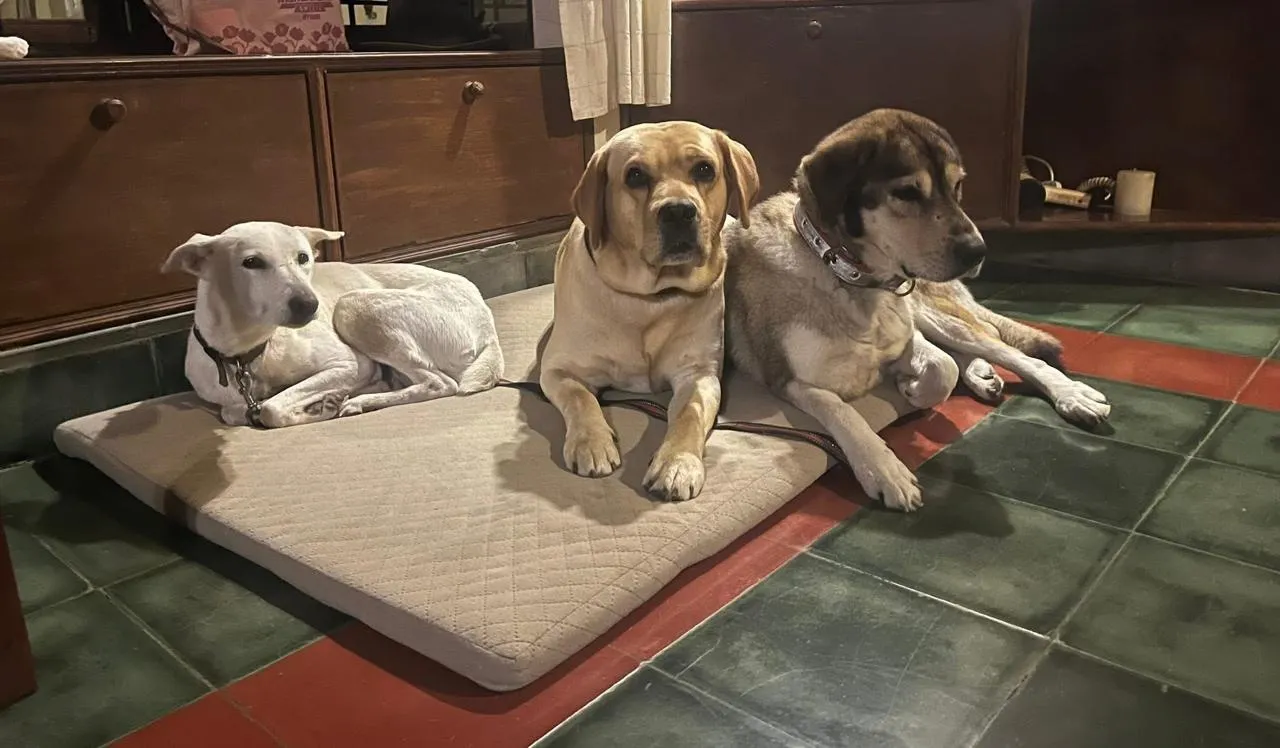
The dogs, Frank Zappa, Muddy Waters and Willy Wanka / K.C.Aiyappa
The three main characters here are his dogs, Frank Zappa, Muddy Waters and Willy Wanka; they accompany you on estate visits and fishing by the pond, where you can use Vinoo’s fishing rods to catch baraemeen, rohu, katla or grass carp. Days on the estate are for foraging, especially when the seasonal pannpuli produce is used to make kachampuli (a black vinegar liquid extract from the pannpuli fruit). Vinoo uses the work shed at the entrance to make bottles to sell. And nights at Chengappa Estate are for the sound of cicadas and the crackle of the bonfire, and an endless expanse of paddy fields above which lie starry skies against silhouettes of the Kunda range. Rooms at Rs 6000 per night per room (includes breakfast) (extra charges for lunch and dinner) Location: 5 kms from Ponnampet Town and 1 Km from Kundha School (B Shettigeri Rd.), Kundha, Coorg; Contact: KC Aiyappa, +91 98454 93688; IG: @coorgvillager
source: http://www.cntraveller.in / Conde Nast Traveller / Home> Hotels & Homestays / by Sitara Cariappa / April 20th, 2026
The three-day tour will begin on April 27, starting from Bengaluru at 12.30 pm. The team will visit Dubare, Nisargadhama, and Kushalnagar before reaching Madikeri by 6 pm.
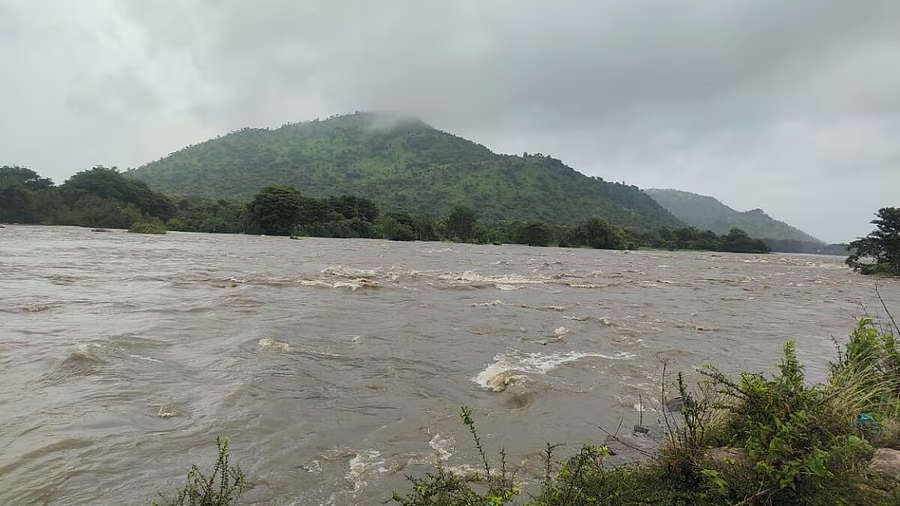
A view of Cauvery river / Credit: DH Photo
Mysuru:
Stating that Karnataka has been facing continuous injustice regarding the sharing of Cauvery River water, the Cauvery River Protection Committee will undertake a study tour of the river basin from April 27 to 29. The tour aims to collect ground-level data and evidence, to support a writ petition the committee plans to file before the Supreme Court in May.
Addressing a press conference, in Mysuru, on Wednesday, committee president H K Ramu said that the study will be conducted under the leadership of retired Supreme Court judge N Gopalagowda.
Study tour
“The committee will visit various reservoirs and agricultural lands in the Cauvery River basin to interact with farmers, labourers, and members of various farmer organisations. We will collect information, photographs, and video evidence of the current situation, which will be submitted to the Supreme Court during the filing of the writ petition,” Ramu said.
Itinerary
The three-day tour will begin on April 27, starting from Bengaluru at 12.30 pm. The team will visit Dubare, Nisargadhama, and Kushalnagar before reaching Madikeri by 6 pm.
On April 28, the team will offer prayers at Talakaveri at 8 am, followed by a public meeting in Kushalnagar or Harangi. In the afternoon, the committee members will inspect the Hemavathi Dam in Gorur and meet farmer leaders. The day will conclude with a visit to the Krishnaraja Sagar (KRS) dam in Srirangapatna taluk of Mandya district and a meeting at the Jaladarshini Guest House, in Mysuru city.
On April 29, the team will visit the Kabini Dam at 9.30 am and interact with local farmers, elected representatives, and workers. The tour will continue through Nanjangud, T Narsipur, and Shimsha, concluding at Mekedatu in Kanakapura taluk, Bengaluru South district, before returning to Bengaluru city.
Committee office-bearers M Chandrashekar, H L Yamuna, K C Madesh, Gangadhara Gowda, Brijesh Kariyappa, Prakash, and former corporator K V Mallesh were present at the press meet.
source: http://www.deccanherald.com / Deccan Herald / Home> India> Karnataka> Mysuru / by T R Satish Kumar / April 23rd, 2026
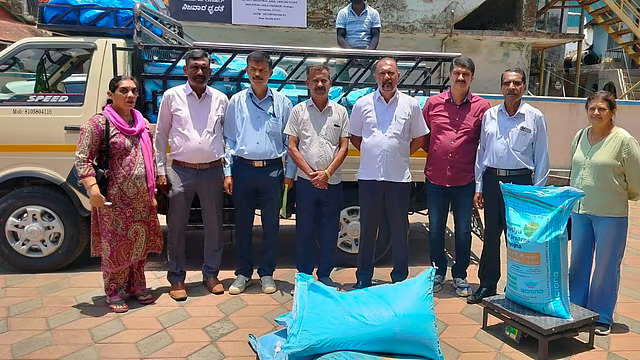
The members of Hathur PACS arrived at the Office of the JD of Agriculture in Madikeri with bags of fertilizers and a weighing scale. Photo | Expre
In a dramatic display, the farmers and cooperative representatives weighed the bags on the premises of the Joint Director’s office, highlighting what they termed as “fraudulent practices” by fertiliser suppliers.
Madikeri :
Allegations of large-scale discrepancies in fertiliser bag weights surfaced in Kodagu on Thursday, as members of the Hathur Primary Agricultural Cooperative Society (PACS) staged a protest demonstration infront of the office of Joint Director of Agriculture in Madikeri.
Led by Kodagu District Cooperative Central Bank president Bonda Ganapathi, the PACS members arrived with truckloads of fertiliser bags supplied by Indian Potash Limited (IPL), claiming significant shortages in weight. The members alleged that several 50-kg bags were found to be underweight by as much as 4 kg.
In a dramatic display, the farmers and cooperative representatives weighed the bags on the premises of the Joint Director’s office, highlighting what they termed as “fraudulent practices” by fertiliser suppliers. They urged the Agriculture Department to initiate an immediate and thorough investigation.
“This is not an isolated issue. We suspect such discrepancies could be happening across the district and even elsewhere in the country,” members alleged, warning that such practices directly harm farmers financially.
Expressing strong displeasure, Ganapathi claimed that nearly 51 tonnes of fertiliser supplied to the society between February 18 and March 3 showed consistent weight variation.
He termed the issue a “serious injustice” to farmers and demanded that the losses be compensated by the supplier. He also called for reimbursement of loading costs and a district-wide inspection of fertiliser stocks in all cooperative societies.
Joint Director Chandrashekar assured the delegation that the matter would be escalated to higher authorities for further action.
Ganapathi said a formal complaint would be submitted to the Deputy Commissioner and warned of intensified protests, including a possible lockdown of the Agriculture Department office, if swift action is not taken.
A follow-up meeting involving cooperative representatives and department officials is scheduled at the KDCC Bank building on April 27 to discuss the issue further.
source: http://www.newindianexpress.com / The New Indian Express/ Home> Karnataka / by Prajna GR / April 23rd, 2026
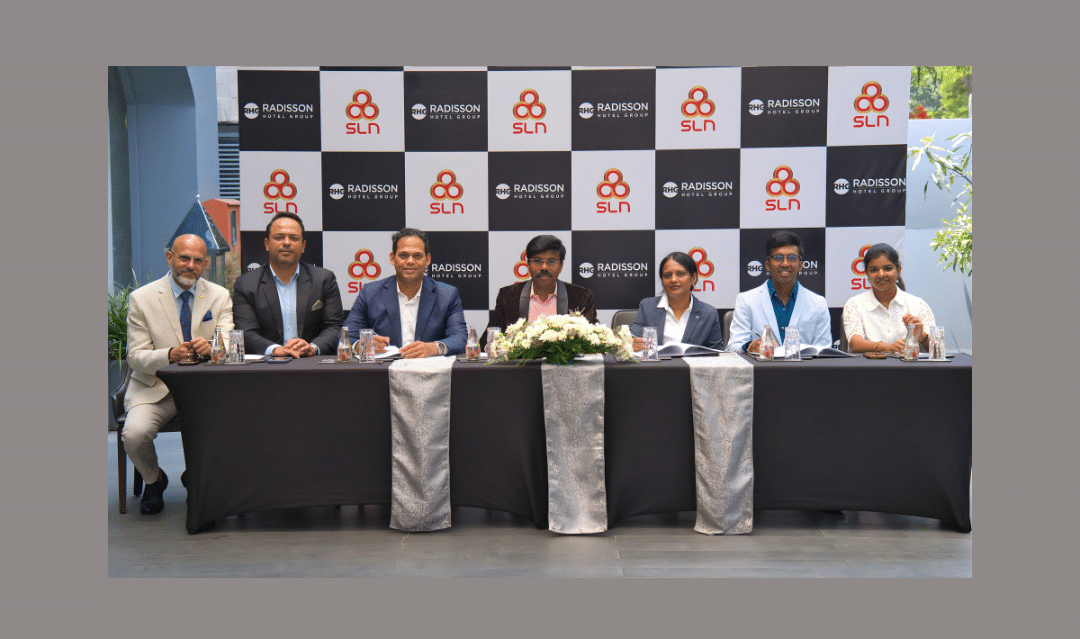
Dual signing introduces two resort properties under Radisson Individuals Premier, marking the Group’s entry into Coorg.
Radisson Hotel Group continues to expand its footprint in India’s high-potential leisure destinations with the signing of Purple Mist Resort & Spa Coorg, A Member of Radisson Individuals Premier, along with Purple Palms Resort & Spa, which will be converted under the same brand.
This dual-deal marks the Group’s entry into Coorg, one of India’s most sought-after leisure destinations, establishing a strong and scalable presence in a market defined by nature-led travel and destination-driven demand.
A nature-led retreat designed for experiential stays
Purple Mist Resort & Spa Coorg, under Radisson Individuals Premier, is a 102-room property with 98 standard rooms and four suites. It will include an all-day dining restaurant, a lobby lounge/deli, two banquet halls with pre-function areas, a fitness centre, and a spa.
Purple Palms Resort & Spa Coorg, under Radisson Individuals Premier, is a 78-room property that will be converted and repositioned under the brand. It includes 74 standard rooms and four suites, along with two restaurants, a banquet hall, a boardroom, and wellness facilities such as a gym and spa.
Together, the two resorts create a strong combined offering in Coorg, addressing demand across leisure stays, destination weddings, corporate retreats, and social events, while allowing flexibility across guest segments.
Expanding in high-potential leisure markets
“With this signing, we are entering Coorg with a differentiated approach that allows us to build meaningful scale in a high-demand leisure market. The dual-resort model enables us to create a strong combined offering, catering to both individual travellers and large-format events. As demand continues to evolve towards experiential and destination-led travel, developments like these allow us to strengthen our presence in emerging leisure markets while leveraging the flexibility of our Radisson Individuals Premier brand,” said Nikhil Sharma, Managing Director & COO, South Asia, Radisson Hotel Group.
Unlocking growth through strategic development
“RHG’s advent to Coorg marks successful implementation of our strategy to spread across key business & leisure destinations of South India. A ready to open resort at a premium leisure destination accelerates our expansion plans by catering to all segments of market by furthering our outreach. The dual signing is also a strong value proposition for the ownership to capitalise on RHG’s brand repute & robust distribution system,” said Davashish Srivastava, Senior Director, Development, South Asia, Radisson Hotel Group.
A shared vision to elevate the destination
“We are delighted to partner with Radisson Hotel Group for this landmark development in Coorg. Our vision is to create a hospitality offering that reflects the destination’s natural beauty while introducing world-class standards and infrastructure. With two complementary resorts in close proximity, we believe this project will redefine the hospitality landscape in Coorg and position it as a preferred destination for both leisure travellers and large-scale celebrations,” said N Viswanathan, Managing Partner, SLN Hotels & Resorts.
source: http://www.hotelierindia.com / Hotelier India / Home> Development / April 24th,2026
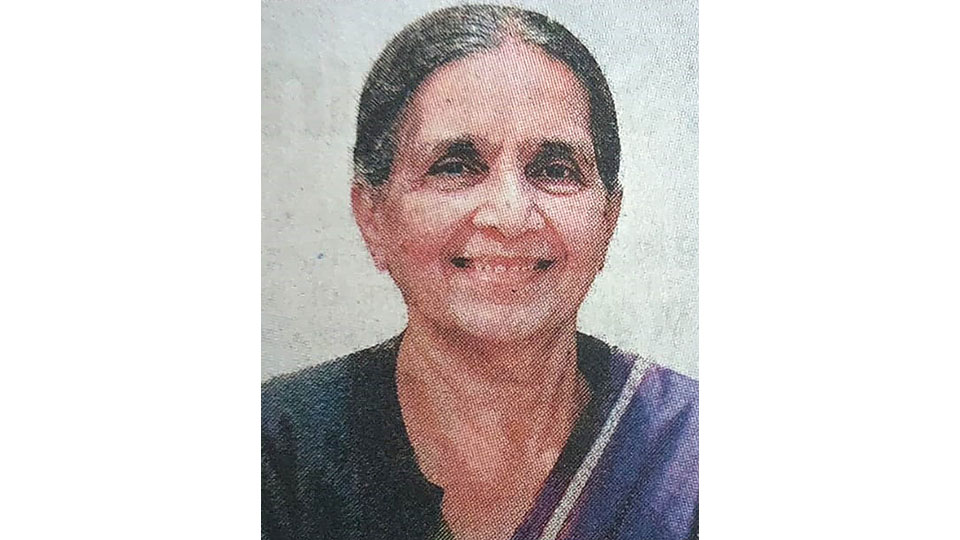
Palecanda Bojamma (91), wife of late Palecanda P. Muthanna (former Advocate General of Karnataka and former President of Kodava Samaja, Bengaluru), passed away in Arizona, USA, on Apr. 22.
Originally from Madikeri town in Kodagu, Bojamma (Paruvangada) leaves behind her daughters Dechu Muthanna, Dr. Neeli Muthanna, son Poonacha Muthanna, grandsons and a host of relatives and friends.
Cremation took place at Paradise Memorial Gardens, East Shea Boulevard, Scottsdale, Arizona, USA today (Apr. 24).
source: http://www.starofmysore.com / Star of Mysore / Home> Obituary / April 24th, 2026
Tamara Leisure Experiences has, since inception, embedded Responsible Hospitality into its core, guided by a clear vision of people, planet, and profit thriving in tandem. Across its portfolio of nine properties, from luxury resorts in Coorg and Kodaikanal to upscale O by Tamara hotels in Coimbatore and Trivandrum, mid-scale Lilac hotels, and its flagship wellness offering Amal Tamara, a NABH-accredited Ayurveda hospital, this philosophy translates into an elevated form of eco-conscious hospitality where design, service, and setting come together to deliver immersive, low-impact luxury. The flagship property, The Tamara Coorg, holds the Global Sustainable Tourism Council certification, underscoring its alignment with global sustainability standards, with a clear roadmap to extend this benchmark across all Tamara properties.
Samir MC, CEO, Tamara Leisure Experiences, said, “Our nine property portfolio is aligned to GSTC principles. And I want to be honest about what that distinction means, because the certification is the outcome, but the real value is in the discipline the journey instills across your entire organisation. This is not a badge. It is a framework to make your circular systems auditable, measurable, and accountable. Our goal is to make that the portfolio standard, not a novelty at one property.”
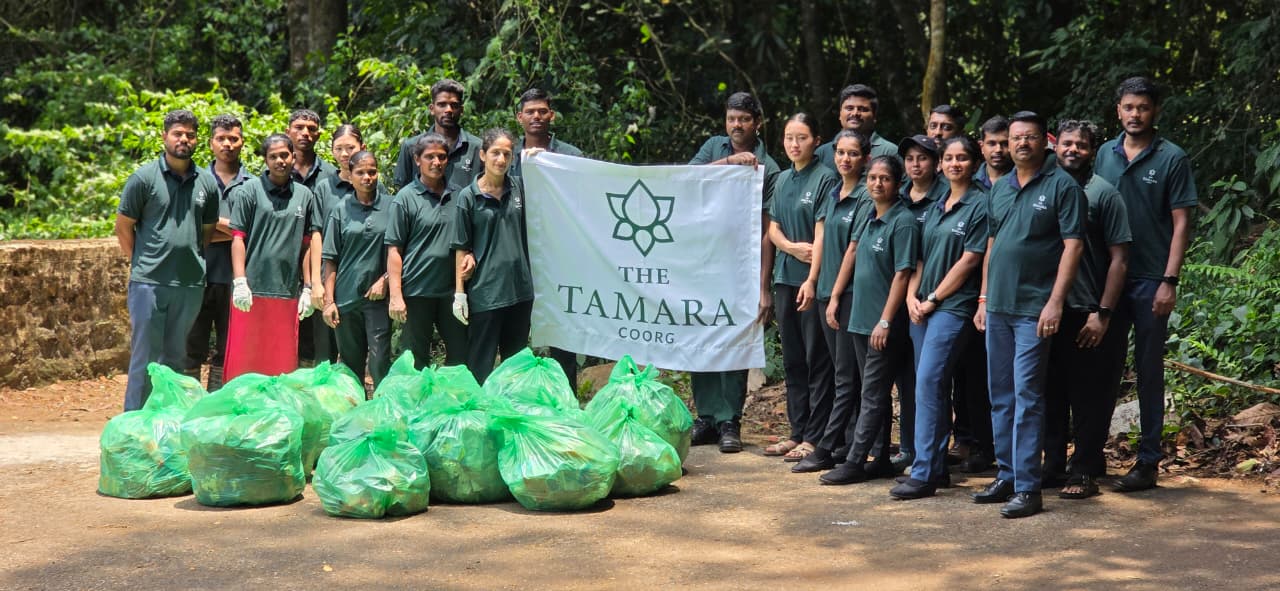
“Earth Day serves as a timely reminder of shared responsibility towards the planet, and at TamaraLeisureExperiences, this is reflected through on-ground actions across its properties, from farm to table experiences and community clean-up drives to sustainability-led engagements. These efforts extend into Earth Week (22–28 April) through nature-led activities, conscious dining, and community participation, where sustainability is not an add-on but the experience itself. At Tamara, responsiblehospitality is foundational, shaping every stage from design and conceptualization to operations and guest experience. For us, sustainability is not a seasonal campaign, but a part of our daily operating philosophy.”
Here’s how this philosophy comes to life across key pillars:
Sustainability in Design
Each Tamara property is planned with the local environment in mind, designed to retain and work with its natural surroundings, allowing the ecosystem to shape how the space is built and experienced. For example, At The Tamara Coorg, sustainability is a design decision guided by a clear ethos, build less to preserve more. Set across 28 acres of largely untouched landscape, the resort was developed with minimal ecological disruption, felling just 17 trees and consciously scaling down from 60 to 56 cottages to protect even more. Elevated on stilts, each structure sits lightly on the land, allowing the forest to remain undisturbed, where trees are not cleared but seamlessly woven into the architecture and experience.
Rooted in Community care, designed for continuity
At Tamara, sustainability extends to the people who shape the experience, expressed through local immersion, farm to table practices, and menus rooted in regional flavours and wellness, from Kodava cuisine in Coorg to place-led dining across properties. This continues at Verandah, the in-house boutique, where locally inspired crafts, natural wellness products, and plantation-grown spices offer a tangible extension of the region’s heritage.
Guided by community and circular thinking, nearly half the workforce is locally hired and close to 40% of procurement is regional, strengthening livelihoods while keeping operations rooted. This comes through most tangibly in the organic minibar, where every product is local, organic, and traceable, and in the kitchen, where menus are shaped by what is locally and seasonally available, ensuring procurement drives the plate. Ongoing support for education and local institutions reinforces a long-term commitment to community development.
Zero Waste Living
Across Tamara properties, 15-40 tonnes of waste is reimagined as a resource through a closed loop system where nothing is discarded and everything is repurposed. 100% food waste is recycled in house through low impact processes like Bio Manthan, plastic is replaced with glass bottles, stainless steel dispensers and refillable amenities, while circular practices extend to repurposed linen, reused bottles, kitchen gardens, greenhouses and seed saving, with food waste reduced to 0.54 kg per head. With zero significant chemical spills in FY 2024-25, this carries into the guest experience, with leaf coasters, bamboo alternatives, towel reuse, alternate linen changes, and sapling takeaways ensuring the philosophy is both visible and lived.
Mindful use of every resource
Resource conservation is deliberate and deeply local. Natural waterfalls and stream water are left untouched to preserve community sources. While rainwater harvesting systems and tap aerators reduce consumption, LED lighting, heat pumps, lithium battery buggies, key tag controls, EV infrastructure, solar panels and emission management ensure energy optimisation. Behind the scenes, efficiency is engineered into every system, smart laundry and advanced STP and ETP plants enable reuse, while continuous monitoring of water, energy, and carbon, along with thoughtful material reuse, keeps operations tightly optimised and low impact.
Quiet design and conscious tech
Throughout properties, impact is reduced through thoughtful restraint. The absence of DJ music and harsh lighting limits noise and light pollution, while low lux pathways, timers, and sensors minimize ecological disturbance. A seamless tech enabled journey with digital check ins, e-bills, and paperless feedback reduces waste, supported by in-house water systems over plastic. From horn free EV buggies to reusable linen elements and locally rooted touches, every detail is intentional and quietly conscious
At Tamara, responsiblehospitality shapes how we think, design, and operate across the portfolio. It brings sourcing, consumption, and recovery into careful alignment, ensuring that sustainability is quietly built into everyday operations
source: http://www.businessnewsthisweek.com/ Business News This Week / Home> Business / by Neel Achary / April 22nd, 2026
WELCOME. If you like what you see "SUBSCRIBE via EMAIL" to receive FREE regular UPDATES.
Read More »