With urbanisation and changing social structures, nuclear families, which were intrinsic in preserving tradition and rituals, have replaced joint families.
Women and a child don traditional attire at a Keri function
Madikeri:
With urbanisation and changing social structures, nuclear families, which were intrinsic in preserving tradition and rituals, have replaced joint families. To ensure their culture is not lost, various Kodava families in Kodagu district have joined together under one ‘keri’ (colony).
“The concept of ‘keri’ – synonymous with area or colony – started in Bengaluru among the Kodava community. The concept was adopted in the district too, with the first keri being formed 27 years ago,” says Kayapanda Shashi Somaiah, a resident of Madikeri.
As Kodava families started to move to cities from their native villages, the culture of the community was at stake. To prevent this, the keri concept was introduced in towns of Kodagu, including Madikeri, Virajpet and Ponnampet. “There are a total of 12 keris in Madikeri town. Cauvery Keri was among the first to be established in Madikeri. ‘Dechur Keri’ was established in 1998 and is one of the largest compared to other keris,” explains Madeyanda Ravi Kunjiappa, president of Dechur Keri.
He adds that this keri has over 300 members and an annual meeting is held after Puthari festival, which sees the coming together of all members.
Talking about the purpose of a keri, Shashi Somaiah explains, “For instance, if a death takes place in a Kodava family, members may not be acquainted with the rituals that need to be followed. That is when the keri becomes a second family of sorts.
Before relatives arrive from far off places, keri members who stay in the same area come together to help with the rituals.” Keris have a president and directors who are elected by the members once in three years. Emergency funds too are collected. Shashi says, “Death funds are handed over by the keri trust to family members.” The community also bonds over other matters during keri meetings.
“When people from the same community gather under one roof, talks pertaining to marriage also take place. There are instances where two people have been matched during keri functions,” says Ravi Kunjiappa.
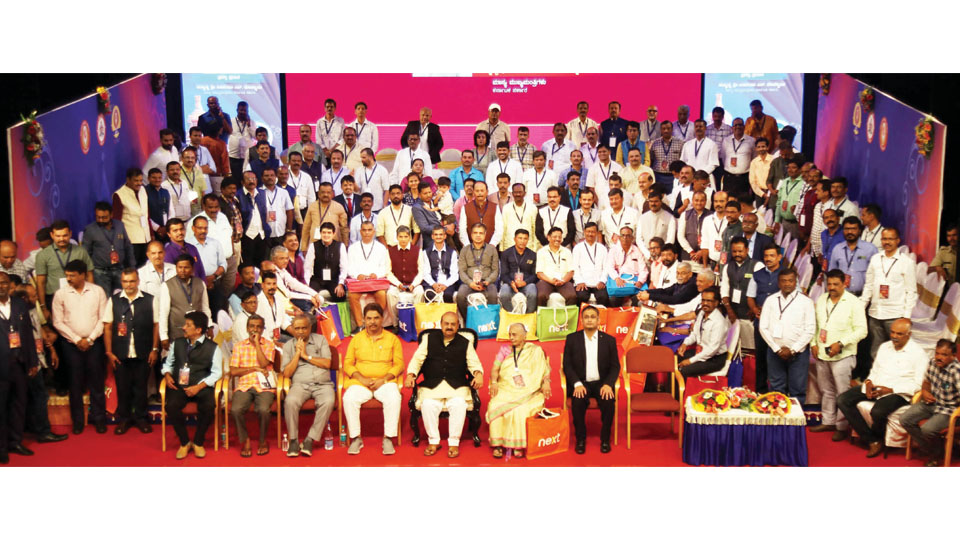
Ravi adds, “During annual meetings, children who have achieved in academics or sports are recognised and felicitated. Similarly, elders who have achieved in government services or youngsters who have excelled in various fields will be felicitated and encouraged. Communities get to share their triumphs and trials.” Apart from being a support system, these keris also help in preserving Kodava culture. “The annual meeting becomes a platform for various cultural activities. Youngsters and children are required to take part in this cultural extravaganza. Children get trained by elders in ‘kolata’, ‘umathat’ and various other cultural activities,” says Ravi.
These skills are then put to test in the form of inter-keri competitions organised in each township once in three years. While inter-keri events have been organised in Madikeri six times, Virajpet town saw its first event this year. “Each keri takes turns to organise this function, which aims to unite Kodava families from different keris. The aim is to promote Kodava culture among the younger generation. This is the best way to teach our children about our traditions,” says Madanda Latha Somaiah, a member of Dechur keri.
source: http://www.newindianexpress.com / The New Indian Express / Home> States> Karnataka / by Prajna GR, Express News Service / March 15th, 2020
The 117th Birth Anniversary of General K.S. Thimayya will be jointly celebrated by Kodava Samaja, Mysuru, Kodava Samaja Cultural and Sports Club, Mysuru and Shri Kaveri Kodagu Mahila Sangha, Mysuru, at Kodava Samaja premises in Vijayanagar I Stage here on March 31 at 10.30 am.
Samaja President Mechanda M. Shashi Ponnappa, Club President Kuttimada D. Muthappa, Sangha President Ponjanda Lovely Appaiah, office-bearers and members will be present on the occasion.
source: http://www.starofmysore.com / Star of Mysore / Home> In Briefs / March 29th, 2023
Community welcomes Government’s long-pending decision
Madikeri:
The State Government yesterday notified the constitution of the Karnataka State Kodava Development Corporation. This comes just days after Chief Minister Basavaraj Bommai made an announcement in Kodagu during the inauguration of the Appachattolanda Hockey Festival that the Corporation will soon be constituted.
The notification stated that the newly constituted Corporation will strive for the comprehensive development of the Kodava community.
Virajpet MLA K.G. Bopaiah has thanked the Chief Minister for constituting the Corporation. “I had personally led a large delegation and met the Chief Minister underlining the importance of constituting a Board or a Corporation for the development of the community. Though this was a long-pending demand, the Chief Minister has notified it now,” he said.
People of Kodagu are thankful to the Government as the Corporation will exclusively strive for the development of the unique culture and distinct customs of Kodavas, he added.
The Kodava Development Corporation was one of the main and long-pending demands of the Kodava community. Expressing his happiness over the constitution of the Corporation, Kokkalemada Manju Chinnappa of the United Kodava Organisation, who was the force behind the demand, told Star of Mysore this morning that it is a huge victory for the community.
“Kodavas have played a crucial role in taking the State forward and reaching newer heights. We have unique tradition, customs, heritage and culture that needs to be protected and the Corporation is a huge step in this regard. The community has played a vital role in the country’s defence sector and sports field, earning national and international accolades, he added.
Though there are notable achievements from the community, Kodavas have remained politically weak when compared to many other communities in Karnataka.
“The State Government has finally honoured the genuine demand of a political and cultural minority. It is a well-deserved gift for the distinct community and the complete credit goes to CM Basavaraj Bommai, former CM B.S. Yediyurappa, MLA K.G. Bopaiah, former MLC Veena Achaiah, Congress leader and former Advocate General A.S. Ponnanna, other MLAs, MLCs and largely the community,” Manju Chinnappa added.
source: http://www.starofmysore.com / Star of Mysore / Home> News / March 21st, 2023
The Kodava hockey festival is a vibrant, month-long celebration held between March and April. The festival exudes the ambience and excitement of a mela with its draped festoons, welcome arches, and numerous stalls.
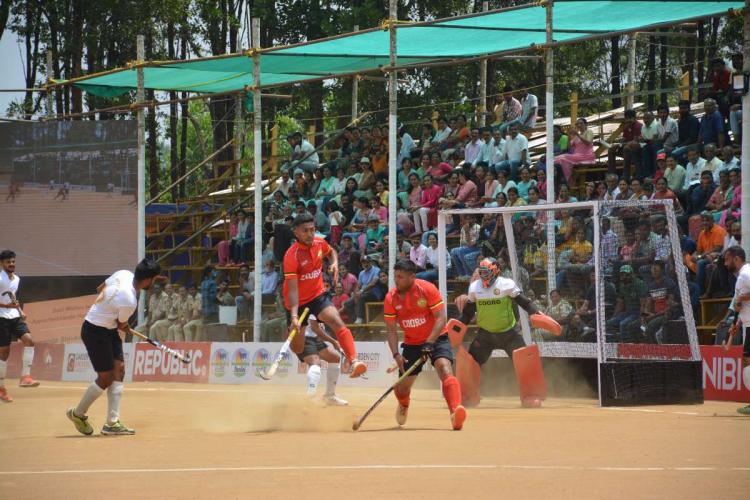
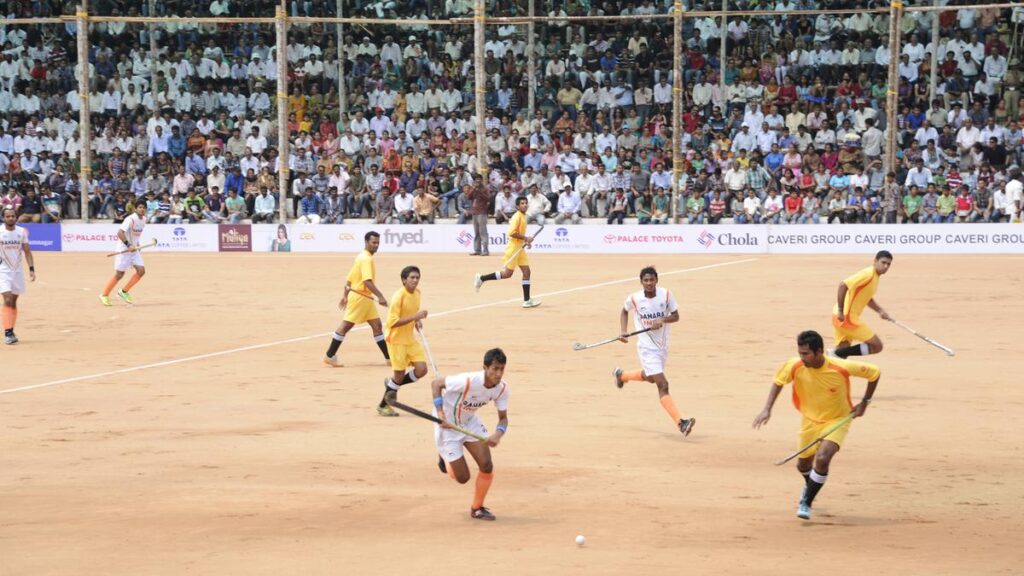
Come summer, and it’s hockey festival time in Kodagu. When schools close for summer vacation and coffee plantations take a break, Kodava families from around the world head home to participate in the Kodava Hockey Namme (festival) held in Kodagu (Coorg). It is time for Kodavas to battle with their hockey sticks at this tournament held in their home turf. With hundreds of families participating, the tournament is recognized as one of the largest field hockey tournaments in the world and finds a mention in the Limca Book of Records.
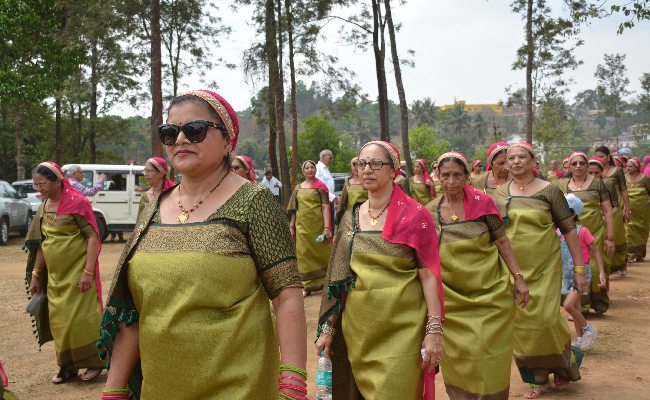
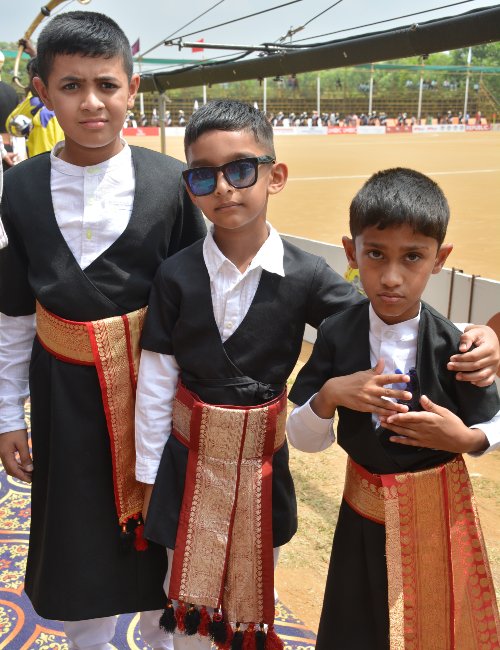
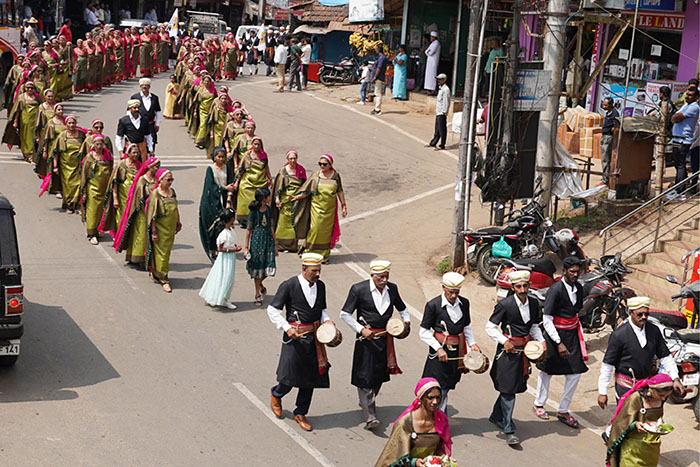
The Kodava hockey festival is a vibrant, month-long celebration held between March and April. The festival exudes the ambience and excitement of a mela with its draped festoons, welcome arches, and numerous stalls selling everything from automobiles to food. It is also an occasion for the Kodavas to dress up in traditional attire and participate in the procession and cultural programmes. Dancing and music add to the fun and frolic. One has to be here during the festival to experience the fierce pride of Kodavas in their glorious heritage, which they jealously guard.
Procession of Kodava women in their traditional attire
The genesis of the hockey festival can be traced back to 1997. It was the brainchild of late Pandanda Kuttappa, a former banker and State league referee. He is said to have conceptualised the festival after realising the deterioration in the standards of hockey played in the district. He hit upon the idea for a tournament among the families in order to encourage more youngsters to take up the sport.
The first editions of the festival were held in the village of Karada with 60 families competing. The festival has no permanent venue, something organisers are striving to achieve, and the festival has been held across the district in previous years.
Kodava children flaunt their traditional dress
The tournament started with the dual purpose of paying rich tribute to the sport in the region, and bringing together players in thousands in order to identify the best talents for the country. Over the years, more than 50 Kodavas have represented India in international hockey, earning their district the title of ‘Cradle of Indian hockey’. Hockey is to Kodagu what cricket is to India. It is common to find hockey sticks in every home.
This annual festival is hosted by a different family each year and will be known by the name of the host family. A family may not host the event more than once. Families apply to the Kodava Hockey Academy expressing interest and are allotted the tournament after evaluation. In a lifetime, a Kodava will only get to see their family host the cup once. For the 800-odd families in Kodagu, it has become a matter of pride and honour to host this iconic tournament. This is one of the reasons why family members from far and near take leave and arrive in droves to participate in the much- awaited festival games.
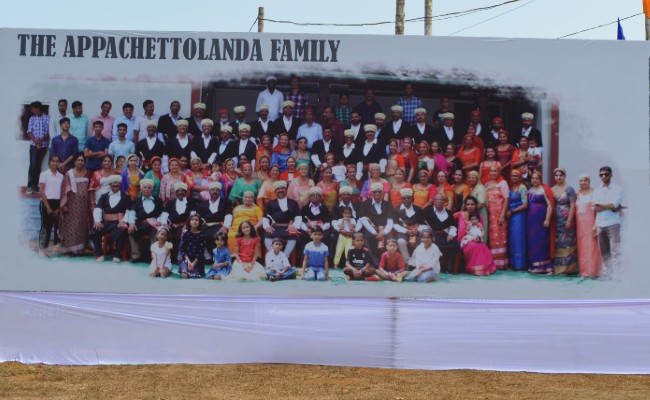
Appachettolanda, the host family of the 23rd edition of the Kodava Hockey Festival
The hockey festival has accomplished what perhaps nothing else could have — uniting distant families. It is the time for annual family reunions in their ancestral homes. What makes this festival distinctive is that it remains a family-oriented event, which has morphed into a major sporting event and festival in the country. Besides uniting warring relatives and families torn by strife, the hockey event is also a platform for community members to discuss and transact trade and business, besides scouting for marital alliances.
After a hiatus of four years due to floods and the pandemic, this year the hockey festival kickstarted with renewed vigour and energy. “This year (the 23rd edition) the Appachettolanda family is organising the event under the aegis of Kodava Hockey Academy. The festival is held at an estimated cost of Rs 1.5 crores, raised through contributions from the families, a grant from the Karnataka Government, and through sponsorships. More than 350 teams will participate in the festival this time. While the winning team will be given a cash prize of Rs 3 lakh, the runner-up will get Rs 2 lakh, and the teams that came third and fourth will get Rs 1 lakh each,” said Manu Muthappa, convener, Appachettolanda Hockey Festival.
pix05
An interesting feature of the festival is that both men women take part in the matches and there is no restriction on age. The only rule for forming a team is that all members must be from the same family and can include children and grown-ups from both genders. Young boys and girls, fathers, mothers, uncles, professionals, and even former Olympian heroes are all players. The women have the choice of playing for their in-laws’ team or their parents’ team. There have been instances when three generations of players have played together in a single match.
The festival is also ideal for talent spotting. Sometimes, officials from the Sports Authority of India arrive here to select players who are then offered training and equipment. Some of them have gone on to become state and national players. Plans are afoot to set up a hockey stadium to offer more facilities to budding players from the district. It is heartening that there is a growing interest among the younger generation in the hockey festival. But there is a need for more stadiums and turfs to facilitate more players to practise regularly.
Schedule of the hockey festival: General Thimmaiah Stadium, Napoklu, from March 18 to April 10.
Misty Woods Resort is an ideal place to stay to cover the hockey festival as it is within driving distance from the venue.
All pics by Susheela Nair.
Susheela Nair is an independent food, travel and lifestyle writer and photographer contributing articles, content and images to several national publications besides organising seminars and photo exhibitions. Her writings span a wide spectrum which also includes travel portals and guide books, brochures and coffee table books.
source: http://www.thenewsminute.com / The News Minute / Home> Features> Sports & Culture / by Susheela Nair / March 27th, 2023
Bopanna thus surpassed Daniel Nestor of Canada, who had claimed the 2015 Cincinnati Masters to become the oldest champion at the age of 42.
Matthew Ebden, of Australia, left, and teammate Rohan Bopanna, of India, hold up the men’s doubles winner’s trophy at the BNP Paribas Open tennis tournament.(Photo |AP)
Indian Wells :
India’s Rohan Bopanna became the oldest ATP Masters 1000 champion when he and his Australian partner Matt Ebden claimed the men’s doubles crown at the BNP Paribas Open here.
The 43-year-old Bopanna and Ebden, 35, defeated top-seeded Wesley Koolhof of the Netherlands and Neil Skupski of Britain 6-3, 2-6, 10-8 in the final on Saturday.
“Truly special. It’s called Tennis Paradise for a reason,” said Bopanna, who was playing in his 10th ATP Masters 1000 final.
“I’ve been, over the years, coming here and seeing all these guys win for so many years. I’m really happy that Matt and I were able to do this and get this title here.
“It’s been some tough matches, close matches. Today we played against one of the best teams out there. Really happy that we got the trophy.”
Bopanna thus surpassed Daniel Nestor of Canada, who had claimed the 2015 Cincinnati Masters to become the oldest champion at the age of 42.
“I spoke to Danny Nestor and I told him sorry I’m going to beat his record,” he joked.
“Winning the title, that stays with me, so really happy with that. ” It was the 43-year-old’s fifth Masters 1000 doubles title and first since he won in Monte Carlo in 2017.
This was the third final of the year for the Indo-Australian duo.
He now holds 24 tour-level trophies in his cabinet.
The Indo-Australian pair stunned defending and two-time desert titlists John Isner and Jack Sock in the semi-finals, while getting the better off Canadian singles stars Felix Auger-Aliassime and Denis Shapovalov in the quarters.
Bopanna and Ebden had defeated Rafael Matos and David Vega Hernandez in their opening match.
A former World No.3, Bopanna jumped four places to No.11 in the Pepperstone ATP Live Doubles Rankings.
source: http://www.newindianexpress.com / The New Indian Express / Home> Sports> Tennis / by PTI / March 19th, 2023
Bommai inaugurates Appachattolanda Cup Kodava Hockey Festival at Napoklu
Madikeri:
Chief Minister Basavaraj Bommai said that Kodava Development Corporation, a long-pending demand of the people of the district, will be a reality soon.
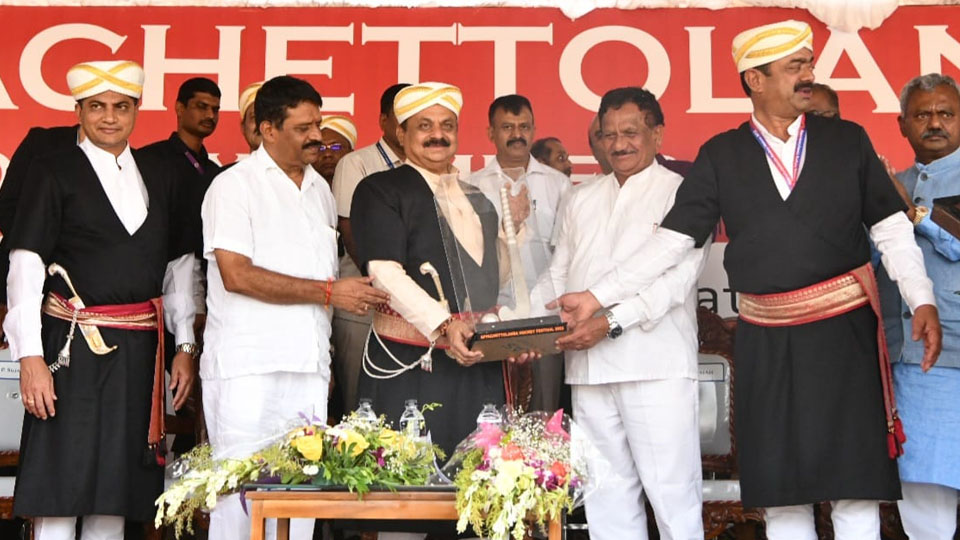
“I will issue an order on the setting up of the Kodava Development Corporation at the earliest,” he said after inaugurating the Kodava family hockey tournament hosted by the Appachattolanda family at General Thimayya Stadium in Cheriyaparambu of Napoklu last evening.
“Kodavas are physically strong and protect the nation. The Government is committed to the welfare and growth of the Kodava community and the Kodava Community Development Corporation that will strive exclusively for the overall development of the unique Kodava community has been a long-pending demand from the community and steps would be taken to realise it,” he added.
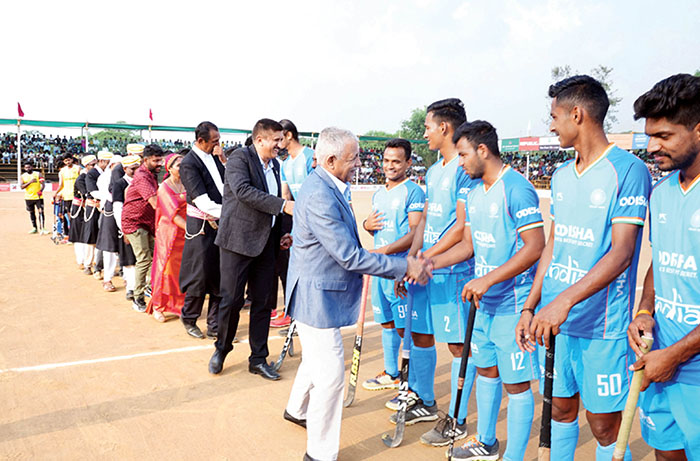
Picture shows former Indian Team hockey coaches M.P. Ganesh and A.B. Subbaiah greeting the players.
Heaping praises on the concept of a family hockey tournament, the CM said that the concept is wonderful and unique and brings Kodava families under one roof. “Kodava families are well-knit families. At a time when relationships are waning, the tourney has helped bring together families. Families should be united and relationships should bring together the people,” he said. “This is a special tournament as it is organised by the Kodava families. These families enjoy a good relationship, and family bond and the heritage of the Kodava community is being promoted through the game of hockey. The culture, tradition, and practices of the Kodavas unite all. Their attire and food are special,” he added.
“It is happy to note that this tournament is going on for the last 23 years. Families must unite and relationships must prosper. This is the culture of India. This kind of tournament is not seen anywhere in the world. Hence, the State Government has released Rs. 1 crore for the tournament,” Bommai said.
The hockey festival is being held from Mar. 18 to Apr. 9 on three grounds and a record 336 families or teams have registered for it. This is the 23rd edition of the event which had a four-year break from 2018 onwards owing to natural calamities in the district followed by the COVID-19 pandemic.
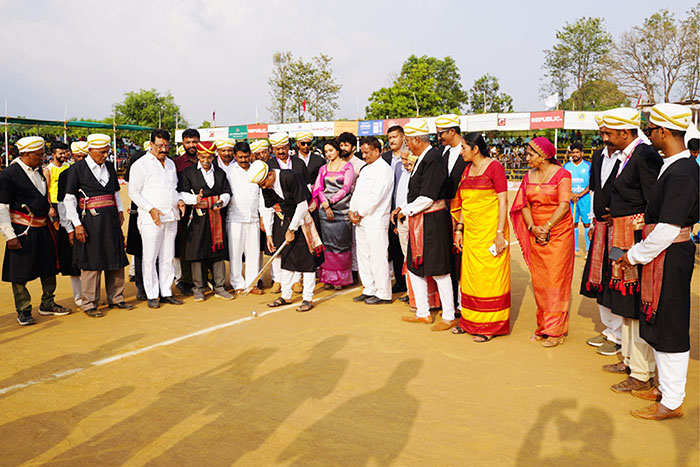
Earlier, the tournament began with a grand procession. Besides this year’s participants, the family teams which have participated in the tournament in the previous years also took part in the procession. Heads of the family teams gave the green signal for the hockey festival by firing 23 rounds of gunshots in the air.
The idea of a family tournament to bring together different Kodava families was conceived by the late Pandanda Kuttappa, popular as Kuttani, and the first edition was held in 1997 and has since then grown into a major event. The first exhibition match was held between the 37th Coorg Field Regiment and Kodava Academy-11. The second exhibition match was held between Indian Junior Hockey team and Karnataka team consisting of Olympian players from Kodagu.
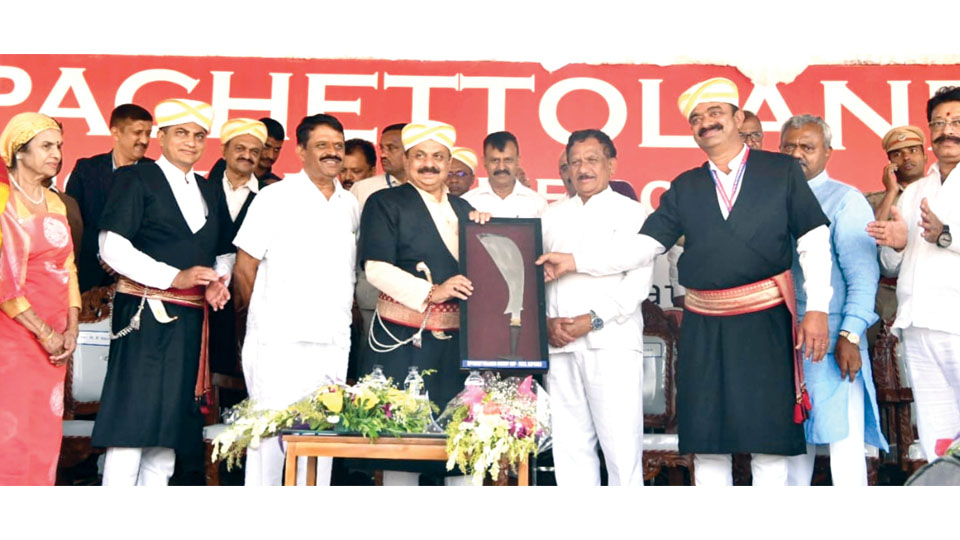
The CM was felicitated by handing over a silver hockey stick and silver ‘odikathi’ on the occasion. Bommai was dressed in Kodava attire, complete with ‘Kupiya-chele’, ‘peechekathi’ and ‘mandethuni’. Several cultural programmes were performed.
Minister S.T. Somashekar, MLAs K.G. Bopaiah, Appachu Ranjan, MP Pratap Simha, MLC Suja Kushalappa, former MLC Veena Achaiah, DC Dr. B.C. Satish, SP Ramarajan, ZP CEO Akash, ADC Nanjundegowda, CCF B. Niranjan Murthy, Kodava Hockey Academy Director Cheeyanda Satya, Hockey Festival Convener Appachattolanda Manu Muthappa, Appachattolanda family Pattedara Erappa, ex-Advocate General and Congress leader A.S. Ponnanna, Bangalore Kodava Samaja President M.T. Nanaiah, Padmashri Rani Machaiah, former hockey coaches M.P. Ganesh and A.B. Subbaiah were present.
source: http://www.starofmysore.com / Star of Mysore / Home> News / March 19th, 2023
Nine journalists from Mysuru among 123 in State receive the honour
Bengaluru:
Chief Minister Basavaraj Bommai has presented Karnataka Media Academy Awards to 123 journalists including nine from Mysuru, for the years 2019 to 2022, in a ceremony organised at Ravindra Kalakshetra here yesterday.
Andolana Award given for best district newspaper and instituted by Andolana Daily of Mysuru, was bestowed on ‘Nrupathunga’ Daily of Kalaburagi for the year 2019, ‘Navika’ of Shivamogga for the year 2020, ‘Sanje Darpana’ of Hubballi for the year 2021 and ‘Jayakirana’ of Mangaluru for the year 2022.
Mysuru Digantha Award given for best stories on human issues was given to Bagalkot’s Chandrashekar More of ‘Udayavani’ for his report titled ‘Maneyalle Eeji Samagri Tandevu’ for the year 2019, ‘Prajavani’ Mangaluru reporter Pradeesh H. Marody for his report titled ‘Keluttilla Male Makkala Alalu’ for the year 2020, T.N. Padmanabh of ‘Vijaya Karnataka’, Ramanagar for his report titled ‘Pusthaka Hidyuva Kaige Hasuvina Hagga’ for the year 2021 and V.R. Shivakumar of ‘Vijayavani,’ Hunsur for his report titled ‘Jopadiyalle Jeevana Bandi’ and Deepak Sagar of ‘Vijayavani,’ Shivamogga for his report titled ‘Kaggadalli Mulugida Meghaane Vanavasigalu’ jointly for the year 2022.
Executive Editor of ‘Mysuru Digantha’ Ghanavantha Malali was present on the occasion.
Special Awards were conferred on K.N. Tilak Kumar of ‘Deccan Herald’ for the year 2019, Vijay Sankeshwar of ‘Vijayavani’ for the year 2020, H.R. Ranganath of ‘Public TV’ for 2021 and economic expert Susheela Subramanyam for the year 2022.
Annual awards for the year 2019 were given to R. Manoj of ‘Kasturi TV,’ Chamarajanagar district, Sudarshan Chinnangihalli, ‘Vijaya Karnataka’ and H.V. Kiran, ‘TV9,’ Hassan, Kenche Gowda, ‘Vijaya Karnataka,’ Mandya and Anantha Shayana, ‘Shakti,’ Kodagu.
Annual awards for the year 2020 were given to Dharnesh Bookanakere, ‘Digvijaya News’ and senior journalist D.L. Lingaraju, Mandya, Nagesh Panathale, ‘Vijaya Karnataka’ and senior journalist Mahesh Machaiah, Kodagu, B.R. Udaykumar, ‘The New Indian Express’ and G. Prakash, ‘Vijaya Karnataka,’ Hassan and Mullur Raju, ‘Vijayavani,’ Mysuru.
Annual Awards for the year 2021 were given to A.M. Suresh of ‘Udayavani,’ Mysuru, Mohan, ‘Vishwavani’ and Mullur Shivaprasad, ‘Andolana,’ Nanjangud, K.P. Nagaraj, ‘Public TV’ and Shankar Bennur, ‘The Hindu.’
Annual Awards for the year 2022 were given to K.B. Ramesh Nayak, ‘Andolana,’ Chamarajanagar, Ravi Nakalgod, ‘Hello Hassan,’ Hassan and Somashekar Keragodu of ‘Kemmugilu,’ Mandya.
President of Karnataka Media Academy K. Sadashiva Shenoy delivered the welcome address.
N. Manjunath Prasad, Principal Secretary of the Department of Information and Public Relations and Dr. P.S. Harsha, Commissioner, Department of Information and Public Relations, were present during the awards presentation ceremony.
source: http://www.starofmysore.com / Star of Mysore / Home> News / March 14th, 2023
The Kodava community in the hilly district conducts the inter-family hockey tournament every year where players from over 200 families participate.
The annual Kodava hockey festival has no bar on age or gender. The only rule of forming a team is that all members must be from the same family. | Photo Credit: File photo
Napoklu, a small town 21 km away from district headquarters Madikeri, is all set to host what is termed the world’s largest field-hockey tournament, as the annual Kodava hockey festival will be held from March 18 to April 9 after a four-year gap.
The town has only three mud grounds. On Thursday, workers were seen preparing the grounds for the tournament, while temporary bleachers were up on all sides of the ground where 30,000 spectators can be accommodated, said Navin, a member of the festival organising committee, while overseeing preparations at the Napoklu General Thimayya Ground.
“In all, three grounds will be utilised for the hockey tournament and they will also be used as a backup in case it rains,” he said. Multiple galleries, lighting, speakers, and display boards have been set up on the ground. An estimated ₹1.5 crore have been spent to organise the event by the family.
The Kodava community in the hilly district conducts the inter-family hockey tournament every year where Kodava players from over 200 families come together to play. From 2018, the hockey festival was not held due to large-scale devastation caused by heavy rainfall and the COVID-19 pandemic.
The sporting event has no bar on age or gender. The only rule of forming a team is that all members must be from the same family.
This year, the Appachettolanda family is organising the tournament under the aegis of Kodava Hockey Academy. “From every family, young boys and girls, men, women, and professionals, and former hockey players who have represented the State or country, will be part of the family team. Through this event, we are bringing all the Kodavas together. Most of the community members who are outside the district working in various professions come to Kodagu to be part of the sporting event like a festival,” said Appachettolanda Manu Muthappa, president of the Hockey Festival Committee.
The late Pandanda Kuttappa conceived the idea of the Kodava family hockey tournament, which morphed into a major sporting event and festival in the country. “Mr. Kuttappa started the Kodava Family Hockey Tournament in 1997 and was organised by the Pandanda family first in a belief that tapping the inherent love among the Kodavas for hockey could help bring the families and the community together,” Mr. Muthappa noted.
The tournament also emerged as a platform for the community members to discuss trade and business interests besides scouting for marital alliances, according to Maletira Srinivas, secretary of Kodava Hockey Academy. “In the first tournament which was held in 1997, nearly 60 teams took part. The format of the tournament was such that every year, one of the Kodava families had to host the event. Now, over 200 families participate where 3,000 players play hockey,” Mr. Srinivas said.
“Starting with the first tournament, the numbers have increased, reaching a high of 281 in 2003, where this event became the world’s largest hockey tournament. Lasting three weeks, it is a single-elimination tournament and concludes on April 9,” he added.
CM to inaugurate
The Kodava Hockey Namme (festival) is hosted by a different family each year and named after it. Families apply to the Kodava Hockey Academy expressing interest and are allotted the tournament after evaluation. There is no permanent venue; the festival has been held across the district in previous years.
On March 18, Chief Minister Basavaraj Bommai will inaugurate the festival, which will open with an exhibition match between India Junior XI and Karnataka Men’s XI. The organisers said the festival is held at an estimated cost of ₹ 1.5 crore all raised through funds. While the winning team of the festival this year will be given a cash prize of ₹3 lakh, the runners-up will get ₹2 lakh, and the second runner-up will get ₹1 lakh.
source: http://www.thehindu.com / The Hindu / Home> News> India> Karnataka / by Darshan Devaiah B P / March 17th, 2023
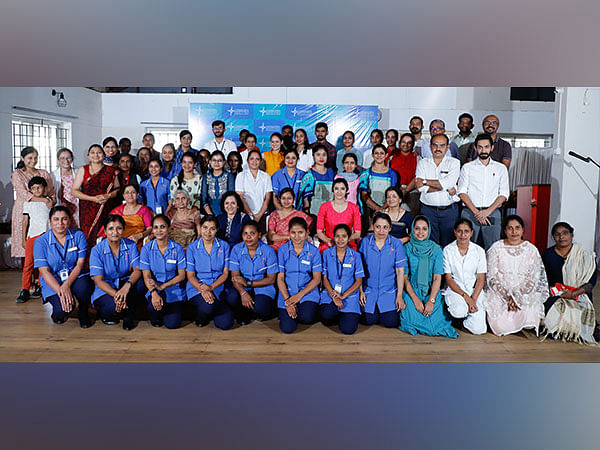
On the occasion of International Women’s Day, Lopamudra Hospitals, Gonikoppal organized a special event to celebrate women.
The event was graced by three renowned women from the region, Dr Gowramma Paruvangada, Consultant OBG at PNM hospitals, with five decades of practice in mother and child care, Dr. Fathima Kariappa, President of IMA Virajpet and Consultant OBG at Virajpet Nursing Home, and Uzma Jabeen, Panchayat Development Officer, the youngest in the district of Kodagu.
The event was presided over by the Managing Directors, Capt. Madappa M. A. and Dr Amrit Nanaiah M.M., a Consultant Physician at the Hospital. Dr Soumya Ganesh Nanaiah the Director of the Lopamudra Drishti Eye Hospital, a Cataract and Refractive Surgeon was present. She also emceed the event. Dr Sonia Mandappa, Consultant OBG, and Dr Trupthi Uthappa, Consultant ENT, were also present.
Speaking of their varied experiences, the Chief Guests enlightened the gathering on a multitude of topics.
Dr. Gowramma Paruvangada spoke about her long-standing commitment to serve women from rural parts of the country and her willingness to contribute more to the society at large. Dr Fathima Kariappa reminisced about how the babies she helped deliver were today doctors at the very Lopamudra Hospitals. She also emphasized the importance of women empowerment in today’s society and the role of family as an institution. Uzma Jabeen highlighted various government schemes available for women and how they could avail the benefits by contacting her.
The event was a sequel to a ‘Women’s Health Camp’ that saw more than 100 women availing the benefits of a health package curated to check overall well-being of women.
On the event of International Women’s Day, the hospital unveiled its new logo and a toll-free number for quick response. The hospital can now be reached at 1800 8333653. They also inaugurated the B Scan recently installed at the eye hospital. The B Scan is the first to be installed in Kodagu district. It can be used to assess the posterior segment of the eye in cases of media opacities and can be useful in cases of advanced cataracts
Dr Ruth Adhlaka, a Consultant Physician at the hospital, gave the vote of thanks, acknowledging the importance of such events and the hospital’s commitment to serving and empowering women.
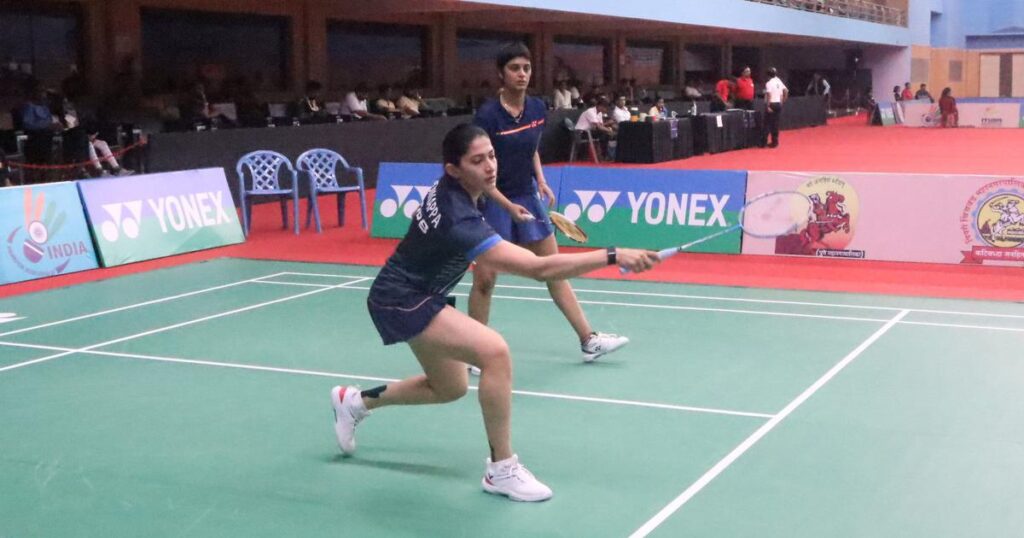
Ponnappa, 33-year-old former World Championship bronze medallist, has formed a new partnership in women’s doubles with 19-year-old Tanisha Crasto.
Ashwini Ponnappa along with her new partner Tanisha Crasto in Pune | Senior Badminton National Championships
Through the course of her career, Ashwini Ponnappa has been part of many firsts in women’s doubles for Indian badminton. Ponnappa and Jwala Gutta, became the first Indian women to win a badminton BWF World Championship medal (bronze in 2011). She has won gold, silver and bronze medals at the Commonwealth Games and also the women’s team bronze medal at the Incheon Asian Games in 2014. She has been part of Uber Cup bronze medal-winning squads.
But now the 33-year-old, a veteran of the sport in India, finds herself in the nascent stage of a women’s doubles partnership. In December, she made the decision to pair up with 19-year-old Tanisha Crasto for women’s doubles.
The change sees the once world No 10 women’s doubles player now find herself ranked 141 as a pair with Crasto, albeit they’ve played just two international competitions together – a quarterfinal finish at the Super 500 event in Indonesia in January, followed by a first round exit at the Thailand Open Super 300.
A third event was the quarterfinal finish at the 84th Senior National Championships, at the Balewadi Sports Complex in Pune on Sunday as they put up a good fight before losing against the in-form top-seed pairing of Gayatri Gopichand and Treesa Jolly.
It’s a long way back to the top, but in an interview with Scroll in Pune she asserted she’s looking forward to climbing back up the ladder, while also exploring a new role in commentary.
Excerpts from the interview:
How has the new partnership been working for you?
It’s good. Tanisha is young, she’s very energetic. It’s nice to play with that energy. We haven’t really had many tournaments together, we’ve played two and this is the third. But I’m excited to be here at the Nationals, it’s been a while since I played at this competition.
Earlier you had Jwala Gutta as a partner who was senior to you, then N Sikki Reddy who was not much dissimilar in terms of age. Now you have a partner who is 19. Are you also playing the role of mentor?
You could say that. I would say there’s a vast difference from when I started playing with Jwala to the youngsters now. They’ve all been playing international tournaments from when they were 17 or 18. They’ve all been there, done that. The doubles game has changed and the approach has changed. There’s not a lot of mentoring, she is good in mixed doubles and she’s done well there. Women’s doubles is a little different, but it’s good to have someone who moves into the net. She has that energy and speed on the court.
With age have you changed your approach to the game?
Of course. It’s inevitable for that to happen. I can’t be compared to a 19-year-old in terms of fitness and energy on court. I definitely have to be smarter on court towards the game in order to make sure that I can physically take the toll that badminton has on the body. I have to be very mindful of my training and how I approach the game.
Is it about the warmups and cooldowns getting longer now for you?
Yeah. Probably. But I’ve always been someone who had a longer duration for warmup. But cooldown definitely still needs to get better.
Recently we saw a different side to you – as a commentator. How was that experience?
I happened to be at the tournament and they asked me if I’d like to give it a shot. I felt no harm in doing that, although I feel that it’s not my cup of tea in terms of how I speak. I’d love to get better at it.
But I loved the experience. It was fun being on the other side of the TV. Watching players play you see things differently. You see patterns which you otherwise don’t look out for unless you’re getting ready for a match. That was interesting for me.
I sat for five matches during the Thailand Open, it was interesting for me to watch patterns match out of match. Like if one side was slower or faster, how players dealt with it. You understand that the player who is actually smarter on that day in dealing with the conditions has the upper hand. So that was very interesting that way.
Do you feel there were more expectations when you’re in the commentary box? Since people know here’s someone who has played at the highest level, is there an expectation for some insight which you’d not get otherwise?
Yeah, I am supposed to be the expert. The colour commentary part of it. It does get tricky because, that’s what I meant that it’s not my cup of tea. Not in a bad way, but being articulate about what I see, I’m not a journalist, I’m don’t have the lingo for it. So sometimes I feel, ‘what am I saying?’ Sometimes it’s so repetitive. But it was nice. Although I was a bit nervous, it was an enjoyable experience.
Is that something you’re looking to pursue later on?
Maybe later. Honestly, I don’t know. Right now, I’m definitely focusing on the game. But if I get these opportunities in between to commentate, I’ll definitely give it a shot.
What are the kind of things you and Tanisha have to do off-court just to get the chemistry going to gel on-court? And what are the targets?
This was our third tournament together. We’ve sent out entries for tournaments where we haven’t got an entry. But Tanisha will be playing in mixed doubles (with Ishaan Bhatnagar) in those tournaments. We haven’t had so much time in general to build the partnership because it is brand new, we just started. There’s still a long way to go, we still need that bonding time.
Is that, perhaps the target?
I would say the first target is to get an entry.
You mentioned the doubles game has changed. How?
Over the years the whole approach has changed. When Jwala and I were playing, we were kind of like the path-breakers in a way for doubles. There wasn’t a lot before us. Nobody we could look up to, nobody who had ever won. We had a lot of firsts together. But the game-changer has been that youngsters have been given a lot of exposure to tournaments. They’ve been playing tournaments since they are 17 – that was unheard of back then. We didn’t even have those tournaments in India.
Right now we have four international tournaments in India. You’re giving youngsters an opportunity to get that hunger at a very young age because you’re giving them a taste of what international badminton is. Also, everyone is going out, everyone is sponsored. That’s changed.
That’s why you see a lot of youngsters playing and taking it up. Otherwise, our generation, people in the past, they trained a lot, but never played tournaments. I wouldn’t say you didn’t have that talent back then, you just didn’t know. They were just training, they didn’t have the exposure, no push to go out. That has changed, and that’s why we see a rise in a lot of doubles players playing and doing well.
It’s because they’ve been pushed from a young age, getting out to participate, get that exposure, start training at a young age. These girls are 19. At that time, at 19, nobody was really encouraged to go out.
Yet you’ve remained relevant throughout this. What’s been the changes you’ve had to make in the way you approach the game to continue playing at the highest level?
I would say, I still need to get to the top. I have, in the past. But currently I’m starting from scratch. Ground zero. It’s challenging because you’ve been there and you’re coming back all the way down. It’s a reset.
source: http://www.scroll.in / Scroll.in / Home> Badminton / by Shahid Judge / February 27th, 2023
WELCOME. If you like what you see "SUBSCRIBE via EMAIL" to receive FREE regular UPDATES.
Read More »