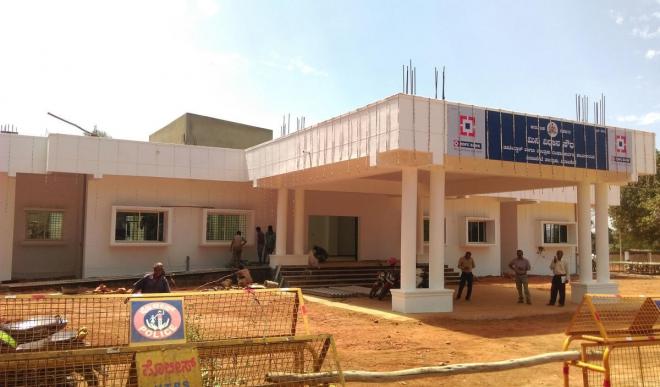
The first phase of the Mini Vidhana Soudha in Virajpet has been completed and will be inaugurated on Sunday.
With this, the long-pending demand of the people in the taluk will be realised. The first phase of the work was taken up at a cost of Rs 2 crore. It has seven rooms including the tahsildar’s court and toilets.
In the second phase, two-storeys will be built. A proposal for Rs 6 crore has been submitted to the state government. With the completion of the first phase of the work, the taluk office, sub-treasury, Department of Survey will be shifted. Once the second phase of the work is complete, entire Revenue Department of the taluk will function under one roof, according to officials.
The mini Vidhana Soudha for Virajpet was sanctioned way back in 1997. A committee was constituted to decide on the place for the Vidhana Soudha. Though there was a demand to build the Soudha at Ponnampete or Gonikoppa, it was decided to construct it at Virajpet keeping in mind the convenience of the citizens.
It was said that three years were spent on identifying the land. As suitable land was not available it was decided to construct it in a place where the old taluk office existed. The old building was demolished to facilitate the work on the Vidhana Soudha.
Accordingly, PWD invited e-tender for the work. Two contractors who had taken up the work left the work halfway. Later, once again tender was invited in 2013. Owing to a shortage of sand, and change in contractor, the work was further delayed.
District-in-charge minister M R Sitharam will inaugurate the Mini Vidhana Soudha, while MLA K G Bopaiah will preside.
With the completion of the first phase work, the offices will start functioning from mini Vidhana Soudha from March itself, said tahsildar R Govindaraj.
source: http://www.deccanherald.com / Deccan Herald / Home> District / DH News Service, Virajpet / February 17th, 2018
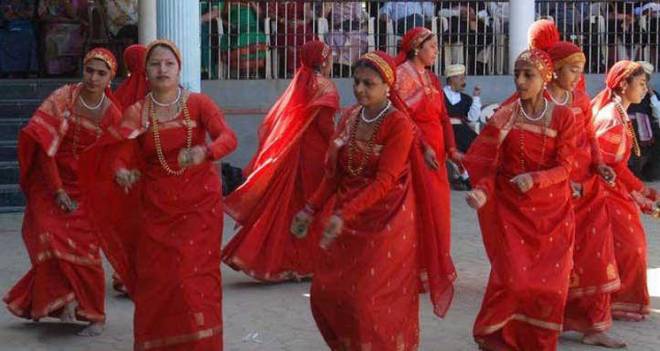
GRACEFUL: Kodava women perform Ummathat dance at the Kodava Samskrutika Mela at Napoklu in Kodagu on Monday.
Karnataka Kodava Sahitya Academy president Rani Machaiah on Monday called upon the Kodava-speaking groups to foster the unique Kodava culture to perpetuate it for posterity.
She was addressing a gathering at the Madikeri taluk Kodava Samskritika Mela (Kodava cultural convention) held at the Napoklu Kodava Samaja premises in Madikeri taluk, an official release said here.
The academy had been doing its best to preserve the unique Kodava culture by organising various cultural programmes across the district, she said. The Virajpet taluk convention would be held in Birunani on February 7 and in Somwarpet taluk in March, Ms. Machaiah said.
The traditional Bolakkat dance was inaugurated by Neriyandammanda Prabhu, Ummathat by Ikolanda Dotty Aiyappa, Kolatt by Mechira Ravishankar Nanaiah and Kodava song competitions by Boppanda Bollamma Nanaiah.
The former president of the Academy Bacharaniyanda P. Appanna presented a paper on the history of Nalnad area, comprising Napoklu and surrounding areas, at a seminar later.
There were five taluks in Kodagu in 1834 and several ‘nads’ (nad is a group of villages), he said. However, they had undergone geographic changes, Mr. Appanna said.
There were 26 villages in the Napoklu nad. The credit of preserving the Kodava culture should go to Napoklu nad, he added.
Mr. Appanna remembered the contributions of Kodavas of the past to nurture Kodava culture such as Appachira Mandanna, Kaliyatanda Ponnappa, writers such as Appaneravanda Appacha and Nadikeriyanda Chinnappa, all of whom hailed from the Nalnad area (Napoklu and surrounding areas).
Biddatanda Ramesh Chengappa, vice-president of the Napoklu Kodava Samaja, presided over the function.
Writer Moovera Rekha Prakash spoke on the history of Cauvery on the occasion.
source: http://www.thehindu.com / The Hindu / Home> National> Karnataka / by Staff Correspondent / Madikeri – February 01st, 2011
Says it has not approved the Thalassery-Mysuru rail link
A burgeoning environment movement across Kodagu was put to halt — albeit breifly — by the state government on Wednesday.
Putting an end to the rising levels of anxiety among thousands of Kodavas and green activists, the state government clarified that it has not approved the controversial rail link connecting Thalassery (Kerala) with Mysuru (Karnataka) via Kodagu. Further, the state government clarified that it would not even allow preparation of detailed project report (DPAR) for the proposed rail link as the project would jeopardise the fragile ecosystem of the pristine Western Ghats.
Allaying the fears of thousands of people, RV Deshpande, Minister for Large and Medium Scale Industries and Infrastructure, told the state legislature that the government expressed its opposition for the project. Drawing the attention of the state government, BJP MLA from Virajpet KG Bopaiah alleged that both Karnataka and Kerala already met once and agreed to carry out survey for the proposed rail link amidst stiff opposition from the local population.
Deshpande acknowledged that a meeting between secretaries of Karnataka and Kerala did take place recently, however, the Karnataka government had not consented for the project. “Holding a meeting does not ensure our approval for the project. We have not consented for the rail link project. Further, the project is yet to be approved by the Railway Board and thereafter a formal request has to be made by the Kerala government. Only then, we will be able to take a decision,” Deshpande revealed.
Going further, Deshpande stated, “We already had discussion about the project at government level. Our forest department has not only expressed reservations but also opposed the project as it would jeopardise the green cover and affect elephant corridor through which the rail link passes. Hence, the state government in principle has not consented for the project.” According to Bopaiah, as per the Railway minister’s reply in the Lok Sabha in December 2017, a joint meeting between Kerala and Karnataka secretaries had resolved to take up survey along the route only if the Kerala government submits a proposal to Karnataka provided it does not cause disturbance to wildlife areas. Interestingly, the rail link spanning more than 200 km would pass through Wyanad of Kerala and enter Kodagu at Kutta to pass through thick forest regions like Balele-Nittor-Canoor and Thithimati to reach Mysuru.
Perturbed that the new railway line with a project cost of Rs 6,685 cr would result in clearing of about 40 per cent of Kodagu’s forest, Kodavas, including retired defence officials, planters, environmentalists and public had staged massive protest rallies recently at Kutta and Madikeri. Fighting against the projects that would spell doom over the fragile eco-system of Kodagu where the River Cauvery originates, people from Kodagu, Mysuru and Bengaluru had launched Save Kodagu and Cauvery campaign led by Coorg Wildlife Society. Col (Rtd) Muthanna had even accused Kerala political leaders, including Congress parliamentarian KC Venugopal, of misusing his office as the Congress in-charge in Karnataka by leading Kerala delegations to push for destructive projects cutting through Kodagu benefiting Kerala.
source: http://www.bangaloremirror.indiatimes.com / Bangalore Mirror / Home> News> States / by Niranjan Kaggere, Bangalore Mirror Bureau / February 08th, 2018
The Kodavas were always a martial race with a pronounced colonial hangover (Agency Photo)
It’s an impressive roll call. Field Marshal K M Cariappa, Gen Thimmaiah, B C Nanda, M P Ganesh, Prasad Bidapa, Len Aiyappa….The Kodava community, from southwestern Karnataka, has always punched above its weight in Indian public life. Kodavas rose high in the Indian Army; they excelled at sport, particularly hockey and flourished in the coffee trade. But that was then. Today, the Kodavas are buffeted by the winds of change. Modernity and migration are taking their bewildering toll on a people that set great store by tradition.
This is the context of renewed demands for a separate Kodava autonomous region, which would give them a separate place of their own, in keeping with their claims of being vastly different from everyone else. For this would also accrue all the benefits that go with a distinct identity. The men are strikingly handsome and their women appealing winsome. Their customs and traditions too are quite different from those in the rest of the region,one being that an uncle usually marries his niece. For nearly two decades, the Codava National Council (CNC) has been fighting for autonomy and the issue is back on the agenda with regular dharnas and sporadic protests at the state legislature.
The Kodavas were always a martial race with a pronounced colonial hangover. Their loyalty to the British meant they found secure footing in the armed forces. Even though they had few officers and mainly made up the rank and file, the Army had a significant Kodava presence. No longer. Kodava recruitment at the Bangalore Army headquarters, which caters to Karnataka, Kerala, Mahe and Lakshadweep, fell steadily from 85 in 2001-02 to 28 in 2007-08. Today, the highest-ranking Kodava officer is a lieutenant-general and they have just a few major-generals.
The once-famous Coorg Regiment has suffered too. Twenty-five years ago, every Kodava family could proudly list several of its men in uniform. That’s history. Sons prefer to head for engineering colleges now or professions more lucrative than the Army, say recruitment officers.
It is the same with sport and the Kodava’s once-legendary skill on the hockey field. M P Ganesh, the first Kodava to captain the national team, heads a list that also features ace players such as M M Somaiah, B P Govinda, Len Aiyappa and Mandepanda Monappa. The community always enjoyed and excelled at traditional war games such as pareya-kali and shakti-kolu. This is why Ganesh, who started playing hockey late, was deemed a natural.
Army hockey teams, particularly those that played for the Madras Engineering Group, had several Kodavas. They were robust, used to walking to school several miles a day. And they had the right temperament for the game. But now, hardly any Kodavas play hockey, says Ganesh. “High coffee prices, other employment opportunities and a more sedentary lifestyle have led to a lack of interest in the game,” he says.
Today, the Kodava’s passion for hockey surfaces only during the annual tournament in Madikeri, the town in the Kodagu district that Kodavas regard as home. The tournament is hosted by one Kodava family or clan. Other families and clans play for pride and honour. Women are allowed to compete. National and state players are welcome but Ganesh says they are nothing like yesterday’s Kodava hockey stars. “Players should be picked up from here and coached,” he suggests. Eight Kodavas play in the Karnataka team today, but none in the national team. Len Aiyappa was the last to distinguish himself at the national level.
It is hardly different in the former Kodava mainstay, the coffee plantation. Once upon a time, almost every Kodava family owned a coffee estate, or part of it, ranging from a few acres to vast swathes of land. Coffee is cultivated on roughly 2.5 lakh acres in Kodagu, says M C Nanaiah, a member of the state legislative council, but the Kodavas no longer rule the roost.
Many Kodava families are selling off their ancestral homesteads and estates and migrating to Bangalore or Mysore. The trickle grew to a flood after coffee prices slumped a few years ago. Kodavas are also converting their palatial bungalows into home-hotels, burgeoning business ventures for sure but emblematic of their decision to swap a timeworn culture for modern commerce.
The winds of change are sweeping the little district, bearing the scent of the white coffee flowers. The Kodavas are hanging up their hockey sticks and Army boots. Many argue that it is all to the good for a community to change with the times, embracing newer professions such as IT and science. For the Kodavas, the change may be eagerly sought but bewildering.
deepa.bhasthi@timesgroup.com
source: http://www.timesofindia.indiatimes.com / The Times of India / News> India News / by Deepa Bhasthi / TNN / November 02nd, 2008
In 1837, this anger turned to action for freedom and the British suffered a temporary defeat, says N.S. Deviprasad Sampaje, Writer.
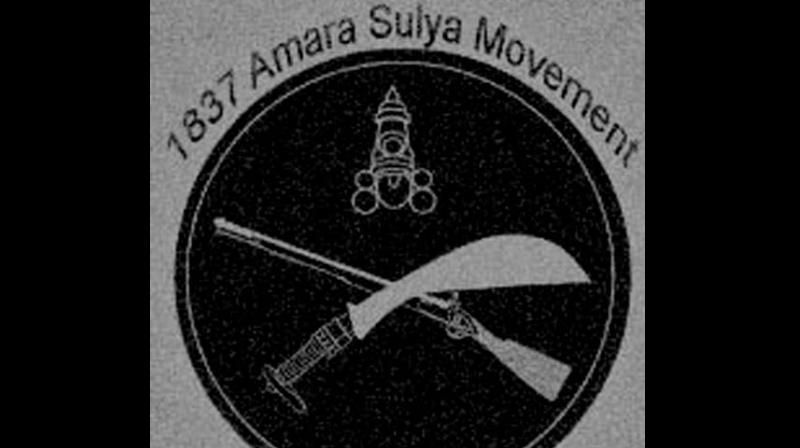
The Jangama Kalyanaswamy’s flag used during the Sullia rebellion was hoisted by Guddera (Guddemane) Appaiah against the British in 1837 was later adopted as the Kodagu Gowda coat of arms. They are also called Arebhashe Gowdas
Mangaluru:
It was the first armed uprising against the British, which took place 20 years before the First War of Indian Independence in 1857. The men who laid down their lives in this uprising of 1837 in Mangaluru are not forgotten.
The Tulunadu Rakshana Vedike and several others organisations marked the 179th anniversary of the uprising on Tuesday at Bavutagudda, where the rebels hoisted the Indian flag to mark their victory over the British on April 5, 1837.
“The people of Kodagu and Canara (coastal Karnataka) were unhappy with the British for various reasons. In 1837 this anger turned to action for freedom and the British suffered a temporary defeat,” recalls writer, N.S. Deviprasad Sampaje.
Mr Sampage , who wrote the book ‘Amara Sulliyada Swatantrya Sangrama,’ detailing this early struggle for freedom, says it was a mass movement and not restricted to some villages or caste.
“It received unprecedented support from the people of Dakshina Kannada. However there were efforts to tone it down by labelling it ‘Kalyanappa na Katakayi, or ‘loot of Kalyanappa’.
But in reality it was a major movement for freedom in the region, which scared the British. The reports of the then Collector of Dakshina Kannada, Leven, reveals this,” he says.
The rebellion was led in Kodagu by leaders such as Aparampara, Kalyanappa and Putta Basappa and continued in Sullia, Puttur before culminating in Mangaluru, the seat of the British Collector.
It is said the rebels held control of the city for 13 days before British reinforcements arrived in Mangaluru and recaptured it.
But it took two months more for the British to arrest the rebels and hang them in public to silence the movement.
“The government must do a proper study of the entire movement so people get to know its importance,” emphasises Mr Sampaje.
source: http://www.deccanchronicle.com / Deccan Chronicle / Home> Nation>Current Affairs / by Gururaj A. Paniyadi, Deccan Chronicle / April 06th, 2016
Many men and women serve in Indian defence forces from the small hill district Kodagu, known for coffee. Each family tries to ensure that at least one joins the defence force and the trend continues.
Life has not changed though many lost lives during service. The immense desire to serve the nation has not stopped women too. The latest to join the ranks as wing commander in Indian Air Force (IAF) is Pandanda Wilma Bheemaiah, wife of Pandanda Bheemaiah.
Daughter of Alamengada Muddappa and Tara from Hudikeri in Kodagu, Wing commander Wilma is presently stationed in Agra.
She served in African nation Congo on a united peace keeping mission and has many proud moments in her career.
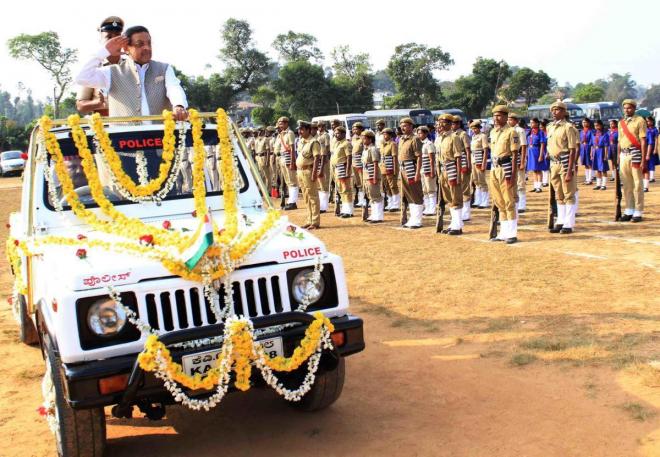
Kodagu District In-charge minister M R Seetharam receives the guard of honour during the Republic Day event in Madikeri on Friday.
The state government is committed to the development of the state and is working relentlessly, surpassing the barriers of caste, religion and language, said District-In-charge Minister M R Seetharam.
He was speaking after hoisting the Indian flag during the Republic day celebrations at General Thimmaiah ground in Madikeri on Friday.
The Indian Constitution upholds the value of ‘unity in diversity’. The contribution of Dr B R Ambedkar and others in providing us with a written constitution will be remembered by all the generations to come, he said.
The lives of the general public hold utmost importance for the government. Harmony and brotherhood is the mantra of development. Thoughts of people in a secular country should be based on secularism and equality, he said. All must take a pledge to respect the constitutional values, he said.
M R Seetharam said that during his recent visit to the district, Chief Minister Siddaramaiah had initiated projects worth Rs 122 crore. 94,011 families have been benefited by Anna Bhagya scheme in the district. 5514 and 799 people have been provided with title deeds under 94 C and 94 CC respectively. The construction work of 528 houses for Diddalli evacuees is on. Around 8,200 families of Jenu Kuruba and Erava Soliga communities are being provided with nutritious food. Forest Rights have been provided to 1,392 forest dwellers.
The minister further said that Indira Canteen will be set up in Somvarpet, Madikeri and Virajpet.
Troupes from DAR Police, Civil Police, Home Guards, MFC College, Koodige Sainik School, Bharatiya Vidya Bhavan, Government PU College, Government High School, General Thimmaiah School and St Micheal High Schools carried out a march past on the occasion.
MLC Veena Acchaiah, Zilla Panchayat President B A Harish, CMC President Kaveramma Somanna and Deputy Commissioner P I Srividya were present among others.
Schoolchildren presented cultural programmes on the occasion.
source: http://www.deccanherald.com / Deccan Herald / Home> District / DH News Service, Madikeri / January 26th, 2018
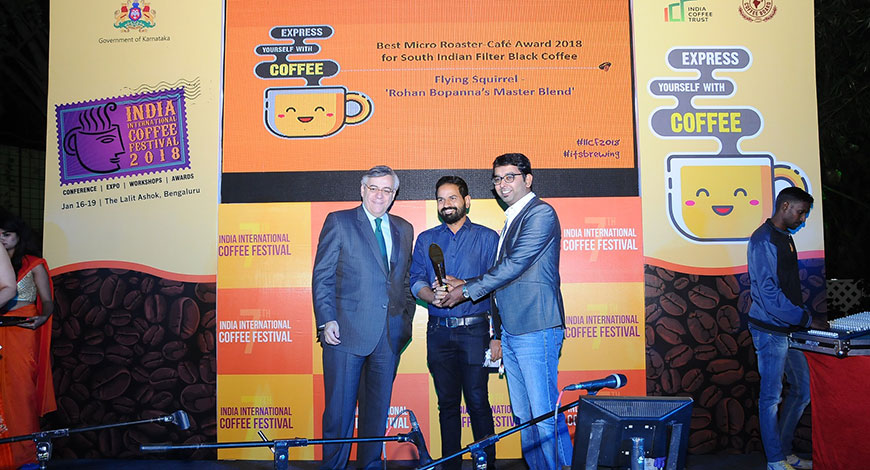
7th edition of India International Coffee Festival 2018 hosted at The Lalit Ashok, Bengaluru saw a host of activities including the coffee workshops, exhibition, keynote sessions, Fireside chat with Shri Priyank Kharge, Hon’ble Minister for IT, BT and Tourism, Government of Karnataka, Coffee Quiz Competition for Coffee enthusiasts ending the day with Café Awards ceremony.
The day started with workshops on ‘Role of sustainability in Post-Harvest Processing Equipment to secure the right quality, type and quantity of coffee.’ The session was led by Carlos Brando and Joao Alberto Peres Brando from Pea Marketing Ltd.
Shri Priyank Kharge, Hon’ble Minister for IT, BT and Tourism, Government of Karnatakagraced the occasion and attended a fireside chat session along with Mr. Anil Kumar Bhandari, President, India Coffee Trust where he emphasized on experiential tourism.“Today people want to experience and learn from their outings, hence experiential tourism is leading to a lot of buzz around homestays. We have offline and online strategies in place and are ready to build infrastructure and jointly manage it with associations. We have opened up 11 new eco-trails that will benefit the homestays and provide exhilarating experience to travelers,” said Shri Priyank Kharge while addressing the gathering.
He further said that, “I am privileged to have a unique opportunity to bring together information technology and biotech to further tourism in the state. I urge the startup fraternity and innovators to come forward with solutions that will help us build a sustainable tourism ecosystem in Karnataka.”
Commenting on this occasion, Anil Kumar Bhandari, President, India Coffee Trust said,“This year the festival focused on skill-building workshops, showcase of products and services, key sessions by delegates on Global Coffee Outlook and Future of Indian Coffee Sector.”
“The Indian coffee sector is growing at a rapid pace. And to sustain this growth, the dependence on government subsidies needs to come to an end,” said Shri Srivatsa Krishna, IAS, Chief Executive Officer and Secretary, Coffee Board of India.
Also, addressing a keynote session here, Jose Dauster Sette, Executive Director, International Coffee Organization said, “India is the sixth place in internal coffee consumption. In future by 2050, the production of world coffee might further decrease due to factors such as climate change that facilitates spread of pests and diseases. Both Arabica and Robusta are also negatively affected by the climate change.”
source: http://www.everythingexperiential.in / Everything Experiential – Business World / Home / by EE News Desk / January 24th, 2018
The International Coffee Festival brings growers, sellers, and lovers together in the same mug
Coffee love is serious love, and Bengaluru knows how to keep up with it. Just last month, Coffee Santhe celebrated your favourite brew with a three-day carnival. It had the best estates in India showcasing their blends and coffee-related demonstrations to coffee-related food and art.
Cut to the present. Coffee love is hogging the limelight yet again, thanks to the ongoing India International Coffee Festival (IICF) 2018. The expo, which is in its seventh edition, organised by India Coffee Trust – an NGO formed by various stakeholders of the Indian coffee fraternity, is on till Friday. And the event is dotted with different kinds of activities – from panel discussions to exhibitions by various growers.
Today, for instance, you can flaunt your knowledge of coffee at a quiz. Or, sit down for a workshop about the ‘Role of Sustainability in Post-Harvest Processing with the Right Processing Equipment to Secure the Right Quality, Type and Quantity of Coffee’ by Carlos Brando of Pea Marketing.
Over two days, you can listen to coffee experts and policy-makers talk about the trends in the coffee market, innovation in the production and packaging segment, startups making coffee ‘cooler’, alternate brewing techniques, and how to turn India into a ‘Coffee Nation’.
Jose Sette, executive director of International Coffee Organization, will speak about ‘Global Coffee Outlook – addressing challenges to meet future demand’; Dr Joseph K Kimemia, chairman of African Fine Coffee Association, will talk about ‘Initiatives on Promotion of African Coffee’; Dr Peter Baker, director of Climate Edge UK, will share his thoughts about ‘The Changing Climate for Coffee – farming in a time of extremes’; Sanjay Khajuria, senior VP (Corporate Affairs), Nestle India, will discuss the topic ‘Creating Shared Value –
How responsible business and communities work together’. The fest will also felicitate the best in the business.
Anil Kumar Bhandari, president of the India Coffee Trust, says that the coffee industry owes a lot to the country’s café culture that has grown rapidly in the past decade or so. “I need to give a little background into this festival. We started this expo in 2002, which begun in tacit with the Coffee Board, commerce industry, and ICT. However, we never asked for funds from the government because we didn’t want the show to come with strings attached.
There are only 4-5 large corporate houses that are part of this trust. Initially, it was started by a bunch of coffee growers like me, and the idea was to generate domestic consumption of coffee, and to help the growers market their coffee better. In India, 98 per cent of coffee growers are small, which means they farm on less than 10 acres. Now in 2002, the industry across the world suffered a massive slump because the global market was saturated. There was no strength in the industry to combat this deep depression. It is at that time that we considered generating a new idea – something that will increase domestic consumption – instead of the going to the government to ask for waivers and subsidies.” And this where cafes have come into play.
However Bhandari also adds that the coffee drinking habit remains mostly out of home, but “yes, it created a whole new lifestyle. Before the modern version of cafes, the smaller places had no focus, no identity, barring a few landmark places.”
Yes, the expo is quite industry-oriented. It is an ideal networking ground for people engaged in the growth, production, packaging, and promotion of coffee, or are planning to make a career switch in the direction. Nonetheless, platforms such as these provide common man a chance to learn what goes into bringing their latte, espresso, cappuccino, or the humble filter coffee to their tables.
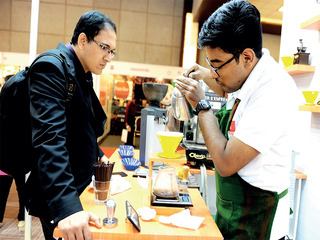
Besides these talks and coffee quiz, an exhibition is being held across two halls – Kalinga 1 and Siddhartha. On showcase are a range of coffee beans and blends, with Coffee Board of India itself displaying and selling 15 varieties (light, medium, and dark) hailing from Coorg to Chikmagalur, Araku Valley, Nilgiris and Wayanad. Plus, you can sift through coffee filters, including a cute, ceramic one. Needless to say, there’s a lot of coffee for you to sip on, from the regular instant brews to the speciality. Moreover, a few vendors will also teach you the method to making a cuppa of your choice.
Two stalls are interesting. One is selling coffee paintings – painting with coffee powder (see pic on left). It is the handiwork of Himabindu, an IT professional who’s currently on sabbatical. She has put up 30 paintings, and had managed to sell quite a few by Wednesday afternoon. The second one will have you scratch your head as it promises to print your selfie on coffee broth. The set-up will be fully operational today.
If you want to take your coffee expertise a notch up, you can enquire about the ‘Q Grader Arabica Training & Certification’ programme, which will take off towards the end of February. Or drive down to coffee estates in the state and learn about the bean-to-cup process there. You can get information at the tourism stalls.
Catch IICF 2018, January 18-19, at The Lalit Ashok, Kumara Krupa High Grounds Details: iicf.in
source: http://www.bangaloremirror.indiatimes.com / Bangalore Mirror / Home> Entertainment> Lounge / Bangalore Mirror Bureau / January 18th, 2018
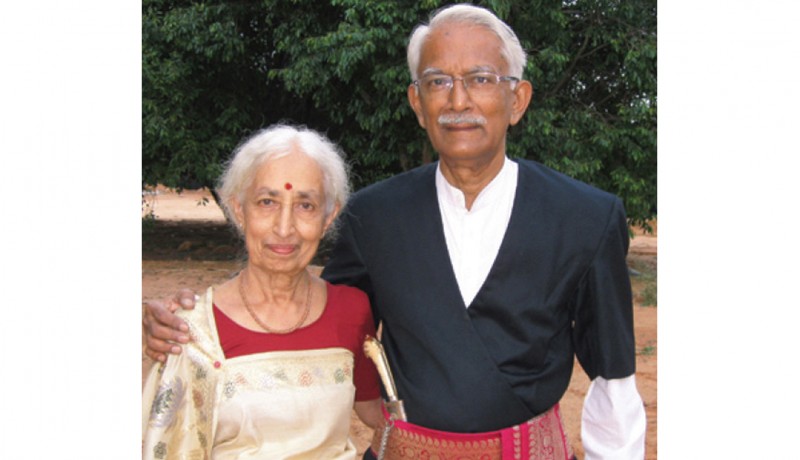
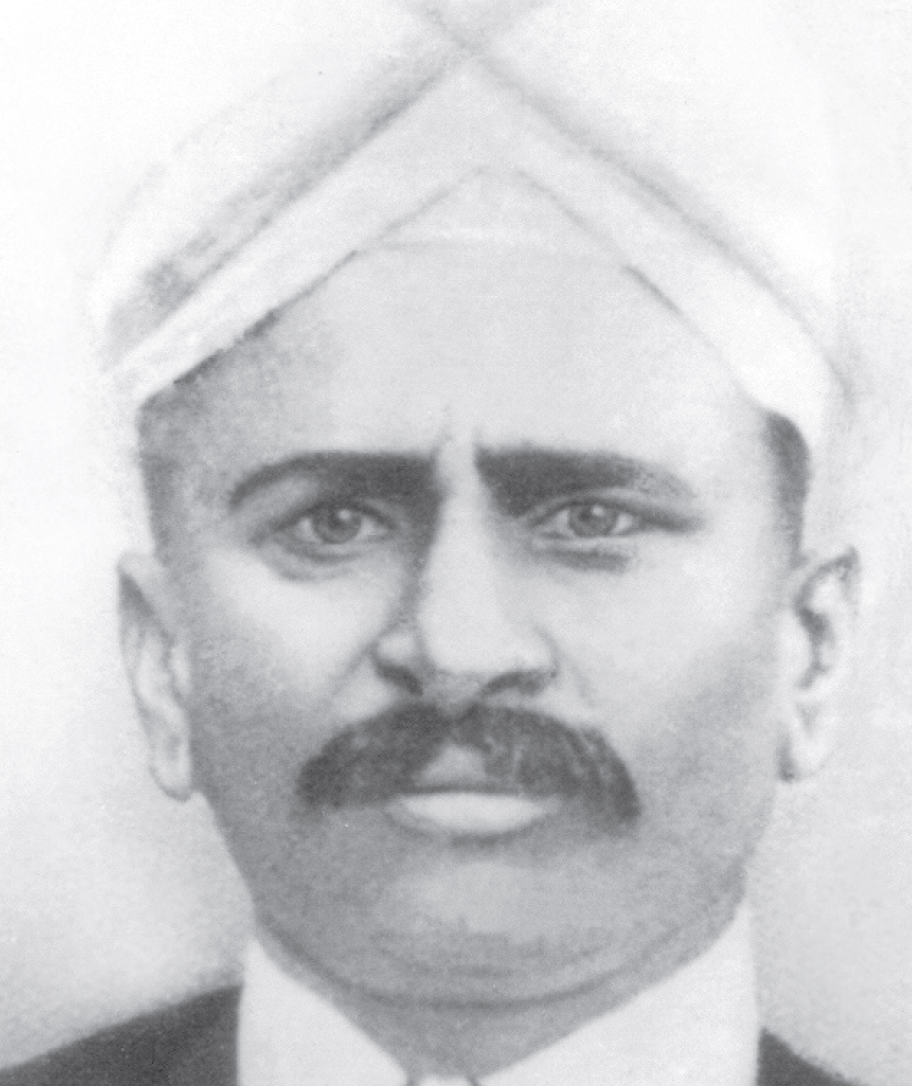
Boverianda Nanjamma And Chinnappa Recollect The Efforts Of Their Late Grandfather In Documenting The Folklore And Songs Of The Kodava Community.
Much as we admire him and are inspired by him, we have never seen our grandfather Nadikerianda Chinnappa; he died before we were born. We—Nanjamma and Chinnappa—are cross cousins. The narrative of our grandfather that follows is based on the recollections of our parents, aunts and elder cousins, gleaned from casual conversations over the years.
Our grandfather, who worked with the police, had gone to a remote village, riding his horse across a stream and through a forest path to investigate a quarrel over the ownership of a strip of land. On his way back, he stopped by the stream to eat the akki (rice) roti sweetened with jaggery his wife had packed for him. The sun was setting behind the hills and had painted the skies in brilliant hues of red and gold. Captivated by the scene, Nadikerianda Chinnappa sat lost in thoughts, when he heard the distant sound of Kodava dudi (small handheld, hourglass-shaped drums). Mounting his horse, he set out to locate the origin of the drumbeats. He found four men seated around a bonfire singing Kodava folk songs, practising for Puthari, the harvest festival. It was getting dark but he waited for them to finish. Recognising that our grandfather was in the police, the singers touched his feet respectfully. Our grandfather took the leader of the team home on his horse.
This was not uncommon; his wife Nanjavva knew he had brought a singer home for the night. She made a bed for the visitor in the attic and served them a hot meal with a drink of frothing toddy. Refreshed, grandfather and the singer sat in the hall; while the singer sang a ballad, Chinnappa transcribed the words late into the night. After many such sessions with various singers, he had a good collection of Kodava songs sung during weddings, funerals and festivals, and ballads in praise of deities and heroes.
Himself a good singer, Chinnappa’s passion for Kodava songs and ballads prompted him to transcribe them. During his travels around Kodagu as a police officer in the early 1920s, he observed that the unique customs and traditions of the Kodava community were being forgotten or altered. Chinnappa feared that Kodava traditions and songs that had been handed down orally over generations would be lost because of the dominance of English, and the influence of the cultures of neighbouring areas. So, he decided to document them.
Late in the evenings, after work, he neatly wrote down all the songs, proverbs and riddles by the dim light of a kerosene lamp, while smoking his favourite cigars. When he started documenting the customs and traditions, he consulted his mother Ponnavva who was well-versed in them. Meanwhile, his wife would read the draft first to ensure that it was clear to a layperson. If there were parts she did not understand, Chinnappa rewrote them. It used to be said that the waste paper basket would always be full in the morning.
British officials in Coorg—as Kodagu was called by them—got his draft reviewed by some prominent Kodavas. On their recommendation, C S Sooter, commissioner of Coorg, authorised financial assistance to publish it. Chinnappa chose the name Pattole Palame, meaning ‘silken lore’, for his book, which was first published in 1924. The 6th edition was printed in 2012.
Pattole Palame is a precious document of the heritage of the Kodava community. In the second edition published by the University of Mysore in 1975, the editor describes it as “one of the earliest, if not the earliest, extensive collection of folklore of any Indian community written in an Indian language by an Indian”.
The text of Pattole Palame is in Kannada and the folk songs, proverbs, etc, in it are in Kodava thakk, the language of the Kodavas, an oral language written using the Kannada script. Nearly two-thirds of the book consists of folk songs transmitted orally down generations, which are sung even today. Traditionally known as Balo Pat, these songs are sung by four men beating dudi. The songs have haunting melodies and evoke memories of times long past. Kodava folk dances are performed to the beat of many of these songs, which are a rich source of information on the culture, language and history of the Kodava people.
Chinnappa himself began translating Pattole Palame into English but could not complete it, as he died of cancer in 1931 at the age of 56, a few months after his retirement. It was in 2003, nearly 75 years after Pattole Palame was first published, that we, his grandchildren, translated it into English and published it.
Although he was best known for Pattole Palame, Chinnappa’s major literary work as a poet was Bhagavantanda Paat, his translation of the Bhagavad-Gita into the Kodava language, composed in the style of Kodava folk songs, published in 1929.
When Grierson, a British linguist, embarked on the first Linguistic Survey of India (1913 to 1920), he looked for knowledgeable representatives of the various Indian languages. Chinnappa, who was fluent in both English and Kodava thakk, was chosen for the Kodava language. As required, he translated the parable of the ‘Prodigal Son’ into Kodava thakk and narrated it, and sang his own poem, Sri Moola Kanniye, an ode to river Kaveri. These were recorded in 1922 on gramophone records; copies of the recordings were kept in the British Library in London and the Madras Museum. They were digitised recently by the Linguistics Department of the University of Chicago.
Born in 1875, Chinnappa was the fifth of eight children. After matriculating in Madikeri, he went to Mangalore for further studies. But when his elder brother Subbayya died suddenly, Chinnappa returned to Kodagu to take on family responsibilities. In accordance with Kodava tradition, he married Subbayya’s widow, Nanjavva.
His career took many twists and turns. A teacher at first, then a revenue inspector, and then an officer in the Coorg Regiment of the Army, he joined the police department when the regiment was disbanded in 1904, and rose to the rank of a prosecuting inspector.
Our grandfather was fond of sports. He was a bowler in the All Coorg XI Cricket team, which in those days consisted mainly of Englishmen. When he played billiards at Victoria Club in Virajpet, his British opponents would often swear under their breath on losing a game to him. On one such occasion, Chinnappa lost his patience, broke the billiards stick on his knee and threw it on the floor. This was a very daring act for an Indian in those days.
Chinnappa was also involved in establishing the Police Officers’ Cooperative Society, Coorg Cooperative Society, Coorg Central Bank and the Coorg Education Fund. He was fond of children and always carried peppermints in his pockets. He was a caring father to his own three children, the two stepchildren by his elder brother, and to his deceased sister’s daughter, whom he and Nanjavva adopted. He sponsored the education of many poor children, and there were always a few students boarding in his residence, free of cost.
Our grandfather was a man of vision and talent, and was self-driven. He was a folklorist, poet, police officer, sportsman, historian, singer, philanthropist, and caring householder. Above all, he was a man who lived life to the fullest and left a lasting and invaluable legacy for his people in his writings.
The authors are translators and scholars of Kodava studies
Featured in Harmony — Celebrate Age Magazine
August 2016
source: http://www.harmonyindia.com / Harmony / Home> Columns / August 2016
WELCOME. If you like what you see "SUBSCRIBE via EMAIL" to receive FREE regular UPDATES.
Read More »