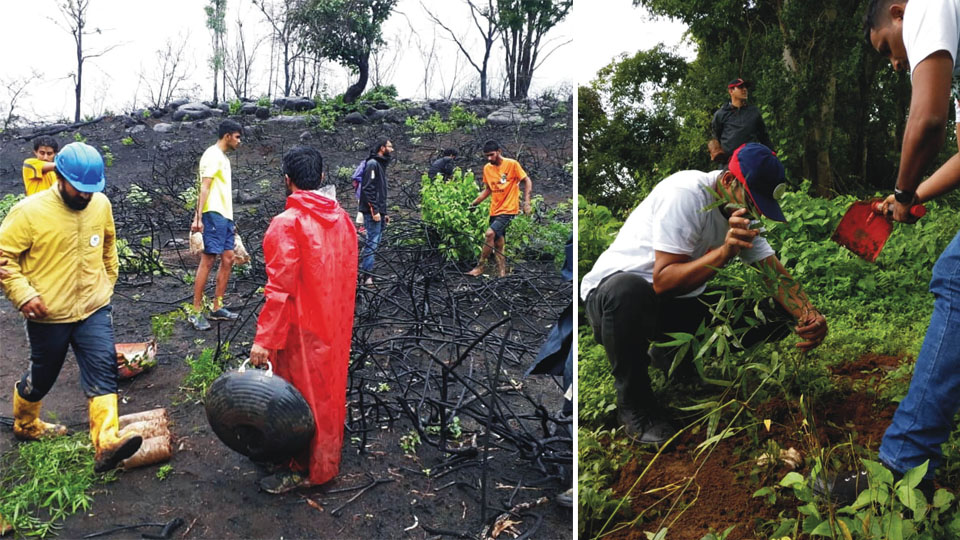
Over 400 volunteers to plant 50,000 seed balls, 10,000 saplings near Anechowkur on July 27
Mysuru:
Year-by-year weakening of regular rainfall in Kodagu and depleting green cover along the Cauvery River basin and the resultant shortage of water has made environmentally conscious groups to come together to organise a massive tree-plantation drive in Kodagu, the principal catchment of Cauvery.
An initiative taken up by Kodavaame, Team Roots of Kodagu, Kodagu Jawa Yezdi Motorcycle Club and Forest Department of Karnataka, TATA Coffee, Madikeri Akashavani, Kodava Samaja Bengaluru and over 72 organisations and voluntary groups from Kodagu, Mysuru, Bengaluru and Chennai are coming together for the tree-plantation drive on July 27 from 9 am onwards near Anechowkur Gate, Thithimathi Forest Range in Kodagu under the Nagarahole Tiger Reserve.
This plantation drive is kick-started by individual volunteers to help rejuvenate and rebuild green cover in Kodagu. Volunteers have sourced more than 50,000 seed balls to be planted during the drive and the Forest Department will provide 10,000 saplings of various wild species that are native to Kodagu and the Nagarahole forests.
Kodavaame initiated this annual tree-planting drive three years back and last year, saplings were planted at Aanekaadu forest near Kushalnagar.
Speaking to Star of Mysore yesterday, Shammi Belliappa of Team Roots of Kodagu said that the Forest Department will identify the places where saplings are to be planted and all the necessary permissions and approvals have been taken.
“Different groups and individuals are coming together in Kodagu to work towards the common goal of protecting the flora and fauna. This event can be an ideal start to a great new direction in Kodagu and further can spread to other districts,” he said and added that as it is an annual event, the next plantation initiative is likely to be taken up at Chennangi in Kodagu.
All volunteers have been directed to wear water-proof jackets, rain coats and gum boots or rain shoes. While many volunteers will be grouped to plant saplings and seed balls, the rest will look into the supply of logistics and will ensure smooth traffic flow.
Organisers are expecting over 400 volunteers and as it is a Tiger Reserve, the volunteers will strictly follow the instructions from the Forest Department, he said.
While Lions Club-Gonikoppal and Rotary Club Kushalnagar will provide food and beverages for the volunteers, Kodava Samaja, Bengaluru, will sponsor the free bus ride to and fro for volunteers who are travelling for this greening event.
source: http://www.starofmysore.com / Star Of Mysore / Home> News / July 24th, 2019
Provides sensor-based online real-time data on storage level to officials in New Delhi
Madikeri/Mysuru:
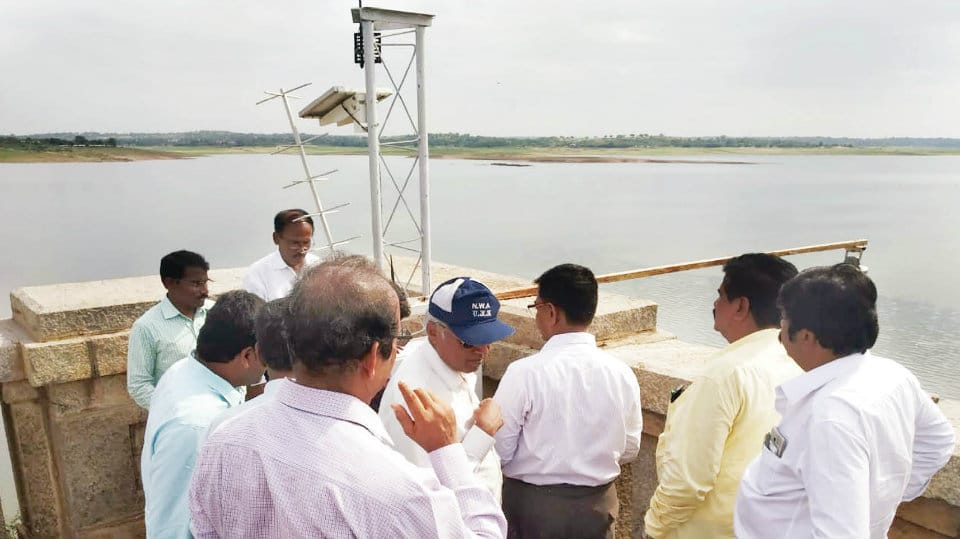
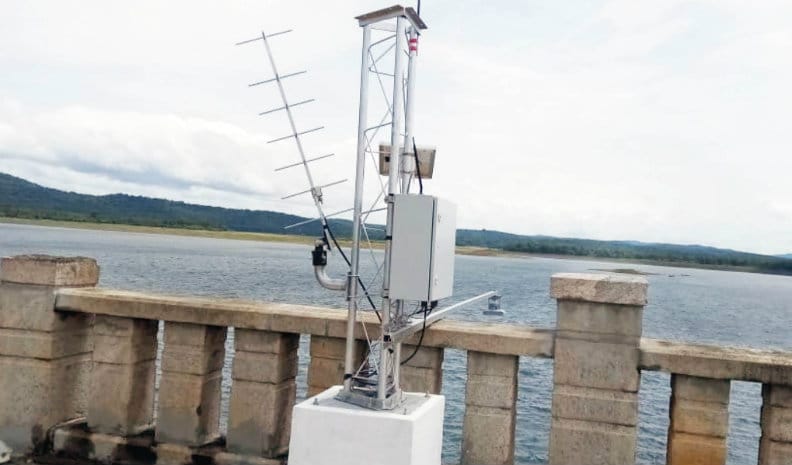
Telemetric Water Gauge has been installed at Krishna Raja Sagar (KRS) Dam in Mandya district and also at Harangi Dam in Kodagu for sensor-based real-time data on the storage level, inflow and outflow of the reservoirs.
The installation comes weeks after an Internal Committee of Cauvery Water Management Authority (CWMA) visited the two Dams in the first week of June this year. The team, after studying the water levels and reporting mechanisms, had decided to set up Online Monitoring System for all the reservoirs in Cauvery Basin through Telemetry-based Real-time Data Acquisition and Transmission.
The facility transmits data to CWMA Office in New Delhi and the authorities who decide on the water release as mandated by Supreme Court need not wait for the data from the Dams. They can easily access the data through the Telemetry Transmission system.
No room for errors: All these years, the authority sitting in New Delhi had to obtain data from each reservoir every day to determine the storage levels, inflow and outflow. This system was prone to errors as the people manning the Dams take physical measurements. Now with the new system, errors are eliminated and accurate real-time data can be accessed, making the decision-making process easy and accurate.
The Union Government has constituted the CWMA and and Cauvery Water Regulation Committee (CWRC) as directed by the Supreme Court and an Internal Committee comprising Irrigation experts from the Cauvery Basin States of Karnataka, Tamil Nadu, Kerala and Puducherry has been formed.
Real-time data acquisition
During their visit, the CWMA team discussed real-time data acquisition and transmission, installation of water-level sensors, flow rate sensors at all canals / outlets taking off from all the eight Reservoirs coming under Cauvery Basin and technical issues such as capacity enhancement of Dams, safety of Dams, prevention of leakages, modernisation of canals for prevention of seepage, etc.
The new advanced telemetry system has been installed based on the directions from CWRC. Sources said that such a system has been installed at Reservoirs including Hemavathy, Harangi, Kabini and KRS in Karnataka and in Banasura Dam at Kerala and Lower Bhavani, Amaravathi and Mettur dams in Tamil Nadu.
On mobiles
Speaking to Star of Mysore this morning, Vasudev, Assistant Executive Engineer of Cauvery Neeravari Nigam Limited (CNNL) that manages KRS and Harangi, said that the Telemetric Water Gauge gives live data to CWMA and CWRC authorities and they can access the data at any given point of time on their mobile phones.
The system transmits live data from the Dams and an exclusive cell has been set up at CWMA Office in New Delhi to receive the data and send them real-time through mobile phones. “With this system, now no one can bluff the CWMA by constantly claiming more water, hiding the real storage level data at the Dams. Even the CNNL authorities can access the data,” he said.
The data will measure minute details about number of canals and their location, water levels inside the canals, their turbulence, number of sluice gates, size of gates and the amount of water discharged from the crest gates. It also records spill- over water.
source: http://www.starofmysore.com / Star of Mysore / Home> News / July 26th, 2019
Under the campaign, ‘Roots of Kodagu’, local youth have pledged to plant 60,000 saplings on Mysuru-Kodagu National Highway with the objective of protecting River Cauvery, the lifeline of Southern Karnataka.
The campaign will be flagged off from Anechowkooru border within the limits of social forest on July 27.
The saplings will be planted and seed balls will be sown particularly in the forest area which was engulfed by fire.
The programme will be carried out under the guidance of the Forest Department. Around 70 organisations had pledged support to the campaign. As many as 400 volunteers were expected to take part in the event.
Say Tree organisation of Bengaluru had provided 50,000 seed balls and the Forest Department had given 10,000 saplings for the campaign.
The organisers said that fruit-bearing plants and the plants in tune with the climate of Kodagu will be planted in large numbers. These plants will act as sources of food for wild animals. This will not only minimise human-animal conflicts but also will improve the groundwater table.
Besides conducting the campaign, volunteers will also create awareness about afforestation. They will urge the public to plant saplings during family functions in order to commemorate the event.
The main objective of ‘Roots of Kodagu’ is to recreate the green forest cover in Kodagu, which will protect River Cauvery, said the volunteers.
The programme encourages collective responsibility in the preservation of River Cauvery.
“One should understand that if River Cauvery is protected, everyone stands protected,” stressed ‘Roots of Kodagu’ volunteer Chendanda Shami Madaiah.
source: http://www.deccanherald.com / Deccan Herald / Home> State> Mangaluru / by DH News Service, Ponnampet / July 26th, 2019
The President of Coorg Wildlife Society (CWS) K.C. Biddappa has been appointed as the Honorary Wildlife Warden of Kodagu District by the State Government in recognition of his service in protecting the wildlife and environment, according to a press release.
source: http://www.starofmysore.com / Star of Mysore / Home> In Briefs / July 24th, 2019
Morning Glory, a school located in Coorg, Karnataka, will soon teach underprivileged students about waste segregation, conservation of natural resources using natural educational aids.
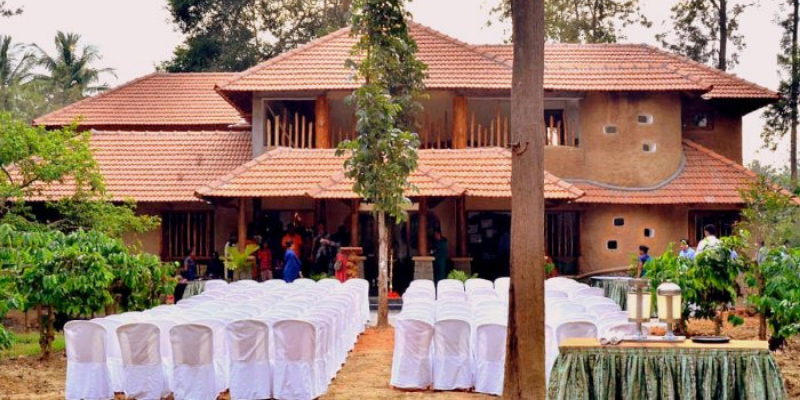
Education is an important tool for survival in today’s world. So is knowing how to preserve the environment and ensuring that future generations don’t bear the brunt of our poor living choices. And combining education and eco-friendly initiatives is Morning Glory, a school in Coorg, Karnataka.
The school, which has been set up exclusively for the children of plantation workers, tribal communities, and the underprivileged in the Siddapura district, will not charge any fees either.
Morning Glory, a school in Coorg, Karnataka.
Managed by Bangalore-based educational foundation Building Blocks and funded by the Orange County Resorts & Hotels Ltd (now also known as Evolve Back), Morning Glory teaches its students about various eco-friendly moves. Speaking to Edex Live about the school, Evolve Back Executive Director Jose Ramapuram said,
“Morning Glory is an initiative to create a clean, healthy, and environment-friendly atmosphere for young underprivileged children to learn. We want children to grow with an understanding of environmental sustainability and the need to preserve mother nature. This all-inclusive free school is our way of giving back to the community that has been a backbone to our growth and success.”
Here, the children will be trained according to their age on various environmental practices and the importance of conserving the environment. For instance, children would be taught the 3Rs (Reduce, Recycle, and Reuse) through stories, songs, visual arts, and activities.
Further, to make students capable of taking care of plants, the school has a garden where the kids will be taught how to care for and respect vegetation.
Children will also be taught about waste segregation practices, and the conservation of natural resources, and will learn with natural educational aids like leaves, pebbles, rocks, sticks, and pressed flowers.
Speaking to Deccan Herald, Institution Manager Anish Kanti said,’
“Usage of plastic has been reduced to the maximum extent possible. Along with the school structure, the equipment within the school such as the chairs and tables too are designed to reflect the vintage concept. This is done to create a homely atmosphere for the children.”
An English-medium school, Morning Glory will also provide books, bags and other things necessary for the children, including two free meals per day. As many as 40 children have already enrolled in the school for this academic year.
(Edited by Evelyn Ratnakumar)
source: http://www.yourstory.com / Your Story / Home> Social Story / by Think Change India , edited by Evelyn Ratnakumar / July 16th, 2019
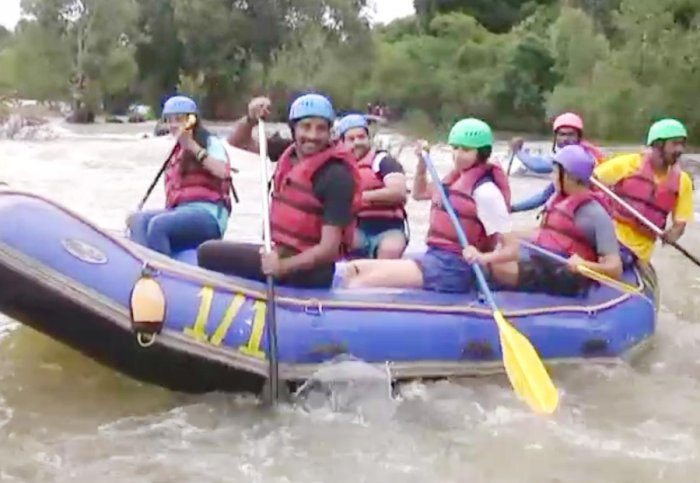
Rafting, an activity that is a big favourite of tourists at Dubare, is back. As a result, the tourist camp is buzzing with activities again.
As river rafting had been banned in River Cauvery at Dubare a year ago, the number of tourists had dipped drastically.
The rafting association had urged the district administration and District In-charge Minister Sa Ra Mahesh to lift the ban on rafting and support the local entrepreneurs.
As the ban has been lifted, tourists are now making a beeline during weekends to take part in the adrenaline-pumping and adventurous activity.
This, in turn, has left the organisers of the rafting activities as well as the local vendors smiling.
River water level
Water rafting at Dubare is being conducted along a distance of eight kilometres. The water level in River Cauvery too has risen, following good rain in the district. More number of youth were seen enjoying rafting.
The sport was relaunched at Barapole as well. Barapole is located 35 kilometres away from Madikeri. A fee of Rs 600 is charged per head for those keen on rafting activity.
River rafting was introduced in Dubare in 2002. In case of good rain, rafting activities can been conducted till December.
Dhanush, a software engineer who took part in rafting at Dubare, said, “The plans to take part in the rafting activity could not be realised a year ago as it had been banned. Now, we got a new experience.”
Elephant camp
Businessmen said that as the rain was less this year, more number of tourists were landing in Kodagu. Many of the tourists have also been visit the elephant camp at Dubare.
Randeep from Bengaluru said that he would like to explore all tourist sites in Kodagu.
Tourists have been thronging Raja Seat, Abbey Falls, Mallalli and Irpu Falls. The homestay and resort business has also been revived, the businessmen added.
source: http://www.deccanherald.com / Deccan Herald / Home> State> Mangaluru / by Adithya K A / DH News Service, Kushalnagar / July 19th, 2019
It is monsoon season in Kodagu and though rains are less this year, people in remote villages of Kodagu, who have grown Garcinia gummi-gutta tree in their estates or have access to the tree grown in the wild, are busy in preparing Kachampuli, the dark, tart vinegar. Kachampuli preparation has been passed on from generations and is indispensable in Coorg cuisine. Every Coorg kitchen has a couple of bottles, or more, of Kachampuli tucked away at the corners or stored in the attic. This Weekend Star Supplement introduces readers to this enigmatic liquid and explains the process of obtaining it from yellow fruits hanging on top of tall trees.
Kachampuli: The Quintessential Coorg Condiment
A full-fledged processing unit at Ponnampet Forestry College
by B.C. Thimmaiah
Souring agents are an integral and inseparable part of our culinary traditions. Depending on the State and community, souring agents vary. Apart from lip-puckering tamarind and lime juice that is quite ubiquitous in most Indian dishes, there are a host of other souring agents that enhance the flavour of dishes like Kodava Pandi Curry (pork curry) where Kachampuli makes it the ‘Dish with a Zing’.
The concentrated juice is obtained from Garcinia gummi-gutta, the same fruit that is used in dried form in parts of Kerala, where it is known as punampuli or kodampuli/kudampuli. It is a relative of kokum, which is used in Mangalorean, Konkan and Maharashtrian cuisines. In Kodava language, the fruit is known as ‘Panpuli’ and its boiled extract is ‘Kachampuli’.
The fruit is like a large Amla but with prominent sections. In its fresh form, it is known to possess medicinal properties and is the basis for many weight-loss products. The English name is Brindle Berry. Before it is stored, the Panpuli is taken apart in slivers, dried and then smoked. It’s here that the green fruit turns into matt black. Later, dry pieces are soaked in warm water and torn apart before being added to the curry.
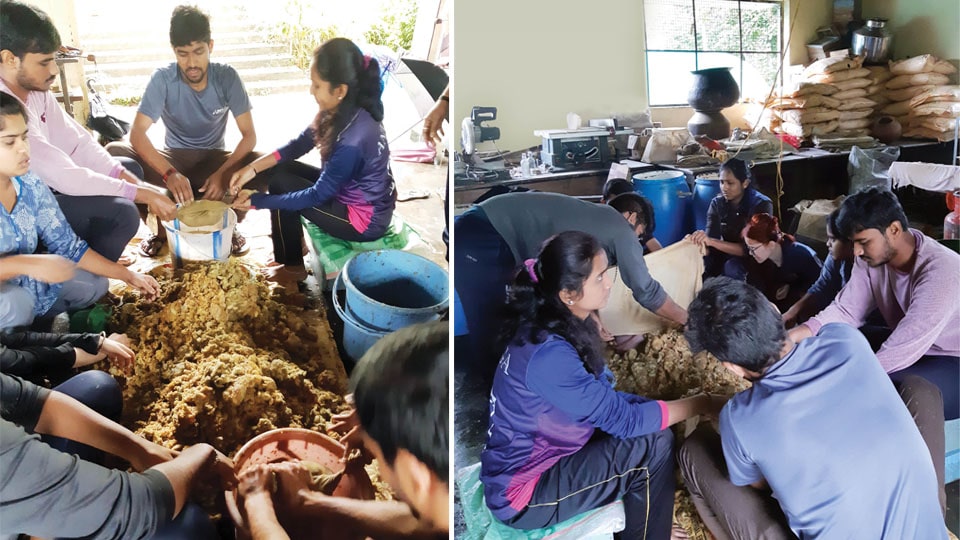
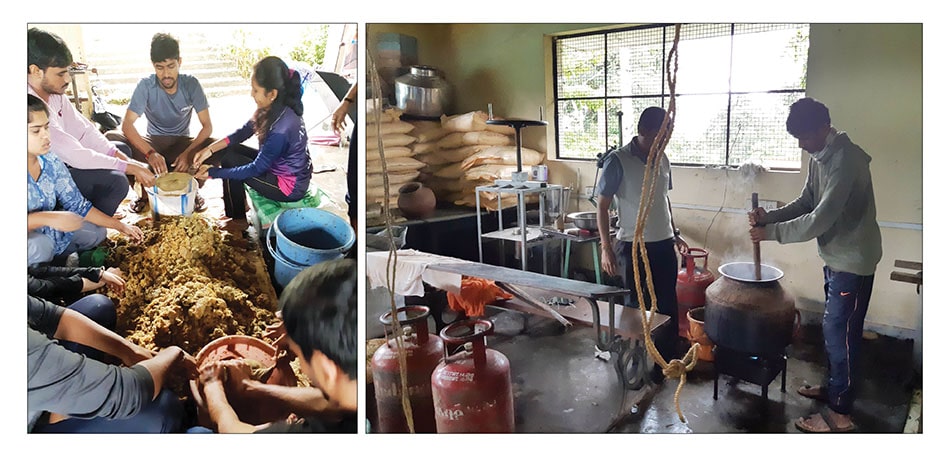
Students of Forestry College, Ponnampet, extract the seeds from the fruit. Once the succulent aril is separated from the seeds, the extracted juice is boiled and stirred constantly to procure the thick Kachampuli.
Juice preparation process
In Kodagu, the fruit is left out in baskets until the pulp breaks down. A large vat is kept below to collect the juice and the pulp is removed. The juice at first is pale and golden. It is then boiled in large clay pots until it turns dark burgundy in colour. This slow heating turns it into a syrupy vinegar. The final result is a dark and thick liquid and this liquid extract is known as Kachampuli.
Interestingly, Kachampuli improves with age. The older brews are preferred over the newer ones for cooking. The new bottles are usually stored in attics in Kodagu and are left there to mature and attain that perfect texture, taste and colour. Kachampuli is usually used in the final stages of cooking, mainly in meat and fish dishes, most famously in Pandi Curry and fish curry.
An expensive commodity
While Kachampuli was abundantly available in the open market earlier, now it is a scarce and an expensive commodity even in Kodagu, its hometown, thanks to the present generation that is unwilling to take the trouble of preparing it as it is a long-drawn and pain-staking process. Adulteration of Kachampuli to make a quick buck too has become rampant.
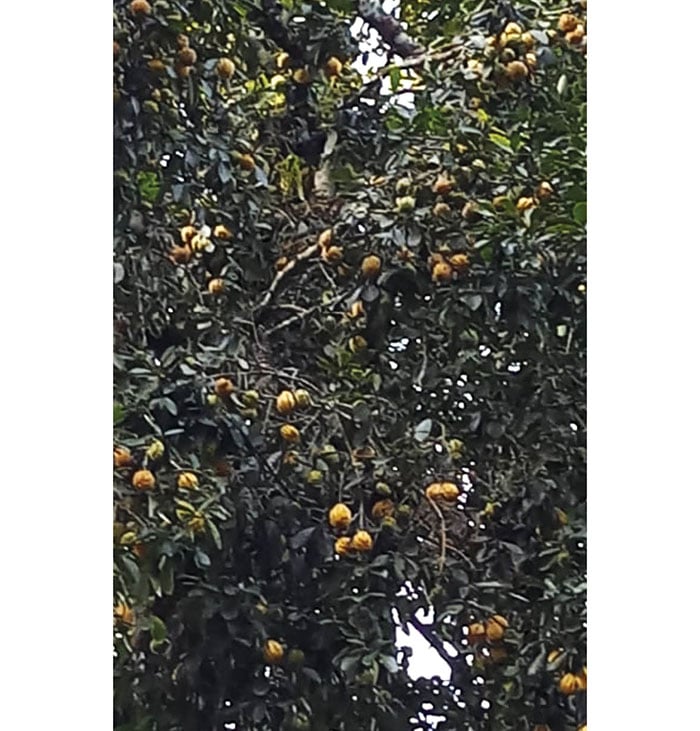
A fully grown Panpuli or Garcinia gummigutta tree in Kodagu with its yellow fruits
Realising Prime Minister Narendra Modi’s ‘Make in India’ initiative
Considering the rarity of the fruit and its many uses, College of Forestry at Ponnampet in South Kodagu has started a full-fledged unit that procures the Garcinia gummi-gutta fruit from farmers, processes it, prepares Kachampuli and then markets it. This initiative has not only ensured that the tradition continues but also eased the scarcity of the unique product in the market.
The initiative at the College was started by former Dean of the College Dr. B.C. Uthaiah and continued on a major scale by the present Dean Dr. C. G. Kushalappa, who has conducted extensive research in Devarakadus, the Sacred Forests of Kodagu and the wild and edible fruits of Kodagu, and Dr. B.N. Satish, Assistant Professor, Department of Forest Products and Utilisation.
Hands-on Training
The College is following the traditional methods of using forest produce available in Kodagu. “Our College offers Hands-on Training (HoT) programme to add value to non-timber forest produce where wild and edible fruits of Kodagu like Garcinia gummi-gutta, gooseberry, kokum and Karada (karmunji in Kodava language) fruit are made into products including pickles, jams and jellies, candies, squash, toffees and, of course, Kachampuli. This apart, we do produce hair care products from soap nuts and agarbathi. These exotic products are marketed under Sayhadri Brand,” says Dr. Kushalappa.
“This initiative is completely agriculture-and-farmer-oriented and we want to tell our farmers that their products have value and market. We provide plantation material or saplings, standardise production, maintain quality and focus on effective waste disposal. We have procured Government of India-manufactured machines from Coimbatore and we have a larger plan to set up Small Scale Industry production units at Ponnampet,” he explains.
Efforts to retain youths from migration
Basically it is to retain the youths in Kodagu who are migrating to cities in search of job opportunities. “We want to tell them that they can lead a comfortable life by adopting innovative farming and cultivate such unique fruits in a large scale as Kodagu is a natural zone under Western Ghats for such fruits. Our intention is to make them self-reliant. It is our way of nation-building aligning with the theme of Prime Minister Narendra Modi’s Make in India initiative,” he rues.
“It is an entire world out there when it comes to wild berries and there is a huge market. For example, Garcinia gummi-gutta extract by multi-national companies is sold in the US and Europe as bio-slim products. We are trying to tie up with institutes like Central Food Technological Research Institute (CFTRI) for product development,” Dr. Kushalappa explains.
Grafted trees for high yield
Apart from producing the actual and authentic Kachampuli, the College supplies Garcinia gummi-gutta saplings for large-scale cultivation. “It is a huge tree and no coffee plant can grow under it. Our grafted tree does not grow that tall and growers can take up integrated coffee and Garcinia gummi-gutta cultivation. Our saplings are short and gives a high yield,” he reveals.
On the Kachampuli product marketed by the Forestry College, Dr. Satish says that the product is made in a traditional way with the use of modern techniques. “It is free from any sort of adulteration and we have not used any preservatives. There is a great demand for the product from both residents of Kodagu and the natives who live outside the district,” he says.
One tree, many fruits, multiple uses
The Garcinia gummi-gutta is a small or medium-sized tree and the bark of the tree is grey, smooth and contains abundance of bright-yellow gamboges (a gum resin produced by various trees, used as a yellow pigment and in medicine as a purgative). The tree starts bearing fruits when it is eight-years-old and it continues to bear fruits till it reaches 40 to 45 years. The fruits are two to three inches in diameter and are yellow when ripe with six to eight grooves. One tree can yield 100 to 125 kgs of fruit.
Around 25 kgs of Garcinia gummi-gutta fruit is required to prepare one litre of Kachampuli with an investment of Rs. 300 to Rs. 350 per litre. Once the product is ready, it can be sold up to Rs. 1,500 per litre.
There will be six to eight seeds surrounded by a succulent aril (an extra seed covering, typically coloured and hairy or fleshy). Usually, the Garcinia gummi-gutta flowering takes place from February to May every year and from June to August it is fruiting season and that’s the time when people of Kodagu get on to prepare the famed Kachampuli.
Uses of Garcinia gummi-gutta fruits
The Garcinia gummi-gutta fruits are edible, but too acid to be eaten raw. They are valued for their dried rind which is used in Travancore-Cochin and Malabar as a condiment for flavouring curries in place of tamarind or lime. In Sri Lanka, the fruits are picked under-ripe, the thick pericarp cut into sections, dried in sunlight and preserved for future use. The dried material is used along with salt in the curing fish. The edible oil extracted from the seed resembling kokum butter is used extensively in preparation of the local dishes.
Apart from using the fruit and its extracts for food purposes, the raw and processed rind of the fruit is extensively used as a condiment, coagulant and for polishing gold and silver articles. The Garcinia gummi-gutta seed is an edible source of fat and interestingly the tree does not have any pest or disease and is a characteristic trait of the tree family. The fruit is also used in Indian traditional medicine for edema, delayed menstruation, constipation and other intestinal disorders.
source: http://www.starofmysore.com / Star of Mysore / Home> Feature Articles / July 14th, 2019
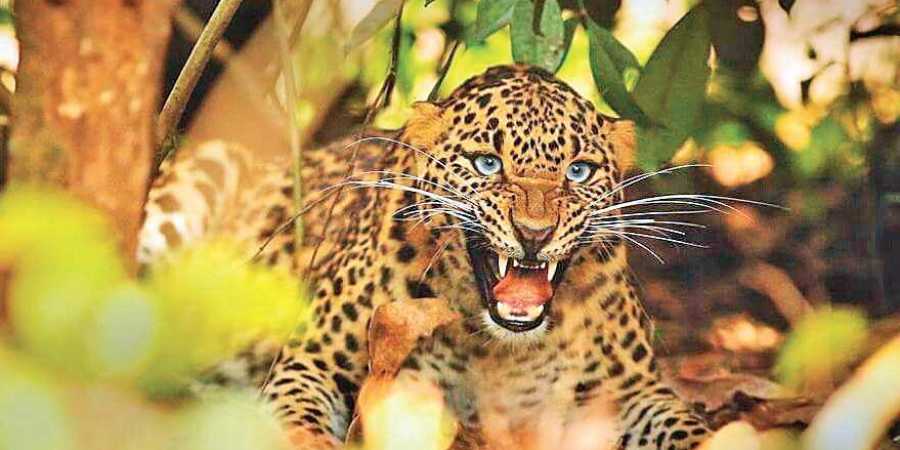
A day after a Bandipur ranger was attacked by a tiger, wildlife experts have asked foresters working in tiger reserves and national parks to exercise caution.
Hubballi :
A day after a Bandipur ranger was attacked by a tiger, wildlife experts have asked foresters working in tiger reserves and national parks to exercise caution. They suggest that field-level officers develop the instinct to sense danger when in the wild, so that animal-human conflicts can be checked.
Four cases of animals attacking forest officials have been reported from various reserves of Karnataka in the last one year, and two people have died in different incidents. While IFS officer Manikantan heading Nagarhole Tiger Reserve was trampled to death by an elephant, a temporary forest watcher from Cauvery Wildlife Sanctuary met with the same fate.
After a tiger attacked Range Forest Officer Raghavendra in Bandipur, experts are asking why the officer ventured into the tiger area, that too unarmed. “The officer should have been aware of surprises the wild can throw up. Before being deputed at Bandipur, Raghavendra had worked in BRT Tiger Reserve. It was wrong of him to venture out to check the presence of a tiger without precautions. Field officers must be made aware of negative aspects of forest protection and use this knowledge to avoid dangerous situations,” a wildlife expert told TNIE.
K M Chinnappa, a senior wildlife conservationist, revealed that from his observation, most wild attacks occur when animals are chased. “The unfortunate death of a forester near river Cauvery happened when a team was driving away elephants. When foresters are transferred to different forests, they must be trained to cope with the different conditions they are likely to encounter, for some could be very dangerous,” he said.
“We have been asking the government to appoint local guards, who would know the terrain and dangers involved,” he added.
A retired forester admitted that there is no specific training given to field officers to deal with surprise wild attacks. “Sloth bears and elephants (tuskers) are most unpredictable in the wild. It is important that a forest team is made aware of possible dangers to expect, and be in a position to take precautionary measures,” he said.
source: http://www.newindianexpress.com / The New Indian Express / Home> Cities> Bengaluru / by Amit S. Upadhaye / Express News Service / July 03rd, 2019
A narration of experiences of retired Forest Officer K.M Chinnappa
Mysuru:
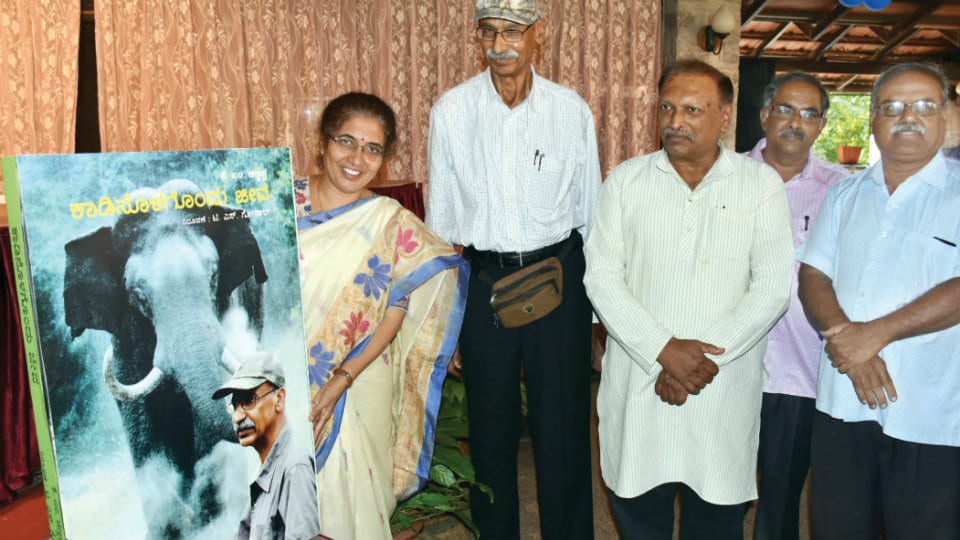
Wildlife First and Bharathi Prakashana, Mysuru, had organised a programme at Hotel Roost on Hunsur Road here this morning for the release of the book Kaadinolagondu Jeeva, based on the first-hand experiences of retired Forest Ranger K.M. Chinnappa, written by T.S. Gopal, retired Principal of Srimangala Junior College.
Releasing the book, Tejaswini Ananth Kumar, President of Adamya Chetana Trust and wife of late former Union Minister H.N. Ananth Kumar, observed that humans to prove their greatness were going against nature and inviting problems. She regretted that people were unaware of safe disposal of waste materials leading to environmental pollution. She commended Chinnappa for his experiences as a Forest Officer.
Speaking on the book, Dr. S.V. Narasimhan heaped praises on the ‘Hero’ of the book Chinnappa and the author of the book Gopal in evolving a great study volume. He appreciated the enthusiasm of the 80-year-old Chinnappa in narrating the experiences in the forest vividly.
Addressing the gathering, Chinnappa asked people to be aware of animal behaviour in forests. He warned that rampant deforestation would invite more drought. He commended Gopal in putting his (Chinnappa) experiences beautifully through words.
Author Gopal was present.
source: http://www.starofmysore.com / Star of Mysore / Home> News / July 03rd, 2019
On Monday from 7 to 8:30 p.m. is the next program in the Sanctuary Lecture Series, “Sinkholes to Stars: Diving into Lake Huron’s Sinkholes while Reaching for the Heavens.”
Doors open at 6:30 p.m. for this free program at Great Lakes Maritime Heritage Center, 500 West Fletcher St., Alpena.
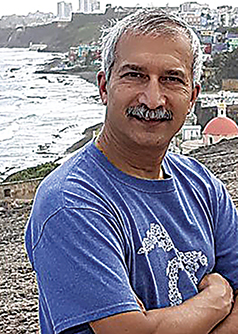
Grand Valley State University Professor Bopi Biddanda will share the excitement of over a decade of exploration of life in Lake Huron’s sinkholes carried out in collaboration with Thunder Bay National Marine Sanctuary, and ponder the relevance of these findings to major issues of both scientific and societal interest such as Earth’s current biologic and physiologic diversity, oxygenation of early Earth in the distant past, and humanity’s ongoing search for extra-terrestrial life.
Biddanda is an aquatic microbial ecologist studying the movement of carbon driven by microbes at the Annis Water Resources Institute at GVSU. He grew up in the lush subtropical mountains of Southwest India, and came to the U.S. in the 1980s to obtain a Ph.D. in ecology from the University of Georgia. Subsequently, he went on research and teaching adventures at the Alfred Wegener Institute for Polar and Marine Research (Germany), National Institute of Oceanography (India), University of Texas Marine Science Institute, University of Rio Grande (Brazil) and University of Minnesota.
For the last decade and a half at GVSU, he has been studying the microbial cycling of elements in the Laurentian Great Lakes — exploring life in extreme environments such as Lake Huron’s sinkholes and operating a world-class time-series buoy observatory in Muskegon Lake.
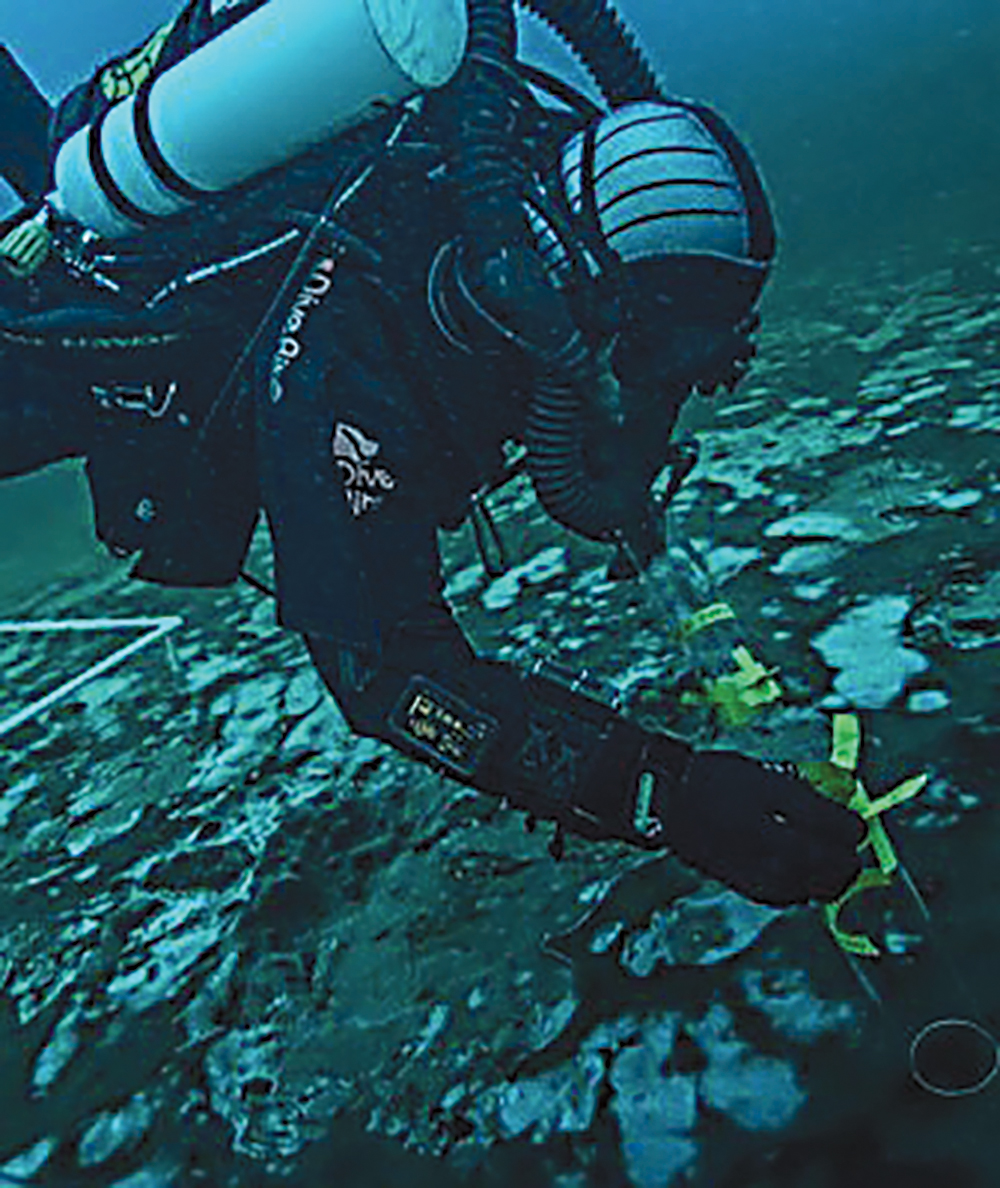
Courtesy Photo A diver navigates a sink hole in Lake Huron.
He teaches classes in marine biology and aquatic ecology, and directs NASA’s Michigan Space Grant Consortium programs at GVSU. He hopes to continue to study Earth’s lakes — one of our most vital freshwater commons — as sentinels of change.
For more information, contact Stephanie Gandulla at steph.gandulla@noaa.gov or 989-884-6200.
source: http://www.thealpenanews.com / The Alpena News / Home> Life / June 06th, 2019
WELCOME. If you like what you see "SUBSCRIBE via EMAIL" to receive FREE regular UPDATES.
Read More »