Category Archives: Nature

Trekking alongside clouds

TadiyandomolKF30oct2014

If you are looking for a getaway that takes you through green hills, misty clouds and silent paths, Tadiyandamol is for you, says Maya B.

Imagine walking through the clouds, running your fingers across cold ice crystals, and watching the rains from above the clouds. These are a few soothing moments one can experience from standing at the summit of Tadiyandamol, the second highest peak in Karnataka. Situated in the hilly district of Kodagu, Tadiyandamol is the tallest mountain in the district, with its highest point being 1,748 metres above sea level.

It is a lesser-known trekkers’ paradise that has fortunately not been commercialised yet.
The mountain is wide and gigantic, with two peaks, and lies on the Kerala border. Tadiyandamol in Malayalam or Kodava loosely translates to tall hills with a broad base. The best time to start the trek would be early in the morning, around 6 am. It is approximately an eight-km trek, which could be mildly strenuous.

Adventure enthusiasts can begin the trek at a small waterfall, about half a km from the foothills. A tarmac road leads to the waterfall, and further up, there are no motorable roads. A safer option to park vehicles would be at the Nalaknad Palace.

“A stream is a nice place to begin and end the trek as the cold water is invigorating,” says Aalok Gokhale, a regular trekker who has scaled Tadiyandamol twice. Trekkers first traverse through a dirt-road, which leads to a fork. Take the road sloping upwards as it passes through a forest area and a couple of streams. On the downside, the stretch is infested with leeches during monsoons.

Dreamy routes
And then there is a winding route that leads you into the open. That’s when you get the first glimpse of the mountain you will be climbing, and a complete view of the hills you are surrounded by. The trick is to simply walk in the direction of the peaks. You will come across a huge boulder on the way which is an ideal spot for a break and has the perfect viewpoint.

Here, the trekkers can choose one peak out of the two. The one on the left is higher than the one on the right. “When hiking to the peak on the right, you can take the route less travelled on, through the grass, or the man-made path. Once you reach the peak, you can see that the path continues to two more viewpoints, and the best view awaits at the end of the range, and it is tranquil,” shares Aalok.

“When it starts raining, a dreamy mist sets in. You can see clouds moving up the mountain side, towards you, and then finally, you walk through the clouds,” he adds.
The route to the peak on the left, that is the highest point of the mountain, leads you to a false summit at first and then,unexpectedly, opens up into a dense forest area.

The path leading to the forested area could be barren or grassy, depending upon the season. There is a natural stair-like formation throughout the mini-jungle which could be very steep at times. Once this tedious journey ends, you are out in the open yet again and the majestic mountain rises in front of you. The ground up the mountain is full of gravel and slippery, so be careful while trekking.

The summit of the mountain is a wide area which slopes down slightly to culminate in a cliff, and it is breathtaking view from the top. The boulders around could be great for picnics.

All in all, Tadiyandamol is a wonderful weekend getaway and takes you away from the hectic urban life.

Single peaks can be covered on the same day, and both the peaks can be trekked in a single day or over a course of two days by camping on the mountain overnight. But trekkers must be wary of elephants, as their dung can be spotted at certain places.

Ankith Joshi, founder of the travel agency ‘Time to Trawel’, who regularly sends troupes to Tadiyandamol for camping says, “There are several points across the hills where you can pitch tents. But the best would be at the peak as it has a wide base and the experience is thrilling. You can’t enjoy the beauty of the place if you camp elsewhere.”

Those who prefer warmer accommodation can choose homestays in Kakkabe and Virajpet. The best seasons to visit Tadiyandamol would be mid-monsoon and winter (August-January). During these seasons, the atmosphere is cool and misty, which feels heavenly.

source: http://www.deccanherald.com / Deccan Herald / Home> Supplements> Spectrum / Maya B / DHNS, October 28th, 2014

Gram Panchayat least bothered about basic facilities near Abbey falls

Abbey waterfalls in Kodagu district is one of the itinerary included in the list of tourists who visit the district.

Breathtaking waterfalls, its roaring sound and beautiful cascades spring back to life with the monsoon. A large number of tourists visit the waterfalls during weekends. Inspite of the fetching income from tourism, the gram panchayat has failed to provide basic facilities for the tourists near the waterfalls.

Abbey waterfalls is situated amidst coffee plantation. It cascades down 30 to 40 feet from a hillock. The land where Abbey falls is situated belongs to a private individual.

The land belongs to Neravanda Indira. To ensure that tourists are not disappointed, she has allowed them to walk in between her estate. However, the gram panchayats have not taken any measures to ensure that no harm is done to the estate.
Those who visit the waterfalls pluck coffee plants, throw plastic carry bags, cigarettes, beedi, gutka packets and liquor bottles, she said.

Indira said “the gram panchayat had promised to lay grills to the foot road that passes through estate. However, the promises have remained only on paper. The tourists damage the plants.”

“In protest against apathy of the gram panchayat, I had even locked the main gate. To ensure that no inconvenience is met to the tourists, I started opening the small gate to allow the tourists to enjoy the beauty of nature,” she said.

“The gram panchayat fetches income by collecting parking fee. However, they are least bothered to provide toilets, drinking water and cleanliness in the region,” said tourist Subrahmanya from Shimoga.

source: http://www.deccanherald.com / Deccan Herald / Home> District / by Srikanth Kallammanavar / DHNS, Madikeri – October 19th, 2014

Coffee prices get a Brazilian boost

International coffee prices rose sharply this week, as fears resurfaced that Brazil’s crop could get adversely affected by a drought

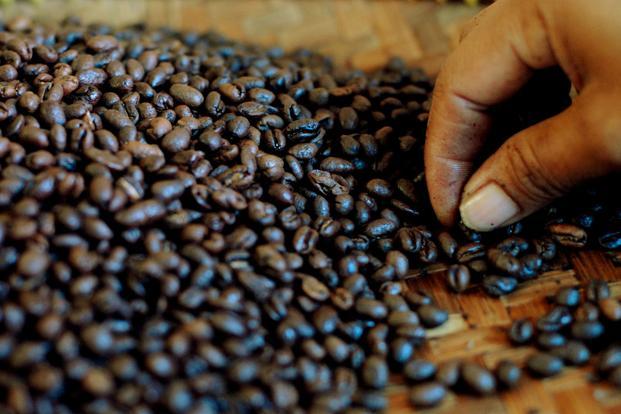
A thin harvest may be bad news for Brazil but is good news for growers in other countries. Indian coffee producers are seeing firm crop trends in 2014-15. Photo: Bloomberg

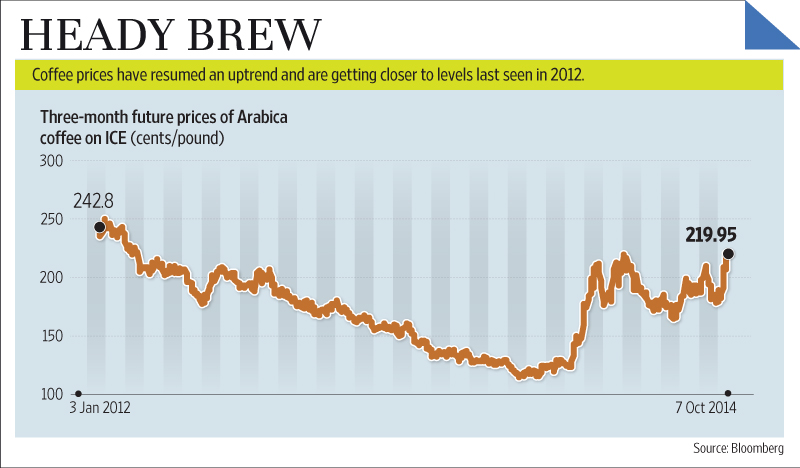
International coffee prices rose sharply this week, as fears resurfaced that Brazil’s crop could get adversely affected by a drought. This comes just a fortnight after Brazil’s agricultural organization Conab released its September estimate, which had assuaged market fears and even saw prices drop.

But on Monday, the three-month forward Arabica coffee contract rose by 9.2% intra-day, according to The Wall Street Journal, and closed the day with a gain of 6.9%. This marked a two-and-a-half-year high for this contract. On Tuesday, its level was unchanged. If the news on the weather from Brazil continues to support higher prices, then this uptrend could be sustained. But recent months have seen volatile price movements; so, there is risk of a reversal, too.

GraphKF15oct2014

The International Coffee Organization’s price data show the prices of all grades of Arabica coffee have moved up, in sync with Brazil. Though Brazil’s effect is felt more by the Arabica variety, even the lower Robusta grade has perked up in October. It has recovered losses sustained in September.

A thin harvest may be bad news for Brazil but is good news for growers in other countries. Indian coffee producers are seeing firm crop trends in 2014-15. The country’s coffee crop is estimated to increase by 13.2% to 344,750 tonnes. The Arabica crop is expected to increase by 3.2%, while Robusta, which is the main local crop, is expected to rise by 18.3%.

Thus, one can expect the plantation business of growers such as Tata Coffee Ltd and CCL Products India Ltd to post good results. But this uptrend poses a challenge for coffee marketers such as Nestlé India Ltd and Hindustan Unilever Ltd (HUL). Rising input costs will force them to hike prices, which can hurt volume growth.

source: http://www.livemint.com / Live Mint / Home> Money / by Ravi Ananthanarayanan / Tuesday – October 07th, 2014

Dasara jumbos return to their forest abode

Mysore :

After spending days together in the royal city, it was time for the Dasara jumbos to bid farewell to each other and return to their abode in the forests. Of the 14 elephants camping in the city, 11 left on Tuesday while three jumbos, Gajendra, Srirama and Durgaparameshwari, will head to their habitat in K Gudi in Chamarajnagar district on Wednesday.

Before they bid adieu to city life, they got a traditional farewell at the Mysore Palace from bureaucrats and politicians led by district minister V Srinivas Prasad. The herd led by howdah elephant Arjuna started their journey at 3pm as they were loaded on to trucks. Their mahouts, kavadis and family members too accompanied the jumbos in the trucks. By 6pm, Arjuna had reached Nagarahole national park.

Veteran Abhimanyu too has returned to the forest. “He is healthy and doing well. That is why we chose to send him back along with the 10 other jumbos,” vet D N Nagaraj told TOI denying that the 48-year-old tusker was injured. Abhimanyu has been part of Dasara festivities for 15 years now and is traditionally assigned the job of pulling the musical chariot, known as Aane Gaadi.

source: http://www.timesofindia.indiatimes.com / The Times of India / Home> City> Mysore / by H.M. Aravind, TNN / October 08th, 2014

Expert panel gives go-ahead for power line; 50,000 trees in Kodagu forests will go

The figure is floated by green activists and is disputed by the authorities, though within the government agencies it varies from 2,247 to 21,000. The trees fall in the verdant forests of Kodagu and the activists could be close to the mark, admit official sources

KodaguTreeKF30sept2014

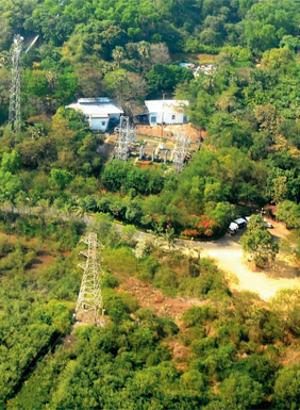
Protests and campaigns have come to a nought, and the axe is set to fall on over 50,000 trees in the evergreen deciduous forests of Kodagu with an expert panel giving its nod to the power line project meant to light up towns and villages in Kerala.

Terming the alternative routes proposed by the locals as technically and financially unfeasible, the three-member expert committee has given its go-ahead to the high power transmission line between Mysore and Kozhikode. Activists of the ‘Save Cauvery’ movement in Kodagu say the decision will ring the death knell for more than 50,000 trees.

While the Power Grid Corporation of India (PGCI) continued to maintain only 2,247 trees will be cut, deputy conservator of forests, Virajpet, has submitted an affidavit before the Green Tribunal in Chennai that a total of 21,000 trees will be felled along the alignment line proposed by PGCI. However, activists who have trekked the entire stretch using GPS coordinates argue that not less than 55,000 trees, both in private areas and on forest land, will face the axe.

Following widespread protests across Kodagu district over the large-scale clearance of forest and degradation to the fragile eco-system of the area, the state government had appointed a three-member expert committee to look into the issue and study the feasibility of possible alternative routes as proposed by the activists. The committee comprising noted elephant expert Prof Raman Sukumar of Indian Institute of Science (IISc) and Ajai Misra, Additional Principal Chief Conservator of Forests (APCCF) was headed by R S Shivakumara Aradhya of Central Power Research Institute (CPRI).

‘Other routes not feasible’

NGOs and activists had proposed alternative routes that would be less damaging to the eco-system, but the committee has stated in its report that these routes are not only detrimental to wildlife conservation, but require huge capital and are technically not feasible. According to the report, accessed by Bangalore Mirror, adopting other routes would require more forests to be cleared than what the present proposal will necessitate. Activists had suggested use of the D-line (District line dividing the two districts of Mysore and Wayanad in Kerala) passing via Nagarhole or the existing 220 KV line on the Kadakola-Kaniyampetta corridor for linking Karnataka with Kerala and Tamil Nadu in the South, besides upgrading the 110 KV corridor between Kasaragod and Mangalore.

“Alternative routes will destroy the Kodagu environment as a large number of trees will have to be cut, adversely affecting the Dubare-Devamachi reserve forest which has considerable presence of elephants and tigers. Using these routes will not only affect the tribal settlement inside forests, but also call for felling of trees in coffee estates which are part of Kodagu ‘s ecosystem. The paddy fields along the proposed line would become unfit for cultivation. The temperature of line conductors will affect coffee plants and affect the national forest policy, which envisages about 33 per cent forest and tree cover. Work in these areas would not only reduce inflow to Kaveri and its tributary Lakshmana Theertha, but also intensify the man-animal conflict,” the report said.

‘Existing lines are over-exploited’

On the prospects of using the existing corridors, the committee observed: “While the corridors are designed to carry a load of 130 MW to 140 MW, they have been used to transmit 180-200 MW of power regularly. Due to overloading, there already has been high sagging of conductors. Further, the ground clearance is low and there have been instances of elephants being subjected to fatal shocks. The Dasara elephant ‘Drona’ too had been a victim of this in the past. The existing 220 KV line runs North East-South West of Kabini for about 32 km of which 20 km is through Nagarhole forest; upgrading the line would only further disturb the ecology.”

‘Tunnelling will hit coffee estates’

Studying the feasibility of laying underground cables, the committee reported it would cost five to 20 times more than the cost of overhead transmission lines. “If the cable is laid, the ground above has to be cleared of vegetation and must be provided with access roads for maintenance. The cable has to be cooled by forced air or by way of circulating water. Further, the repair time is 25 times greater than that of overhead line repair,” the report states.

The experts clarified that laying a double circuit line along the D-line will require 130 hectares of dense tropical forest to be cleared. Besides, reactive power absorption devices have to be installed every eight to 10 km along the cable route; these sub-station-size structures requiring about 2,500 sq metres, the experts said.

‘Project crucial for Karnataka too’

Even though the line between Mysore and Kozhikode was planned under Kaiga Stage II for transferring the generated power from Kaiga to other places way back in 2007, work could not be taken up for several administrative and technical reasons. “Besides this project, there is absolutely no grid connectivity between Kerala and Karnataka. The proposed line, besides helping Kerala, will help us draw power from Koodankulam and other new stations planned along the Tamil Nadu coast. This Southern grid connectivity will help Karnataka harness more than 3,500 MW wind power generated in Tamil Nadu,” said a senior official from the energy department.

Referring to illegal clearance of forests in excess of what was permitted, the committee said, “The line route, proposed by the Power Grid Corporation, requires about 6,000 trees to be cut within a 12-km stretch of coffee plantations in Kodagu, in addition to the 2,247 trees (above 55 cm girth) already felled in that stretch.” Acknowledging clearance of forest for about 52 metres as against the permitted 46 metres along a four-km stretch, the experts suggested efforts to regenerate the natural vegetation in the stretch of land between the 46-52 metre width in Dubare and Devmachi reserved forests.” The committee has also directed the forest department to implement a conflict mitigation plan for preventing man-animal conflict in the area which will completely be funded by PGCI for a minimum of three years after completion of the project.

Reacting over the recommendations of the committee, power minister DK Shivakumar told BM, “The committee has given us a green signal to go ahead with the project. The activists, farmers have to understand this and must support the government by giving all the necessary help. There is tremendous pressure from the Centre to accomplish the project and it is more important from the energy security of the state in future. It helps us draw more and more power in a short duration time from the generating stations of Tamil Nadu. We are just waiting for the rains to stop and once the rains are officially ended, we will take up the work along the proposed corridor.”

source: http://www.bangaloremirror.com / Bangalore Mirror / Home> Bangalore> Cover Story / by Niranjan Kaggere, Bangalore Mirror Bureau / September 29th, 2014

Western Ghats report makes Karnataka planters jittery

Bangalore :

Coffee planters in Karnataka’s Kodagu district are an apprehensive lot. They believe the acceptance of the Kasturirangan report to conserve Western Ghats will make them helplessly watch their disease-afflicted crop wither away for it bans the use of pesticides in their area.

They feel they may not be able to cut down trees on their plantation in times of distress as that too would be prohibited.

The very mention of Kasturirangan report sparks off angry reactions in Kodagu district. “One cannot force small-time agriculturists to convert to organic farming and not use pesticides – it must happen gradually and voluntarily. Implementation of any report should create a win-win situation for all,” says Col CP Muthanna, president of the Coorg Wildlife Society.

A cocktail of apprehensions and genuine fears has stirred up a massive resistance to Kasturirangan report along the Western Ghats. “Forests are the lifeline of Kodagu and a huge per centage of people are dependent on them. It is therefore important to initiate a dialogue with locals before taking far-reaching decisions,” says Air Marshal (Retd) Nanda Cariappa, a resident of Kodagu.

Some experts admit some of the fears are genuine. “People still dependent on forest produce are opposing the implementation. Quite rightfully so as all this while no one raised an issue each time they went to the forest, gathered berries etc and sold them off for a livelihood. But with this classification they will not be able to do so,” said environmentalist Suresh Heblikar.

Locals are knowledgeable and have a fair idea of the topography of the place. It would be unfair to remove them from the system altogether when they have been an inclusive partner of the ecosystem for centuries together, he said.

But experts say a “deliberate campaign of misinformation” has made the Kasturirangan committee report unimplementable. They allege people with vested interests are at work and misleading the locals.

“There is a common fear among people of losing their lands with 37% of Western Ghats earmarked to be notified as Ecologically Sensitive Area (ESA). These directions have been issued under Section 5 of the Environment (Protection) Act, 1986 and related Rules which does not empower the government to acquire any land. Therefore the question of people losing their legally owned lands located either in the identified villages or outside does not arise at all,” said Wildlife First trustee Praveen Bhargav.

Environmentalists even doubt the government’s commitment to implement it as it means existing policies will have to be withdrawn. “These reports are in the interest of the common man and in favour of ecology. According to scientific findings, hilly regions should have 66% forest cover but what remains in Western Ghats is a mere 10%, which is also under attack by vested interests,” said environmentalist Panduranga Hegde, who heralded the Appiko movement to protect trees in Western Ghats.

source://www.timesofindia.indiatimes.com / The Times of India / Home> Environment> Development Issues / by Saswati Mukherjee B, TNN / January 20th, 2014

Honey park proposed at Bhagamandala

State government has already released `60 lakh
HoneyCombKF25sept2014

To bring back the glory of honey production in Kodagu, the State government has come forward to set up a honey park in Bhagamandala. The State government has already released Rs 60 lakh and primary preparations are in progress.

The Honey Park would act as a comprehensive centre for honey production and related activities. It would also endeavour to provide marketing facilities for the product in the entire State. The park will come up in Apiculture Training Centre at Bhagamandala. The Park will be maintained by food processing division of Agriculture department.

The Park will be set up to promote apiculture, which will supplement the income of the farmers. Agriculture department in-charge Secretary and Director of Horticulture department have already held talks with farmers on the structure of the Honey Park, and a proposal has been sent to the government. There are more than 10,000 farmers engaged in apiculture in Kodagu district. Apiculture has spread to Chikmagalur, Shimoga, Dakshina Kannada, Uttara Kannada, Mysore and Chamarajanagara. Owing to diseases affecting honey bees, apiculture had seen a set back in the recent years.

Apiculture was ruling the roost in Kodagu two decades ago. There were bee hives in each and every plantation. Apiculturists were getting 10 to 15 kg of honey from one bee hive. However, now it has reduced to six to seven kg honey, said Apiculturist C Madappa.

“With diseases affecting honey bees, apiculture saw a set back in the district. In the first phase, honey bees will be nurtured in the Park. Later, a research unit, museum on apiculture, honey processing unit, and an export unit will be set up.”

Along with Honey Park, a training centre will also be set up. Tribals and farmers will be trained in apiculture. The tribals will be trained in collecting honey in forests. This in turn will help in improving the economic condition, said Horticulture Department Deputy Director (in charge) S N Sudheendra Kumar.

source: http://www.deccanherald.com / Deccan Herald / Home> District / by Shrikanth Kallammanavar / Madikeri, DHNS – February 04th, 2014

Indian firm develops vaccine for Blue Tongue

Hyderabad :

Indian Immunologicals Limited (IIL) has launched a vaccine for Blue Tongue disease that affects domestic animals such as goats, sheep, cattle and camels. India is among the top victims of this disease. The mortality rate is quite high at 30 per cent.

The penta-valent vaccine Raksha-Blu protects all the five virus strains that cause the disease in India. It is priced at Rs. 5 a dose.

An arm of the National Dairy Development Board (NDDB), the IIL claims that it is the first vaccine developed indigenously for the disease.

“There are 24 viral strains prevalent in the world. In India, about five strains are predominant. Besides high level of mortality, it causes morbidity too. There has been no vaccine developed so far to protect the animals from the disease,” a company statement said here on Wednesday.

The Indian Council of Agricultural Research (ICAR) and Tamil Nadu University of Veterinary and Animal Sciences too have taken part in the development of the vaccine.

source: http://www.thehindubusinessline.com / Business Line / Home> Agri-Biz / by K. V. Kurmanath / Hyderabad – September 24th, 2014

From berry to brew…

CoffeeKODAGU21sept2014
Coffee was once a closely guarded Arabian secret until Baba Budan, a Sufi mystic, smuggled seven beans from Yemen and scattered them on the hills of Chikmagalur, from where it spread to the rest of India…Anurag Mallick and Priya Ganapathy spill the beans on the story of coffee, the world’s most popular brew.

It was Napoleon Bonaparte who once grandly announced, “I would rather suffer with coffee than be senseless.” Sir James MacKintosh, 18th century philosopher, famously said, “The powers of a man’s mind are directly proportional to the quantity of coffee he drank.” In The Love Song of J Alfred Prufrock, when T S Eliot revealed, “I have measured out my life with coffee spoons,” he hinted at the monotony of socialising and the coffee mania of the 1900s. German musical genius J S Bach composed the ‘Coffee Cantata’ celebrating the delights of coffee at a time when the brew was prohibited for women.

“If I couldn’t, three times a day, be allowed to drink my little cup of coffee, in my anguish I will turn into a shriveled-up roast goat,” cried the female protagonist! French author Honoré de Balzac wrote the essay ‘The Pleasures and Pains of Coffee’ to explain his obsession, before dying of caffeine poisoning at 51. Like Voltaire, he supposedly drank 50 cups a day! So, what was it about coffee that inspired poets, musicians and statesmen alike?

Out of Africa

Long before coffee houses around the world resounded with intellectual debate, business deals and schmoozing, the ancestors of the nomadic Galla warrior tribes of Ethiopia had been gathering ripe coffee berries, grinding them into a pulp, mixing it with animal fat and rolling them into small balls that were stored in leather bags and consumed during war parties as a convenient solution to hunger and exhaustion! Wine merchant and scientific explorer James Bruce wrote in his book Travels to Discover the Source of the Nile that “One of these balls they (the Gallas) claim will support them for a whole day… better than a loaf of bread or a meal of meat, because it cheers their spirits as well as feeds them”. Other African tribes cooked the berries as porridge or drank a wine prepared from the fermented fruit and skin blended in cold water.

Historically, the origins of the coffee bean, though undated, lie in the indigenous trees that once grew wild in the Ethiopian highlands of East Africa. Stories of its invigorating qualities began to waft in the winds of trade towards Egypt, North Africa, the Middle East, Persia and Turkey by the 16th Century. The chronicles of Venetian traveller Gianfrancesco Morosini at the coffee houses of Constantinople in 1585 provided Europeans with one of the foremost written records of coffee drinking. He noted how the people ‘are in the habit of drinking in public in shops and in the streets — a black liquid, boiling as they can stand it, which is extracted from a seed they call Caveè… and is said to have the property of keeping a man awake.’

It was only a matter of time before the exotic flavours of this intoxicating beverage captured the imagination of Europe, prompting colonial powers like the Dutch, French and the British to spread its cultivation in the East Indies and the Americas. Enterprising Dutch traders explored coffee cultivation and trading way back in 1614 and two years later, a coffee plant was smuggled from Mocha to Holland. By 1658, the Dutch commenced coffee cultivation in Ceylon (Sri Lanka). The word ‘coffee’ is apparently derived from qahwah (or kahveh in Turkish), the Arabic term for wine. Both the terms bear uncanny similarity to present day expressions — French café, Italian caffè, English coffee, Dutch koffie or even our very own South Indian kaapi. A few scholars attribute ‘coffee’ to its African origins and the town of Kaffa in Ethiopia, formerly known as Abyssinia. However, the plant owes its name “Coffea Arabica” to Arabia, for it was the Arabs who introduced it to the rest of the world via trade.

As all stories of good brews go, coffee too was discovered by accident. Legends recount how sometime around the 6th or 7th century, Kaldi, an Ethiopian goatherd, observed that his goats became rather spirited and pranced after they chewed on some red berries growing in wild bushes. He tried a few berries and felt a similar euphoria. Excited by its effects, Kaldi clutched a handful of berries and ran to a nearby monastery to share his discovery with a monk. When the monk pooh-poohed its benefits and flung the berries into the fire, an irresistible intense aroma rose from the flames. The roasted beans were quickly salvaged from the embers, powdered and stirred in hot water to yield the first cup of pure coffee! This story finds mention in what is considered to be one of the earliest treatises on coffee, De Saluberrima Cahue seu Café nuncupata Discurscus, written by Antoine Faustus Nairon, a Roman professor of Oriental languages, published in 1671.

Flavours from Arabia

Coffee drinking has also been documented in the Sufi monasteries of Yemen in South Arabia. Arabic manuscripts dating back to the 10th Century mention the use of coffee. Mocha, the main port city of Yemen, was a major marketplace for coffee in the 15th century. Even today, the term ‘mocha’ is synonymous with good coffee. Like tea and cocoa, coffee was a precious commodity that brought in plenty of revenue. Hence, it remained a closely guarded secret in the Arab world. The berries were forbidden to leave the country unless they had been steeped in boiling water or scorched to prevent its germination on other lands.

In 1453, the Ottoman Turks brought coffee to Constantinople, and the world’s first coffee shop Kiva Han opened for business. As its popularity grew, coffee also faced other threats. The psychoactive and intoxicating effects of caffeine lured menfolk to spend hours at public coffee houses drinking the brew and smoking hookahs, which incited the wrath of orthodox imams of Mecca and Cairo. As per sharia law, a ban was imposed on coffee consumption in 1511. The Grand Mufti Mehmet Ebussuud el Imadi was hailed when he issued a fatwa allowing the consumption of coffee, by order of the Ottoman Turkish Sultan Selim I in 1524.

Though subsequent bans were re-imposed and lifted at various points of time according to the whims of religious politics and power, coffee pots managed to stay constantly on the boil in secret, or in the open, for those desirous of its potent influence. Given the fact that Sufi saints advocated its uses in night-time devotions and dervishes and Pope Clement VIII even baptised the bean to ward off the ill-effects of what was regarded by the Vatican as ‘Satan’s drink’ and the ‘Devil’s Mixture of the Islamic Infidels’ till the 1500s, it is easy to see why coffee is nothing short of a religion to some people.

Coffee enters India & beyond

Surprisingly, India’s saga with coffee began in 1670 when a Muslim mystic, Hazrat Dada Hyat Mir Qalandar, popularly known as Baba Budan, smuggled seven beans from Arabia and planted them on a hillock in the Chikmagalur district of Karnataka. The hills were later named Baba Budan Giri in his memory. From here, coffee spread like bushfire across the hilly tracts of South India.

In 1696, Adrian van Ommen, the Commander at Malabar, followed orders from Amsterdam and sent off a shipment of coffee plants from Kannur to the island of Java. The plants did not survive due to an earthquake and flood but the Dutch pursued their dream of growing coffee in the East Indies with another import from Malabar. In 1706, the Dutch succeeded and sent the first samples of Java coffee to Amsterdam’s botanical gardens from where it made further inroads into private conservatories across Europe. Not wishing to be left behind, the French began negotiating with Amsterdam to lay their hands on a coffee tree that could change their fortunes. In 1714, a plant was sent to Louis XIV who gave it promptly to the Jardin des Plantes at Paris for experimentation. The same tree became the propagator of most of the coffees in the French colonies, including those of South America, Central America and Mexico.

The importance of coffee in everyday life can be gauged by the fact that its yield forms the economic mainstay of several countries across the world; its monetary worth among natural commodities beaten only by oil! It was only in 1840 that the British got into coffee cultivation in India and spread it beyond the domain of the Baba Budan hills.

Arabica vs Robusta

Kodagu and Chikmagalur are undoubtedly the best places to know your Arabica from your Robusta and any planter worth his beans will trace coffee’s glorious history with pride. The strain that Baba Budan got was Coffea arabica and because of its arid origins, it thrived on late rainfall. Despite its rich taste and pleasing aroma, the effort required to cultivate it dented its popularity. The high-altitude shrub required a lot of tending, was susceptible to pests, and ripe Arabica cherries tended to fall off and rot. Careful monitoring at regular intervals affected production cost and profitability.

Till 1850, Arabica was the most sought-after coffee bean in the world and the discovery of Robusta in Belgian Congo did little to change that. Robusta (Coffea canephora), recognised as a species of coffee only as recently as 1897, lived up to its name. Its broad leaves handled heavy rainfall much better and the robust plant was more disease-resistant. The cherries required less care as they remained on the tree even after ripening. Its beans had twice the caffeine of Arabica, though less flavour, which was no match for the intense Arabica. It was perceived as so bland that the New York Coffee Exchange banned Robusta trade in 1912, calling it ‘a practically worthless bean’!

But in today’s new market economy, the inexpensive Robusta makes more commercial sense and is favoured for its good blending quality. Chicory, a root extract, was an additive that was introduced during the Great Depression to combat economic crisis that affected coffee. It added more body to the coffee grounds and enhanced the taste of coffee with a dash of bitterness. Though over 30 species of coffee are found in the world, Arabica and Robusta constitute the major chunk of commercial beans in the world. ‘Filter kaapi’ or coffee blended with chicory holds a huge chunk of the Indian market. Plantations started with Arabica, toyed with Liberica, experimented with monkey parchment and even Civet Cat coffee (like the Indonesian Luwak Kopi — the finest berries eaten by the civet cat that acquire a unique flavour after passing through its intestinal tract), but the bulk of India’s coffee is Robusta.

As the coffee beans found their way from the hilly slopes of the Western Ghats to the ports on India’s Western Coast to be shipped to Europe, a strange thing happened. While being transported by sea during the monsoon months, the humidity and winds caused the green coffee beans to ripen to a pale yellow. The beans would swell up and lose the original acidity, resulting in a smooth brew that was milder. This characteristic mellowing was called ‘monsooning’. And thus was born Monsooned Malabar Coffee.

Kodagu, India’s Coffee County

Currently, Coorg is the largest coffee-growing district in India, and contributes 80% of Karnataka’s coffee export. It was Captain Lehardy, first Superintendent of Kodagu, who was responsible for promoting coffee cultivation in Coorg. Jungles were cleared and coffee plantations were started. In 1854, Mr Fowler, the first European planter to set foot in Coorg, started the first estate in Madikeri, followed by Mr Fennel’s Wooligoly Estate near Sunticoppa. The next year, one more estate in Madikeri was set up by Mr Mann. In 1856, Mr Maxwell and Mcpherson followed, with the Balecadoo estate. Soon, 70,000 acres of land had been planted with coffee. A Planters Association came into existence as early as 1863, which even proposed starting a Tonga Dak Company for communication. By 1870, there were 134 British-owned estates in Kodagu.

Braving ghat roads, torrid monsoons, wild elephants, bloodthirsty leeches, hard plantation life and diseases like malaria, many English planters made Coorg their temporary home. Perhaps no account of Coorg can be complete without mentioning Ivor Bull. Along with District Magistrate Dewan Bahadur Ketolira Chengappa, the enterprising English planter helped set up the Indian Coffee Cess Committee in 1920s and enabled all British-run estates to form a private consortium called Consolidated Coffee. In 1936, the Indian Cess Committee aided the creation of the Indian Coffee Board and sparked the birth of the celebrated India Coffee House chain, later run by worker co-operatives. With its liveried staff and old world charm, it spawned a coffee revolution across the subcontinent that has lasted for decades.

Connoisseurs say Coorg’s shade grown coffee has the perfect aroma; others ascribe its unique taste to the climatic conditions and a phenomenon called Blossom Showers, the light rain in April that triggers the flowering of plants. The burst of snowy white coffee blossoms rends the air thick with a sensual jasmine-like fragrance. Soon, they sprout into green berries that turn ruby red and finally dark maroon when fully ripe. This is followed by the coffee-picking season where farm hands pluck the berries, sort them and measure the sacks at the end of the day under the watchful eye of the estate manager.

The berries are dried in the sun till their outer layers wither away; coffee in this form is called ‘native’ or parchment. The red berries are taken to a Pulp House, usually near a water source, where they are pulped. After the curing process, the coffee bean is roasted and ground and eventually makes its journey to its final destination — a steaming cup of bittersweet brew that you hold in your hands.

The ‘kaapi’ trail

In India, coffee cultivation is concentrated around the Western Ghats, which forms the lifeline for this shrub. The districts of Coorg, Chikmagalur and Hassan in Karnataka, the Malabar region of Kerala, and the hill slopes of Nilgiris, Yercaud, Valparai and Kodaikanal in Tamil Nadu account for the bulk of India’s coffee produce. With 3,20,000 MT each year, India is the 6th largest coffee producer in the world.

Recent initiatives to increase coffee consumption in the international and domestic market prompted the Coffee Board, the Bangalore International Airport and tour operator Thomas Cook to come together and organize coffee festivals and unique holiday packages like The Kaapi Trail to showcase premium coffees of South India. Coffee growing regions like Coorg, Chikmagalur, B R Hills, Araku Valley, Nilgiris, Shevaroy Hills, Travancore, Nelliyampathy and Palani Hills are involved in a tourism project that blends leisure, adventure, heritage and plantation life.

At the Coffee Museum in Chikmagalur, visitors can trace the entire lifecycle of coffee from berry to cup. In Coorg and Malnad, besides homestays, go on Coffee Estate holidays with Tata’s Plantation Trails at lovely bungalows like Arabidacool, Woshully and Thaneerhulla…
The perfect cuppa

Making a good cup of filter coffee traditionally involves loading freshly ground coffee in the upper perforated section of a coffee filter. About 2 tbs heaps can serve 6 cups. Hot water is poured over the stemmed disc and the lid is covered and left to stand. The decoction collected through a natural dripping process takes about 45 minutes and gradually releases the coffee oils and soluble coffee compounds. South Indian brews are stronger than the Western drip-style coffee because of the chicory content. Mix 2-3 tbs of decoction with sugar, add hot milk to the whole mixture and blend it by pouring it back and forth between two containers to aerate the brew.

Some places and brands of coffee have etched a name for themselves in the world of coffee for the manner in which coffee is made. The strength of South Indian Filter coffee or kaapi (traditionally served in a tumbler and bowl to cool it down), the purity of Kumbakonam Degree Coffee, the skill of local baristas in preparing Ribbon or Metre coffee by stretching the stream of coffee between two containers without spilling a drop… have all contributed to the evolution of coffee preparation into an art form.

With coffee bars and cafes flooding the market and big names like Starbucks, Costa, Barista, Gloria Jean’s, The Coffee Bean, Tim Horton’s and Café Coffee Day filling the lanes and malls in India along with local coffee joints like Hatti Kaapi jostling for space, it’s hard to escape the tantalising aroma of freshly brewed coffee. And to add more drama to the complexities of coffee, you can choose from a host of speciality coffees from your backyard — Indian Kathlekhan Superior and Mysore Nuggets Extra Bold, or faraway lands — Irish coffee and cappuccino (from the colour of the cloaks of the Capuchin monks in Italy) or Costa Rican Tarrazu, Colombian Supremo, Ethiopian Sidamo and Guatemala Antigua. And you can customise it as espresso, latte, mocha, mochachino, macchiato, decaf… Coffee is just not the same simple thing that the dancing goats of Ethiopia once enjoyed.

source: http://www.deccanherald.com / Deccan Herald / Home> Supplements> Sunday Herald / September 21st, 2014
KSTDC to stard one-day package tours in Kodagu from Sept. 12

Mysore :

With the influx of tourists to Kodagu district and Dasara fast approaching, the Karnataka State Tourism Development Corporation (KSTDC) will commence one-day package tour in Kodagu from Sept. 12. The decision has come after the recent visit of KSTDC Managing Director Dr. P.S. Harsha to Madikeri during which he had promised to introduce one-day package tour to various tourist spots in the district.

During his visit, Dr. Harsha held a meeting with the stake holders and later decided to introduce one-day package tours from Madikeri on Sept. 12. The introduction of package tours is expected to bring down the burden on tourists who often complain about being charged exorbitantly at the tourist locations.

The package tour will be flagged off on Sept. 12 at 8.30 am from Hotel Mayura Valley View in Madikeri by Kodagu Deputy Commissioner Anuraj Tewari. The package tour, which begins from Madikeri, will travel to Bhagamandala, Talacauvery, Rajara Gadduge, Abbi Falls, Raja Seat, Omkareshwara Temple and will return back to Madikeri. Tourists may visit in person Hotel Mayura Valley View (KSTDC), Kodava Samaja Building, near Police Station, for reservations or contact Ph: 08272-228372 or 08272-223333 or Mob: 89706-50028 or 89706-50116 or 93417-93984.

Pick-up Points: Hotel Mayura Valley View, Madikeri, Convent Junction, SBI Junction, KSRTC Junction, Kodava Samaja and Thimmaiah Circle have been identified as pick-up points said V. Paneesh, Asst. Director, Department of Tourism.

source: http://www.starofmysore.com / Star of Mysore / Home> General News / Wednesday -September 10th, 2014