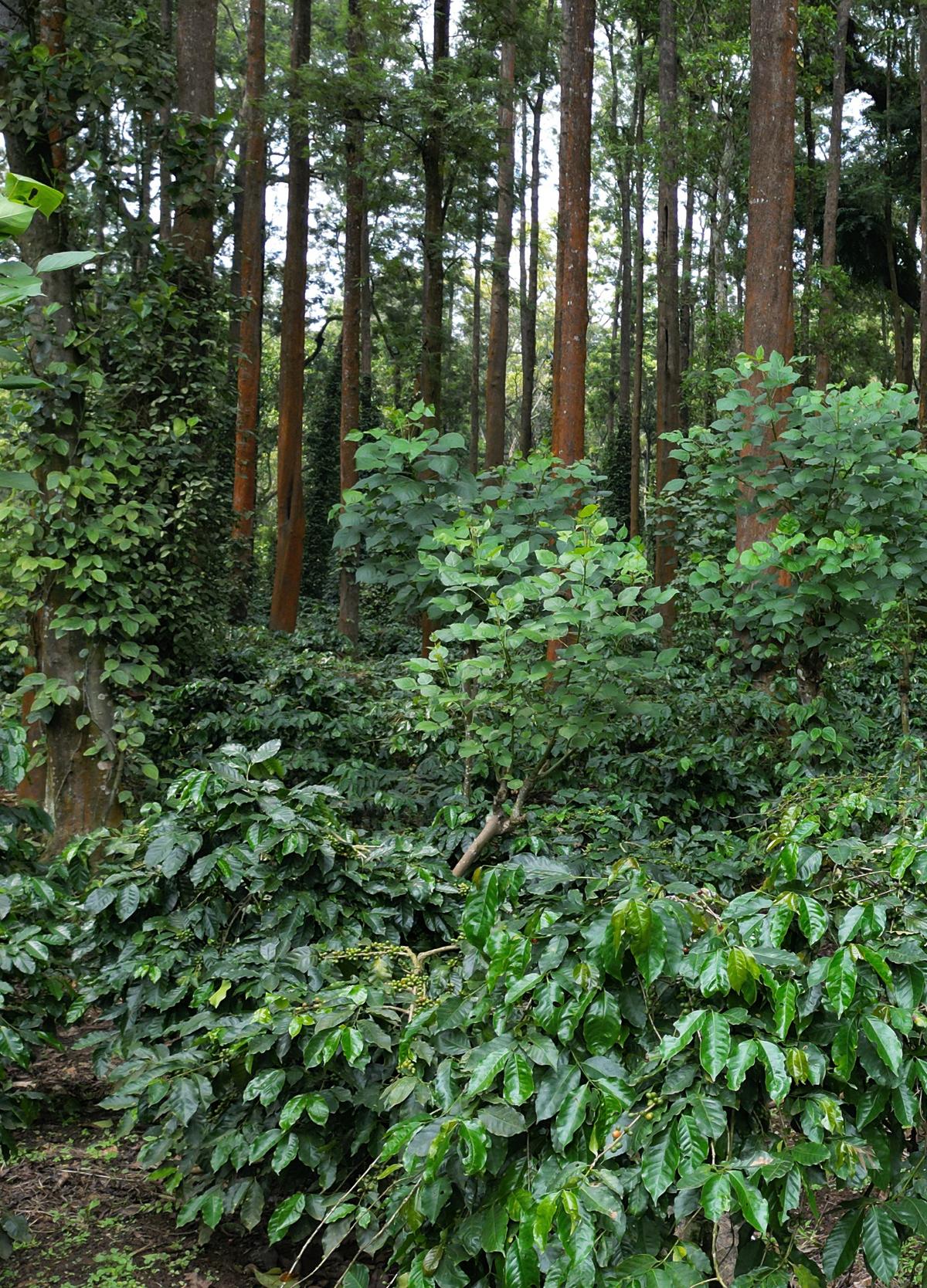
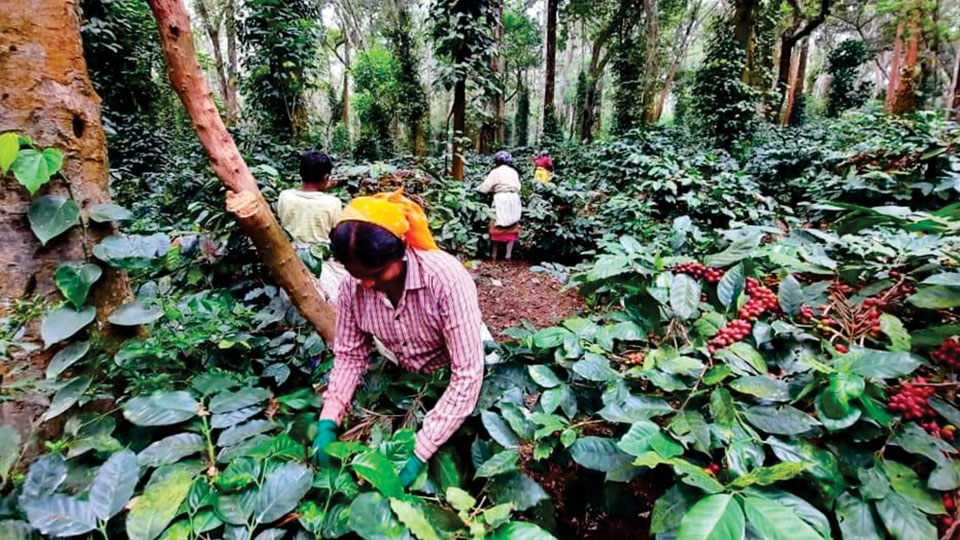
Shade-grown coffee at a Coffee estate in Kodagu district (Coorg), Karnataka. File | Photo Credit: Murali Kumar K.
India’s major plantation sectors such as rubber and coffee have heaved a sigh of relief as the EU Parliament has voted in favour of a proposal by the European Commission to delay the implementation of EU Deforestation Regulation (EUDR) allowing growers, exporters and traders additional time for compliance.
Accordingly, large coffee operators and exporters must meet EUDR regulations by December 30, 2025, while micro and small growers and traders have time until June 30, 2026 to comply, as against the earlier EU set mandatory due diligence procedures and compliance deadline of December 2024.
Being EUDR-compliant indicates a grower’s forest-based coffee produce is legal, and not sourced from any deforested land or unethically cultivated.
Notably, over 70% of Indian coffees are sold in EU countries, and therefore the compliance extension has direct implications on coffee players in India, although India was one among the few countries which grew coffee under two tier thick shade of native trees, say industry players. “Our coffee estates, in addition to coffee and shade trees has diverse flora and fauna. So Indian coffees are most sustainably grown.
In spite of that India opposed EUDR since the compliance does not incentivise sustainably grown coffees,” Coffee Board of India CEO and secretary K.G. Jagadeesha told The Hindu. “Now given that EUDR is a regulation already passed by EU, we have no option but to comply as 70% of Indian coffee exported is going to EU. Coffee Board is developing a platform for assisting coffee producers in India to comply with EUDR. We also welcome the EU decision to extend the deadline,” he added. However, the Coffee Board CEO said EUDR compliance burden on planters and growers would be huge as it required technological and financial resources which won’t be compensated.
Expressing similar concerns K.G. Rajeev, chairman, Karnataka Planters’ Association which represent over 70% of coffee growers in the country, said, ‘‘There are challenges in mobilisation of resources to invest by small and medium sized holdings to be EUDR compliant. Also there are elements of ambiguity. Strict enforcement without clarity on methodology to be implemented may not have desired results. All these may have adverse impact on productivity and profitability of the industry.”
According to Mr. Rajeev, EUDR is a regulation with requirements for due diligence and traceability, which needs lot of data to demonstrate compliance both on ground and documentation. He insisted that Indian coffee couldn’t be compared with coffees in any other geographies as it was predominantly grown under shade.
Coffee activities also encouraged preservation of existing forests which in turn provided habitat for variety of wildlife, avian populations and thus promoted natural biodiversity, he argued. Instead of putting the onus of compliance only on growers, industry institutions and government bodies should help in establishing compliance of regulations, he opined, adding, eco-friendly practices with improved soil health and carbon sequestration aligns with EUDR focus of protection of biodiversity and ecosystem.
Postponement of the implementation of the EU Deforestation Regulation is expected to buoy up the international market for rubber and related products in the short term, said Santosh Kumar, chairman of the Rubber Committee of the United Planters’ Association of Southern India.
“There were ambiguities and concerns in the market. Now that the EUDR will be implemented from 2026, the international market will have a positive impact in the short term,” he said. According to Rubber Board Executive Director M. Vasanthagesan, with the postponement of the regulation by an year, there is more time to prepare the rubber sector. The measures will continue, he added.
The board has entered into an agreement with Hyderabad-based TRST01 as its technology partner to issue due diligence certificates to rubber exporters. “We recently held a stakeholders meeting and will start registering the exporters. We plan to do it in phases, starting with select districts in Kerala. The small-scale exporters will pay an user-fee and register,” he said.
Industry sources said that of the annual production of about 8.5 lakh tonnes of natural rubber, only 4,000 tonnes are exported directly. However, exporters of rubber products will have to source from the growers who are compliant with the EUDR and so the impact will be on the growers.
source: http://www.thehindu.com / The Hindu / Home> Business> Industry / by Mini Tejaswi & M Soundariya Preetha / November 17th, 2024
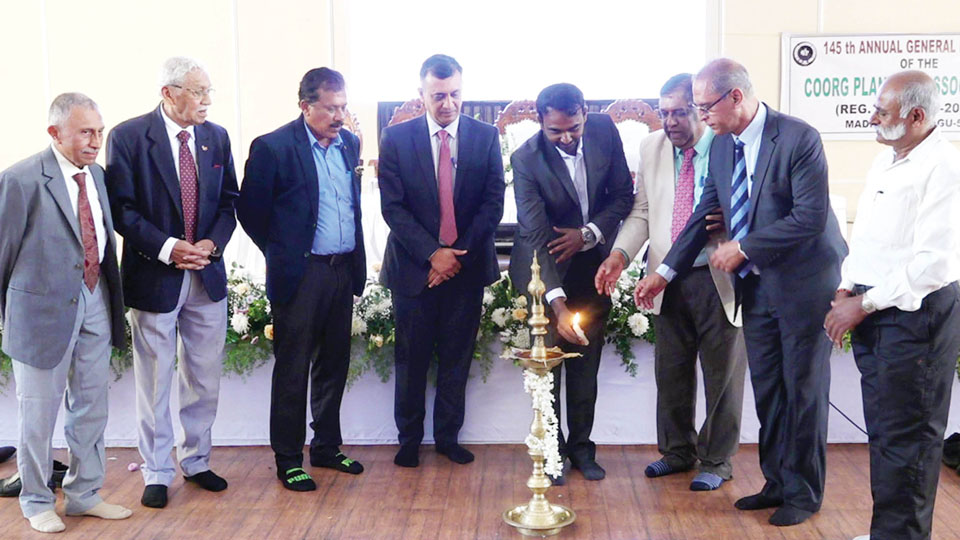
145th Annual General Meeting of the Coorg Planters’ Association held in Madikeri
Madikeri:
The Coffee Board has launched an ambitious initiative to elevate coffee quality across regions by forming community farmer groups at the hobli (village cluster) level. This initiative, announced by Coffee Board CEO and Secretary Dr. K.G. Jagadeesh during the 145th Annual General Meeting of the Coorg Planters’ Association in Madikeri recently, aims to gather insights into coffee quality and apply targeted improvements.
Dr. Jagadeesh highlighted that prioritising quality will ensure a robust future for Indian coffee. Under the initiative, community groups of 100 farmers will be established in each hobli, where collected coffee bean samples will undergo laboratory analysis to determine quality.
Should quality fall short, Coffee Board experts will provide growers with specific guidance on improvement measures, helping them achieve standards that could command higher prices in the international market.
In an effort to attract young talent to coffee farming, the Board also introduced a two-year Coffee Cultivation Diploma. Open to those who have completed the 10th Standard, the diploma programme offers formal training in cultivation and plantation management, addressing the current shortfall of trained supervisory and managerial staff in the industry.
Recognising the expanding demand for skilled café staff, the Board announced plans to offer Barista training for women, youth and enthusiasts. As an estimated 3,000 new coffee cafes are expected to open across India next year, this training will equip individuals to serve plantation visitors and tourists with high-quality coffee..
Tata Coffee Managing Director P.A. Mandanna stressed the importance of sustainable coffee farming, urging growers to embrace environmental, economic and social responsibility. He shared that Tata Coffee has implemented eco-friendly pulpers and rainwater harvesting systems across its estates, which has improved soil fertility and raised groundwater levels.
Experts, including Dr. Raja Vijay Kumar, British agricultural specialist Mark Trisney and K. Sudhindra offered practical demonstrations on various coffee cultivation techniques, providing valuable insights to growers.
Coorg Planters’ Association President A. Nanda Belliappa said that the Association continues to provide essential information to farmers and has actively raised their concerns with the Government.
Other prominent attendees included Association Secretary C.K. Belliappa, Vice-President A.A. Chengappa, Karnataka Coffee Planters’ Association President K.G. Rajeev Ganapathy, former Coffee Board Vice-Presidents N. Bose Mandanna and B.D. Manjunath, among other industry leaders.
The meeting also featured an exhibition and sale of agricultural equipment, drawing significant interest from participants.
This initiative marks a pivotal step by the Coffee Board and industry leaders in strengthening quality and sustainability in Indian coffee farming, aiming to bolster India’s position in the global coffee market.
source: http://www.starofmysore.com / Star of Mysore / Home> News / November 10th, 2024
Supply issues drive prices higher, shipment volumes drop marginally.
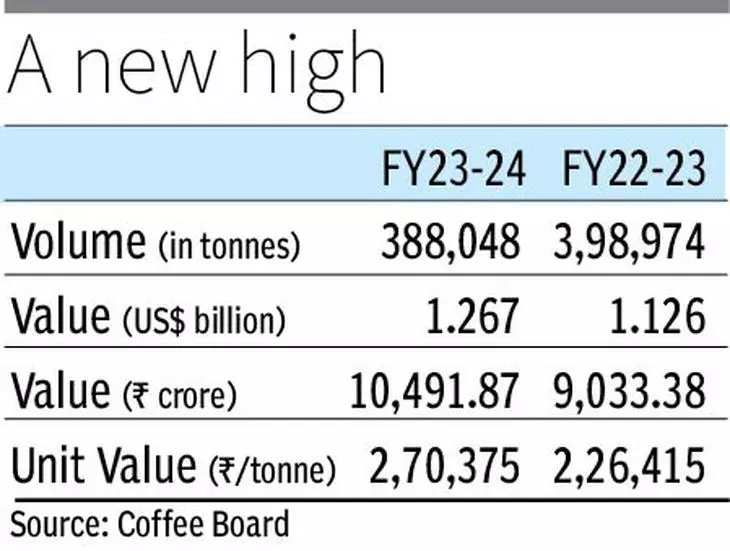
Thanks to the surging trend in global Robusta prices, India’s coffee exports for the financial year ending March 2024 touched a new high in value terms.
Despite a marginal decline in the volumes, shipments were at a new record. In fact, financial year 2023-24 was the third consecutive year during which Indian coffee shipments registered a new record.
In dollar terms, Indian coffee shipments registered an increase of 12.5 per cent to $1.26 billion over $1.12 billion in the 2022-23 fiscal. Similarly in the rupee terms, exports were up 16 per cent at ₹10,491 crore over ₹9,033 crore.
In quantity terms, the exports saw a marginal decline of 2.5 per cent at 3.88 lakh tonnes over 3.98 lakh tonnes in 2022-23.
Supply issues
The global robusta prices are at a three-decade high on supply issues in the top producing countries such as Vietnam and Brazil. This has worked to the advantage of the Indian coffee sector, where robusta is the most widely-produced variety. As a result of high robusta prices, the per unit realisation for Indian exporters went up by about a fifth to ₹2.7 lakh per tonne during 2023-24 compared with ₹2.26 lakh in the previous financial year.
“A combination of factors such as the good market prices for Indian coffee, supply side disruptions in Brazil and Vietnam have helped push up the exports” said K G Jagadeesha, Secretary and CEO, Coffee Board. “Our export quantity in the last three years has increased principally from instant coffee,” he said.
India exports over about two-thirds of the around 3.5 lakh tonnes of coffee produced in the country. It also imports cheaper robusta coffee to re-export them after value addition.
Ramesh Rajah, President, Coffee Exporters Association, said, most of the increase in export value during financial year 2023-24 has come from the robustas. The demand is good and the shipments during the last two quarters of the financial year have been better than the earlier quarters.
Farmgate prices
Farmgate prices of robustas in India have overtaken the arabicas in the recent weeks, tracking the global uptrend. Robusta parchment prices are ruling at ₹14,000-14,500 per 50 kg bag, while the robusta cherry, the widely-produced coffee variety in the country, is ruling at ₹8,500-8,950. Arabica cherry coffee is hovering around ₹8,000-8,300 per bag, while Arabica parchment is ruling at around ₹13,900-14,300.
In fact, Indian robusta parchment AB is commanding a premium of $700-750 a tonne over the London terminal prices, while the premiums for robusta cherry is hovering around $350-400 per tonne.
Italy, Germany, Russia and UAE are among the major destinations for the Indian coffees. For the crop year 2023-24 starting October, the Coffee Board, in its post-blossom estimates, has projected a crop size of 3.74 lakh tonnes over the previous year’s final estimates of 3.52 lakh tonnes.
source: http://www.thehindubusinessline.com / Business Line, The Hindu / Home> Economy> Agri Business / by Vishwanath Kulkarni / April 02nd, 2024
Aimed at coffee enthusiasts, industry professionals, and the general public, IICF will feature speciality coffee stalls, equipment showcases, workshops, competitions, and entertainment.
The Specialty Coffee Association of India (SCAI), in collaboration with the Coffee Board of India, is set to launch the India International Coffee Festival (IICF) in October 2024. Built on the success of the 2023 World Coffee Conference in Bengaluru, which attracted over 2,400 delegates and more than 20,000 visitors, IICF aims to offer an even larger celebration of coffee culture.
The festival will span three major cities, Delhi, Mumbai, and Bengaluru, with preliminary events scheduled for Delhi (October 4-6), Mumbai (October 11-13), and Bengaluru (October 28-30). The grand finale will take place in Bengaluru from December 13-15, where India’s national coffee champion will be chosen to represent the country on a global stage.
Aimed at coffee enthusiasts, industry professionals, and the general public, IICF will feature speciality coffee stalls, equipment showcases, workshops, competitions, and entertainment. The event will also include prestigious contests such as the National Barista Championship, the Brewers Cup Championship, and Coffee in Good Spirits, combining coffee and mixology.
SCAI President DM Purnesh expressed excitement, stating, “It gives us immense joy and satisfaction to bring the largest coffee festival to India. The country with an ever growing coffee drinking audience is a very important market for us and India does play a major role in shaping the future of coffee culture. We hope to see connoisseurs and stakeholders coming and spending three fruitful days in these three leading cities of India. Let the festival be a meeting ground of ideas and exchange of creative skills.”
source: http://www.bwhotelier.com / BW Hotelier / Home> F & B / by BW Online Bureau / October 07th, 2024
Kodagu grows coffee across 1197 sq km area and the district contributes to 35 per cent of the country’s coffee production.
Representational Image/ File Photo
Madikeri :
Even as the central government has released Rs 307.80 crore to the Coffee Board of India, funds have been reserved to extend subsidies to the coffee growers. In Kodagu, Rs 19.05 crore fund is reserved for the subsidy scheme and the growers can apply for the same before September 30.
Kodagu grows coffee across 1197 sq km area and the district contributes to 35 per cent of the country’s coffee production. However, the coffee growers in the district, especially the small growers, have become victims of the changing weather patterns and have incurred losses in the past.
While the Coffee Board extended subsidies to the growers through various schemes, the same ended in 2017 due to some financial implications. Nevertheless, the subsidies have resumed from last year.
In 2023-24, the Board extended subsidy for re-plantation of coffee crops and irrigation facilities including the establishment of ring wells, open wells, drip irrigation or sprinklers to all the growers alongside subsidy for construction of drying yard and godown to growers from the SC-ST category. Nevertheless, with more funds being released to the Board this year, additional subsidies are being extended to the growers from the Board.
“This year, a subsidy is being released for machinery purchase and for the establishment of a pulping unit alongside irrigation and re-plantation work. The subsidy for the establishment of a drying yard or godown has been extended to all the growers this year,” confirmed Dr V Chandrashekar, DD (Extension), Madikeri.
Further, with an aim to promote the education of the kids of the coffee labourers and workers, the Board will provide scholarships to the children of coffee labourers and coffee workers. “Scholarships will be extended to the students pursuing first PUC, first-year degree and for professional courses. The students must be children of coffee labourers or coffee workers including kids of labourers in coffee curing works,” he explained.
He added that the Rs 9.5 crore fund is reserved for subsidies for growers from the General category in the South Kodagu Gonikoppal extension. Similarly, Rs 5 lakh has been reserved for SC category growers and Rs 1 crore for ST category growers in the Gonikoppal extension. For North Kodagu growers, Rs 8.5 crore has been reserved for the subsidies. The growers eligible for the subsidies can submit an application to the Board before September 30.
The extension of the subsidy scheme is welcomed by the growers of the district even as Dr Kaverappa, former VP of the Coffee Board, urged the officials to continue the subsidies throughout the year. Meanwhile, the Coffee Board officials are conducting a joint survey alongside revenue and agricultural departments of the crop loss across heavy rainfall areas in the district and a report on the extension of the damage will be submitted to the district administration shortly.
source: http://www.newindianexpress.com / The New Indian Express / Home> Karnataka / by Prajna G R / August 28th, 2024
The Union Commerce Ministry has announced a significant boost for coffee growerswith a grant of Rs. 307.80 crore.
This aid, channelled through the Coffee Board, aims to provide much-needed support to the coffee industry in the region. It will provide coffee planters with access to subsidies for plantation development.
According to Coffee Board President Dinesh Devabrinda, the grant has increased by 36 percent compared to the previous year. In 2022-23, Rs. 228.23 crore was allocated, while in 2023-24, the amount was raised to Rs. 307.80 crore.
Package highlights
Key highlights of the aid package include subsidies for machinery and infrastructure, an education fund for workers’ children and support for coffee community initiatives.
Dinesh Devabrinda said that the eligibility criteria for subsidies have been expanded, raising the limit from 10 hectares to 40 hectares.
Coffee planters can now receive subsidies for a range of purposes, including the development of drying yards, warehouses, pulper units and coffee bean drying machines. Additionally, subsidies are available for establishing open wells, constructing tanks, installing sprinkler and drip irrigation systems, and upgrading machinery in coffee curing units.
“Our goal is to support growers by providing subsidies to increase the quantity and quality of coffee produced,” he said.
Damage survey
In collaboration with the Revenue Department, the Coffee Board will conduct a survey to assess damage to coffee plantations, with compensation to be provided to those with damage exceeding 33 percent.
To improve education for the children of coffee plantation workers, the Government has allocated Rs. 4 crore for scholarships. Additionally, 17 committees have been formed following the recent coffee community meeting to explore ways to increase coffee production.
source: http://www.starofmysore.com / Star of Mysore / Home> News / August 27th, 2024
The five-day Barista training workshop, organised by the Coffee Quality Division of Coffee Board of India in collaboration with CFTRI, Mysuru, will be held from June 24 to 28 at the BioNEST Incubation Centre at CFTRI premises in city.
Training in brewing coffee, cupping, manual brewing, signature beverage, introduction to green coffee etc., will be conducted.
Those who undergo the training successfully will be provided certificates.
For details and registration, call Mob: 94821-57878 or e-mail: baristatraining.coffeeboard@gmail.com
source: http://www.starofmysore.com / Star of Mysore / Home> In Briefs / June 04th, 2024
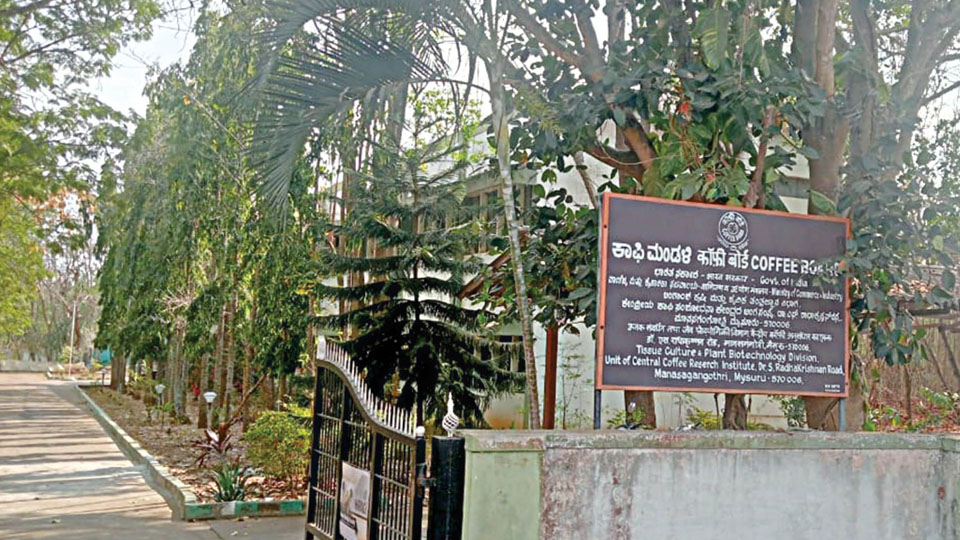
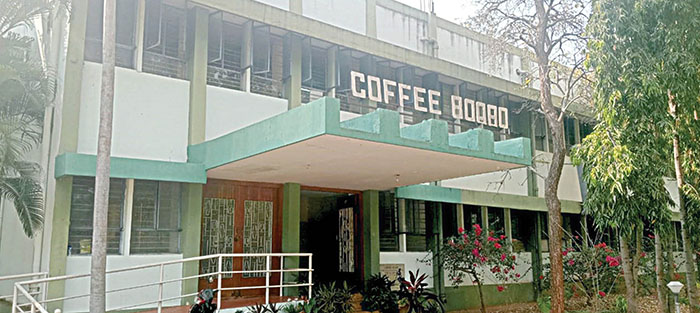
The Coffee Board, established by the Government of India at Manasagangothri premises over five decades ago to act as a link between the cultural city and coffee growing Kodagu district, is now being silently shifted to Chettalli in Kodagu district.
The then Deputy Minister of Foreign Trade A.C. George had inaugurated the Coffee Board Office, opposite the University of Mysore (UoM) main entrance gate facing Mysuru-Bogadi Road on Feb. 4,1972 in the presence of the then UoM Vice-Chancellor Prof. D. Javaregowda (Dejagow). Since then, the Board has been working on coffee species development, bean development, seeds etc.
The Board also functioned as a training centre for Botany students of the UoM, JSS institutions and other Universities by appointing them as apprentice and providing them training on various aspects of coffee cultivation.
Now, the Board is being silently shifted to Chettalli in Kodagu and as a first step in this regard, the appointment of apprentices has been stopped.
Upon coming to know of its shifting, many apprentices of the Coffee Board have expressed disappointment over the shifting.
Pointing out that the Board was of great help to Botany students, they expressed apprehension that the shifting to Chettalli in Somwarpet taluk of Kodagu, will surely hit its infrastructure and research studies.
They demand that the authorities drop the shifting in the better interests of research studies as well as coffee growers.
Sources said that the Board may be shifted to Chettalli in June or July once the Lok Sabha polls get over. Meanwhile, Botany students too have opposed the shifting move. Noting that it is pointless to shift the Board to Somwarpet’s Chettalli, they decried the justification given by the higher authorities who say that research has taken a hit.
They also said, it is hard to believe the version of the authorities, wondering how the hurdles that were not there for over 50 years, have surfaced suddenly.
source: http://www.starofmysore.com / Star of Mysore / Home> News / March 23rd, 2024
In a significant development for the Indian coffee sector, the Coffee Board of India organised a buyer-seller meeting at Dubai, marking a new chapter in the industry’s global expansion.
The event, held on the sidelines of Gulfood 2024, was jointly organised by the Indian Embassy in UAE and the Coffee Board of India. Speaking on the Occasion, Indian Ambassador to the UAE, Sunjay Sudhir, highlighted Dubai’s strategic role as a global trade hub, and the upcoming Bharat Mart at Jebel Ali free zone as enablers for India’s global coffee ambitions. He also emphasized Dubai’s unique position as a logistical powerhouse, boasting a busy port and efficient airport, offering an ideal platform for Indian coffee producers to showcase their diverse blends directly to international buyers and establish lasting brands.
The meeting featured a presentation by KG Jagadeesha, CEO of the Coffee Board of India, who provided a comprehensive overview of the country’s coffee industry. He highlighted the vast coffee plantations spanning over half a million hectares, supporting millions of farming families, and the impressive production and export rates that surpass domestic consumption. Jagadeesh emphasized India’s significant contribution to the international coffee market, particularly as a leading exporter of instant coffee.
India’s coffee industry, with its balanced production of Arabica and Robusta beans, has witnessed remarkable growth since the establishment of the Coffee Board in 1950. Notably, 35% of the country’s coffee exports now comprise value-added and specialty coffees, showcasing a shift towards premium offerings. India’s coffee is unique in the sense that it is shade-grown and the Robusta variety is treated at par with Arabica in the Western market. This event not only celebrated the distinct flavors and rich heritage of Indian coffee but also marked a strategic move to leverage Dubai’s logistical strengths.
source: http://www.newsonair.gov.in / News Services Division, All India Radio / February 22nd, 2024
Jagadeesha added that there is a lot of opportunity for coffee in India, because we have a very low coffee-drinking base.
The increasing number of cafes and coffee joints show that coffee is no longer a beverage, but an experience.
Coffee opportunities in India are very high. Despite the high price, Indian coffee is most preferred globally. The increasing number of cafes and coffee joints show that coffee is no longer a beverage, but an experience. Cafes have transformed into work stations for startups and this is good for the Indian economy, said Dr KJ Jagadeesha, CEO and Secretary, Coffee Board, in a conversation with the editors and staff of The New Sunday Express. Excerpts of the interview:
Tell us about the coffee scenario and the pricing concerns ….
Coffee in India is doing well, especially over the last three years, but we are not the price setters. Reason being, India’s overall contribution is around 4%. Brazil and Vietnam contribute 60% of the global production, and they set the price. But in the last few years there is supply disruption in Brazil and there is a shortage in supply globally. So, we are happy as Indian coffee is getting a good price. India is the 7th largest in terms of production and 5th largest in exports.
Can you please explain about exports?
Our exports are better than our production. We export, re-import and export all our coffee. Most of the instant coffee is made from coffee imported from cheaper destinations. Not a single Indian coffee bean is left unsold. There is very high demand for Indian coffee that even if we double production, traders say they will sell it. Indian coffees are expensive because they are grown under shade. Unlike in other countries like Brazil where it is open cultivation. When you grow under shade, coffee production is less by around 50%. But the quality is very good. This coffee takes longer to mature and has some unique characteristics that are not present in other coffee.
How is the coffee export business?
Around 80-90% of coffee is exported as green coffee. Green coffee can be kept for a year and usually, roasted coffee lasts only 15 days. Beyond that, the quality comes down. We export green coffee and then the seller blends it with different beans to get different notes. We export to 120 countries. Europe is our biggest market. We export about 60% of coffee grown here.
What about the rising number of private, instant and star-rated cafés and types of coffees served?
I am happy they are increasing. There is a lot of opportunity for coffee in India, because we have a very low coffee-drinking base. In other countries, people drink 8-9 kg of coffee per annum, per capita, but we are 50-100 grams. People who are getting into coffee now are the new generation who feel coffee is the most affectionate and fashionable drink. They love to drink coffee even if it’s high priced. They drink coffee for the experience. Ambience should be great and products should be innovative. They don’t like drinking the same coffee every day. Cafes now have become work spaces where people exchange ideas and conduct business. Many start-ups are running their businesses or whole companies from these cafes. This is how we expect and want the coffee industry to grow. Growers will get better prices, employment will be generated and GDP will get a boost.
How does coffee compete with tea?
Tea and coffee are complementary beverages, not competitors. Consumers typically don’t switch between them. Coffee consumption, especially among the younger generation, is on the rise. Tea remains affordable and easy to make, while making quality coffee requires skill. Many aren’t aware that if coffee is boiled above 90 degrees Celsius, it’s a waste. In future, skill-based courses will be introduced for over one lakh self-help women’s groups, and also 5,000 college graduates will be trained.
What is the situation in Karnataka?
Karnataka is a leader in Indian coffee production, accounting for around 70%, though we have 50% of the area. In the last 3-5 years, the crop has been reasonably good and prices too.
Hasn’t climate change affected coffee production?
It has, as coffee is a sensitive crop. Even if there is a 15-day delay in rainfall, during March and April, the crop gets affected to a large extent. Climate change is something that needs to be taken seriously and addressed. The Coffee Board has taken several measures to address it like bringing some climate-resilient varieties, training farmers and providing incentives.
Did drought affect coffee plantations?
Drought effect was relatively low. The reason is that even if there is a 50% reduction in rainfall, coffee will still grow. The yield might be less, but 800-900 mm of rainfall is enough for the plantation and the impact has been minimal.
Which is the best variety of coffee?
While there are many varieties, one of the best is Chandragiri. Farmers also say that it is superior compared to any other variety across the globe. The yield is good and it is resistant to most of the rust viruses. The cupping quality is very good.
What about collaborative research?
Research should not be restricted to scientists and labs. It should be a joint effort between growers and scientists. Work on this started 2-3 years ago and we have identified elite robusta plants. Growers and scientists together shortlisted around 60-70 of them and found 8-10 varieties promising. They will be released as tissue culture and MoUs are being signed.
How many varieties do we have?
Right now eight have been developed in collaboration with farmers. Otherwise coffee has many varieties. Some 28 varieties have been given to us by private firms. There are cases where a variety does well in other countries, but not in India.
Do we have more varieties when compared to other countries?
Brazil may have more varieties than us. Other than Brazil, we have more. It does not mean anything. Farmers prefer the leading variety. We have also kept some varieties for cupping. If somebody says that I want quality and I am not worried about production then we have Selection 5 and 9 varieties. These two are excellent in cupping and taste.
What are the proposals before the Coffee Board in the coming days?
We have developed a new plan and it has been submitted to the government. It includes many things. To address labour shortage there is a plan for mechanisation. Second is quality improvement. Many say Indian coffee is excellent on the plant. But after harvesting, since it is poorly handled, quality dips. Importance is being given to harvesting and storing. Fermentation is important. It is done using different techniques to get different aromas. We are also looking at franchising India Coffee Houses to rural areas.
Are you also planning to add more coffee varieties to India Coffee Houses to compete with private players?
Coffee Board is a nodal agency to promote coffee as a sector. India Coffee Houses are not meant for competing. Given that there are a lot of nostalgic memories about them and people love to come there, we are working on expanding the menu. At the Queen’s Road Coffee House, the Board has collaborated with a social organisation that deals with specially-abled people. We complement each other.
How do people perceive the addition of chicory in coffee, considering its potential health implications?
The debate around chicory’s health impact exists. Chicory was brought in during the Second World War to meet the rising demand among soldiers when production was less. It continues to be blended even now. However, coffee has various health benefits. It’s beneficial for the heart and kidney, apart from being a refreshment. When chicory is mixed, the benefits of coffee get diluted.
How has urbanisation impacted coffee production?
Urbanisation is affecting everything, but its effect on coffee production is relatively limited due to the remote locations where coffee is typically grown.
How is the Board addressing man-elephant conflict?
It poses a significant challenge in coffee-growing regions, causing fear among residents and reluctance among labourers. The Board is actively engaging with the forest department and other authorities to address these issues.
Are there any courses being offered by the Board related to coffee for graduates?
We offer postgraduate diploma programmes and short courses focused on coffee, covering topics including cafe management and coffee trading.
What are the byproducts derived from coffee beans?
The use of coffee beans in the cosmetic industry is increasing. The leaf and pulp are used for skincare and makeup products. The leftover coffee after brewing is also used in making byproducts.
How many farmers are involved in the coffee industry, and is this number expected to increase?
There are about 4.7 lakh farmers working currently in India and it will increase in the coming years.
Are coffee plantations primarily done by small-scale farmers, or is there a monopoly in the industry?
It is a myth that coffee plantations are managed by affluent farmers. The reality is that 99% of the plantations are managed by small-scale farmers. Only around 1% of farmers are considered large growers but they occupy around 30% of the land.
What do you say about coffee tours gaining popularity?
Coffee tourism is gaining traction, providing coffee growers with an additional source of income. However, it’s crucial for both tourists and growers to responsibly manage activities to ensure minimal impact on the ecosystem as regions where coffee is grown are in Western and Eastern Ghats.
What other types of businesses can be done with coffee besides opening a coffee shop?
People can establish their own coffee brand with their estate, offer consultancy services, provide technology solutions such as market information, engage in trading and roasting and explore businesses centered around deriving coffee byproducts.
Coffee Board has also ventured online and started selling, how has that progressed?
Customers came to the Board and requested us to start e-commerce so that they could easily purchase online. Today we have entire operations in the basement which has a roastery, grinder and 24×7 packing staff. As soon as we get an order we pack it and dispatch it. The initiative is doing well.
Does the Board have enough staff or are there too many vacancies?
There are of course limitations to hiring more staff. Currently, we have a vacancy of 50 people with a total sanctioned strength of 587. We are looking to expand in the north eastern regions and we need a lot of people to convince farmers, educate them and handle estates. We are also looking at promotion both in domestic and international events to build the brand value of Indian coffee and its quality.
Can coffee be grown on terrace gardens?
Coffee plants can be grown anywhere, outdoors or inside homes, however, it will not yield commercially viable beans or fruits. Some might have berries too but when you roast it and make a cup of coffee it doesn’t taste like coffee. Coffee requires an elevation of more than 500 metres above sea level and secondly, the rainfall has to be good. It also requires optimum shade to grow.
How successful was the coffee festival in terms of partnerships with other players?
We had more than 20-30 international brands who were present, around 200-300 Indian brands participated and around 400-500 buyer-sellers met formally. Strong relations were built that not just last for one year but go on for decades, once the buyer finds the perfect blend for himself there is no going back.
What do you want to say to youngsters who want to start a coffee business?
Coffee is a very passionate profession. I’ve seen people who make a profit not because they’re working for it but it’s about passion. They like growing coffee and living on the estate. I have seen Baristas who are passionate about making better coffee every day, they enjoy it.
source: http://www.newindianexpress.com / The New Indian Express / Home> Karnataka / by Express News Service / February 11th, 2024
WELCOME. If you like what you see "SUBSCRIBE via EMAIL" to receive FREE regular UPDATES.
Read More »