Bollanda Unnathi Aiyappa set the new meet record in women’s 100 mts hurdles at the ongoing South Asian Junior Athletic Meet, here yesterday.
She won the event with a record timing of 13.93 sec beating the old timing of 14.19 sec set by S. Kumari of Sri Lanka in 2018 at Colombo. However, this was not Unnathi’s best as she had previously completed the event with a personal best timing of 13.66 sec at an event held in Dubai earlier this year.
Unnathi is the daughter of International athletics coach B.P. Aiyappa and Olympian Pramila Aiyappa (Guddanda).
Indian athletes bagged a total of nine gold medals out of 10 in the offing with Ritik (55.64 mts, old record 54.44 mts set by Sachin in 2013 at Ranchi) and Anisha (49.91 mts, old record 48.60 mts set by A. Bajwa in 2018 at Colombo) setting new meet records in men’s and women’s discus throw.
source: http://www.starofmysore.com / Star of Mysore / Home> Sports / September 13th, 2024
Athlete Bollanda Unnathi Aiyappa, who had won a gold medal setting a new meet record in the South Asian Junior Athletic Meet at Jawaharlal Nehru Stadium, here on Thursday, won her second gold medal setting another new meet record in women’s 200 mts on last day of the Meet.
Unnathi completed the race in the record timing of 23.91sec beating the old record of 24.32 mts set by A. Suseedran at Ranchi in 2013. India’s Nancy (23.11 sec) and Neeru Pathak (29.91 sec) finished in second and third place respectively.
Speaking to Star of Mysore, Unnathi Aiyappa said, she was delighted for having won two gold medals and added that she was in the best of the form because of continuous travelling.
“After World Junior event, I was not able to give my best. I took part in the South Asian Junior Championship with no expectations. But, having won two gold medals has delighted me,” she said.
Though, this was event of the season, Unnathi will be seen in action at the All India Inter University Athletic Championship to be held in December. She is the daughter of Intl. Athletic Coach B.P. Aiyappa and Olympian G.G. Pramila Aiyappa (Guddanda), residents of Bengaluru.
Meanwhile, city’s Thelapanda K. Bopanna won bronze in the men’s 800 mts run. He won bronze with a timing of 1:50.45 sec behind Sri Lanka’s H.D.S. Awishka (1:49.83sec) and India’s Vinod Kumar (1:50.07sec) who won gold and silver respectively.
Bopanna is the son of Dentist T.M. Kalappa and Rachana Kalappa, residents of V.V. Mohalla in Mysuru.
India with a total of 48 medals (21 gold, 22 silver and 5 bronze) finished in the top position of the medals tally followed by Sri Lanka and Bangladesh in second and third positions.
source: http://www.starofmysore.com / Star of Mysore / Home> Sports / September 14th, 2024
Amrita Chengappa moved to a small village in Uttarakhand in 2002 in search of a simpler life. With her partner, she runs SOS Organics that sells all-natural soaps, candles, home care items, teas, seasonings and cold pressed oils, all made with indigenous produce.
To escape a hectic city life, full of woes and stress, and relocate to a quiet abode in the hills might very well be every urban dweller’s dream today. But how do you shift to an organic way of life in the hills without infringing upon the rights and agencies of the area’s original inhabitants?
Amrita Chengappa, who left behind her bustling city life in Lucknow in search of something simple, remains mindful of these questions. In 2002, she, along with her husband Santosh, moved to Chitai Pant village in Uttarakhand’s Almora district to lead a better life. “The idea was not to come to a village and turn it into an industrial area,” Amrita tells The Better India. “People come to the hills with many agendas and ideas in mind, but then they build a house on someone’s land, and the owner of the land ends up becoming a watchman for their home.” This, she says, was something that both her and Santosh wanted to avoid.
Together, the couple runs SOS Organics, launched in 2008, to integrate sustainable farming with producing a vast range of organic products, including candles, natural cosmetics, seasonings, honey, health foods, salt lamps and home care items.
All SOS Organics products are all-natural and free of chemicals (Photos: Amrita Chengappa)
‘Small is beautiful’
Amrita has always been interested in traditional knowledge including ayurveda, something she says is very prevalent in the southern region of the country, where she is from. The entire idea of SOS Organics was inspired by E F Schumacher’s Small Is Beautiful: A Study Of Economics As If People Really Mattered. “In the book, he talks about an economic system which is more decentralised and small, where people do work that they actually enjoy or can take something away from, besides only monetary benefits,” she explains.
“We wanted people to understand that you can make a viable project without actually taking from the Earth. Locals in the Kumaon region are generally only employed by the government or the army. Our idea was to do something women-centric. We were also clear that we wanted the project to be sustainable, economically or otherwise,” she adds.
It took Amrita and Santosh five years of travelling and acquainting themselves with the area before SOS organics took shape. “We did research and looked into the lives that locals were leading. Gandhi had talked about how villages should be making their own candles and other products, which I thought was a good idea to implement,” she says.
Besides lessons in a sustainable lifestyle, SOS offers breathtaking views and wholesome community living (Photos: Amrita Chengappa)
At SOS, the idea is to take as little from nature as possible. “The entire project runs only on rainwater harvesting. We don’t even have a Jal Nigam connection. We’re living in a rain shadow area that experiences a lot of water problems. Watching a local carry a 50-litre can of water so you can take a bath is an eye opening experience, and really made me think twice about my own water usage. So one of the first things we did was build water harvesting tanks, where around 2 lakh litres of water has been harvested. Around 70% of our power is solar-generated. We also aim to use whatever produce is already available here,” she says.
Going into further details about what exactly goes into SOS’s products, Amrita explains, “All the colours we use in our soaps are natural. We use the bichu buti, or stinging nettle, which gives a lovely green colour. We also use haldi, and neel patta (indigo). We use essential oils instead of fragrant oils, which have artificial smells. We make teas from tulsi, rhododendron, stinging nettle, and other herbs that are found here easily. We also use them to make Italian mixes where we take, say, junglee ajwain, to be incorporated. We wanted to use whatever was already growing here, and then look at value addition.”
“We have access to junglee apricot kernels, which we use to make cold pressed oils using our kachi ghani. The skin that’s left is powdered, dried and made into other products. So we avoid as much wastage as we can, and leave behind small footprints. You actually need very little to create a livelihood,” she says.
All products are hand-made (Photos: Amrita Chengappa)
Their candles are priced at around Rs 160, cold-pressed honey at around Rs 220, and seasonings at around Rs 140.
While COVID-19 slightly impacted their earnings last year, SOS Organics was able to generate a turnover of around Rs 1.2 crore. They receive around 25-30 orders per week. “One of the best things has been repeat customers who contribute to around 60% of our total orders,” Amrita notes.
‘Prepare yourself for what’s to come’
“Because we don’t use chemicals, the shelf-life of our products is around one year. So we can’t really get into a massive distribution model and produce a million pieces. In any case, that’s not our vision. We’re different from a big brand that just calls themselves ‘organic’,” she says.
She adds that they’ve never had a budget for marketing, and most of their popularity has spread through word-of-mouth. Most of their funding has been private. It took them around five years to break even.
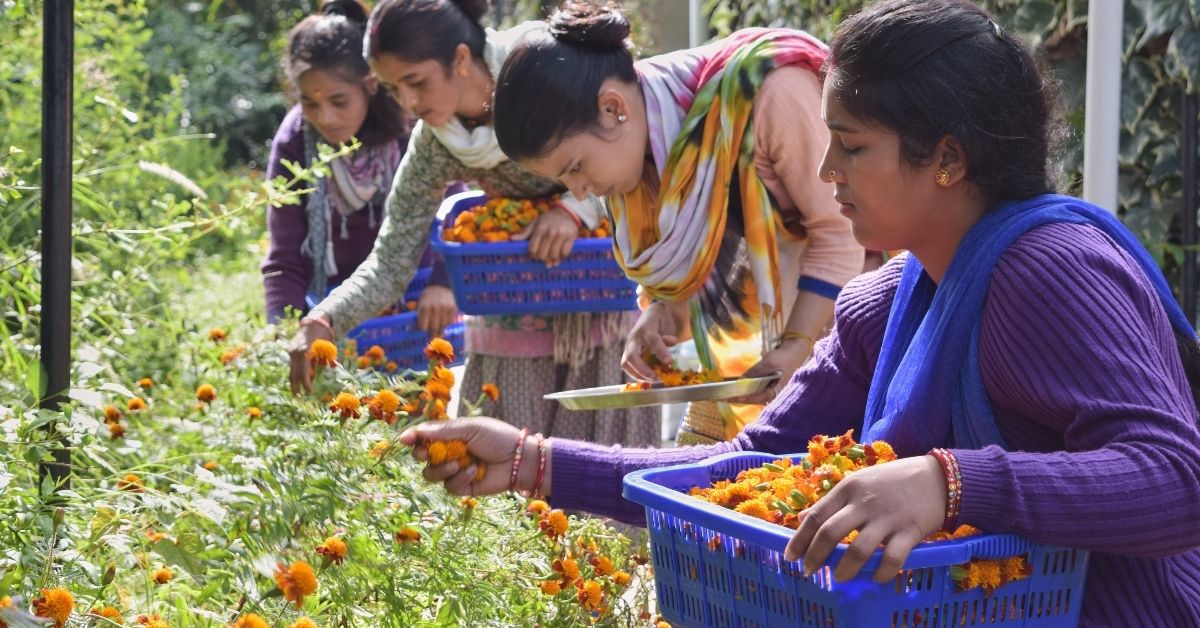
To make the products, SOS has employed a small team of local women who make everything by hand. “They all live about a 5-minute walk from where they work, and do so in two shifts. They come in at 9.30 am and leave at around 1 pm. Then they come back at 2 and leave at 5,” Amrita says. The women leave before it gets dark, as they have to carry wood and water back home. In addition, the area is often frequented by leopards, so maintaining the women’s safety is a priority for SOS, she adds.
They have a separate self-help group of women that only sort their grains. Around 7 women have been employed to make the products. They’re interchangeable with their skills, Amrita says, so while she comes up with the smells and combinations, it’s the ladies who see the final product through. The village is plagued with a massive problem of alcoholism, she adds, so she ensures the money goes directly to the women’s bank accounts, instead of the hands of other family members who might misuse these earnings.
A small team of Kumaoni women have been employed to help Amrita in her business (Photos: Amrita Chengappa)
Coming to what challenges she faced in starting and running the business, she says, “People were a little suspicious when we first came here, possibly because they’ve seen their lands being exploited by urban dwellers. We were met with a bit of resistance from locals, which dissipated when they understood our intentions better. When we first came here, we also found that people were not aware of or well-connected to their roots. For example, to them, ragi used to be gareeb ka khana [food of the poor]. They were also apprehensive about anything that was ‘traditional’. We had to convince them that there was a market for the produce found in their region.”
On what advice she would give to people hoping to make an all-round lifestyle change to a more sustainable way of life, Amrita notes, “Sustainable living starts with yourself. People have this misconception that they can go to the mountains and have the same lifestyle as they did in, say, Delhi. That’s not how it works. If you want to fly first class and drive a Beemer and then come to a village to start a project — those two things don’t go hand-in-hand. You also need to know that you can’t just go into this expecting an abundance of profits. So if you’re not mentally prepared, it can be quite taxing. People looking to shift to a more sustainable lifestyle need to be open and prepared to learn a lot. When we began, we did everything by ourselves, because we couldn’t afford to hire anyone. Designing our first label, setting up our first website, the first photographs we clicked — that was all us.”
Her transition from the city to a village in the middle of nowhere, Amrita says that there were challenges but adds, “I have access to fresh air, clean water, and an uncontaminated environment. So what more could I have asked for?”
For orders, or more information on the importance of sustainability and how to lead this lifestyle yourself, you can visit SOS Organic’s website.
source: http://www.thebetterindia.com / The Better India / Home> English> Stories> Farming> Sustainablity / by Divya Sethu / edited by Yoshita Rao / April 17th, 2021
More than 800 sports enthusiasts took part in the 14th edition of Celebration Mysore Marathon, organised by Life is Calling in city this morning.
The marathon was flagged-off by Mountaineer Dr. Usha Hegde in front of Kote Anjaneyaswamy Temple near the Balarama Gate of Mysore Palace at 6 am.
Speaking on the occasion, Dr. Usha Hegde said that taking part in sports event is important for people to stay fit and healthy. “Events like marathon should be organised more frequently to enhance the health conditions of those taking part,” she added.
The event comprised 30K Run, 21K Half Marathon, 10K Run and 5K Fun Run/ Walk. Organisers had made all necessary arrangements for the runners including drinking water at various points, medical team and ambulance on stand-by, and direction boards for the benefit of the participants.
Results
Open Male 10K Run
1. S.Y. Prajwal (36:35.7), 2. A. Abishek (36:35.9), 3. K. Kiran (37:00.00).
Busy working on high-budget Telugu period-drama “Rudhramadevi”, southern actress Aditi Chengappa is simultaneously working on multi-lingual film “X”.
Busy working on high-budget Telugu period-drama “Rudhramadevi”, southern actress Aditi Chengappa is simultaneously working on multi-lingual film “X” and says she agreed to do the indie movie because she prefers “quality over quantity”
“X” is being directed by eleven filmmakers – Abhinav Shiv Tiwari, Anu Menon, Hemant Gaba, Pratim D. Gupta, Q, Raja Sen, Rajshree Ojha, Sandeep Mohan, Sudhish Kamath, Suparn Verma and Gautham Vasudev Menon. She is wowed by the creativity brought forth by the independent filmmakers to the project.
“I think what makes independent filmmakers brilliant is their creativity and resourcefulness. It is far more challenging, and I have a lot of respect for them. The crew seemed more like a group of my friends. We had a fantastic time shooting, no ego, no fuss, just hardworking and enthusiastic filmmaking.
Despite knowing “X” is an independent project and might have a limited release, Aditi signed the film because for her “it’s always been quality over quantity”.
“I’m aware that it may not have a wide release, however what satisfies me is that I’m part of a very classy and intelligent filmmaking process, honestly a dream come true.”
Aditi, who has starred in southern films such as “Konjam Koffee Konjam Kadhal” and “Takita Takita”, is cast opposite Rajat Kapoor in “X”.
“It was a pleasure working with Rajat, who is so talented and respected and yet down to earth. I was nervous initially, but he broke the ice and made things comfortable with his great sense of humoUr on the sets,” Aditi said.
She further added: “I admire his presence of mind in every moment. His attention to details in each performance and situation is impeccable.”
Aditi, who calls this exercise of collaborating and working “a unique concept”, has been shooting for her part for over the past few days. The part featuring her is being directed by Sudhish Kamath.
“X”, being produced by Manish Mundra, is slated to release later this year.
source: http://www.newindianexpress.com / The New Indian Express / Home> Telugu / by IANS / August 29th, 2013
Model and actress, Shubra Aiyappa, who abandoned formal education at 18 to pursue her passion of acting, feels that the right environment is crucial for one to be able to chase what their heart desires. In a conversation with us, she talks about her upbringing and emphasises the need for balancing boundary setting with being sociable.
Excerpts:
“I excel at getting people to open up. My fascination lies in understanding emotions rather than actions, delving into the nuances of individuals,” says Shubra, talking about how most people she meets feel at-ease confiding in her. “My friends say I could have been a therapist, if not an artiste,” she adds.
Giving context to this nature of hers, she explains how all of her life’s learnings have been experiential. “Whatever I have learned in life has been through books and experiences. Stories inspired me and helped me do better in life. I hope to create a space where people can be open and vulnerable. When people share their stories with me, I just hope that those who’re listening find learnings and inspiration to keep going from it, because life will always hand you failures along with successes, and it all boils down to how you confront your testing times.”
‘I’m grateful to my parents for letting me carve my own path in life’
I come from a simple South Indian family. I took part in a modelling contest which I never thought I’d win but when I did, I told my parents that I will be discontinuing my formal education, and they agreed. I think I flourished because they let me carve my own path.
source: http://www.msn.com / further acknowledgement: The Times of India / by Devika V Menon / December 17th, 2023
Mysuru-born athlete Reeth Abraham has won the bronze medal for India in the women’s Triple Jump final event of the World Masters Athletics Championships held in Björlanda, Sweden recently.
Reeth finished with a best effort of 9.83 metres, behind USA’s Neringa Jakstiene (9.99 m) and Great Britain’s Joanne Willoughby (9.91m).
The 63-year-old Reeth finished a considerable margin ahead of fourth-placed Hilde Bottin of Belgium, who managed a best of 9.29 metres.
Now settled in Bengaluru, Reeth is the daughter of late Ballachanda A. Devaiah (Chimney) and Tomy Devaiah, resident of Saraswathipuram, Mysuru.
A former Asian medallist in long jump and 100 metre hurdles disciplines and a former National Champion in heptathlon, Arjuna Awardee Reeth Abraham has four sisters, popular as Devaiah Sisters (Preeth, Geeth, Seeth and Neeth), who too were prolific sportspersons and have represented their respective Universities, State and country in various sports fields.
source: http://www.starofmysore.com / Star of Mysore / Home> Sports / August 27th, 2024
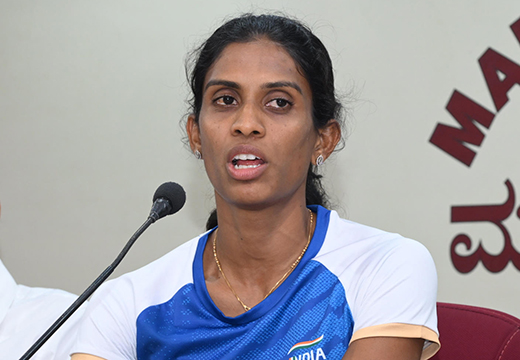
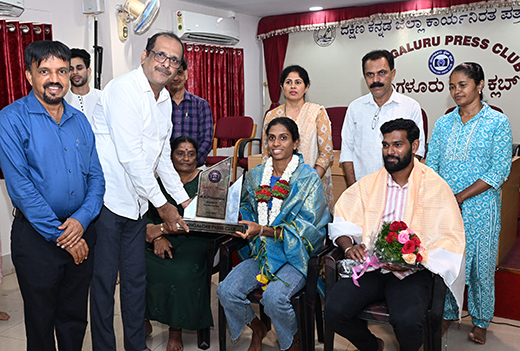
MR Poovamma, a three-time Olympian representing India, spoke at the Press Club’s ’Gaurava Athithi’ program organized by the DK Working Journalists Association on Saturday.
She credited her family, particularly her parents and husband, for supporting her throughout her sports career, stating that her achievements are shared with them.
Despite being 34, Poovamma emphasized that age should not be a barrier for athletes. “I wanted to prove that I can still compete and inspire others, regardless of age,” she said. She also expressed her intention to continue her career for a few more years and plans to open a sports academy post-retirement.
Acknowledging her husband Jitin Paul’s support in managing her training and household responsibilities, Poovamma praised her mother for her unwavering presence at all her events since her school days.
She highlighted the growing opportunities in sports, noting the government’s supportive role through programs like Khelo India and improved facilities. Poovamma advised young athletes to remain resilient in the face of setbacks, injuries, and failure, encouraging parents to support their children’s interest in sports. She stressed the importance of good practice, adequate rest, and proper nutrition for athletes’ physical and mental fitness.
source: http://www.mangaloretoday.com / Mangalore Today / Home> Main News / by Mangalore Today News Network / August 25th, 2024
Sulthanpalya wins overall championship for 2nd time at Inter-Sangha Kodava Samaja badminton tournament
Bengaluru :
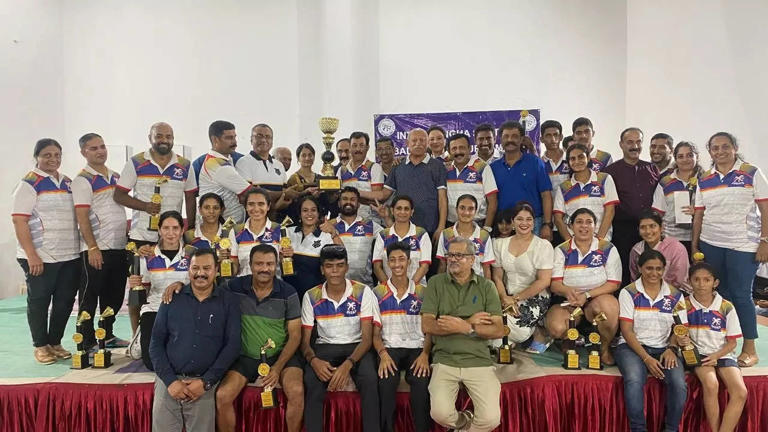
Sri Vijaya Ganapathi Kodava Sangha (SVGKS), Sulthanpalya, secured the overall championship for the second consecutive year at the 18th annual inter-sangha shuttle badminton tournament, organized by Kodava Samaja, Bengaluru. The tournament concluded on Sunday, with SVGKS dominating the competition by accumulating a total of 80 points.
The month-long event saw participation from 30 of the 31 sanghas under Kodava Samaja, Bengaluru. Vidyaranyapuram sangha finished as the second runner-up.
SVGKS, Sulthanpalya, achieved a remarkable feat by winning 11 out of the 15 finals and securing 4 runner-up positions, setting a new record in recent times.
The success of the team was attributed to the efforts of coach Chendrimada Ganapathy, sports secretary Koothanda Santhosh, manager Chemira Sanju Poonacha,, Theethramada Satish Bopanna , SVGKS secretary Bayavanda Sharath Kushalappa and Kodava Samaja secretary Chiriapanda Vivek Muthanna.
Here is the list of winners and runners-up from Team SVGKS:
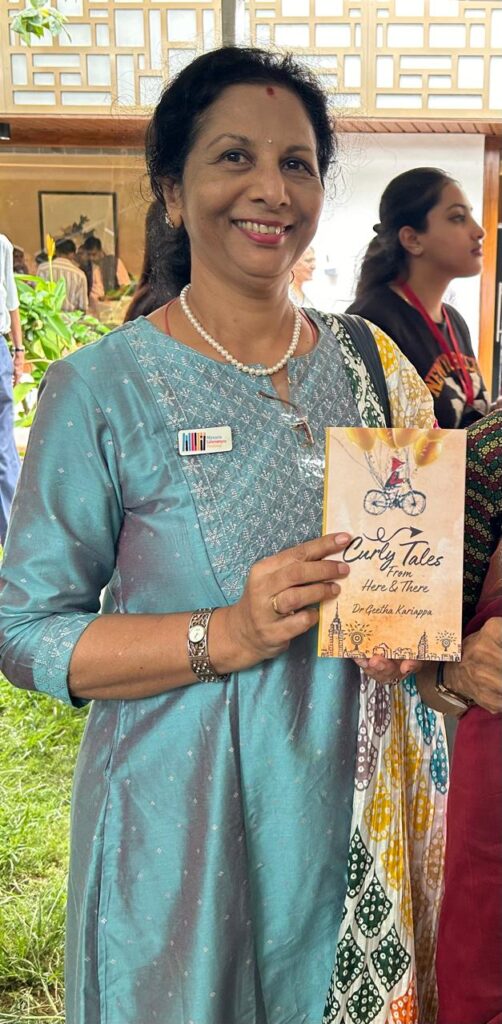
Dr Geetha Kariappa is a professor of English and a published author of four best-seller novels on Amazon. Her stories straddle Kodagu and its lifestyle as she weaves narratives which examine the condition of man and woman in a conventional society, with a humanistic perspective. She has penned numerous poems, short stories and articles in national and international journals.
This poem was inspired by the story of ‘Girl with the Diary’ written by Dr Geetha Kariappa, which narrates the saga of bravery and integrity of a teenager Kia who honours the dying wish of a mystery lady. She sets out on a precarious journey of discovery, as she is drawn into a web of intriguing clues, hinting at a long-forgotten crime, into the mist-clad land of Coorg. The exciting story takes her into the charming town of Madikeri and the coffee estate, Devkunj. It narrates the tale of the undying love of a man, a woman and his land.
“An excerpt from the novel, “Girl with the Diary”
The 100-acre estate was spread out before us in a sea of coffee blossoms. The fragrant land, heady with perfume, steaming gently in the sun, hugged the swell and curve of the land. A stately bungalow stood at the head of the winding gravel drive. Nearby were paddy wetlands with paddy and a few acres with native ginger. The undulating swathes of coffee bushes in well-manicured grooves interspersed with neat rows of shade trees, orange, jackfruit and silver oak, created a charming appearance of a jungle, securing its borders. Pepper vines twined about the trunk of shade trees which arched over cardamom, almond and vanilla bushes. The glittering estate pond lay at a short distance from where frogs croaked from the damp grass and winged insects skimmed over the coffee blooms. At the horizon, the bluish mist of the mountains, crested with clouds, looked picturesque.”
Travel note: The town of Madikeri nestled in the Brahmagiri hills of Western ghats in Karnataka, originally known as Muddurajanakeri, translates into “the city of Mudduraja,”, while paying homage to the Haleri kings who once ruled these lands. This picturesque hill station stands proudly among the world’s eight most remarkable centres of biological diversity. UNESCO recognises its ecological importance, and the town is a designated World Heritage Site. Madikeri is a hot travel destination because of its cool climate and resemblance to the Scottish countryside.
MADIKERI, IN MEMORY
In the core of Coorg, where Western Ghats cradle the sky,
Rests Madikeri, whose charm we cannot deny.
Sung by poets in nostalgic ragas,
Of misty hills soaked in yearning stanzas,
Where every syllable is a nostalgic saga.
Just as the monsoon arrives in the plains,
Madikeri, you wear the bridal veil of rains.
Clouds caress your coffee blossoms,
coaxing them into white celestial blooms.
Mist twirls with the mountains, and rivers swell in volumes.
In this watery symphony, your beauty eternally booms.
Madikeri, you perch on verdant hills,
like sentinels defending rugged sills.
Your winding roads like ballads,
Keep unearthing hidden waterfalls.
The moist air- fragrant coffee and eucalyptus,
hold out the sacred contract of paradise.
When the sun rises, spilling gold over rooftops,
ignites Madikeri, of charming landscapes.
This mist-kissed charm remains a poet’s muse,
Sparking the mindscape, waiting for poetries to bloom.
At the head of winding gravel, a colonial bungalow stands,
Its veranda, a sanctuary for weary souls.
Devkunj—an estate cradled in emerald arms,
Houses within, an angel of secret and balms.
The undulating coffee bushes,
Clustered in ivory blooms like uplifting hymns,
And Sandalwood, Teak bow to her gracious whims,
As she steps forth, with graceful limbs.
In the garden, a child dances with mud pies,
encompassing the valley with her dimpled smiles.
Rubber ducks sail in a pool, and paper boats get adrift,
A puppy chases its tail, and chicks run abreast.
Mother Angel bends to kiss the curly locks,
Her love, unmeasured, boundless, all pain blocks.
Her eyes, holding profound stories of storms,
Those were weathered, and now only becalms.
His gaze of reverence, of remembrance,
Of her quiet strength and youthful stance,
Of her love, blooming, riveting like rare fragrance.
She is the heartbeat, the keeper of Devkunj,
She, the symbol, the nurturing spirit of motherhood,
tending to man, child and his fertile land.
Walking in his dreams through whispering wood,
Where the cicadas hum, and the silver oaks stand guard.
Here, time slows, and the tree in melancholy, sighs.
Where the land conspires, papery leaves rustle,
whispering of brave lore of kings and queens,
as it unfurls dreams and of true love applauds.
source: http://www.interviewtimes.net / Interview Times / Home> National> National Times> Odisha> The Leading Story / by Subhechcha Ganguly / July 08th, 2024
WELCOME. If you like what you see "SUBSCRIBE via EMAIL" to receive FREE regular UPDATES.
Read More »