Chief of the Army staff General Bipin Rawat will honour the Kodava martial warriors and unveil statues of First Field Marshal of Indian Army K M Cariappa and Padma Bhushan General K S Thimayya on November 4 at Gonikoppal in Kodagu district on November 4.
Field Marshal Cariappa is also a recipient of the prestigious order of the British Empire (OBE) for his role in the Burma campaign against the Japanese during the 2nd World War. General Thimayya, was awarded the Padma Bhushan in 1954 and took over as Chief of the Indian Army on 7 May, 1957.
The site for the statues has been provided by the Cauvery Educational Society and is located in close vicinity to the ‘lyn house’, the ancestral house of Kodavdira family belonging to theGenerals. The two statues are placed side by side about 25′ above the road level.
The bronze statues, 7’6″ in height have been made in Bidadi by Shilpi Vijay at a total cost of Rs 17 lakhs. This is the only LoC in India where statues of the Army Chiefs are Co-located.
The Field Marshal Cariappa General Thimayya forum was formed with the aim of helpingthe veterans of the area and to motivate youngsters to join the Defence Forces.
The two bronze statues will be unveiled in presence of Lt General R K Anand, General Officer Commanding, Dakshin Bharat Area, Major General K S Nijjar, General Officer Commanding, Karnataka & Kerala Sub Area.UNI MSP AE1323
— (UNI) — C-1-1-DL0100-1112494.Xml
source: http://www.news.webindia123.com / WebIndia123 / Home> News> India / Bengaluru – Tuesday, October 31st, 2017
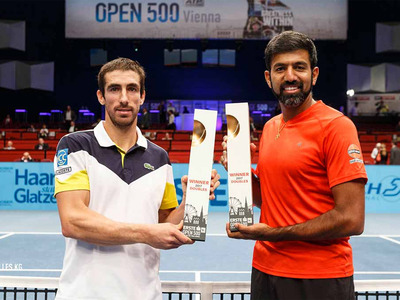
In a memorable day for Indian tennis, Rohan Bopanna won the Erste Bank Open title in Vienna with Pablo Cuevas while the team of Saketh Myneni and Vijay Sundar Prashanth clinched the Vietnam Open trophy at the Ho Chi Minh City.
However, Divij Sharan and his partner Scott Clayton ended runners-up at the Brest Challenger event in France, preventing what could have been an incredible as well as unique culmination to the week for the Indian players on the circuit.
In Vienna, unseeded Bopanna and Cuevas saved two match points before prevailing 7-6(7), 6-7(4), 11-9 over Sam Querrey and Marcelo Demoliner.
Bopanna and Cuevas were down 7-9 in the deciding super tie-breaker but saved both the match points to win the title.
It was third title of the season for Bopanna, having won Chennai Open (with Jeevan Nedunchezhiyan) and Monte Carlo Masters (with Cuevas).
In Vietnam, the unseeded Indian pair of Myneni and Vijay Prashanth quelled the challenge of the Japanese combination of Go Soeda and Ben Mclachlan 7-6(3), 7-6(5) in the summit clash of the $50,000 event.
It was first title of the season for Myneni and maiden Challenger level trophy for Prashanth.
“It was a great week. We combined well and enjoyed ourselves. I still feel I have something left in singles but definitely I will focus on doubles too,” Prashanth said.
Myneni, who has missed most part of the season due to injuries and has slipped to 724 in singles, was also asked if he would shift focus on doubles but he responded with a cryptic reply.
“Still the same plan as before, nothing has changed with me,” he said, indicating that he still have singles in mind.
Divij Sharan and his British partner Scott Clayton ended runners-up at the Brest Challenger following a 4-6, 5-7 defeat against Sander Arends and Antonio Sancic.
After losing the opening set, Sharan and Clayton led the second set 5-3 but lost four games in a row to lose the title clash.
It was second consecutive final for Sharan, having won the European Open (ATP 250 event) with Scott Lipsky last week in Antwerp, Belgium.
source: http://www.timesofindia.indiatimes.com / The Times of India / News> Sports News> Tennis News / PTI / October 29th, 2017
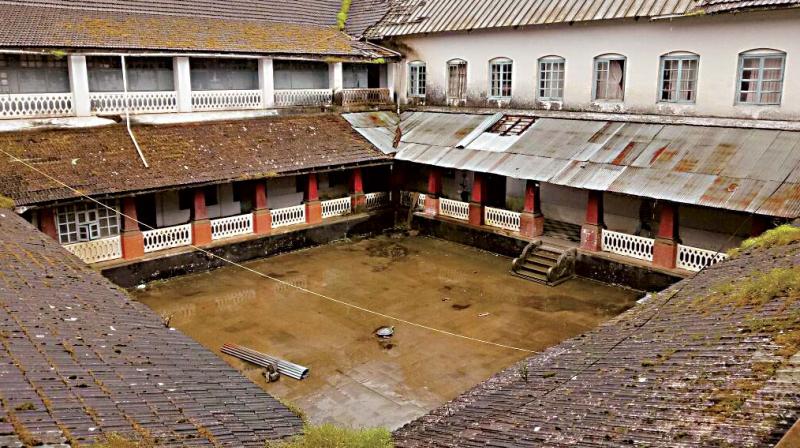
After losing out to the British, the Haleri royal family moved to Periyapatna and later to Mysuru city where they settled at Shivrampete. Madikeri Palace is in a shambles now
Centuries ago, the battlefields of Coorg thundered with their war cry as they took on marauding armies of the invader, sowing the seeds for a martial race which continues to amaze the world with its heroism and audacity. But the days of the dynasty and the royals are long gone and the kings of Coorg, like everyone else, now have to contend with the rigours of a modern age where democracy, the great leveller, makes sure everyone has to toil for his bread. Some dynasties have switched to politics with remarkable success , others preferred a life as ordinary as it could be, sacrificing their vast tracts of lands, palaces, forts and the antiques of their forefathers. M.B. Girish profiles the Coorg royal dynasty which once ruled from Madikeri and now runs a flour-mill and a chilli powder shop in the busy Shivarampete of Mysuru city
It has been a remarkable journey for the family members of HCN Wodeyar, the king of Madikeri, one finds it hard to believe that here sitting before you, are the descendants of a royal family. Except for a huge pile of documents gathered from the authorities concerned, HCN Wodeyar no longer has the antiques left behind by his forefathers nor does he lead a lavish lifestyle which could remind people that his family once held sway over Madikeri.
For more than a century, the family has been running a flour mill attached to a store selling masala powder and flour on the busy Vinoba road in Shivrampete. Sachida nanada Hittina Angadi (flour shop) as it is known, has history written all over it-on the walls of the store, one can spot a couple of portraits of royal family members. An inquisitive visitor who ventures to ask whose portraits they are, would get an answer that the store is run by descendants of the Haleri Ursu Royal Family who once ruled Kodagu.
Not many know that the store now belongs to Haleri Chinnanna Nagaraju Wodeyar (75), the King of the Princely State of Kodagu and was started by his father Chinnanna. The lineage of the Haleri royal family starts with Veera Raja who ruled from 1600 AD and was succeeded by Appaji Raja and later Muddu Raja who ruled the region from 1633 AD to1687 AD. The rulers belonged to the Banajiga Lingayat community.
HCN Wodeyar and (right) his flour mill in Mysuru
HCN Wodeyar tracing the history of the royal family, says his great grandfather Haleri Mallappa was married to queen Devammaji and he is the son of Chinnanna and the heir of the erstwhile royal family of Madikeri. Devammaji ruled the place for two years from 1809-11 before Britishers took control of the region.
To support his claim that he is the true heir, HCN has maintained various records issued by different authorities on the family tree of his erstwhile royal family. When asked about the decline of his family, HCN turns emotional and says, “everything is gone.”
After the Britishers started making inroads into the Princely States in India one after the other, his royal family too became a victim of British rule and gave away the kingdom which once stretched from Kushalanagar to Mangaluru. “Our great grandfathers, mainly Dodda Veera Raja traded in lemon, tobacco, oranges among others which were sent to markets in Kerala and Delhi in those days,” he recalls.
After losing out to the British, the Haleri royal family moved to Doddabeedi in Periyapatna and later shifted to Mysuru city where they settled at Shivrampete.
The royals-turned business family now stays at Chamaraja Mohalla where a board in Kannada at the entrance facing the road, states, “HCN Wodeyar is the owner of Madikeri Palace.”
The Palace of the Haleri royal family was built during the rule of Muddu Raja and later modified during British rule. Though his kingdom has disappeared, HCN longs to regain ownership of Madikeri Palace, situated on 77 acres at Karnangeri and is engaged in a legal battle since 1998. “The palace is in a dilapidated condition and if the structure is given to me, repairs will be taken up to restore its past glory,” he says.
HCN first got to see his ancestral palace when he was a child. “My father took me to the palace for the first time and since then, I have visited the palace about 15 times,” he says.
At Chamaraja Mohalla, he lives in a small tiled house with his wife, sons and grandchildren. His grandchildren play on the wooden sofas while wife Sowbhagya attends to domestic chores with her daughters-in-law.
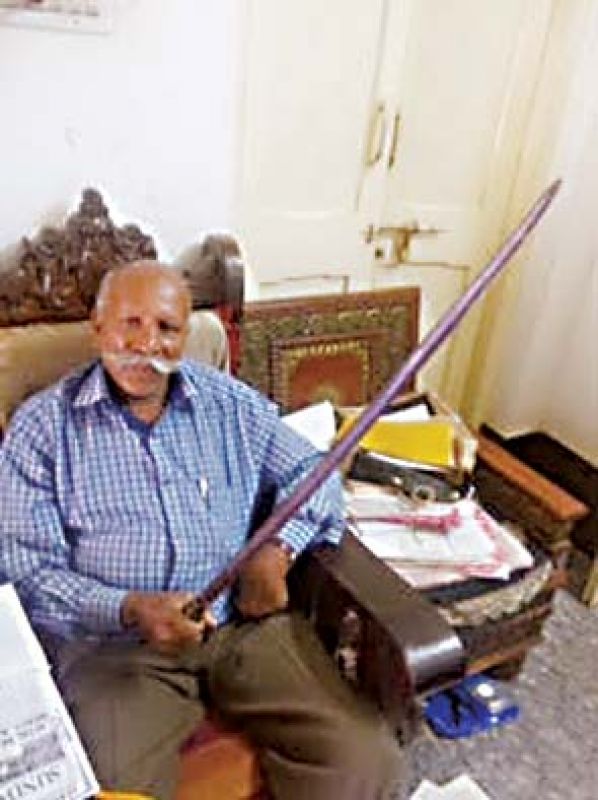
The family no longer has the royal antiques such as swords, spearhead, royal seals and royal attire. “A throne was taken away by the British among other precious items,” laments the Haleri king. Just then, HCN’s grandson Milind (13) brings out a lone sword from the room and flaunts it.
Though he no longer lives in Madikeri in the palace, HCN says people still hold the royal family in high esteem. Milind, a class 8 student at JSS Public School says, “My classmates and teachers are aware that I hail from a royal family.” As many as 70 types of masala powders are sold at the shop- both vegetarian and non-vegetarian. There are people like Prakash, a resident of Hassan, who says he is surprised to know that the flour shop is run by the Coorg royal family and recalls that he has walked by the shop on a number of occasions but had no idea about the history of the family running it.
Not many have been able to make the transition from royalty to a democratic way of living smoothly, many have struggled and fallen into bad times. It has not been easy for the Coorg royal family either for the times have changed but then they have risen to the challenge in the hope of a better morrow. Nor would the Coorgis like to forget the Haleri royal family for they bring back memories of the times of the kings, of grandeur and magnificence which no ordinary mortal can match.
source: http://www.deccanchronicle.com / Deccan Chronicle / Home> Naton – In Other News / by MB Girish / October 29th, 2017
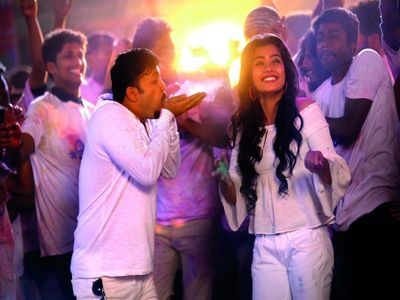
SuNi’s #Chamak is nearing completion. The team is currently filming a fight sequence, which involves the lead pair, Ganesh and Rashmika Mandanna.
Like most of SuNi’s films, he has tried to do something unique with this sequence.
“This scene involves Ganesh and Rashmika going to celebrate Holi. Over there, some people misbehave with them and this sets the prelude to a fight. We have Ganesh then taking on the miscreants, who he recognizes using colours. We’re currently shooting for this sequence in Bengaluru,” says SuNi.
source: http://www.timesofindia.indiatimes.com / The Times of India / News> Entertainment> Kannada> Movies> News / by Sunayana Suresh / TNN / October 20th, 2017
Ganesh and Rashmika Mandanna-starrer Chamak, directed by Suni, is nearly done with shoot for just one fight sequence left. Meanwhile, the team has just returned from north Karnataka, after shooting for a song.
Suni tells City Express, “It was for a romantic track, but what is exciting is that we got to shoot at unexplored locations, which we spotted around the coastal belt of Karwar.” The director shares photos from the location with us, and adds, “This speciality of this song is that Ganesh does scuba diving in it and the location is Tilmati, on the black beach during monsoons and along the mango grove”.
The lyrics written by Arjun Louis has been sung by Supriya Lohit and Abhinandan.
Suni is targetting a Christmas release and is working towards it. The romcom, which has Ganesh playing a gynecologist for the first time.The film is produced by T R Chandrashekar and has music by Judah Sandy and cinematography by Santhosh Rai Pathaje.
source: http://www.newindianexpress.com / The New Indian Express / Home> Entertainment> Kannada / by Express News Service / October 11th, 2017
Robin Uthappa and wife Sheetal welcomed their first child and both announced it on their social media handles.
Robin Uthappa announced the arrival of his first child ‘Neale Nolan Uthappa’ on Wednesday on his official social media account, thanking his fans and followers for all the love and support. Robin also shared the picture of his first kid along with his wife Sheethal Goutham.
In a tweet, Robin, who called their relationship ‘batman and joker’, wrote, “Our bundle of joy has arrived!! NEALE NOLAN UTHAPPA! thank you for all the love and support!! #whentwobecomethree #batmenandjoker.”
The India discard got hitched with long time girlfriend Sheethal, who is a former tennis player, in March last year.
Uthappa, who played for Karntaka for 15 years, made a change of teams when he joined Saurashtra ahead of the 84th season of Ranji Trophy. Uthappa had been one of the key players for Karnataka in the domestic circuit.
Uthappa has also represented India in ODIs and T20Is. On his ODI debut, he scored 86 runs against England before being run out. This was record individual score by an Indian batsman on debut, a record which he kept until fellow Karnataka batsman KL Rahul broke it last year with a century.
Uthappa has been part of Kolkata Knight Riders team in the Indian Premier League. He has won two IPL titles with KKR.
source: http://www.indianexpress.com / The Indian Express / Home> Sports> Cricket / by Express Web Desk / October 11th, 2017
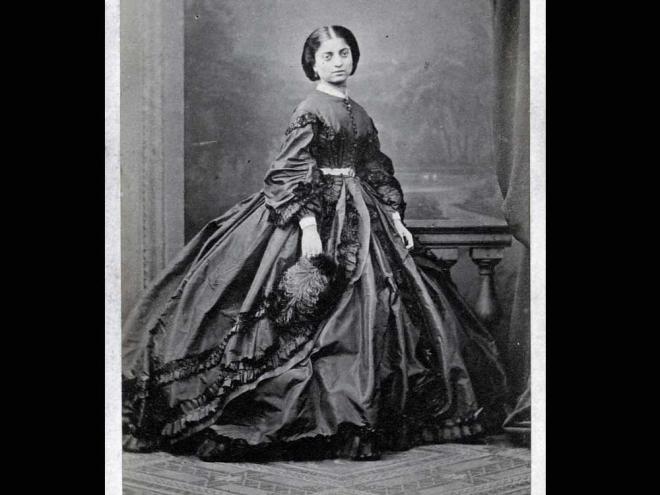
It has been a series of serendipitous discoveries ever since I started researching about the story of Princess Victoria Gowramma of Coorg. I stumbled upon on several hitherto unknown details of the period that Chikka Veerarajendra and his daughter spent in the Victorian England. Princess Gowramma had the unique privilege of being Queen Victoria’s goddaughter. She was baptised as an 11-year-old in the presence of the queen, who lent her own name to the Indian princess.
In my book, Victoria Gowramma: The Lost Princess of Coorg, I wrote that Gowramma and her husband Colonel John Campbell had a daughter named Edith Victoria, who married Captain Henry Edward Yardley in 1882. Their only son, Henry Victor Yardley, emigrated to Australia. Henry Victor died in a motorbike accident in 1936. I concluded that there were no further descendants of Gowramma.
However, I was wrong. It was while releasing my book at Nehru Centre in London that I met Anne Phillips — a direct descendant of Colonel John Campbell from his first wife, Margaret Mathew. Colonel John Campbell had served in India. He was an officer in the 38th Madras Native Infantry. One of his postings was in Bellary. She told me that Henry Victor Yardley married Ethel May Field in 1910 and they had three children. Anne also gave me some rare photographs of Gowramma and her daughter Edith, from her private collection.
Anne’s late mother had recollections of having met Edith, and had preserved the photographs and other memorabilia. Anne is now in possession of a bracelet along with a handwritten letter from Queen Victoria, presented to Lady Lena Login (sister of Colonel John Campbell), for having looked after her goddaughter who had a troubled but eventful life in England. Princess Gowramma died in 1864, aged 23.
Anne Phillips and I collaborated in tracking the descendants of Victoria Gowramma in Australia. Using the Australian registry of births, deaths and marriages, we were able to gather information and draw the family tree of Gowramma’s descendants. However, we could not get in touch with the family. This however changed when Robert Yardley, a great-great-grandson of Victoria Gowramma, read my book and left a message for me on one of the blogs. The family lives in New South Wales in Australia.
Robert’s daughter Natashya Yardley got in touch with me a few months ago and informed me of her visit to Coorg. Natashya is Gowramma’s great-great-great granddaughter. I was excited at the prospect of meeting a direct descendant Princess Victoria Gowramma.
I took Natashya to various places of interest connected with the Haleri dynasty in Coorg, including the royal tombs of her ancestors at Gaddige in Madikeri. Natashya was intrigued that the Indian branch of her ancestry could be traced back to Veeraraja.
Natashya sent me a rare photograph of her great-grandfather, Henry Victor Rajendra Yardley, the grandson of Princess Gowramma.
It was a singular experience for me to meet and interact with a direct descendant of Princess Gowramma. After meeting Natashya, I feel that I have connected with my muse, Princess Gowramma, by ‘six degrees of separation’!
source: http://www.deccanherald.com / Deccan Herald / Home> Supplements> Spectrum / by C.P. Belliappa / October 10th, 2017
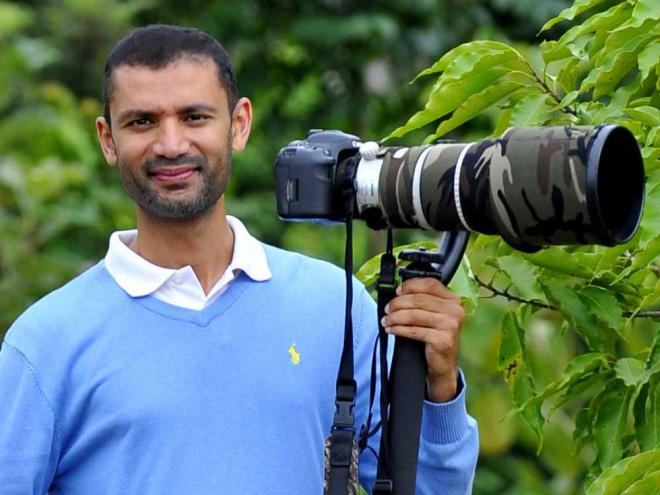
It is said that in order to see birds, it is necessary to become a part of the silence. But the silence these days is deafening. The avian population is leaving the city in droves and so are the birdwatchers, who are running off to the outskirts in search of the now-elusive chirps.
“I usually head to the outskirts of the city now, to areas like Nandi Hills, Kanakapura Road, Tumkur Road, Sarjapur and so on,” says Sudhir Shivaram, director and founder of ‘Sudhir Shivaram Photography’ and an avid bird watcher for the last 15 years. “Any area which is a good habitat for birds and has limited human activity is a good option for bird watching. And such areas are only on the city’s outskirts now.”
There are plenty of reasons why the feathered community is giving the city a miss. “The decline of water bodies and their beautification is a big reason. The bunds on the lakesides are making way for stones and concrete for aesthetic appeal but this is not favourable for birds,” points out Sudhir. Bopanna Pattada DP
“Apart from biological factors, like crows and pigeons edging out other species that feed on grains, external reasons like use of kite ‘manja’ and pigeon netting as well as an increase in the domestic cat population, has resulted in a decrease in the bird population in the city,” lists out Bopanna Pattada, who heads ‘Bangalore Birding Adventures’.
Like everyone else, he also prefers to head out of the city for bird-watching expeditions now and says places like Bannerghatta National Park and Rishi Valley School are good options. “So is Hoskote Lake which has regained its water level in the last 5-6 years and now attracts a wide variety of birds.”
But while enthusiastic birders and photographers don’t mind going the extra mile, the growing crowds around avian havens are becoming a cause for concern for many. “Even places like Nandi Hills are seeing huge crowds now. There is a lot of noise and garbage and thus the previously large numbers of birds is coming down,” says Punith Suvarna, a data analyst and bird photographer.
“A lot of offroading is happening now and vehicles are going very close to water bodies and green areas. We need to give birds some space. So intense is the desire and competition for unique clicks, that people are resorting to means like destroying the nests so that others can’t get the same shots,” he adds.
The birds are on their way out. Pretty soon we will only be left with their pictures on social media then.
source: http://www.deccanherald.com / Deccan Herald / Home> Supplements> MetroLife / by Rajitha Menon, DH News Service / October 05th, 2017
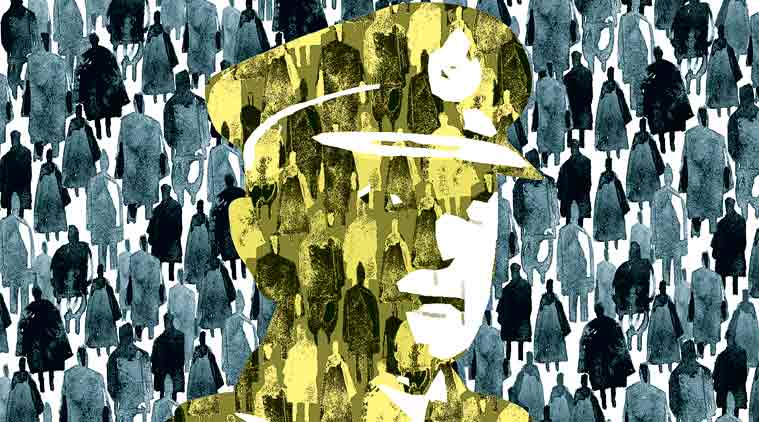
The field marshal’s military philosophy is a useful pointer and guide at this critical juncture in the Valley.
He knew that they were warm and hospitable if treated with respect and as equals. (Illustration: C R Sasikumar)
An interesting anecdote about a great Indian soldier, Field Marshal K.M. Cariappa, is lodged in my memory since childhood. As a habit, I keep asking questions. I had asked a question about Cariappa Park during my school days. Nobody had an answer till the senior political leader from Baramulla, Sheikh Mohammad Akbar, told me a fascinating story of how he had fulfilled the desire of the people of Baramulla, as chairman of the Town Area Committee, to commemorate Cariappa.
Once, after chasing the raiders beyond Uri, Cariappa was stopped by a group of people at Baramulla and told that they had suffered a lot due to the absence of food supplies, including salt. It was a puzzling question for the general, as no stocks were available with the army. But he fulfilled his assurance the next day when he visited the old town and distributed flour, rice and salt to the most needy families. He followed this gesture in many ways in various parts of Kashmir. K.S. Thimayya, whom he had put in command of the 19th Infantry Division at Baramulla, followed Cariappa in this regard. Grateful Baramullians named a park after Cariappa and the park exists even today.
My quest to learn more about Cariappa was deepened when I heard some commanders in Kashmir asserting during the recent turmoil that “yes”, stones would be answered through bullets and pellets. The people of Kashmir feel this attitude has been encouraged after Major Nitin Leetul Gogoi was awarded for using a civilian as a “human shield” in Budgam.
The Indian army’s history tells us that Cariappa showed great valour as a commander and the success he obtained was squarely his own. But many people in India may not know that apart from his military valour, he employed another natural tool as a workable mechanism to deal with the people all around including the enemy. Reading authors like B.C. Khanduri, J.S. Bindra, S.K. Sinha, L.P. Sen, K.C. Cariappa and others, I came to know of many interesting stories woven around the personality of that great soldier. When I came to know of Cariappa’s Waziristan experience, I was flabbergasted.
In June 1939, Cariappa was transferred to the 1st Battalion of the Rajput Regiment which became his parent unit. The battalion moved to Waziristan and he had to spend three years there. He was posted Waziristan in 1922 as well.
In November 1945, Cariappa was finally given command of a brigade. He was posted as commander of the Bannu Frontier Brigade in Waziristan.
Having served in the NWFP as a young officer, Cariappa was conversant with the terrain as well as the habits of the Pathan tribesmen who lived in the area. He had seen that the British policy of trying to keep them under control by force had not succeeded and he resolved to try a different method. He decided to win the hearts and minds of the tribesmen by extending a hand of friendship. He knew that they were warm and hospitable if treated with respect and as equals.
One day, while passing through a village, he saw a group of Pathan women carrying pitchers of water. When he found out that they had to fetch water daily from another village, four miles away, he immediately ordered a well to be dug near their own village. He followed this gesture with many similar deeds. The Pathans were overwhelmed and started calling him “Khalifa”. Later, when the region was torn by communal strife, Bannu remained a haven of peace thanks to the goodwill generated by Cariappa. When Jawaharlal Nehru visited Bannu in 1945 as head of the Interim Government, Cariappa organised a public meeting which was attended by all tribal leaders. The next day, when he visited Razmak where another brigade was stationed, Nehru was fired upon by the tribesmen and the visit had to be called off. Nehru was impressed by Cariappa’s leadership qualities and rapport with the tribesmen.
Veekay’s History Book (Victory of Knowledge Global Publications) tells us an interesting story about Cariappa. “In February 1946, he was appointed Presiding Officer of one of the General Court Martials constituted to try members of the Indian National Army (INA). Before the trial, he visited some of the detention camps, where the prisoners were lodged. He found them full of rancour and hatred against the British for treating them badly and holding them without trial. Cariappa was pained by their plight and wrote to the Adjutant General, requesting him to expedite the trials. He also recommended that some of them such as Shah Nawaz Khan, G.S. Dhillon and P.K. Sehgal should be pardoned. But, when as Chief of the Armed Forces he was to consider the recommendation to accommodate Indian National Army (INA) personnel including Shahnawaz, Dhillon and Sehgal and he refused to take them into the Indian Army, particularly for the reason that they would bring politics into the Army. There was a lot of pressure on him for this and Nehru relented only after Cariappa threatened to resign on this issue.”
I invested some more time to understand both sides of Cariappa’s character. He was a very tough general when it came to leading the armed forces, as was required by military ethics, and he never compromised his principles.
B.C. Khanduri, who worked with him as operations staff officer, says in his book Field Marshal K.M. Cariappa; His life and Times that, “Once between Mahura and Uri, he was snipped at from close quarters. He showed no signs of fear while his staff officers perspired.”
Lt. Col. J.S. Bindra, as intelligence and liaison officer with Cariappa recalls in his book an incident at Srinagar. He says: “The 268 Infantry Brigade was without a commander for a few days. Cariappa informed Army Headquarters to post Brigadier Bikram Singh. He (Bikram Singh) represented to the army that his relations with Bakshi Ghulam Mohammad, the then Deputy PM of J&K, were not too friendly and that Bakshi might create problems for him in his command.Cariappa asked him what else? Then, he told Bikram to put his ego in his pocket and do what he desired him to do. Bikram was in Tithwal by the same night and on the job”.
The other side of his character is described in Veekay’s History Book: “While Cariappa admonished Thimayya for lighting a cigarette while travelling in an Army vehicle, he asked the driver to stop to allow Thimayya to smoke.”
Lt. General Sen in his book, Slender was the Thread: Kashmir Confrontation 1947-48, describes another quality which Cariappa possessed and it was his broad-mindedness. He says, “He treated all troops the same and was utterly free of any parochial feelings.” He was best known for his love for the Indian soldier. Troops not only loved him, they worshipped him. But then, he never pardoned if anybody indulged in a crime.
Cariappa is no more but his philosophy of military leadership is available to us. Many retired and serving generals have emphasised again and again that there is no military solution to the Kashmir dispute. It has to be resolved through methods other than force. I am confident that the spirit of Cariappa’s soldiery would be a better guide at this critical juncture of the Union’s relationship with Kashmir.
The writer is a senior Congress leader and former Union minister.
source: http://www.indianexpress.com / The Indian Express / Home> Opinion> Columns / by Saifuddin Soz / October 05th, 2017
The best coffee growers of the country were awarded at the India Coffee Awards ceremony organised by the Coffee Board of India on Wednesday.
The awards were divided into national and regional categories.
The best coffee growers for Arabica and Robusta types of coffee and their specialities were awarded the ‘Flavour of India Fine Cup Award for the years 2016 and 2017. The award ceremony also witnessed the recognition of small coffee growers for the first time.
The winners were selected by a national and international jury of expert cuppers or coffee tasters as part of the ‘Favour of India Fine Cup Award – Cupping Competition’.
“We faced difficulties with regard to lack of water availability but we did our best to maintain our quality by using dedicated good practices that helped us achieve a good quality yield,” said Gowri Pandyanathan, a coffee grower from Yercaud and owner of Gowri Estate who won the national award for the best robusta coffee.
“The coffee growers are facing a tough time with lack of water, change in policies and non-assured income. In spite of this, they are doing their best to continue the practice. The coffee awards are an effort to recognise the same,” said Dr M M Chengappa, chairman of Karnataka Planters Association.
source: http://www.deccanherald.com / Deccan Herald / Home> State / DH News Service / Bengaluru – October 05th, 2017
WELCOME. If you like what you see "SUBSCRIBE via EMAIL" to receive FREE regular UPDATES.
Read More »