Hosts Appachettolanda family expecting participation of more than 350 teams
Madikeri:
The Kodava Family Hockey or ‘Hockey Namme’ is back with a bang after a gap of four years. This time, the tournament will be hosted by the Appachettolanda family from March 20 to April 10, 2023 at Napoklu village in Kodagu.
“After 2018, the hockey festival did not see the light of the day due to natural disasters and the COVID-19 pandemic. We will be organising the 23rd annual ‘Hockey Namme’ in 2023 in a grand manner. The fest will be held at Napoklu General Thimayya Ground and more than 350 Kodava families are likely to take part in the tournament,” said Appachettolanda Manu Muthappa, the President of the Hockey Festival Committee.
Addressing a press conference in Madikeri recently, he said that in the last hockey tournament held in 2018, a total of 333 Kodava families participated in the Kulletria Cup Hockey and this time, they were expecting the participation of more than 350 families.
The festival is being conducted under the aegis of Kodava Hockey Academy.
It may be mentioned here that to prepare the family teams for the upcoming hockey festival, the Kodava Hockey Academy had organised the first Pandanda M. Kuttappa Memorial Cup rink hockey festival, in memory of the founder of the Academy and the hockey festival. It was organised from Oct. 27 to Nov. 6 at Ponnampet Turf Ground and a total of 114 teams had participated.
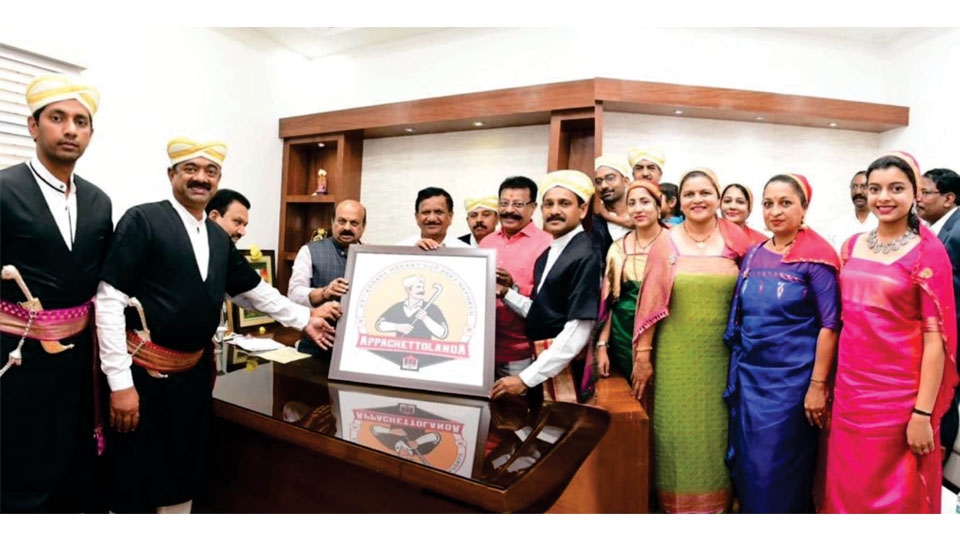
The logo of the Appachettolanda Cup family tournament was unveiled in Bengaluru recently by Chief Minister Basavaraj Bommai where a delegation of the family had called on the CM. Virajpet MLA K.G. Bopaiah, MLC Suja Kushalappa and the tournament-organising family members were present.
“The CM has assured us that a Rs. 1 crore grant will be released for the hockey festival for the first time and the CM has consented to inaugurate the tournament on March 20. In all, Rs. 1.50 crore will be spent for the festival and the remaining Rs. 50 lakh will be pooled-in by the family members and collected from donors. We are planning to invite and felicitate a host of national and international hockey players who have made the Kodagu district proud and hockey champions from all communities will be honoured,” Manu Muthappa said.
In all, three grounds will be utilised for the hockey festival and they will be also used as a back-up in case it rains. Kodava Hockey Academy President Pandanda Bopanna, who is the son of late Pandanda Kuttappa, will be one of the guests in the inaugural event. “It was his father who launched the first Kodava Family Hockey Tournament in 1997 and was organised by the Pandanda family, Manu Muthappa noted.
Secretary of the Hockey Festival Committee Appachettolanda Vasanth Muthappa, members Appachettolanda Harish Somaiah, Appachettolanda Ravi Monnappa, Appachettolanda Janath Kumar and others were present.
source: http://www.starofmysore.com / Star of Mysore / Home> News / December 13th, 2022
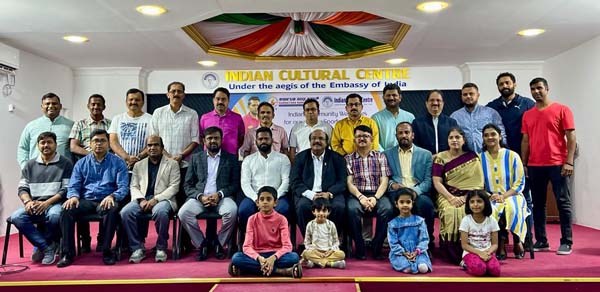
Karnataka Sangha Qatar in cooperation with Indian cultural Center hosted Indian Community.
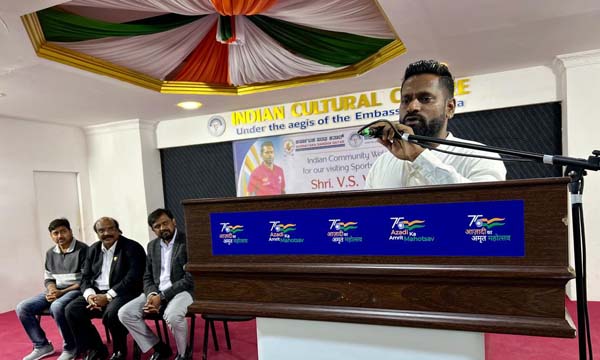
Welcome reception to V S Vinay, ex Indian Hockey team player and current Hockey Karnataka Sr team coach and felicitated on December 6 at Ashok Hall Auditorium of Indian Cultural Centre.
Dignitaries present during this event was president of Indian Cultural Center P N Baburajan, vice president of Indian Cultural Center Subramanaya Hebbgelu.
The platform to this felicitation was created by Indian Cultural Centre to Honour the dignitaries visiting State of Qatar during the FIFA 2022 event.
Mahesh Gowda president – Karnataka Sangha Qatar welcomed the gathering and thanked V S Vinay for giving time for the reception and expressed confidence that under his mentorship many players will get trained and join Indian Hockey team and play for the country, also mentioned it is a proud moment that V S Vinay hails from Coorg district of Karnataka and which is know for producing world class players and won many medals for India.
Mahesh Gowda also thanked Indian cultural organisations for their invite and all Associated Organisations for felicitating the guest.
P N Baburajan in his address briefed the dignitary about Indian Cultural Center and how ICC is involved in the FIFA celebrations.
V S Vinaya thanked Karnataka Sangha and Indian Cultural Centre for felicitating him and people for there time to meet him, also motivated the parents to put their children in any sports and also briefed how their children get all the training facilities from the federation if they are really doing well in the sport.
The programme emcee was done by KSQ member Nithi Ramesh.
source: http://www.daijiworld.com / Daijiworld.com / Home> Middle East / by Media Release / December 10th, 2022
From 2000, Cheshire Homes India Coorg has been helping children & adults with intellectual disabilities.
Chairperson Gita Chengappa
Madikeri :
‘Save Soil’, ‘Swachh Bharat’, ‘Atmanirbhar…’ are not just grand slogans here. They are constants that motivate the functioning of Cheshire Homes India Coorg (CHIC), in Pollibetta of Kodagu district. An institution for the specially-abled, it caters to the needs of children and adults with intellectual disabilities – a majority of whom are from economically weak backgrounds.
Started in the year 2000, the centre has helped shape the lives of people with special abilities by providing special education and vocational training for free. Students are provided sustainable education and are involved not just in readying themselves to face a not-so-inclusive society but are also taught to lead a sustainable, eco-friendly life. Apart from special education, vocational training involves recycling plastic, clothes, paper and manufacturing eco-friendly value-added products.
“The institution is run under the umbrella of Cheshire National Council, but we are an autonomous body. The institution supports the strengthening of the National Council so that we have a stronger body for disability in India,” explained Gita Chengappa, chairperson of the institution.
The centre receives support from the state government. “The state releases Rs 19 lakh annually and supports us. However, on an average, the institution requires Rs 40 lakh to Rs 50 lakh, which is raised through various donors. The institution caters mostly to people from very poor economic backgrounds,” added Gita.
Community acceptance While most special schools are residential, CHIC is a day care centre. Each day, five school vans (hired on rent) leave the institution in five different directions. Designated pick-up spots have been drawn up and students are brought to these spots by their parents, where they are picked up and dropped back after school. “We spend over Rs 13 lakh for the van facility annually. Yet, we don’t want to make this a residential institution. We want the community, parents and society to be responsible for children with special abilities,” she opined.
The institution started off with just six students with special abilities. During the initial period, the institution involved itself in Community Based Rehabilitation (CBR) and travelled the length and breadth of Virajpet taluk. “We went door to door, looking for children with special abilities and convinced parents not to keep these children hidden but to admit them to the institution. It was then run in a small building in Pollibetta,” she recalled.
vice-chairperson Punita amaswamy and honorary secretrary Asha Subbaiah
The CBR programme was continued for eight years, and the institution currently operates in a spacious location with improved facilities, with 68 specially-abled students who are diagnosed with intellectual disabilities.
“After Covid-19, the number of students dwindled as many fell sick. But we continued to cater to their needs and are still providing them the required medication,” she said. The institution helps them avail of government schemes for the specially-abled. During the pandemic, the institution supported their families with provisions and monetary help.
Driving force The centre has six special educators. Shivraj, a specialist in visual impairment and mental retardation, heads the team as headmaster. Apart from the special educators, the centre has appointed vocational trainers. “The students are being skilled under different campaigns. While an inclusive society is still a distant dream, we are helping to skill them to earn a living within the boundaries of our institution,” she explained.
Single-use plastics, used papers and newspapers, used clothes and other recyclable plastic waste are turned into value-added products. Children with even severe impairment are involved in vocational activity which can help shape a sustainable, eco-friendly society. Used plastics are cut into pieces and woven (with help from a few women) into aesthetic mats. Used papers are cut into small pieces and processed into eco-friendly reusable paper, which is turned into paper bags and other items, and decorated with indigenous paintings.
From coasters to pillow covers, the talents of the specially-abled not just earn them a good living but help raise funds for the institution. The centre also has a ‘Jumble Sale Room’ where used clothes and other used items are stored and later sold. “We try unique methods to raise funds and build the institution,” explained Gita. The centre has a handloom unit operated by women from economically weak backgrounds, who are paid for their work. They also raise funds through handloom sales.Having addressed the needs of specially-abled people across Virajpet taluk, the institution is slowly expanding to the borders of Somwarpet taluk.
SPECIAL TOUCH
Institution equipped to support needs of specially-abled, has ‘tactile paving’ that helps guide the visually impaired
Toilets fabricated to meet the needs of specially-abled
Institution has full-time physiotherapist and psychiatrist
Helps recycle and upcycle plastic and paper waste, provides means of sustainable earnings to
the specially-abled
Centre has a ‘care unit’ where people with severe intellectual disabilities are cared for and nurtured
Projects of Central government are implemented to empower the specially-abled
source: http://www.newindianexpress.com / The New Indian Express / Home> Good News / by Prajna GR, Express News Service / December 04th, 2022
As the son of an Indian naval officer, Bidanda Bopaya was born in Pune, has lived all over the Indian coastline, and was sent to a boarding school in Ooty at a young age. His wife, Louella, daughter of an Indian air force officer, is a psychologist in private practice.
The Bidandas moved to Pittsburgh in 1987 after graduate work at Penn State and have raised two children in the Burgh. Their daughter, Maya is pursuing a PhD in finance & economics after an early career on Wall Street, and their son Rahul is an engineering graduate from Pitt. The Bidandas live in Fox Chapel.
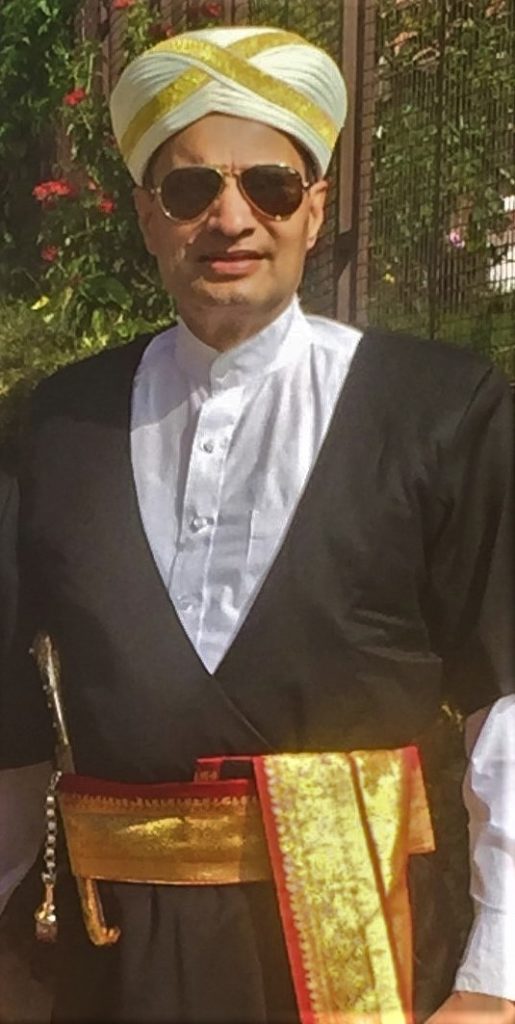
Bopaya, a professor of engineering at the University of Pittsburgh and President of the Institute of Industrial & Systems Engineers, has authored/edited 13 books in the subjects of his specialization. Here is Bopaya in his contemporary dress and also in the traditional Kodava attire.
Editor’s note:
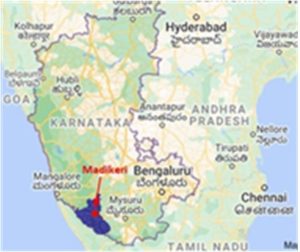
My early childhood was in Madikeri (earlier name Mercara) in Kodagu District, earlier known as Coorg (population: over 500,000 people) in Karnataka State. Madikeri is the headquarters for Kodagu and the home of the Kodavas, a small, accomplished, and colorful community in the Indian social tapestry. Kodavas are ~20% of the population of Kodagu District, and have contributed disproportionately to India’s armed forces, sports teams, and other professions including as India’s first female ambassador, India’s first PhD in sports medicine, the founder of the National Institute of Sports in Patiala, and of course, India’s first Commander-In-Chief (Gen. Kodendera Subbayya Thimmayya), and India‘s first Field Marshal Kodendera Madappa Cariappa.
Location of Coorg District and Madikeri town in Karnataka.
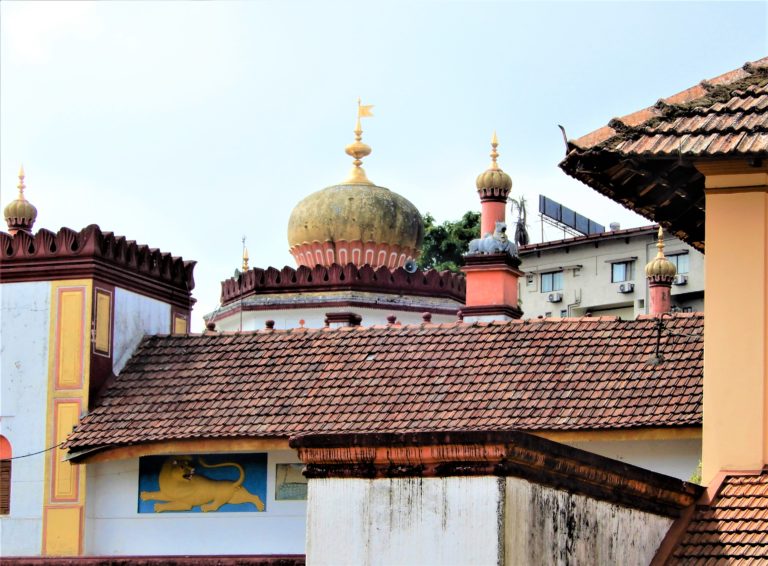
After sixty years, I chanced to drive through Madikeri. I had a vague memory of Omkareshwara Devasthana, a Shiva Temple there. Since it was the only temple I knew in my childhood, it made no impact then. When the driver showed me the temple from a mile away from the hills, I told him it looks like a mosque. His reply: was saar, iduve devasthana. (No sir, this IS the temple.) Stunned at the unique architecture for a Hindu temple with a typical Islamic dome including the four minarets, I stood in silence in front of the temple absorbing the ambience.
Then during the Patrika fundraising, I saw one Bidanda Bopaya as one of the on-line contributors. From the name, I recognized he is a Kodava (known earlier as Coorgis). I contacted him with my Madikeri roots, and one thing led to another in our exchanges, which finally culminated with Mr. Bopaya writing this article for the Patrika. – Kollengode S Venkataraman
The Omkareshwara Temple is a picturesque and unique place of worship in Madikeri, the heart of a salubrious and verdant hill station in Karnataka. Our family spent summers in Kodagu, and the place remained a well-kept secret because of the absence of a railhead. Now, it is a weekend getaway to Bangalore IT techies arriving in hordes.
Steep hills studded with vibrant homes surround the temple. Legend has it that the Raja of Kodagu, Lingarajendra II, built the temple repenting for some terrible act he committed. He was advised to build a Shiva temple that would awe people, as long as the sun and the moon are around! He commissioned the temple, consecrating it in 1820, with a Shivalinga brought from Kashi enshrined at the temple’s sanctum.
Omkareshwara Devasthana with its dome and four minarets
Omkareshwara Devasthana is the only known example of a Shiva temple for that matter, any Hindu temple built like a mosque with four turrets (or minarets) at each corner and a dome at the center. The rationale for this one-of-a-kind architectural style (Islamic with a Gothic touch) for a Hindu temple is not precisely known even though the temple is only 200 years old, given the frosty relations between the Kodavas and Muslims, thanks to Tipu Sultan (1750-1799), who repeatedly invaded and unsuccessfully tried to take control of the region. Search the web under Tipu Sultan and Kodavas to get multiple perspectives of this complicated relationship.
Given today’s strife-ridden global situation among all religions, it is inspiring that one Hindu temple integrated multiple styles of architecture into its place of worship two centuries ago. As children, we played hide-and-seek with our extended family around the temple.
The Rajaâ’s tomb located nearby, built in 1809, also has an Islamic architecture. My great-great-grandfather Bidanda Bopu was the Commander-in-Chief of the Kodagu Rajaâ’s army and is buried next to the Raja. Growing up, our family often celebrated festivals and visited the tomb to pay respects to our ancestors.
The Kodavas are proud people and maintain unusual traditions. Kodagu is often called the land of generals, beautiful belles, coffee, cardamom, pepper and honey, all because of its hilly terrain and suitable weather, honey, large number of military leaders, and charming and gracious women! Some interesting features of Kodavas
1)Are Kodavas Hindus? While Kodavas are governed by the Hindu laws, they are technically not Hindus, with the absence of a caste system; Kodavas are ancestor- and nature-worshippers. Most festivals are centered around agrarian and martial themes and traditions. However, many Kodavas have now adopted a Hindu lifestyle and traditions.
KODAVA FESTIVALS: Kodavas are rooted to their land as farmers and agriculturists. No wonder, all Kodava festivals are around farming.
2) Kailpodhu: After the paddy fields are transplanted in early September, Kodavas worship their weapons and tools, after cleaning and decorating them. This is followed by festivities (shooting competitions, athletic prowess, while feasting on spicy food and copious alcoholic beverages). Kodavas have the right to bear firearms and weapons without license.
3) Kaveri Sankramana: The river Kaveri originates in Kodagu District in a small natural spring in Bhagamandala, close to Madikeri. In mid-October, at a specified time, the sacred River Kaveri ” yes, for Kodavas in particular, and for all Kannadigas, Kaveri is sacred ” renews with new divine springs gushing towards a larger body of water. This is the birthplace of the river. People take dips in this holy water. Goddess Kaveri is then worshipped in Kodava homes with youngsters touching the feet of elders for blessings. Kaveri is perhaps the most common name for girls among Kodavas. This is the only meatless festival among Kodavas!
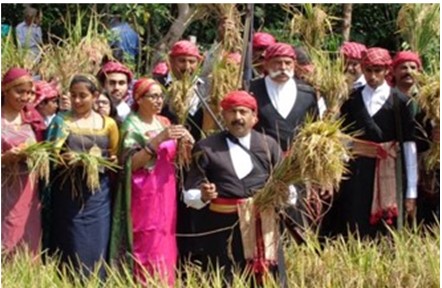
Kodavas in the field during the the Puttari Harvest festival
4)Puttari (meaning New Rice), is the traditional harvest festival, celebrated in early December when people gather in their traditional family home (ainamane) nicely decorated with farm motifs. Like Onam, Pongal, Lohri, Baishakhi, Bihu, and of course, Thanksgiving here, special culinary items are prepared. An important part of this festival is the matriarch of the family leading others into the fields for a symbolic first harvesting of rice paddies.
In addition to these, individual villages have temples that celebrate colorful festivals, including walks thru hot beds of coals. The best way to experience these is to be with Kodavas in their home during the season.
Pattaya, a traditional granary decorated for the Puttari harvest festival.
5)Is there a Kodava cuisine? Yes, of course. Kodava cuisine is replete with unique and fiery dishes including Pandhi Kari (pork curry cooked in a special vinegar), Baimble-Kari (bamboo shoot curry), mango paji (mango chutney), kuru kari (kidney beans, green beans, in a coconut gravy), akki rotti (rice chapattis) and the list goes on!!
7)Interesting fact: No priests at Kodava weddings. Family elders lead all the religious rites, with a frenzy of Kodava dancing, pandhi curry, libations, and ceremonies steeped in family traditions.
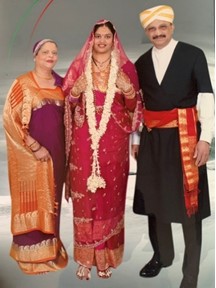
Drs. Palecanda and Nirmal Chengappa, longtime Pittsburgh residents, in traditional Kodava dress and jewelry at the wedding of their daughter Kaveri.
Websites offer a ton of information on tourism-related questions on Kodagu — places of interest, cuisines, lodging, what to do, how to reach, the best time to visit. One website is: www.coorgtourisminfo.com
source: http://www.pittsburghpatrika.com / The Pittsburgh Patrika / Home / by Bidanda Bopaya, Fox Chapel, PA / October 2022 issue
The museum is buzzing with activities ranging from art exhibitions to music events.
Grounds teeming with young school children, tourists stopping by to admire artisan demonstrations, galleries filled with a cornucopia of artefacts from across the country — these are all familiar sights at DakshinaChitra, the living museum, that has been a constant on the Chennai cultural map since its inception in December 1996. But the pandemic decidedly forced the museum to pause its trajectory and plans for the third decade of the millennium.
Sharath Nambiar, director, DakshinaChitra is happy that the grounds are now slowly coming back to life. “For the first time since 2020, we have crossed pre-pandemic numbers in terms of visitors and footfall. Schools and colleges have resumed field trips and our expanse of over 10 acres is now brimming with energy and activity. We even have 22 artist stalls with live demonstrations and are looking to add more to the roster,” he says.
The museum had envisioned a Garden Show in 2020, but that did not pan out. “We have planned a grand showcase in January 2023, with a flower show, workshops, and prizes for the city’s best home gardens, bonsai, terrace and vegetable gardens, as well as ikebana and other techniques. Chennai should have a garden show like Ooty and Bengaluru,” says Nambiar.
A lot is happening here. Over the past few weekends, musical ensembles have performed at the museum’s multiple venues, including juniors from the Sunshine Orchestra, supported by the AR Rahman Foundation and the KM Music Conservatory, and Madras Commune’s Follow the Sound that had audiences literally moving towards the music at different venues. The art galleries have focussed on Tamil heritage through November.
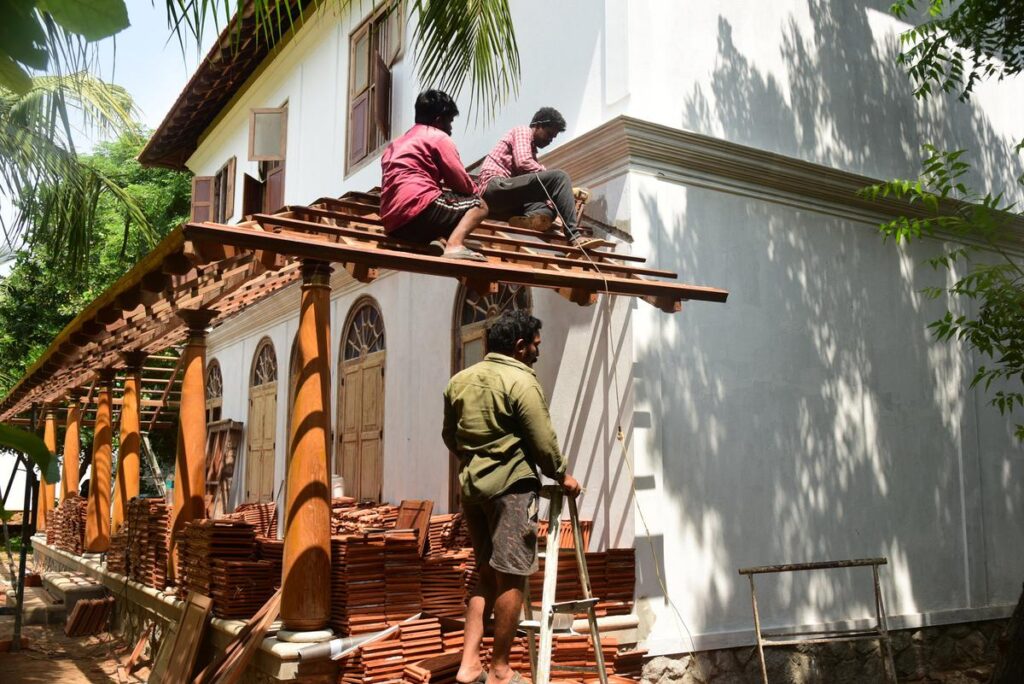
But the one project that has the museum buzzing with activity and anticipation is the construction of its Calicut House. “We started this project in March 2020, but then were forced to stop, since the movement of man and material was difficult during the pandemic. We resumed construction only this April, hoping to open its doors during summer 2023. The home belonged to a Muslim family in Calicut, and we had a team of 12 carpenters from Kerala, who carefully worked to reconstruct the home exactly as it was. We envision an exhibition around sustainability, using this Calicut house,” says Nambiar. The plan is to use the rear facade to install solar panels, use rain water harvesting apparatus, water conservation and composting techniques, in the adjacent compound area, to sensitise, “our millennial audience to environmentally conscious processes that were a part of our heritage in different forms over decades. We worked with Benny Kuriakose and his team of architects as well as a team from Auroville to set this up,” adds Nambiar.
Calicut house under construction | Photo Credit: Special Arrangement
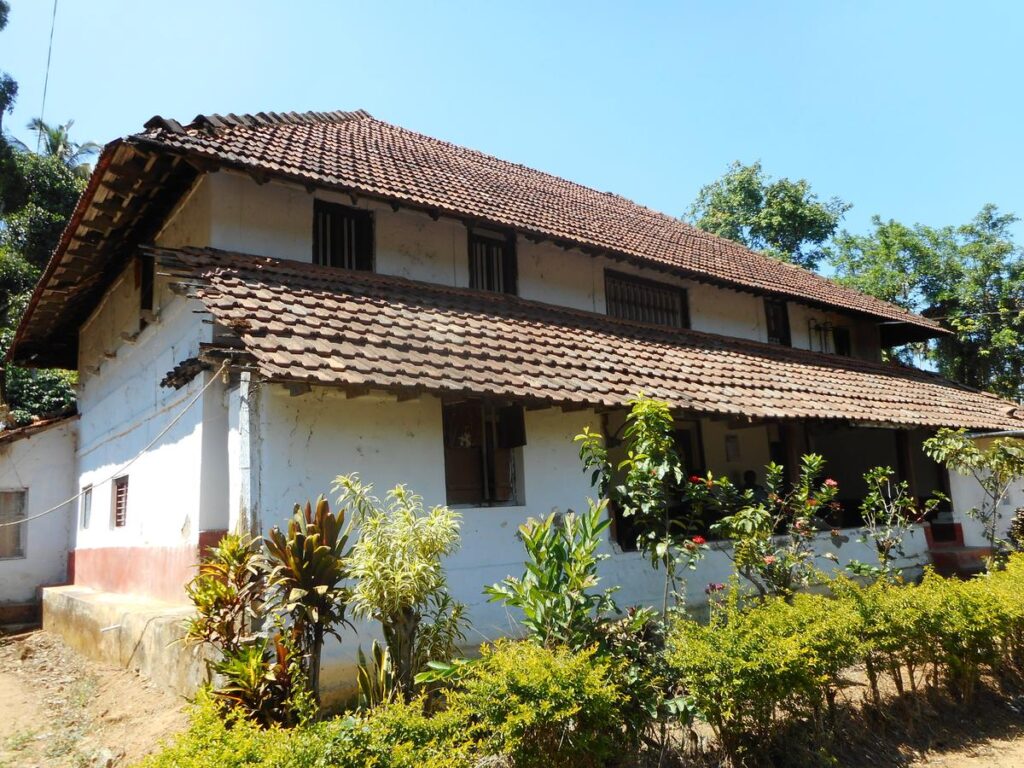
While the Calicut House is all but ready for the public, the Kodava House or Coorg House will be the latest addition to the living heritage space, “to focus on the Kodava community which came into focus with the book, The Vanishing Kodavas by Kaveri Ponappa, and this project will be bolstered by the presence of the Sandooka—The Living Museum of Kodava Culture , an interactive virtual museum expected to be formally launched in 2023 as well,” adds Nambiar.
The Coorg style house in its original location | Photo Credit: Special Arrangement
The Kodava House will showcase the way of life of the community living in the Western Ghats of Karnataka. They have a deep connect with the land. The house to be reconstructed has been identified. “We have to carefully document the structure, then the parts are numbered, photographed, we have drawings to scale, then the home is painstakingly taken apart, using teams from the area who understand the materials and techniques. Then we slowly start the process of moving the parts to be assembled in the museum, in the exact same way.
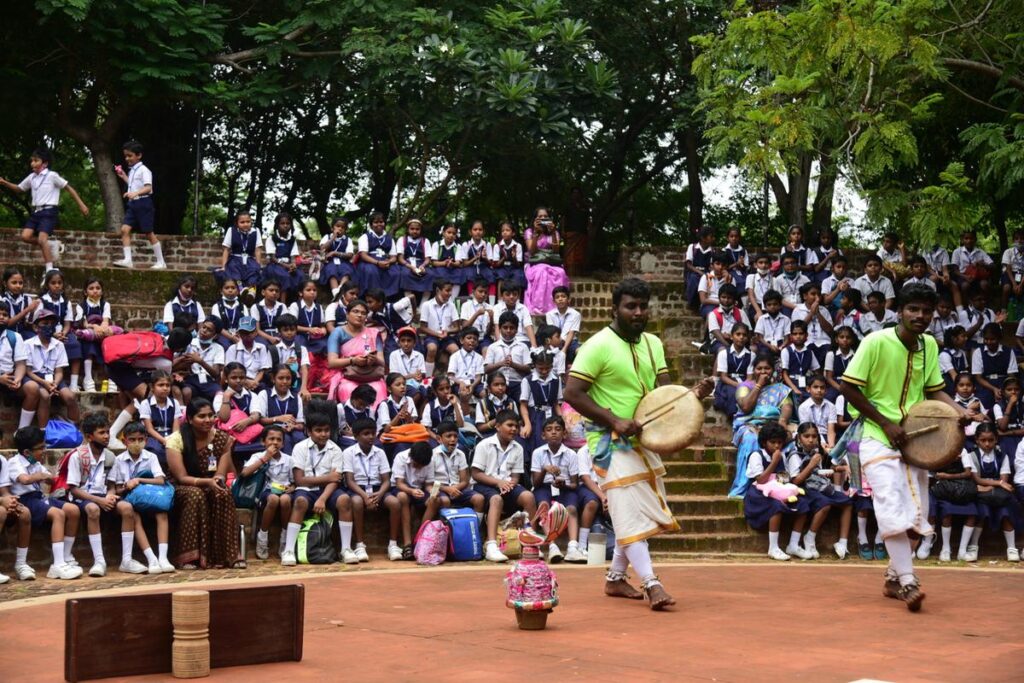
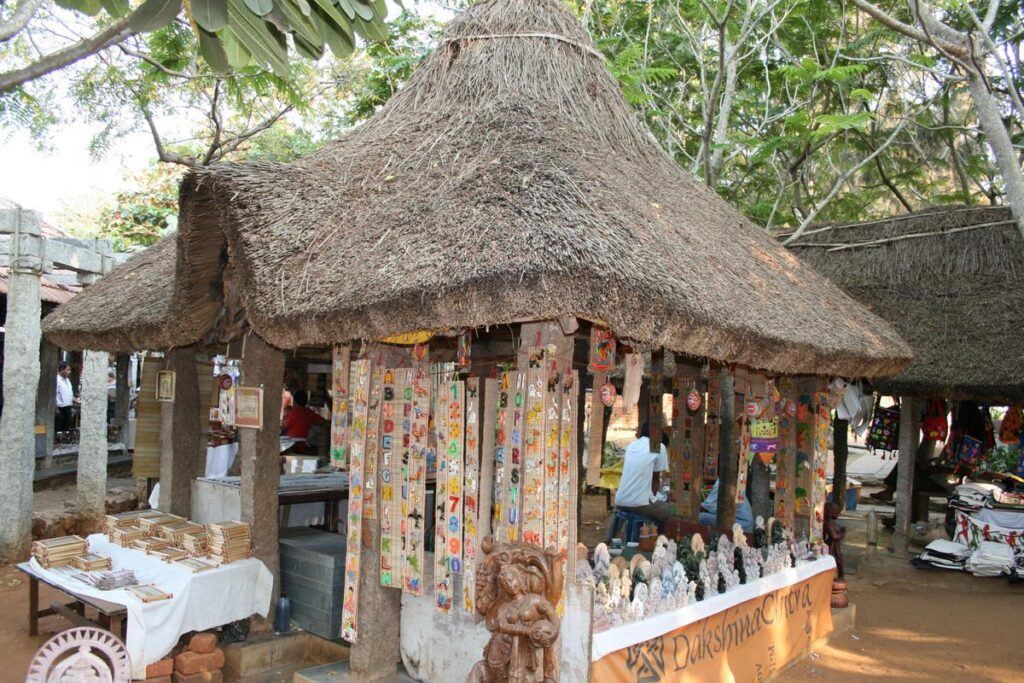
A tapattam performance | Photo Credit: Special ArrangementCrafts Bazaar | Photo Credit: Special Arrangement
The process starts early 2023 and would take close to 16 months to complete,” concludes Nambiar, as the museum readies itself for a hectic Margazhi season packed with performances, as well as a December anniversary celebration replete with spirited folk performances and a unique exhibition showcasing the state of Arunachal Pradesh.
source: http://www.thehindu.com / The Hindu / Home> E Paper> Life & Style / by Anisha Menezes / November 24th, 2022
At the first glance it seems to be another piece of metal with the sign of a star embossed on it. The hardly visible recipient’s name along with the date it was received is engraved in a corner. To own this piece of metal is an irrepressible desire of every soldier who goes to war. That’s because it represents valor. It’s the ‘Maha Vir Chakra’, second highest gallantry award given to those who exhibit exemplary courage and valiance. It is the Indian equivalent of the ‘Distinguished Service Cross’ of the British. Since 1947, Only 218 braves of the mighty Indian Army have been the proud recipients of the Maha Vir Chakra. 6 among them have received the Maha Vir Chakra twice, also called the Maha Vir Chakra Bar. Considering this, only two from Karnataka, a state which has given some of the most valiant soldiers and officers to the Indian army, have been the illustrious recipients of this gallantry award.One is Squadron Leader Ajjamada B Devaiah famously known as the ‘Tiger of Sargodha’ and the other is Major (Later Lt. Colonel) P S Ganapathi. While the former was martyred in action during the 1965 war and was awarded the Maha Vir Chakra posthumously, the latter is a living example of unparalleled gallantry amongst us today.
Saga of a living memorial
Unlike the brave souls of Punjab, there have been no books published about this hero. He hasn’t given any interviews to TV channels or attended public events which are flashed all across the media. Almost nothing is known about him yet. He is relatively unknown even in his own hometown, Coorg, the land of the brave warriors. Shy of any kind of publicity and one who lives by the dictum ‘Safeguarding the nation is my duty alone’ is how Lt. Col. Puttichanda Somaiah Ganapathi has led his life throughout. Participating in public events is not at all a difficult task. However, Lt. Col.PS Ganapathi believes that safeguarding the honor of the esteemed medal is his paramount duty and is more valuable than any kind of publicity.
At 73 today, Lt. Col.Ganapathi might not have a large frame but his baritone voice, characteristic of military officers, hasn’t waned a bit. Lethargy that comes with age is alien to him. The agility of his mind is intact despite many years of retired life. Currently residing at ‘Sena Vihar’ in Bengaluru, Lt. Col.Ganapathi’s retired life is anything but idiosyncratic with lives of retired people who prefer a laidback existence.An effervescent man, unlike most people his age, he drives to his hometown in Coorg once every month on his own.His life in the concrete jungles of Bengaluru hasn’t sapped his love for farming one bit.His suave demeanor and absence of any signs of pretension for being the proud owner of a national gallantry award, is the true nature of this hero.
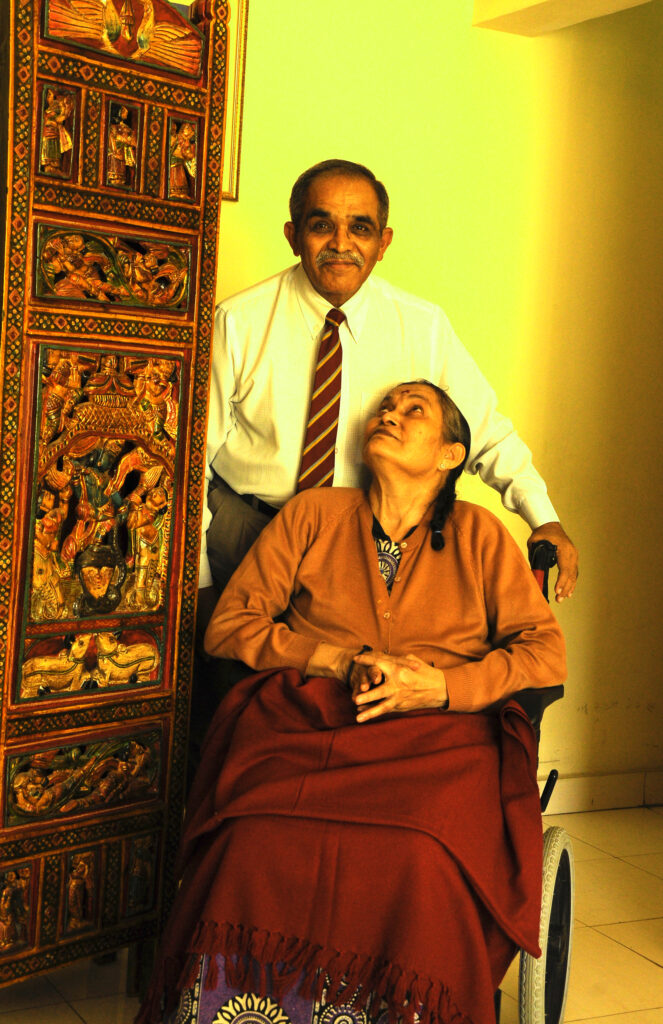
While seated at his home in the multistory apartment complex at the Army’s ‘Sena Vihar’, Lt. Col. Ganapathi began to narrate the stirring story behind his Maha Vir Chakra. He was soon joined by his wife on her wheelchair, with a cup of coffee in her hand. Although, she had heard her husband’s heroic tale umpteen times,her desire to keep listening to the saga made her tolend her ear once again. The showcase behind the Lt. Col. was decked with the upright photo which had captured the invaluable moment when he was presented the MVC by the President. Adjacent to it was the photo of his son, who departed untimely, adorned with a sandalwood garland. The enduring agony of the deceased son was apparent, albeit fleetingly,in the stern battle-hardened face of the Lt. Colonel.
As a worthy prelude to his tale of heroism, Lt. Col. Ganapathi began by recollecting his childhood.
Madikeri Central High school, 1952
After completing his primary education from Napoklu in Coorg, Ganapathi was admitted to the Central School at Madikeri for High school studies. This was the school from where towering personalities like Field Marshal Cariappa and General Thimmayya studied, played hockey and graduated. The Central School was famous all over Coorg for its quality English education, encouragement in sports and its discipline. While most kids ran towards the ‘Mens Compund’ Ground to play hockey as soon as the school bell rang, Ganapathi used to run to the school auditorium to gaze at the large portraits of FM Cariappa and Gen. Thimmayya which were hung on its walls. Years of gazing and drawing inspiration from them, sowed seeds of desire within Ganapathi to join the military and become a decorated officer like the two greats.As soon as he completed the ‘Seventh Form’, he began his preparations and started to spend a lot of time on the ground. He used to sit and listen to the stories of war and valor from retired soldiers in the town. Though many years had passed, the inspirational portraits from his school never ebbed from his mind.
Years later, after completing his college education, Ganapathi joined as a Forrester. While he was posted at Kolhapur in Maharashtra, he attempted to join the military. He failed. He attempted again in Bengaluru and failed yet again. But he did not give up and again attempted to join the military at Bengaluru. He succeeded in this attempt. Ganapathi’s ambition that blossomed at Central High schoolin Madikeri had now come true.He was deputed to the Officers Training Academy (OTA) at Chennai. After the successful training in Chennai, Ganapathi became an officer of the 14th Mahar Regiment.
Within a few days of joining the military, PS Ganapathi duly ingrained the military traits of discipline and diligence. Those portraits of Central High school had only become larger in his mind. He was selected for the Anti-Insurgency battalion formed to tackle the militancy spread in Nagaland and Mizoram. He worked in various areas in the North-East like Palampur, Gangtok, Nathu La, etc. He received further training for a few years in Belgaum. He was then deputed to Assam Rifles. During this period, Ganapathi has served in various regions, under different environments and had experienced adverse conditions from close quarters.
Colombo, 1987 July 29
That was an era during which rivers of blood was flowing all across Sri Lanka. India too bore the brunt of the bloody strife there. Lakhs of people from the affected areas from Sri Lanka sought refuge on the shores of Tamil Nadu daily. The Tamils of Sri Lanka had the sympathy of Indians. India was caught in a quandary over the dispute in Sri Lanka. On the one hand, the Lankan government was adamant on not granting any kind of special status to the Tamils there. The then Prime Minister Rajiv Gandhi, with the arbitration of the then CM of Tamil Nadu MG Ramachandran, invited LTTE’s Chief Prabhakaran to Delhi to deliberate on the Tamil issue. Indian Intelligence institutions had exerted considerable pressure on the LTTE chief. Soon after this, Rajiv Gandhi undertook a tour of Sri Lanka. However, the Tamils of Sri Lanka were displeased at the way their leader was purportedly treated in Delhi. On the very first day of his visit, a Sri Lankan soldier had attacked Rajiv Gandhi with a gun during the ceremonial Guard of Honor. Subsequently, Rajiv Gandhi and the then Sri Lankan President G R Jayavardhane conducted bilateral talks and signed a deal. As per the deal, the Sri Lankan government would recognize the Tamil aspirations and grant special status and privileges to them. India on its part had promised to send its military to Sri Lanka and undertake the task of persuading the Tamils to lay down their arms.
The world assumed that this historic deal would solve the century old dispute and put an end to the 3-decade old cycle of bloodletting in Sri Lanka. India’s initiative to solve the crisis was lauded the world over. It was deemed that the Intervention of India would change the situation in the island nation. Everyone believed that the fighting Tamils would lay down their arms and hoped that the lives of Tamils, who formed 20% of Sri Lanka’s population, would change for the better. Many even penned poems over the cause. Congress leaders in India started to sing paeans to Rajiv Gandhi and even declared that there was no difference between King Ashoka who sent saplings of the Bodhi tree to Sri Lanka and Indira Gandhi’s son Rajiv in their speeches.While all these events were happening, Tamils the world over had exercised a conspicuous silence which was ominous of the lull before astorm. The world had thought that a single treaty would resolve India’s refugee crisis, establish peace in Sri Lanka and assuage sorrows of the Tamils.
Tamilnadu, 1987 August
The Indian troops arrived in Sri Lanka with much zeal to fulfil the obligations of the peace accord. With the over-confidence brought by the success of signing the pact, Indian government sent over ten thousand Indian soldiers to Sri Lanka in the first week of August itself. All the three arms of Indian armed forces crossed the ocean into Sri Lanka. The India troops which consisted of The Sikh Regiment, Maratha Light Infantry, Mahar Regiment, along with battalions of 10th Para Commandos, Armored regiment with U-72 battle tanks, Gorkha and Rajputana battalions, soldiers of 4th mountain division, Chetak and Cheetah helicopters of the Air Force, several units of ‘Marcos’ commandos of the Indian Navy, landed at several places in Jaffna, Trincomalee, Batticaloa, Ampara, and Urumpirai with overweening confidence.
In a land that it did not belong to, in an environment that it was alien to, the Army did not have a faint idea about the war that was about to ensue. The only plan of action in mind was to establish peace. Hence there were no adequate preparations or efficient battle plans. Even the intelligence gathering was not robust enough. The maps of the area were woefully inadequate. In such circumstances, the truth of the grim scenario dawned on the Indian army. The LTTE had armed even the women and children with guns. The LTTE terrorists who had hidden capsules of cyanide, stunned the Indian soldiers. The troops which had arrived with the sole aim of establishing peace in the island, had its plan turn topsy-turvy in just a few days. The LTTE which had mastered the art of subversion, began to hoodwink the Indian Army. At several places, in a beguiling act of reciprocating to the peace accord, LTTE cadres surrendered old and rusted weapons to the Indian Army. A few days later, a leader of the LTTE committed suicide by consuming cyanide. This incident completely grounded any chances of establishing peace in the island nation. LTTE’s Chief Velupillai Prabhakaranused this as an opportunity to declare a direct war against the Indian troops. The war resulted in the martyrdom of 1138 brave Indian soldiers, the same soldiers who had come to the island with an idea of establishing peace. More than 3000 Indian soldiers were critically wounded. By the time the Indian government decided to recall its peace-keeping forces, the Army was decorated with 1 Param Vir Chakra (posthumously) and 6 Maha Vir Chakras. Among the six recipients of the MVCs was PS Ganapathi.
Trincomalee, 1987 July 30
(In first person) I was deputed from the Assam Rifles to the 8th Mahar Regiment. Pursuant to the orders of the government, the first batch of the peace-keeping force was airlifted from Tiruchirapalli to Jaffna on 30th July, 1987. I was in this batch. The dense jungles around Jaffna made me anticipate the struggles we would face in event of a military operation. I had a premonition of the same at the first glance of Jaffna. It did not take many days for my apprehensions to become true. This was because the LTTE waged a direct war against us. Within a few days of our landing, the LTTE attacked the Palali Airbase on the outskirts of Jaffna. The CRPF troops which were part of the peacekeeping force, were also attacked. The Jaffna Radio station was captured. Despite several counter-attacks by our forces, the LTTE did not capitulate easily. Jaffna was LTTE’s bastion and it was fighting to hold on to it at any cost. By this time, we understood that unless the LTTE loses Jaffna, its strength would not be depleted. But the Land mines buried unsuspectingly, suicide squads whose strategies were difficult to comprehend, disheveled all plans of our troops. The situation turned so grave that the then Chief of Army Staff Krishnaswamy Sundarji had to pay a visit to Sri Lanka in October 1987 and guide our troops in the peace keeping operations. The LTTE attacks were so dreadful and brutal that the Sri Lankan army abandoned and withdrew from areas which were the strongholds of LTTE. We were then clear that our next goal was Jaffna.
LTTE had assembled a strong army at a place called Maruthanamadam to defend Jaffna. Unless Maruthanamadam was cleared of the LTTE forces, the path to Jaffna would not be easy. We had to proceed towards Maruthanamadam from our station in Uduvil. Though our troops did not have exact information about this path, we were aware of the fact that LTTE cadres were present on the entire stretch. It was 6AM in the morning of August 11, 1987 when I was summoned by my Commanding Officer of the 8th Mahar Regiment Colonel BS Rathi. He informed me that he was entrusting the task of clearing Maruthanamadam from LTTE militants to me. Maruthanamadam was about 3 KMS from the place we were stationed. Without further delay, I along with 60 of my regiments’ soldiers proceeded towards Maruthanamadam. Our troops were adequately equipped with Medium Machine Guns, Hand grenades, personal weapons and few 106 RCL guns. As we reached Maruthanamadam, we faced heavy resistance. Those 3 KMS we traversed to Maruthanamadam that day is etched in my mind,just like a movie,even to this day.It was an uninhabited area, with kutcha roads.We neared Maruthanamadamaround 7AM. It was an atmosphere of stoic silence characteristic of a graveyard. Though we could see a few houses, no humans were visible. As we mulled over the scenario, a sudden barrage of gun fire fell upon us. We were stunned for a moment. While we deliberated our action, we realized that our estimation
that LTTE had modern weapons was indeed true. We also realized that the gun fire was emanating from within the houses there.Tackling the militants who are hiding inside such houses is a very dangerous operation. We had to overcome the danger at any cost. Lobbing grenades inside the houses through the windows was our only option. I then order my troops to lob 36 High Explosive grenades into the houses. Our soldiers blasted atleast 40-50 houses and destroyed the safe havens of the militants. Havildar Kaka Phule was grievously injured in the operation and attained martyrdom later. He was awarded the Vir Chakra for his courage.
Anaicottai, October 15, 1987
The success of the first operation had given lot of confidence for our troops. Jaffna was still in the hands of the LTTE. We had only advanced by a single step. With each step we took, the dangers only increased. Our next target was the town of Anaicottai. It was also called as Jaffna junction. The path to Jaffna would be easier only if we cleared this junction. LTTE agents were active throughout the path. The stretch was deserted with no signs of human activity. But in the silence that pervaded the area, temple bells used to ring all of sudden. It soon occurred to me as to why the Temple bells tolled when there were no one visible. I had realized at Maruthanamadam that the LTTE was a step ahead of us in gathering intelligence. The temple bells were used from far distances to convey to the LTTE cadres that the Indian Army was approaching Anaicottai. We proceeded with caution after we realized their modus operandi. We now only had enough arms and ammunitions to fight for 12 hours. We did not carry surplus arms as we had expected the 41st Brigade to arrive at Anaicottai by the evening of 16thOctober. As soon as we reached the Jaffna junction where four roads meet, we were attacked by the LTTE with their full might. We had to fight back hard and stop the enemies from advancing further. As the fighting ensued, the sun started to set and darkness had engulfed us. We would not retreat for any reason come what may.By nightfall, it started to rain and our adversaries were merely at a distance of 200 to 300 meters from us. While plain wetlands were behind us, scrub forests lay ahead of us.The ground beneath was sludgy. We were forced to consume rain water itself to quench our thirst.The incessant military operation since morning was taking its toll on our fatigued troops. Everyone ran the risk to slipping into deep sleep if anyone attempted to shut their eyes even for a moment.The gun fire from the enemies used to stop intermittently and start again all of a sudden. This continued throughout the night.I opined that we had to defeat them through the waiting game. I then sent the corresponding message to our headquarters. I received the communication that the 41st Brigade had departed from India and we should keep the enemy engaged until the Brigade arrives. We then received the message that a troop of 1st Maratha Light Infantry commanded by Colonel Oberai and armed with 81MM mortars would come to our rescue. As day and nights passed, we continued to fight the LTTE without as much as battling our eyelids. The putrid rainwater that had accumulated around continued to quench our thirst for days. The LTTE had come as close as 50 meters from us. We could not delay further and began our intense counter attack. Our soldiers fought valiantly like I had never witnessed before. By this time, the 8th Mahar regiment supplemented out efforts with their 81MM mortars and the 31st Light Regiment safeguarded us with their 120MM mortars and they fired upon the LTTE fiercely. While the battle raged on, I was forced to witness the deaths of several of my beloved boys. Unanticipatedly the LTTE fired a large explosive which landed close to me. The intensity of the blast was so deafening that my left ear started ringing. Decades after the war was over and even many years after my retirement, this was the only sound I heard in my left ear. The LTTE forces advanced further maybe after they realized our condition. During one of these nights I positioned myself in the Rifle trench and had my aim directed at the enemy. Despite the incessant and intense gun fire from their side, we did not fire a single shot. Silence from our side gave two soldiers of LTTE the confidence to walk towards our lines with the help of torch lights. I waited in my trench until they came very close to me. When I could see their face clearly, I fired upon them using my Sten machine carbine. Those two bullets I fired at that instant had a tremendous effect on the enemy’s psyche. LTTE’s courage had taken a beating.
The next day, a contingent of 15 soldiers led by Capt. Sunil Chandra arrived to deliver food and ammunitions to our troops. Capt. Sunil was a handsome young man but a tad impulsive, maybe owning to his young blood.While he was conversing with me in the rifle trench, Capt. Sunil got up to light a cigarette. I had forewarned him that lighting cigarettes could be dangerous. He must have taken a puff when his headsurfaced a few inches above the trench. A sniper bullet pierced through his scalp. Capt. Sunil Chandra breathed his last right in front of me. I took a headcount of my troops while lying in the trench itself. 11 of my brave boys had laid down their lives in the battle. I then could feel the heaviness in my heart. Finally on the morning of 19th October, 41st Brigade commanded by Brig. Manjit Singh arrived for our support. By then we had almost vanquished the enemy. A few of them had fled from their positions. For an operation that was supposed to last only 12 hours, we had fought relentlessly for 72 hours.
Uduvil, 25th January, 1988
Pursuant to the operations at Maruthanamadam and Anaicottai, Maj. Ganapathi was deputed to serve at the Army Headquarters at Uduvil. It was 8.30PM in the night of 25th of January. As usual, everyone in the camp were listening to news on the radio. A special bulletin was about to be broadcast. But none were aware of this and were eager to hear the news related to the Republic Day which was a day later.Then the announcement came on the radio that the ‘Indian Government had declared the Maha Vir Chakra for Maj. PS Ganapathi for exemplary courage demonstrated during the operations to clear Jaffna of LTTE militants and for the gallantry displayed during the operations to capture Maruthanamadam and Anaicottai’.
All his friends were elated and joyous. Congratulations poured in from his senior officers and staff. However,Ganapathi was reticent throughout. He neither felt proud for the award nor did he thank anyone.But he asked the only question that was haunting him. “You have bestowed the Maha Vir Chakra on me. But will it be possible to get back those 11 boys whom I lost?”
source: http://www.santoshthammaiah.wordpress.com / December 02nd, 2016
Mysuru entrepreneur Kuppanda Chayaa Nanjappa Rajappa has been appointed as the National President of Association of Business Women in Commerce and Industry. She is a first generation rural woman entrepreneur and Founder-Managing Partner of Nectar Fresh.
Nectar Fresh, backed by Khadi and Village Industry Board, has its unit in Srirangapatna, Mandya district. It offers various products like honey, jams, sauces, chia seeds and natural vinegar.
A recipient of various awards like CNBC-TV18 and Women Entrepreneur Award in 2014-2015, Chayaa was also honoured by Indian Federation of Culinary Association for breaking the monopoly of the international brands. She bagged the Business Person of the Year Award by Mysore Chamber of Commerce & Industry (MCCI) in 2019.
Nectar Fresh has been the first brand in India to be using the ‘Women Owned’ logo of ‘We Connect’. Their latest venture ‘Veeravrutham’ is the first social enterprise in ‘Aatmanirbhar Bharat’ which will support over 3,000 tribals and rural artisans locally. Tribal and rural artisans’ products will gain place not only in the Indian market but will also find place in the international market.
Born to Paruvangada Nanjappa and Poly Nanjappa of Nalkeri village in Kodagu, Chayaa is married to Kuppanda Rajappa, who was the first businessman to bring in the concept of supermarket (Nilgiris) to Mysuru. The couple has donated one acre of land for a Bharat-Israel Study Centre through Diya Minora Foundation, a sister concern of Veeravrutham Foundation. It will be a culture and technology exchange platform between India and Israel.
Chayaa is motivated by the principles of Rashtriya Swayam Sevak Sangh (RSS) and has implied the principles in her profession besides working in various fields apart from business. She is the first woman to hold a national-level position in Vishwa Hindu Parishad (VHP) and also holds a position in the State Committee of RSS’ Laghu Udyog Bharti.
She is a member of the executive committee of the R&D Institute for Food and Technology at Indian Institute of Food Processing Technology (IIFPT) and is one of them from the industry to be chosen as part of the National Honey Mission.
IIM Professors chose Nectar Fresh story as a case study for the Ivy League Competition, adding another feather to the cap of Nectar Fresh that grew up as a brand with ethics and quality than investing in marketing.
source: http://www.starofmysore.com / Star of Mysore / Home> News / June 25th, 2021
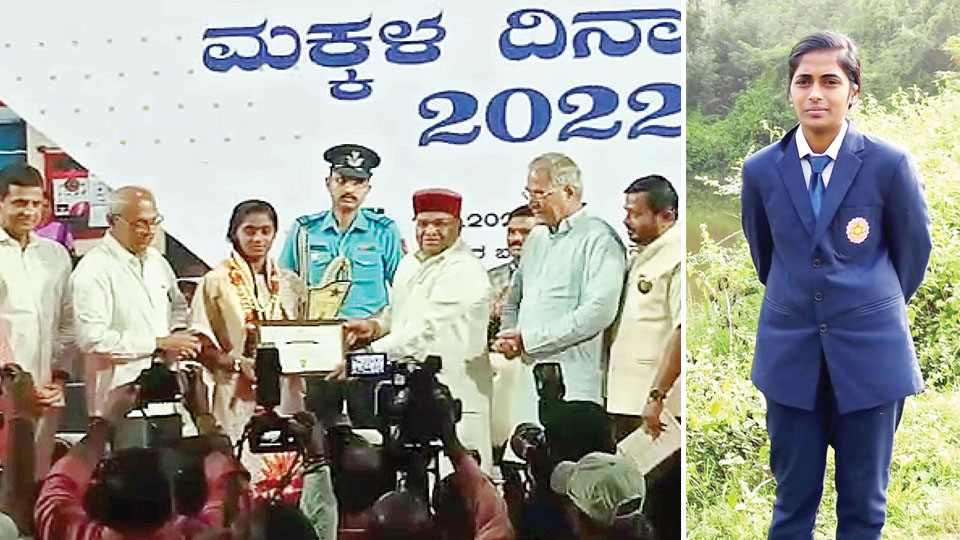
A girl, who had saved an elderly man from drowning in a lake, has been honoured with Keladi Chennamma Bravery Award by Governor Thaawarchand Gehlot at the Children’s Day function held at Jawahar Bal Bhavan in Bengaluru on Nov. 14. The bravery award is instituted by the Department of Women and Child Development.
The girl, who bagged the award is Namratha, daughter of Shabareesh and Shantha couple of Seegethodu in Gonikoppal of Kodagu district.
A student of Sarvadaivatha PU College at Arvathoklu in Gonikoppal.
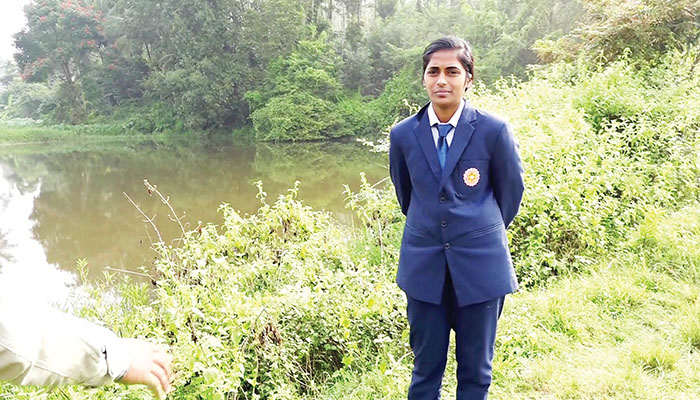
Namratha, on Nov. 6, 2021, was walking towards her home after finishing her college, when she noticed an elderly man drowning in the lake, next to her house. Without thinking twice, Namratha jumped into the lake and dragged the elderly man out of the water, thus saving his life.
The officials of the Department of Women and Child Development, who took notice of this bravery act, recommended the name of Namratha for the Keladi Chennamma Bravery Award.
Namratha has dedicated the award to her parents, College Principal and her School Head Master. Her mother Shantha said she was very happy for her daughter who has saved a life. Namratha has participated in National-level throwball and also bagged many prizes.
source: http://www.starofmysore.com / Star of Mysore / Home> News / November 16th, 2022
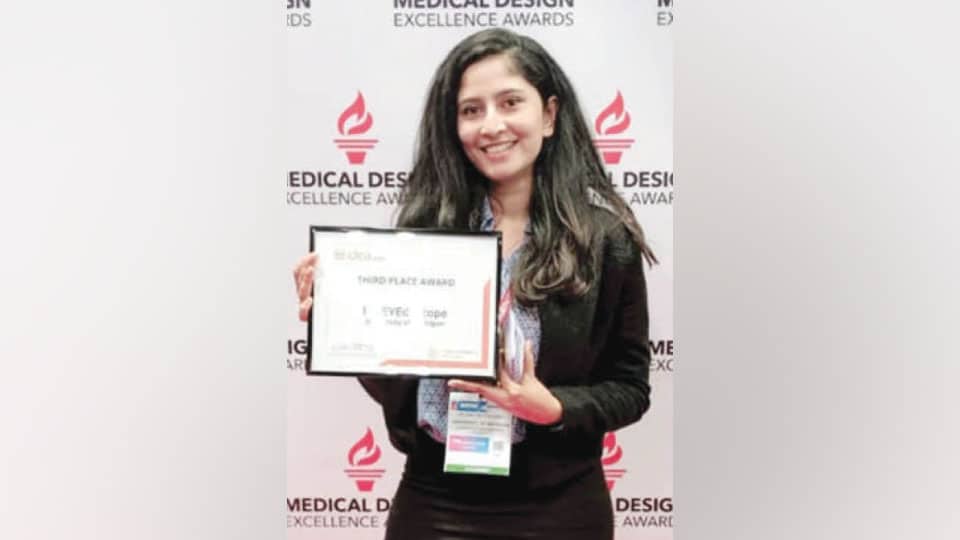
Palandira Vichal Muthanna has won the Medical Design Excellence Award-2019 with her team. The team stood third in national-level competition “BMEidea-2019” where teams across the United States with new innovative medical technologies participated.
The award ceremony was held at Jacob K. Javits Convention Centre, New York, on June 11. During her research at the University of Michigan, Vichal and her team developed a new device called ‘KalEYEdoscope’ to track the progression of a condition called ‘Age-related Macular Degeneration’
Macular Degeneration is the leading cause of blindness in the world and currently there is no device in the market to help track its progression on a regular basis. The award was in recognition of their work in the development of this innovative, simple and novel medical device and in support to further develop the same.
Palandira Vichal is an M.Tech in Bio-Medical Signal Processing and Instrumentation from BMS Engineering College in Bengaluru. Earlier, she had invented a device to monitor the vitals of both mother and child during labour. The device invented by Vichal not only monitored the vital parameters of both mother and child, but also raised an alarm in case of any fluctuations so that the doctors and medical staff can rush to the patient’s rescue.
Vichal completed her early education in St. Joseph’s Girls High School, Madikeri and higher secondary education at Vidyaniketan PU College, Gonikoppal. She did her engineering from Vidyavardhaka College of Engineering in Mysuru and M. Tech from BMS College of Engineering in 2015.
Vichal is the daughter of Palandira Jaya Muthanna and Mithuna Dechamma (daughter of Mukkatira Doremani Ponnappa) of Murnad in Kodagu district and grand-daughter of Karnataka Rajyotsava Awardee late Palandira Devaiah.
In her academics, Vichal was the co-ordinator for the Indian Society for Technical Education (ISTE) for 4 years from 2009-2013. She was the Branch Association (IMPULSE) Co-ordinator for two years in Vidyavardhaka from 2011-2013. She won the Gandhian Young Technological Innovation Award -2006 from Biotechnology Industry Research Assistance Council (BIRAC) – Society for Research and Initiatives for Sustainable Technologies and Institutions (SRISTI) for her project ‘Device for Intrapartum MaternoFetal Care.’
source: http://www.starofmysore.com / Star of Mysore / Home> News / June 21st, 2019
BP Govinda is very impressed by the Indian Men’s Hockey Team’s attacking unit.
New Delhi :
With less than 100 days to go for the FIH Odisha Hockey Men’s Hockey World Cup Bhubaneswar-Rourkela 2023, the anticipation to witness the world’s best hockey players at one of the world’s most preferred hockey destinations – Odisha, is only increasing by each passing day. While the Indian team carries out their preparations to end the medal drought in the prestigious event, it’s time for the hockey fans to relive the memories from India’s historic World Cup campaigns through Hockey India’s Flashback Series – World Cup Special.
Through these Series of articles leading up to the marquee event in Odisha, Hockey India will bring you thoughts, anecdotes and trivia from Indian Hockey Legends who ruled the world with their wizardry and panache.
Winner of the Silver Medal in the 1973 World Cup held in Amsterdam in Netherlands, and the Gold Medal in the 1975 World Cup held at Kuala Lumpur, the legendary BP Govinda recalls his memories from the years gone by.
One of the most crucial cogs in the system for the Indian Men’s Hockey Team in the 1973 and 1975 World Cups, it was BP Govinda who ensured a berth in the Final at Amsterdam with the winner against Pakistan in the Semi-Final. The former forward terms that semi-final as one the best games in what was a decorated career.
“The Semi-Final against Pakistan is one of the best matches of my life. We won that game by one goal, and I scored the winner. I reverse flicked the ball and the keeper didn’t know where the ball was going and it went and hit the roof of the net. It was regarded widely as one of the best goals, by my teammates and the media,” he recalled.
“People used to love watching India and Pakistan in hockey when we were playing, we had full stadiums.”
Unmissable on the field of play due to his stylish long hair, Govinda said that the Indian Men’s Hockey Team believed that playing as a unit would always yield results. “Our team always had the thought process where we believed, no matter how strong the other team is, if we play as a team, we can achieve anything. Whether it was a practice match or tournament, I always played to win.”
Speaking about his camaraderie with the Captain of the 1973 team, MP Ganesh, the former forward said, “As a Captain, he was very straightforward and he would ask the players to play according to the plan. He wouldn’t scold any one, but he would tell everyone to go all out for the win, all the games. He used to guide all the players.”
Turning his attention to the glorious 1975 World Cup campaign in Kuala Lumpur, Govinda, who was considered to be among the fastest players at the time, recalled the love the team received from the fans.
“We outclassed Pakistan in the Final and the stadium was full with plenty of fans. When we came back to India, people told us that commentators made them feel like they were in the stadium and not listening in another part of the world.”
“I remember landing in New Delhi, and the fans were there with drums and they carried all of us. I don’t know where we finally went and landed, but it was definitely well outside the airport. It was a reception that I will never forget. I remember coming out of the aircraft and then the fans took over, we hadn’t got a chance to get our baggage either.”
‘Indian Men’s Hockey Team Will Not be Easy to Beat’
A former national selector himself, Govinda is quite impressed with the Indian Men’s Hockey Team and noted that they would not make an easy opposition at the FIH Odisha Hockey Men’s World Cup 2023 Bhubaneswar and Rourkela. India have been drawn in Group D along with Wales, Spain and England.
“I think the current Indian Men’s Hockey Team is quite fit. And I think our forward line is playing well and I think the strikers have also improved a lot. It was nice to see the team scoring more field goals.”
“In the upcoming FIH Odisha Hockey Men’s World Cup 2023 Bhubaneswar and Rourkela, I think the Indian Men’s Hockey Team is not an easy one to beat. They will give a good fight to each and every top team who are taking part in the World Cup,” he signed off.
Link to video of BP Govinda taking us down memory lane –