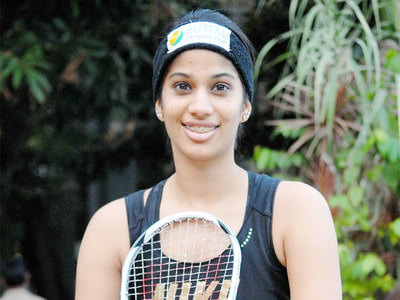
Chinappa made the main draw of the China Open earlier this week. (TOI Photo)
New Delhi :
India’s highest ranked squash player, Joshna Chinappa, has gained two places to be 12th in the latest PSA rankings.
Chinappa made the main draw of the China Open earlier this week before losing in the opening round.
Her teammate Dipika Pallikal moved up a place to be 21st. Pallikal had lost to Chinappa in the China Open qualifiers.
Both Pallikal and Chinappa will be seen in action at the HKFC International in Hong Kong next week.
Among the male players, Saurav Ghosal dropped a place to be 28th while Vikram Malhotra was on 62, Harinder Pal Sandhu on 66 and Mahesh Mangaonkar on 67.
source: http://www.timesofindia.indiatimes.com / The Times of India / Home> Sports> News / PTI / September 01st, 2017
Name: Coorg Kannada Family
Designer: Ramakrishna Saiteja
Foundry: Indian Type Foundry
Release Date: Pending
Back Story:
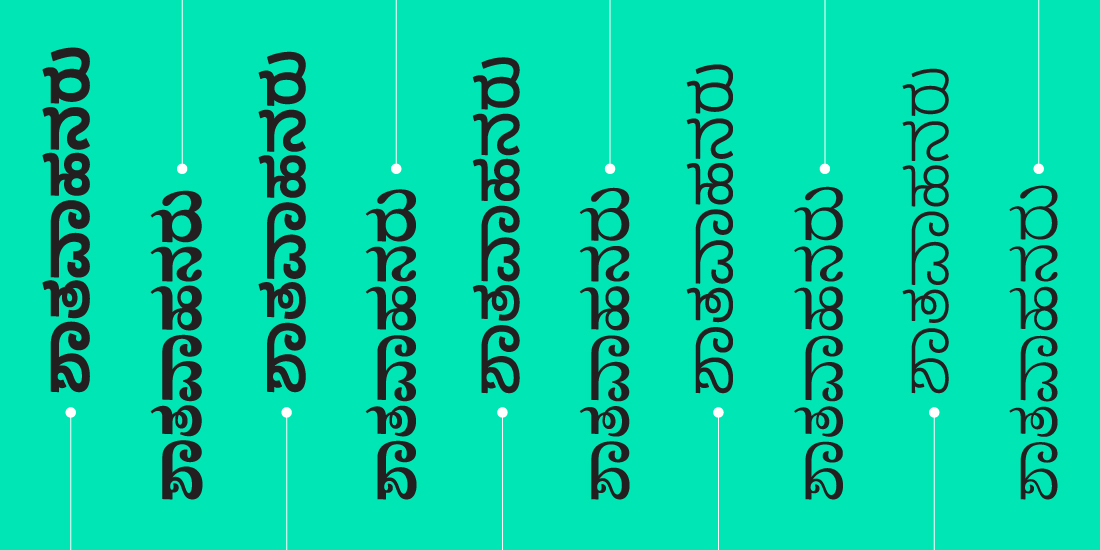
23-year-old Saiteja of Bangalore, India, is this year’s Society of Typographic Aficionados Catalyst Award winner, in recognition of his significant achievement and future promise in the field of typography. His elegant design for the Coorg Kannada type family makes reading Indian-language newspapers more of a joy and less of a struggle. Kannada is a Dravidian language spoken by 50.8 million people in southern India. Its written form derives from a 5th century script, Kadamba, and can be a bit tricky for type designers: it has an inherently wide proportion, and an atypical reverse stress when compared with Latin type. Some forms fall below the baseline as subscripts to indicate added sounds. As if this wasn’t challenging enough, the height added to each character by the subscripts forces fewer lines per page.
Saiteja first began working on Coorg Kannada in early 2016 because he found the typefaces in local Kannada newspapers lacking. “The fonts used in most newspapers are poorly designed for text due to an unresolved and uneven texture, and don’t enhance the reading experience in any way,” Saiteja says. Guided and advised by his colleague, Satya Rajpurohit (one of ITF’s founders, along with Peter Bil’ak) he perfected and refined the design and followed up with Coorg Kannada Sans as a more neutral variant of the typeface.
Why’s it called Coorg Kannada?
The Coorg language, which uses Kannada script as a writing system, is widely spoken by the people of Kodava, India, and the type family is named in their honor.
What are its distinguishing characteristics?
Designed to maximize legibility, the Coorg Kannada family’s letterforms in both Classic and Sans follow the proportions of Kannada and are balanced so that they work well together. Certain characters bear stylized terminals plus angled head strokes and ink traps where needed. The subscripts are matched in terms of weight and gray value with the main characters, with a careful eye towards creating an even texture on the page. It adds up to a well thought out, visually coherent type system.
What should I use it for?
Coorg Kannada shines for setting text in any medium. It has five weights unlike previously available Kannada fonts, providing options for a wide range of text hierarchy within the same typeface. The heavier weights of both styles are intended to be used for display purposes.
What other typefaces do you like to pair it with?
The Classic Kannada sits well alongside ITF Gujarati in terms of Indic scripts. William Text is a good Latin typeface match. As for the Sans, try it with sturdy Equitan or Neutral.
source: http://www.eyeondesign.aiga.org / AGA Eye on Design / Home> Type Tuesday / by Angele Riechers / June 20th, 2017
Tyag Uthappa from Kodagu is planning to gift a 3-bedroom house covering 2,400sqft, built in 24 hours flat
A Bengaluru-based company is out to prove a point, and also set a world record with this dream home
The Limca Book of World Records has acknowledged this claim and will send a team to document the execution
__________________________________________________________
Bengaluru :
A three-bedroom house covering 2,400sqft, built in 24 hours flat. At Rs 48 lakh, plus tax. That’s some fast and furious work, and cheap too.
A Bengaluru-based company, specializing in rapid construction and building innovation technology , is out to prove a point, and also set a world record with its dream home for a city businessman.Tyag Uthappa, coffee planter and businessman from Kodagu, is planning to gift the marvel to his wife on her birthday .
Using the precast method of construction, the project is tentatively scheduled for July 15 at T Agrahara, close to Stonehill International School in North Bengaluru. The Limca Book of World Records has acknowledged this claim and will send a team to document the execution.
The construction will cost Uthappa about Rs 48 lakh, plus tax, compared to Rs 70-80 lakh for a normal construction of this size.
“The delay in the project handover, quality of construction and exorbitant prices are making people think twice before investing in real estate projects. Precast technology could be the answer. It reduces construction timelines and improves sustainability and quality . Most important, precast buildings can last a lifetime,” said Paddy Menon, chief disruptor, REBEL Disruptive Building Technologies, who’s taken the lead in attempting a record.
According to the 2015 Survey of Construction from the Census Bureau, the average completion time of a singlefamily home is around seven months. “The amount of time it takes to build your home depends on the type of home you’re building and various other factors, like labour, raw material supply and weather.But this is amazing, considering that these factors become irrelevant. The new technology can give a fillip to affordable housing and the Modi government’s ambitious project to provide houses to all by 2022,” said a builder.
How is the construction done in such quick time?
Menon explained: “We use moulds using precast to create structural elements which are standardized.” A house could have 15 to 25 large elements. These are transported to the site, using trailers. We use standard strip foundations we normally see at construction sites, and with the help of cranes we assemble these walls (elements) and construct the whole house. We ensure that the elements are assembled with great care and precision, with appropriate joints.This technology helps us skip a lot of procedures which we follow in the conventional method of construction, and makes work easier and faster,” Menon explained.
Construction trend: In 2016, a 10 storey structure was built in 48 hours in Mohali, using precast technology , and entered the Limca Book of Records.
A builder said there have been instances of houses being built in 48 hours, a week or month, but this is the first time someone is attempting to set a record by building a 2,400 sqft house, which could change the way the construction industry is going about its work.
Saves time, improves quality: Paddy Menon, chief disruptor, REBEL Disruptive Building Technologies, said precast technology has proved its worth by saving a lot of construction time in Europe and West Asian countries. The best part of the technology is that it not only speeds up construction work but also enhances quality of the final output.
This technology is still nascent in India, though a few large projects are happening in a few metros, and need a lot more awareness among common people.
source: http://www.timesofindia.indiatimes.com / The Times of India / News> City News> Bangalore News / by Manu Aiyappa Kanathanda / July 03rd, 2017
The Professional Business Women-Albuquerque chapter has selected an executive of a hearing care practice as “Albuquerque Business Woman of the Year.” Honored was Naina Ballachanda, chief financial officer of Premier Hearing Center, which serves thousands of patients with hearing loss from five locations New Mexico, Arizona, and Texas.
In the award citation, Ballachanda was described as a “strong female leader [who] leaves an outstanding impression on people.”
The honoree is married to Bopanna Ballachanda, PhD, CEO and director of audiology at Premier Hearing Center, who was formerly on the faculty at Purdue University and the University of New Mexico.
source: http://www.hearinghealthmatters.org / Hearing Health & Technology Matters / by David Kirkwood / November 12th, 2011
Ace Indian tennis player Rohan Bopanna, who recently became the fourth Indian to win a grand slam after clinching the mixed doubles title at the French Open, on Wednesday, met Union Minister of Sports Vijay Goel to discuss the promotion of tennis among youth in the country.
Bopanna, playing alongside Canada’s Gabriela Dabrowski, clinched his maiden Grand Slam title at the Roland Garros last Thursday.
The seventh-seeded Indo-Canadian pair staged a comeback after losing the opening set and defeated Lena Groenefeld and Farah 6-2, 2-6, 12-10 in a summit clash that lasted for one hour and six minutes at Court Philippe Chatrier.
The Sports Minister shared the pictures of him meeting the 37-year-old tennis star on his official Twitter handle.
?Delighted to meet #FrenchOpen Mixed Doubles ’17 winner @rohanbopanna; discussed promotion of #tennis among #youth. Keep inspiring all Rohan!? wrote Goel.
Speaking to reporters after the meet, Goel said, ?I discussed about the promotion of tennis with Bopanna. He told me about his academy and I am happy that already there are around 70 students there? The government always encourages such private academies.?
?I wish he open his academies in the other parts of the country as well,? he added.
Meanwhile, Bopanna thanked Goel for taking out his time and said, ?It was really nice that he took out some time to meet me?I am really happy that he is encouraging sports a lot.?
?I think this is what is required in India for every aspect in our field, no matter what sport it is,? he added.
Bopanna became only the fourth Indian to win a Grand Slam title after Leander Paes, Mahesh Bhupathi and Sania Mirza.
The All India Tennis Association has also declared that they will recommend the tennis player from Bangalore for this year?s Arjuna Award.
Speaking about the same, Bopanna told ANI, ?We will know in a few months if I receive the award or not, if I do, I would be very grateful and very honoured.?
(This article has not been edited by DNA’s editorial team and is auto-generated from an agency feed.)
source: http://www.dnaindia.com / DNA / Home> India> News> Sports News / ANI / Wednesday – June 14th, 2017
Rohan Bopanna clinched his maiden Grand Slam title when he won the French Open mixed doubles final with Canada’s Gabriela Dabrowski in Paris on Thursday.Canada’s Gabriela Dabrowski and India’s Rohan Bopanna hold aloft the trophy after winning the French Open mixed doubles title in Paris on Thursday. The pair defeated Germany’s Anna-Lena Groenefeld and Colombian Robert Farah 2-6, 6-2 (12-10). (AP)
Indian tennis ace Rohan Bopanna and Canadian partner Gabriela Dabrowski produced a fighting performance to beat their German-Colombian opponents Anna-Lena Groenefeld and Robert Farah in the final to clinch their maiden French Open mixed doubles title in Paris on Thursday.
Seeded seventh, Bopanna and Dabrowski took an hour and six minutes to win, saving two match points, as they overcame the unseeded Groenefeld and Farah 2-6, 6-2, 12-10 on Philippe-Chatrier Court.
Bopanna has become only the fourth Indian to win a Grand Slam crown, after Leander Paes, Mahesh Bhupathi and Sania Mirza. Indians have accounted for 20 Grand Slam mixed doubles titles. Two of those victories belong solely to India with Sania Mirza partnering Mahesh Bhupathi.
Bopanna entered the final of a Grand Slam tournament after a gap of seven years. He had also qualified for a Major final in 2010 when he and Pakistan partner Aisam-ul-haq Qureshi entered the title clash of the US Open.
The 16th seeds had then lost to American twins Bob and Mike Bryan in the final.
Bopanna is the also the fourth Indian to win a mixed doubles crown at the world’s premier clay court tournament. Bhupathi won India’s first Grand Slam title in 1997 when he partnered Japan’s Rika Hiraki to claim the French Open.
Bhupathi again won in 2012, this time with compatriot Sania Mirza.
Paes too had savoured glory on the red clay when he won in 2016 with Martina Hingis.
Bopanna and Dabrowski did not start well, losing the first set 2-6. The seventh seeds gave away as many as four breakpoint chances and Groenefeld and Farah converted two to take the lead in the match.
However, the Indian-Canadian combine fought back well to clinch the second set with the same scoreline.
Though they were broken once, Bopanna and Dabrowski converted three of the five breakpoint opportunities they got to push the match into a match tie-break (earlier known as Super Tie-Break).
The German-Colombian pair led throughout the tie-break, and held two match points at 9-7. However, Bopanna and Dabrowski somehow managed to save both.
Bopanna and Dabrowski had their first chance when they took the lead at 10-9. They lost the opportunity as scores were levelled at 10-all but the pair grabbed the next two points to seal victory at Roland Garros.
source: http://www.hindustantimes.com / Hindustan Times / Home> Tennis / HT Correspondent, Hindustan Times / June 08th, 2017
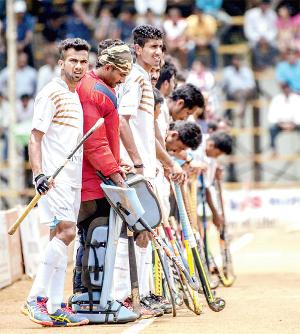
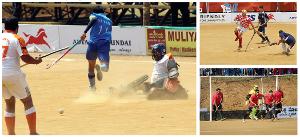
Hotbed for hockey. Nikkin Thimmaiah with his Chendanda team at the Kodava Hockey Festival final.
The Kodava Hockey Festival is testimony that the game is still thriving in Kodagu, feels internationals Nikkin Thimmaiah and SK Uthappa
A crowd of 30,000 people turned out to watch the Kodava Hockey Festival final between Chendanda and Pardanda on May 14, an eye brow-raising statistic to the uninitiated. This wasn’t an international event, not even a national championship. The average spectator turnout for an Indian Premier League game at the M Chinnaswamy Stadium was 25,000 but this hockey contest — played between families in Kodagu district — beat even the IPL. Cricket, they say is religion in the country. In Kodagu district, it’s hockey that gets the adrenaline pumping.
“Every player from Kodagu begins his career in this tournament, including me,” Nikkin Thimmaiah, India forward and a member of the Chendanda winning team, said.
“I watched my father play in this tournament as a six-year-old. That was one of the catalysts that spurred me to take up the sport.”
The tournament is unique in many ways. A team comprises members of a family and there is no distinction between either age or gender. The festival itself has been conducted annually since 1996. The game, though, goes on through the year as youngsters are encouraged to make it a career. “It’s the most talked about sport in Kodagu and even now, kids are still enthusiastic about the game,” Thimmaiah added. “Kids generally place hockey on a priority.”
Over the years though, the number of players from Kodagu making it to the international level has fallen. Currently, there are only three — Thimmaiah, SK Uthappa and SV Sunil — in the Indian squad. There’s no player from Karnataka in the junior team, but Uthappa insists hockey is not dead. The sport is now alive, more than ever, and tournaments like the Kodava Hockey Festival keep it ticking. “I began playing hockey seriously after watching my brother play,” Uthappa said. “I played badminton first, but in Coorg, everything is about hockey. Hockey is in our blood and that’s why we start playing. The next influential factor is your family. It depends on how they support and encourage you to play hockey as a child. Thanks to that tournament, it’s a tradition that everyone participates in it.
“Even now, that culture of developing the sport remains. You often hear that gadgets have taken the fun out of outdoor games. There are kids who use iPads in Coorg but they know how to balance it with the game. I think that love for the sport is influential in getting everyone to play it. Imagine you have to play this sport in every school. You will naturally be inclined to it.”
But it’s not just this tournament which gets Kodavas hooked to the sport. Uthappa says everyone is interested in playing some sport, but what cricket is to the entire country, hockey is to a Kodava. “We Kodavas follow, discuss and dissect hockey just as other people in the country do with cricket,” Uthappa said. “Families here are aware of everything that we do. Over the years, they have become more educated about hockey, thanks to the promotion and media exposure hockey is getting. Now, everyone’s involved in an educated discussion. For example, they tell me I played well in the first quarter, but my dribbling went awry in the third quarter and so on. Earlier, it was only the basic question of whether you won or lost and by what score.”
source: http://www.bangaloremirror.indiatimes.com / Bangalore Mirror / Home> Sports> Others / by Aravind Suchindran / Bangalore Mirror Bureau / May 23rd, 2017
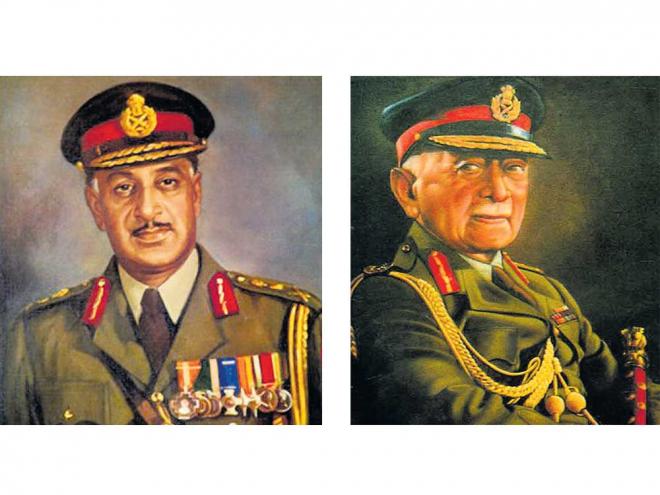
Role Models: Paintings of General K S Thimayya, Field Marshal K M Cariappa.
Kodagu is not just known for its serene landscape and picturesque surroundings, but also for the valour of its people. Rightly, the district boasts of several military heroes. The statues of such brave men can be seen in Madikeri. The Sudarshan Circle in Madikeri is flanked by the statue of Field Marshal K M Cariappa and the equestrian statue of Subedar Guddemane Appayya Gowda.
One of the earliest revolutionaries from Kodagu, Appayya Gowda, was hanged by the British in 1837. His contemporary revolutionaries from Kodagu included Subedar Naalnaad Mandira Uthayya, Chetty Kudiya and Shanthalli Mallayya who were imprisoned for many years by the British. Further along the main road, you can see a circle with the statue of General K S Thimayya. If you take the deviation to the right, you will find Major M C Muthanna Circle near the town hall and Squadron Leader A B Devaiah Circle near the private bus stand.
The first family
In Kunda, near Gonikoppal, lived the Kodandera family, hereditary chieftains of a group of villages. I M Muthanna’s Coorg Memoirs mentions that Naad Parupatyagar (native village official) Kodandera Kuttayya was the grandson of Diwan Mandepanda Thimmaiah. Between 1901 and 1909, he was the assistant commissioner and highest ranked native official in the then Coorg province. When his wife Dechy, or Dechamma, passed away, a locality in Madikeri was named as Dechur in her memory.
Two members of this family, Field Marshal Kodandera Madappa Cariappa and General Kodandera Subayya Thimayya, rose to become the chiefs of the Indian Army. Hence, the Kodandera family came to be considered as the first family of Kodagu’s military heroes. Field Marshal Cariappa was the son of Kuttayya’s younger brother Madappa, who worked in the revenue department. General Thimayya was the grandson of Kuttayya.
Born in 1899, Field Marshal Cariappa, ‘the Grand Old Man of the Indian Army’, studied in the Madikeri Government Central High School and then in the Madras Presidency College. He gained admission at Daly Cadet College, Indore, in 1919 and was commissioned as a second lieutenant in Bombay’s 88th Carnatic Infantry, during World War I. The following year, he served in Mesopotamia (Iraq) and was promoted as a lieutenant.
He became the first Indian army officer to attend the Staff College in Quetta. He married Muthu Machia, a forest officer’s daughter, had a son K C Nanda Cariappa, who later rose to the rank of air marshal, and a daughter, Nalini. During World War II, Cariappa was awarded the Officer of the Most Excellent Order of the British Empire (OBE). He became the first Indian to become a brigadier.
Cariappa also served as India’s first commander-in-chief (C-in-C) between 1949 and 1953. Now this position rests with the President of India. He represented India as its high commissioner in Australia and New Zealand from 1953 to 1956. In 1986, he was made a field marshal. Thus, he became one of the two Indian army officers to hold this rank. He died in 1993.
General Thimayya’s actual name was Subayya, while Thimayya was his father’s name. He was born in Madikeri in 1906. Admitted to the then Prince of Wales Military College in Dehradun, he was one of the six Indian cadets who underwent training in Royal Military College, Sandhurst, England. In 1926, he was commissioned into the Indian army. In 1935, he married Codanda Nina and the couple went to Quetta. During the Quetta earthquake that year the couple rendered outstanding humanitarian service.
During World War II, Thimayya was awarded Distinguished Service Order (DSO). He represented India during the Japanese surrender. Between 1953 and 1955, Thimayya was the chairman of the Neutral Nations Repatriation Commission. He gained international fame for the way he handled the exchange of the prisoners of war (POWs) held during the Korean War. In 1954, he was awarded the Padma Bhushan. Between 1957 and 1961, he was the chief of the Indian army.
In 1964, he was appointed Commander of the United Nations Forces in Cyprus, where he passed away. Cyprus released a stamp in his memory, and later, his wax statue was displayed in Singapore. Both Cariappa and Thimayya are iconic figures in India.
Fond memories
According to Major General Arjun Muthanna, a great grandson of Kuttayya, Cariappa and Thimayya belonged to a generation of Indian officers who stormed the bastion of India’s colonial masters and deftly navigated unchartered situations. Both had huge responsibilities thrust upon them at a relatively young age and rose to the challenge. Cariappa, commissioned as a lieutenant when Indians were just being permitted to become British Indian Army officers, would ‘Outbritish the British’, probably to be accepted and treated as an equal by the British officers.
A strict disciplinarian, he demanded punctuality and proper dress code. He was fiercely nationalistic and moulded the Indian Army into its current apolitical position.
In 1948, the Kashmir situation grew tense and war was imminent. Lieutenant General Cariappa became the head of the Western Command and led Lieutenant General S M Shrinagesh and Major General Thimayya. It was during this war that Thimayya helped India secure Ladakh.
Cariappa’s contemporary and friend, Lieutenant General Nathu Singh, was first offered the post of C-in-C but he declined and stated that his senior Cariappa, who won the 1948 war for India, was more eligible for the post. It was on January 15, 1949 that the three centuries old colonial army became a national army. That was the first time an Indian, General Cariappa, was made chief of the Indian armed forces.
Every morning, Cariappa paid his respects to the portrait of his parents and the statue of a jawan. He was ever thankful to the soldiers for protecting the country. Hence, he was called the soldiers’ general. Cariappa would go to the war front, even after retirement, in order to motivate the troops.
Muthanna narrates a personal anecdote about the Field Marshal, “When I called on him at his residence, in Madikeri, in May 1986, to invite him for my wedding, I was wearing a half sleeve shirt and trousers as appropriate for the hot summer day. After accepting the invitation, he commented on my attire saying ‘You’re an officer in the army aren’t you? In which case, you should be wearing a coat and tie.’ I had no response and thought in my mind I’m calling on my family elder. Pat came his next comment, as if he’d read my mind, ‘In case you’re calling on me as a relative you should be wearing our traditional dress of kupya.’ He walked the talk. He was always dressed formally as a respect to the person who was visiting him.”
Thimayya was charismatic, approachable and had great interpersonal skills. When Thimayya visited his Dehradun alma mater as an alumni, one of the cadets there wanted to know how to address the general. Thimayya simply replied ‘Call me Timmy’, referring to his nickname!
Some of the other military heroes of Kodagu are: Major Mangerira Chinnappa Muthanna, who was awarded the Shaurya Chakra posthumously, and Squadron Leader Ajjamada Bopayya Devaiah, nicknamed ‘Wings of Fire’, the only Air Force personnel to be awarded the Maha Vir Chakra posthumously so far.
Around 4,800 players will participate in Kodava community’s event
The Kodava community’s craze for hockey is as legendary as their participation in the Indian army.
This love for the sport is celebrated by the people of Kodagu with an annual hockey festival, where family teams from the community get together to test each other’s dribbling skills.
This year’s festival will have a special resonance as the organisers are making a bid to enter the Guinness World Records for the most number of participants at a hockey event.
The festival which started in 1996 with 60 teams will see the participation of 306 hockey family teams this year.
Speaking to Bangalore Mirror, Ramesh, the organizer of the festival, said, “This year, we have more than 300 teams, which means that 4800 players will be articipating. Theirs is a Guinness Record for 4000 players taking part in a tournament. This event will break that record.”
Ramesh also said that they have already entered the Limca Book of Records in 2004 for participation of more than 281 teams in the festival.
Speaking about the significance of the event, Ramesh said that it has become a cultural festival for the Kodavas.
“We never call it a hockey tournament, but we call it a hockey festival. It is the 21st year of the celebrations and it has become a cultural milestone for the Kodavas,” he said.
About the festival
* The hockey festival in Kodagu was started by Pandanda Kuttappa and Kashi Brothers at Karada in 1996.
* Kuttappa and Kashi Brothers also founded the Kodava Hockey Academy in 1997 and continuing to be the founder president for the academy till now.
* The festival follows the international rules for hockey.
* It also encourages the participation of women and senior members in the hockey team.
source: http://www.bangaloremirror.indiatimes.com / Bangalore Mirror / Home> News> States / by Bangalore Mirror Bureau / May 12th, 2017
She’s a hardcore advocate of tribal rights, who, as the government have realised to their cost, will not back down.
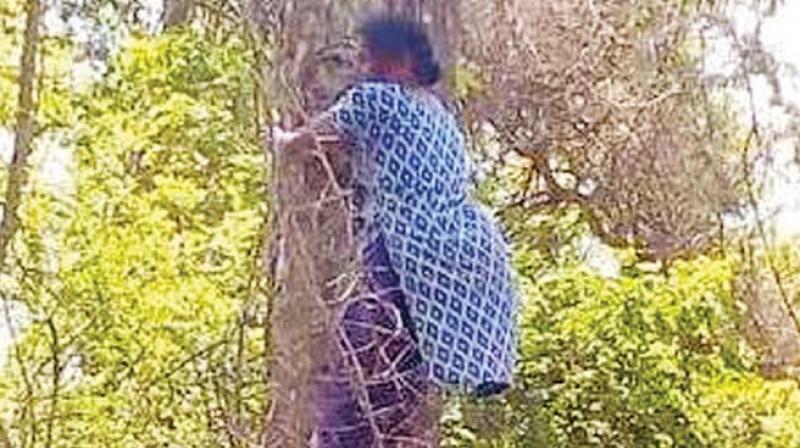
Tribal leader Muthamma climbs a tree in support of her demands at Diddalli in Kodagu on Thursday
Mysuru:
Muthamma, the woman who transfixed her supporters and critics by shedding her clothes to lead a protest, parading stark naked against the unfair treatment meted out to the tribals of Kodagu, is no exhibitionist. She’s a hardcore advocate of tribal rights, who, as the government have realised to their cost, will not back down.
“It is not easy for a woman to remove her clothes and march nude in public. But it was my intense agony for my people and anger over the injustice they had suffered that forced me to opt for such a protest,” says 48- year-old Muthamma, who is leading the tribals camping in Diddalli in their fight for housing sites and land to farm on.
A video of her nude march to protest the tribals’ eviction from Diddalli in December last year had gone viral on social media. Married to Basappa, a daily wage worker, Muthamma has four children and her younger brother, Appaji is a GP member.
“As a child I was deeply pained to see my own parents moving from one place to another after they were removed from the forests. But they did not give up and go to line houses in coffee plantations. Instead they ensured that I studied till class 10. Later the Union government made me part of the Mahila Samukya, where I trained in empowering women and motivating them to have an education. In 1993, I was elected a GP member, but my hands were tied and I couldn’t do much to help my people,” she recalls. Although her parents finally settled in Channanakote in Diddalli, the family got land rights only in 2008 after a prolonged battle with the government.
“Although there are 200 of us in Channanakote, only 30 have got land rights. I was shocked to hear about our Diddalli tribals living in line houses in plantations in Kodagu being treated as bonded labourers. I was an Aasha health worker, but gave up that job to lead their protest,” she reveals, adding, “I am not part of any NGO, but just another daily wage worker fighting for justice for my people.”
source: http://www.deccanchronicle.com / Deccan Chronicle / Home> Nation> Current Affairs / by Shilpa P / May 06th, 2017
WELCOME. If you like what you see "SUBSCRIBE via EMAIL" to receive FREE regular UPDATES.
Read More »