Category Archives: Amazing Feats

Army day greeting

Imphal: January 14:

On the occasion of Army Day 2012, Lt Gen Dalbir Singh, AVSM, VSM, GOC 3 corps, conveys his greetings and best wishes to all ranks of the Army. The Army Day which is schedule on 15 of January every year in recognition of Lieutenant General (later Field Marshal) K.M. Cariappa becoming the first Indian commander-in-chief in 1949.

GOC 3 Corps, in his message, brought out that all ranks of Army should feel proud of being a soldier of this great and glorious Indian Army. The released also said that “all ranks of spear corps have been working together with the local civil administration and the people of the land to bring in greater growth and prosperity in Northeastern region.

GOC 3 Corps also expressed his appreciation to the dedicated efforts of each soldier towards this noble cause.

The released further said that Army has been a source of inspiration and has contributed to society’s development in a number of ways. Army’s efforts to undertake infrastructure developmental projects, to motivate school children, to recruit Jawans, to conduct vocational training, to provide medical & veterinary services at remote locations and to encourage women empowerment has made significant difference in the overall growth of the region. The General also added, “We salute the brave soldiers who have made the supreme sacrifice in the performance of their duty”.

source: http://www.kanglaonline.com / by Imphal Free Press / January 14, 2012

Indian Army: Poised to safeguard the nation and uphold democratic norms

New Delhi, Jan.14 (ANI):

In India, the month of January witnesses two things in ample measure – the biting cold and a spirit of nationalism. National fervor is whipped up by the Republic Day celebrations with parades and revelries generating tremendous enthusiasm.

Yet another ode to nationalism is the Army Day celebrations held across the Nation on January, 15. It was on this historic day in 1949 that the Indian Army divested the control of the British with General (later Field Marshal) K. M. Cariappa taking over as the first Commander-in-Chief of the Indian Army from Sir Francis Butcher.

A number of parades, memorial lectures, equipment displays, investiture ceremonies organised by the Army on this day elicit tremendous response from the general public.

The Army Day is also a time to audit the achievements of the Army in the year gone by. The pace for this very sensitive exercise is set, in no small measure, by the traditional press conference of the Chief of Army Staff (COAS). This year, the press conference by General VK Singh, COAS, was held at the majestic Manekshaw Stadium on January, 12. Many issues of relevance came up during the press conference.

In the year gone by, the Army continued with its operational engagement in such pockets of the Nation where inimical forces are not desisting from spreading the cult of terrorism. 65 brave soldiers of the Army made the supreme sacrifice while upholding the safety and integrity of the Nation in 2011. These included 11 officers, 06 Junior Commissioned Officers and 45 brave soldiers.

Due to relentless anti terrorist operations by the Army, the year gone by was the most peaceful in the Kashmir Valley since 1990. Jammu province witnessed 74 per cent decline and the Kashmir Valley witnessed a 33 per cent decline in terror violence as compared to 2010.

Terrorism related violence in 2011 dropped to an all time low of around 190 incidents. Beyond internal security, the Army also upheld its tradition of being the first to respond to natural calamities. It made a sterling effort to restore the situation in earthquake afflicted Sikkim and also some flood affected regions of the country.

Operationally, the Army made quantum progress in critical aspect of modernisation and transformation designed to make the force more lethal, mobile and network centric.

Some new structures were put to test and validation. A primary validation initiative was Exercise Sudarshan Shakti which culminated in mid December, 2011. The exercise was witnessed by none other than the President of India, Pratibha Patil. It successfully validated a number of new concepts that were earlier on the drawing board.

The fighting capability of the Army was enhanced during the year by better surveillance, improved night fighting capability, air defence capability and human resource development. The Army is now better poised for tactical decision making and deeper strikes.

The Army rendered significant assistance in preparing Police and Para-military Forces (PMF) in tackling internal strife. About 33000 police and paramilitary personnel were trained for counter Naxal operations.

Advisories were given when sought and footprint in the region was improved by an increase in recruitment. However, the army desisted from getting directly involved in counter Naxal operations since it would weaken its bond with the people and negatively impact its preparedness for its primary task of defending the country’s borders against external aggression.

The environment in the neighbourhood continued to pose a challenge to India’s security. Even though Pakistan remained instable, its internal problems did not lead to a letdown in support to cross border terrorism.

The army remained ready for all eventualities; it constantly monitored the border and had complete information about the 42 camps in Pakistan occupied Kashmir which facilitate infiltration.

The circumstances dictated enhanced vigil in Jammu and Kashmir and also the continuance of enabling legislations like the Armed Forces Special Powers Act which provide protection to the soldiers performing extraordinary duties under extraordinary circumstances.

The line of actual control with the Chinese did generate issues of perceptions but confidence building measures remained in place even as necessary steps to build up defence capability in the form of force accretion and improvement of infrastructure were put into motion.

The army attempted to reach out to other countries in India’s extended neighbourhood through the medium of joint exercises and exchange of ideas on tackling terrorism and insurgencies.

The army also continued with its sizeable contribution to the United Nation (UN) peace efforts with more than 7000 personnel deployed in UN missions abroad.

The internal health of the Indian Army was addressed by emphasis on the core value systems which form the bedrock of its culture. A clear message was sent out that rank and power will not come in the way of punishing those who indulge in misdemeanours and acts of impropriety.

The army’s thrust towards sports and adventure was encouraged and the result was as many as 112 medals in the National Games. Five army sportsmen have already been selected to represent the country in the London Olympics.

The Indian nation is going through some testing times. The Indian Army is prepared for all eventualities and for effectively performing its responsibilities towards the nation.

The people of India see the Indian soldier as the epitome of all that is the best in the country due to his demonstrated qualities of courage, self sacrifice, integrity, strength of character and commitment to the cause of the nation.

It is the bounden duty of the nation to ensure that the blood spilled by the soldier as also his contribution to the national cause does not go waste. To ensure the same all out efforts should be made to maintain him at a highest pedestal professionally, socially and psychologically. By Jaibans Singh (ANI)

source: http://www.newstrackindia.com / ANI / New Delhi / Saturday, January 14th, 2012
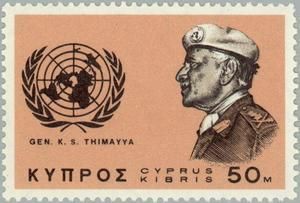
Commemorative Issue – General Thimayya

General Kodandera Subayya Thimayya was born in Madikeri, the district town of Kodagu (also known as Coorg), Karnataka, India. He was a graduate of the Royal Indian Military College in Dehra Dun. He served in the Indian Army from many posts.

He became Chief of Army Staff of the Indian Army in 1957. He was also awarded the Distinguised Service Order. After the Korean War, he headed an United Nations unit dealing with the repatriation of prisoners of war. After his retirement from the Indian Army, he was appointed as the Commander of UN Forces in Cyprus (UNFICYP) in July 1964.

While in Cyprus, he died of a heart attack, in 1965. The Republic of Cyprus, in addition to this stamp issue, honored him by renaming an avenue of the city of Larnaca after him.

Commemorative Issue General Thimayya

Cyprus
Date of Issue: 06 June 1966 /4/1966
Technical Information
Quantity: 292329
Designer: A. Tassos

source: http://www.philatelism.com
http://www.philatelism.com/details.php?issueid=24

Award for P.M. Belliappa


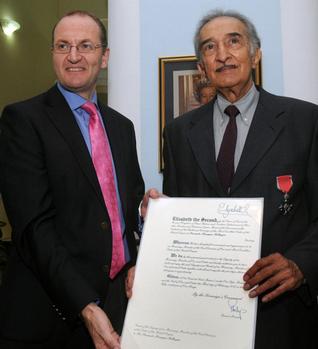
British Deputy High Commissioner in southern India Mike Nitharvrianakis presents the Most Excellent Order of the British Empire citation and medal to the president of ABS P.M.Belliappa in Chennai on Monday. Photo: K Pichumani
Recognising his contribution towards improving the Indo-U.K. relationship, the British High Commission presented the Most Excellent Order of the British Empire (MBE) badge to P.M. Belliappa, president of the Association of British Scholars at a function here on Monday.

Mike Nitharvrianakis, British Deputy High Commissioner in southern India, said that the award is to recognise Mr. Belliappa’s services to environmental protection and for promoting Indo-U.K. alumni relations through the ABS. Calling the award as a “very, very rare honour”, Mr. Nitharvrianakis said “Indians who study abroad always try to give something back to the country where they spent their academic life. Mr.Belliappa is a prime example.”

Terming the occasion as a moment of great joy and pride, Kartar Singh, Deputy Director, British Council, said that Mr. Belliappa is a true ambassador of Indo-U.K. relationship. “This award celebrates his human spirit,” he said. Reflecting on his life and career, Mr.Belliappa said “I have had three careers, running almost in parallel – civil service, my years as an international environmental consultant and the ABS. In all of them, I’ve achieved a measure of success. But the results were achieved only due to a collective endeavour.”

source: http://www.thehindu.com / News> Cities> Chennai / by Staff Reporter / April 12th, 2011

Bajaj Discover presents 6th Dr. Batra’s Positive Health Awards 2011, Anil Kumble Felicitates the Awardees

Mumbai, Maharashtra:

The awardees recognized were Ms Sujatha Burla, Mr Siddu S. Loute, Mr Shreedhara T S and Ms Bhumika Rajendra for their exemplary effort of transforming humans to heroes.

Bajaj Discover presents Dr. Batra’s 6th Positive Health Awards 2011, held at the Chowdiah Memorial Hall today witnessed Anil Kumble, the cricket legend felicitating this year’s positive health awardees. This was an initiative to honor significant people who live a positive life despite their physical disabilities. Four such heroes were awarded in the presence of about 1,000 people in appreciation of their laudable efforts and their outstanding courage in their endeavor against diseased and disabled conditions of life.

The winners for this year’s edition of the awards were recognized and selected by an eminent panel of jurists comprising of Smt. Maneka Gandhi, Ms. Anu Aga, Mr. Vivek Oberoi, Mr. R. Balki, Mr. Rajiv Bajaj and Dr. Mukesh Batra. The awardees recognized were Ms Sujatha Burla, Mr Siddu S. Loute, Mr Shreedhara T S and Ms Bhumika Rajendra for their exemplary effort of transforming humans to heroes.

In addition to a short biographic film on each awardee, attendees at the award function were treated to scintillating performances by the dance guru Shiamak Davar’s troupe of specially-abled children.

Admiring the spirit of the awardees, the Indian Cricket Legend, Anil Kumble, said, “I am immensely delighted to felicitate these heroes who have fought out the trials and tribulations in life and have created a niche for themselves in the society. The foremost rule of any sport is to never give up, no matter what, but to keep fighting till the end. These individuals have lived that never ceasing spirit and have successfully fought against all the impossibilities in life to create possible winning situations for themselves. I salute Dr Mukesh Batra and Mr Rajiv Bajaj for this extra-ordinary event and for the great work that they are doing to contribute towards such a noble cause.

Speaking on the occasion, Dr. Mukesh Batra, Founder and CMD, Dr. Batras’ Positive Health Clinic Pvt. Ltd. said, “Dr. Batra’s Positive Health Awards salutes people with unyielding grit and unflinching determination, who have beaten all odds to overcome seemingly hopeless situations and have been dedicated enough to make commendable contributions to society. These heroes have demonstrated the strength of the human spirit and have proved that, all it takes to make a difference in the world is a strong will power and great positivity. The Positive Health Awards honor this spirit and re-affirm Dr Batra’s commitment to health and positivity.”

Reiterating his support to the cause, Mr. Rajiv Bajaj, MD, Bajaj Auto Ltd. said, “The Dr. Batra’s Positive Health Awards is a step in a noble direction and we are proud to be associated with this initiative for the second consecutive year. We firmly believe that the lives of these awardees will inspire and spread hope to others.”

About the Awardees:
Ms Sujatha Burla (32 years): A road accident that happened 10 years back changed her life forever making her quadriplegic with limited mobility below the shoulders. She is a TEDx speaker and a popular TV presenter for TV9 hosting a show called “Close Encounter with Suzy”. She has never suffered with bed sores in last 10 years as she practices yoga and physical exercises regularly. She provides counselling to paraplegic people and also addresses the NASA & ISRO scientists with motivational speeches on positive thinking and living. She has been running an orphanage for the past 3 years. She belongs to a middle class family from Hyderabad. Her father passed away few years ago. With no financial support from any of her 3 elder siblings, she earns a living and supports her mother too.

Mr Siddu S. Loute (25 years): Visually impaired since birth, Mr. Siddhu is a Mathematics prodigy fondly called as a human computer. By Class II, he had already memorized math tables up to 56 lakh and now claims to have memorized tables up to 99 crore. When provided with a date from the past or future, he can provide the exact day the date falls on. He has memorized 45,000 phone numbers which makes him a walking-talking telephone directory. He had also participated and won a prize in a popular television show on Sony TV called ‘Entertainment ke liye kuch bhi karega’. His unique talent combined with his irrecoverable condition got him featured on a couple of TV channels such as TV9, Suvarna, Suvarna News, DD 1 and Sakshi. Overtly ambitious as he is, he has completed his LLB and aims to become an IAS officer with an honest intention to help the needy and the downtrodden. Son of a truck driver, he was abandoned by his family since the age of 5, and has since been living independently.

Mr Shreedhara T S (23 years): Mr. Shreedhara is 100% blind but he can read, write and speak English, Hindi and Kannada. He has developed a Kannada version of the text-to-speak software (first generation open source software) through which any visually challenged person can read, write and work on computers. The Knowledge Commission of Govt. of Karnataka has hosted his software named ‘E-Speak’ on its Kannada Wikipedia website to be used free of cost. He has hands on experience with Windows 98, Windows 2000/XP, Windows Vista, MS Office 2003. He can type at a speed of 35-40 wpm and has extensive knowledge and experience in using the internet. Coming from a farmer’s family, his parents practice farming in a village in the Shimoga District of Karnataka. Currently, his father has come to Bengaluru and has been assisting him in pursuing further education in computers.

Ms Bhumika Rajendra (9 years): She was only 3, when she had an elevator accident and had to get her right leg amputated above the knee. In spite of this disability, she had always wished to excel in Bharatnatyam and classical singing and would constantly practise to turn her dreams into reality. Though the artificial leg that was fitted to her knee was akin to an alien, she accepted it as a vital part of her being and has ever since been pushing her limits to excel in the Bharatanatyam dance form. During her dance sessions, there have been instances when her skin used to give way and the stump bled. And every time that happened she thought of giving up, but she fought unceasingly against all odds with a positive spirit. She has performed with the famous Kannada cine actor Sridhar at a “Zee Kannada” programme organized by Zee TV Network in Bengaluru. She has given many stage performances and has been extensively covered by various publications. She belongs to a lower middle class family from Kodagu District in Karantaka and her father works as a lecturer.

source: http://www.indiaprwire.com / HealthCare/Hospitals> Awards /
December 15, 2011 /India PRwire/

Coming in the line of hunters, he became a frontline warrior of forests

In Coorg, where men once loved hunting, K M Chinnappa broke the tradition by turning his gun to protect the forests. Anita Pratap captures the spirit of the man, and Mahesh Bhat his image

By Anita Pratap and Mahesh Bhat

Hunting was a way of life in the verdant forests and foothills of the Western Ghats in Karnataka’s Coorg area. It was an integral part of tradition, folklore, manhood, sport, food and commerce.

From poor, forest-dwelling tribesmen to the flamboyant royalty and courtiers in bustling Mysore, everyone loved hunting. But one man stood tall to end this way of life. His name is K.M.Chinnappa.

K M Chinnappa was the Range Forest Officer of Nagarahole for over two decades and was single-handedly responsible for making it one of the finest national Parks of India

Born in 1941 in Kumtur village near Nagarhole to a soldier who fought in the First World War, Chinnappa spent his youth roaming the forests of his ancestral land, listening to birds, watching the cavalcade of animals in their habitat, absorbing the every day miracles of the rich eco-system.

An enduring love for nature was thus born in him. Like his father, he too would become a mustachioed soldier. But with a difference. He would become a gun-toting, frontline warrior of the forests, dedicated to protecting wild life. Says he simply: “Wildlife is the purpose of my life.’

In 1967, he joined the Nagarhole National Park as a forester. The park was in ruins. Hunting had taken its toll. There were hardly any deer left, forget tigers and other big game. To cultivate rice, villagers had encroached on the swamps – the beloved play-ground of the elephants.

Tribesmen lived in clusters deep within the park to collect forest produce, ranging from honey to berries. Livestock herders grazed their cattle on the park’s grasslands. Hunters preyed on animals and birds.
Poachers hunted tigers for their skin; elephants for their tusks. Timber logging was a thriving mafia business. Sandalwood smugglers roamed with abandon.

The destroyers of Nagarhole’s environment used a range of weapons – hunters shotguns, tribesmen used snares and livestock herders used poison. Wild life protection laws were weak and the Forest Department concentrated on logging, misguidedly uprooting the diversity of natural vegetation to replace them with the monocultures of teak.

Rued Chinnappa: “If this devastation continued, I was dead certain that there would be no wild life left in Nagarhole in 30 years.”

He became a one-man army to reverse this process. And he succeeded. In less than a quarter of a century, Nagarhole revived, expanding from a 250 sq km part to 640 sq kms.

The poachers have retreated, the encroachers have gone and the hunters are virtually extinct, restoring Nagarhole to its rightful inhabitants – tigers, panthers, leopards, sloth bears, jackals, wild boars, porcupines, hares, langur and varieties of deer.

In the bad old days, tigers had to roam 200 sq kms before they could find prey. Now they can find it within 12 sq kms. The elephants are back where they belong: in the lush swamps and bamboo groves. The trick? Explains Chinnappa: “All you have to do is to stop human interference. Just leave the forests alone and they will regenerate themselves”.

Chinnappa was the right man at the right time. In 1972, in the wake of a groundswell of opinion generated by several leading Indian conservationists, then Prime Minister Indira Gandhi took a slew of measures to protect the environment.

Several laws were enacted and sanctuaries in Kanha, Corbett, Ranthambore, Bandipur and Nagarhole among others were pulled back from the brink of destruction.

Forest departments had new direction, muscle and teeth. Still, keeping the humans out of the forests was not easy. Chinnappa paid a high personal price to fulfil his mission to safeguard Nagarhole. He was arrested, jailed, transferred. His home was burned down. But he has no regrets. Says he with his characteristic robust optimism: “What’s the use of just going to office. I led a colourful life.”

To protect wild life, Chinnappa had to take on a range of human beings who lived on the wild side of life. He captured a large number of poachers and smugglers and filed court cases against them. But they were all acquitted in no time and were back to their wicked ways.

He realized he would have to terrorize them, make it really dangerous for them to hunt and poach. He took up the gun and did not hesitate to shoot. He recalls: “No body used high-calibre guns. I had only a 12 bore rifle. And I used only buckshot. But at that time, it was enough.”

He remembers the legend of a tribesman whom the locals nicknamed “parari Thimma” – vanishing Thimma. He was a notorious poacher who nimbly eluded forest guards. Chinnappa began tracking him and one day shot at him. And then he vanished forever!

Chinnappa became the local legend. Supporters hailed him as a hero, the phantom of the jungles. Poachers called him “The Devil” who stalked their hunting grounds.

Chinnappa used his immense knowledge of forest trails, tracking spoor, jungle craft, fabled night vision and stealth maneuvers to ambush the poachers and hunters. Guided by moonlight, he silently crept upon the forest brigands and opened fire. And the old way of life began to end.

But not without resistance. In no time, the threatened “vested interests” – profiteering poachers, unscrupulous smugglers, wealthy hunters, criminals, mafia operators and politicians all ganged up against Chinnappa.

In 1993 after voluntarily retiring from Karnataka Forest department, Chinnappa started Nagarahole Wildlife Conservation Education project reaching out to the local students, youth and the public.

Even the villagers rose in revolt. For Chinnappa, life took a curious turn. On the one hand, the regeneration of Nagarhole won high praise. He bagged the Karnataka Chief Minister’s Gold Medal in 1983, received an award from the Wildlife Conservation Society and foreign environmentalists showered glowing tributes in books and magazines.

His spartan way of life, incorruptibility and military discipline became legendary. Says Ullas Karanth, a leading wildlife biologist: “Chinnappa is a man of integrity. He is tough, efficient and incredibly courageous in the face of grave physical danger. His accomplishments in Nagarhole are undoubtedly a major milestone in the history of Indian wildlife conservation.”

He was admired and respected by his peers. But some of the locals feared and hated him. In 1988, one of Chinnappa’s guards publicly shot a local coffee planter who had killed and eaten his pet samba deer.

The dispute spun out of control and soon local poachers instigated a public agitation, accusing Chinnappa of masterminding the murder. Bowing to political pressure, Chinnappa was arrested and jailed for 12 days. Eventually he was cleared of all charges and reinstated

But vested interests continued to persecute him. He was implicated in the killing of a poacher in 1992 and a riot erupted. A frenzied mob ransacked the Forest Department’s buildings, burnt vehicles, assaulted staff, set fire to large swathes of forest land and set ablaze Chinnappa’s ancestral home.

Once again, he was cleared of all charges, but this time, Chinnappa decided to quit. He could understand why the poachers, smugglers and politicians ganged up against him. But the fact that they could enlist the support of villagers had a profound impact on him.

He realized he needed to move to another plane of conservation: education. He had to make the locals realize the practical and moral imperative to protect their environment. It was not merely the job of foresters. It was a collective responsibility.

And so in 1993 he retired prematurely from the Forest Department and started his NGO, the Nagarhole Wildlife Conservation Education Project to educate the local people and especially the children on the need to protect the environment.

His motto was simple: “Without humans, the forest will flourish. Without forests, we humans cannot flourish.” Through forest camps, discussions and slide shows, he opens the doors to a magical kingdom of flora and fauna, encouraging children to take delight in observing nature instead of hunting animals.

His mission also involves fighting legal cases. As President of Bangalore-based NGO, “Wildlife First”, Chinnappa and a group of conservationists documented the ecological devastation caused by the iron ore mine operators in Kudremukh. In retaliation, they were slapped with 12 criminal cases.

Says Bittu Sehgal, editor of environment magazine, ’Sanctuary’: “Law suits are filed by those who have money or power on their side to prevent public minded citizens from ‘interfering’.” The cases dragged on for years and wound up in the Supreme Court, which ordered the closure of the mines in December 2005.

Chinnappa’s accomplishments are all the more laudable because they were won against the stiffest odds. He endured setbacks, difficulties, threats, attacks, vilification, arrests and court cases.

But, remarkably, he has emerged unscathed, his innocence, courage, dedication, honour and optimism intact. He is completely devoid of bitterness. He chooses to forget the troublemakers who made life so difficult for him and his loyal wife Radha, but remembers fondly the senior officers and lowly guards who stood by him.

Through all his trials and tribulations, one thing remained undiminished: his sheer will to save the forests. With deep conviction he says: “If you have the will, you can do wonders.”

Today, Chinnappa derives enormous satisfaction from the guns – the yesteryear symbol of manhood – that lie rusting in many a Coorgi home. Cheering the end of that bygone era are the sights and sounds of a promising new life, symbolized by the swaying foliage and barking deer.

(Extract from the book ‘Unsung’ by Anita Pratap and Mahesh Bhat)

source: http://www.theweekender.com / Home> Causes> Gun Reversal /vol. 2, issue. 50 / 16-22 December, 2011

Appaiah Gowda Memorial to Honour Freedom Fighter

MADIKERI:

Freedom fighter Guddemane Appaiah Gowda, who led the “Katukai battle” (Amara Sullya Dange) against the British in 1837, is one of the greatest heroes Kodagu has produced, said Lt. Gen. (retd.) B.C. Nanda on Wednesday.

Unveiling a plaque to mark the construction of a memorial for Appaiah Gowda at the Nehru Park here, Gen. Nanda said Kodagu has produced many freedom fighters who fought against Hyder Ali, Tipu Sultan or the British, and all of them had great pride in the culture of the region. The “Beerakallu” (stone memorials) found in many parts of the district symbolised the valour of the freedom fighters of the past, he said.

The educationist and philanthropist Kurunji Venkataramana Gowda announced that he would donate Rs. 1 lakh for the construction of the memorial. He donated Rs. 50,000 as the first instalment to the Madikeri MLA, K.G. Bopaiah, who presided over the occasion. He also offered 27 acres of land at Mekeri near here for starting an educational institution.

Precedent

Appreciating the decision of the committee to erect a memorial to Appaiah Gowda, the educationist M.M. Chengappa said that the late freedom fighter had set a precedent for the freedom movement in the country.

The Deputy Commissioner, P. Subramaniam, hailed Appaiah Gowda as the “Father of the Freedom Struggle” in Kodagu. Gowda’s heroics should inspire the youth to develop patriotism and enlist themselves more in the armed forces, he said.

Stating that Appaiah Gowda was a symbol of patriotism, self-respect and pride for Kodagu, Mr. Bopiah said the ideals of the late leader still inspired all. Appaiah Gowda, who was hanged by the British in 1837 in front of the Madikeri Fort for leading protests against the colonial power, did not want outsiders to have a say over the affairs of Kodagu, said Mr. Bopiah.

Although a memorial for Appaiah Gowda was deemed necessary in the region from as early as 70s, it is good that it has materialised at least now, he added.

The working president of the Guddemane Appaiah Gowda Memorial Committee, T.P. Ramesh, and the former Madiker iMLA D.S. Madappa spoke

source: http://www.thehindu.com / Staff Correspondent / Karnataka – Madikeri / online edition / Thursday May 19th, 2005

First Woman IFS Officer Muthamma Passes Away

C B Muthamma, the first woman Indian Foreign Service (IFS) officer, died here on Wednesday. She was 85. 

She passed away in a private hospital where she was undergoing treatment, her family members said.

Chonira Belliappa Muthamma was born Jan 24, 1924, in Kodagu. In a career that began in 1949, she served as ambassador and high commissioner to a number of countries. She retired in 1982.

Muthamma had fought against gender bias in the foreign service and had taken the Indian government to court in 1979 for bypassing her for the coveted foreign secretary’s post.

Though the Supreme Court dismissed the petition, it noted that there was truth in Muthamma’s contention that there was gender discrimination in the foreign office.

Muthamma brought out in the form of a book essays she had written over the years. Titled ‘Slain by the System – India’s Real Crisis’, it was published in 2003.

She had also co-authored a book on Kodava cuisine.


source: http://www.bangaloremirror.com / IANS / Thursday  Oct 15th, 2009

Surgery Pumps New Life into Her

Wockhart doctors perform rare operation that helps 13-year-old girl’s left ventricle pump more blood to the body


Looking at her sitting with quiet dignity, facing the glare of harsh lights, you would never guess what her tiny heart has been through.

Indira, 13, a farmer’s daughter from Kodagu, was born with her heart on the right side of her body, while the heart’s pumping chambers and arteries had got inter-changed.

She got a ‘new life’ after Dr Devananda from Wockhardt Hospital and his team performed three surgeries her – all within a year which has worked miracles for the child.

Ever since she was a year old, Indira used to fall sick frequently. She made trips to many hospitals, where she was prescribed medicines for for ailment. When she grew older, she had difficulty in breathing and used to turn blue after even after a little work.

Options open

Fortunately, Dr Devananda met her and explained to her family that surgery was the only chance for her survival.
Indira’s heart was unable to pump blood to the entire body as her ventricles had got interchanged. The right ventricle pumps blood to the lungs and the left ventricle to the rest of the body. As her left ventricle wasn’t strong enough to pump blood at required pressure, doctors had to train her heart by creating obstructions in the blood flow to increase blood pressure.

There have been only a handful of cases in the world where the ventricle has been trained to pump blood after the age of 12. As her parents could not afford the surgery, the Needy Heart Foundation stepped in along with Wockhardt Hospitals to facilitate the same. The final step, the ‘double switch’, was completed successfully. The girl was on artificial ventilation for two weeks as she had developed pneumonia after her surgery, on May 26 this year. Before the final surgery, doctors had given her a 25-50 per cent chance of survival. But Indira insisted she wanted the surgery and her parents relented.

Dr Prakash Vemgal, who monitored her after surgery till her discharge, spoke about how, after the tubes were removed from Indira’s mouth and she could speak, she told doctors that her birthday was on June 16.  A surprise party was arranged for her and she cut the cake.

After speaking to the press, she quietly left with her mother in an autorickshaw.

source: http://www.bangaloremirror.com / Bangalore Mirror Bureau / Monday, Sept 22nd, 2008

Country’s First Woman Diplomat Dies at 85

C B Muthamma

The country’s first woman diplomat (Indian Foreign Service (IFS) officer), Chonira Belliappa Muthamma, died at a private hospital in Bangalore on October 14, 2009,  following a brief illness, family sources said.  Muthamma (85) was born in a modest family at Virajpet in the hilly Kodagu district of Karnataka.

She had served as the ambassador to Hungary, the Netherlands and Ghana. She was also part of Indian diplomatic missions in several countries in Europe, Asia and Africa. Muthamma, the first woman to enter Civil Services in 1949 after clearing UPSC examinations, opted for foreign service and was posted as Third Secretary in the Indian Embassy,Paris.

She had also served in Indian Missions in Yangon and London, besides the Pakistan Division and American Division of the Ministry of External Affairs. The late diplomat was member of the special Non-Governmental Commission on Disarmament and Security Issues set up by Olof Palme, better known as the Palme Commission.


source: http://www.coorgnews.wordpress.com / Oct 22nd, 2009