In Coorg, where men once loved hunting, K M Chinnappa broke the tradition by turning his gun to protect the forests. Anita Pratap captures the spirit of the man, and Mahesh Bhat his image
By Anita Pratap and Mahesh Bhat
Hunting was a way of life in the verdant forests and foothills of the Western Ghats in Karnataka’s Coorg area. It was an integral part of tradition, folklore, manhood, sport, food and commerce.
From poor, forest-dwelling tribesmen to the flamboyant royalty and courtiers in bustling Mysore, everyone loved hunting. But one man stood tall to end this way of life. His name is K.M.Chinnappa.
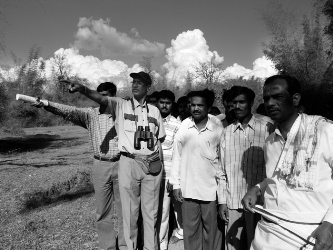
K M Chinnappa was the Range Forest Officer of Nagarahole for over two decades and was single-handedly responsible for making it one of the finest national Parks of India
Born in 1941 in Kumtur village near Nagarhole to a soldier who fought in the First World War, Chinnappa spent his youth roaming the forests of his ancestral land, listening to birds, watching the cavalcade of animals in their habitat, absorbing the every day miracles of the rich eco-system.
An enduring love for nature was thus born in him. Like his father, he too would become a mustachioed soldier. But with a difference. He would become a gun-toting, frontline warrior of the forests, dedicated to protecting wild life. Says he simply: “Wildlife is the purpose of my life.’
In 1967, he joined the Nagarhole National Park as a forester. The park was in ruins. Hunting had taken its toll. There were hardly any deer left, forget tigers and other big game. To cultivate rice, villagers had encroached on the swamps – the beloved play-ground of the elephants.
Tribesmen lived in clusters deep within the park to collect forest produce, ranging from honey to berries. Livestock herders grazed their cattle on the park’s grasslands. Hunters preyed on animals and birds.
Poachers hunted tigers for their skin; elephants for their tusks. Timber logging was a thriving mafia business. Sandalwood smugglers roamed with abandon.
The destroyers of Nagarhole’s environment used a range of weapons – hunters shotguns, tribesmen used snares and livestock herders used poison. Wild life protection laws were weak and the Forest Department concentrated on logging, misguidedly uprooting the diversity of natural vegetation to replace them with the monocultures of teak.
Rued Chinnappa: “If this devastation continued, I was dead certain that there would be no wild life left in Nagarhole in 30 years.”
He became a one-man army to reverse this process. And he succeeded. In less than a quarter of a century, Nagarhole revived, expanding from a 250 sq km part to 640 sq kms.
The poachers have retreated, the encroachers have gone and the hunters are virtually extinct, restoring Nagarhole to its rightful inhabitants – tigers, panthers, leopards, sloth bears, jackals, wild boars, porcupines, hares, langur and varieties of deer.
In the bad old days, tigers had to roam 200 sq kms before they could find prey. Now they can find it within 12 sq kms. The elephants are back where they belong: in the lush swamps and bamboo groves. The trick? Explains Chinnappa: “All you have to do is to stop human interference. Just leave the forests alone and they will regenerate themselves”.
Chinnappa was the right man at the right time. In 1972, in the wake of a groundswell of opinion generated by several leading Indian conservationists, then Prime Minister Indira Gandhi took a slew of measures to protect the environment.
Several laws were enacted and sanctuaries in Kanha, Corbett, Ranthambore, Bandipur and Nagarhole among others were pulled back from the brink of destruction.
Forest departments had new direction, muscle and teeth. Still, keeping the humans out of the forests was not easy. Chinnappa paid a high personal price to fulfil his mission to safeguard Nagarhole. He was arrested, jailed, transferred. His home was burned down. But he has no regrets. Says he with his characteristic robust optimism: “What’s the use of just going to office. I led a colourful life.”
To protect wild life, Chinnappa had to take on a range of human beings who lived on the wild side of life. He captured a large number of poachers and smugglers and filed court cases against them. But they were all acquitted in no time and were back to their wicked ways.
He realized he would have to terrorize them, make it really dangerous for them to hunt and poach. He took up the gun and did not hesitate to shoot. He recalls: “No body used high-calibre guns. I had only a 12 bore rifle. And I used only buckshot. But at that time, it was enough.”
He remembers the legend of a tribesman whom the locals nicknamed “parari Thimma” – vanishing Thimma. He was a notorious poacher who nimbly eluded forest guards. Chinnappa began tracking him and one day shot at him. And then he vanished forever!
Chinnappa became the local legend. Supporters hailed him as a hero, the phantom of the jungles. Poachers called him “The Devil” who stalked their hunting grounds.
Chinnappa used his immense knowledge of forest trails, tracking spoor, jungle craft, fabled night vision and stealth maneuvers to ambush the poachers and hunters. Guided by moonlight, he silently crept upon the forest brigands and opened fire. And the old way of life began to end.
But not without resistance. In no time, the threatened “vested interests” – profiteering poachers, unscrupulous smugglers, wealthy hunters, criminals, mafia operators and politicians all ganged up against Chinnappa.

In 1993 after voluntarily retiring from Karnataka Forest department, Chinnappa started Nagarahole Wildlife Conservation Education project reaching out to the local students, youth and the public.
Even the villagers rose in revolt. For Chinnappa, life took a curious turn. On the one hand, the regeneration of Nagarhole won high praise. He bagged the Karnataka Chief Minister’s Gold Medal in 1983, received an award from the Wildlife Conservation Society and foreign environmentalists showered glowing tributes in books and magazines.
His spartan way of life, incorruptibility and military discipline became legendary. Says Ullas Karanth, a leading wildlife biologist: “Chinnappa is a man of integrity. He is tough, efficient and incredibly courageous in the face of grave physical danger. His accomplishments in Nagarhole are undoubtedly a major milestone in the history of Indian wildlife conservation.”
He was admired and respected by his peers. But some of the locals feared and hated him. In 1988, one of Chinnappa’s guards publicly shot a local coffee planter who had killed and eaten his pet samba deer.
The dispute spun out of control and soon local poachers instigated a public agitation, accusing Chinnappa of masterminding the murder. Bowing to political pressure, Chinnappa was arrested and jailed for 12 days. Eventually he was cleared of all charges and reinstated
But vested interests continued to persecute him. He was implicated in the killing of a poacher in 1992 and a riot erupted. A frenzied mob ransacked the Forest Department’s buildings, burnt vehicles, assaulted staff, set fire to large swathes of forest land and set ablaze Chinnappa’s ancestral home.
Once again, he was cleared of all charges, but this time, Chinnappa decided to quit. He could understand why the poachers, smugglers and politicians ganged up against him. But the fact that they could enlist the support of villagers had a profound impact on him.
He realized he needed to move to another plane of conservation: education. He had to make the locals realize the practical and moral imperative to protect their environment. It was not merely the job of foresters. It was a collective responsibility.
And so in 1993 he retired prematurely from the Forest Department and started his NGO, the Nagarhole Wildlife Conservation Education Project to educate the local people and especially the children on the need to protect the environment.
His motto was simple: “Without humans, the forest will flourish. Without forests, we humans cannot flourish.” Through forest camps, discussions and slide shows, he opens the doors to a magical kingdom of flora and fauna, encouraging children to take delight in observing nature instead of hunting animals.
His mission also involves fighting legal cases. As President of Bangalore-based NGO, “Wildlife First”, Chinnappa and a group of conservationists documented the ecological devastation caused by the iron ore mine operators in Kudremukh. In retaliation, they were slapped with 12 criminal cases.
Says Bittu Sehgal, editor of environment magazine, ’Sanctuary’: “Law suits are filed by those who have money or power on their side to prevent public minded citizens from ‘interfering’.” The cases dragged on for years and wound up in the Supreme Court, which ordered the closure of the mines in December 2005.
Chinnappa’s accomplishments are all the more laudable because they were won against the stiffest odds. He endured setbacks, difficulties, threats, attacks, vilification, arrests and court cases.
But, remarkably, he has emerged unscathed, his innocence, courage, dedication, honour and optimism intact. He is completely devoid of bitterness. He chooses to forget the troublemakers who made life so difficult for him and his loyal wife Radha, but remembers fondly the senior officers and lowly guards who stood by him.
Through all his trials and tribulations, one thing remained undiminished: his sheer will to save the forests. With deep conviction he says: “If you have the will, you can do wonders.”
Today, Chinnappa derives enormous satisfaction from the guns – the yesteryear symbol of manhood – that lie rusting in many a Coorgi home. Cheering the end of that bygone era are the sights and sounds of a promising new life, symbolized by the swaying foliage and barking deer.
(Extract from the book ‘Unsung’ by Anita Pratap and Mahesh Bhat)
source: http://www.theweekender.com / Home> Causes> Gun Reversal /vol. 2, issue. 50 / 16-22 December, 2011
 Looking at her sitting with quiet dignity, facing the glare of harsh lights, you would never guess what her tiny heart has been through.