Category Archives: Arts, Culture & Entertainment

7th India International Coffee Festival 2018 reflects on experiential tourism in Karnataka

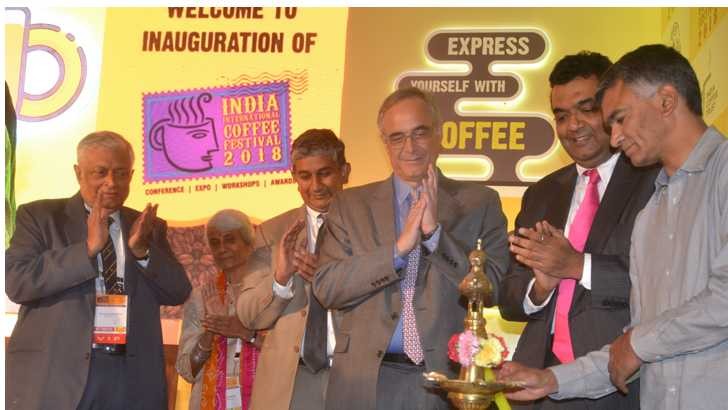
7th edition of India International Coffee Festival 2018 hosted at The Lalit Ashok, Bengaluru saw a host of activities including the coffee workshops, exhibition, keynote sessions, Fireside chat with Shri Priyank Kharge, Hon’ble Minister for IT, BT and Tourism, Government of Karnataka, Coffee Quiz Competition for Coffee enthusiasts ending the day with Café Awards ceremony.

IndiaCoffeeExbn31jan2018

The day started with workshops on ‘Role of sustainability in Post-Harvest Processing Equipment to secure the right quality, type and quantity of coffee.’ The session was led by Carlos Brando and Joao Alberto Peres Brando from Pea Marketing Ltd.

Shri Priyank Kharge, Hon’ble Minister for IT, BT and Tourism, Government of Karnatakagraced the occasion and attended a fireside chat session along with Mr. Anil Kumar Bhandari, President, India Coffee Trust where he emphasized on experiential tourism.“Today people want to experience and learn from their outings, hence experiential tourism is leading to a lot of buzz around homestays. We have offline and online strategies in place and are ready to build infrastructure and jointly manage it with associations. We have opened up 11 new eco-trails that will benefit the homestays and provide exhilarating experience to travelers,” said Shri Priyank Kharge while addressing the gathering.

He further said that, “I am privileged to have a unique opportunity to bring together information technology and biotech to further tourism in the state. I urge the startup fraternity and innovators to come forward with solutions that will help us build a sustainable tourism ecosystem in Karnataka.”

Commenting on this occasion, Anil Kumar Bhandari, President, India Coffee Trust said,“This year the festival focused on skill-building workshops, showcase of products and services, key sessions by delegates on Global Coffee Outlook and Future of Indian Coffee Sector.”

“The Indian coffee sector is growing at a rapid pace. And to sustain this growth, the dependence on government subsidies needs to come to an end,” said Shri Srivatsa Krishna, IAS, Chief Executive Officer and Secretary, Coffee Board of India.

Also, addressing a keynote session here, Jose Dauster Sette, Executive Director, International Coffee Organization said, “India is the sixth place in internal coffee consumption. In future by 2050, the production of world coffee might further decrease due to factors such as climate change that facilitates spread of pests and diseases. Both Arabica and Robusta are also negatively affected by the climate change.”

source: http://www.everythingexperiential.in / Everything Experiential – Business World / Home / by EE News Desk / January 24th, 2018

Anita Cariappa bags nataka academy award

Madikeri:

Anita Cariappa of Kodagu, has bagged the Karnataka Nataka Academy award for the year 2006-07 for her contribution to the field.

She is the wife of stage artiste and founder of “Sristi” theatre in Kodagu, Addanda Cariappa. Ms. Cariappa is a product of the “Neenasam” and a postgraduate in Kannada.

She is the recipient of many awards relating to Kannada and Kodava theatre.

Ms. Cariappa had been a member of the Karnataka Nataka Academy.

She has acted in Kodava films, such as “Bal Polandat” and the national award-winning movie “Hasina”, apart from acting in television serials.

N.S. Deviprasad, who also hails from Kodagu, who has organised various theatre activities in the district, has been selected for the Suvarna Karnataka award from the academy, according to information reaching here.

source: http://www.thehindu.com / The Hindu / Home> National> Karnataka / by Staff Correspondent / July 11th, 2007

A Slice Of History

Boverianda Nanjamma and Chinnappa

Boverianda Nanjamma And Chinnappa Recollect The Efforts Of Their Late Grandfather In Documenting The Folklore And Songs Of The Kodava Community.

Much as we admire him and are inspired by him, we have never seen our grandfather Nadikerianda Chinnappa; he died before we were born. We—Nanjamma and Chinnappa—are cross cousins. The narrative of our grandfather that follows is based on the recollections of our parents, aunts and elder cousins, gleaned from casual conversations over the years.

Our grandfather, who worked with the police, had gone to a remote village, riding his horse across a stream and through a forest path to investigate a quarrel over the ownership of a strip of land. On his way back, he stopped by the stream to eat the akki (rice) roti sweetened with jaggery his wife had packed for him. The sun was setting behind the hills and had painted the skies in brilliant hues of red and gold. Captivated by the scene, Nadikerianda Chinnappa sat lost in thoughts, when he heard the distant sound of Kodava dudi (small handheld, hourglass-shaped drums). Mounting his horse, he set out to locate the origin of the drumbeats. He found four men seated around a bonfire singing Kodava folk songs, practising for Puthari, the harvest festival. It was getting dark but he waited for them to finish. Recognising that our grandfather was in the police, the singers touched his feet respectfully. Our grandfather took the leader of the team home on his horse.

This was not uncommon; his wife Nanjavva knew he had brought a singer home for the night. She made a bed for the visitor in the attic and served them a hot meal with a drink of frothing toddy. Refreshed, grandfather and the singer sat in the hall; while the singer sang a ballad, Chinnappa transcribed the words late into the night. After many such sessions with various singers, he had a good collection of Kodava songs sung during weddings, funerals and festivals, and ballads in praise of deities and heroes.

Himself a good singer, Chinnappa’s passion for Kodava songs and ballads prompted him to transcribe them. During his travels around Kodagu as a police officer in the early 1920s, he observed that the unique customs and traditions of the Kodava community were being forgotten or altered. Chinnappa feared that Kodava traditions and songs that had been handed down orally over generations would be lost because of the dominance of English, and the influence of the cultures of neighbouring areas. So, he decided to document them.

Late in the evenings, after work, he neatly wrote down all the songs, proverbs and riddles by the dim light of a kerosene lamp, while smoking his favourite cigars. When he started documenting the customs and traditions, he consulted his mother Ponnavva who was well-versed in them. Meanwhile, his wife would read the draft first to ensure that it was clear to a layperson. If there were parts she did not understand, Chinnappa rewrote them. It used to be said that the waste paper basket would always be full in the morning.

British officials in Coorg—as Kodagu was called by them—got his draft reviewed by some prominent Kodavas. On their recommendation, C S Sooter, commissioner of Coorg, authorised financial assistance to publish it. Chinnappa chose the name Pattole Palame, meaning ‘silken lore’, for his book, which was first published in 1924. The 6th edition was printed in 2012.

Pattole Palame is a precious document of the heritage of the Kodava community. In the second edition published by the University of Mysore in 1975, the editor describes it as “one of the earliest, if not the earliest, extensive collection of folklore of any Indian community written in an Indian language by an Indian”.

The text of Pattole Palame is in Kannada and the folk songs, proverbs, etc, in it are in Kodava thakk, the language of the Kodavas, an oral language written using the Kannada script. Nearly two-thirds of the book consists of folk songs transmitted orally down generations, which are sung even today. Traditionally known as Balo Pat, these songs are sung by four men beating dudi. The songs have haunting melodies and evoke memories of times long past. Kodava folk dances are performed to the beat of many of these songs, which are a rich source of information on the culture, language and history of the Kodava people.

Chinnappa himself began translating Pattole Palame into English but could not complete it, as he died of cancer in 1931 at the age of 56, a few months after his retirement. It was in 2003, nearly 75 years after Pattole Palame was first published, that we, his grandchildren, translated it into English and published it.

Although he was best known for Pattole Palame, Chinnappa’s major literary work as a poet was Bhagavantanda Paat, his translation of the Bhagavad-Gita into the Kodava language, composed in the style of Kodava folk songs, published in 1929.

When Grierson, a British linguist, embarked on the first Linguistic Survey of India (1913 to 1920), he looked for knowledgeable representatives of the various Indian languages. Chinnappa, who was fluent in both English and Kodava thakk, was chosen for the Kodava language. As required, he translated the parable of the ‘Prodigal Son’ into Kodava thakk and narrated it, and sang his own poem, Sri Moola Kanniye, an ode to river Kaveri. These were recorded in 1922 on gramophone records; copies of the recordings were kept in the British Library in London and the Madras Museum. They were digitised recently by the Linguistics Department of the University of Chicago.

Born in 1875, Chinnappa was the fifth of eight children. After matriculating in Madikeri, he went to Mangalore for further studies. But when his elder brother Subbayya died suddenly, Chinnappa returned to Kodagu to take on family responsibilities. In accordance with Kodava tradition, he married Subbayya’s widow, Nanjavva.

His career took many twists and turns. A teacher at first, then a revenue inspector, and then an officer in the Coorg Regiment of the Army, he joined the police department when the regiment was disbanded in 1904, and rose to the rank of a prosecuting inspector.

Our grandfather was fond of sports. He was a bowler in the All Coorg XI Cricket team, which in those days consisted mainly of Englishmen. When he played billiards at Victoria Club in Virajpet, his British opponents would often swear under their breath on losing a game to him. On one such occasion, Chinnappa lost his patience, broke the billiards stick on his knee and threw it on the floor. This was a very daring act for an Indian in those days.

Chinnappa was also involved in establishing the Police Officers’ Cooperative Society, Coorg Cooperative Society, Coorg Central Bank and the Coorg Education Fund. He was fond of children and always carried peppermints in his pockets. He was a caring father to his own three children, the two stepchildren by his elder brother, and to his deceased sister’s daughter, whom he and Nanjavva adopted. He sponsored the education of many poor children, and there were always a few students boarding in his residence, free of cost.

Our grandfather was a man of vision and talent, and was self-driven. He was a folklorist, poet, police officer, sportsman, historian, singer, philanthropist, and caring householder. Above all, he was a man who lived life to the fullest and left a lasting and invaluable legacy for his people in his writings.

The authors are translators and scholars of Kodava studies

Featured in Harmony — Celebrate Age Magazine
August 2016

A-slice-of-history

source: http://www.harmonyindia.com / Harmony / Home> Columns / August 2016

‘Restart genealogical study on Kodavas’

Codava National Council members stage a protest in Madikeri on Tuesday to urge the government to conduct a genealogical study of Kodavas.

Codava National Council (CNC) members staged a protest in Madikeri on Tuesday to urge the government to restart the genealogical study of Kodavas, which has been stagnant.

The report on the study should be submitted to the centre by the end of this month, the protestors demanded.

Gathering in front of the deputy commissioner’s office, the members urged the government to complete the study so that the Kodava community could be added to the list of tribes.

Council president N U Nachappa said that the demands should be considered seriously. The elected representatives should exhibit will power in fulfilling the aspirations of the Kodava community.

During Chief Minister Siddaramaiah’s visit to Kodagu recently, MLC Veena Acchaiah had submitted a memorandum to him, requesting to restart the genealogical study of Kodavas, he said, and added that the study should not become an election gimmick.

A memorandum was submitted to the deputy commissioner on the occasion.

Codava National Council leaders Katumaniyanda Umesh, Pullera Kalappa and Chambanda Janat participated in the protest.

source: http://www.deccanherald.com / Deccan Herald / Home> District / by DH News Service / Madikeri – January 16th, 2018

Warrior Women of Coorg

Veena Poonacha’s recent book on three Kodagu women chronicles a significant journey into the changing fortunes of women in India, says Geeta Seshu

“At the age of 15, my great-grandmother travelled every day to supervise the construction of our family home, sustaining herself only on curd-rice and dry fish. Though my grandmother was widowed at the age of 39, she lived alone with a pistol under her pillow and built the family fortune. My mother went back to her roots and devoted her life to education.”

Meet Dr Veena Poonacha. And meet her great-grandmother, Ponamma, her grandmother, Subamma, and her mother, Neelamma. And don’t stop here. Meet all the courageous, intrepid women of the Kodava (Coorgi) community who helped carve out a unique race of warriors in the land of a thousand hills.

Dr Veena Poonacha, Director of the Research Centre for Women’s Studies (RCWS) at Mumbai’s SNDT University, has devoted many years to a study of the status of women in Coorgi society. She has drawn inspiration from the rich lore of oral history and the amazing collection of letters and photographs from her family and clan for her book, “From the Land of a Thousand Hills: Portraits of three Kodagu women”, published in December 2002 by SPARROW, the Sound and Pictures Archives for Research on Women.

“My mother was a great storyteller. She literally fed us with stories of her mother and her grandmother and of life in the Kodava/Coorgi community. I merely retold their stories,” says Poonacha.

Indeed, the folk literature is replete with the rich cultural and social history of Coorg. Coorg, or Kodagu as it is now known, is the smallest district in Karnataka. It has beautiful forests and verdant hills that house the landowning warrior community that even now forms a significant part of the Indian army. They were free of the pernicious caste system and taboos. While paddy was the primary crop, the economy was monetised under the British and coffee was introduced in 1845. Land relations changed and traditional inheritance laws, that hitherto maintained that land devolved from one generation to another, were replaced by the colonial policy wherein ancestral property was transferred from father to son.

Consequently, gender relations underwent a major transformation. In the past, the family owned the land and was maintained by both men and women of the community. Women never lost the right to return to their maternal home. Child (pre-pubertal) marriages, prostitution and polygamy were not known. Women were educated and enjoyed a respected status in the community.

The folklore of the Kodavas celebrates the involvement of the women in cultivating the land and reaping the harvest; of their confident initiatives in love affairs and even of their bravery in dealing with clan enemies and eking out a living in inhospitable terrain inhabited by wild animals. The ballad, ‘Polladevira Aiyappa’ tells of Chiyavva of the Kelappanda Okka (clan) who encounters a tigress when she goes to the jungle to fetch wood. She kills the tigress and captures her cubs. Then, referring to the social practice of honouring a man who kills a tiger, she demands to be similarly honoured by her community.

It was not easy for Poonacha to write about her family. Though she has done extensive research on the women of Coorg, co-authored a book on domestic violence (‘Responses to domestic violence in Karnataka and Gujarat’) and written on gender and human rights, these were largely academic pursuits.

“I first thought of preparing archival material for SPARROW. But when I began working on it, the names of my grandmother and great-grandmother kept coming up,” she says. Their histories span 82 years, from the late 19th century to the mid-20th century, and end with the marriage of Neelamma in 1950. Clearly, Ponamma was a larger than life figure. She got married at the age of 13 and then set about building the family fortunes against all odds. She taught herself English and inculcated the value of education in her vast family.

Subamma, a gentler version of her mother Ponamma, struggled throughout her life. She was widowed young. But this did not prevent her from learning all the arts and excelling at playing the violin. She was a shrewd businesswoman and made wise investments that saw her family through the collapse of the banks and the crash in coffee prices in the 1930s. Though she lost her vision in later years she still fought a bitter legal battle to retain control of her marital property.

Subamma’s daughter, Neelamma, was initially not keen on marriage but wanted children. She made the first move in her relationship with her husband, Subiah, quaintly referred in the book as Willie, an English nickname. A large part of the book is devoted to the letters exchanged between Neelamma and her husband. The couple discussed women’s rights, education and their hopes for a bright future. The letters also provide a fascinating insight into the minds of two educated, socially enlightened people during the Freedom Struggle and as India gained Independence.

For Poonacha, writing about her mother Neelamma was not an easy task. For one, her own version of her parents differed considerably from that of her brothers. “We need to see our parents as human beings,” she feels. Gaining a perspective into the lives of her ancestors, and through them, into that of her community, Poonacha’s book chronicles a significant journey into the changing fortunes of women in India.

Geeta Seshu is a Mumbai based freelance journalist who writes on development issues.

source: http://www.indiatogether.org / India Together / Home / by Geetha Seshu / January 01st, 2003

English welcomes Sowmya Dechamma

SowmyaDechammaKF16jan2018

This autumn English will be welcoming Sowmya Dechamma CC, PhD who has received a prestigious Commonwealth Fellowship to work in association with Dr Stephen Morton in the area of postcolonial studies.

Dr Dechamma is an Assistant Professor in Comparative Literature at the University of Hyderabad, India. Her area of study is Minority Discourse in Colonial India, and her project title is ‘Between the Colony, Anti-Colony and the Modern: The Politics of Identity of Kodagu’. Her tenure at Southampton is from September 2010 to February 2011.

Professor Anne Curry (Head of Humanities) commented: “This is important recognition of Stephen Morton’s and English’s excellence in the area of postcolonial studies.”

source: http://www.southampton.ac.uk / University of Southampton / Home> English> Part of Humanities> News & Events> News / June 25th 2010

Elephants In The Coffee To Be Screened At BNHS

The growing coffee industry in India has given rise to conflicts between humans and elephants leading to deaths of both humans and these huge mammals.

Poster of the movie 'Elephants in the Coffee'
Poster of the movie ‘Elephants in the Coffee’

Having a cup of coffee is a routine activity for many. Have you ever thought is your cup of coffee fatal for anyone? The growing coffee industry in India has given rise to conflicts between humans and elephants leading to deaths of both humans and these huge mammals. A documentary by international photographer, author and explorer D. K. Bhaskar and journalist Dr Thomas Grant ‘Elephants in the Coffee’ offers an insight into this topic. The screening of this internationally acclaimed documentary has been organized at BNHS Hornbill House on Friday, 19th January at 6:00 PM followed by a discussion with Mr. Bhaskar.

The Documentary:
Celebrated as the elephant God in India, elephants are now seen as a ‘menace’. ‘A god that became a menace’ reads the tagline of this documentary which is catchy and strong yet could implore an array of ideas. Shot mainly around the Nagarhole National Park in Karnataka and surrounding coffee estates, this 58 minute documentary sheds light on the relationship between humans and elephants.

The documentary explores and highlights the views of all involved stakeholders including villagers, coffee estate owners, naturalists, government and even the mahouts or elephant care takers. This documentary has garnered national and international appreciation and multiple awards at film festivals.

‘Elephants in the Coffee’ has been produced by CLIC Aboard, a non-profit organization established by Mr. Bhaskar which works to connect students in US and India through photography.

The team which worked on this documentary included three student associates from CLIC apart from Dr. Grant, Mr. Bhaskar and others. For more details regarding the film, visit http://www.elephantsinthecoffee.com/

The documentary will be screened at BNHS on Friday, 19th January at 6:00 PM. Mr. Bhaskar would later engage in a discussion session to throw light on the film, the human-elephant conflict and related topics. The screening is free and open to everyone.

Details in a nutshell:
What: Screening of ‘Elephants in the Coffee’
When: Friday, 19th January
Time: 6:00 PM
RSVP: Siddhi Shelar – s.shelar@bnhs.org / 022-22821811

source: http://www.mid-day.com / Mid-Day / Home> Mumbai / by mid-day online correspondent / January 10th, 2018

Kodavas: One of the few tribes in India allowed to possess a gun without a licence

A Kodavn takes aim: a shortage of bullets threatens his way of life

An acute shortage of cartridges is threatening the way of life of the Kodavas, a martial race living in Kodagu (Coorg) district in south-west Karnataka. The Kodavas are one of the few tribes in India allowed to possess a gun without a licence. Cartridges are sold like any other commodity in Janata bazaars, cooperative stores and by private traders throughout the district.

But every time a fresh consignment of cartridges is received by the 36 licenced ammunition dealers, long queues are formed in front of these shops. The cartridges are rationed and usually-one box is allotted per person. At least four private dealers have closed shop because of the shortage.

C.U. Kalappa, president of one of the Janata bazaars, told India today in Mercara: “We had indented for 20,000 cartridges but the Government supplied us only 5,000. Now there is such a big rush for them that quarrels are frequent.” Of course, there are no shoot-outs as bullets have become a scarce commodity. Of the district’s demand of two-and-a-half lakh cartridges, the Government was able to supply only 1.3 lakh last year.

Shortage of bullets had been reported in the past few years after the Government banned manufacture of ammunition by private dealers and made the Government ammunition factory at Kirki the sole supplier. But it is only now that the shortage is being felt acutely and has restricted certain rituals of the Kodavas for whom guns are as common as ploughs.

Exception: The Kodavas have been exempted from the Indian Arms Act right from the time it was introduced by the British in 1834. The British made an exception for this tribe in appreciation of their valiant support to them in their fight against Tipu Sultan. Of the 3.8 lakh people living in Kodagu, almost every family possesses a gun, some even ten. The only regulation is that the Kodavas should obtain an exemption certificate from the Government, which gives them the right to possess any gun without a licence. Borkar, the district superintendent of police said: “In the past five years 12,189 exemption certificates have been issued. We can roughly estimate that about 40,000 weapons are in the district.”

Kodagu is perched on the summit of the Western Ghats and its numerous hills are covered with thick forests. Panthers, tigers, wild boars, bisons and elephants abound in large numbers and the Kodavas are adept hunters. The 1973 Wild Life Preservation Act put an end to one of the important traditions of this tribe. But even now, clandestine hunting goes on.

Legend has it that in the good old days no Kodava was allowed to cultivate a handlebar moustache unless he had shot a tiger. Even as late as 1970 there were nine forests reserved specially for hunting and licences were issued to people who wanted to shoot tigers. Today most of the ancestral houses are decorated with stuffed bisons or boar heads and tiger skins.

The Kodavas are one of the few races in India who worship a god for sports and hunting called Sarthau. Every year a special festival called Kiel Poldu (worship of arms) is held in which Kodavas perform poojas for their guns and swords. Every festival is usually accompanied by a shooting competition in which three coconuts are placed and the men are expected to knock them down. The Kodava festive dress, a black robe with a white turban, is embellished with jewelled guns and swords.

The men usually carry an ornamental dagger and a sharp sword. According to tradition, whenever a male child is born two rounds of ammunition are fired in the air. When a male member dies, two rounds are fired simultaneously and if it is a female, only one round. During the death ceremony, every time a group of mourners pay homage to their dear departed, a round is fired.

Complaint: Because of the acute shortage of cartridges, these customs have to be curtailed drastically. The more affluent families still observe these customs with the full paraphernalia and usually buy the bullets in ‘black’ at double the controlled price. Said B.D. Ganapathy, a noted Kodava writer: “We don’t use the guns as indiscriminately as before because of the cartridge shortage. But it has not drastically affected our culture because we are still willing to buy cartridges from other sources. But I don’t know how long we can continue.”

Said K.N. Ponappa, vice-president of the Mercara Kodava Samaj: “Our major complaint is that our crops are systematically being destroyed by wild animals and we are helpless because of the Government Act banning shooting. The Government must modify these laws.”

The present law stipulates that if a wild animal is troubling a village then the forest officer should be called to shoot it. But one planter said: “Who can afford to wait till a government officer comes to shoot the animal?” Many planters kill the animal themselves and have a feast at dusk.

source: http://www.indiatoday.in / India Today / Home> News> Magazine> Coorg / by Raj Chengappa / November 20th, 2013

Tracing the roots of Kodava tribe

There is opposition to releasing the findings of research

Blood samples of 100 couples to be drawn for DNA tests Kodava tribe is said to be 2,000 years old Research team asked to be cautious while dealing with sensitive issues There is apprehension that research findings may divide the community

Virajpet (Kodagu Dt.) :

Kodagu Natural Sciences Society has launched a unique initiative to trace the origin of Kodavas by ascertaining the ancestry, customs, culture, language and a study of genealogy by the Kodagu Natural Sciences Research Society.

A research professor from Delhi University has drawn 150 blood samples of selected Kodava families for conducting the DNA test. This was revealed at a seminar organised by the Akhila Kodava Samaja here on Friday, attended by representatives of various Kodava Samaj units, prominent Kodavas and office-bearers of society. The significance of the research will be to carry out DNA tests on Kodavas to trace their origin and roots.

Society president Lt. Gen. B.C. Nanda said Kodavas inhabited Kodagu 2,000 years ago. The first recorded instance of Kodavas was found in 1174 AD during Hoysala dynasty in the State. Kodava was the only community that accepted the “gotra” system other than non-Muslim and non-Christian communities, he said.

Speaking in favour of tracing the origins of Kodavas, Gen. Nanda said modern scientific inputs gave ample opportunities to take up research work. Along with the DNA test, socio-cultural aspects, somatometry (physical measurements on various attributes) and demography should go hand-in-hand to corroborate the theory. The final report will be submitted to Akhila Kodava Samaja president Matanda.C. Monnappa.

Gen. Nanda said the pilot project started involving nine couples aged between 20 and 40. As many as 100 DNA samples will be drawn from Kodavas living in all parts of Kodagu. The outcome of the study will be kept confidential.

The former president of the Karnataka Kodava Sahitya Academy B.P. Appanna, who did not approve of the idea, said a report on the scientific study on Kodavas can turn out to be sensitive. The principal investigator of the study team is M.A. Abdul Kalam, Department of Anthropology, University of Madras, Chennai, and the project coordinator is Xavier Raj from the Social and Environmental Research Centre, Chennai. The cost estimated for carrying out the study is Rs. 11.80 lakhs.

source: http://www.thehindu.com / The Hindu / Home> National> Karnataka / by Jeevan Chinnappa / February 18th, 2006

Nidhi Subbaiah bereaved: loses her father to cancer

NidhiSubbaiahKF16jan2018

Actress Nidhi Subbaiah lost her father Bollachanda Subhash Subbaiah on late Sunday night.

The actress, who is currently shooting for the film 5G that is being directed by Yogaraj Bhat protege ‘ Guru Raghavendra, has been shuttling between her shoots in the city and her home in Mysuru to be with her father, who she was very attached too.

Her father was battling cancer lately, we hear.

source: http://www.timesofindia.indiatimes.com / The Times of India / News> Entertainment> Kannada> Movies> News / TNN / January 24th, 2017