As per the data, exports stood at $1.28 billion in 2023–24, compared to $1.14 billion in 2022–23. Europe continues to be the top destination for Indian coffee, with key markets including Italy, Germany, Belgium, Middle East nations, South Korea.
India’s coffee exports have surged by 125 per cent over the past 11 years, touching $1.8 billion in 2023–24, up from $800 million in 2014–15, according to central government data. The rise in exports has been attributed to a series of policy measures implemented by the Coffee Board of India, including digitalisation of permits, export incentives, and support for value addition in processing.
As per the data, exports stood at $1.28 billion in 2023–24, compared to $1.14 billion in 2022–23. Europe continues to be the top destination for Indian coffee, with key markets including Italy, Germany, Belgium, Middle East nations, South Korea and Japan.
To bolster exports, the Coffee Board has taken steps such as digital issuance of RCMC, export permits and certificates of origin, regular engagement with exporters to address bottlenecks, and providing global market intelligence. Additionally, the government has introduced transit and freight assistance, offering Rs 3 per kg for value-added exports and Rs 2 per kg for high-value green coffee shipments to far-off markets such as the US, Canada, Japan, and Nordic countries. To further aid domestic processors and entrepreneurs, the Board offers 40% subsidy on machinery costs, capped at Rs 15 lakh, for roasting, grinding and packaging units.
India, the seventh-largest coffee producer globally with a 3.5% share, ranks fifth in exports with a 5% global share. The country produces about 3.6 lakh tonnes of coffee annually, with Karnataka, Kerala and Tamil Nadu being top growers. The sector directly and indirectly supports around 2 million people.
With its plant-based cuisines, Twisted Basil is a sanctuary for vegetarian travellers to Coorg.
Perched amidst the verdant embrace of Timbertales Luxury Resort in Coorg, Twisted Basil stands out as a feast for both the eyes and the palate—a pure‑vegetarian sanctuary where plant‑based cuisine is elevated to an art.
If you are looking for an interesting tasting menu on your next trip to Coorg, look no further than Twisted Basil that offers a choice of tasting menu that include Pan Asian, Continental as well as a Chef’s Choice option, which is a mix of what is in season and fresh produce of the day.
Food: The continental menu starts with the first course called ‘starting savoury’. The Creamy Carrot Soup is hearty, served with a hint of basil oil. The Carpaccio Di Barbabietola salad with roasted beetroot carpaccio, navel orange and goat cheese is delicious. Next up is the Frittelle Di Zucchine e Parmigiano—crispy fritters made with grated Zucchini and Parmesan cheese, served with a tangy tomato and basil dip. It hits the right spot with its mellow flavours. The Cannelloni Spinach—a tender coconut and pineapple granita is a perfect for the main course. For dessert, the Barretta Di Cioccolato Croccante, a crunchy chocolate bar with salted caramel and white pearls, is a sweet end to the meal.
Service: The service is excellent with the staff explaining each course and ingredients well.
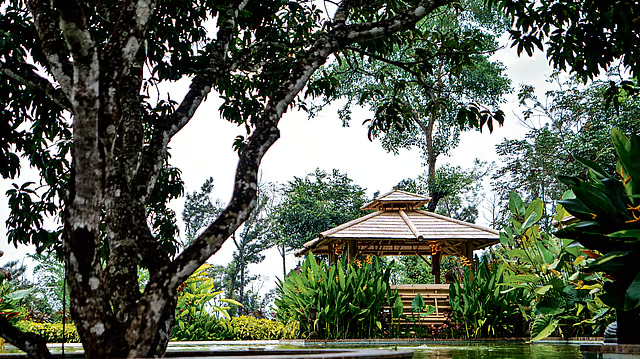
Décor: Set over water, framed by lush bamboo and ambient fountains, the restaurant pairs bold, globally inspired flavours with a serene, tropical backdrop—perfect for travellers seeking a refined and memorable dining adventure.
Price: The price is on the higher end, a meal for two costs Rs 10,000 without taxes.
Address: No. 94/2, Kedakal Post, Modur, Madikeri, Karnataka – 571237.
source: http://www.newindianexpress.com / The New Indian Express / Home> Food / by Bindu Gopal Rao / June 22nd, 2025
Chief Minister Siddaramaiah has assured that one of the metro stations in Bengaluru will soon be named after Field Marshal K. M. Cariappa, India’s first Commander-in-Chief.
He made this announcement on Sunday during a felicitation ceremony organised by the Kodava Samaja Bengaluru at the Kodava Samudaya Bhavana in Vasanthnagar. The event honoured Siddaramaiah and Deputy CM D.K. Shivakumar for allocating seven acres of land to the community in the State capital.
He said that the proposal to name a metro station after Field Marshal Cariappa will be placed before the Cabinet, and a final decision will be taken shortly.
For years, the Kodava community has been urging the State Government and the Bangalore Metro Rail Corporation Limited (BMRCL) to honour Cariappa’s legacy in this manner.
In July 2024, members of Kodava Samaja formally submitted a request to BMRCL Managing Director Maheshwar Rao, reiterating the demand to name a metro station after the iconic military figure. Praising the Kodava community’s contributions, Siddaramaiah lauded its inclusive spirit, highlighting that Kodavas respect all Indians regardless of caste or religion.
He also expressed confidence in the political future of Kodagu MLAs A.S. Ponnanna (Virajpet) and Dr. Manthar Gowda (Madikeri), describing Ponnanna as an emerging firebrand leader comparable to the late A.K. Subbaiah and M.C. Nanaiah, known for their socially conscious speeches in the legislature.
Deputy CM Shivakumar appealed to the Kodava community to continue supporting Congress government. “Our government has initiated many programmes for you. We have allotted land to families of Armed Forces personnel, appointed Kodavas to Rajya Sabha and ensured representation in the legislature. Recognising this legacy, we request your continued support,” he said.
He pointed out that the Government’s decision to allot seven acres of land in Bengaluru to Kodava Samaja comes with only nominal financial concessions, underscoring that no price tag can match the community’s discipline, sacrifice and patriotism.
“We must safeguard our traditions and culture. Your dedication is beyond monetary value,” he added.
The event was attended by Ministers K. J. George, Krishna Byregowda, Byrathi Suresh, MLA Rizwan Arshad, MLAs A.S. Ponnanna and Dr. Manthar Gowda and Bengaluru Kodava Samaja President Karavattira Pemmaiah, among others.
source: http://www.starofmysore.com / Star of Mysore / Home> News / June 19th, 2025
Coffee growers believe that while the region’s coffee is known for its flavour and aroma, without proper branding, it loses value in larger market.
Despite contributing nearly 70 per cent of India’s total coffee production, Karnataka’s coffee continues to be sold without a unified label which can represent varieties produced in the state.(Representative image)
Bengaluru :
Taking a cue from the success of Nandini in the dairy sector, coffee growers in Karnataka are pushing for a similar branding model for the state’s coffee. The Karnataka Growers’ Federation (KGF) is working on a proposal to create a unified brand called ‘Karnataka Coffee’ to give the state’s produce an identity in both national and international markets.
Federation officials confirmed that preliminary meeting have already been held with Chief Minister Siddaramaiah and Chief Secretary Shalini Rajneesh, and they are hopeful that the proposal will be taken forward in the coming days.
Despite contributing nearly 70 per cent of India’s total coffee production, Karnataka’s coffee continues to be sold without a unified label which can represent varieties produced in the state. Coffee growers believe that while the region’s coffee is known for its flavour and aroma, without proper branding, it loses value in larger market.
“Karnataka is the largest coffee-producing state in the country, but we still don’t have a common brand that represents our coffee,” KGF President H Shivanna said, adding that if the state creates one, it will improve market visibility and directly benefit growers, specifically in districts like Kodagu, Chikkamagaluru and Hassan.
He stressed that the idea is to follow a cooperative model similar to Karnataka Milk Federation (KMF), which helped make Nandini a wider brand. “The Nandini model also ensured fair pricing for farmers and made distribution marketing more efficient. We want to apply the same structure to coffee,” Shivanna said.
Federation officials pointed out that creating a state-backed brand could help bring attention to long-pending issues faced by planters, including frequent human-elephant conflict, pressure from forest officials, confusion around deemed forest classifications, and the need to extend land lease periods for growers.
source: http://www.newindianexpress.com / The New Indian Express / Home> Karnataka / by Rishita Khanna / June 16th, 2025
“The matter to name a Metro Station in Bengaluru city will be placed before the cabinet meeting to arrive at a decision,” said the Chief Minister and exuded confidence that “None will have objection to name a Metro Station after Field Marshal Cariappa.”
Field Marshal K.M. Cariappa —DC Image
Bengaluru :
Responding to a plea to name a Station of Bangalore Metro Train Corporation Limited (BMRCL) in Bengaluru city, Chief Minister Siddaramaiah on Sunday assured to fulfill the wish of the Kodavas to name a Metro Station after Field Marshal K.M. Cariappa, the first Field Marshal of independent India. Field Marshal K.M. Cariappa was from Kodagu district.
“The matter to name a Metro Station in Bengaluru city will be placed before the cabinet meeting to arrive at a decision,” said the Chief Minister and exuded confidence that “None will have objection to name a Metro Station after Field Marshal Cariappa.” Though a request has been made to name a Metro Station but have not stated a particular Station.
“I will make an honest effort to name the Metro Station after Field Marshal Cariappa,” Siddaramaiah said at a felicitation programme organized by members of Kodava Samaj in Bengaluru. The felicitation to Chief Minister Siddaramaiah and Deputy Chief Minister D.K. Shivakumar was organized in honour of the State Government allocation of 7 acres for Kodava Samaj in Bengaluru city.
At the function, D.K. Shivakumar assured the Kodava Samaj members that the demand of Kodava Samaj to name a Metro Station after Field Marshal K.M. Cariappa has been received with an open mind and stated “The State Government will make all efforts for the coming generations to remember Field Marshal K.M. Cariappa.”
source: http://www.deccanchronicle.com / Deccan Chronicle / Home> Southern States> Karnataka / by M B Girish / June 16th, 2025
Funds adding to over Rs 10 lakh are being collected to enable the renovation and revival process of the school building.
The institution did not even record a centenary celebration due to financial issues. However, the alumni of the institution became active recently and are now involved in the revival process of the institution.
Madikeri :
As several government schools are struggling to see the light of the day due to non-maintenance, an alumni association of a government school in Kodagu is striving towards renovating the institution.
Funds adding to over Rs 10 lakh are being collected to enable the renovation and revival process of the school building.
The Suntikoppa Government Primary School, established 108 years ago, has educated lakhs of students. The institution was expanded with high school education 44 years ago. However, the lack of funds for development works had remained a challenge.
The institution did not even record a centenary celebration due to financial issues. However, the alumni of the institution became active recently and are now involved in the revival process of the institution.
Recently, a group of alumni organised a reunion event as a Guru Vandhana programme, which witnessed participation from the former teaching staff.
The Alumni Association was launched as plans took shape to renovate the school building, which is in a vulnerable condition.
Funds adding up to Rs 10 lakh were collected by the alumni association. The school classrooms are being renovated and upgraded even as the alumni will initiate plans to increase admissions to the institution.
Key alumni members KH Sharif, Harish, Anil Kumar, C Mahendra, Razak, Abdul Aziz, Arun Kumar, Dhanu Kaverappa, Vincent, Shashikumar, and Kamalahasan, alongside local donors from Suntikoppa and neighbouring areas, have committed themselves to elevating the school’s standards to match private institutions.
The alumni association has members from all walks of life, some who have reached reputable posts following their primary education at the institution. “We cannot be more grateful to the alumni for taking up the renovation project,” shared Geetha, headmistress of the government school.
“This renovation represents our modest contribution to the institution that shaped our lives. Some of our alumni have become High Court judges, and under their guidance, along with support from other alumni, we are undertaking this renovation. We are ensuring minimal disruption to current students’ education,” shared RH Sharif, the VP of the alumni association.
source: http://www.newindianexpress.com / The New Indian Express / Home> Karnataka / by Express News Service / June 04th, 2025
To speed up the restoration of the electricity network, the Madikeri division of the CESC has deployed 231 personnel. | Photo Credit: Special arrangement
Relentless rain and strong winds have impaired the power infrastructure in Kodagu, damaging a total of 1,442 electricity poles, 11 transformers, and 13.105 km of power lines.
Despite the current adverse weather, power supply restoration efforts are under way. The authorities of Chamundeshwari Electricity Supply Corporation (CESC) have so far replaced or repaired 1,091 poles and nine transformers. On average, about 100 poles are being replaced every day. However, the continuous downpour and gusty winds are hampering progress and causing further damage, a release issued by Executive Engineer (Operations and Maintenance Division), CESC, M. Ramachandra said.
To speed up the restoration of the electricity network, the Madikeri division of the CESC has deployed 231 personnel. In addition, 52 staff members have been brought in from other divisions, along with 75 outsourced workers and 124 contract staff — all equipped with tools and equipment. The teams are working on a warfooting to restore normalcy, the release added.
Officials have acknowledged that the past 10 days of incessant rain have slowed down repair work and caused repeated disruptions to the power supply. Therefore, they have urged the public to cooperate as the restoration work is in progress in the district.
Field officers and technical staff remain engaged in power restoration efforts. Because of the workload, section officers may not be able to respond to customer calls promptly. Instead, the authorities have set up a dedicated toll-free helpline for the Madikeri division to handle consumer complaints. Consumers can report power-related issues by calling the toll-free number: 1800-599-0061.
The executive engineer has assured the public that every effort is being made to restore power supply at the earliest.
source: http://www.thehindu.com / The Hindu / Home> News> India> Karnataka / by The Hindu Bureau / June 03rd, 2025
At 7 AM, we set out on a walk through Makkandur Forest in Madikeri, Coorg. Mist-covered hills and sprawling coffee plantations framed our path, with the gentle songs of birds accompanying us on this immersive journey into the rich biodiversity of the Western Ghats — a UNESCO World Heritage Site. Makkandur is home to rare trees and bird species, offering sweeping views of Coorg’s countryside dotted with tropical evergreens, wild ferns, and medicinal plants. The region is home to hundreds of unique species, including over 350 types of birds, reptiles, insects, and amphibians. Among them are vividly coloured cobras and vipers, striking turquoise butterflies, and palm-sized crimson snails with gleaming black shells. Larger inhabitants include elephants, bison, barking deer, wild boar, and the rare, elusive tiger. Along the trail, black pepper — though cultivated — thrives naturally in the forest’s microclimate alongside cardamom and vanilla vines, which are occasionally found growing wild. Tree trunks, often cloaked in moss, lichens, and ferns during the monsoon, host blooming epiphytic orchids clinging to misty branches. This is Kodagu’s wilder side: untamed, meditative, and deeply intertwined with nature — a place where you can still hear the forest breathe.
Here, we plucked four avocados hanging from the tree.
Our guide, Naturalist Abilash Puliyeri Ravi at Coorg Marriott Resort and Spa, recalls growing up with avocado—what locals call a butter fruit—mashed with jaggery or sugar, and sometimes a splash of milk, for a quick snack or breakfast. While not part of traditional Kodava cuisine, avocados are finding their way into modern Coorg kitchens, adding a creamy richness to salads, smoothies, and chutneys. The fruit thrives in Coorg’s cool climate and well-drained soils, often grown in homestead gardens or intercropped with coffee and pepper. Although not native, it has been cultivated here for decades and is now gaining commercial traction. The ICAR-developed ‘Arka Coorg Ravi’ variety, prized for its high yield and pulp recovery, is leading this shift. Westfalia, an avocado-focused agricultural company, also operates a nursery in Coorg, supplying premium cultivars such as Hass. Butter fruit has a thin green skin and a larger pit. It also does not ripen consistently and tastes less sweet. The Hass has more flesh, a longer shelf life, is creamier and sweeter, and has a dark, black exterior. These also have a fat content of around 12 per cent, making them tastier. Initially, Westfalia attempted to cultivate the indigenous variety, but it proved unsuitable for long-distance transportation and exports. Hence, they decided to go with Hass. With rising urban demand and a growing market, Coorg is quietly becoming an emerging hub for avocado cultivation.
While pandi curry is Coorg’s most iconic dish, Kodava cuisine is far more diverse — deeply rooted in seasonal produce, forest foraging, and ancestral traditions that reflect the community’s bond with the land Abhilash also shared how oranges in Coorg — locally known as Coorg mandarins — were once as iconic to the region as coffee and pepper. These small, juicy, and sweet citrus fruits flourished in the region’s cool, hilly climate and well-drained soils. Traditionally grown alongside coffee in shade-grown plantations, they added biodiversity and provided farmers with a valuable secondary income. However, since the early 2000s, orange production in Coorg has declined sharply due to the widespread occurrence of fungal diseases such as citrus dieback and greening, poor replanting practices, shifting weather patterns, and depleted soil fertility. Today, revival efforts are underway, led by the Indian Institute of Horticultural Research (IIHR) and the Kodagu Orange Growers’ Associations, which are introducing disease-resistant varieties and training farmers in improved orchard management.
While pandi curry is Coorg’s most iconic dish, Kodava cuisine is far more diverse — deeply rooted in seasonal produce, forest foraging, and ancestral traditions that reflect the community’s bond with the land
That night, we enjoyed a hearty meal of Kodava cuisine at the Madikeri Kitchen at the hotel, minus the iconic pandi curry, prepared by the hotel’s Executive Chef Anirudh Deshpande. It gave us an insight into the cuisine’s nuanced culinary tradition shaped by the forests, fields, and festivals of Coorg. Seasonal ingredients like Balekkai Kootu (raw banana with dal), Anabe Barthad (wild mushroom with fennel, crushed black pepper), Tarkari Gasi (mixed veg with coconut, coriander seed, jeera and tamarind), Hagalakayi Palya (bitter gourd with mustard seed, onion and grated coconut), Coorgi Mutton Curry, Koli Saaru (chicken with roasted coconut, fennel and local spices) reflect the community’s deep connection to the land. The Soppu Charu was our favourite, so was the Mango Curry—both had distinct flavours, laced with simplicity.
Spices are minimal but meaningful—pepper, bird’s eye chilli and kachampuli (a tart vinegar made from brindle berry fruit) give Kodava food its distinctive, tangy kick. Chef Deshpande believes it’s not just about what’s on the plate—it’s about preserving identity, seasonality, and storytelling through food.
Bella Coffee
We found it interesting that a passion fruit drink is also a part of the thali. Locally known as passimara juice, it’s made from passion fruit puree and is lightly spiced with a hint of salt or green chilli—perfect for sipping between the rich, spicy flavours of the meal. Passion fruit has gained popularity in Coorg over the past couple of decades, driven by growing interest in exotic fruits. A tropical climate, ample rainfall and fertile red soil make Coorg ideal for this climbing vine to flourish. It’s mostly grown on trellises, often as a companion crop alongside coffee or on field margins. Over the years, passion fruit farming has been expanding, supported by agri-entrepreneurs and local processing units.
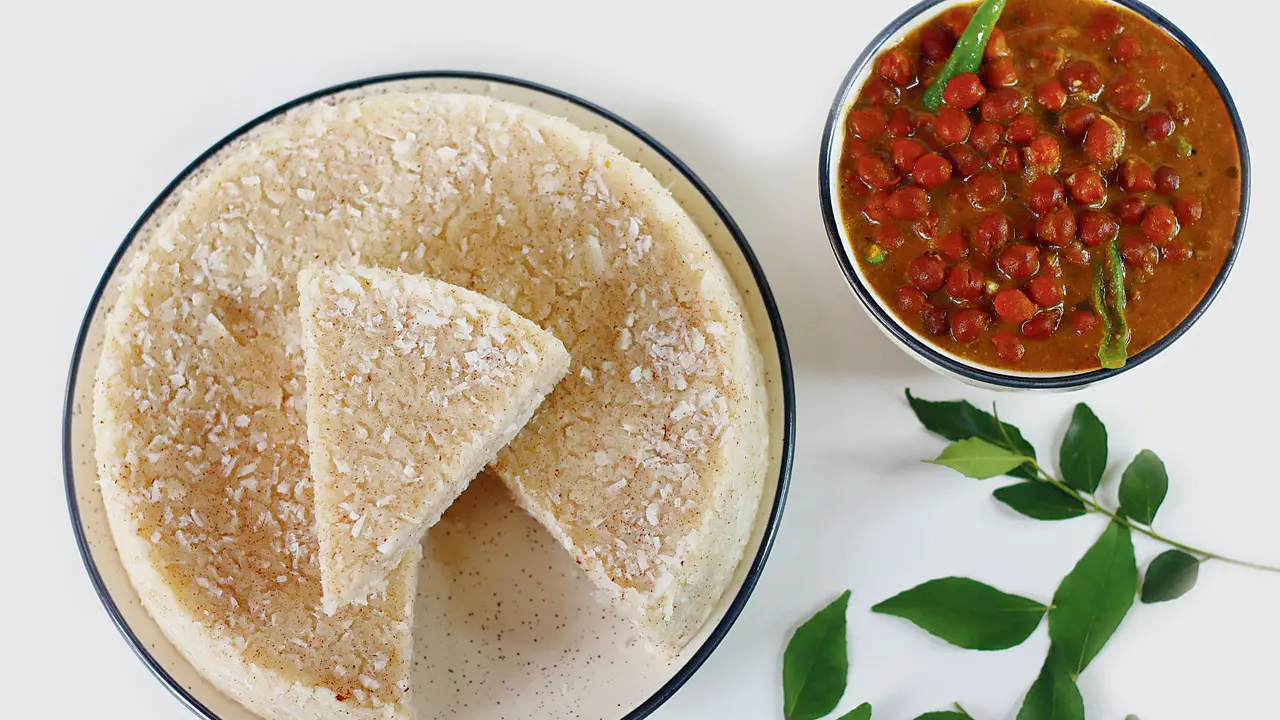
Steamed matta rice cakes, cooked with milk and coconut, are often paired with spiced curries — a comforting taste of traditional Coorg
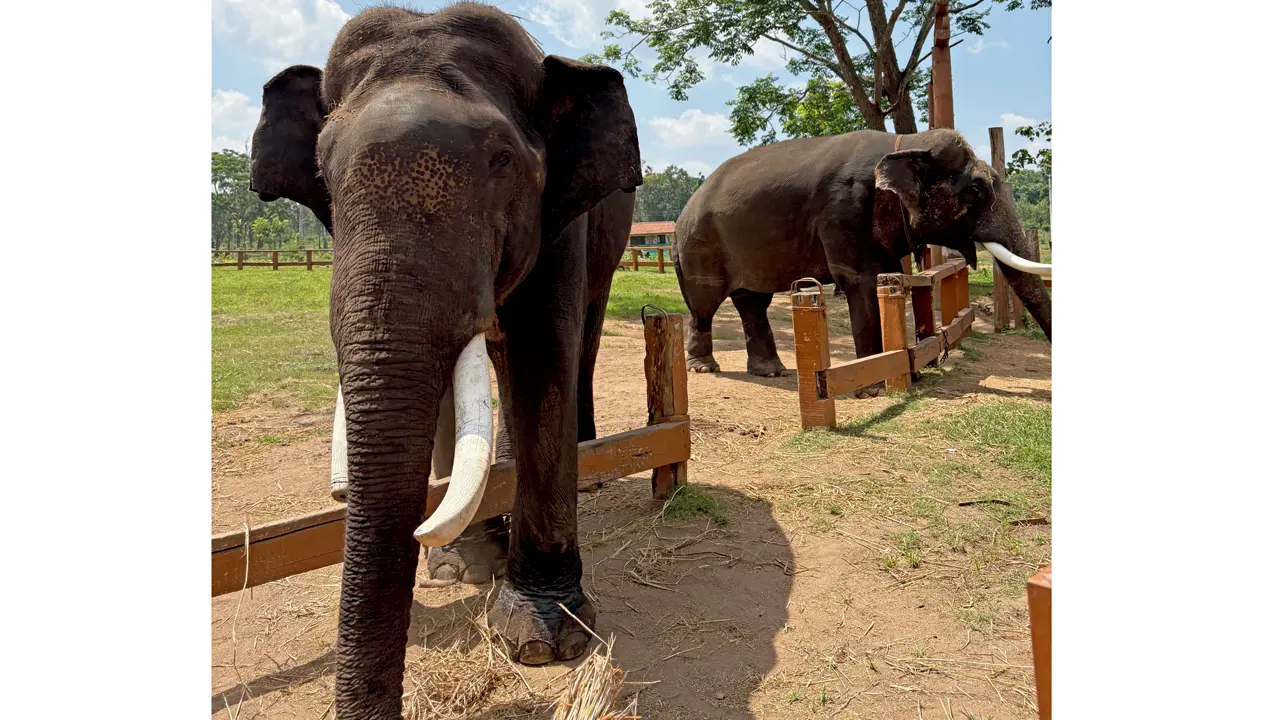
The next evening, during bonfire storytelling sessions organised by the hotel, we learnt about the Kodava community and the deep yet complex bond with the elephants. Traditionally, forest dwellers, agriculturists, and the Kodavas revered elephants as symbols of strength, often featuring them in local lore and rituals. But as forests shrink and farms expand, wild elephants increasingly raid coffee estates and fruit crops, turning sacred animals into a threat to livelihoods. The following day, we crossed the Cauvery on foot—a memorable experience, especially during the dry season when the river’s water level recedes enough to expose shallow stretches and natural stepping stones to reach Dubare Elephant Reserve. Feeding tamed wild elephants in a serene setting was a simple, almost meditative act. Coming back to the elegantly furnished villa, we sipped on coffee, taking in the breathtaking views of the surrounding lands before heading for a relaxing therapy at the hotel’s Quan Spa.
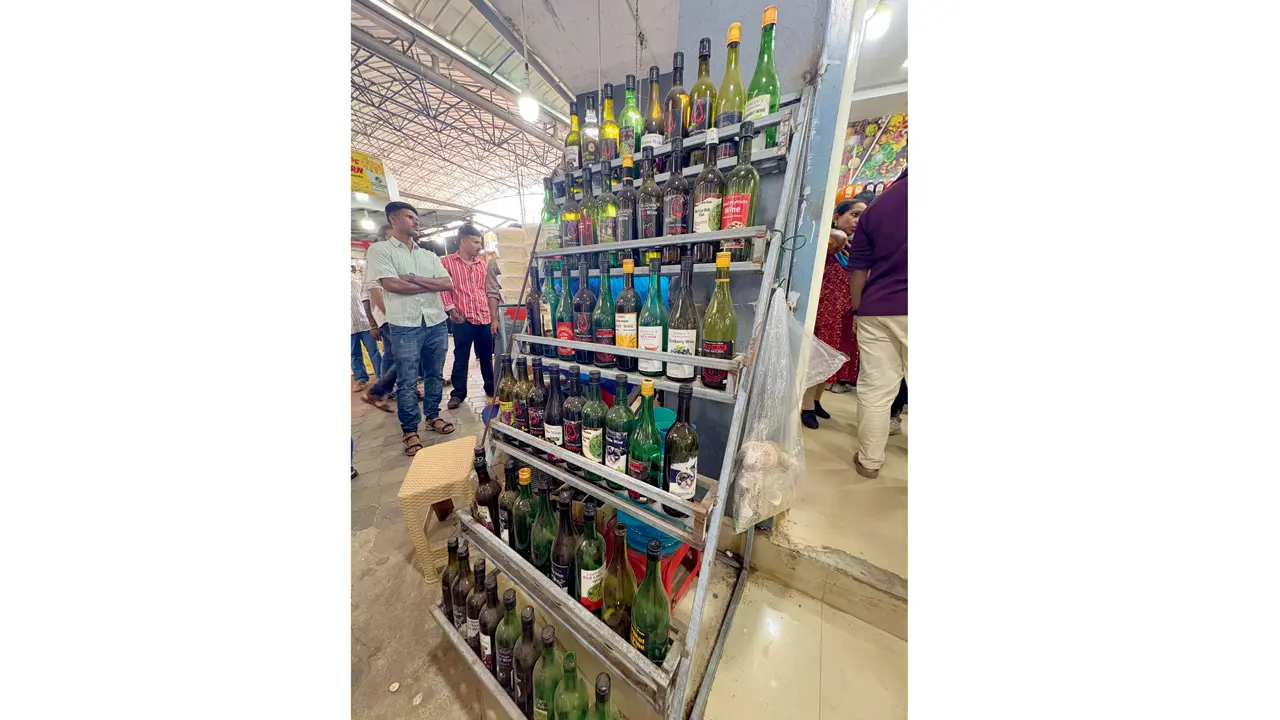
Homemade fruit wines are crafted from local produce
Coorg’s coffee plantations flourish in its cool climate, generous rainfall, and fertile soil, producing shade-grown Arabica and Robusta beans prized for their rich aroma and complex flavours. Often intercropped with spices such as pepper and cardamom, these plantations blend traditional and sustainable farming practices, making Coorg one of India’s most renowned coffee-growing regions since 1854.
Dubare Elephant Reserve in Coorg is a forest camp where visitors can observe, feed, and learn about elephants, many of whom were once part of Karnataka’s logging and festival processions
The Riverside Coffee Estate, founded in 1898, stands true to this heritage. Nestled in a vibrant ecosystem, it combines ecological balance with century-old cultivation methods. Beyond farming, Riverside offers immersive tours and homestays that invite visitors to experience the heart of Coorg’s coffee culture firsthand.
Founder Rishwin Devaya champions the belief that no two Coorg coffees are alike. The Coffees of Coorg project partners with eight planters across varied altitudes and farming styles to showcase eight unique coffees—each telling its own story. He has brought together Nadikeriyanda Vikram Appaiah (Karadigod Estate, Siddapur), Palecanda Anita Aiyanna and Vishal Ponnappa (Devi Villa Estate, Kutta), Paruvangada Chirag Bopaiah and Poonacha (Akankshe Estate), Ashish Rao (Skia Coffee, Nelaji), Codanda Adip Bopaiah (Sree Ram Estate, Thora), Bolacaranda Uma and Dr. Kariappa (Karkukaad Estate), Priamvada Gajaraj (Abeos Estate, Kadagadal) and Appanervanda Anita Nanda and Muddu (Surya Kiran Estate, Hattihole) to retail through his platform for special edition batches. “Over the last few years, we at Riverside have set up facilities to market and sell our coffees directly to consumers. Now, we want to use our platform to empower planters from the region to get their coffee directly to the consumers. More than a product line, it’s a tribute to the planters whose innovations and dedication elevate Coorg coffee into an unforgettable experience,” says Devaya.
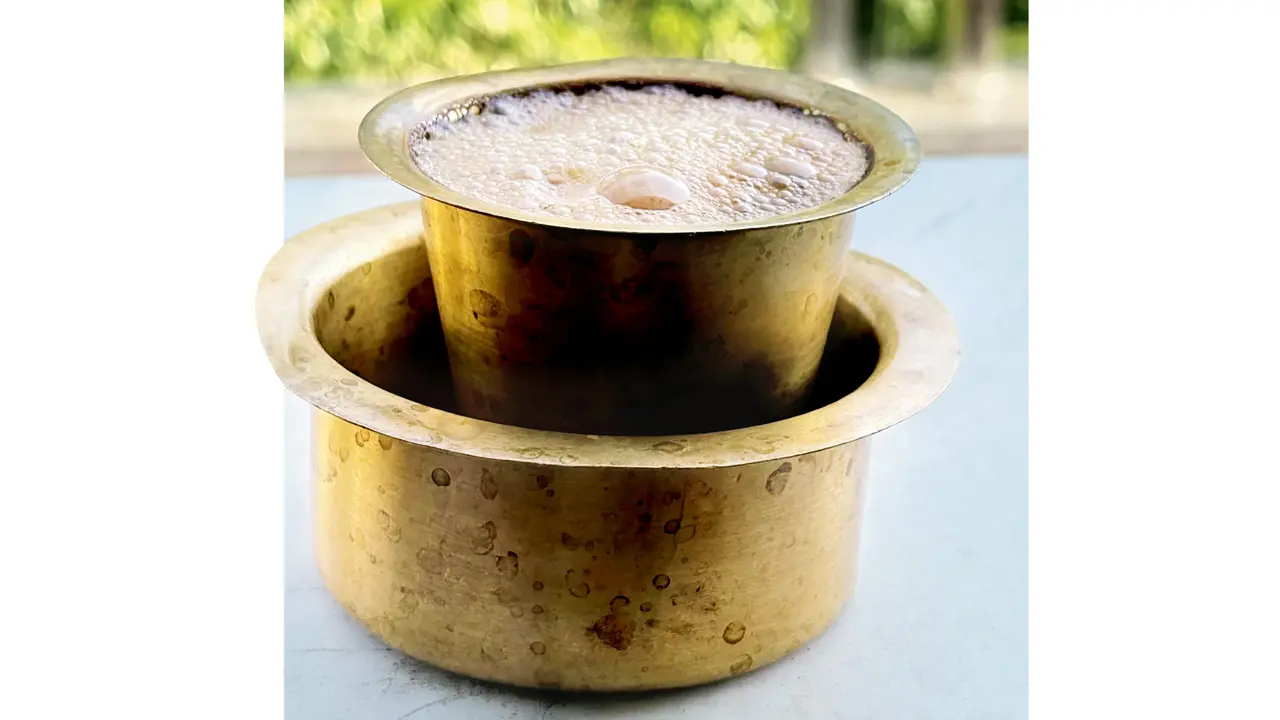
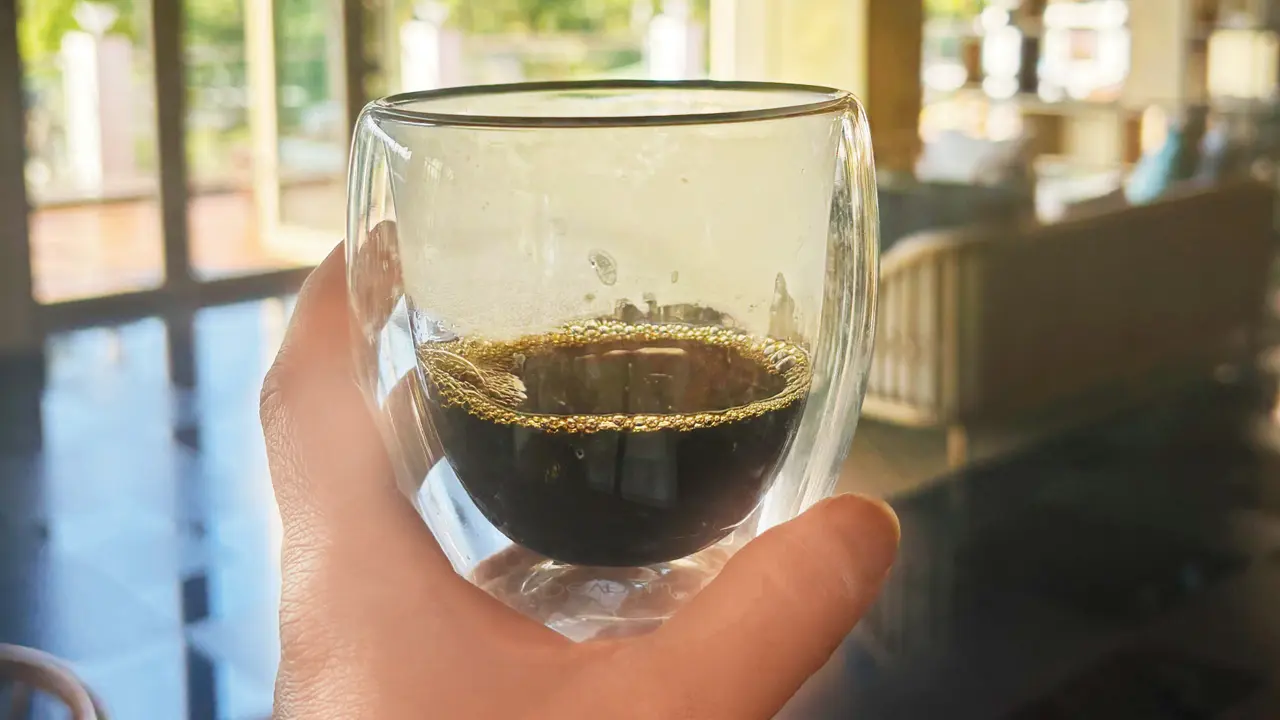
An interesting addiction we acquired from the hotel is the Bella kapi, a traditional Coorg coffee made with jaggery (bella), often enjoyed with breakfast dishes like akki rotis and ellu pajji. The coffee is typically brewed with a strong, dark-roasted coffee powder. Cardamom and crushed ginger are added for additional flavour, and jaggery, instead of sugar, contributes to its distinctive flavour.
The simplicity of the region grows on you. Once a favourite of colonial administrators, Coorg or Kodagu, takes its name from the indigenous Kodava people. It is also called the ‘Scotland of India,’ as the region’s misty hills, lush valleys, dense forests, and cool climate evoke a landscape reminiscent of the Scottish Highlands but Coorg also carries the fragrance of its plantations. We returned with scents of the land, with the aromas of fresh green pepper, cardamom pods, and vanilla still lingering in our suitcases.
Momos are a local favourite
Tibetans of Coorg and their influence on the Kodava cuisine
In 1959, following the Chinese invasion of Tibet, the Indian government resettled thousands of Tibetan refugees in Coorg, primarily in Bylakuppe — one of the largest Tibetan settlements in India. Though culturally distinct, the Tibetan and Kodava communities have coexisted peacefully for decades, contributing to the region’s rich cultural mosaic. The influence of Tibetan cuisine on traditional Kodava food has been subtle yet noticeable, with Tibetan dishes such as momos, thukpa (noodle soup), and tingmo (steamed bread) now commonly found in local markets and food stalls. The coexistence reflects more of a culinary coexistence than a blending — two parallel food cultures thriving in the same geographical area. In fact, in Coorg, the harmonious coexistence of different faiths is beautifully symbolised in a rare sight: a church, temple, and mosque situated adjacent to one another in the town of Virajpet. While the Kodavas themselves are primarily ancestor worshippers and follow their own indigenous practices, the region as a whole has long embraced a multi-religious identity without conflict.
Origins of the clan Although the origin of the Kodavas in Karnataka remains a mystery, researchers believe they are the descendants of pre-Islamic Kurds, originating from the present-day Turkey, Iran, and Iraq region.
1854 Commercial coffee growing began in Coorg. Now, Arabica and Robusta are grown here
350 Types of birds, reptiles, insects and amphibians are found in the forests of Coorg
1959 When the Indian government resettled thousands of Tibetan refugees in Coorg
source: http://www.mid-day.com / Mid-Day / Home> Sunday Mid-Day News / by Nasrin Modak Siddiqui / June 01st, 2025
And there is no respite from inclement weather as the IMD has forecast heavy showers for next two days and sounded red alert for three coastal districts and as many Malnad districts.
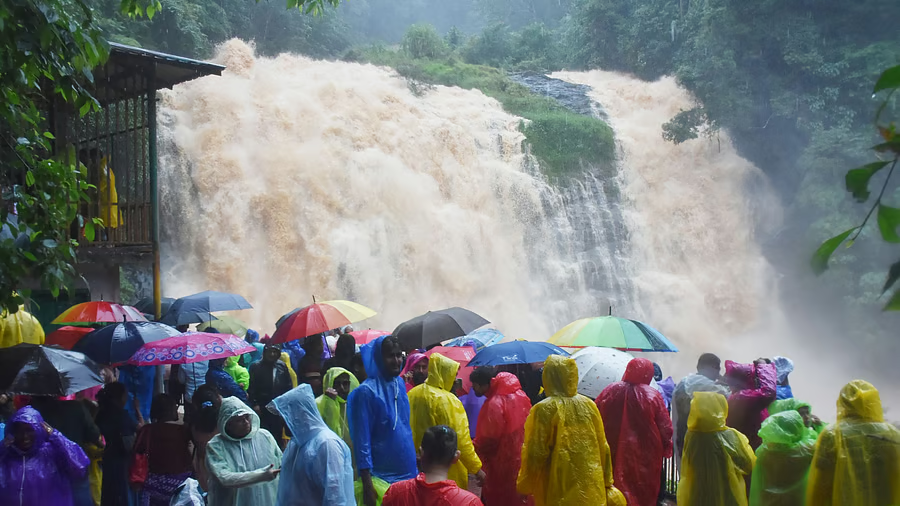
Scores of visitors flock to Abbey Falls in Kodagu district following heavy rain. Credit: Dh photo
Heavy rain continued unabated, damaging houses, roads and power infrastructure and triggering flash floods in coastal districts and Malnad region.
And there is no respite from inclement weather as the IMD has forecast heavy showers for next two days and sounded red alert for three coastal districts and as many Malnad districts.
Two people died in rain-related incidents in Dakshina Kannada. Lily D’Souza (52), a native of Iruvailu near Moodbidri, was electrocuted when she stepped on to an electric wire snapped due to gusty winds, near her house on Wednesday morning.
Suryanarayan (49), a professional photographer from Kasargod, died after his car plunged into an overflowing stormwater drain at Kodikal in Mangaluru.
Three people travelling in a car escaped with minor injuries after a tree fell on the vehicle at Mulki.
Two houses were completely destroyed while several of them suffered a partial damage in the incessant rain that’s lashing Dakshina Kannada for the past few days. As many as 225 electricity poles were uprooted while 13 transformers and eight bridges suffered damages.
In Udupi and Karwar, intense erosion along the coast is posing a threat to people living close to it. At several places, boulders dumped to prevent sea erosion have been washed away due to strong currents. Udupi district, including Udupi town, continued to see heavy rainfall on Wednesday.
Kodagu is shivering under heavy downpour, coupled with strong winds. Several residential areas in Madikeri are forced to spend nights in darkness due to power outages.
The Kodagu administration has declared holiday for schools and colleges for next two days. With Cauvery river flowing in full steam, the forest department has barred visitors to Dubare elephant camp.
However, hundreds of tourists and locals, braving chill weather, visited the Abbey Falls near Madikeri to catch the glimpse of the cascading waterfall.
The water level in Harangi reservoir has reached 2,841.93 feet, just 15 feet short of reaching its maximum level. Meanwhile, Hemavathi dam at Goruru in Hassan clocked 22,000 cusec inflow on Wednesday. It is only 18 feet short of reaching full reservoir level. Yagachi dam in Belur taluk is full to the brim. Excess water is being released downstream.
Vehicular movement to Kukke Subrahmanya was hit following a tree fall on Bisle ghat road in Sakleshpur taluk.
Relentless showers have left the paddy growers in Shivamogga worried. Ready to harvest paddy cultivated on vast tracts lying on farms due to inclement weather even as the grains are sprouting.
Agumbe in Thirthahalli taluk has recorded 150 mm of rain in the last 24 hours while Maani in Hosanagar taluk registered 130 mm.
Up north, Manjra and Bhima rivers are flowing above the danger mark in Bidar and Kalaburagi districts, courtesy heavy rain in Kalyana Karnataka districts and upstream in Maharashtra. Kamalnagar (Bidar), Shahpur (Yadgir) and Raichur city experienced heavy rain intermittently on Wednesday, posing hardships to the people living in low-lying areas.
In the last 24 hours (ending 8.30 am), Almatti dam in Bagalkot district received a massive 4.88 tmcft of water. The reservoir has been receiving heavy inflows due to unyielding showers in the Western Ghats of Maharashtra. The dam, as on May 28,has 40.787 tmcft of water.
Many parts of north and south interior Karnataka received light to moderate spells of rain on Wednesday. The weather department has predicted more widespread rain for the state in the next few days.
source: http://www.deccanherald.com / Deccan Herald / Home> India> Karnataka / by DHNS / May 29th, 2025
The southwest monsoon continued in Kodagu on Wednesday, though the intensity and quantum of rainfall were less compared to the previous three days.
The district received a cumulative rainfall of 62.67 mm during the 24 hour period ending at 8.30 a.m. on Wednesday against 76.82 mm recorded during the previous 24 hour period. However, there were parts of the district where the rainfall was torrential as in Shanthalli in Somwarpet taluk which received 175 mm of rainfall between Tuesday and Wednesday.
Bhagamandala in Madikeri received 103 mm while Hudikeri in Ponnampet taluk received 66 mm and Srimangala recorded 61 mm of rainfall. The cumulative rainfall in Kodagu since January 1, 2025, till date is 806.21 mm against 447.77 mm of rainfall recorded during the same period last year.
Meanwhile, the district officials, led by Deputy Commissioner Venkataraja, visited Banangala village, where a person lost his life when a tree collapsed on him on Tuesday. The district administration handed over a cheque of ₹5 lakh as relief to the family members of the deceased.
Consequent to continuing rains in and around Bhagamandala in Kodagu, the rate of inflow of water into the Krishnaraja Sagar (KRS) dam was 26,424 cusecs at 8 a.m. on Wednesday against 19,129 cusecs at the same time on Tuesday. The reservoir level has increased from 92 feet to 95.35 feet during the same period. Similarly, the inflow into Kabini reservoir was 23,407 cusecs on Wednesday compared to 21,946 on Tuesday.
source: http://www.thehindu.com / The Hindu / Home> News> India> Karnataka / by The Hindu Bureau / May 28th, 2025
WELCOME. If you like what you see "SUBSCRIBE via EMAIL" to receive FREE regular UPDATES.
Read More »