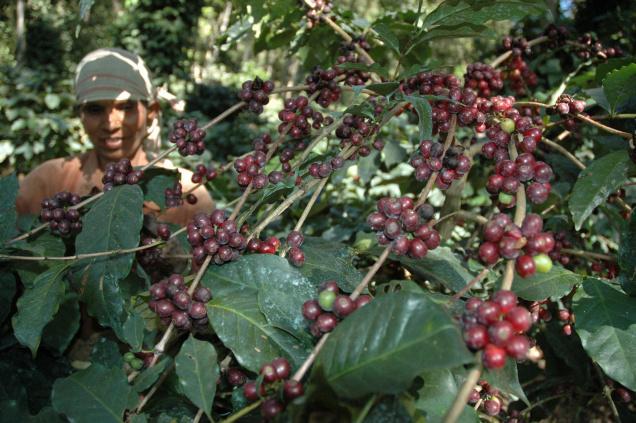
Coffee growers in Kodagu, Chikkamagaluru and Hassan districts are, however, apprehensive.Many want to know the measures taken to protect small and marginal farmers, who constitute 90% of growers in Karnataka.
Bengaluru :
When coffee growers in Karnataka were going through a rough patch due to labour shortage, elephant menace and unprecedented fall in prices, the Centre in November last year allowed 100 % FDI in five plantation crops: Coffee, rubber, cardamom, palm oil and olive oil. The decision, meant to rejuvenate the sector, is expected to have a huge impact on Karnataka, which accounts for 70% of India’s coffee production.
As of now, 100% FDI is allowed only in tea plantation. “Relaxed FDI norms will help coffee and cardamom growers since it is expected to bring in big overseas investors and retail giants besides enhanced technology utilization, automation, research, management and production of value-added products. Permitting foreign investment will also boost India’s coffee exports offering better prices for growers here, ” says Coffee Board chairperson Leena Nair.
Coffee growers in Kodagu, Chikkamagaluru and Hassan districts are, however, apprehensive. Many want to know the measures taken to protect small and marginal farmers, who constitute 90% of growers in Karnataka. Some coffee growers’ associations are holding talks to oppose the move as they fear small growers would be forced to sell their estates to foreign investors. Their entry may prove detrimental for small coffee planters, who may not be able to match the wages and technology of foreign players.
“The Centre should have held consultations and allayed fears before allowing FDI. But they have done in it in a hush-hush manner and kept us in the dark, making us believe that there is a hidden agenda,” says NK Pradeep, a Coffee Board member from Chikkamagaluru. Former Coffee Board vice-chairman Sannuvanda Kaverappa says a parliamentary committee that visited Chikkamagaluru last year to interact with coffee growers left in a huff. Nair allays all fears of growers saying: “The small-grower segment need not worry as enough safeguards have been provided and the Centre and the state government can always reject any FDI proposal in their segment.”
A Coffee Board executive says FDI will benefit coffee growers. The measure is expected to make the coffee industry vibrant like the tea sector, which opened gates for foreign investments in 2002. “Rather than starting a new venture, foreign investors may partner with existing plantations or trading companies. FDI will help boost developmental activities such as replanting, rejuvenation and R&D that need huge funding. It may also help in upgradation, modernization and automation of coffee-processing, curing, marketing,” he adds.
source: http//:www.retail.economictimes.indiatimes.com / ETRetail.com / Home> Industry / February 12th, 2016
Coffee plantation owners keen to use drones to assess crop health
Mumbai:
Enabled by unmanned aerial vehicles (UAVs), drones are leading agricultural data collection and facilitating precision analysis in agriculture globally, helping to improve crop yield.
Though the use of drones by civilians is as yet restricted in India, speakers at a recent coffee seminar urged the government to allow these hi-tech machines to help detect the health of the crop.
Apart from their military use, millions of farmers across the country could use drones and the new emerging technology to boost production and efficiency in their farms.
“We are on the cusp of a new era of farming, where precision agriculture practices can offer a new approach to crop management. We now have a technique that wrings out waste and uses data to maximise crop yields and profits. UAV technology is reshaping farming,” said Jaisimha Rao, coffee plantation owner and entrepreneur.
Game changer
Passionate about technology and agriculture, Rao noticed the lack of data-driven decision making while working on his family’s coffee plantation. He decided to combine the versatility of UAVs and computers, and ensure algorithms to analyse crops. Aiming to bridge the gap, Rao, who holds a Bachelors degree in Electrical and Computer Engineering from the Carnegie Mellon University, founded TartanSense. The company uses UAVs to capture and analyse aerial imagery.
Blanket restrictions
“Flying drones and gathering data is a game changer for agriculture, and especially for large plantations like coffee. How we can use this technology in India is the moot point, since the Directorate General of Civil Aviation (DGCA) has restricted the use of drones,” he said.
Pointing out that the “blanket restriction by the DGCA to operate drones would kill the enthusiasm of start-ups” such as his, Rao said his drones had worked in Indonesia, Japan as well as in the US, with drones costing upwards of $100,000.
Speaking about the new technology, Sanjiv Sarin, Managing Director and CEO, Tata Coffee, who was moderating the talk, said, “We are entering the future of the coffee industry. The Coffee Board can work for government clearances to use drones in agriculture.”
Though coffee is shade-grown among silver oak trees, Rao said, “drones will soon be able to look at a tree and avoid it. Over the next 6-12 months, we are going to have an UAV that can fly under the canopy, measure each and every coffee bush and get data for the planter. Canopy penetration will be the true essence of precision farming.”
Big data
Agricultural drones are UAVs used for precision agriculture, which is a modern method of farming globally that uses big data, aerial imagery and other means to optimise efficiency.
The drone collects the crop’s image and makes a colour coded map based on its health, which is then assessed by the UAV firm.
Drones are helping assess the exact nature and area of crop damage during natural calamities, and are helping save huge amounts.
Stating that a lot of people are fascinated by drones, Rao said the real value add “is not the hardware, which is about how to fly them and get the data, but to analyse it and benefit the farmer.”
Detailing the functioning of the UAV, Rao said, “Our drone flies for about 20 minutes, and then the battery is dead. It can survey about 150 acres. We send the images up to the cloud, and can then stitch the data into a nice map. Once you get the image and sensor data in a map, one can get an actionable report and help the farmer. This is where the real skill lies.”
source: http://www.thehindubusinessline.com / Business Line / Home> Economy> Agri Business / by Amrita Nair-Ghasalla / Mumbai – February 05th, 2016
Chennai-based actress, model and ex-VJ Pooja Gallyot graduated from green tea to coffee last year and now is so hung up on the beverage that she is fast becoming an addict. On the other hand, Kolkata-based fashion designer Kiran Uttam Ghosh, a bona fide coffee lover, zeroes in on new cafes in the places she visits. For naturalist and wildlife conservationist Shrilekha, coffee shops present the ideal rendezvous to conduct business. It is these little tell-tale signs that have had coffee majors scent a business opportunity, even cleverly imparting magical qualities to the brew in that anything can happen over a cuppa. Truth be said, it’s a dramatic cultural switch that’s got the entire nation swaddled in its intoxicating embrace. According to the latest Technopak report, the chain café market, currently at Rs 1,820 crore, is growing at 20 per cent in value and commanding 27 per cent of the Rs 6,750 crore overall cafe market.
Were it not for pilgrim Baba Budan’s temerity in smuggling a few coffee beans into Chickmagalur, Karnataka, we might never have got introduced to this refreshing drink. This history aside, coffee seems to be edging out tea in the social circuit with cafes being the perfect place to hang out, chat or simply relax. That certainly augurs well for business, with Café Coffee Day, popularly called CCD, the biggest player in the Indian market, competing with international brands such as Starbucks, Barista and Costa Coffee, not to mention the popular local hangouts.
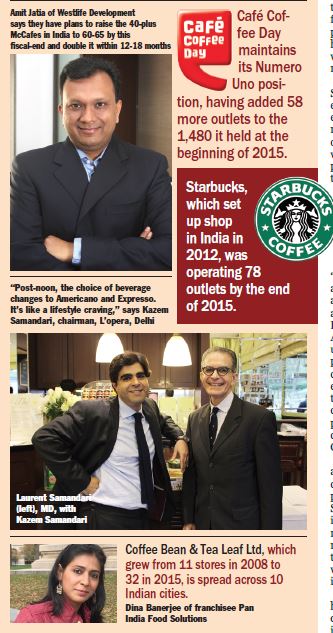
To date, CCD maintains its Numero Uno position having added 58 more outlets to the 1,480 it held at the beginning of 2015. CCD’s principal Coffee Day Enterprises set the stock market abuzz with the largest Initial Public Offering last year. It had fixed its public offer price at Rs 328 per share, taking the total proceeds to Rs 1,150 crore. But when the IPO closed on October 16, it was over-subscribed 1.81 times with a demand worth Rs 2,000 crore.
“Customers today are looking at a differentiated food experience along with their coffees at cafes. Which is why we have introduced a special food menu called the ‘SuperMenu’—a range of soups, sandwiches, burgers and desserts,” says a CCD spokesperson. “We have also started a home delivery service in Bengaluru as a pilot project.”
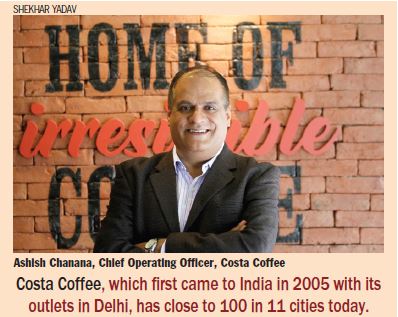
Costa Coffee entered India in 2005 when it opened outlets at Connaught Place in Delhi. Today, it has close to 100 in 11 cities across India. While a good number is present in metro cities such as Delhi, Mumbai, Chennai and Bengaluru, they’re spreading out in tier II cities such as Agra, Jaipur, Pune, Kochi, Ludhiana, Chandigarh and others. “While southern states have always had a strong culture of drinking coffee, over the past decade or so, the drink has penetrated to other parts too,” says Ashish Chanana, Chief Operating Officer, Costa Coffee.
Another chain that is fast expanding is the US-based Coffee Bean & Tea Leaf Ltd, which tied up with Pan India Solutions to start a single outlet at Select Citywalk mall in Delhi. It has grown to 32 stores in 10 cities from 11 in 2008. “We source our coffee from seven different countries,” says Dina Banerjee, CMO, Pan India Food Solutions Pvt Ltd, Mumbai.
Though all eyes are on the newest entrant, US giant Starbucks, which joined hands with Tata Coffee Ltd to set up shop in India in 2012. By 2014, it had more than 60 outlets and the end of 2015 saw it operating 78. It had also managed to clock in Rs 171.2 crore, an 80 per cent jump from previous year’s Rs 95 crore.
Coffee shops have so much become revenue models that another giant has jumped on the bandwagon.
The most telling of entries is American fastfood chain McDonald’s McCafe in the country with its first cafe being launched in Mumbai. “The concept fits in well with what the Indian customer needs. Our plan is to increase the 40-plus McCafes to 60-65 by this fiscal-end and double it within 12-18 months,” says Amit Jatia, Vice Chairman, Westlife Development, franchisee of McDonald’s in South and West India.
There’s a good reason behind the dramatic rise of coffee cafes in India. Fashion designer Ghosh spends her holidays finding new cafes and spending her time reading, sketching and dreaming there. “Cafes across the world reflect the essence of its people and place,” she says, adding that the habit of going to cafes late at night with friends has earned them the moniker, ‘the owls’.
Chanana is in agreement too. Says he: “Coffee shops have given people across all age groups—especially the young—a legitimate, safe and cool place to hang out. Youngsters can go on a date without burning a hole in their pocket. Friends can spend time together at a conveniently located place. We’re also seeing a lot of older couples taking time out to catch up with each other over a cup of coffee. At Costa, we have lots of customers who are by themselves.”
Gallyot is a big fan of Starbucks. “I have gotten used to their coffee as wherever I travelled, I came across an outlet. It’s become like a comfort drink for me,” she says. For 24-year-old MBBS student Anjali Reddy, Starbucks doubles up as a place for study. In fact, people have come to associate coffee concoctions with different times of the day. “Post-noon, the choice of beverage quickly changes to Americano and Expresso. It’s become like a lifestyle craving,” says Kazem Samandari, Chairman of L’opera, Delhi.
Besides cultivating friendships and fun, these places have become the haunt of many working people. Wildlife conservationist Shrilekha often frequents Chamiers, an upmarket café in Chennai. “As I work from home, I often meet business associates at cafeterias and I love Chamiers which while elegant has a lot of breathing space,” shares Shrilekha.
Visiting cafes has widened the horizon of Delhi-based interior designer Parull Mahajan’s social interactions. The caffeine rush helps her mind to stimulate her creativity. “I visit the two of my favourite cafes—Choko La and Starbucks—at least three-four times a week and cannot do without my standard two or three cups a day. It’s an addiction I have no intention of wearing off,” she says.
In keeping with the global trend, coffee shops have become de facto offices for consultants, entrepreneurs, and writers. “Some of our Costa outlets in Delhi, Bengaluru and Mumbai have had the privilege of hosting many start-ups, where the founders polished their business idea over several cups of coffee,” says Chanana. Work is also what takes Anitha KS, National Corporate Sales Manager at Vodafone, to Costa Coffee at the Lulu Mall in Kochi. “After meeting clients in the morning, I come here and carry on my work sipping on a cold coffee or cappuccino,” says Anitha. For his part, the outlet’s manager Anup Anand is delighted with the increased bottom line. “We have plans to open more outlets in Kochi and other cities of Kerala.” That’s significant given that Kerala is predominantly a tea-drinking state.
Coffee reigns with an aromatic fist even as south India leads in the production of coffee, with the drink dominating social interactions. Apart from the big players, there are a host of small and medium joints that gets people over for coffee and chitchat. In Bengaluru, which is the hub for rich traditional filter coffee, local brands such as Maiyas, Adigas, Shanthi Sagars, the SLVs, Hatti Kapi, Katte Kapi, Brahmin’s Coffee Bar and Coffee Board outlets are still going strong. Small joints rule the roost in Chennai too, courtesy Madras Coffee House, Leo coffee outlets (under brand Mylapore Mocha) and Kumbakonam degree coffee outlets.
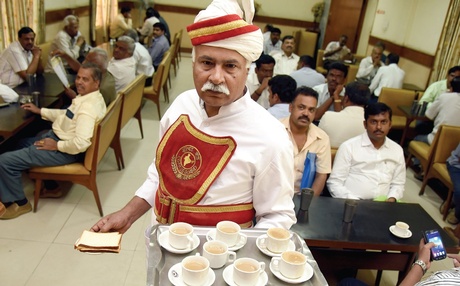
Unique to the Bengaluru-Mysuru region is the ‘by-two’ coffee culture, a mini dose of coffee whose origins can be traced to some 100 years back during the literary and Independence movements. Then literary figures, freedom fighters and political leaders, with hardly any money in their pockets, gave impetus to this culture of having multiple servings of half a cup of coffee over endless discussions.
For many in the garden city, the small joints are the place to be. Marketing professional R N Prasad feels that the prominent coffee cafes are good only to conduct business with coffee being incidental. Each day, he drives some seven kilometres to have a cup of coffee at the Brahmin’s Coffee Bar. According to city historian Arun Prasad, tourists prefer the traditional filter coffee served at small joints.
In the grand theatre of coffee culture, there are the veterans—India Coffee House and Coffee Board outlets. K S Achyuthan, Kannada author and media professional, has been visiting the Coffee Board outlet near Vidhana Soudha in Bengaluru for more than 50 years. “This is a meeting point for many journalists and lawyers as well as musicians and guests who come to All India Radio. I have also seen many legislators, MPs and even celebrities in this place which has hardly changed all these years.” Kannada filmmaker and environmentalist Suresh Heblikar makes it a point to visit India Coffee House whenever he passes by the place.
The India Coffee House in Puducherry, a heritage structure, came close to being torn down in 2008 until INTACH and concerned citizens appealed against the move. With CM N Rangaswamy’s support and renovations later, it opened in mid-2014 and has begun to attract crowds. This outlet also finds a mention in Yann Martel’s Life of Pi.
Looks like the old and the new will exist side by side even as coffee aficionados seek out their happy place.
with Meera Bhardwaj, Ayesha Singh, Shevlin Sebastian, Jonathan Ananda and Suhas Yellapuntala
source: http://www.newindianexpress.com / The New Indian Express / Home> Magazine / by Sunita Raghu / January 23rd, 2016
The sixth edition of India international coffee festival 2016, programmed for three days, concluded this Saturday.
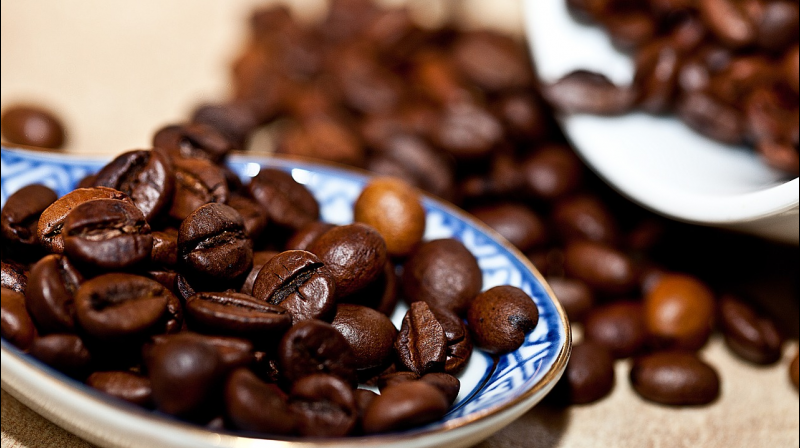
More than 60 companies are exhibited at the Coffee Expo, drawing visitors from across the globe (Photo: Pixabay)
Mumbai:
In order to boost tourism industry with the coffee sector, the central government has allowed the coffee board of India to promote coffee-tourism under flagship of Incredible India programme.
The coffee board chairman Leela Nair said that, following the Karnataka module of Coffee tourism, Ministry of tourism from the current financial year has allowed board to promote tourism with coffee industry. However, due to the delay in request from our side, government couldn’t fund us but has asked to kick-start it under incredible India programme, she added.
In this regard, the Ministry of Commerce and Industry, Chief Secretary, Rita Teaotia, who was the guest speaker, said “When you talk about coffee tourism, you provide great experience for the tourists which is also environmentally beautiful”.
Teaotia added that this would also boost the start-up in the country to partner with the existing plantations and take an advantage of this open market. She urged the young entrepreneurs of India to see coffee as the emerging markets for start-up, which has enormous opportunities.
Further speaking on the coffee tourism, President of India coffee trust, Anil Kumar Bhandari pointed out that more than international tourists, there has been steep increase in the domestic tourists from last five years.
Quoting about the start-up opportunities in coffee sector, Chief Secretary Rita Teaoita said, “If you look at the coffee industry which has number of small plantation sectors could be turned has an opportunity because you make niche product, niche branding and target and a niche market.”
Secondly, India being traditionally south states coffee-drinking area has started looking into the branding and also spreading it into the north India market the Barista and Starbucks, with this chain, somebody with well-placed product can also turned into great opportunity for start-ups, Teaoita mentioned.
“Third is, we do have specific coffee varieties coming in from different region and branding and marketing of those could turn great opportunities for the start-ups to spread”, she added.
The sixth edition of India international coffee festival 2016 that was programmed for three days, concluded on Saturday with guest speaker Ministry of Commerce and Industry, Chief Secretary, Rita Teaotia’s address on start up India campaign in coffee industry.
The festival comprises of an International Conference Exhibition for all things coffee, skill-building workshops, product launches, coffee quiz, coffee awards, and a host of other exciting activities.
The festival also served as a platform for many coffee growers, roasters, retailers, equipment suppliers, researchers and entrepreneurs. This year the festival saw as many as 500 delegates for the conference and skill building workshops.
More than 60 companies are exhibited at the Coffee Expo, drawing visitors from across the globe.
Leading brands like Hindustan UniLever, Tata Coffee, Nestle, Leo Coffee, Buhler, Kaapi Machines MK Associates, Swiss Pack, Bunn-O-Matic, Diedrich, CMA, Probat, YARA India, Rabo Bank, Eltex marketing Services, Controlmatic, etc., are exhibiting at the event.
Start-ups have completely transformed the way India consumes their Coffee be it Coffee delivery or E-commerce or Cafés or Roast & Ground Coffee sellers. IICF also played a large focus on these Start-ups.
source: http://www.deccanchronicle.com / Deccan Chronicle / Home> Business, In other news / by Vaibhav G. Bhansode, Deccan Chronicle / January 24th, 2016
Kodagu district is gearing up for the zilla and taluk panchayat elections, after the MLC elections.
The elections for the 29 zilla panchayat and 50 taluk panchayat seats will be conducted on February 20, while the results will be out on February 23.
The district has 29 zilla panchayat seats. Madikeri, Somwarpet and Virajpet taluks have seven, 11 and 11 constituencies, respectively. The number of taluk panchayat seats has been hiked by one – Hoddur being the new constituency – making it 50 this time. There are 12, 19 and 19 taluk panchayat constituencies in Madikeri, Somwarpet and Virajpet taluks, respectively.
There are a total of 3,76,065 voters in the district – 1,86,643 men and 1,89,422 women voters. Madikeri has 88,745 voters – 44,396 are men and 44,349 are women. Somwarpet has 1,45,078 voters – 71,459 are men and 73,619 are women, while in Virajpet taluk, there are 1,42,242 voters – 70,788 are men, 71,454 are women.
Option of NOTA
For the first time, the option of NOTA (None Of The Above) has been given to voters in zilla and taluk panchayat elections. It may be recalled that nobody in the district had opted for it during the recently concluded MLC elections.
In the current elections, however, the candidate may contest under the name of a political party and symbol. Electronic voting machines will be used for the polls.
source: http://www.deccanherald.com / Deccan Herald / Home> District / by Srikant Kallammanavan / DHNS, Madikeri – January 21st, 2016
Mysuru MP Pratap Simha, has urged Railway Minister Suresh Prabhu, to include the Mysuru-Kushalnagar-Madikeri new railway line in this year’s budget.
In a letter to Mr. Prabhu, the MP has said that Kodagu district lacked rail connectivity and it was a long-pending demand of the people.
He said the survey work up to Madikeri has been completed and the consolidated report would be submitted to the Railway Board by the end of this month.
He has also sought a road over bridge (ROB) at level crossing number 3 in Hassan to facilitate smooth movement of vehicles.
source: http://www.thehindu.com / The Hindu / Home> National> Karnataka / by Special Correspondent / Mysuru – January 21st, 2015
The quintessential Indian grandmother tells consumers what they ought to drink and why in late entrant Tata Coffee Grand’s launch campaign
Tata Global Beverages recently entered the instant coffee market with the launch of Tata Coffee Grand. The company has backed up the launch with a high decibel multi-media campaign. The protagonist is an Indian grandmother dressed in traditional south Indian attire. However, she appears in the garb of a hip-hop artiste, complete with contemporary accessories and sunglasses. The spirited granny takes on a bunch of youngsters as she raps about ‘coffee, the way it should be’.
With the new product, Tata Coffee is eyeing the Rs 1,300 crore instant coffee market in India dominated by Hindustan Unilever’s Bru and Nestle’s Nescafe. “Strategically we have strong competition,” says Sushant Dash, regional president, India, Tata Global Beverages. “There are players that have been entrenched in the market for long. To compete against them, it was not good enough for us to be a me-too brand. To make an impact, we had to break the category norms through our product offering, packaging and communication.”
The brief to the creative agency, Mullen Lintas, was to come up with a differentiated brand and communication strategy, encompassing the product’s packaging, imagery etc. So instead of the regular browns and greens Tata Coffee Grand stands out in its blue packaging. Similarly, the television commercial (TVC) highlights the spirited and quirky side of an older generation, rather than talking directly to a younger audience.
Dash says, “Being a late entrant in the market, we needed to talk about the product, highlight the strong heritage and plantation expertise that we offer and others do not. And as we spoke to young people, we could not sound boring. At the same time, we needed an authoritative figure to talk about our product. Who better than a granny to do all this.”
He adds that the one person who enjoys maximum credibility in a family or the society at large is the grandmother. She comes with a lot of experience and wisdom. At the same time she can be wicked in her own way. She is highly opinionated and can become animated if she does not agree with someone else’s point of view. Young at heart, the granny represents wit and humour in equal measure. And, if required, she can be up to any challenge.
The company launched the Tata Grand Coffee with a 360 degree virtual reality tour where drinkers could experience the entire product journey. Also, instead of launching the brand through traditional channels, the company introduced the product online as part of an exclusive tie-up with Amazon. “In the next six to seven months our sole purpose will be to create awareness and motivate people to re-evaluate what they are drinking,” says Dash. While picking the granny as a central character, the decision swung in favour of a South Indian character because South is the coffee heartland of India. The creative heads threw in rap to add that extra ‘swagger’ to the granny’s character.
“The brief to us was simple,” says Shriram Iyer, national creative director, Mullen Lintas, “to create disruptive and differentiated communication, just like the product. Coffee, being a staple beverage in the South of India with Tamil Nadu being the unofficial expert of the beverage, we have taken the highest authority of coffee from Tamil Nadu as the ambassador for the brand.”
What makes Tata Coffee Grand a disruptive product? The company sources the coffee beans from its own plantations and the coffee has decoction crystals in it. “In terms of the execution, the key challenge for us was getting the casting of the granny right: We needed someone who, while retaining her authoritative stance, could also add oodles of ‘coolness’ to the film,” says Iyer.
Industry estimates put the budget for the campaign at Rs 20 crore. Digital media will be an integral part of the campaign. The company is using digital media to create intrigue around the protagonist. It has planned a few short films exclusively for the digital media where the granny will be seen walking into real situations unannounced and slapping people around her if she is not happy with their choice of drink. Dash likens these films to topical advertisements by Amul, which are an entertaining take on contemporary issues. Similarly, the Tata Coffee granny’s take on real-life situations will be worldly-wise.
The South Western Railway has commissioned Computerised Advanced Reservation System at Virajpet post office at Virajpet in Kodagu district.
This is the 10th India Post Computerised Advanced Reservation Centre (PRS) in Mysuru division.
Working hours
The facility in South Coorg will benefit those in surrounding areas like Gonikoppal, Ammathi, Ponnampet and others, said K. Anil Kumar, Senior Divisional Commercial Manager.
The working hours of the PRS will be from 8.30 a.m. to 2.30 p.m. except on Sundays and general holidays. All transactions including tatkal bookings will be undertaken here.
In addition to normal charges, the following commission is payable per ticket: sleeper and II sitting – Rs.15; 3AC and AC chair car – Rs. 20 and other upper classes – Rs. 30, a release said.
For cancellation of reservations, in addition to normal cancellation charges, a commission of Rs. 10 per ticket will be levied.
Rajkumar Lal, Divisional Railway Manager, South Western Railway, Mysuru, said this facility would be very useful for people of South Coorg.
source: http://www.thehindu.com / The Hindu / Home> National> Karnataka / by Special Correspondent / Mysuru – January 13th, 2016
New Mangalore Port Trust (NMPT) conducted a trade meet with coffee exporters and logistics providers from Madikeri, Kushalnagar, Chikmagalur, and Hassan regions at Kushalnagar recently.
A press release by NMPT said here on Tuesday the initiative was taken to facilitate a face-to-face interaction between coffee exporters, custom house agents, mainline vessel operators, logistic providers, and the port trust.
PC Parida, NMPT Chairman, said coffee exporters from Madikeri, Kushalnagar, Chikmagalur, and Hassan regions exported around 1.59 lakh tonnes of coffee in 2014-15 from NMPT.
The growing frequency of container vessels calling at the port, coupled with improved road connectivity and infrastructure at the port, had helped the port achieve the export performance. He hoped the trend would continue in the current fiscal also.
Suresh P Shirwadkar, Deputy Chairman, and Nownith Kumar, Senior Deputy Traffic Manager, spoke on the occasion.
The release said coffee exporters assured that they would route their consignments through New Mangalore Port.
source: http://www.thehindubusinessline.com / Business Line / Home> Economy> Logistics / The Hindu Bureau / Mangaluru -January 12th, 2016
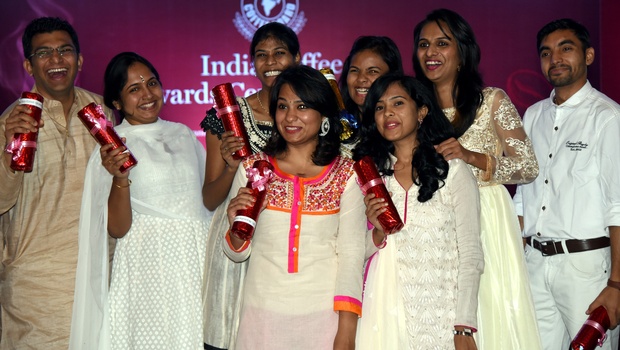
Students of PG Diploma in Coffee Quality Management during the India Coffee Awards Ceremony in Bengaluru on Thursday | NAGARAJA GADEKAL
Bengaluru :
The Coffee Board on Thursday conferred the Best Coffee Exporters’ Awards to the best exporters of green coffee, specialty coffee, instant coffee and roasted coffee.
Coffee Board chairperson Leena Nair said the since 1999-2000, the board has been presenting the awards to motivate, encourage and maximise export performances, especially to key destinations.
Indian coffee exports have been good over the past few years, touching three lakh metric tonnes annually. Of the 538 exporters, 128, who actively exported coffee during 2013-14, were judged by a jury for the awards.
Chief Secretary Arvind Jadhav, who was the chief guest during the ceremony, said the coffee sector needs to be given a boost to drive the economy of the state in a major way. “Coffee cultivation in the state is threatened by climate change, but proper research should be put in to mitigate the effect and produce top-end coffee,” he added.
India exported 2.99 lakh metric tonnes of coffee during 2013-14 with export earnings of $776 million (Rs 4,594 crore), covering more than 100 countries. Italy, Germany, Russia, Belgium, Turkey and Spain are the top six countries importing Indian coffee.
source: http://www.newindianexpress.com / The New Indian Express / Home> States> Karnataka / by Express News Service / January 08th, 2016
WELCOME. If you like what you see "SUBSCRIBE via EMAIL" to receive FREE regular UPDATES.
Read More »