Category Archives: Business & Economy

Coorg jewellery: Website launched

A new website has been launched featuring Femina Miss India (Miss Photogenic) 2011 Dayana Erappa to showcase the unique jewellery and costume of Coorg.


www.coorgjewellery.in is the first exclusive website dedicated to Coorg jewellery and costume.
An interesting part of the website is a video featuring Dayana Erappa, an international model who is also from Coorg, on how to drape a Coorg style sari.

The video has been directed by fashion guru Prasad Bidapa, according to a press release.

Distinctive

Coorg or Kodava jewellery is very distinctive. Coorg style bracelets (kadagas) have become popular with non–Coorg women in cities like Mysore and Bangalore.

Though in the past traditional Kodava jewellery was made only in Kodagu, now-a-days many jewellers in Bangalore also make them. An interesting aspect of some of the Coorg jewellery is that they are hollow and lac is filled inside to give them a sturdy appearance.

The repousse work commonly used in Coorg jewellery, uses a small quantity of metal, beaten to paper thinness, to convey an impression of weight and solidity, and a three-dimensional effect.

Besides jewellery, the website has sections for Coorg sari, men’s costume and accessories, said the release.

There is a section devoted to Coorg wedding which is a colourful affair and an occasion that allows women an opportunity to show off their saris and jewellery.

The website has been promoted by the group which started Coorg’s first news portal www.coorgtourisminfo.com in 2005, said the release.

source: http://www.DeccanHerald.com / Home> District/ Mysore, March 13th, 2012 / DHNS

Pandya talks about his bridal couture store

BANGALORE:

A bridal couture store in the city with a wide range of wedding wardrobe options, Tamanna retails over fifty of India’s leading young designers as well as their in-store collection of clothes for every marriage ceremony. Lokesh Pandya, Director of Tamanna speaks to Vyas Sivanand about his collection, the demand and his expansion plans.

Tamanna is almost 25 years old. What sets it apart from others?

The first Tamanna store came up on Dispensary road in 1987, which I started with my wife, Dhanya Pandya. From the beginning, we have ensured that the collection which we have at our store is exclusive and not available in any other store.

We source the fabric from Benaras, Lucknow, Dubai and Milan. These fabrics are then given to our designers who design exclusively according to our requirements.

What is the collection on offer at your stores?

The Tamanna collection features options for mehendi, sangeet and bridal ceremonies with Swarovski, Zardozi and other intricate embroideries. We offer traditional saris and ghagras to the modern cocktail collections. We have recently introduced well-fitted ready made designer blouses also.

The grooms collection include suits, bandhgalas and sherwanis.

Who are your designers?
Our designers include Gourav Chabra, Shashank Devsarey, Mohit Kapoor, Sulakshana and Style Guru brand.

What is your price range?

The price range for grooms is between Rs 15,000 to Rs 2 lakhs while for the bride, it is between Rs 12,000 to Rs 2.5 lakhs.

Are you planning to expand with more stores?

We are opening another showroom at Orion Mall, Rajajinagar, which will be our third store.
We have plans to open more stores in Jayanagar, JP Nagar, Koramangala and Whitefield.
We might also look at other cities like Cochin, Chennai and Hyderabad.
Even the tier-II and tier-III cities are showing potential, but all these plans will materialise only after 2015-16.

Are you looking at franchisees?

If somebody is enthusiastic about taking up a franchise route for our store and is willing to invest, then we are also open to explore the option.

What is your promotional strategy?
We organise fashion shows once in every three months. Our fashion choreographer is Prasad Bidappa and we have got great reviews and responses to our shows.

It is a good promotional activity. But our main USP is the display at the store which changes every week.
As and when we get new stocks, we ensure that the display is updated and it has definitely been able to get customers.

Demand must have changed over the years. What is in vogue?

There used to be good demand for artificial georgette, artificial satin, etc. Many fabrics have come and gone in these few years.
Today, the demand is more for nets, chanderi silk, pure chiffon and pure georgette. Benarasi fabric as an add-on is also in great demand.

source: http://www.ibnlive.in.com / South> Bangalore / by Vyas Sivanand / The New Indian Express , Express News Service / Bangalore, March 06th, 2012

Fight against Central Empowered Committee: A K Subbaiah

Former MLC A K Subbaiah has called upon the people to fight unitedly against the report of the Central Empowered Committee (CEC) constituted by the Supreme Court, which has recommended acquisition of forest grown on private land.

Speaking to press persons, he said the people of Kodagu had grown coffee and forest in their private lands. The coffee plants were not grown in reserve forest.

Fight unitedly

He said: “The private lands may be coffee estates. The people of the district should unitedly fight against the CEC report, which has recommended acquiring private lands.”
“The Supreme Court had directed the CEC to look into the issue of Kadamakalla road. It had to raise the issue of forest in private land along with the road. Pseudo environmentalists were responsible for such a report of the CEC,” he said.

“The CEC report cannot be justified. It is an unilateral decision and is against the interest of the people of Kodagu. The committee has taken into account the statements of pseudo-environmentalists and not local residents.

Opinion

Even I had given my opinion before the committee. However, my opinion did not find a place in the report,” he added.

Coffee growers and the public should file a writ petition against the report in the Supreme Court and argue in favour of rejection of the report and state that there is no deemed forest in Kodagu, he suggested.

‘Need road’

Subbaiah said: “We need Kadamakalla road. The road will provide connectivity to the people of the region to the outside world. The government should provide basic facilities including road, water and electricity to the citizens. Why is there opposition when the government has decided to lay a road?” he asked.

“Elected representatives should respond to the needs of the people. Accordingly, Speaker K G Bopaiah, MLA M P Appacchu Ranjan and former MLA S G Medappa have rendered their duty, by supporting the cause of Kadamakalla road. There was nothing wrong in their action,” he added.

source: http://www.DeccanHerald.com / Home> District / DHNS / Madikeri, March 04th, 2012

CBS to be introduced by NABARD at district co-op banks in Karnataka

National Bank for Agriculture and Rural Development (NABARD) will assist four district central cooperative banks in Karnataka to adopt Core Banking Services (CBS). The banks situated in Kodagu, Kanara, Chikmagalur and Bijapur districts have inked an agreement with Tata Consultancy Services (TCS).

The Chief General Manager of NABARD, Mr. S. N. A. Jinnah said, “We are to play the role of an advisor and facilitator in the process and extend project management support during the roll out of the CBS.”
He also said, “By this, we ensure that the interests of the banks are protected throughout the implementation process.”

source: http://www.RupeeTimes.com / Home> News & Advice> Personal Loans / by Vaibhav Aggarwal / February 08th, 2012

Nutrition food card to Jenukurubas

Madikeri, Feb 4, 2012, DHNS:
The state government has started a programme to distribute nutritious food for Jenukuruba and Koraga community members in the state.

Jenukuruba community members are found in Kodagu, Mysore and Chamarajanagar districts and find it difficult to carry out their living during monsoon. Hence, they are given nutritious food for six months in a year.

Every family is given 15 kg ragi, 2 kg tur dal, one kg horse gram, 2 kg jaggery, one litre oil and 30 eggs. There are 3,105 Jenukuruba families in the district. The nutritious food is given to 2,064 families in Virajpet and 1,041 families in Somwarpet. A sum of Rs 28 lakh is spent on Jenukuruba families in the district. The TDP officer Ganti said all the families are given a nutrition food card.

source: http://www.DeccanHerald.com / Home> Districts / DHNS / February 04th, 2012

Tata Global Beverages Forms JV With Starbucks Group

Tata Global Beverages Limited through its subsidiary, Tata Coffee Limited has formed 50:50 JV – Tata Starbucks Limited with Starbucks group.

The first cafe will open by August-September and will be named – Starbucks Coffee – A Tata Alliance. The JV plans to open 50 outlets in the initial phase, beginning with Mumbai and Delhi and expand into other cities and Tier-II towns. The initial investment will be R400Cr ($80Mn).

Luthra & Luthra Law Offices advised Tata for the deal.

According to MOU, Starbucks will set up stores in the Tata group’s retail outlets and hotels, besides sourcing and roasting coffee beans from Tata Coffee’s Kodagu facility.

Starbucks, which runs over 16,000 stores worldwide, has been in talks with the Future Group, Reliance and Jubilant for an entry into India, but none of those discussions fructified.

Headquartered in Seattle, Starbucks operates in more than 50 countries. It has been sourcing coffee beans from India for the last seven years. Starbucks sells a wide variety of coffee and tea products with a range of complementary food items, primarily through retail stores.

Tata Global Beverages Limited engages in the development, marketing, and distribution of tea products. Tata Coffee Limited engages in growing, curing, manufacturing, marketing, retailing, and exporting coffee and tea in India and internationally.

The company produces more than 10,000 MT of shade grown Arabica and Robusta coffees at its 19 estates in South India and its two Instant Coffee manufacturing facilities have a combined installed capacity of 6000 metric tones.

It exports green coffee to countries in Europe, Asia, Middle East and North America. In 2006, Tata Coffee acquired Eight ‘O Clock Coffee Co., a segment leader in the US coffee retail market for US$ 220 million.

Last August, Tata Global acquired 31% stake in US-based Rising Beverages, which is known for vitamin water based products. It had also signed a MoU with Kerala Ayurveda to form a joint venture for product development.

In 2010, the company formed a joint venture firm with Pepsico – NourishCo Beverages, to produce non- carbonated ready to drink beverages.

In this segment major players include Barista (200 outlets), Cafe Coffee Day (1,040 outlets) and Costa Coffee and others (100).

source: http://www.dealcurry.com / Home> Category: Mergers & Acquisitions> Industry: Agro/ Food & Beverage / by Charmi Gutka/ January 31st, 2012

Leading by segmentation


The Vivanta by Taj Surya, Coimbatore
The Taj brand’s decision to categorise its properties, covering the spectrum from upper upscale to budget, has been especially useful in times of recession.

Amidst an impatient and noisy crowd eager for his attention and, of course, his sound bites, Raymond N. Bickson’s unhurried voice had to sometimes struggle to make itself heard. It was the day of the launch of the Vivanta by Taj property in Coimbatore last week.

“This is our 22nd Vivanta by Taj property and the third in the last one year,” he said, over a cup of tea.

The global economic turmoil in the last few years has hit many businesses hard. The hospitality industry, particularly at the high end, is in a shambles.

Hotels have not been able to hold on to room rates since 2008. Occupancy has dropped. The national average has been hovering at 50-60 per cent.

Bickson, in his 10th year at the helm of Taj Hotels and Resorts, says, “For us, the growth came from the budget, upscale and upper upscale markets.”

Thanks to his initiative, Taj rolled out its brand architecture five years ago, segmenting the mono-brand Taj into four different brands for different markets, with the launch of its first Vivanta in Bangalore.

Besides consolidating its products under the new brand architecture, the company has also been communicating the brand specifications clearly to its guests. Taj, one of the most visible brands, was associated with all properties across categories.

“It was confusing. We wanted the brand Taj to represent only luxury. Hence the new brand architecture,” he explained earlier. The success story of the brand architecture exercise is now a Harvard case study, he says.

It has been extremely difficult since 2008 considering the recession in source markets, terrorism in the region and high inflation – particularly food inflation, mounting tremendous pressure on cost. However, for Taj, thanks to a remarkable growth in domestic travel, the budget and upscale categories really grew, driving the average room rates and RevPAR (revenue per available room) in these markets. Segmenting has really helped Taj cash in on the trend.

“The proof of the pudding is in the eating. Our Ginger (budget hotel brand), Gateway (upscale brand) and Vivanta by Taj (upper upscale brand) properties were doing really well,” he says adding, “That’s precisely where all the growth came from.”

The room inventory in India has more than doubled from 65,000 rooms in 2003 to 130,000 rooms today. Particularly in the last two-three years, there have been a lot of new players and new properties coming up across the country.

Taj itself opened 14 Gateway hotels, besides three Vivanta properties, in the last 26 months.

Notwithstanding the economic downturn, “we had to focus on our growth agenda, consolidating our brands under the new architecture. We have aggressive plans for further expansion in the domestic and overseas markets as well,” says Bickson.

Taj currently has 109 hotels (of which 16 are outside India) under four brands – 27 luxury hotels under the Taj brand, 23 Vivanta by Taj; and 10 upper upscale properties in India (which may soon be brought under the Vivanta umbrella; 25 Gateway Hotels and Resorts across India and a chain of 24 Ginger hotels.

It has close to 50 hotels under various stages of development in India and abroad. In the next couple of weeks it will launch two Vivanta properties in Hyderabad and Bekal in Kerala. Hotels in Madikeri (Coorg), Dwaraka and Gurgaon are also planned for the year.

It is also launching its 17{+t}{+h} overseas property, in Morocco, in the next few months, and the next one in Beijing. The pipeline is longer. “By 2015, we will have at least 150 properties in our fold,” he says.

Bickson believes that to compete with multinational brands effectively, Taj needs to have a considerable number of properties in source markets and other global destinations. It has half-a-dozen hotels planned for China alone.

“We are very excited about the Chinese market, and the Taj brand is well recognised there,” he says. Paris, London, Frankfurt, Zurich, Melbourne, Singapore, Brazil, Dubai, Abu Dhabi and sub-Saharan countries are also on its radar. However, he said, the growth outside India will mostly be through the asset-light model, either management contracts or property leasing. “At best, we may go in for partial ownership deals.”

This will enable Taj to achieve its target revenue ratio of 50:50 from its domestic and international businesses. Currently, it’s at 70:30.

To facilitate smooth sailing, “we need to have a good balance sheet, and in the last three years we managed to lower our debt-equity to 0.6:1 from 1.2:1 earlier,” he said.

So, is the focus only on expanding Vivanta’s footprint? “No, we are pretty much focused on our Gateway and Ginger line-up too.” In fact, the company is proposing another brand to occupy the space between Ginger and Gateway. There is a big gap between the two price points of Rs 2,500 and Rs 6,000.

“We are seriously considering another brand there in the next two to three years, before any of the foreign brands go and put one of their brands in these markets,” he said. Being in the industry for more than a century, “we want to be the first mover in that space”.

On the challenges the industry faces in India, he said the Government should facilitate business growth by simplifying processes and formalities. For example, it’s very cumbersome to set up a property here. “You need 120 permits to start a hotel in India, whereas in Singapore you need only 11 permits.”

source: http://www.TheHinduBusinessLine.com / Features> Brandline / by R. RaviKumar / January 2012

Homestays to face regulations in Madikeri

This hill paradise, which pioneered the concept of homestay, is going to regulate them. Ten years after homestay became a part of Madikeri’s tourism circuit, the local civic body is looking at it as a source of income.

Starting from next financial year, the Madikeri City Municipal Council (MCMC) will charge an annual fee of `2,000 to each individual who runs such a facility.

“This is not a tax, but a fee payable by the owner of every homestay in return for the no objection certificate (NOC), which will be issued by the civic body. The new tourism policy has made provisions for issuance of NOC by the local civic body in addition to the ‘trade licence’ by the regional tourism office,” HM Nandakumar, president of MCMC said.

“There are not more than 50 legal homestays. But the number of illegal homestays is five times this number. If they are to survive, they should adopt regulations which will be good for them and to the city,” he said.

The owners stand to gain as their establishments will get a legal stamp by having the licence from regional tourism office and NOC from the City Municipal Council. The establishment will be automatically certified and no owner can run away from the law.

Opposition leader in the council TM Aiyappa was critical of homestay owners who hoodwink the city municipality.

“They cannot have a free run anymore. They have to fall in line and pay the city its due. They should consider themselves lucky that the council did not impose a tax but only a fee for the annual NOC,” he said.

Madikeri City Municipality commissioner Shashikumar said the civic body had passed a resolution recently to this effect.

“Civic leaders of Madikeri thought it fit to collect just a NOC fee. But later, homestays may come under a tax structure. That will be decided by the urban development department. In addition to the NOC and the fee, the council decided to impose hefty fines to those homestays that pollute the environment by indiscriminate dumping of garbage.

District in-charge minister J Krishna Palemar, who is also the state environment and ecology minister, hailed the move of the civic body. “Homestay is a commercial activity. During their formative years, homestays were welcomed with open arms. They grew without any regulation except for a licence from the tourism department.We have to consider that period as a gestation period or even as a tax holiday. The owners should not rue the fees and should consider it as their contribution towards the growth of Madikeri as a hill tourism centre of the state,” Palemar said.

However, those who run homestays are not amused.

“It is wrong to say that we’ve year-long business. There are certain seasons and each season does not last more than a few weeks.

Only techies from Bangalore, Mangalore and Mysore were patronising home stays in Madikeri, Nowadays, they go to Chikmagalur and Shimoga. which have also embraced this business. It is all right if the CMC charges us fees for grantingthe NOC, but if they are thinking of further taxing us, many of us will go out of business,” said office-bearers of Kodagu Home Stay Association.

Techies from Bangalore and Mysore going to Madikeri homestays during week-ends may have to dig deeper into their pockets as the homestays and estate stays have become 10% costlier.

A one-room facility will cost not less than Rs2,200 to Rs3,000 per 24 hours while a two-room, four-bed family facility will cost Rs4,000.

Urban development department official are thinking of bringing in a uniform rate of taxes and fees payable by home stays to civic bodies.

source: http://www.DnaIndia.com / Home> Bangalore> Report / by M Raghuram / Place: Madikeri / Agency: DNA / Monday, January 23rd, 2012

The Bandipur-Brazil corridor

In Bandipur: dung sold at Rs 3,000 a lorry load.In Brazil: a ravaged coffee crop. Asks NITIN SETHI : what’s the relation?

Hangala was selling cow dung Auctioning
— (Credit: Photographs: M D Madhusudan

It’s hard to tell who was the first in the village to really strike upon the business idea. But very soon everyone in Hangala was part of it. The sleepy and dry village at the periphery of Bandipur National Park, Karnataka, had in a mere two year’s time, transformed itself into the nerve centre of a booming trade.

Hangala was selling cow dung. Auctioning it, quite literally, and making millions. The buyers came from other parts of Karnataka — from Tamil Nadu and Kerala, as well. Those were years of boom, the 1990s. It isn’t too bad, even today; though you are quite likely to get this wistful remark from the village’s residents today: “The high point of the trade lasted for about five years and we all made good”.

Hangala was not the only one to prosper from dung trade; the other 74 villages on the periphery of the park also thrived on it. And unknown to them, the trade was fuelled by happenings in Brazil.

Hangala, or any other village for that matter, never came to know how. They didn’t care to, or needed to, say villagers, they just wanted to make the best of it. For, the region was in dire straits then. Rains had failed Karnataka repeatedly. 60 per cent borewells had gone dry in Hangala and the village’s rainfall-dependent agriculture was on the verge of collapse.

The villagers, like most others in the region, grew low- yielding crops of millets and pulses. The average annual family income was as low as Rs 17,000. The money to be ploughed in to agriculture on the other hand was huge; labour, manure, fertilisers and seeds had to be bought before the monsoons. “Cash strapped, we perpetually ran to the local moneylenders,” says Kalappa. Interest rates ranged from 60-340 per cent annually. Even if drought spared them one year, there would always be the crop-depredating wild pigs and elephants to deal with. As an alternative some farmers opted for cash crops, cotton and castor. The crops were to some extent resistant to depradations by wild animals and brought them instant cash. But only so much.

Everyone in the region was looking for better opportunities. And, when coffee prices around the world shot up in the early 1990s, the villagers found a way out of their difficulties. These were the years when the flurry of activity at coffee markets across the world matched the fury with which the frost struck and destroyed Brazilian coffee.
High on coffee After crude oil and metals, coffee is the hottest selling commodity in the international market. The annual global exports exceed US$12 billion. About 60 countries trade in it, and Brazil, the largest grower contributes approximately 30 per cent of the global production.

Brazil’s annual coffee production is, however, prone to recurrent bouts of frosts and droughts. In fact, frosts have severely damaged Brazil’s coffee crop 31 times in the last 172 years. The frequency of the attacks have increased during the last few decades. And, in the mid-1960s and the mid-1990s Brazil suffered the worst, losing 50 per cent of its exports.

Each time the golden rule of the free market came into effect: when supply of goods reduces, prices shoot up. In fact, prices rose quite dramatically as coffee was (and continues to be) the centre of a international speculative trade, which keeps its prices volatile. The beneficiaries of this sudden rise were bound to be coffee farmers in minor producer countries, such as India (which produces 3-4 per cent of the coffee grown globally), with their produce steady in times of global slump.

But Indian growers were in no position to benefit in the 1960s. For, the farmers had to compulsorily sell their produce to the state-run Coffee Board at a fixed price. However, things were different in the 1990s: the Coffee Board had lost its control over the coffee growers. Now, the latter minted money.

And how?
The value of India’s average annual coffee export rose by 158 per cent between 1989-93 and 1994-98, although the corresponding increase in export volume was only 36 per cent. Profits soared by as much as 834 per cent, much of it shared between coffee farmers of three contiguous districts: Kodagu in Karnataka, Nilgiris in Tamil Nadu, and Wayanad in Kerala. For, about 45 per cent of India’s 3,467 square kilometres expanse of coffee-growing areas falls within these districts, which together produce 57.2 per cent of India’s coffee. While the going was good, farmers increased the land under coffee plantations. There was a problem though: manure. Indian coffee growers prefer organic manure, which gives their produce a distinct taste and value. The ever-increasing plantations now needed larger volumes of it. The obvious source: cattle. But coffee growers were loath to let cattle graze on fertile and valuable lands that could alternatively be brought under coffee, yielding even more profits.

Dung had to be managed from outside the plantation area.

Bright idea
If coffee growers couldn’t keep cattle on their highly priced land, couldn’t someone else? It is difficult to say who thought of it first; the fact remains that the entire region cottoned on fast. Coffee growers prospected and hit upon the well-connected villages around Bandipur. A good choice: livestock was abundant, agriculture was nominal, and land was not intensely used, and therefore very cheap. Here was a source for manure, loads of it.

What must have clinched the ‘deal’ was that most villages on the northern boundary of the national park had free access to the park forests. So fodder was not a problem. The pact struck, an inter-state trade in cow dung took off.

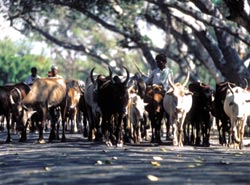
Villages such as Hangala began auctioning their dung for as high as Rs 3,000 a lorry load. Brazil’s ill luck and the vagaries of international commodity trade had brought the region unexpected riches. Hangala alone produced 39 tonnes of dung daily at the peak. Of this, it sold 16-24 tonnes — an average of 4 truckloads every day. Here was a business with no recurring costs; the fodder was ‘stolen’ from forests. “And the cattle were bought dirt cheap from Ooty. We didn’t need high milk-yield varieties, just ones which could amble through the adjoining forests and defecate” says Kalappa, a resident of Hangala.

Simple rules governing dung collection came into effect: all dung that fell in the cattle shed belonged to the cattle-owner; that deposited while cattle grazed in the forests was gathered by dung collectors (including women who found a formal occupation, finally). Dung collectors sprung up. So did agents, lorry managers, suppliers, brokers — a supply chain.

The village council in Hangala decided it should also get a share of the trade proceeds and began auctioning off streets and public places for dung collection. Exclusive collection rights were auctioned off at nine public locations — including the cattle pound and eight streets cattle used to reach grazing grounds. “We thought auctioning would bring money to the village for its development,” says H S Nanjappa, zilla panchayat member. After all, the annual trade from this village alone was worth about Rs 65 lakh.

The fact that much of the village manure was going out did not impact farming: the money earned helped purchase government-subsidised fertilisers.

Over time, villagers bought more cattle; the bovine population increased in all the villages participating in the trade; in some, by as much as 30 to 40 per cent over just five years. And in a few villages the growth rate of livestock shot up as high as 13-17 times greater than the national average livestock growth rate for the same time period.
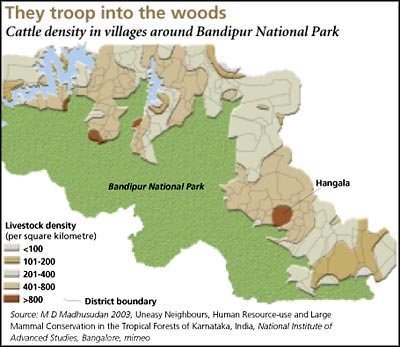
All this cattle grazed in the forest, with people following, avidly
collecting. The only alternative for grazing, common pasture lands, had anyway long disappeared. Additionally, most villages were now cropping marigold, turmeric, cotton and sunflower, which produce no consumable waste. “And even where ragi (finger millet) is grown, it’s a hybrid that produces very little hay,” says A Obireddy, principal scientist, National Dairy Research Institute, Bangalore. The forest was the cheapest, and at times the only, source of fodder for the thousands of cattle.

And today
Brazilian coffee is doing extremely well. Indian coffee growers face their worst crisis ever in 30 years. But the dung trade has acquired a steam of its own. “We now sell dung to Kerala for ginger, chilly, tea and many other crops. It’s not as voluminous as before, but prices have risen by almost Rs 1,000 in the last two years,” says M C Subbappa of Mangala village, which depends entirely upon dung trade (only about 10 of its 200-odd families own land). “What other options do we have?” he asks, as his 20-odd cattle rush home, tended by a labourer he pays Rs 5,500 annually. “I have had a daughter married off with this money. My son can work in the fields elsewhere because my future is secure.” “Our dependence on moneylenders has reduced considerably,” says Nagamma, a local tribal leader.

In Hangala too, the trade is flourishing. In the day, the village wears a desolate look: most men are out with their cattle. “Some are also trying for a few hybrid cows, for milk. The grass this side of the forest has been over-grazed. I tell them not to sell all their manure but what’s to stop them? Its not illegal,” says Nanjappa. Villagers recollect a local politician trying to stop the dung trade, even as his own henchmen made money off the trade.

It’s not illegal to sell cattle for meat either and there is a huge demand from across the border in Kerala. “Well, some do sell their cattle for a good price,” reluctantly accepts Kalappa. The village has more than 6000 cattle and nearly 5000 sheep and goats; there is enough meat to sell. A single cow can fetch up to Rs 8,000 for meat in Kerala. “Sometimes people who want to supposedly protect the cows from slaughter impound our cows at the Kerala border. But I guess they have to also fit into the business, right?” smirks Mallikarjun of Mangala village. He then goes right back to what he thinks is best for him: tending his cattle.

Inputs from E Vijaylakshmi
source: http://www.downtoearth.org.in/ Home> Features/ Issue October 31st, 2004


Govt move attracts more paddy growers

Madikeri:

The support price for paddy this year has attracted more farmers to sell their paddy production directly to the government agencies. Hence, this has increased the government’s paddy sock in Kodagu district.The state government has fixed the price per quintal of paddy at Rs 1,110 for ‘A’ grade variety, the government will add Rs 250 subsidy for this and the farmer will get Rs 1,360 per quintal.

The medium quality paddy will get price of Rs 1,080 plus Rs 250 and the aggregate amount of Rs 1,330. Farmers are selling their paddy production directly to agricultural produce marketing committees (APMC) in Madikeri, Gonikoppal and Kushalnagar. “The purchase started last month. So, for 882 quintals in Madikeri,1,192 quintals in Gonikoppal and 113 quintals in Kushalnagar, and in total 2187 quintals of paddy, is sold in APMC,” explained Jayadevaraje Urs, executive, District Food And Civil Supply Corporation Ltd.
Private buyers could not compete with the price, they cannot provide any subsidy and farmers are rushing towards APMC centres as the facility is scheduled till March-end. Later, there is no guarantee whether the same price will be continued by the government. The subsidy will be given to farmers on the basis of 18 to 20 quintals of production per acre and up to the maximum limit of 100 quintals only. The quality test is a compulsory process and moisture test will be done before the paddy is purchased from farmers.”The farmers should bring paddy in gunny bags and each bag should contain only 50 kg. They should also bring certification from the respective village accountants that the paddy is grown during 2011-12.

They should produce record of rights of property. The APMC will give acknowledgement for receiving the paddy and the cheque will be sent to the bank account of sellers within a week,” said Bellu Somaiah, president, APMC, Madikeri.Thalur Kishore Kumar, a farmer from Bettageri, expressed happiness over the government’s new support price. He said that he sold 25 quintals of paddy at Rs 1,300. “When I asked private dealers, they were willing to offer him only Rs 750 per quintal. The government’s new policy has provided the farmer an opportunity to make profit and has encouraged the cultivation of more paddy during next season,” he added.

source: http://www.articles.timesofindia.indiatimes.com / City> Mysore/ TNN / January 14th, 2012