Category Archives: Business & Economy

It’s all about Honey … HONEY!

Caption:

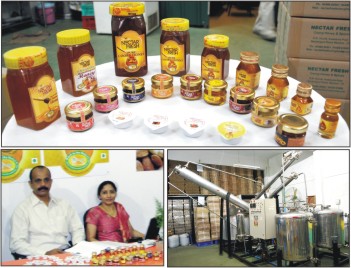
1) Some of the honey, jams and sauces produced by Nectar Fresh. 2) Chayaa Nanjappa with business partner Rajappa at Ahaar expo in Chennai. 3) The entire processing unit consisting of a container to feed honey to the settling unit.

They say ‘fruit of hard work is sweet’ and in this case it is metaphorically and literally sweet. Shall we call this a success story of a lone lady who made it big in the small scale industries sector or the growth of a brand which has today become one of the leading names in the field of honey? It is difficult to describe one without the other as this is the story of a lady who started a honey brand from scratch which has grown to great heights over the years. In this Weekend Star Supplement, SOM introduces its readers to this lady who says ‘If I could make it, then any other lady can

’ A flavour for every season

History:

Nectar Fresh was launched by Chayaa Nanjappa in 2007 at Bangalore and was backed by Khadi and Village Industries Board. Born on June 20, 1971 at Kodagu, Chayaa says, “I had a gut feeling and wanted to do something connected with my hometown. That instant I knew I wanted to start honey manufacturing and wanted to name it as Nectar Fresh.”

“The plant was doing well in Bangalore but due to some circumstances we had to relocate to Mysore in 2010.

Initially people said that Mysore is a small town and is not feasible for such businesses. But for me Mysore has been a lucky mascot. Most of the major deals were struck after we shifted here,” she says.

The plant was relocated to Kadakola near Mandakalli Airport when Chayaa partnered with Rajappa of MyStore.

Speaking about Nectar Fresh, Chayaa says, “We are one among the top 5 honey manufactures in India and are the only ones who are manufacturing different varieties of honey. Usually the Khadi and Village Board products are not considered as product for the high end markets. But today we have replaced international brands in hospitality sector under the Board. We have used their logo in our brand because it is the Board which has supported us. Also, there is a notion that business is only for the elite class who come from the same background or have the educational qualification for it. But we have proved this wrong. Anyone can do it if they have the survival instinct. Today we employ around 50 persons all over the country and around 20 in our Mysore plant.”

Chayaa, a PG Diploma holder in Mass Communication, underwent specialised training at Central Bee Research and Training Institute, Pune. She is also a member of the National Bee Board and is the first lady to have a honey processing plant in the country.

Process

The company has its mobile vans placed near the fields across India. Hence they are the only producers of a variety of honey in the country. They are also the first brand to launch honey blisters.

“Every month we have different varieties of honey according to the flowering season. This month it is acacia, clover and Himalayan honey,” says Chayaa, adding that lychee honey has the greatest demand.

Although Nectar Fresh has a wide network, it’s manufacturing unit is only at Mysore. The unit produces around 1,000 tonnes a day and is planning to increase it to 4,000 tonnes by procuring more equipment.

Processing plant: First, the honey is loaded into the container. This honey undergoes around 30 microns of filtration. It later undergoes moisture reduction and then again 2 microns of filtration. It is then cooled and sent to settling tanks. This will later be filled in containers and packed.

The brand has also started dealing with jams and sauces to help sick women groups. It aims to provide them with the technical knowhow and quality assurance and in turn market their produce thereby giving them a channel to avoid middlemen.

The processed honey is tested for quality at Pristine Laboratories, Bangalore and also at the units’s in-house laboratory.

Varieties

Nectar Fresh is known for its varieties in honey which include Coorg honey, rapeseed/mustard, eucalyptus, lychee, sunflower, Himalayan, acacia, clover, south Indian etc.

Market and export

Nectar Fresh today exports its produce to the Middle East, Malaysia and Australia. They will be looking forward to capture the US and European markets very soon.

The brand has replaced top international brands in India and today has a monopoly with the five star hotels.

“Previously we were not keen on our own private labeling and would supply in bulk and to the hospitality sector. But now we are entering the retail market also. We are the major suppliers to the Honey Society and are vendors for DFRL in city. Apart from this, ITC, Kerala Ayurveda, Taj group of hotels, Apollo etc., bottle their products here,” says Chayaa.

Mission beyond market

With an aim to be a leader in their business in India, Nectar Fresh is also seeing to offer its service beyond market. Apart from helping women with jams and sauces, they have empowered the locals around Kadakola region by providing them training and employment. They are also backing tribals by sourcing honey from the Sirsi belt.

The company is also associated with various charitable organisations helping girl child and Chayaa herself is a member of many women organisations in the country.

Competition

When asked about their major competitors in the market, Chayaa said “We have replaced many international brands including Australia’s Beerenberg Farm. In India, our major competitors are Kashmir Apiaries and Kejriwal Enterprises.”

Future

The company will soon be launching honey pouches with an aim to make honey available to even the lowest section of the society. The pouches are being prepared with the help of CFTRI. They will also be launching premixes of coffee and tea. The mix, which comes with milk, sugar and coffee/tea powder, can be prepared by just adding to a cup of water. With this the company plans to rule the Indian market and introduce Mysore and Kodagu to international customers.

Work hard and believe in yourself

I am not a feminist. But I support those women who work hard to stand on their feet. Most of the time, laws favouring women are abused and the most genuine cases do not have the privilege to use it. Hence, through our brand we intend to empower such women.

“Believe in yourself and have that never-let-go attitude. The success you achieve through this will give you a lot of self-respect rather than finding easy ways of making money.

“I have faced many hardships while coming this far. As a single woman, it was initially difficult for me to survive in this field. But that did not discourage me. With help from Corporation Bank, the government and of course from my business partner, now sky is the limit for Nectar Fresh. If I was able to achieve so much, then any woman can.”

source: http://www.starofmysore.com / Feature Articles / October 29th, 2011

Upasi annual meet delayed, but sees many youngsters taking part

COONOOR: Oct 23rd
Ministers give it a miss at the last minute

The Annual Plantation Conference hosted by the apex association in the South – The United Planters Association of Southern India (Upasi) appears to be losing its sheen in recent years.

Union Ministers, who have confirmed participation, have in the last 4-5 years given the event a go at the last minute leaving Upasi to find either a local Member of Parliament or the Chairperson of one of the commodity boards stand-in to inaugurate the conference.

This year, the association postponed the event by more than a month to October 23 and 24, hoping to get the Union Commerce Minister, Mr Anand Sharma, participate in this annual conference.

People in the know of developments say that for the first time in the history of Upasi has the conference been postponed by over a month. (It has for the last four-five decades been conducting the event by mid-September as a ritual).

When this did not materialise, the association sought time from the Union Minister for Rural Development, Mr Jairam Ramesh, and the Minister for Labour and Employment, Mr Mallikarjun Kharge. Though Mr Jairam Ramesh had confirmed his programme, it is learnt that he could not make it at the last minute.

The postponement of the conference, it now appears has not brought about the desired effect.

The association even departed from its usual format of arranging the commodity outlook session a day-ahead of the annual conference.

Over dependence on the elected representatives and ministers, missing schedule-deadline in the conduct of the annual meet seems to have taken its toll on the attendance at this year’s meet with more than half the members giving it a miss.

YOUNG MINDS

A visible, yet welcome change was the presence of plantation owners’ children taking part in all the deliberations this year, eagerly listening to the older generation.

Mr M.D. Balakrishna, former Upasi President (1988-89) and a coffee planter from Chikmagalur, said, “Earlier, the meets were orderly, for the corporate brought their professional work culture in managing the events and organising them. The annual meets used to be held much early, before the crop year commenced. Now only few corporates are in the sector; many have withdrawn. With their absence, the onus is on the plantation owners and few service providers to managing the meets annually.”

Plantation owners have two issues on hand – manage the trade body and manage their estate besides coping with the changing national and global policies. This has delayed the younger generations to actively involve on both platforms.

Many plantation owners’ children do work in different industries such as banking, managing cafes or at different value chain of commodity processing before going back to managing their estates. This has also delayed them to take a plunge in serving the trade bodies.

Talking about the diverse talent younger generation is bringing to the trade bodies, Mr Marvin Rodrigues, Vice-Chairman, Karnataka Planters’ Association (KPA) and a planter from Hassan, said, “youngsters are coming back to the plantation sector after having worked at industries. For me, managing labour shortages on the estate has taught me good HR skills.”

Mr Bose Mandana, former Vice-Chairman of the Coffee Board and a coffee planter from Kodagu, said: “We have come long way to reach a stage in managing our trade bodies ourselves. When total export controls were in place, we had limited or no role to play in marketing the produce. Now, we are free to manage, but problems are plenty.”

source: http://www.thehindubusinessline.com / L.N. Revathy > Anil Urs / October 23rd

Modern Hanging Bridge Facilitates Kodagu-Mysore Villages

Kushalnagar:

The much-anticipated dream of the villagers to get a hanging bridge for Cauvery river near Kanive Sri Ramalingeshwara Temple in the north Kodagu region, has at last come true.

A hanging bridge for Cauvery river has been built by Malenadu Area Development Authority at a cost of Rs.42 lakh by using modern technology. The attractive bridge, constructed under the guidance of hanging bridge expert from Sullia, Girish Bharadwaj, is now ready for inauguration. It is the nearest bridge connecting Kodagu and its neighbour Mysore district. This bridge lessens the distance between various border villages including Dodda Kamarahalli, Shyanubhoganahalli, Dindigaadu, Muttina Mullusoge, Kanagalu, Hanumanthapura, Karadilakkana Kere of Periyapatna taluk in Mysore district and Kodagu valley, Bhuvanagiri, Huluse, Hakke, Koodige, Marooru, Hebbale and other villages of Kodagu district.

Girish Bharadwaj, who has built the bridge with the help of 20 labourers in two months, says the help and trust of the villagers of the valley has been memorable. Two concrete pillars of two metre width and 33 feet height on two sides of the river are balancing the 83.5-metre- long hanging bridge with the help of iron ropes. Galvansied iron cables are fitted to the sides of the bridge for safety, Girish said.

The hanging bridge is a result of the special interest shown by MLA Appachu Ranjan, who heeded to the requests of the villagers for a bridge. Until now, the villagers including students crossed the river on the dangerous canal bridge built for lift irrigation to reach Kodagu for their daily business and schools and colleges. Many women commuted to Kudloor everyday for coffee curing works and it was difficult for them to return home at dark after 7 pm on the dangerous old bridge. The new hanging bridge has facilitated the villagers from both sides of the river to carry out their daily activities without much hassle, said Sri Ramalingeshwara Temple Committee President E.S. Ganesh, expres-sing his happiness that both the temple and tourism will improve due to the hanging bridge.

source: http://www.starofmysore.com / by Raghu Hebbale / August 22nd, 2011

Jobs in Coffee Board of India

Total of 89 posts advertised as available:

Specialists,  Subject Matter Specialists,  Assistant Specialists,   Research Assistants,  Junior Liasion Officer,  Extension Inspectors

Last Date for submission:  Jul 12th, 2011

For more information on the posts and how and where to submit applications, please click on the link below:

http://www.indiacoffee.org/userfiles/ADVT_COFFEE%20BOARD_board_16x27[1].pdf

Stamp Exhibition on Sunday

Madikeri:

A district-level philatelic exhibition “Kodagupex 2009” will be held on February 8 at the Field Marshal K.M. Cariappa Multipurpose Indoor Auditorium here.

Superintendent of Post Offices, Kodagu, Division, K. Thammanna made this announcement at a press conference here on Tuesday.

Postmaster General, South Karnataka Region, Shanti Nair will inaugurate the exhibition.

On the same occasion, Ms. Nair will release a special cover with the Madikeri Fort in the background. Lt. Gen. B.C. Nanda (retd.) will be the chief guest. In the philatelic exhibition, 35 people will participate in the junior category; seven in the senior category; and eight in the invitee category, Mr. Thammanna said.

Timings

The exhibition will open at 9 a.m. Prizes will be distributed at 3.30 p.m., he said.

source: http://www.thehindu.com /Staff Correspondent / National / Karnataka / Feb 04th, 2009

First Woman IFS Officer Muthamma Passes Away

C B Muthamma, the first woman Indian Foreign Service (IFS) officer, died here on Wednesday. She was 85. 

She passed away in a private hospital where she was undergoing treatment, her family members said.

Chonira Belliappa Muthamma was born Jan 24, 1924, in Kodagu. In a career that began in 1949, she served as ambassador and high commissioner to a number of countries. She retired in 1982.

Muthamma had fought against gender bias in the foreign service and had taken the Indian government to court in 1979 for bypassing her for the coveted foreign secretary’s post.

Though the Supreme Court dismissed the petition, it noted that there was truth in Muthamma’s contention that there was gender discrimination in the foreign office.

Muthamma brought out in the form of a book essays she had written over the years. Titled ‘Slain by the System – India’s Real Crisis’, it was published in 2003.

She had also co-authored a book on Kodava cuisine.


source: http://www.bangaloremirror.com / IANS / Thursday  Oct 15th, 2009

Be a Green Thumb this New Year

Turn over a new leaf this year with these no fuss potted plants that will brighten up any corner of your home

When software engineer Shabari Madappa had a baby she decided to make the most of her homemaker status by plunging her hands into mud and manure literally. She got together with friend Dhanya Menon (an interior designer) to start Green Essence, a gardening venture and soon-to-be store where she sells ornamental plants, herbs, orchids and bonsai among others potted in colourful planters and garden accessories.

Started in November, 2010, Green Essence is an extension of  Madappa being quite a green thumb herself. “I love gardening and have been into it. We also have a nursery in my family’s coffee estate in Coorg” says Madappa. Under Green Essence, the duo sells easy-to-care for cubicle planters such as cactus and succulents, herbs like lemongrass, oregano, rosemary, thyme, basil, curry and mint leaves for your kitchen window, exotic plants like orchids, desert rose and dromeliada.

They also do balcony and terrace makeovers and sell ceramic planters and Bio degradable pots made out of coconut choir. One of their best products, according to Madappa, are the self watering planters that only require you to water plants once in three weeks.

“The excess water collects in a tray and the soil pulls it back in a reverse osmosis process. There is no leaking or mess, so we even have these decorative covers or skins for these planters,” says Madappa. Green Essence will soon launch itself in the form of a store in the same premises as lifestyle store Orange Bicycle. Madappa plans to start a bonsai club once the store is in place where people can display their bonsais and even sell them.

At: Orange Bicycle, House no. 3353, 12th A Main, 5th Cross, HAL 2nd Stage, Indiranagar
Call: 98458 27010
Log on to: the Facebook page for Green Essence
For: Ornamental and herb planters, Rs 250 onwards, exotic planters ,Rs 850 onwards, bonsai Rs 3,000 onwards and balcony makeovers Rs 5,000.

onwardsource: http://www.mid-day.com / by Amirta Bose / 2011.01.03

Kodagu’s Charms

To say Kodagu is a tourist haven would be an understatement. The district has many interesting sights, from cascades, peaks to ancient temples and tombs, writes P T Bopanna
The scenic Kodagu (erstwhile Coorg) district is a tourist paradise for nature lovers. Kodagu is not the sort of place for the routine tourist, undertaking a ‘package tour’. It is for those who want to soak in nature. 

Kodagu shares one of its boundaries with Kerala. The landlocked district is not connected by train or air. The only way to reach this nature’s resort is to take a bus ride from Mysore, Mangalore or Hassan cities. Madikeri (known earlier as Mercara), the district headquarters of Kodagu, is 120 km from Mysore and 260 km from Bangalore.

Though Kodagu is dotted with several towns like Virajpet, Kushalnagar, Somvarpet, Gonikoppal and Pollibetta, only Madikeri and Kushalanagar to some extent, have good tourist facilities. There are not many clean budget hotels in Kodagu. Most tourists prefer to stay at ‘home stays’ spread across Kodagu, including at Madikeri. The home stays are mostly located away from the towns and housed in the midst of coffee plantations.

Home stays are a big draw

Home stays involve either sharing homes with the resident family or staying in independent bungalows. They offer an opportunity to enjoy the legendary hospitality of the Kodavas, the predominant community of Kodagu. There are an estimated 1,000 home stays in Kodagu, catering to various categories of tourists.

The tariff could range from around Rs 800 a couple per day to Rs 3,000, depending upon the facilities and location. Kodagu’s roads are a driver’s nightmare. Though the region has emerged as a major tourist destination, not much it seems, has been done to improve road connectivity and tourist infrastructure.

Madikeri is dotted with red-tiled bungalows and has an old world charm about it. Madikeri has several interesting tourist spots. The Raja’s Seat in Madikeri offers a breathtaking view of the towering hills and green valleys studded with paddy fields, and could be considered one of the most scenic spots in South India. Raja’s Seat attracts a lot of tourists and morning walkers. For the nature lover, the ideal time to visit the spot is in the morning when the first rays of the sun pierces through the mist covered valley. Madikeri Palace of the erstwhile Kodagu Rajas located inside the Fort, now houses the offices of the Deputy Commissioner. The brick and mortar structure was built in 1814.

The Omkareshwara temple in Madikeri was built by Lingarajendra II in 1820 in the Mohammedan style of architecture with a dome at the centre and four turrets at the four corners. The temple is akin to a Muslim dargah with a Linga installed near the entrance door.

Gaddige, or the tombs of kings Veerarajendra and Lingarajendra at Madikeri, is one of the important monuments of Kodagu. The hillock where the tombs are located is to the north of Madikeri and provides a commanding view of the town. The tombs are in the style of Mohammedan edifices with domes in the centre and turrets at the corners. Abbey Falls is a picnic spot eight km from Madikeri town, where water from the Madikeri stream gushes down from a height of 70 feet. It is a treat to watch the torrent of water in the monsoon season between July-October.

Talacauvery, the birthplace of the sacred river Cauvery, is located on the slopes of Brahmagiri Hill. Besides being a pilgrimage centre, Talacauvery is known for its natural beauty. On Tula Sankaramana day in the middle of October, thousands of pilgrims flock to the birthplace of the river to witness a sudden upsurge of water in a small pond, at a predetermined auspicious time. This gushing of water from the small pond is considered a miracle.

Bhagamandala is at the foothills of the Talcauvery. It is eight km downstream from Talacauvery and 39 km from Madikeri. Bhagamandala is at the confluence of the sacred rivers Cauvery and Kanike and legend has it that a third river Sujyothi, a subterranean stream, joins the two rivers here.

The Rajiv Gandhi National Park (Nagarahole) is one of the best maintained game parks in India. The Nagarahole (meaning snake river in Kannada) sanctuary derives its name from the serpentine river which flows through the park.

Irupu Falls, located 48 km from Virajpet on the way to Kutta from Gonikopppal, is both a picnic spot and a pilgrimage centre. The Falls is located in Kurchi village, not far from the Rajiv Gandhi National Park. A stream flowing down the Brahmagiri hill range plunges down 170 feet in two stages with a resounding roar into a rocky valley surrounded by dense forest.

Bylekuppe near Kushalanagar is one of the largest Tibetan settlements in South India. The settlement, set up in 1960, is dotted with several monasteries. Prominent among these are the Great Gompa of Sera Je and Sera Mey and the Namdroling monastery. The gold-coated Buddhist statues in the monastery are imposing and unique, reflecting the rich cultural heritage of the Tibetans. Tourists can shop for handicrafts, carpets, incense, sweaters, dress material and other accessories.

Cauvery Nisargadhama is a breathtakingly beautiful island off the state highway, two km from Kushalanagar town and 28 km from Madikeri. The 64-acre island, surrounded by the Cauvery river, can be accessed by walking across a hanging bridge.
Established in 1989, the picturesque picnic spot with lush foliage of thick bamboo groves, sandalwood and teak trees has lovely river-side cottages.  The Harangi dam, built across river Cauvery, is located eight km from Kushalanagar. Behind the dam is a vast reservoir. On the banks of the reservoir stands a temple of Basavanna. Dubare Elephant Training Camp, located 15 km from Kushalanagar, on the banks of the Cauvery river, is run by the Karnataka government-owned Jungle Lodges and Resorts Ltd. A visitor can spend hours simply watching and interacting with elephants, some of which have participated in the Mysore Dasara festivities.
Virajpet town, 32 km from Madikeri, is a taluk headquarters. The town, situated at the foot of a hill, is well connected by road to the coastal Kerala towns of Kannur and Tellicherry.

The Clock Tower is the most visible landmark in Virajpet, erected in 1914 to commemorate the Delhi Durbar of King George V. Another important landmark of Virajpet is St. Anne’s Church built in the Gothic style in 1868.

Tadiyandamol peak (1,745 meters) is the highest peak in Kodagu and poses an exciting challenge to seasoned trekkers. The peak is located in the south-eastern part of Kodagu and is 8 km from the town of Kakkabe which is 35 km from Madikeri. A steep serpentine path from the Nalaknad Palace, leads to the Tadiyandamol peak from where on a clear day, one can view the distant Arabian Sea.

Off the beaten track
But, if you are one of those who wants to take the path not trodden, then, you should probably be exploring Mandalpatti, Mallalli Falls or Honnamana Kere, for instance. The fog-covered awe-inspiring mountains around Mandalpatti, located 20 km from Madikeri, is perhaps the most unexplored region of Kodagu till recently. The presence of treacherous curves makes it risky to travel by road from Madikeri to Mandalpatti during the monsoon.

The forest department has constructed a watchtower atop the mountain which provides a magnificent view of the Pushpagiri mountain range.

The villagers assemble at the mand (village plains) during the annual Hutthari festival for staging sports events and other cultural activities. In recent years, Mandalpatti has emerged as a popular venue for film shooting because of the scenic location.
Mallalli Falls, located 25 km from Somvarpet, is one of the most beautiful water falls in Kodagu. The Kumaradhara river takes a plunge from over 200 feet, creating a spectacular sight. The Falls which lies in the foothills of the Pushpagiri hill ranges is situated in Bettadahalli Gram Panchayat in Somvarpet taluk.

The water falls into a gorge which is surrounded by steep lush green hillocks, making it an ideal place for trekking.

Honnamana Kere is perhaps the biggest lake in Kodagu, situated at Doddamalthe, six km from Somvarpet town, amidst beautiful hills and coffee plantations. During the Gowri festival, a special pooja is conducted and ‘Bagina’ is offered to goddess Honnamma. Newly wed couples visit the lake to make offerings. It is an ideal place for boating and fishing.


source: http://www.deccanherald.com/ by P T Bopanna /Supplements / Spectrum / Travel /


Its Coorg Oranges vs Nagpur Oranges in Kodagu District

Now a days, Kodau-Nagpura oranges are highly discussed topic in Kodagu. The revival of Coorg orange under National Horticulture Mission and purchase of Rs 2.43 lakh worth Nagpura orange plants have given food for discussion in Kodagu.
Coorg orange which received global recognition.  dh photoCoorg orange has global recognition and has attracted the attention of the customers at the global level due to its colour and taste. In 1960s, oranges were grown in 50,000 to 60,000 hectare land. However, over the years, disease attacked orange plants. As a result, the land under orange cultivation was reduced to 3,000 to 4,000 hectares. After the price of coffee rised in the international market, orange estates have disappeared in Kodagu. 

Based on the proposal of the horticulture department on the need for reviving oranges in Kodagu, the Central government released a sum of Rs one crore in 2009-10. The Horticulture department purchased Nagpura orange plants instead of Coorg Orange plants. According to officials in Horticulture department, Kodagu-Nagpura varieties are one and the same.

However, after Indian Horticulture Research Scientists reported that Nagpura variety of orange plants are not suitable for the weather in Kodagu, the discussion on Coorg and Nagpura oranges have increased. Though elected representatives from BJP tried to ascertain the fact that both the varieties are same, Congress and JD(S) are demanding Lokayukta probe into the misappropriation in the purchase of Nagpura orange plants.
Under National Horticulture Mission, 2.43 lakh Nagpura variety of orange plants have been distributed. A sum of Rs 47 lakh have been spent over it. However, distributing Nagpura variety of orange plants in a hurry without giving any information to the growers have given room for suspicion.

Another interesting thing is that the department had given advertisement in local newspaper for the supply of orange plants. However, in the tender, individuals from Hassan and Shimoga have taken the tender to supply the plants.

However, horticulture department is supporting its stand on the distribution of Nagpura variety of orange plants. In the beginning, Chettallu Horticulture Research Institute had agreed to supply 10,000 orange plants. As the demand was more, it was necessary to purchase Nagpura plants.

The geography of Kodagu is different. Kodagu receives six months rain and the temperature does not rise. However, Nagpura oranges grow under 40 degree celsius weather. With the Kodagu weather, the colour and taste of orange may vary feel scientists.

The taste of Coorg orange can not to compared with Nagpura orange, said a senior officer.

Some say that horticulture department runs eight nurseries in Kodagu and spend Rs 15 lakh annually.

Instead of purchasing 2.43 lakh Nagpura variety of orange plants, the department could have developed plants in its own nurseries in a phased manner.

However, we can not brush aside the fact that globally recognised Coorg orange will be a thing of past if Nagpura oranges start giving yield within three to four years in the district.

source: http://www.deccanherald.com / Madikeri / DH News Service / Oct 21st