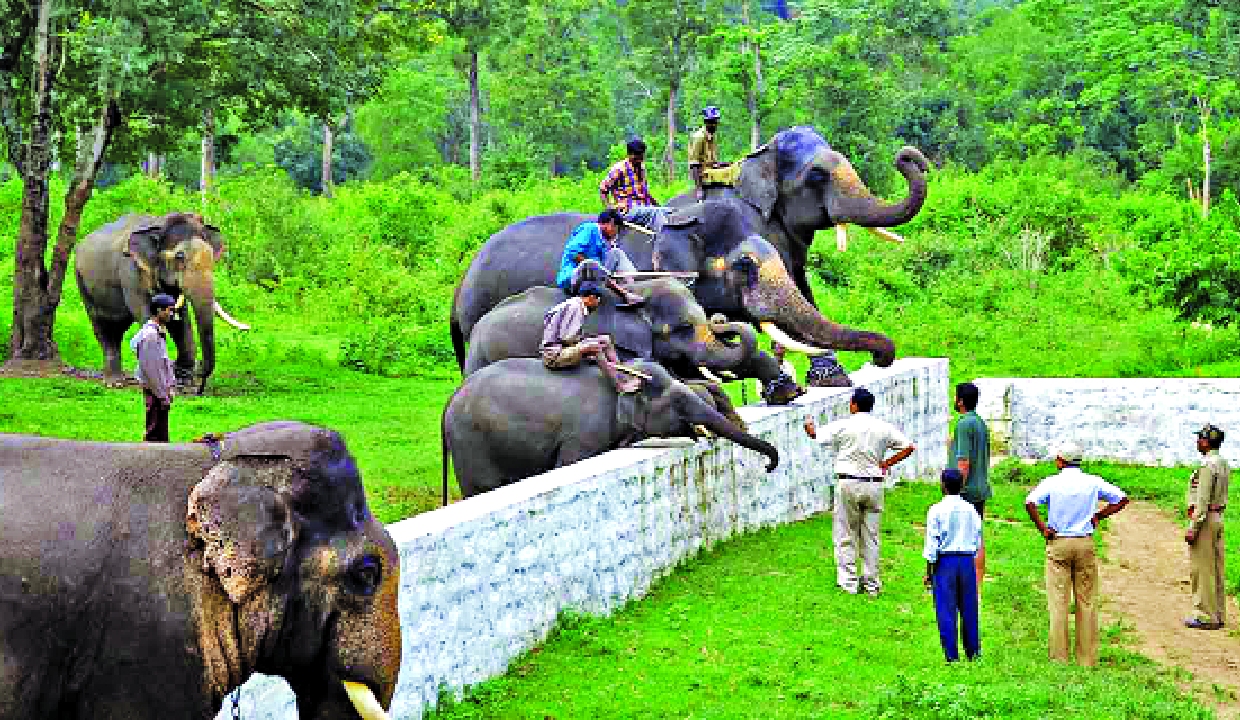
The tragedy raises urgent questions about the continued use of captive elephants for tourism, festivals, and processions in the name of tradition, even as shrinking habitats, broken elephant corridors, and rising human interference intensify conflict between humans and wildlife.
This week’s tragedy at Dubare elephant camp in Kodagu district, deep inside Karnataka’s Western Ghats, questions the decision of the authorities to permit tourists to bathe captive elephants in the flowing waters of the Cauvery River. This camp is located deep within forests dominated by the movement of wild elephants. All captive elephants in this camp were not born in captivity; many were captured from the wild and later tamed in such camps. It is not fair to conclude that tamed elephants have shed all their wild characteristics and fully obey the command and control of their masters – mahouts and kavadis. There have been instances in the past where elephants have killed their masters – mahouts and kavadis. There have also been instances where elephants did not obey the commands of the mahout and ran amok, inflicting casualties and death among crowds.
Captive elephants are often subjected to torture by mahouts using iron ankushes, which can cause bleeding and septicaemia. The footpads of elephants are frequently injured from walking on paved roads. Though camps have treatment facilities under the supervision of veterinary doctors, bleeding from earlobes and footpads is often neglected, and the elephants continue to suffer.
Let me examine in this piece how far we are justified in taking elephants for processions during special occasions and marriages where large crowds gather, and how far we are justified in continuing age-old traditions where tourists are permitted to pour water and rub the elephants’ bodies while standing beside them. On several occasions, I have personally failed to convince the Karnataka government not to use captive elephants during Mysuru Dussehra. The argument advanced was: why discontinue traditions?
Captive elephants were extensively used in dragging timber logs across hilly terrain in forestry operations in the past. The Forest Department maintained elephant camps for such operations. However, maintaining these camps was always costly, which restricted their expansion. As forestry operations have now been scaled down and tree felling in hilly terrains prohibited in the interest of conservation, these camps have largely lost their relevance.
Now, bureaucrats and politicians see these camps as permanent centres for training wild elephants that stray out of forests, damage crops and property, and threaten human lives. Earlier, the Karnataka Forest Department carried out khedda operations to capture only a few elephants needed for logging operations. However, with the advent of safer tranquillising techniques, more and more wild elephants are being captured. The department often comes under public pressure to capture elephants straying into villages. The argument advanced is that the elephant population in the wild is increasing due to conservation, and the excess population must therefore be brought into captivity. Wild elephants involved in conflicts, when translocated several hundred kilometres away into another elephant habitat, have often returned to their original homes within weeks, strengthening the argument for bringing such elephants into captivity.
In an era when elephant habitats are continuously fragmenting and shrinking owing to the expansion and widening of linear infrastructure, diversion of forests for mining, industries and development projects, and unauthorised encroachment on forest land, wild animals — especially elephants — are left with little option but to migrate in search of food, shelter, and water, thereby straying into human settlements.
The spread of invasive species and forest fires has also degraded elephant habitats. Palatable plant species and bamboo forests have suffered extensive damage, forcing elephants to move out of forests regularly. Elephant corridors that once provided migratory routes have been occupied by humans. Human settlements and cultivation inside forest pockets have expanded, to the detriment of conservation.
Captive elephant camps like Dubare are themselves islands of human activity within forests. As part of their daily routine, camp elephants are released into forests during the daytime, where they interact with wild elephants. Fights between captive and wild elephants are reported regularly. There have even been instances where captive elephants were killed by wild tuskers. Aggression is a natural part of elephant behaviour and cannot always be controlled by a mahout’s ankush. Sometimes, the animals can surprise us.
About a decade ago in Karnataka’s Kalaburagi district, an elephant in a procession kicked its mahout in full public view. The kick was mild and the mahout survived the scare. Feeling insulted, the mahout attempted to attack the elephant with an ankush. The elephant became even angrier and kicked him with such force that he fell nearly 20 feet away and died. Elephants killing their mahouts is not uncommon, and such incidents have been reported from across the country.
Within a herd, stronger elephants are also known to target weaker members. This is what happened at Dubare earlier this week. A tusker attacked a makhna (another male elephant without tusks) while tourists were permitted to bathe the herd. The hostility had likely built up over time, and on that fateful day, the tusker chose to attack the makhna in full view of tourists. The makhna collapsed onto a female tourist bathing it, crushing her to death. The tusker continued attacking the makhna until the mahout managed to calm it down. Despite the best treatment provided at the camp, the makhna died the following day.
Dubare camp also has tourist lodges run by the state-owned Jungle Lodges and Resorts (JLR). One of the activities offered to tourists is bathing the camp elephants, while another is jeep safaris through nearby forests to view wild animals. It has also been found that the entire camp and JLR premises lie within a corridor historically used by wild elephants. Blocking this corridor has disrupted elephant movement and intensified human-elephant conflict.
There are other forest pockets in Kodagu that have been granted for coffee estates. These estates too obstruct elephant corridors. More than 10,000 acres of coffee estate owned by Tata lie within this corridor. The entire estate is fenced, diverting elephants into human settlements and aggravating conflict. Sometimes elephants break through the fencing and enter the estates, threatening workers’ lives. Even the narrow roads inside coffee estates are covered by drooping coffee branches on both sides, limiting visibility. Estate management must ensure better visibility and safer movement.
This is a vicious cycle. As wild elephant movement is obstructed, incidents of conflict increase, and every human death places additional pressure on the Forest Department to capture the elephants involved and bring them into captivity. The continued operation of such elephant camps and JLR facilities is not in the interest of conservation.
Such elephant camps should be downsized in a phased manner, and corridors must be restored by removing fencing in Tata Coffee estates and around JLR properties. Tourists should not be allowed near camp elephants, and under no circumstances should close interactions be permitted. Tourist viewing areas should instead be cordoned off, allowing visitors only to observe elephants bathing in the river from a safe distance.
Dubare camp also has tourist lodges run by the state-owned Jungle Lodges and Resorts (JLR). One of the activities offered to tourists is bathing the camp elephants, while another is jeep safaris through nearby forests to view wild animals. It has also been found that the entire camp and JLR premises lie within a corridor historically used by wild elephants.
The writer is a retired Head of Forest Force, Karnataka, and teaches Economics at the Karnataka Forest Academy; Views presented are personal.
source: http://www.dailypioneer.com / The Pioneer / Home / by B K Singh / May 28th,2026

