Category Archives: Business & Economy

From doodling for food to doodling for money – Rachna Prabhu’s artsy journey

“Itni shiddat se maine tujhe pane ki koshish ki hai, ki har zarre ne mujhe tumse milane ki saazish ki hai,” lines delivered by Shahrukh Khan in a movie is often used to describe how if you have the passion for something, the world will conspire to bring you closer to it.

In real life too, this theory seems to work and Rachna Prabhu is a case in point.

RachnaPrabhu01KF28feb2018

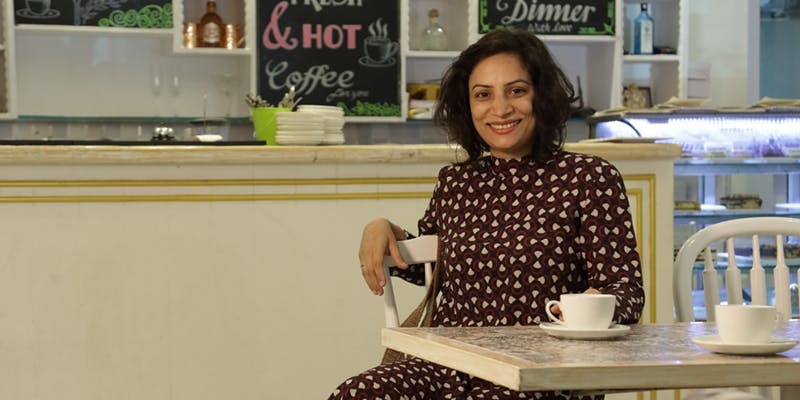
Rachna Prabhu, an entrepreneur and the Founder of Doodle Doo, has been drawing ever since she was old enough to pick up a pencil.

“I never had any formal art education. In school I’d draw for friends (in exchange for grub) and of course doodle on the pages of my notebooks. My parents were most encouraging, even at a very young age. Over the years I experimented with different styles. But it was only in my 20s that I found an illustration style that was unique to me, and that has stuck with me ever since,” she says about her journey with drawing.

She has an online store. She also enjoys interacting directly with her customers in flea markets, which, she says, has provided great results in terms of sales.

Her target audience is mostly women and her USP – products with playful illustrations for young women. “Funnily, a fridge magnet that says ‘A princess never cooks’ is my single most popular product! But as a category, my pocket mirrors are popular with my customers,” she shares with a smile.

This 29-year-old from Coorg works from her home studio in Mysore. Since her parents were planters based out of Kerala, her formative years were spent in Ooty in a boarding school. She got married two years ago and moved to Mysore.

Rachna pursued her bachelors in business management and holds a master’s degree in mass communication from COMMITS in Bengaluru.

“It was during my journalism course that my professor asked me if I would illustrate stories for our college’s monthly newsletter. That’s when something changed – I realised that I could do a lot more with my illustrations.”

So while at her first job as a PR at a firm in Bengaluru she began secretly emailing local publishers with the hope of getting work as a children’s book illustrator. “I was lucky enough to hear back from one publisher, despite having no art portfolio to boast about. From there I just dove in.”

RachnaPrabhu02KF28feb2018

Well with technology transforming how we work and function, she was informed that she would need to submit her work in its digital form. “Of course I didn’t know how to use any software, so I just logged into YouTube, learnt how to use Photoshop, and kick started my night-shift job as an illustrator, even illustrating three children’s books that same year. There has been no looking back since then. The Internet has been my greatest learning tool but everything I know, I have learnt on the job, and there is no greater sense of achievement,” says Rachna with the pride that comes from hard work that yields success.

Even though Rachna changed jobs and began working for a content syndication firm and later as a corporate communications professional in an IT firm, her tryst with drawing continued. All along, in addition to her 9 to 5 job she kept drawing and working on some great commissioned work. Up until two years ago, she worked during the nights and weekends as an illustrator.

It was her marriage and her husband that changed the status quo. “Thanks to my super-supportive husband that I transitioned to being a freelance illustrator full time and started Doodle Doo. It was the best decision ever.”

While working the nights on illustrations, Rachna had pondered over the idea of printing artwork on products and selling them. “Pocket mirrors in particular piqued my interest, because every time I walked into a quirky store, I’d look for cute pocket mirrors but just never found any. I immediately knew the first product I wanted to design and sell. I also knew that I wanted to start by selling at flea markets in Bengaluru because I was a regular at them.”

So when Rachna quit her job she knew exactly what she wanted to do – start her own line of illustrated products. That’s how Doodle Doo took root. She designed her favourite pocket mirrors, fridge magnets, doodle kitchen towel, laptop sleeves, beware of the dog signs, and a recipe book with an illustrated cover. She recently launched a 2016 desk calendar too.

At the moment there is a one-woman army behind Doodle Doo. Rachna takes care of everything right from creating artwork, to replying to emails, taking care of online orders, packaging and shipping products to customers.

It takes anything between an hour to a few days to complete an illustration, depending on the work involved. “I scribble it out in my sketchbook and make it pretty on Photoshop while listening to loud music and of course,” she says, “some days I do have creative blocks.”

It has not been a walk down the green pastures for Rachna, with absolutely no idea of how to start and run a business, her biggest challenge initially was starting a business that, “was a true representation of me but still had sale value. I was also very apprehensive of the artwork I had used on products because I wasn’t sure if the general public would like them. But it was my first big sale at a flea market that put all my worries to rest. Seeing the customers’ happy faces and receiving their wonderful feedback was all I needed to know that I’d got my first step right. The Internet has been my best friend and thanks to social media, Facebook in particular, my online store is well into its 12th month.”

“So I guess for any entrepreneur or freelance artist, the initial months or years are a struggle. But over time, it falls into place – at least for me it has, thankfully. And then it becomes a job that you love,” she says.

Rachna’s business mantra is, “Strive to be unique and original to set yourself apart from the rest; success will follow. And most importantly, remember to celebrate small victories along the way.”

She enjoys the flexibility that comes with being ones own boss. “Finding the right balance between work and break time is hard. I am slowly learning how to draw a line between the two. You begin to think that it’s normal to work all day and sometimes well into the night too,” was her response to my question about work-life balance since she works from home.

Rachna is happy and content and thoroughly enjoying herself. In the near future she says, “I hope to add some new products to my online store. I’m also hoping to collaborate and find some amazing personal and client work as an artist to challenge me into the New Year.”

Keeping her motivated is the positive feedback she has received. It keeps her confident and going. But her important piece of advice to other entrepreneurs like her is, “I do believe that one must work really hard and be very patient as it takes time to build a customer base that loves your products and wants to support what you do.”

source:http://www.yourstory.com / YourStory.com / Home> Women Entrepreneurs / by Tanvi Dubey / November 25th, 2015

Don’t make a killing

Elephant01KF05feb2018

A documentary film about the elephant-man conflict in Karnataka posits that solutions to loss of life due to elephant attacks can only come through co-existence. Not everybody agrees, though. We look for some answers.

There is a moment in Elephants in the Coffee when Naveen Cariappa (his family has farmed an area in Coorg for more than three generations) talks about how media, officials and conservationists rush to the site of an elephant death, but remain silent when a coffee plantation worker is killed as a result of conflict with the very same elephants. The lament encapsulates the kernel of the 58-minute documentary – that the solution to such man-elephant conflict lies not in taking sides, but in pursuing solutions that encourage a peaceful co-existence between both parties.

Created by author, documentary filmmaker and cultural explorer Bhaskar Krishnamurthy and journalist-turned-educator Tom Grant, Elephants in the Coffee looks at the fragile relationship between elephants and humans, and has been shot mainly around Nagarahole National Park and the coffee estates skirting it.

Krishnamurthy, who was in the city for the screening (he is based in the US) says this, his first film on the subject, was born out of a desire to understand what happens as human population grows and elephant habitat shrinks. “Are we at the threshold of cutting our relationship with animals? The more plantation workers die as a result of this conflict, the more tolerance for wildlife is going to reduce. And that doesn’t bode well,” he says. Grant adds: “Cariappa represented an important duality, or internal conflict, among farmers. He loved elephants and nature. He worked with people in the national park to help improve the situation for elephants. But when they began destroying his crops and threatening his workers, he had to seek solutions. He found no reasonable measures by which he, as a small farmer, could protect his farm from crop raiding elephants. In our minds, he is a symbol of the Indian farmer who is being forced to change his attitude toward an animal he once saw as a benevolent god. Now he, as many others, see the elephant as a menace that must be addressed.”

There are others. PC Bopanna, a farmer describes how he survived after an elephant pelted him to the ground, but today, hobbles along on a crutch, his leg badly damaged in the incident, even multiple surgeries later.

Then there is the other side – of elephants losing their habitat, of majestic creatures being robbed of their homes and reduced to residents of tiny spaces once they’re marked as violent and aggressive and eventually, captured. Krishnamurthy speaks with feeling of the 60 elephants housed in captivity in Karnataka, and how they may be alive, but living regimented lives like that for the rest of their days “is no life at all”.

Fences have not worked, as illustrated by viral videos of an elephant slipping under a railway crossing barrier at Chapramari Wildlife Sanctuary earlier this year.

Elephants in the Coffee also shows how elephants outsmart all kinds of barriers, trampling them with ease. As the film makes clear, ‘If you make a 20-foot-long moat, the elephant will walk till the 21st foot and cross over there’. Successful models have been few, such as the SMS-based warning system developed by Dr Anand in Valparai to warn workers when an elephant is in the area, or the SMS messaging system at Tata Coffee, demonstrated in the film by biologist Karthic Krishnan.

Conservationist Padma Ashok is also of the opinion that co-existence is the only way forward. She opines that solutions need to be thought of by people local to the area, by taking into consideration the topography, landscape and geographical features of the area. “From the elevation to the length of the river in that area, everything matters. And you need a combination of two-three solutions to tackle the problem, because elephants are able to outsmart most,” she says.

Not everyone agrees, though. Praveen Bhargav, former member of the National Board for Wildlife, believes harmonious co-existence is “one of the greatest myths in conservation”, a utopian idea that “rarely works in the long term with most conflict-prone large mammals”. He advocates “site-specific solutions driven by scientific knowledge and a deep understanding of the social context”. He adds: “Loss of a family member is tragic but it must be seen in perspective. In Karnataka alone, more than 10,000 people have lost their lives in road accidents in 2015 while around 15 people have died due to elephant conflict. Large swathes of elephant habitat have been fragmented/lost due to agriculture, human settlements, encroachments, dams, highways, resorts etc which is a major driver of conflict.

There is no magical solution but conflict can be minimised by spatially separating humans and large wildlife to the extent possible by deflecting developmental projects, preventing ad-hoc grants of public lands by the revenue department, incentive-driven voluntary resettlements and innovative ideas for creating viable buffers around reserves involving local communities. In some specific cases, marooned, isolated population of elephants may have to be moved out to minimise conflict.”

Krishnamurthy believes the biggest problem is a lack of education. People have no idea what impact a cup of their coffee is having in the wild. He suggests the promotion of sustainable wildlife products, say by giving “a premium to the coffee you drink”. “At least that way a part of it will go back to wildlife conservation.” He would also like more stringent requirements for ownership of coffee estates and homestays that have mushroomed indiscriminately in these areas over the past few years. “So many of them are owned by people living, say, in Bengaluru. Maybe one way to minimise the number of such estates is to lay down laws that owners have to have strong roots in Coorg,” he explains. And to ensure better welfare of the captured elephants, mahouts need to be treated better and paid more. “Otherwise they’re losing interest and daily wage labourers who are paid a pittance and have no interest in forming a relationship with the animal, are taking their place.” The best answer, though, he believes, is technology. “Even the SMS warning service is eventually a human intervention. Instead, I’m sure that in Bengaluru we can develop technology to identify elephant movement and tracking, where there is no need at all for a person to physically go out there and do it.”

For Grant, the solution also lies in people considering the cost of their cup of coffee. As he puts it: “Americans drink an average of three cups of coffee each, but they have little idea how coffee is grown. India is one of the top exporters of coffee. And now Tata has a joint operating agreement with American coffee giant Starbucks. Yet no one in America who drinks coffee knows that India’s elephants are locked in a struggle for survival with the people who grow coffee.”
The answer isn’t that people stop drinking coffee, he emphasises.

Rather, “if every coffee drinker gave a penny for elephants with every cup, we could solve this problem in an instant”.

source: http://www.bangaloremirror.indiatimes.com / Bangalore Mirror / Home> Opinion> Sunday Read / by Sowmya Rajaram, Bangalore Mirror Bureau / April 30th, 2017

7th India International Coffee Festival 2018 reflects on experiential tourism in Karnataka

7th edition of India International Coffee Festival 2018 hosted at The Lalit Ashok, Bengaluru saw a host of activities including the coffee workshops, exhibition, keynote sessions, Fireside chat with Shri Priyank Kharge, Hon’ble Minister for IT, BT and Tourism, Government of Karnataka, Coffee Quiz Competition for Coffee enthusiasts ending the day with Café Awards ceremony.

IndiaCoffeeExbn31jan2018

The day started with workshops on ‘Role of sustainability in Post-Harvest Processing Equipment to secure the right quality, type and quantity of coffee.’ The session was led by Carlos Brando and Joao Alberto Peres Brando from Pea Marketing Ltd.

Shri Priyank Kharge, Hon’ble Minister for IT, BT and Tourism, Government of Karnatakagraced the occasion and attended a fireside chat session along with Mr. Anil Kumar Bhandari, President, India Coffee Trust where he emphasized on experiential tourism.“Today people want to experience and learn from their outings, hence experiential tourism is leading to a lot of buzz around homestays. We have offline and online strategies in place and are ready to build infrastructure and jointly manage it with associations. We have opened up 11 new eco-trails that will benefit the homestays and provide exhilarating experience to travelers,” said Shri Priyank Kharge while addressing the gathering.

He further said that, “I am privileged to have a unique opportunity to bring together information technology and biotech to further tourism in the state. I urge the startup fraternity and innovators to come forward with solutions that will help us build a sustainable tourism ecosystem in Karnataka.”

Commenting on this occasion, Anil Kumar Bhandari, President, India Coffee Trust said,“This year the festival focused on skill-building workshops, showcase of products and services, key sessions by delegates on Global Coffee Outlook and Future of Indian Coffee Sector.”

“The Indian coffee sector is growing at a rapid pace. And to sustain this growth, the dependence on government subsidies needs to come to an end,” said Shri Srivatsa Krishna, IAS, Chief Executive Officer and Secretary, Coffee Board of India.

Also, addressing a keynote session here, Jose Dauster Sette, Executive Director, International Coffee Organization said, “India is the sixth place in internal coffee consumption. In future by 2050, the production of world coffee might further decrease due to factors such as climate change that facilitates spread of pests and diseases. Both Arabica and Robusta are also negatively affected by the climate change.”

source: http://www.everythingexperiential.in / Everything Experiential – Business World / Home / by EE News Desk / January 24th, 2018

A rush of Caf Feine

The International Coffee Festival brings growers, sellers, and lovers together in the same mug

CaffeineKF20jan2018

Coffee love is serious love, and Bengaluru knows how to keep up with it. Just last month, Coffee Santhe celebrated your favourite brew with a three-day carnival. It had the best estates in India showcasing their blends and coffee-related demonstrations to coffee-related food and art.

Cut to the present. Coffee love is hogging the limelight yet again, thanks to the ongoing India International Coffee Festival (IICF) 2018. The expo, which is in its seventh edition, organised by India Coffee Trust – an NGO formed by various stakeholders of the Indian coffee fraternity, is on till Friday. And the event is dotted with different kinds of activities – from panel discussions to exhibitions by various growers.

Today, for instance, you can flaunt your knowledge of coffee at a quiz. Or, sit down for a workshop about the ‘Role of Sustainability in Post-Harvest Processing with the Right Processing Equipment to Secure the Right Quality, Type and Quantity of Coffee’ by Carlos Brando of Pea Marketing.

Over two days, you can listen to coffee experts and policy-makers talk about the trends in the coffee market, innovation in the production and packaging segment, startups making coffee ‘cooler’, alternate brewing techniques, and how to turn India into a ‘Coffee Nation’.

Jose Sette, executive director of International Coffee Organization, will speak about ‘Global Coffee Outlook – addressing challenges to meet future demand’; Dr Joseph K Kimemia, chairman of African Fine Coffee Association, will talk about ‘Initiatives on Promotion of African Coffee’; Dr Peter Baker, director of Climate Edge UK, will share his thoughts about ‘The Changing Climate for Coffee – farming in a time of extremes’; Sanjay Khajuria, senior VP (Corporate Affairs), Nestle India, will discuss the topic ‘Creating Shared Value –
How responsible business and communities work together’. The fest will also felicitate the best in the business.

Anil Kumar Bhandari, president of the India Coffee Trust, says that the coffee industry owes a lot to the country’s café culture that has grown rapidly in the past decade or so. “I need to give a little background into this festival. We started this expo in 2002, which begun in tacit with the Coffee Board, commerce industry, and ICT. However, we never asked for funds from the government because we didn’t want the show to come with strings attached.

There are only 4-5 large corporate houses that are part of this trust. Initially, it was started by a bunch of coffee growers like me, and the idea was to generate domestic consumption of coffee, and to help the growers market their coffee better. In India, 98 per cent of coffee growers are small, which means they farm on less than 10 acres. Now in 2002, the industry across the world suffered a massive slump because the global market was saturated. There was no strength in the industry to combat this deep depression. It is at that time that we considered generating a new idea – something that will increase domestic consumption – instead of the going to the government to ask for waivers and subsidies.” And this where cafes have come into play.

However Bhandari also adds that the coffee drinking habit remains mostly out of home, but “yes, it created a whole new lifestyle. Before the modern version of cafes, the smaller places had no focus, no identity, barring a few landmark places.”

Yes, the expo is quite industry-oriented. It is an ideal networking ground for people engaged in the growth, production, packaging, and promotion of coffee, or are planning to make a career switch in the direction. Nonetheless, platforms such as these provide common man a chance to learn what goes into bringing their latte, espresso, cappuccino, or the humble filter coffee to their tables.

Besides these talks and coffee quiz, an exhibition is being held across two halls – Kalinga 1 and Siddhartha. On showcase are a range of coffee beans and blends, with Coffee Board of India itself displaying and selling 15 varieties (light, medium, and dark) hailing from Coorg to Chikmagalur, Araku Valley, Nilgiris and Wayanad. Plus, you can sift through coffee filters, including a cute, ceramic one. Needless to say, there’s a lot of coffee for you to sip on, from the regular instant brews to the speciality. Moreover, a few vendors will also teach you the method to making a cuppa of your choice.

Two stalls are interesting. One is selling coffee paintings – painting with coffee powder (see pic on left). It is the handiwork of Himabindu, an IT professional who’s currently on sabbatical. She has put up 30 paintings, and had managed to sell quite a few by Wednesday afternoon. The second one will have you scratch your head as it promises to print your selfie on coffee broth. The set-up will be fully operational today.

If you want to take your coffee expertise a notch up, you can enquire about the ‘Q Grader Arabica Training & Certification’ programme, which will take off towards the end of February. Or drive down to coffee estates in the state and learn about the bean-to-cup process there. You can get information at the tourism stalls.

Catch IICF 2018, January 18-19, at The Lalit Ashok, Kumara Krupa High Grounds Details: iicf.in

source: http://www.bangaloremirror.indiatimes.com / Bangalore Mirror / Home> Entertainment> Lounge / Bangalore Mirror Bureau / January 18th, 2018

Want to make India a ‘coffee nation’, Coffee Board

Bengaluru (PTI) :

The Coffee Board wants to make India a coffee nation and position it as the drink for Prime Minister Narendra Modi’s vision of New India, a top official of the board said today.

Speaking at the inaugural event of the Seventh India International Coffee Festival,Coffee Board secretary Srivatsa Krishna said, “We are positioning coffee as the drink for Prime Minister’s vision of New India.” “Chai (Tea) has been the drink for many many years and British gave tea for free at the street corners and made this country a tea drinking country. We want to make it a coffee nation,” he said.

“Today outside the southern world and the national capital and a few other state capital, nobody drinks coffee.

Can we have pure Arabica and Robusta as the drink for the tea bugs from Tier I and II cities of New India? That is the dream we are pursuing.” To achieve its goal,the board wants to make Indian coffee as famed as the Darjeeling or Shillong tea,said Krishna at the four-day event.

He said the board was working towards branding and geo-tagging Indian coffee, telling the world the unique India coffee story and sell it as a premium product.

Krishna said the Board was the first organisation in India to introduce the block chain technology into coffee in a pilot project through Eca Analytics.

Under the project, it intends to bring together growers, curers, roaster, exporters and the Coffee café.

Eca Analytics would also help the board utilize the 100 years of rainfall and soil data to help the growers.

Krishna said the board has also partnered with Harvard University to experiment with ‘precision agriculture development’.

“We are also partnering with Harvard University. Two professors,Michael Kremer and Prof Sean Paul,have come forward with something called precision agriculture development.” “Today they are working in three states of India. We are bringing them into the coffee world wherein through an IVR call working with scientists at CCRI. They can give precise advise to the grower. This will hopefully take off by the end of Q-1,” said Krishna.

On the occasion, a mobile application developed by the Coffee Board for growers and exporters was also demonstrated.

It will be formally launched two months later by the Union Commerce Minister.

PTI GMS RA APR APR .

source: http://www.newindianexpress.com / The New Indian Express / Home / PTI News / January 17th, 2018

A tech booster coming for domestic coffee industry

(from left) Jose Sette, ED, International Coffee Organisation; Krishna Byre Gowda, Minister for Agriculture, Government of Karnataka, at the inauguration of the India International Coffee Festival (IICF) in Bengaluru on Wednesday - Photo: SOMASHEKAR G R N
(from left) Jose Sette, ED, International Coffee Organisation; Krishna Byre Gowda, Minister for Agriculture, Government of Karnataka, at the inauguration of the India International Coffee Festival (IICF) in Bengaluru on Wednesday – Photo: SOMASHEKAR G R N

Bengaluru :

India’s coffee sector is seen getting a technology boost with the State-run Coffee Board proposing to introduce a host of initiatives ranging from blockchain to drones soon.

Coffee Board Secretary Srivatsa Krishna said the Board has partnered with Eka Analytics to introduce blockchain technologies into the coffee sector covering growers, consumers, exporters and the trade including cafes on a pilot basis.

Rainfall, soil data
Besides, the rainfall data gathered for over 100 years and soil info are being used to deliver extension and advisory services to the growers on demand through a mobile app, Krishna said at the inaugural of the 7th edition of the India International Coffee Festival.

Besides, the Board also proposes to introduce the model of Precision Agriculture Development, developed by Harvard professors Michael Kremer and Shawn Cole to the coffee sector in the country and deploy drones for crop estimation, Krishna added.

He also urged the growers to come together to promote coffee.

Krishna further said that the Board has applied for a GI tag for four coffee varieties, a move that could help position better and fetch premiums.

The four-day IICF, organised by the India Coffee Trust and the Coffee Board, is perceived to be a precursor to the International Coffee Organisation’s World Coffee Congress which India will be hosting for the first time in 2020 in Bengaluru.

India is the sixth largest producer of coffee and about 70 per cent of the country’s produce is exported to Europe and Russia among others.

Karnataka Agriculture Minister Krishna Byre Gowda, while inaugurating the festival, said the domestic market provided a big opportunity for the coffee fraternity to boost consumption.

Tax issues
Sudhir Sitapati, Executive Director-Refreshments, at Hindustan Unilever Ltd, stressed upon the need for a parity in GST between tea and coffee.

While the leaf tea attracts a GST of 5 per cent, on instant coffee it is pegged at 18 per cent.

The main objective of the festival this year is to capture the changes that are taking place in the coffee sector and to discuss issues faced by the industry and growers, said Anil Kumar Bhandari, President, India Coffee Trust.

source: http://www.thehindubusinessline.com / Business Line / Home> Economy> AgriBusiness / The Hindu Bureau / January 17th, 2018

‘Indian cuppa needs own brand for domestic, global markets’

With international prices falling due to excess production, domestic strategic brand initiative crucial.

Leading coffee growing countries like Brazil, Colombia, Vietnam and Indonesia has caused an oversupply with the prices of the commodity falling by about 30% in the global markets.

Bengaluru:

The Coffee Capital, Banga-lore, will host a four-day international coffee festival, beginning today, amidst global uncertainty over the future of the commodity. Excess coffee production from leading coffee growing countries like Brazil, Colombia, Vietnam and Indonesia has caused an oversupply with the prices of the commodity falling by about 30% in the global markets.

Indian coffee industry is at the crossroads now and the only option available for the industry is to create its own coffee brand, for the domestic and international markets, suggested Anil Kumar Bhandari, president, India Coffee Trust.

“The Ministry of Commerce should set up a special focus group for coffee, involving all stake holders in the industry, to create a profile, brand and a sophisticated communication for Indian coffee at home and outside. The government also has to sanction a fund to build a brand,’’ he said.

Prediction for climate change impact on coffee producing countries, including India, is already causing a lot of concern for coffee growers. The entire industry is worried about the rumour of Coffee Board getting restructured. The board is the only entity that holds the industry together. Also the industry hears that an Export Promotion Board is on the anvil for coffee.

Bhandari said, “India has been exporting all its surplus coffee for decades. We grow the best quality coffee, including several specialty varieties. In fact we are the only country that grows coffee under the shade of rain forests. No other country does that. Still, Indian coffee is not able to command a premium in the global markets, because we have not yet built a brand for it. So the need of the hour is to build a sophisticated campaign for our coffee and not creating another entity for exports.’’

Coffees from Central American countries, South American countries, Kenya, Ethiopia are getting premium in global markets, alth-ough none of these countries grow superior quality coffee. During last fiscal, India exported coffee worth Rs 5,600 crore, the basic price fetched at the New York Futures Exchange. “We have the potential to double the value, with the same quantity of exports, if we are able to position our coffee under specialty and premium varieties and not as bulk commodity sold at the basic price,’’ added Bhandari.

Vietnam has recently launched a five-year campaign to build its own premium coffee brand.

The country is spending some $7.5 million in this exercise.

Indonesia, with an average production of 691,000 tonnes a year, is witnessing a sudden spurt in coffee culture, followed by a mushrooming of cafes across the country. Brazil is the largest coffee producer, consumer and exporter of coffee followed by Vietnam, Indonesia and Columbia.

China is also quite bullish on coffee retailing, and it’s enthusiasm in the space is evident with every fortnight witnessing the opening of a Starbucks outlet in the country. China’s domestic coffee consumption is in the 12 to 15% range against 5 to 7% that of India.

source: http://www.asianage.com / The Asian Age / Home> Business> In Other News / by Mini Tejaswi / January 16th, 2018

How single-origin coffees in India disappeared

With tax, growers have lost the incentive to sell cured coffee

Slip between the cup and lip: Production of fine coffee needs a lot of effort, but rewards are uncertain.   | Photo Credit: pixelliebe
Slip between the cup and lip: Production of fine coffee needs a lot of effort, but rewards are uncertain. | Photo Credit: pixelliebe

Under the Constitution, agricultural income can be taxed by the State and not by the Centre. However, in the case of tea, the Centre contended that there was a substantial manufacturing process involved in the production of tea; hence, income from tea could not be classified as fully agricultural income and that a part of the income had to be taxed as central income.

This was done under Sec 8 of the I-T Act, which stated that due to the manufacturing activity involved, 40% of the income would be taxed by the Centre.

In 2002, the Centre then followed the same logic and introduced Sec 7 & 7B for rubber and coffee respectively. It decided to partially tax the agricultural income from both commodities, claiming there was manufacturing activity involved.

Where coffee is cured or hulled before being sold, manufacturing activity was involved and hence 25% of the income was to be taxed by the Centre.

Curing is a process by which raw coffee is converted to green beans ready for roasting. Substantial machinery and effort is involved but the actual cost of curing works out to about ₹2 per kg for a product worth about ₹200 per kg, or 1%. The Centre thus claimed the right to tax 25% of the agricultural income from coffee.

How did this lead to the end of single-origin coffees from India?

Rise of raw coffee

Once this legislation was enacted planters, started selling uncured coffee instead of cured coffee. The coffees were sold in raw coffee form which is a ‘bulk’ coffee. Soon, a vibrant, active, regular and credible market for raw coffee developed. Today, the farm gate prices are quoted mostly for raw coffee. When raw coffee is traded, the criteria looked at is moisture content, appearance and outturns, not so much the cup taste. Overnight, the charm of producing a fine cup disappeared.

Good bulks at the least cost of production became the norm. The coffee was then bought by curers, exporters and domestic roasters, who cured, graded and bulked the coffee according to customer requirements. In the process, the origin of the coffee got lost.

The production of fine coffees takes a lot of effort; while the extra input and efforts are certain, the rewards are uncertain. There is a considerable marketing effort involved and the price realisations are uncertain.

In such a scenario, most growers will be reluctant to pursue fine coffees when they know that they fall within the jurisdiction of an income tax officer.

Though today there is no agricultural income tax, central income tax can also be avoided. As a result, one finds that most of the fine coffee awards are won by corporates, who have the administrative capacity to deal with the extra headaches.

Just before the enactment of the rule 7B, pooling of coffee was abolished and free open market sales began. The first coffee auctions were opened for growers. This was an opportunity to sell their coffees after curing in the name of the estate and an opportunity for buyers to buy single-origin coffees.

It was the ideal platform for promoting single-origin coffees. Then came Rule 7B and the sellers disappeared. The auctions never recovered from this setback.

Low-hanging fruit

The Finance Minister often talks of reducing complexity in income tax rules; deleting this rule is one of the easiest steps he can take.

Using an appropriate cliché, it is “one of the lowest hanging fruits” he is ever likely to find. This is a rule that brings little revenue, may be even no revenue, but destroys a beautiful business. We hope he picks this ripe coffee cherry at the earliest.

And, if he is a coffee drinker himself, he will find he has many fine single-origin coffees from India to choose from.

(The writer is a coffee planter with an interest in financial markets and agricultural development)

source: http://www.thehindu.com / The Hindu / Home> Business> Agri-Business / Guest Columns / by M.Meyyappan Jr / January 17th, 2018

Karnataka coffee growers in a fix over wage hike

The new structure suggests 10% hike in the basic daily wage

Bengaluru :

Amidst the prevailing volatile price trend, an imminent wage hike of over 10 per cent is seen inflating the cultivation costs for the coffee growers of Karnataka, which accounts for more than two-thirds of India’s output.

Negotiations of wage hike have been completed recently between the growers and labour unions and the Karnataka government is expected to notify the new wages soon.

As part of the new wage structure, the basic daily wage is fixed at ₹305 — up 10.10 per cent over the current ₹277.41, said N Bose Mandanna, a member of the committee that negotiated the new wage structure. Including the other social costs, the total outgo for a worker would be in the range of ₹450-470 per day, he said.

Total outgo up
Labour wages account for around 60 per cent of the cultivation costs in the coffee sector, followed by fertiliser and fuel which constitute 35 per cent, Mandanna said.

“The wage hike is going to affect the growers badly,” said HT Pramod, Chairman, Karnataka Planters Association, the apex body of the growers in the State.

To offset the wage hike impact, the government should help the growers by reducing the interest costs. “We have urged the government to reduce the interest on loans up to 25 lakh at 3 per cent and above 25 lakh at 6 per cent,” he said. Pramod further said the impact of the wage hike could be more on growers of arabica, where the cost of production and pest incidence is higher and the productivity is low compared to robustas.

Global production
The revision in wages, after a gap of around four years, is happening at a time when the prices globally have been volatile and at multi-year lows.

The prevailing bearish trend in prices is largely attributed to a surge in global output, which is seen heading for a record in 2017-18 (October-September) at 158.8 million bags (of 60 kg each), about 0.7 per cent higher than last year’s 157.7 million bags, according to the latest estimates of the International Coffee Organisation released on Tuesday.

Production of arabicas is projected to reach 97.3 million bags — down 1.1 per cent from the 2016-17 season.

Robusta production in 2017-18 is seen at 61.5 million bags, up 3.7 per cent over last year, mainly on account of rebound in output of Vietnam, the largest producer of the variety. The prospect of a hike in global output is seen resulting in a bleak outlook for rebound in prices.

“We don’t have any hopes of getting a better price this year,” said DM Purnesh, a large grower in Chikmagalur.

Back home, the harvest of arabicas is almost over, while that of robustas has commenced in the key growing regions of Kodagu and Chikmagalur.

For 2017-18, the State-run Coffee Board sees a 12 per cent increase in total output at 3.5 lakh tonnes with output of arabicas estimated at 1.03 lakh tonnes and robustas accounting for the rest. Growers and the trade, based on the harvest and marekt arrivals, estimate arabica production to be around 90,000 tonnes, while that of the robusta could be much lower than the Board’s estimates.

source: http://www.thehindubusinessline.com / Business Line / Home> Economy> Agri-Business / by Vishwanath Kulkarni / January 11th, 2018

Raitha Santhe yard to open on Jan 12

A view of the APMC yard in Madikeri where Raitha Santhe will be held every Friday.

To provide an opportunity for growers and consumers to make a direct transaction, a Raitha Santhe will come into force at the APMC yard near the KSRTC depot in Madikeri from January 12.

The Raitha Santhe has come up on a two-acre land belonging to the APMC. Toilet and drinking water facilities have also been provided. The APMC yard has enough parking space as well.

Also, the Raitha Santhe will be held on every Friday. The farmers will be allowed to sell not only farm produce, but also cattle, fowls, pigs, goats and fish. They will be permitted to carry out their business without any fee.

So far, a shandy market was held every Friday at Mahadevapete, where farmers were forced to sell their products in a congested area, said APMC members.

source: http://www.deccanherald.com / Deccan Herald / Home> District / DH News Service / January 07th, 2018