The Suttur Mutt has deeply condoled the passing of K.B. Ganapathy, Founder-Editor of Star of Mysore and Mysuru Mithra. In his condolence message, Suttur Seer Sri Shivarathri Deshikendra Swamiji recalled that Ganapathy was originally an Advocate who practised at the Karnataka High Court and Civil Courts.
“Driven by a deep interest in journalism, Ganapathy left his legal profession and worked for The Free Press Journal and The Indian Express for several years. He later founded the English eveninger Star of Mysore in 1978 and the Kannada morning daily Mysuru Mithra in 1980, becoming the Founder-Editor of both newspapers. These publications quickly gained popularity for their in-depth reporting on local issues affecting Mysuru and surrounding districts, the Swamiji added.
“Ganapathy wrote thought- provoking editorials and book reviews, often highlighting social shortcomings. He also served the society in many capacities — as a Member of the Karnataka Media Academy, President of Mysuru District Journalists Association, Chairman of Bharatiya Vidya Bhavan (BVB) and Vice-President of Kodava Samaja. He actively participated in relief efforts through Mysuru Nagaraikara Vedike, extending help to Tsunami victims in Tamil Nadu and others affected by natural disasters,” the Seer said.
Sri Deshikendra Swamiji further noted that Ganapathy authored four books in Kannada — ‘Adarshavadi’, ‘Kodagina Mele Shilubeya Neralu’, ‘Choomantra’ and ‘Shivajiya Khadga’ — and seven in English. “His book ‘Life and Times’, which reflects on life, literature, religion, spiritualism and personalities, stands out as a significant work. His recent book ‘The Hidden Life of a Yogi’ was released during the 9th edition of the Mysuru Literature Festival-2025. His popular Abracadabra column in Star of Mysore and its translated versions in Mysuru Mithra were widely read and appreciated. He received numerous accolades, including the Rajyotsava Award and an Honorary Doctorate from the University of Mysore,” the Seer added.
“His demise is a great loss to society and the field of journalism. May the Almighty grant strength to his family, relatives and well-wishers to bear this loss. We pray for his soul to rest in peace,” the Seer said.
source: http://www.starofmysore.com / Star of Mysore / Home> News> Top Stories / July 14th, 2025
K.B. Ganapathy served as the Chairman of Bharatiya Vidya Bhavan (BVB), Mysuru Kendra. He has also served as its Vice-Chairman; Former Vice-President of Kodava Samaja, Mysuru; Former Vice-President of Mysore District Journalists Association (MDJA) and Member of Karnataka Patrika Akademi 1993-1995.
Fund raising
1. Funds were raised for the victims of the Kargil war in 1999.
2. Funds for the Gujarat earthquake in 2001 were raised by collecting about Rs. 12 lakh with the help of Rotary Mysore.
3. Collected Rs. 3.80 lakh as relief funds in association with Rotary Mysore for the earthquake victims of Latur district in Maharashtra in 2003.
4. Star of Mysore collected Rs. 74 lakh from various organisations and handed it over to the Mysore Citizens Forum (MCF) to be distributed to those who lost their lands and homes in the Tsunami that struck Tamil Nadu in 2004.
5. Star of Mysore has been giving monthly financial help to the nursing home being run by Little Sisters of the Poor and the rehabilitation centre for the mentally challenged being maintained by Mother Teresa Mission Charities in Bannimantap, and also presenting Rs. 10,000 annually to Deena Bandhu Charitable Trust to be distributed among talented children.
6. Star of Mysore also collected Rs. 7.5 lakh for successful surgery for a hearing-impaired child for a Cochlear implant.
7. Among other services, the company instituted the ‘Star of Mysore Silver Jubilee Endowment Medal’ at the University of Mysore. The gold medal is awarded to the candidate who has passed the MA Exam in Journalism by securing the highest marks in the entire course (in all the papers). The candidate, however, must have studied in the English Medium.
DEVELOPMENT OF SCHOOLS
1. Adoption of Government Kannada-Urdu High School in HUDCO Colony in Bannimantap and constructing separate toilets for boys, girls and teachers at the school and compound for the school.
2. As a patron of Kodagu Model School in Vidyashankara Layout, which is a lower-middle-class area, Ganapathy personally raised over Rs. 40 lakh donations and also contributed substantially to its development.
3. Star of Mysore has raised money to build infrastructure for other schools, too.
source: http://www.starofmysore.com / Star of Mysore / Home> News> Top Stories / July 13th, 2025
and Publisher of STAR OF MYSORE & MYSURU MITHRA Newspapers
Dr. Kalyatanda B. Ganapathy, the former Chairman & Managing Director (CMD) and Editor-in-Chief of Star of Mysore English Evening Daily and Mysuru Mithra Kannada Morning Daily of Mysuru, published by Academy Newspapers Pvt. Ltd., Bannimantap, Mysuru, passed away at the age of 85 in Mysuru today (July 13, 2025).
Mysuru city’s largest circulated and popular evening newspaper, Star of Mysore, was founded by K.B. Ganapathy and late C.P. Chinnappa in 1978. The Kannada morning regional newspaper Mysuru Mithra, a sister concern of Star of Mysore, was founded in 1980 and is equally popular, covering five districts — Mysuru, Mandya, Hassan, Chamarajanagar and Kodagu.
K.B. Ganapathy with C.P. Chinnappa, with whom he established Academy Press in 1975 and launched Star of Mysore in 1978.
Born on 27.12.1939 to K.A. Bopaiah and K.B. Muthavva (Baby) in Coorg (Kodagu), K.B. Ganapathy is the second of the four siblings. A native of Kunjila (Kakkabbe) village in North Kodagu, his father was a school teacher belonging to the Kalyatanda family, a Kodava clan.
Ganapathy was a Bachelor of Arts and Law and had a Diploma in Journalism from Bharatiya Vidya Bhavan (BVB), Bombay. He practised as an advocate at the Karnataka High Court and the Civil Courts in Bengaluru from 1961 to 1964.
After being a trainee-junior lawyer for four years at a senior advocate’s office in Bengaluru, he wanted to pursue journalism, which he was inclined towards. So he moved to Bombay to study journalism at Bharatiya Vidya Bhavan.
After he got his diploma, he interviewed with T.J.S. George, the doyen of journalism, who was then the Assistant Editor of Free Press Journal, who gave Ganapathy his first job as a Sub-Editor.
Ganapathy worked as a Journalist (Reporter and Sub-Editor) in Free Press Journal and Indian Express, Bombay, till 1970 and then established his advertising agency, ‘Sunbeam Advertising’, Pune, in 1970.
A star was born
After marriage, in 1976, he shifted to Mysuru because his wife K.K. Devamma (Ralie Ganapathy) was a Government College lecturer, and his family members were living in Mysuru. Soon, he ventured to do what he always loved — Journalism. Thus, in 1978, Star of Mysore was born.
Today, 48 years later, Star of Mysore, an evening English newspaper of Mysuru city, with a population of about a million, is the largest circulated newspaper with over a lakh readership. Two years after establishing Star of Mysore, in 1980, Ganapathy recognised the importance of journalism in the local language and started a local Kannada morning paper called Mysuru Mithra.
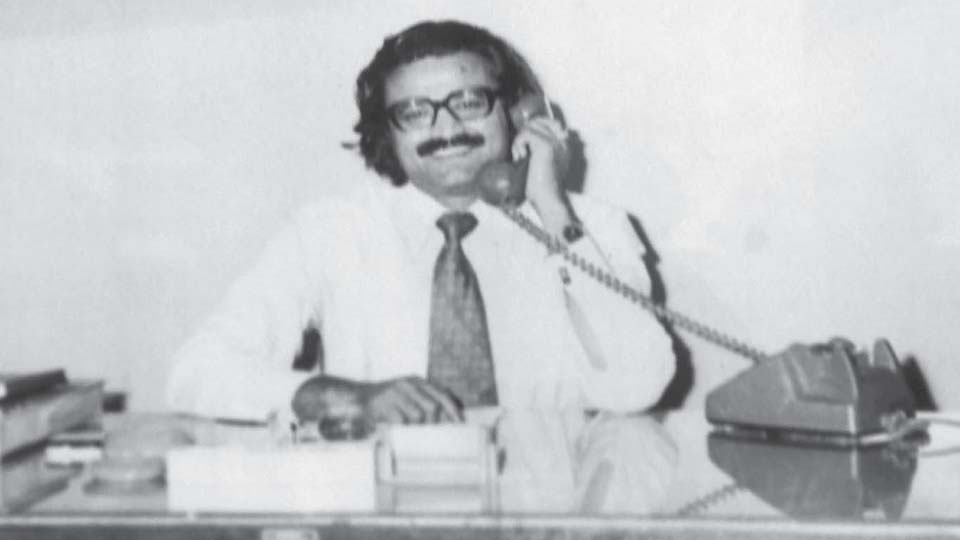
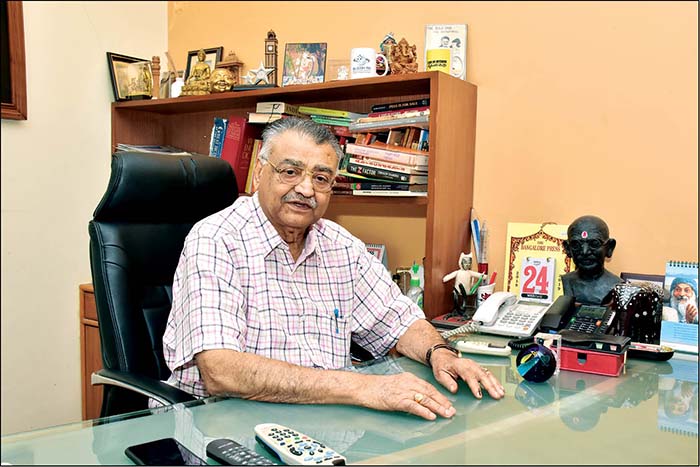
K.B. Ganapathy in his chamber at Star of Mysore office.
Today, this Kannada paper has gone from being a local paper to a regional paper covering five districts with a readership of over 2.5 lakh.
Even though in the 1970s Mysuru had many newspapers, Star of Mysore stood out for its factual reports and in-depth coverage. To add, Ganapathy wrote two columns every other day called Abracadabra and Hocus-Pocus, which helped popularise the paper.
These columns were enlightening, informative, risque and soon captured the attention and imagination of Mysureans. Ganapathy, after 48 years, continued to write his column. His last two Abracadabras were on the global conflict — ‘Pondering over wars and warmongers of the world!’ published on June 19 and ‘A miracle in Jerusalem’ on June 21, 2025.
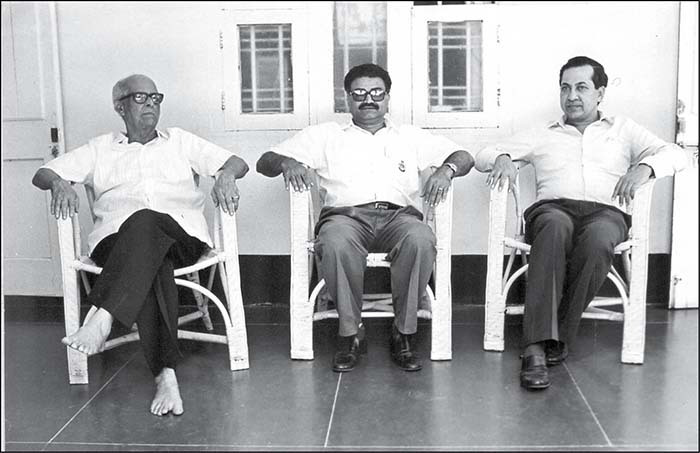
Three Wordsmiths: R.K. Narayan and N. Ram insisted that K.B. Ganapathy sit in the middle flanked by these patron giants of the literary world
Attention to reportage, visual appeal
It is noteworthy that Star of Mysore is probably the country’s only evening subscribed English newspaper. Ganapathy achieved this by building a strong distribution network while paying attention to reportage, an endeavour in which many national newspapers failed.
Ganapathy did three unique things in local journalism. First, he wanted the newspaper to stand out visually. To achieve this, he chose to print Star of Mysore in a unique size — Berliner. Even though this newspaper size costs more money to publish, he felt it was essential for recall. Today, Star of Mysore is the only Berliner- sized newspaper in the country.
The next was his approach to journalism and public participation. Before the term ‘citizen journalist’ was coined, Ganapathy in the 1980s encouraged Mysureans, be it teachers, students or industrialists, to write. Be it a letter to the editor or even articles, everyone was encouraged.
Even today, this tradition continues with columnists like Dr. Javeed Nayeem, Sadhguru, Devdutt Pattanaik, Dr. Balasubramaniam and Gouri Satya.
Many of the young journalists and writers of Star of Mysore from the 1980s-90s did not have a journalism degree, yet they were employed at Star of Mysore and Mysuru Mithra. Ganapathy felt that a ‘nose for news’, a ‘passion for storytelling’ and a ‘sense of journalistic purpose’ were more important than a degree in journalism.
Today, most of these ‘alumni’ of SOM and MM as the two newspapers are fondly abbreviated, are in senior positions in other national media houses.
Some of them are late Girish Nikam (Rajya Sabha TV), late Niranjan Nikam (Deccan Herald), Krishna Prasad (former Editor of Outlook Magazine), Chetan Krishnaswamy (Formerly with The Week Magazine), H.R. Ranganath (former editor of Kannada Prabha and now the Editor-in-Chief, Public TV), Manu Aiyappa (The Times of India), etc.
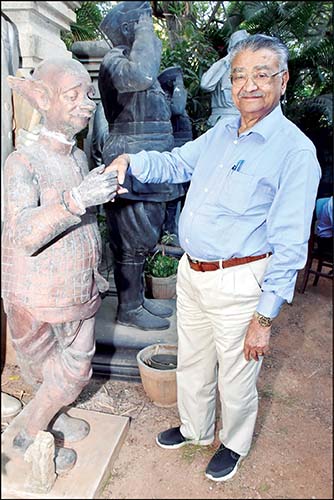
Shaking hands with a replica of noted cartoonist R.K. Laxman’s ‘The Common Man.’
Passion for journalism
In a way, with his passion for journalism, Ganapathy turned his two newspapers into a kind of school for journalism, producing more practising and successful journalists than the journalism schools in Mysuru.
Over the years, both newspapers have also patronised celebrated thinkers and writers such as T.J.S. George, Maneka Gandhi, Devdutt Pattanaik, Sadhguru, to name a few.
With his two newspapers, Ganapathy created awareness among the people of Mysuru city about the usefulness and impact of an influential local evening newspaper on the community.
When a citizen is in trouble due to poor service by various Government or quasi-Government agencies or the local bodies, Star of Mysore and Mysuru Mithra are their voice for justice. More importantly, he showed that local journalism could be influential and have an impact in creating a good city, as it brings awareness among the citizenry, who then hold their leaders accountable for the health of their city.
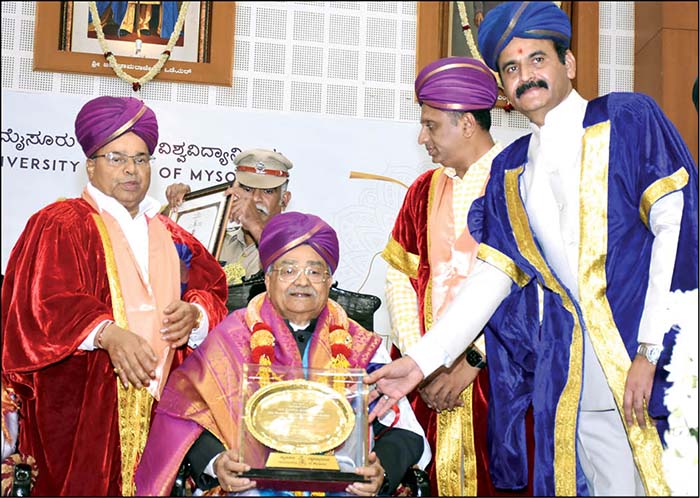
UoM Honorary Doctorate to Dr. K.B. Ganapathy.
Courage and determination
Speaking about Star of Mysore, late Union Minister H.N. Ananth Kumar had said, “If there is a torch-bearer in this part of the country that always stood for liberty and equality, it is Star of Mysore.” He then added, “Ganapathy always wages a silent war with the establishment and in the process, he and his family faced many threats and attacks. This is easier said than done. I salute his courage and determination.”
The combination of an entrepreneur-journalist is scarce, and Ganapathy has achieved a rare feat by being successful as both. Today, his newspapers have become household names, and with their online edition, they have truly become the conduit that connects Mysureans to Mysuru and Mysureans to their leaders.
No wonder late Ananth Kumar stated, “Star of Mysore is now addressed in the same breath as Mysore Pak and Mysooru Mallige. I have seen eveningers like Mid-Day in Mumbai and Bengaluru. But in this part of the country, Star of Mysore has earned its unique and respectful place in the hearts of its readers.”
Mysuru has been better off for having these two newspapers because using the two newspapers, Ganapathy took up numerous causes for the city of Mysuru and Mysureans, such as — Save Kukkarahalli Lake, Campaign against Chamalapura Power Plant, Campaign to Save Heritage buildings, Campaign for Tree Protection, Strived and succeeded in converting noted novelist R.K. Narayan’s house in Yadavagiri into a Museum, supporting Mysore Grahakara Parishat (MGP), an NGO, in its activities, to name a few.
Concern for Mysuru
Star of Mysore’s major article on Rare Materials Plant (RMP), the Uranium Unit of the Bhabha Atomic Research Centre (BARC) in Yelwal, which the local villagers called ‘Bomb Factory’, had brought the top official of Atomic Energy from Bombay to Mysuru to allay fears of the Mysureans.
This article was written by one Saketh Rajan (late), a young, intelligent student. The official held a press meet, assuring that there was no danger of ‘radiation leak’ or of any kind, and all measures for absolute safety and security are taken care of.
Only after this, other NGOs came on the scene demanding closure of this ‘bomb factory’ or revealing the safety measures taken in the event of accidents in the unit.
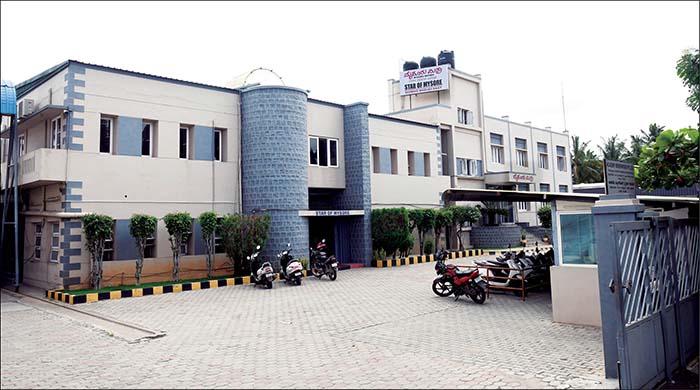
Star of Mysore and Mysuru Mithra head offices in Bannimantap.
Now, the company, Academy Newspapers Pvt. Ltd., under which the two newspapers are published, employs many people apart from providing part-time jobs and serving over 4 lakh Mysureans.
source: http://www.starofmysore.com / Star of Mysore / Home> Feature Articles> Top Stories / July 13th, 2025
Minister in charge of Kodagu district N.S. Boseraju on Friday said that instructions have been issued to take up immediate repair works at 71 anganwadis and 406 schools in the district.
Speaking to reporters in Madikeri on Friday, Mr. Boseraju said 77 houses were damaged in rains in May and June, and compensation has already been distributed. Around 2,364 electricity poles and 22 transformers have been replaced.
Under the Shakti scheme, 500 crore women passengers have travelled across the State, with 1.20 crore in Kodagu district alone, he claimed. The government had borne an expenditure of ₹50 crore for the scheme, he added.
source: http://www.thehindu.com / The Hindu / Home> News> India> Karnataka / The Hindu Bureau / July 11th, 2025
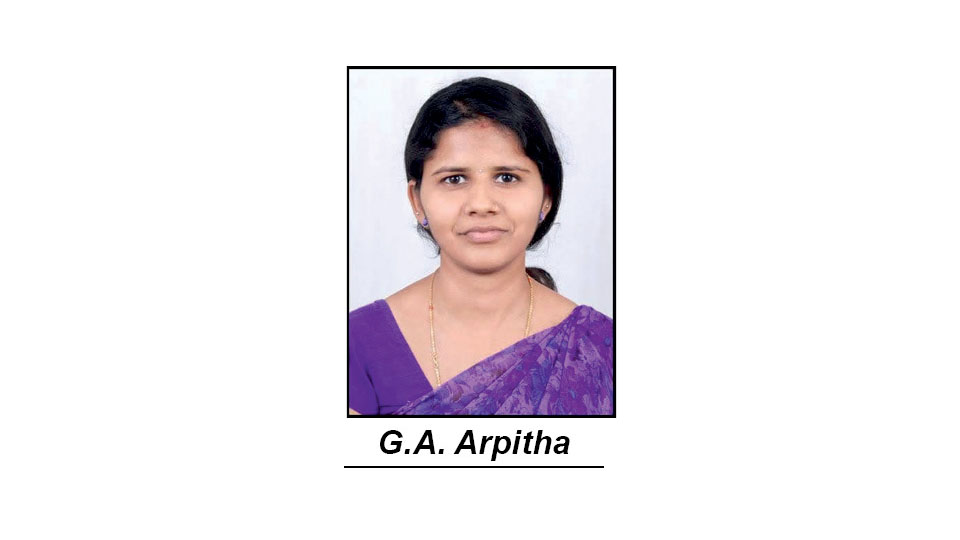
Visvesvaraya Technological University (VTU), Belagavi, has conferred the Doctor of Philosophy (Ph.D.) degree on G.A. Arpitha for her research titled “Landslide Susceptibility Mapping for Kodagu Region using Machine Learning Techniques.”
Her work was carried out under the guidance of Dr. A. L. Choodarathnakara, Professor and Head of the Electronics and Communication (E&C) Department at Government Engineering College (GEC), Karwar.
As part of her research, Arpitha developed a comprehensive landslide susceptibility map and a detailed landslide inventory for Kodagu district. The dataset has been made publicly available to aid future research and enhance disaster management efforts.
She is currently serving as an Assistant Professor in the Department of Electronics and Communication Engineering at Sri Dharmasthala Manjunatheshwara Institute of Technology (SDMIT), Ujire.
Arpitha is married to P.G. Yashavanth, a serving member of the Indian Air Force. She is the daughter of G.N. Achaiah, a retired BSNL employee and Vedavathi, a retired teacher.
source: http://www.starofmysore.com / Star of Mysore / Home> News / July 07th, 2025
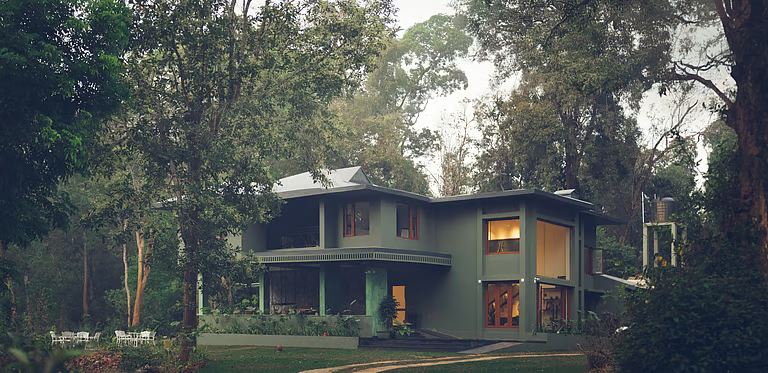
Nestled in a coffee estate near Nagarhole’s Kutta Gate, Coorg Wild Walk by CGH Earth is a four-bedroom immersive retreat for those who seek nature’s quiet charm.
Coorg Wild Walk by CGH EarthSourced
My journey to Coorg Wild Walk by CGH Earth began in Delhi, which was sweltering at 40°C. A quick flight landed me in Bengaluru, and the city welcomed me with the gentlest breeze and cloudy skies as if someone had hit refresh on the weather. The shift was almost cinematic.
From there, we hit the road, a long, winding, 240-250 km stretch that slowly peeled away the layers of city life. Concrete gave way to curves of green, rustling leaves replaced honks, and the air grew dense with the smell of wet earth and roasted coffee. We took the Nagarhole route to Coorg, which was one of the best decisions of the trip. Tall, dense forests looked straight out of a rainforest documentary. Pine trees lined the roads like they were greeting you. The postcard views were only getting better as we drove further.
The monsoon was in full swing, with dramatic grey clouds rolling across the sky, casting flickering shadows over hills and plantations. Every turn brought a surprise: wild boars darting across the road, a family of deer grazing peacefully, birds fluttering overhead in sudden flashes of colour. I kept the car window down the entire time. Not even once did I feel like shutting the world out. It was more than just a ride; it was a slow transition into the wilderness.
The Stay: Coorg Wild Walk by CGH Earth
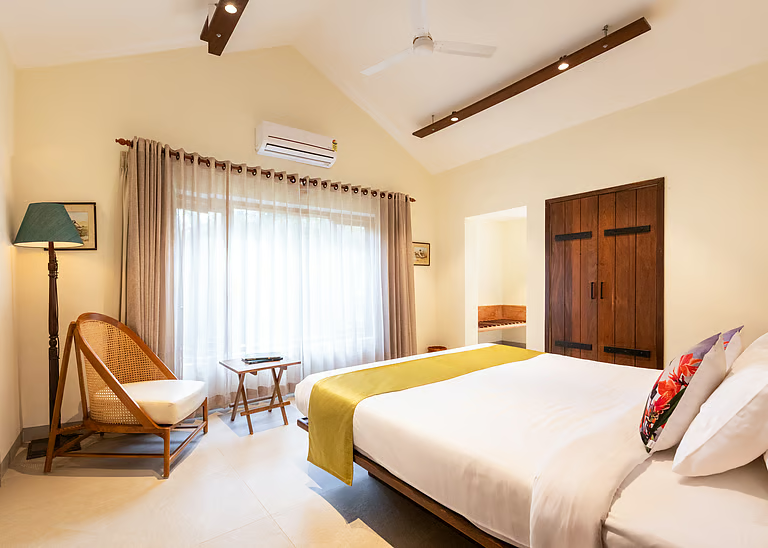
A glimpse of a room at Coorg Wild Walk by CGH EarthSourced
After nearly eight hours on the road, we arrived. But instead of exhaustion, I felt a sense of quietude. The welcome was warm and grounding — a chilled cultural drink in hand and a cool towel to freshen up. Even though we were right on the forest’s edge, it didn’t feel isolating. The villa is designed to blur the line between indoors and outdoors, with massive glass windows that open into dense greenery, open verandahs that double as dining spaces, and a living room so cosy you’ll find yourself curled up with a book without even trying.
Inside, everything feels natural: reclaimed wood furniture, soft, warm lighting, bamboo accents, and handpicked Kodava artefacts that give the space a distinct cultural identity. My room had a large window with the best nature shots — I would sit there for hours with soft music playing, watching jackfruit trees sway, wildflowers bloom, and coffee plants ripple under the wind. Alarms didn’t mark mornings, but by the soft drip of rain, birds singing like lullabies, and the gentle rustle of animals waking up in the forest.
Property manager Lokesh Gowda told me about a leopard that once came and slept at the villa’s doorstep. “It’s his home, too,” he said with a chuckle. Elephants sometimes break through the electric fence at night. “Midnight feasts,” he added casually. Equal parts scary and fascinating, but mostly just humbling.
Dining At Coorg Wild Walk by CGH Earth
Enjoy a meal in the lap of nature at Coorg Wild Walk by CGH EarthSource
If the surroundings calmed my soul, the food healed everything else. Dinner on day one was like coming home to a table laid out by someone who knows exactly what comfort tastes like. Sitting down to a very inviting plate, it pulled me in before the first bite.
There was a crispy Aloo Gobhi Fry that had the perfect crunch and spice, a tangy Pineapple Curry that was equal parts sweet and sour with the fragrance of tempered mustard seeds dancing in the background, and a Spinach Curry that was silky, creamy, and comforting — like the green equivalent of a warm hug. The Coorg-style chicken was rich, peppery, and fell off the bone, while the mutton was slow-cooked till it melted with every bite. And don’t even get me started on the buttery carrot soup; it was thick, velvety, and carried this earthy sweetness that made me smile mid-sip.
Breakfast the next morning was just as dreamy. A spread of fresh fruits, grilled tomatoes, eggs made to order, warm potato tikkis, and sausages sizzling on the side. But it was the local dishes that stole my heart. Kadambuttu, those soft rice balls, soaked up the curry like they were made for each other. Neer Dosas, light and lacy, melted in the mouth. And the Akki Roti, hearty and wholesome, had the flavour that only wood-fired griddles can bring. The grand finale was a warm bowl of Paruppu Payasam — moong dal, jaggery, coconut, and dry fruits, slow-cooked into a sweet, sticky heaven. It was so good that I didn’t know whether to eat it or frame it.
And the best part? All this while sitting outside, under a canopy of trees, with birdsong as your playlist and clouds moving above like nature’s screensaver.
Nearby Experiences
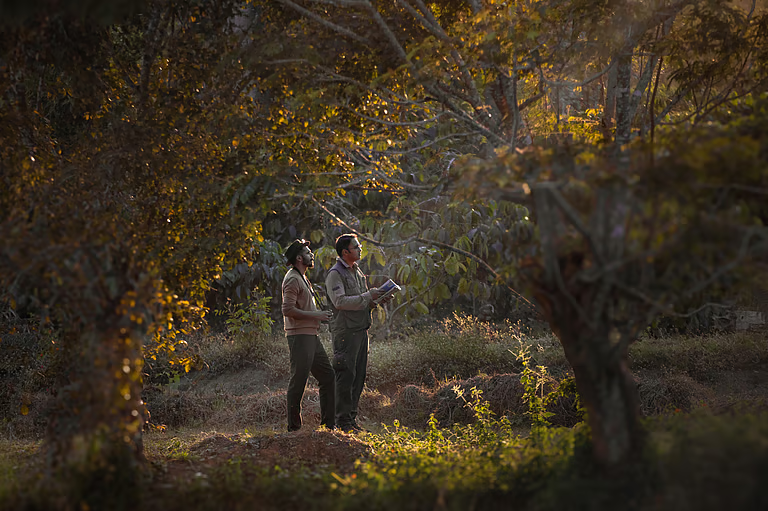
A glimpse of the property / Sourced
Of course, no trip to Coorg Wild Walk is complete without a proper safari. With the Kutta Gate of Nagarhole Tiger Reserve just 3 km away, I set out early one cold morning, jacketless (rookie mistake) but buzzing with excitement.
Nagarhole, or the Rajiv Gandhi National Park, is a massive 847.98 sq. km sprawl of protected jungle, part of the Nilgiri Biosphere Reserve. Its core zones are tiger territory, but the entire area is teeming with life. Our safari began at dawn with only a few jeeps ahead, which meant less noise and more chance to spot animals in their element.
As we rumbled deeper into the forest, the rain-soaked leaves shimmered, and mist clung to the tree trunks. We saw Chital, Sambar Deer, Barking Deer, and even a herd of elephants walking gracefully through the undergrowth. Bright peacocks called from the branches above, and the elusive Indian Giant Squirrel darted like a flash of rust-red through the canopy.
It happened when I had given up hope of a big cat sighting. I spotted a leopard. Calm, unbothered, regal. She walked slowly, elegantly, just a few feet from us. Our eyes met for a second, hers wild and ancient, mine wide with awe. It felt like a shared moment. No roars, no drama, just quiet understanding. The kind you remember long after the ride ends.
The Extras that Make It Whole.
CGH Earth ensures this isn’t just a place you stay. It’s a place you feel. From guided plantation walks where you get to understand the journey of coffee from bean to cup, to peaceful birdwatching sessions and barbecue nights under star-splashed skies, every day has something new to offer. The property is not for the rushed. It’s for those who want to listen more than they speak. For those who like slow mornings, long books, deep conversations, and wild silences. It’s a place where nature doesn’t just surround you — it includes you.
The Information | Coorg Wild Walk by CGH Earth
Address: K Badaga, Nanachi Estate, Kutta, Karnataka 571250
Tariff: Starts at INR 13,571 per night. This includes breakfast and Wi-Fi (excludes taxes). Please note that the prices vary from season to season.
How to reach Coorg?
Coorg is around a 6–7 hour drive from Kempegowda International Airport, Bengaluru. You can hire a taxi or take a private cab. Alternatively, you can fly into Mangalore International Airport (IXE) or Mysore Airport (MYQ). Mangalore is about 140–160 km away, while Mysore is closer, at around 120–130 km.
When is the best time to visit Coorg?
Coorg is a year-round destination. For pleasant, cool weather, visit between mid-November and mid-February. The monsoon months (June to September) transform Coorg into a lush green escape, but expect heavy rainfall and slower city life. Flooding may occur in certain areas, so plan accordingly.
For bookings and other details check their website: www.cghearth.com/coorgwildwalk/
source: http://www.outlooktraveller.com/ Outlook Traveller / Home> Stay> by Mithi Singh / July 01st, 2025
Minister for Municipalities Administration Rahim Khan speaking during his visit to Madikeri on Wednesday. MLA Mantar Gowda and Deputy Commissioner Venkataraja are seen. | Photo Credit: SPECIAL ARRANGEMENT
Municipal Administration Minister Rahim Khan inaugurated the newly constructed Town Municipal Council (TMC) office building at Kushalnagar in Kodagu. The facility has been built at a cost of ₹7 crore.
Speaking at the event on Wednesday, the Minister announced that Chief Minister Siddaramaiah had approved the release of ₹50 crore for various development projects in the Madikeri Assembly Constituency.
Mr. Khan said allocations would be released in phases for development works. He announced the launch of three additional Indira Canteens in the constituency. Each canteen is expected to serve breakfast and lunch to more than 300 people daily, he added.
Madikeri MLA Mantar Gowda said the new municipal office was spacious and well-equipped, adding that Kushalnagar was likely to be upgraded to a City Municipality in future. He proposed the installation of a statue of former Chief Minister R. Gundu Rao on the premises in recognition of his contributions to the town’s development.
He said the merger of several gram panchayats, including Guddehosur with Kushalnagar TMC, strengthened its case for elevation to City Municipality status.
The Minister inspected the Indira Canteen near the KSRTC bus stand.
source: http://www.thehindul.com / The Hindu / Home> News> India> Karnataka / by The Hindu Bureau / June 12th, 2025
Relentless rains continue to lash Kodagu, pushing rivers and streams well above the danger mark. Authorities have evacuated residents from low-lying areas and declared a holiday for all schools and colleges today, as the region remained under a red alert issued until 8 am this morning.
But as Kodagu battles the fury of nature, its most critical weather monitoring tools are failing. Of the 104 Telemetric Rain Gauges (TRGs) installed across the district, 56 — over 54 percent — are non-functional. Shockingly, there is no clear timeline for when these essential devices will be restored.
In a glaring act of official negligence, a TRG installed at Kanoor Gram Panchayat in Ponnampet Taluk — an area known for heavy rainfall — has been placed under a roof. Ironically, it is installed to measure rain but placed where it does not rain.
This baffling decision has rendered the gauge completely useless. With not a drop of rain reaching the sensor, accurate data from this high-rainfall zone is lost. Residents said that the TRG was installed two months ago and nothing has been done to rectify the construction anomaly.
Furious residents have flayed the Panchayat for such incompetence, calling out the lack of basic common sense and waste of public funds. TRGs are vital for real-time rainfall data collection and help agencies like the Karnataka State Natural Disaster Monitoring Centre (KSNDMC) issue timely flood alerts and coordinate emergency responses.
With more rain forecast and rivers swelling dangerously, the failure to properly install and maintain these gauges could cost lives, and underscores a disturbing lack of preparedness to face the monsoon.
source: http://www.starofmysore.com / Star of Mysore / Home> News> Top Stories / June 26th, 2025
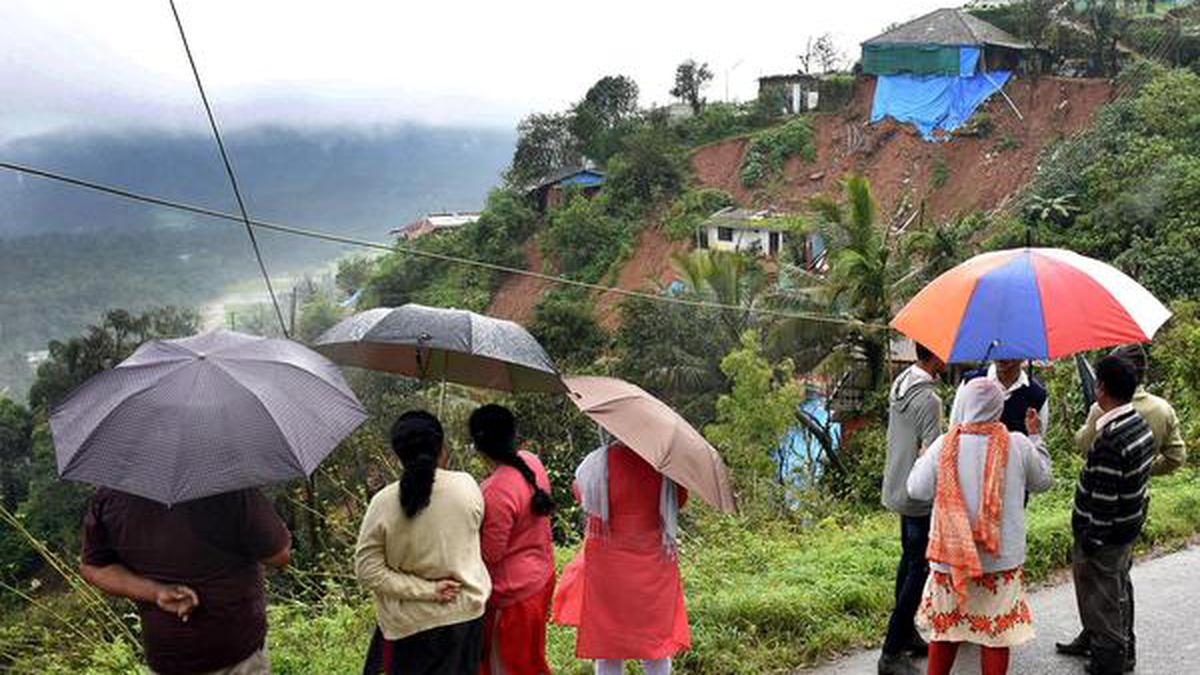
People looking at the devastation near Raja Seat at Indira Nagar in Madikeri.
The abandoned localities on the hilltops near the Raja Seat in Madikeri town, which bore the brunt of landslips, are testimony to the devastation here. People are thronging the roads leading to the dwellings to understand the scale of destruction from a safe distance.
Though tourist arrivals have dropped drastically following the Deputy Commissioner’s diktat to hotels and homestays to not accept bookings until August 31, people carrying relief from various places and those from adjoining places bordering the district are thronging these places to see the destruction that has struck the coffee land this month.
The police have established a check-post near Raja Seat to prevent people from closing in where the remaining houses in Indira Nagar and Sri Chamundeshwari Nagar, the adjoining residential hubs, are delicately positioned. They are facing the looming threat of the earth caving in any time. All the residents had been evacuated to safer places and relief camps.
“The devastation is much bigger in the interior parts which have no access because of damage to roads. Therefore, people are coming to the town to see the havoc,” a local said.
‘Disaster tourism’
Madikeri MLA Appachu Ranjan said VIPs visiting Kodagu to understand the scale of devastation need to bring their escorts with them instead of depending on the local police and officials to usher them to the sites. If a large number of people accompany high-profile visitors, it will hamper the ongoing relief works, he said.
“Deployment of local officers on such visits may end up in relief work getting hindered despite the fact that officers from other districts have been deputed to oversee works,” he argued. “Local officers need to be on duty for relief and rescue since they are aware of the terrain. Deploying outstation officers will not serve the purpose. I have conveyed this to the Minister in charge of Kodagu district, S.R. Mahesh, and Deputy Commissioner P.I. Sreevidya.”
Meanwhile, the district officials and staff have been strictly told not to avail leave for at least a fortnight in order to assist with the relief and rebuilding works.
A woman Madikeri Zilla Panchayat employee said: “We have been told to put off our leave and stay in the headquarters for attending to the relief and other important works.”
An engineer attached to the Public Works Department, who is overseeing the roadworks, said, “Until the situation becomes stable, it may not be possible to avail leave, considering the devastation and the works to be carried out on a war footing.”
source: http://www.thehindu.com / The Hindu / Home> News> India> Karnataka / by Shankar Bennur / August 23rd, 2025
Stirring up the markets were weather updates from Brazil, where a cold front of polar air is approaching. This could bring frost to some areas of Paraná, São Paulo and southern Minas Gerais, although not comparable, according to forecasters, to the winter 2021 events, which caused significant damage to crops.
Roasted coffee beans (credits: Ri Butov from Pixabay)
In the first winter session (austral winter, of course), fears of frost in Brazil caused coffee futures to surge, with a strong recovery seen yesterday, Monday 23 June 2025. In New York, the September contract gained over 3.6% (+1,150 points) to close 326.55 cents. In London, the September contract soared to $3,904, nearly 4.5% higher than the previous session’s settlement.
Stirring up the markets were weather updates from Brazil, where a cold front of polar air is approaching.
This could bring frost to some areas of Paraná, São Paulo and southern Minas Gerais, although not comparable, according to forecasters, to the winter 2021 events, which caused significant damage to crops.
Analysts expect New York coffee futures to trade within the 320–360 cent range in the near future.
According to Safras & Mercado, 43% of the Brazilian harvest was complete by 18 June. This figure is slightly lower than last year (44%), but higher than the five-year historical average (40%).
As for Robusta, Gil Barabach, analyst at S&M, reports “harvesting operations have progressed at a good pace in the last week, helped by favourable weather conditions”.
The Robusta harvest is 58% complete, compared to 62% last year. It should be noted that this year’s harvest is expected to be a record one.
The Arabica harvest advanced eight percentage points in one week reaching 34% of the estimated total. This is slightly below last year’s figure of 35%, but well above the historical average of 30%
“Overall, this year’s crop profile remains positive compared to last year, with an improvement in terms of coffee screen size,” added Barabach.
Meanwhile, Indian exports are booming. The Coffee Board of India reports that exports in FY2024/25 increased in value by 40.2% to over $1.8 billion. The main destinations included Italy, Germany, Russia, Belgium, the UAE and the US.
source: http://www.comunicaffe.com / International Comunicafe / Home> Markets & Trade> Reports & Statistics / June 24th, 2025
WELCOME. If you like what you see "SUBSCRIBE via EMAIL" to receive FREE regular UPDATES.
Read More »