Category Archives: Agriculture

Madikeri’s Raja Seat blooms vibrantly, gears up for Flower Show

The event is being hosted by the Kodagu district administration alongside support from the Zilla Panchayat and the horticulture department.

Raja Seat gearing up for the annual Flower Show event to take place from February 3 to February 6
Raja Seat gearing up for the annual Flower Show event to take place from February 3 to February 6. (Photo | EPS)

The historic mortar at the Raja Seat in Madikeri is blossoming in vibrant colours and happily stepping into the spring season. While greenery covered most parts of the park, it is now filled with brightly coloured, blossomed plants. The iconic tourist destination is now decking up for the annual Flower Show event, which will be held from February 3 to February 6.   

The event is being hosted by the Kodagu district administration alongside support from the Zilla Panchayat and the horticulture department. The flower show will be inaugurated at 4 pm on February 3 with an entry fee of Rs 20.

“Raja Seat is getting ready to host the flower show, with almost 10,000 to 12,000 flowering plants already being set out at the venue,” confirmed Dr BC Sateesha, the Kodagu Deputy Commissioner and District Magistrate. Around 15 to 20 varieties of flowering plants including petunia, canna, salbia, chrysanthemum, marigold, zinnia, calendula, phlox and daliya have been seeded in the park’s garden and are already blossoming in vibrant colours.

Furthermore, the venue will have historical structures of Kodagu decorated in flowers, including the iconic Nalknad Palace. The event will also create awareness of voting where the ballot unit, VV Pat, control unit, etc. will be recreated using flowers. From cardboard cutouts of superheroes to well-known leaders, everything will be decorated with flowers along with bonsai and anthurium that will deck up the entire venue. 

The event will also provide a platform for the farmers to exhibit their unique products, which will be judged for the competition. A total of 60 shops will be established at the Gandhi Maidan (a few meters away from Raja Seat)consisting of various outlets from various government departments and private partners.

Alongside the flower show, a Wine Utsav will also be hosted which will exhibit both homemade as well as wines from the Wine Board that will be available for tasting activity. The event is seen as a boost to the tourism sector as Rs 15 lakh to Rs 20 lakh has been funded. 

source: http://www.newindianexpress.com / The New Indian Express / Home> States> Karnataka / by Express News Service / January 27th, 2023
Spices Board to hold buyer-seller meet in Madikeri on Jan. 24

It will provide a common platform for buyers and sellers of the spice industry to interact directly and establish effective business linkages.

The Spices Board of India will be holding a buyer-seller meet for spices at Hilldale resorts in Madikeri on January 24.

A press statement from the Assistant Director of Spices Board of India’s Divisional Office in Madikeri said the buyer-seller meet, which will be held between 10.30 a.m. and 5.00 p.m., will provide a common platform for buyers and sellers of the spice industry to interact directly and establish effective business linkages.

The Spices Board India, which functions under the Ministry of Commerce, Government of India, in its statement, pointed out that Karnataka holds a significant position in spice production in India by being a major producer of ginger and black pepper.

Karnataka also produces other spices such as cardamom, chillies, turmeric, garlic, coriander, nutmeg, clove, tamarind etc. During the year 2021-22, the State produced 7,09,546 metric tonnes of spices from an area of 3,75,082 hectares, the statement added.

Spices Board India, a flagship organisation for the development and worldwide promotion of Indian spices, said India’s spices exports with “a volume of 15,31,154 metric tonnes, valued at ₹30,576 crore during 2021-22, scaled the landmark level of USD 4.102 million in value realisation, besides recording a growth rate of 26.76 per cent, 38 per cent in rupee terms and 32 per cent in dollar terms, compared to 2019-20, despite the global pandemic situation”.

source: http://www.thehindu.com / The Hindu / Home> News> India> Karnataka / by The Hindu Bureau / January 21st, 2023

KVIC through RE-HAB project of the Honey Mission Programme aims to reduce elephant attacks on humans and farmers’ crops

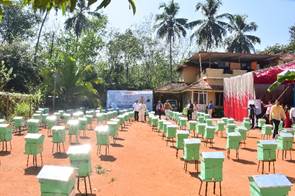
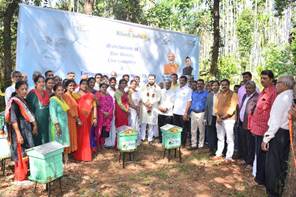
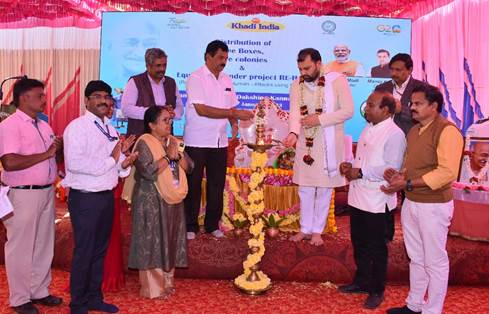
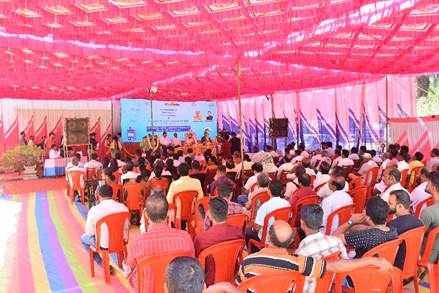
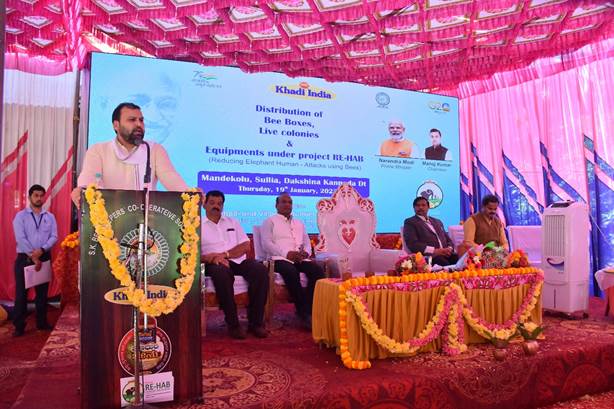
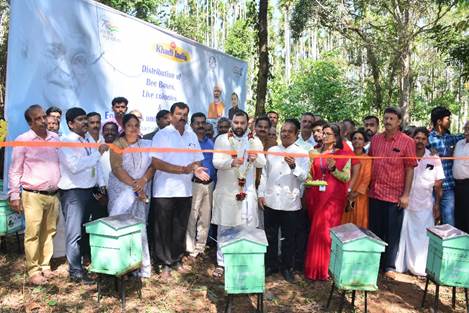
Shri Manoj Kumar, Chairman, KVIC distributed live Bee Colonies, Bee-keeping equipment and 200 Bee-Boxes to the trained beneficiaries at Sulia at Dakshina Kannada, Karnataka under the RE-HAB Project, an initiative under the Honey Mission Programme of Prime Minister Shri Narendra Modi.

Under the Project RE-HAB, “Bee-fences” are created by setting up bee boxes in the passage ways of elephants to block their entrance to human habitats. The boxes are connected with a string so that when elephants attempt to pass through, a tug or pull causes the bees to swarm the elephant herds and dissuade them from moving further.

This is a cost-effective way of reducing human-wild conflicts without causing any harm to the animal. It is scientifically recorded that elephants   fear the bee swarms that can bite their sensitive inner side of the trunk and eyes. The collective buzz of the bees annoys elephants which force them to return.

Speaking on this occasion Shri Manoj Kumar said “It was seen that Bees help the farmers in arresting the encroachment of elephants in their agricultural fields and destroy them.Not only this, some precious lives are also lost in that condition. Taking an initiative, KVIC initiated a pilot project with the Technical assistance of the College of Forestry, Ponnampet, Kodagu District and the results were encouraging. Hence, 6 such projects were sanctioned in the most wanted states namely Assam, Maharastra, west Bengal, Orissa, Uttarkhand apart from Karnataka.”

  Under the RE-HAB farmers are trained in bee-keeping and each of them are supplied with 10 Bee boxes and installed in the elephant corridors so bee boxes and bee hives are placed in the Elephant corridor to restrict elephants from approaching the agricultural field.  This Pilot project has shown very good results in Ponnampet. This project has also helped in the increasing agricultural output due to enhanced pollination as well as Honey Extraction, he informed.

Chairman, KVIC also emphasised the farmers to take benefit of the scheme for it’s long-term advantages. Speaking on this occasion he also shared in details  about the PMEGP Scheme ok KVIC which  has enhanced Loan ceiling  from Rs 25.00 Lakhs to Rs 50.00 by the Prime Minister and encouraged the women and rural youth to take up the scheme.

(Release ID: 1892452)

source: http://www.pib.gov.in / Press Information Bureau, New Delhi / Home / byu Ministry of Micro, Small & Medium Enterprises / January 20th, 2023

Madikeri: New invention – Face mask behind head to avoid tiger attack

Madikeri : 

“Tigers never attack human beings from front. They attack from behind. In order to prevent attack of tigers, people of Sundarbans in West Bengal are using human faced mask on the back of their head and it is found to be successful. This might be useful in Kodagu district also,” said Col C P Muttanna, honorary secretary of environment and health foundation.

Muttanna further said, “Many people have died due to tiger attacks in Sundarbans, area were Brahmaputra river joins Bay of Bengal. Now the incidents have reduced due to people wearing human face mask on the back of their heads.

“In the south part of Kodagu, tiger attacks have increased and five people have already died. So a proposal is sent to the government to provide human face mask made of rubber.

“When one studies the tiger attack cases of the district, it becomes apparent that the tiger attacks people who go for open defecation in the morning. Though it is said that Kodagu district is open-defecation free, there are many areas where people still go to fields to defecate as there are no toilets. The government must provide toilets to households where there is no toilet,” he said.

Col Muttanna also asked people to leave the half eaten carcass of cattle as it is as the tiger will come again to eat the same and it will be easier for forest department to cage it.

source: http://www.daijiworld.com / DaijiWorld.com / Home> Top Stories / by Daijiworld Media Network – Madikeri (MS) / January 12th, 2023

As demand goes up, scientists in Kodagu develop new avocado variety

The new variety will have 80% pulp and is expected to improve coffee based avocado cultivation.

Scientists at Central Horticultural Experiment Station in Kodagu have developed a new avocado variety ‘Arka Coorg Ravi.’ | Photo Credit: DARSHAN DEVAIAH B.P.

Bengaluru:

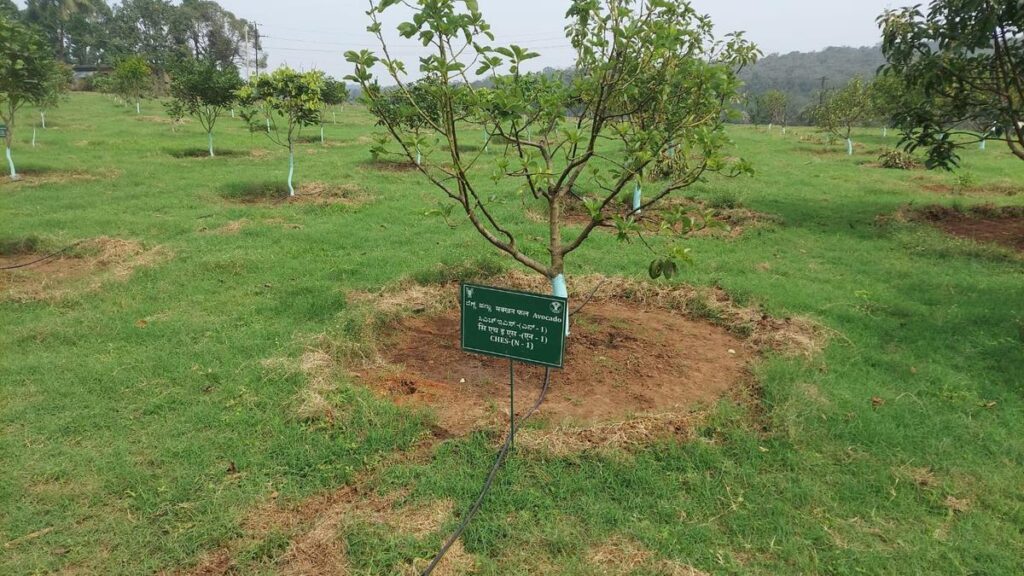
As the demand for avocado, popularly known as butter fruit, is increasing in the cosmetic industry as well as for consumption, scientists at the Central Horticultural Experiment Station (CHES) in Kodagu have developed a new variety called ‘Arka Coorg Ravi’, which will further improve coffee-based avocado cultivation in the district.

According to scientists in CHES, the new variety will have 80% pulp and the rest seed, making the fruit profitable for farmers.

Speaking to The Hindu, Madhu G.S, scientist in CHES, said: “Avocado, which is described as a miracle fruit for its health and nutritional benefits, is now also in huge demand in the cosmetic industry. The fruit is used in many skincare products. We have researched and developed Arka Coorg Ravi, which will help farmers in the district. The fruit is grown on about 500 hectares in Kodagu amidst the coffee plantations and the area of cultivation has seen a rise in recent years.”

The CHES recently started distributing the Arka Coorg Ravi grafts to the farmers. The centre has already developed 30,000 avocado grafts which have been distributed to farmers in the district.

“The new variety developed by the CHES will have at least 450 to 600 grams of weight per avocado, which will make the fruit profitable. Seedlings take 10 years to give yield, while graft plants start yielding from at least in the seventh year,” S. Rajendran, scientist, CHES Chettalli in Kodagu told The Hindu.

Recently, the CHES had a farmer-scientist interaction on the cultivation techniques of avocados in the district. According to CHES, farmers from different parts of Karnataka and also from Kerala, Tamil Nadu, Maharashtra, Andhra Pradesh, and Telangana have been purchasing avocado saplings or grafts to grow in their State.

Since Kodagu district saw two natural calamities in 2018 and 2019, which caused huge losses to farmers, especially coffee growers, they are now growing avocados on the coffee plantations.

“In the last few years, due to the floods in the district, coffee production has come down, and coffee is also not fetching an attractive price now. Hence, I have started cultivating avocados as a mixed crop in my coffee plantation and it is now yielding fruits and it can be a good alternative to offset the losses from coffee and black pepper,” said Roshan Poovanna, a farmer from Virajpet.

According to farmers, Kodagu avocados have a market in Kerala and Maharashtra, apart from Karnataka. “Local varieties yield fruit twice a year, February to May and June to September. Now, we have some more varieties that yield fruits around the year. Now the CHES has developed a new variety. I hope this will produce more avocados from the district and get a good market price. However, the government should promote and create awareness about the growing of mixed crops in coffee plantations so that the farmers can avoid losses from other crops,” said Praveen Nanaiah, a farmer from Madikeri.

Earlier, as part of crop diversification, the farmers in Kodagu were growing ‘Coorg mandarin’ oranges, grown as a mixed crop on the estates along with coffee and black pepper.

However, in the past few years, the Coorg mandarin cultivation is coming down due to the threat of citrus greening disease.

Benefits of avocados

Avocado, botanically known as Persea Americana, is an evergreen plant and can grow in diverse environmental conditions. On average, one avocado tree produces about 120 to 150 fruits annually.

The fruit has a high monounsaturated fat content, which is considered healthy. One fruit contains 25% of the recommended daily amount of saturated fat.

Avocados also have 60% more potassium than bananas and are rich in vitamins B, E, and K. Its juice acts as an antioxidant and its seeds are used to manufacture paper.

source: http://www.thehindu.com / The Hindu / Home> News> Cities> Bengaluru / by Darshan Devaiah B.P. / January 01st, 2023

Govt. land identified

Kodagu Deputy Commissioner B.C. Satish on Monday said 359 acres of government land has been identified for government projects, allocation to ex-servicemen and homeless people.

At a meeting in Madikeri, he said 1,300 applications seeking sites were pending while a decision has been taken to set aside 10-20 per cent of the land for ex-servicemen.

He told the meeting that the list of people without sites can be finalised at the gram sabha meetings for the allocation.

The DC told the tahsildar to immediately sanction land in Madikeri for the construction of Dr B R Ambedkar Bhavan.

source: http://www.thehindu.com / The Hindu / Home> News> India> Karnataka / byThe Hindu Bureau / December 26th, 2022

Kodagu grower makes big gains from dwarf Robusta coffee variety

Suresh has harvested nearly 7000 kilos of ripened coffee beans from a total of 1220 dwarf varieties of Robusta plants.

coffee
Image used for representational purpose only.

Madikeri :

The coffee sector is not doing well. The reasons are many such as crop damage caused by incessant rains, disease outbreaks and overall changes in climatic conditions. However, a 
“progressive” farmer in Madikeri, Ponnachettira Suresh is doing well. Suresh has harvested nearly 7000 kilos of ripened coffee beans from a total of 1220 dwarf varieties of Robusta plants.

“A planter is also a doctor who treats the plants,” Suresh quips.

It was in 2020 that Suresh learnt about the dwarf variety of Robusta coffee from a friend in Kolkata. Always open to experimenting, Suresh availed five seeds of this dwarf Robusta variety and he developed them into seedlings.

“Out of the five seeds, one did not survive. However, from the four seedlings, I propagated 196 dwarf plants and I have now planted 1220 plants of the same species,” explained Suresh.

With 6 feet X 6 feet spacing, a total of three acres of land was developed with the dwarf variety of Robusta and Suresh planted Gliricidia Tree for the shade across the area.

“The plants are yielding after three years and I have picked 7000 kilos so far,” he said.

Suresh explained that the dwarf variety does not require any over-the-top maintenance. “The plantation was manured five to six times, irrigated in February and March with sprinkler irrigation and a chemical spray was carried out before monsoon to avoid dropping and rotting of the plants,” he added. He opined that the maintenance of the plantation varies and depends on the condition of the soil, weather and other variants.

“I do not use complex manure. Instead, I feed the plants with only the required amount of nitrogen, phosphorous and potassium. These nutrients are fed by hand as per requirement. While the labour charge might increase in this process, it will ensure proper health and growth of the plant as not all nutrients are required in equal amounts,” he shared.  He provides the plants with nutrients depending on the weather condition, which has helped his estate flourish.

“However, the dwarf Robusta variety has not been certified by the Coffee Board and this might be due to the lack of interest in this regard. Nevertheless, I have marked five dwarf variety plants and I will be recording the yield of these plants for the coming five years. This data will be handed over to the coffee board,” he said.

Suresh has always been a “progressive” grower and he has a 400-year-old Robusta plant known as Robusta Peridenia, a 200-year-old variety known as Coffea Congensis and other rare varieties of crops that are still yielding. He is also an avid orange grower and has won a state award for best cultivation of Coorg Mandarin.   

source: http://www.newindianexpress.com / The New Indian Express / Home> States> Karnataka / by Prajna GR, Express News Service / December 18th, 2022

Honey festival in Madikeri

The Kodagu district administration has planned a Honey Festival in the gardens of Raja Seat in Madikeri on December 24 and 25.

The festival, which has been planned in association with Kodagu Zilla Panchayat and Horticulture Department, is aimed at encouraging apiculture in Kodagu in view of the worldwide demand for Coorg honey.

The festival is expected to bring together not only people engaged in apiculture, but also scientists, societies and companies engaged in producing honey.

The festival will also feature demonstrations on apiculture and other technical knowledge of the field by local researchers and scientists from the College of Forestry and government officials, and exhibition stalls.

More information can be obtained from the Deputy Director of Horticulture Chikkera Pramod on 94831-10621 and Vasanth B.D. on 94490-75077.

source: http://www.thehindu.com / The Hindu / Home> News> India> Karnataka / by The Hindu Bureau / December 17th, 2022

Acviss Develops Traceability App For The Coffee Board Of India

Acviss Technologies develops a “no internet” blockchain-based traceability application for the Coffee Board of India.

Brand protection and consumer engagement technology company Acviss Technologies develops a “no internet” blockchain-based traceability application for the Coffee Board of India. This app is designed to protect coffee production from counterfeiting. 

The Coffee Board of India has been working with marginalized tribal coffee growers to help them improve their farm productivity and quality. With the introduction of this anti-counterfeiting technology, farmers have been able to benefit from higher incomes in their farm produce.

In the last few years, the demand for differentiated coffees with traceability features has been increasing across the world and the differentiated coffees which can be traced back to their source can help obtain a premium for these coffee farmers. 

Commenting on this, Vikas Jain, Founder, of Acviss Technologies, said, “It has been a pleasure creating a solution for the Coffee Board of India, we’ve not only built something innovative but we’ve also tried to make it accessible and helpful for the common man, the app we have created is very simple and does not require Wifi for farmers to scan. It’s a very easy and user-friendly app created first and foremost for the benefit of farmers”

The blockchain-based traceability application by Acviss is an anti-counterfeiting solution that helps to reorganize the unstructured supply chain, provides transparency in transactions, and protects farmers from fraud and fake GI tag products with the help of quality evaluation. 

This app also helps farmers to generate stable income and protects them from any collateral damage with the help of automated payments, insurance, and financing as there is no middleman involved. For the end users, this app also helps consumers by providing authenticated certifications ensuring that the bought product is safe for consumption.

Talking about this implementation, the officials of the Coffee Board of India, said, “We have worked with Acviss to develop a blockchain solution that has been implemented in Karnataka and we have been very satisfied with the output. With this solution, the farmers have been able to gain benefits. Their incomes have gone up by about 43 per cent because of  this traceability app.”

Coffee has become an increasingly common target for food fraudsters, with low-quality ground coffee beans adulterated with filler ingredients such as corn, barley, wheat, soybeans, rice, beans, acai seed, brown sugar, or starch syrup. One of the main drivers has been a reduction in coffee bean output due to poor harvests in some key producers.

With this application, coffee procured by these tribal farmers can now be traced from the grower to the consumer. Coffee parameters like moisture, weight, type and outturn captured at source farms are mentioned. Along with this, certification data is also available for each sample collected. 

To build consumer confidence, this app also displays the farm locations and the farmer data. It helps in simpler transactions between farmers and the end consumer with the help of digitalization as every product packaged goes through an authentic signature. This digital signature cannot be tampered with and helps in easy tractions between the farmers, processing unit, warehouse, distributor, retail, and finally the consumer.

Coffee has become an increasingly common target for food fraudsters, with low-quality ground coffee beans adulterated with filler ingredients such as corn, barley, wheat, soybeans, rice, beans, acai seed, brown sugar, or starch syrup. One of the main drivers has been a reduction in coffee bean output due to poor harvests in some key producers.

source: http://www.bwdisrupt.businessworld.in / BW Disrupt / Home / by BW Online Bureau / December 03rd, 2022