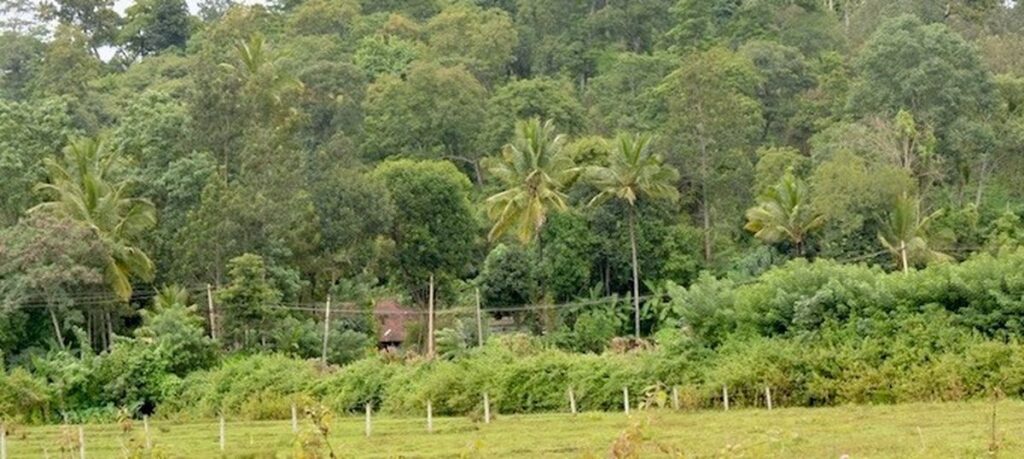
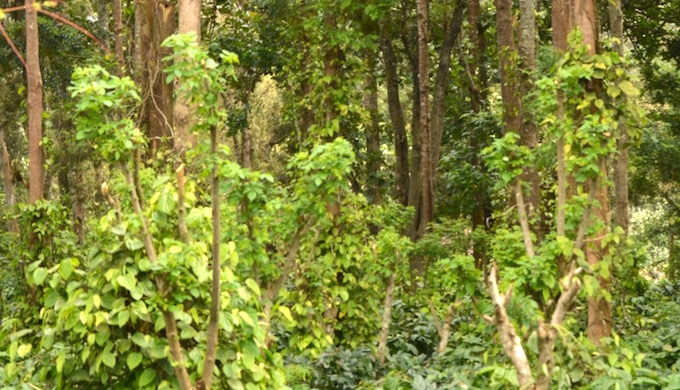
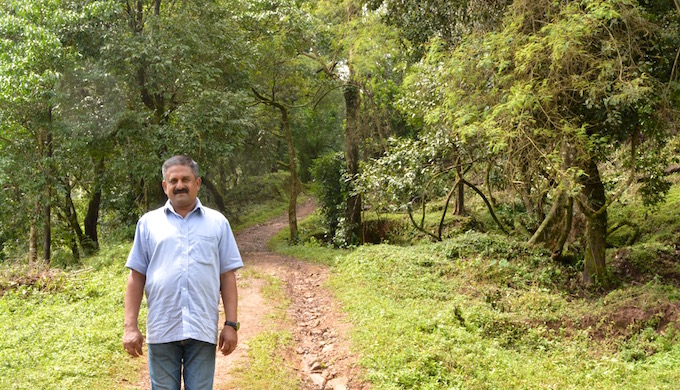
Apart from these conflict mitigation projects, the department is releasing special packages to help farmers located in conflict areas.
Madikeri :
The pandemic situation had affected the maintenance works and sanction of projects from the forest department across Kodagu leading to a peak in the wildlife conflict. Alongside the perpetual problem of wild elephants, the tiger menace had claimed the lives of humans and an increased number of cattle. However, the department has assured to provide a permanent solution to the man-animal conflict and grand plans are in place to address the issue.
Improved conflict-mitigating projects including the deployment of static surveillance teams in heavy conflict areas are underway in the district. An annual budget between Rs 30-40 crore will likely focus on developing conflict mitigation methods to fight man-elephant conflicts.
This year, the department has received approval to install railway barricades for a 22 km stretch across Nagarahole, a 20 km stretch across Madikeri limits and a 2 km stretch across Madikeri Wildlife limits. In 2023-24, solar fences will play a crucial role in addressing the conflict and improved double tentacle solar fences will be installed across a 25 km stretch of the Nagarahole forest area and a 20 km stretch of the Madikeri forest division. In addition to this, the several dysfunctional solar fences (spread across 60 km in different areas) will witness relief and maintenance works.
Apart from these conflict mitigation projects, the department is releasing special packages to help farmers located in conflict areas.
“The farmers can install solar fences across their estates and 50% of the cost will be borne by the department. A one-kilometre solar fence will cost approximately Rs 2,30,000 and the department will release Rs 1,15,000 as a subsidy for the fence. Any farmer or grower is eligible to avail the subsidy,” confirmed BN Niranjan Murthy, Kodagu division CCF. As of this year, funds are ready to be distributed as subsidies for up to 50 to 60 km stretch of solar fence installation by the farmers themselves.
Meanwhile, to address the tiger menace across the estates of Kodagu, the department will provide a 50% subsidy for the construction of cattle sheds to eligible farmers in conflict areas.
“The construction of a cattle shed is estimated at Rs 2 lakh per unit and the department will bear 50% of this cost. The department is ready to extend subsidies to 50 farmers this year. The farmers who own less than four acres of farmland or estate and possess a BPL card are eligible for this subsidy,” confirmed Murthy.
Further, the compensation for death due to wildlife attacks has been increased from the previous Rs 7.5 lakh to the current Rs 15 lakh. Similarly, the crop compensation to all crops will be doubled shortly. Meanwhile, the department has arranged school van facilities for students located in conflict areas and currently, four vans are functioning in severe conflict areas.
“In case of additional requirements, more vans can be engaged by the department,” he confirmed.
The Indian Institution of Sciences is undertaking a scientific study on the steel rope fences to address the man-elephant conflict and the institution is involved in a few modifications to make this a foolproof initiative.
“Once the steel rope fences go through a few design changes, they can be installed instead of railway barricades as the rope fences are extensively cost-effective,” he said.
Deployment of surveillance cameras and solar street lights in conflict areas are also among the projects that have received a green signal to address the conflict in the district.
source: http://www.newindianexpress.com / The New Indian Express / Home> States> Karnataka / by Pragna GR, Express News Service / December 01st, 2022
Climate change-induced weather events are impacting Karnataka’s coffee farms, testing the resilience of farmers.
Karnataka coffee farmers keep meticulous rainfall records that are helping individual and organisational attempts at studying climate change.
Farmers are trying to adapt to changes in rainfall patterns, first investing in sprinklers and now in coffee driers.
At his 38-acre coffee estate at 3,800 metres above sea level, overlooking the pristine Baba Budan giri (hill) in Chikmagalur district of Karnataka, I.S. Umeshchandra is working on creating a database of rainfall records in the region. Crowdsourced from fellow coffee farmers across the district, the exercise struck gold when a farmer shared a rainfall record from 1887.
“I was amazed to see it, though it is unverified. The verified ones date back to 1933,” he told Mongabay-India. His son Navneeth, a data analyst, is helping him crunch the numbers. Coffee farmers in Karnataka keep a record of rainfall in their estates, a practice dating back to colonial times.
A climate change report in 2014, Transitioning towards climate-resilient development in Karnataka, prepared by 26 experts, said that Karnataka would be hit harder by climate change than other states in the country. As rainfall patterns in the state change, the rainfall records of farmers are coming in handy for various individual and organisational attempts at understanding climate change, climate resilience and adaptation in Karnataka.
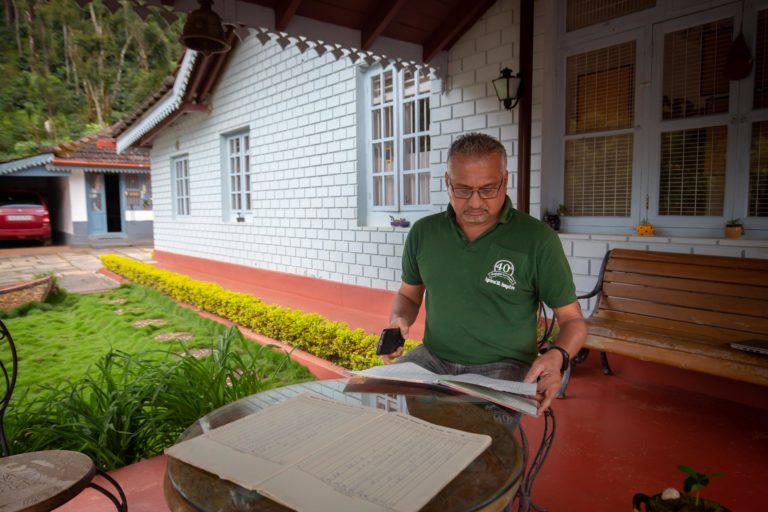
I.S. Umeshchandra with his rainfall records at his house. Photo by Abhishek N. Chinnappa.
In 2011, the College of Forestry in Kodagu district, India’s largest coffee-producing district, participated in an international project, Coffee Agroforestry Network (CAFNET) Project, to study the ecosystem services of agroforestry systems in the district. Rainfall patterns too were studied as a part of the project, where rainfall data of over 60 years from 116 coffee farms was sourced and analysed. The study pointed to a strong fluctuation in annual rainfall every 12 to 14 years and a reduction in the length of the rainy season by 14 days.
Umeshchandra (not associated with CAFNET) has observed some patterns from the initial analysis, though he has yet to find a strong one. “Fluctuations in annual rainfall are noticed every 10-12 years,” he shared. Records from 1887 show an average annual rainfall of 4826 mm (190 inches) in Chikmagalur, which suggests heavy rainfall is not new in this region, which receives an average annual rainfall of around 2500 mm (80-100 inches). “But heavy spells of rain for a few days as against it being spread out is making a difference,” he observed based on his experience.
Ramachandra K.S., a coffee farmer from Shanthalli in Somwarpet taluk of Kodagu, agrees. Flipping through the pages of his handwritten rainfall records dating back to the 1960s, he says there was over 5000 mm (200 inches) of average annual rainfall in 1960-1962, which fell to around 3800 mm (150 inches) in 1970. However, most farmers agree that the rainfall pattern has become unpredictable and daunting in the last five years because unpredictable rains make planning farming events difficult. They say they are constantly stressed.
J. Srinivasan, a professor at the Divecha Centre for Climate Change at the Indian Institute of Science (IISc), told Mongabay-India that these long-term rainfall records that the coffee farmers of the Malnad region of Karnataka (including Chikmagalur and Kodagu) keep are invaluable.
However, he said that the farmers need to compare their records with local IMD (India Meteorological Department) station records to verify them. “A single rain gauge cannot give accurate results,” he said, adding that the Malnad region, which is hilly, experiences microclimates and that one farmer’s rainfall records will be different from that of their neighbour’s.
Ramachandra’s rainfall records. Photo by Abhishek N. Chinnappa.
More rains lead to landslides, infections and pests in plants
Chikmagalur has a special place in the coffee history of the country. Legend has it that a 17th-century Sufi saint Baba Budan secretly transported seven coffee cherries from Mocha in Yemen and planted them in front of his hermitage, which later came to be called Baba Budan giri (hills) in Chikmagalur, marking the origin of coffee cultivation in India.
From Umeshchandra’s estate situated on a slope, Baba Budan giri provides a breathtaking view. But these days, it fills him with dread. While erratic rainfall hasn’t affected the productivity of his estate adversely, he fears physical damage by way of landslides. More wet days and increased daily rains saturate the soil and can damage hills, leading to landslides. Studies have shown a correlation between extreme rainfall and landslide events.
At Attigundi village, about 13 km from Umeshchandra’s estate in Hosapura is his friend Kiran M.R’s 45-acre estate of Arabica coffee. He is focused on phasing out silver oak trees (Grevillea robusta) in his estate and planting more native ones. Karnataka is known for shade-grown coffee, and its agroforestry system encourages an abundance of native trees alongside the cash crop.
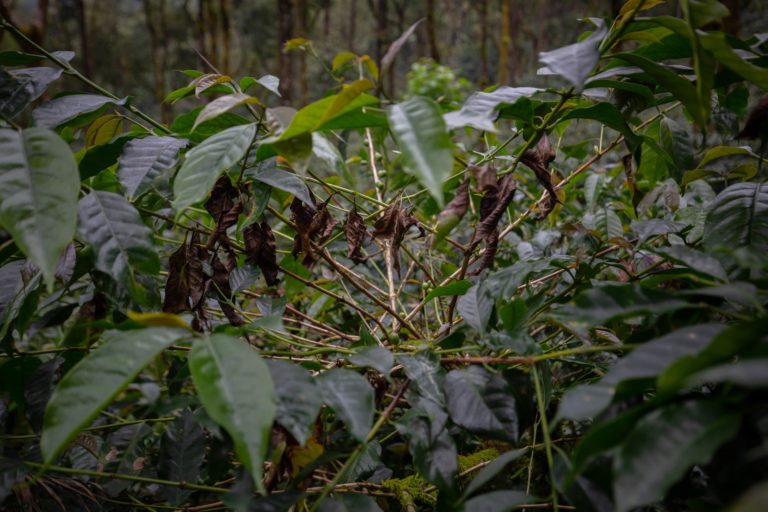
Leaf rust infestation on coffee plants. Photo by Abhishek N. Chinnappa.
Plantation economics and public policies, however, drove the farmers to opt for exotic shade trees like silver oak, which grows fast and can be easily traded as timber. Many farmers are switching back to native trees for various reasons, one of them being the leaf litter of silver oak lacks nutrients and doesn’t decompose as fast as native ones, said C.G. Kushalappa, dean of the College of Forestry. There is also the realisation that a good canopy cover provided by native trees can prevent soil damage during extreme rainfall.
“This July, I got 101.6 mm (four inches) of rain every day for 20 days. Some places nearby recorded around 150-200 mm (6 to 8 inches). This was followed by 1000-1300 mm (40-50 inches) of rain in 10 days in June. “We used to get seven to 10 days of monsoon break in June-August which is crucial for coffee. But no such break in the last three to five years,” said Kiran.
More wet days and little sunshine — a perfect setting for pests and fungal infections — is bad news for coffee. Black rot fungus (coffee thread blight) or Koleroga and coffee white stem borer (Xylotrechus quadripes), a pest, are decimating Arabica plants that were once this coffee belt’s pride. Coffee leaf rust, another fungal disease, is also high among coffee, informs Kiran. “I faced 20-30 percent loss last year,” he said with dismay. He had to shell out Rs. 5000 an acre to remove the black rot infestation at his 60-acre farm in Magundi in Chikmagalur.
Robusta, as the name suggests, is more robust and pest resistant to an extent, said J.S. Nagaraj, joint director of Central Coffee Research Institute at Balehonnur in Chikmagalur. In the last 15 years, there has been a clear shift towards Robusta in Kodagu and Chikmagalur. “While it was 50-50 earlier, it is now 80 percent Robusta in Kodagu,” said Kushalappa. Labour shortage and the high cost of cultivation of Arabica have also tipped the scale in favour of Robusta.
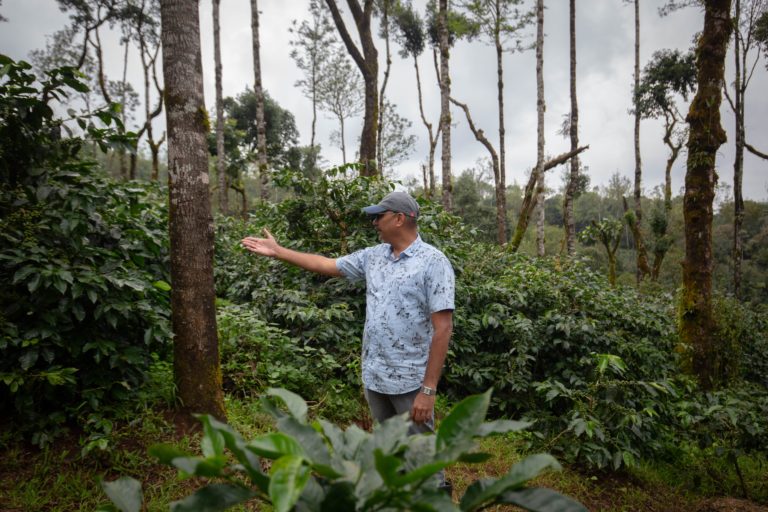
Coffee farmer Kiran points to the infestation. Photo by Abhishek N. Chinnappa
Farmers devise ways to adapt
Coffee farmers here are constantly trying to adapt to a changing climate. “Coffee farming depends on two important rainfall events, blossom shower and backing shower,” explained farmer Jammada Ganesh Ayyanna of Kaikeri village in Gonikoppal in Kodagu. “Blossom showers in the summer months of February to March ensure the blossoming of coffee plants. This must be backed by the backing showers within two weeks for the cherries to set,” he said. In the last three decades, the changes in shower patterns began to affect largely rain-fed agriculture, prompting farmers to invest in irrigation by way of sprinklers. “More than 90 percent of farmers rely on sprinklers now,” Ayyanna told us.
While the northeast monsoon and cyclonic events had little effect on coffee farming in these parts earlier, isolated showers during coffee-picking months (December-February) are working against the industry. Showers during picking months make the cherries drop. The dropped cherries, called “cleanings”, are often picked and sold. While cleanings filled 100 bags (one bag is 50kg) at Ramachandra’s farm last year, Kiran had to let go of the cleanings due to rains. “The cleanings were damaged; damaged cherries don’t fetch a good price,” he said. Picked cherries need at least two months to dry, said Ramachandra.
“No rains and good sunshine are ideal.” Since that hasn’t been the case in the last few years, more farmers, mostly large landholders, have begun to invest in driers.
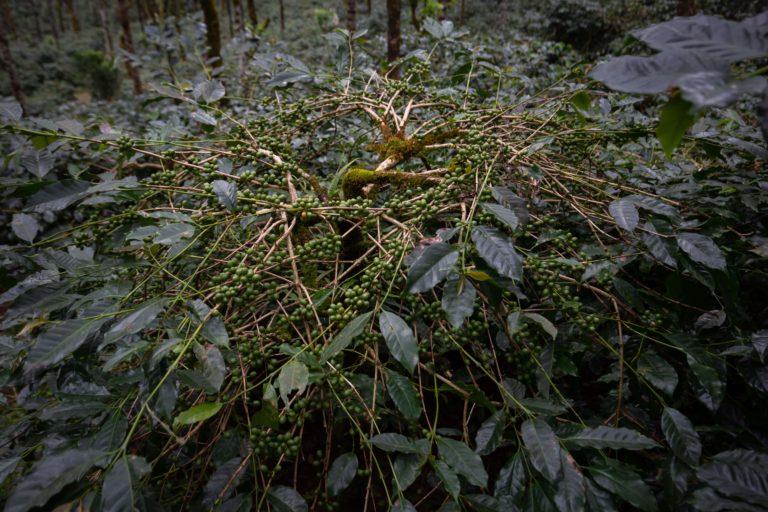
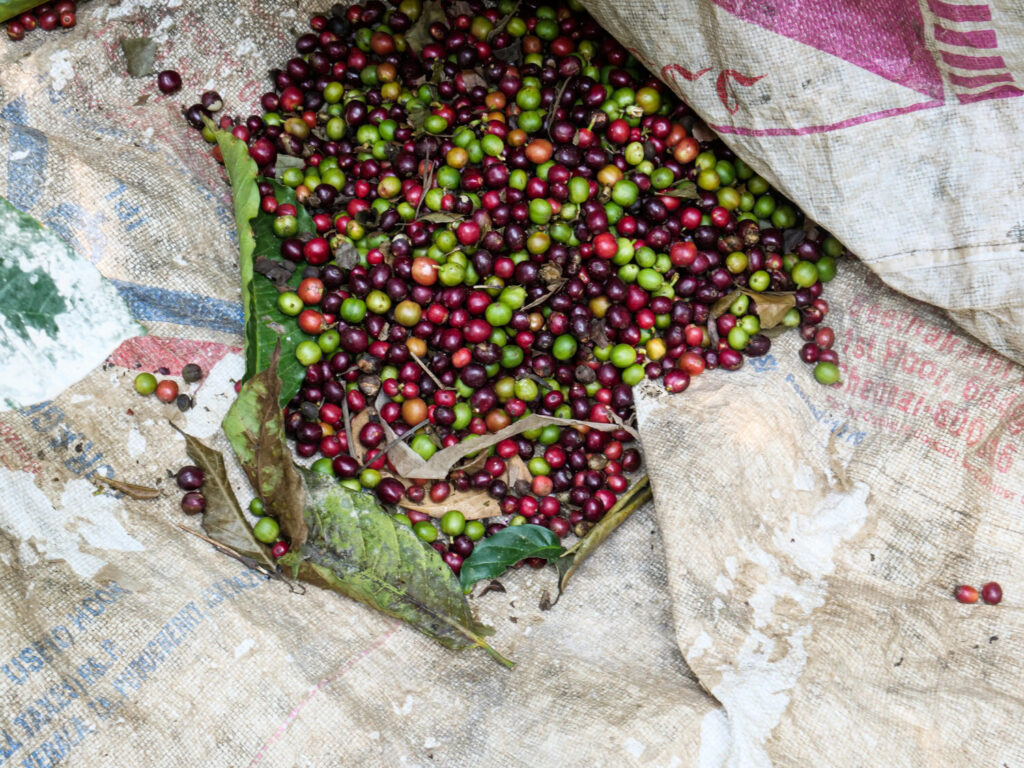
Coffee cherries at Kiran MR’s estate. Photo by Abhishek N. Chinnappa.
“I didn’t want to worry about unexpected rains,” said Gerrard Perreira from Coove Village in Mudigere taluk in Chikmagalur, who has 200 acres of Arabica and Robusta coffee. “For the coffee to dry properly, we need uninterrupted sunshine for a minimum of five days. But that’s hardly been the case in the last few years,” he said. He bought a drier eight years ago when signs of climate change had begun to show.
It has a 4000-litre capacity that can dry 35 bags of coffee at one time at an optimal temperature of 35-40 degrees Celsius for 18-22 hours. “The drying has to be uninterrupted. Since the power supply is unreliable, we use firewood. But a power generator for backup is a must,” he shared.
There are other advantages too. Using driers is more hygienic, quicker, and cuts labour costs, said farmers. Small and medium landholders, however, can’t afford the driers that cost about Rs 12-15 lakhs and are suggesting setting up community-owned driers. Kushalappa has his suspicions since cooperatives have not worked well in the region in the past. Coffee Board is now giving subsidies for driers, informed Nagaraj. “It is not affordable for everyone. But if climate change continues to affect coffee farming, driers are the future,” he said.
source: http://www.india.mongabay.com / Mongabay / Home> Mongabay Saves Climate / by Arathi Menon / December 01st, 2022
A unique eco-certification initiative in Kodagu’s famous coffee estates offers fresh hope for preserving native rainforests of the Western Ghats.
Growing coffee in the shade of evergreen trees in Kodagu. | Gopikrishna Warrier
There was a time in the not-too-distant past when coffee farmers in Kodagu district of Karnataka grew their plants only under the canopy of evergreen forests they had inherited. Now they prefer to grow it under the sun, which has serious implications for the Western Ghats and on the waters of the Kaveri River.
More and more farmers are now letting trees such as Dadup (Erythrina subumbrans), Arecanut (Areca catechu), Balanji (Acrocarpus fraxnifolius) and Jackfruit (Acrocarpus heterophyllus) die so that the canopy can be opened up and they can grow sun-loving coffee varieties that produce more berries and beans, resulting in higher returns.
Instead of the big trees, they are now planting exotic Silver Oaks (Grevillea robusta), whose pole-like trunk can be used as a support for the climbing pepper vines, which help boosting incomes. The proliferation of Silver Oaks has made it one of the more common trees in some parts of the area.
This transition has a larger ecosystem cost. Kodagu, earlier known as Coorg, is located on the western edge of the Mysore Plateau, at an average altitude of 800 metres, as it lifts up to the crest of the Western Ghats ridge (altitude above 1,500 m) and then falls sharply westwards into Kerala. The plateau mainly slopes eastwards, with the streams and rivers joining to form the Kaveri River, which is the lifeline for millions of people in Karnataka, Tamil Nadu and Puducherry.
With insufficient rains over the Western Ghats during this year’s southwest monsoon, there is a shortage of water in the reservoirs across the Kaveri in Karnataka. This has led to the flaring of the water-sharing dispute with the lower riparian state of Tamil Nadu in recent days.
While this acrimony continues, payment for ecosystem services measures are being worked out in Kodagu district so that coffee farmers protect the forests under which they grow their crop, thereby preserving the water flow into the Cauvery. These measures also help to maintain the climate resilience in the river’s catchment and command areas.
With the forest-like mixed-tree canopy in coffee plantations disappearing, the torrential rains of the southwest monsoon flows quickly down the streams, carrying valuable topsoil away and causing floods followed by long dry periods downstream.
Paying for ecosystem services
The Kodagu farmers are being encouraged through payment for ecosystem services, in the form of eco-certification, to continue with their traditional coffee cultivation under the shade of mixed species of trees. This will help strengthen the ecosystem services they receive from the unique landscape of Kodagu, and also strengthen similar services and climate resilience of all those relying on the waters of the Kaveri downstream.
The concept of eco-certified coffee, whose certification process ensures that coffee is grown under mixed-species trees, has gained popularity in the district in the past five years. Close to 900 coffee farmers have converted to eco-certified coffee. Even with a conservative estimate of 10 acre per farmer, this means nearly 10,000 acres of eco-certified coffee. In addition, with Tata Coffee getting all of its 13 estates eco-certified, Kodagu district has at least 20,000 acres under coffee cultivation that aims to minimise damage to the environment.
As an incentive for protecting the environment, the coffee farmers get a premium above the market price for their coffee beans. Coffee is the major agricultural produce from Kodagu, with 33% of the district landscape under its cultivation. About 38% of India’s coffee production comes from the district.
Ecologically, Kodagu district has been identified as a micro hotspot of biodiversity under the larger Western Ghats region. Rightly so, since the western crest of the mountainous district is in the direct path of the southwest monsoon. The dark clouds heavy with rain dump much water over the district. While the western edge of the district receives above 5,000 mm of rainfall on an average, it reduces to around 1,200 mm in the east. Most of the water feeds into the Kaveri.
According to a reportby the College of Forestry at Ponnampet in Kodagu, natural forested ecosystems cover an area of 46% of the total area of the district. These include evergreen, semi evergreen, moist deciduous, dry deciduous and scrub forest types, and even the high-altitude shola-grassland ecosystem.
Traditionally, coffee is grown in the shade of these forests. Coffee estates in Kogadu have on an average 350 trees per hectare, compared with 270 in degraded groves and 640 trees per hectare in the nearby Brahagiri Wildlife Sanctuary, making these estates amongst the densest agro-forestry systems in the world.
“Very few landscapes across the world grow coffee in the way in which Kodagu does,” said C.G. Kushalappa, university head for forestry and environment sciences at the College of Forestry, Ponnampet in Kodagu. “We grow both Arabica and Robusta coffee under the shade of the trees. Our shade-grown Robusta fetch a premium price. When grown under the shade, the berries mature slowly and fill out better. They have good cupping (taste) quality.”
Coffee plants are increasing being cultivated under exotic Silver Oak trees. (Photo by S. Gopikrishna Warrier)
However, he needed scientific data to convince the coffee farmers and the district administration that there was strong ecosystem benefit in maintaining the traditional shade-growing methods. The opportunity for doing this research emerged when the College of Forestry was chosen as the lead institute in India to carry out the Coffee Agro-Forestry Network, or CAFNET study to understand the environmental services from this unique landscape.
Financed by the European Commission, the study was jointly conducted by the College of Forestry, the Coffee Board, the French Institute at Puducherry, CIRAD (the French national agricultural research system) and Bangor University from the United Kingdom between 2007 and 2011.
Rich local knowledge
The study noted that the multi-storeyed coffee agro-forestry system developed and sustained by the farmers based on their local knowledge is one of the most diverse production systems in the world. The traditional coffee agro-forestry system sustains diverse animal, bird, plant and microorganisms, and provide biodiversity, carbon sequestration and water-related ecosystem services. Since multiple crops such as pepper, mandarin oranges, vanilla and timber is also grown in these systems, they help provide resilience to farmers when they are hit by coffee price volatility.
The CAFNET report recommended that coffee farmers growing Arabica and Robusta under shade trees should be paid for the ecosystem services that their farms provide, so that they can protect biodiversity and therefore water in the Cauvery. Two methodologies for payment for ecosystem services suggested was eco-certification and geographical indications protection for Kodagu coffee.
Eco-certification of coffee farms in Kodagu started as a follow-up to this recommendation. Coffee farmer BB Thammaiah says his interest was piqued when students from the College of Forestry came to his farm to carry out biodiversity studies. “After the studies I was told about the uniqueness of the method in which I grow coffee, and I went in for eco-certification,” he said.
The two eco-certifications that have been popularly accepted are from the Rainforest Alliance and Utz. Coffee grower KK Naren in Kunda village near Ponnampet said the main benefit of the eco-certification process is that farmers are trained in good practices that have good environmental benefits and improve the working and living conditions for the workers.
“The economic benefit is not much,” he said. “It is more of training for us, which will be beneficial in the long run. The eco-certification process educates the coffee farmers about the environment.”
Importance of native trees
The most important lesson from the training relating to the eco-certification, according to Narenm was the understanding on the importance of native trees. “It is not that we didn’t know about native trees but we were not that keen on maintaining them,” he said. “The native trees do not give good financial returns, so we gave importance to silver oak.”
According to Naren, the Rainforest Alliance eco-certification process looks at whether native shade trees are present. The certifiers and auditors also look at labour management, whether the minimum labour wage is paid and the cleanliness around the labour quarters. They are very strict about not using child labour. “They also look at the way chemicals are used,” he said. “They are not saying no to chemicals but there are restrictions to some chemicals and the way the rest are used. They are keen that we should not use pesticides of chemicals near the rivers or tanks. They give importance to maintain local environment.”
Individual planters like Thammaiah and Naren got an opportunity, through the eco-certificaion process, to access the international market through a Swiss procurement agency that buys higher quality coffee. Both of them sell their eco-certified coffee to Ecom Gill, who procures the eco-certified produce for supply to Nespresso.
BB Thammaiah in his coffee farm where the plants are grown under the shade of native evergreen trees. (Photo by S. Gopikrishna Warrier)
For Tata Global Beverages Ltd and its production subsidiary Tata Coffee Ltd, the move to eco-certification of all of its 13 estates in Kodagu was an important step in the process to make its supply chain sustainable. According to Anurag Priyadarshi, global sustainability manager for Tata Global Beverages, one of the guiding principles that the group has adopted is to source sustainability. For this, all their estates in Kodagu have been eco-certified by Rainforest Alliance and Utz.
“Through the eco-certification process we are trying to ensure good management practices for the ecosystem, energy, water, waste, soil and agro-chemicals. We ensure the safety of the produce and also occupational health of the workers. Ultimately we want to prevent the impacts of climate change,” he said.
MB Ganapathy, head of plantations for Tata Coffee, said the company is aware about the fact that they are growing coffee in Kodagu, which is a biodiversity hotspot in the Western Ghats. “We have recognised this fact and that is the reason that our vision is to enhance the ecological wealth we have inherited. The eco-certification helps us safeguard the environment.”
Challenges remain
However, the rapid spread of the eco-certification process has also raised some hiccups which need to be overcome, states TR Shankar Raman, scientist at the Nature Conservation Foundation, whose organisation was involved with helping Rainforest Alliance with the certification in the initial years. The three points of concern, according to him, is the very rapid pace at which certification is being done; the relative absence of biologists and social scientists in the auditing process; and the dilution of conservation standards (like the requisite number of native species and canopy cover) in subsequent versions of the certification guidelines.
“While the rapid certification has more and more farmers being eco-certified, we hope the rigour of the process continues to be maintained, so that the end result of conserving the native vegetation is not compromised,” Raman observed.
With more farmers opting for eco-certification, there is a movement towards the protection of the traditional methods of coffee cultivation under the shade of mixed-tree species. For the process to strengthen the farmers should continue to get good economic benefit for their eco-certified produce.
According to Naren, if there is at least 10% more returns from the eco-certified coffee remains constant then there will be an incentive for the opting for opting for the process. At present the price at which procurement agencies such as Ecom Gill buy is linked to the international market price, plus a premium of Rs 60 to Rs 80 for a 50 kg bag of sun-dried cherries. The international prices fluctuate in relation to the local market prices, and as with the current situation can go below the domestic price.
However, Kushalappa says that in addition to the premium, there are other incentives and bonuses for producing good quality coffee beans. The average increase in price above the local market price was around 15% last year, which is well worth the effort.
If additional income for coffee farmers from eco-certification can help conserve unique agro-forestry ecosystem of Kodagu, then it will be the water flow into the Cauvery that would be conserved. Millions of people downstream, including the residents of Bengaluru and other parts of peninsular India, will thank the coffee farmers upstream for their drinking water and climate resilience.
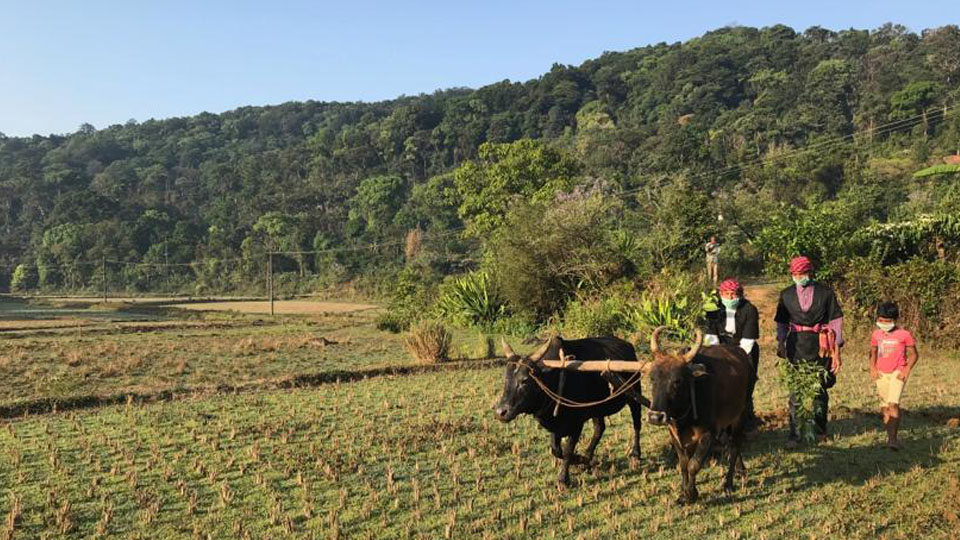
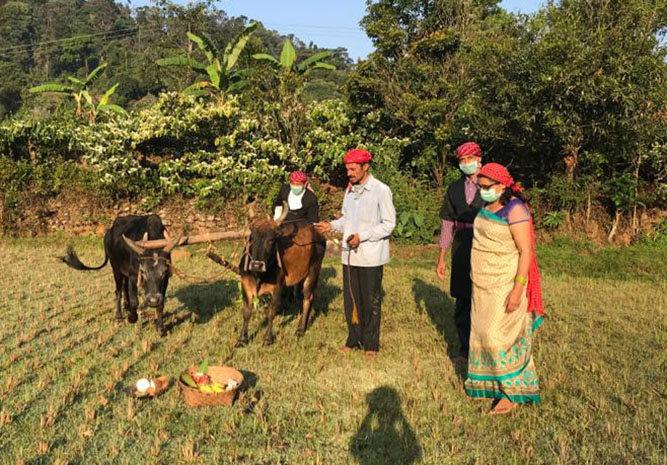
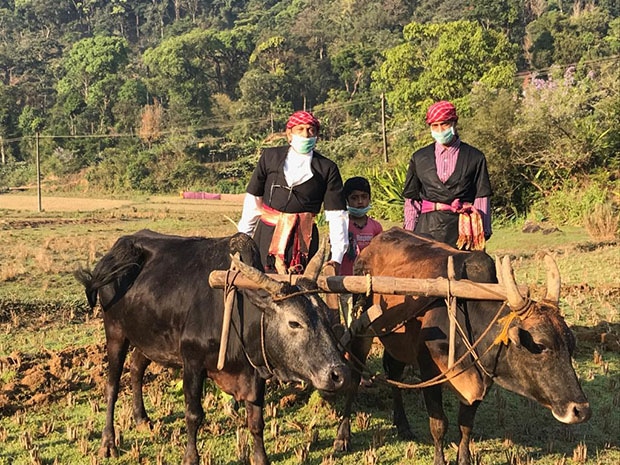
Codava National Council (CNC), which is aspiring for Codavaland Geo-Political Autonomy and ST tag for Kodava tribalism, celebrated its 26th AnnualCodava (Kodava) New Year Day Edmyar-1 as per Kodava tribal almanac by ritualistic ploughing of paddy fields.
CNC President N. U. Nachappa offered prayers to Guru-Karonas at Koopadira clan and reverential prayers to Mother Earth, Sun, Moon before two bullocks named Karianna – Kulla, ploughed a few rounds in the wetlands of Koopadira clan.
To herald the unbreakable bondage of Kodava tribal world with mother soil to entire universe, CNC is determined to showcase and display the age-old folkloric cultural traits and genus of Kodava tribal ancestry. In other words, all these ancient festivities enriched the civilisation of Kodava martial tribe.
CNC also prayed for the well-being of all the people of this world that is reeling under the pandemic COVID-19. Koopadira Sabu, Koopadira Mohan Muthanna, Lt. Col. Parvathi, Kompulira Myna Purandara and Koopadira Pranam participated in the celebrations.
Due to Corona pandemic, CNC’s Annual Edmyar-1 evening’s torchlight (pombolak) procession at Gonikoppal, is not being celebrated today. Speaking on the occasion, Nachappa said, “All Codava folkloric festivities and rituals mirror the agro-pastoral commitment, hunting skills and warrior hood of Codava tribal folk from time immemorial which depicts that we are above the tenets of caste and religion who are living in the rustic hills, mountainous terrain in the midst of rivers and rivulets.”
“We are happy that the Founding Father of the Constitution of India, Dr. B. R. Ambedkar’s birthday coincides with Codava New Year. We are ever grateful to Dr. Ambedkar for his yeomen contribution of accommodating space for expressing grievances of micro-minority tribes like Codava tribe,” he observed.
source: http://www.starofmysore.com / Star of Mysore / Home> Covid-19> News / April 14th, 2020
We walked through meandering coffee plantations and around precarious corners that led up steep cliffs. “Most of these coffee farms belong to local families trying to make a living. They do most of the work themselves. It is difficult labor,” Aarush, the enthusiastic tourism manager at Mojo Plantation, explained. Eventually the forest ascended into open valleys overlooking thick, emerald rainforest below. “You see the mountainside there? There were huge landslides last year.”
Each year during the rainy season, torrential rains cause mudslides that destroy homes, villages, and farmland. Nonetheless, Coorg’s exceptional beauty alongside the promise of fertile land and the increasing boom of the coffee industry have made this slice of southern India an attractive destination to build a livelihood for centuries.
History of Coffee in India
India is a nation typically renowned for its tea. Chai wallahsare found on corners across India selling small cups of tea from roadside stands and carts. Grand tea estates and blossoming tea plantations cover hill stations across both northern and southern India. However, India also has a little-known coffee history that has blossomed into a flourishing industry in recent years.
History tells it that in 1670, a Muslim pilgrim named Baba Budan snuck seven coffee beans in his beard aboard a ship to India. Upon arrival, he planted these beans in the Chikmagalur region near Coorg in Karnataka. At this time, it was illegal to transport green coffee beans outside of Yemen, and the ports were strictly monitored in an effort to maintain a monopoly on local coffee production and trade.
Baba Budan was not only successful at sneaking them out of Yemen but also successfully planted them in Chandragiri Hills. Legend has it that the Baba had his friends carry the beans with them and plant them wherever they went, mostly in gardens and backyards. Coffee production prospered in Chandragiri Hills over the next century. However, the bean didn’t spread throughout other parts of India until the 19th century, when coffee started being exported for trade. Coffee now flourishes in Karnataka, where the slopes of the Western Ghats are brought to life with the fresh aromas of arabica and robusta plants.
Coffee fruit.
Welcome to Coorg
Also known as Kodagu in the local Kodava language, Coorg is a district and hill station in southern Karnataka, a state on India’s southwestern coast. Coorg is rich with colorful folklore and a dynamic history.
“You know there are sacred forests in Coorg? People worship the forests and the species living in them,” Aarush mused. The original Kodava inhabitants were agriculturalists, still evident today in the protection of forests and the emphasis on agriculture in the region.
The undeniable natural beauty and abundance in Coorg—from rainfall and rice fields to fertile soil and diverse water sources—made the region a highly sought-after location to outsiders throughout history. Nonetheless, the Haleri dynasty, which ruled from 1600, withstood countless attempted invasions of Coorg for centuries, reigning strong and quelling outside attacks.
The last king, Chikka Veerarajendra, however, lost the support of his people and eventually the warriors who once propped up the Haleri dynasty also brought it to an end. Shortly thereafter, in 1834, a Coorg general named Apparanda Bopanna invited the British forces into the kingdom. Despite previous resistance to British influence, the partnership with the British beckoned in a period of peace and prosperity. The British introduced coffee cultivation on a mass scale, capitalizing on the coffee beans that were brought over some centuries earlier.
The first coffee estate was established in Coorg in 1854 by an Englishman named John Fowler. Soon, almost every family in Coorg began to grow the infamous bean that energizes people across the globe. This tradition has been carried through generations to present day, perhaps contributing to the nickname Coorg has acquired of being “the coffee cup of India.”
Contemporary Sustainable Farming
Coffee in south India is a competitive commodity to the infamous tea that dominates India’s northern states. Estates are plentiful in the southern Indian states of Karnataka, Kerala and Tamil Nadu. The plants grow beneath thick, natural shade in ecologically diverse and sensitive regions of the Western and Eastern Ghats. Coffee plantations simultaneously contribute to the biodiversity of the local ecosystem and to the socioeconomic development of these hilly, rural regions.
Coorg grows 40 percent of India’s coffee, and the local economy relies heavily on it. The majority of the uninhabited land is cultivated coffee farms, many of them still owned by families as they were when coffee estates first emerged in the mid-19th century.
Today, Karnataka yields 140,000 tons of coffee a year and is the largest producer of coffee in the country. As a whole, India produces 299,300 tons of coffee annually, according to a 2019-2020 census by THE COFFEE BOARD OF INDIA. India is the third-largest producer and exporter of coffee in Asia and the sixth-largest producer and fifth-largest exporter of coffee in the world. It accounts for 3.14 percent of the global coffee production. Seventy percent of India’s coffee is exported, and thirty percent is distributed and consumed domestically.
Spice Farms
Even though Coorg might be known as the coffee cup of India, the region has been renowned for its spices for centuries, long predating the introduction of coffee. Coorg pepper is particularly famous. Since ancient times, traders arrived at the Malabar Coast in bordering Kerala to purchase the treasured black spice grown in the emerald hills of Coorg. Cardamom, cloves and kokum, among other spices, grow abundant in Coorg and supplied the Malabar spice coast trade. Coffee hasn’t replaced the spice trade in Coorg, but rather complemented it. Today, on many estates, coffee and spices grow side by side and benefit from the diversification of the local eco-system.
Sustainable Tourism and Agriculture
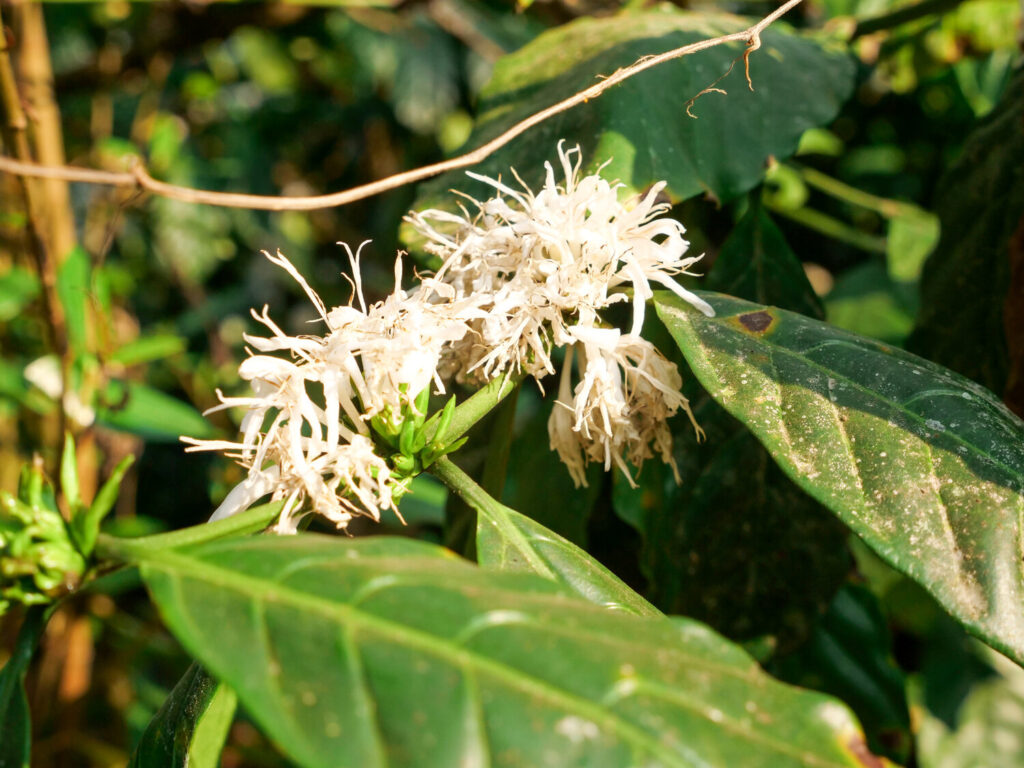
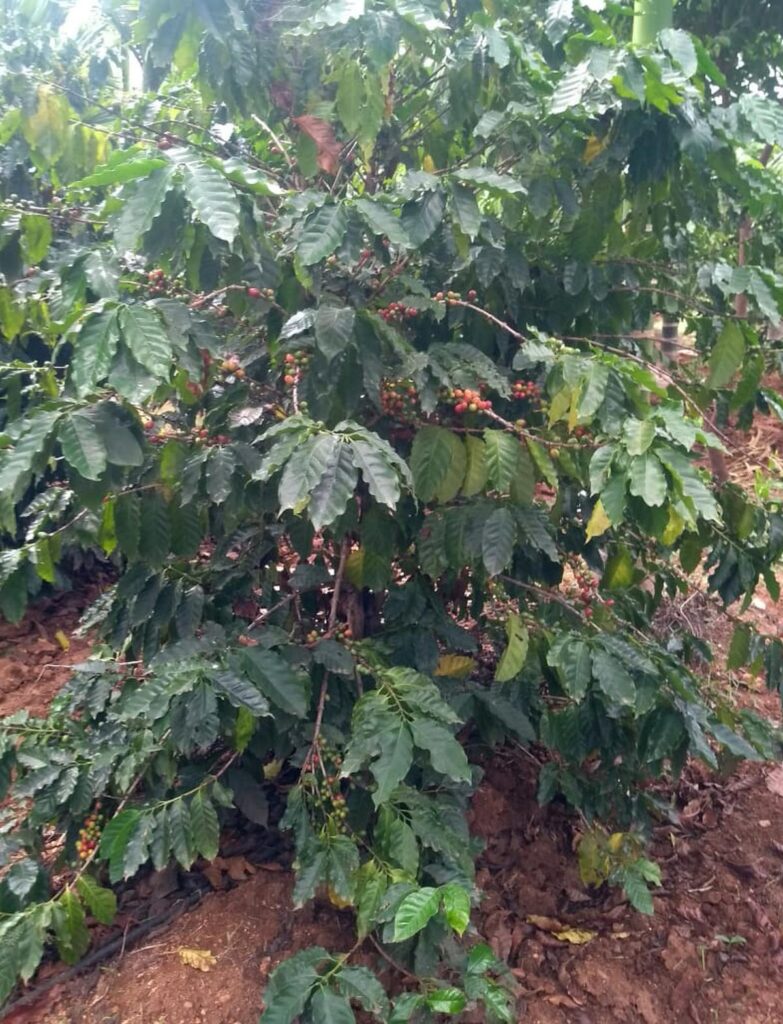
“Can you smell the flowers? Doesn’t it smell like jasmine?” Sunal, my guide at Evolve Back asks me. He is right. I notice a discernible scent of jasmine permeating the air as we walk through rows of blossoming coffee trees. “When the coffee trees are ripe, they have small, white flowers that smell like jasmine.” The rows of arabica and robusta trees hang heavy with burgundy-colored fruit and delicate white flowers. Interspersed among the blossoming coffee trees are ladders of pepper vines climbing into the sky.
There are two different climates in Coorg—rainforest and dry, temperate forests—both of which are friendly for coffee growing conditions. A region relatively far off the typical tourism track, the increasing focus on sustainable, organic farming alongside experiential travel has been monumental in encouraging intentional and experiential travel in Coorg. A handful of initiatives have developed sustainable, organic coffee growing, which is leading to a regionwide awareness around responsible agritourism.
Coffee flowers in bloom.
I started my time at RAINFOREST RETREAT, which is situated outside of Coorg’s main town, Madikeri, and offers an educational and immersive coffee-based tourism experience. This organic farm and guesthouse feeds into the concept of organic, sustainable agriculture. Set amid tropical rainforest, Rainforest Retreat and the adjoined Mojo Plantation are a deeply researched experiment in ecological farming. Understanding and playing to the strengths of the eco-system, the plantation focuses on “agro-ecology.” They encourage all forms of organic farming, including biodynamic farming, permaculture and traditional practices such as panchkavyaandjeevamruth, which all help to sustain healthy, living soils.
On Mojo Plantation, the coffee and spices flourish side by side amid the riches of the rainforest. During my stay, I spent hours each day meandering through thick growth of native trees, vanilla, turmeric, cinnamon, ginger, and black pepper crops; and coffee trees heavy with ripened arabica and robusta beans. The growth of the rainforest canopy is left natural, allowing for the fungi, spiders and insects native to the ecosystem to their important role in the ecological coffee and spice farming in this region. Mojo Plantation also produces the delicacy luwak coffee. The civet cat ingests coffee beans and the excrements are collected and processed into some of the most expensive coffee available on the market.
Mojo Plantation also runs an NGO, which offers workshops and trainings for farmers and agricultural businesses about organic, chemical-free practices, to encourage a continued shift and commitment to ecological farming as a method to grow organic coffee and spices.
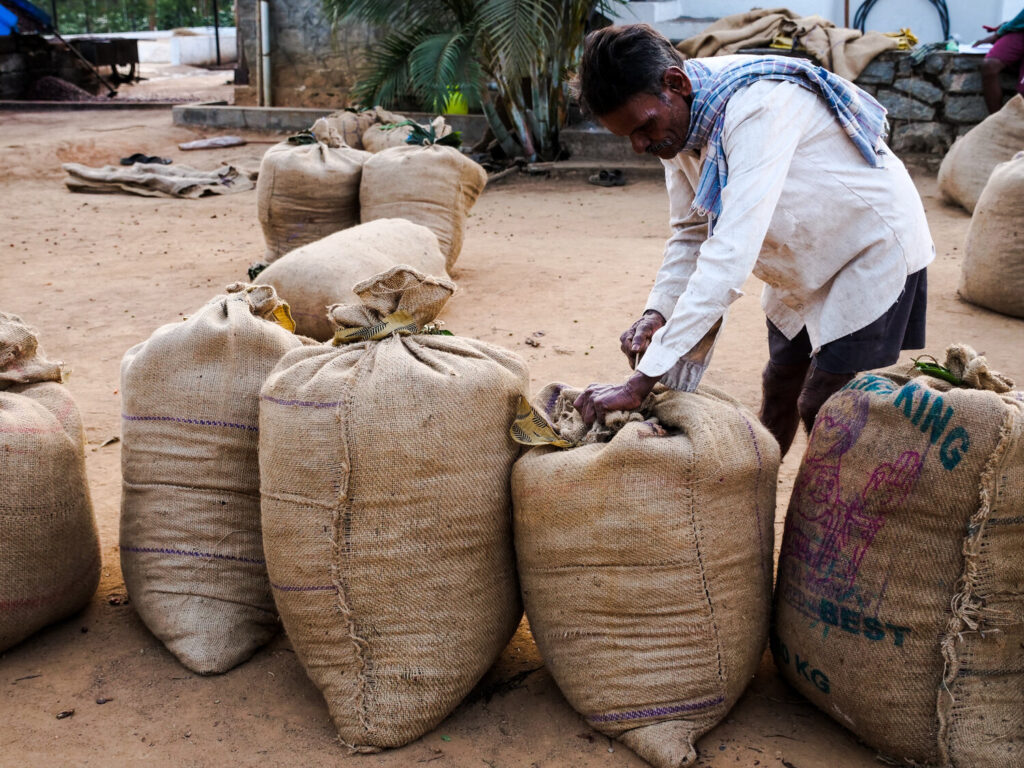
Beans are bagged and ready for market at Evolve Back.
From Rainforest Retreat, I traveled to EVOLVE BACK, which sits on the opposite side of Coorg in a more temperate climate. This family-run plantation and guesthouse dating back over a century stands as an example of the entwinement of mostly domestic tourism and the coffee industry in Coorg. Inviting guests to stay amid an organic coffee and spice plantation, Evolve Back offers a complete immersion into the ebbs and flows of work on a coffee plantation.
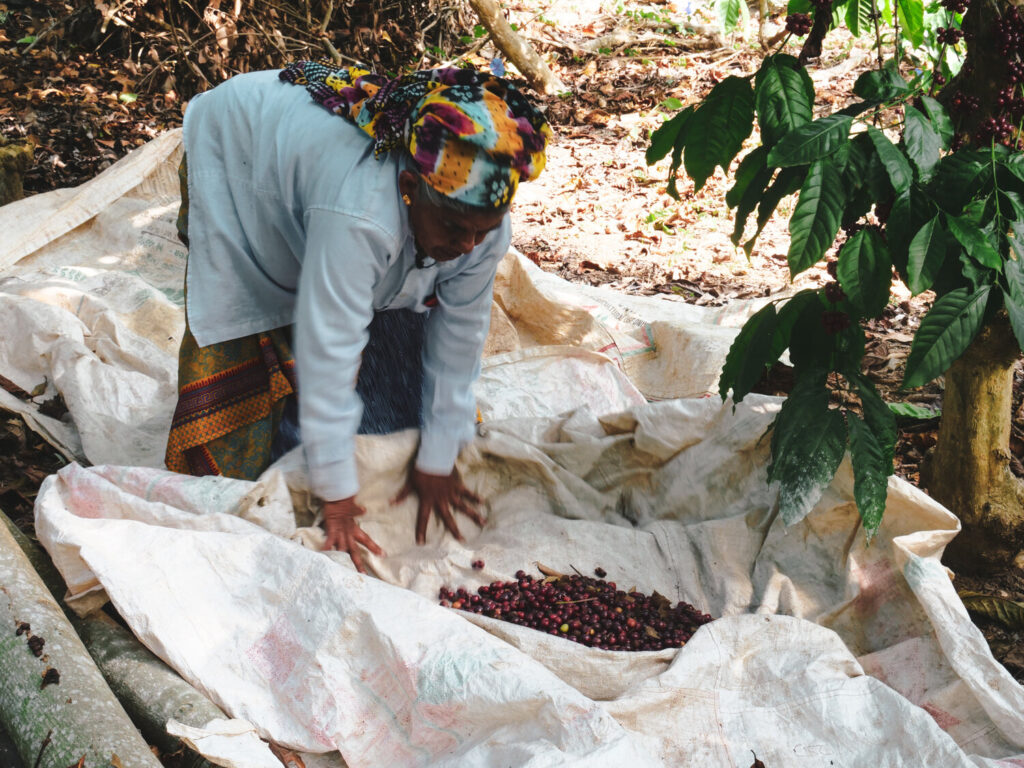
Each day a new experience that was immersive, sustainable and educational. I walked through the expansive breadth of the plantation, abundant in plant and spice varietals. I learned about and visited each step of coffee cultivation, from the fields, to sun-drying the beans, to processing the beans in the factory. I tasted surprisingly smooth coffee wine, a fermented drink made from remaining coffee juice after the beans were separated from their skins. I cycled through villages along the river Cauvary. On my final day, I joined farmers in the field to pick ripe coffee beans. At the end of an afternoon in the fields, I sunk my teeth into delightfully pink rose apples as the truck pulled away, leaving me with the sight of coffee fields receding into the horizon.
Local Consumption
At some point during the 19th century, South Indians began to adopt coffee drinking, and adapted it with their own style. They brew their coffee with milk and sweeten it with jaggery. While coffee remains a beverage mostly consumed at home across India, the southern states of Karnataka and Tamil Nadu are plentiful with street-side coffee stands, much like the chai stands throughout northern India.
“We have saved the best for last: India’s infamous Kaapi coffee,” the barista at Evolve Back announced. Each afternoon Evolve Back hosts a coffee tasting for its guests to try different roasts and ways to brew coffee, from cappuccino to Vietnamese, and including India’s very own coffee, known as Kaapi. Amid the thick green coffee plantations and the stirrings of the surrounding jungle, the barista carefully pours steaming cups of Kaapi.
Also known as South India filter coffee, Kaapi is India’s most recognized coffee specialty. This brew requires boiling milk, to which coffee and sugar are added. The liquid is processed through a cylindrical filter. After the tedious filtration process, the frothy concoction is poured into a metal cup, known as a davara, which is served inside a stainless-steel tumbler.
After days of having to turn down coffee after coffee due to an inexplicable caffeine intolerance I have had for a decade, I couldn’t resist tasting the smooth, flavorful specialty. I savored the few sips I allowed myself to indulge in, drinking in the centuries-long history of coffee that its way into this unassuming forested region off the southwest coast of India.
**Note: Names have been changed for privacy purposes
source: http://www.whetstonemagazine.com / Whetstone / Home> Journal / by Alicia Erikson , Text and Photo www.journeywithalicia.com / September 14th
Farmers in North Karnataka are now trying to grow coffee and if proven to be of good quality, it will be a game changer for the region.
Gaddi Guddappa, a farmer from Huvina Hadagali in Vijayanagara district, has cultivated coffee on his eight acres of land successfully.
Bengaluru :
When someone says coffee from Karnataka, three names immediately come to mind: Kodagu, Chikkamagaluru, and Sakleshpur in Hassan district. But something new is brewing in an unexpected corner of the State: farmers in North Karnataka are now trying to grow coffee and if proven to be of good quality, it will be a game changer for the region.
Gaddi Guddappa, a farmer from Huvina Hadagali in the Vijayanagar district, has cultivated coffee on eight acres of land successfully. Mr. Guddappa told The Hindu, “I bought the plants from Chikkamagaluru and Shivamogga four years back and this year, I have got the yield of 1,600 kg of coffee from my eight acres of plantation.”
According to him, the coffee which he had grown is the first in the district and also in the North Karnataka region. Many farmers in his district are visiting his plantation every day to learn about and see the coffee beans grown. “For me, it was a very new crop and I didn’t know the outcome of it. I learnt how to grow coffee by visiting Chikkamagaluru. Many people from my area who were working in the coffee estates there had told me about it. I bought Arabica-Chandragiri variety coffee from Shivamogga nursery and started to grow it,” Mr. Guddappa added.
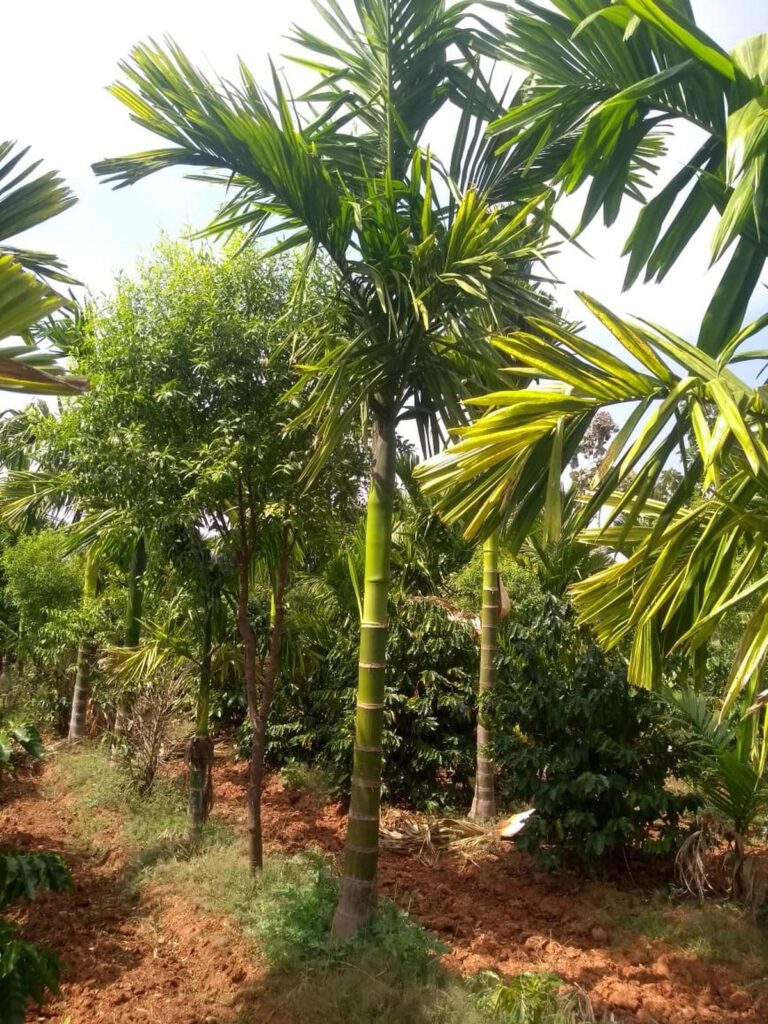
The farmer is using arecanut palms and a few other kinds of trees as shade for coffee plants
Initially, Mr. Guddappa was growing arecanut on his land. He then started to grow coffee in the middle of the arecanut farm, as traditionally, all coffee is shade grown. He is using arecanut palms and a few other kinds of trees as shade for coffee plants while growing pepper as intercrop. “I am the first person to cultivate coffee in this region. This year, a few farmers in Lingsugur in Raichur district and Bagalkot district have also started growing coffee,” he said.
Coffee Board testing it
Coffee Board officials recently visited Huvina Hadagali and collected samples of the coffee for quality testing. K.G. Jagadeesha, Chief Executive Officer and Secretary of the Coffee Board, told The Hindu, “Since we got the information that coffee is grown there, our officials have visited the village and taken samples. Only after proper analysis of the coffee yield and quality will we be able to comment. Testing is going on and it will take time to give our scientific analysis of the crop.”
According to Mr. Jagadeesha, coffee plants can be grown anywhere. However, the quality has to be met to the proper standard for the coffee to be marketable and drinkable. “We don’t want to recommend anything based on physical observation. We want to go by extensive testing of the coffee beans. As a responsible agency, we have to see everything, including long-term sustainability, but we are exploring,” he added.
source: http://www.thehindu.com / The Hindu / Home> News> India> Karnataka / by Darshan Devaiah B.P. / November 25th, 2022
Mysuru entrepreneur Kuppanda Chayaa Nanjappa Rajappa has been appointed as the National President of Association of Business Women in Commerce and Industry. She is a first generation rural woman entrepreneur and Founder-Managing Partner of Nectar Fresh.
Nectar Fresh, backed by Khadi and Village Industry Board, has its unit in Srirangapatna, Mandya district. It offers various products like honey, jams, sauces, chia seeds and natural vinegar.
A recipient of various awards like CNBC-TV18 and Women Entrepreneur Award in 2014-2015, Chayaa was also honoured by Indian Federation of Culinary Association for breaking the monopoly of the international brands. She bagged the Business Person of the Year Award by Mysore Chamber of Commerce & Industry (MCCI) in 2019.
Nectar Fresh has been the first brand in India to be using the ‘Women Owned’ logo of ‘We Connect’. Their latest venture ‘Veeravrutham’ is the first social enterprise in ‘Aatmanirbhar Bharat’ which will support over 3,000 tribals and rural artisans locally. Tribal and rural artisans’ products will gain place not only in the Indian market but will also find place in the international market.
Born to Paruvangada Nanjappa and Poly Nanjappa of Nalkeri village in Kodagu, Chayaa is married to Kuppanda Rajappa, who was the first businessman to bring in the concept of supermarket (Nilgiris) to Mysuru. The couple has donated one acre of land for a Bharat-Israel Study Centre through Diya Minora Foundation, a sister concern of Veeravrutham Foundation. It will be a culture and technology exchange platform between India and Israel.
Chayaa is motivated by the principles of Rashtriya Swayam Sevak Sangh (RSS) and has implied the principles in her profession besides working in various fields apart from business. She is the first woman to hold a national-level position in Vishwa Hindu Parishad (VHP) and also holds a position in the State Committee of RSS’ Laghu Udyog Bharti.
She is a member of the executive committee of the R&D Institute for Food and Technology at Indian Institute of Food Processing Technology (IIFPT) and is one of them from the industry to be chosen as part of the National Honey Mission.
IIM Professors chose Nectar Fresh story as a case study for the Ivy League Competition, adding another feather to the cap of Nectar Fresh that grew up as a brand with ethics and quality than investing in marketing.
source: http://www.starofmysore.com / Star of Mysore / Home> News / June 25th, 2021
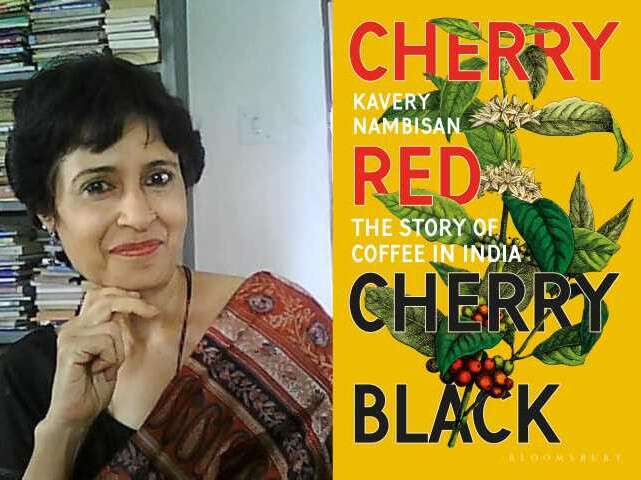
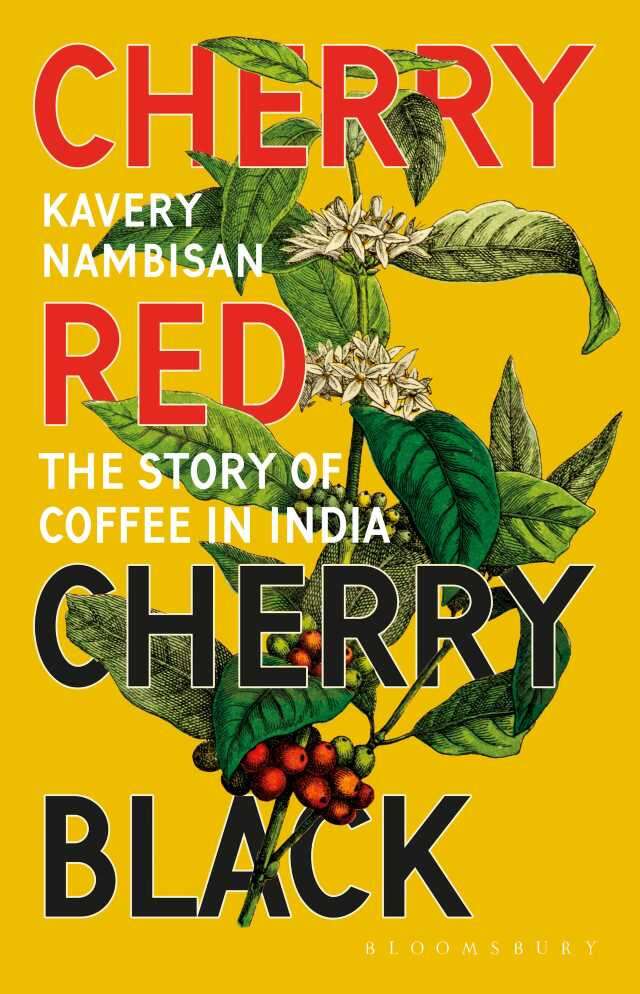
Kavery Nambisan’s new book Cherry Red, Cherry Black details the fascinating story of coffee in India
Kavery Nambisan was born on a coffee estate, grew up among the “twisted branches and dark green leaves of the coffee bushes”; her parents joked that she was among those children who had been “plucked off the coffee bushes.”
It is therefore fitting that the surgeon’s latest book Cherry Red, Cherry Black(Bloomsbury India) is about the history of coffee in India.
Written with anecdotes woven into chronology, this comprehensive look at the coffee industry reveals intriguing nuggets – the origins of the coffee terms ‘Robusta’ and ‘Arabica’; the story of how Southern India became coffee country (it’s more complex than the Baba Budan tale); how coffee made sugar popular… Kavery explores the world of coffee far beyond its cultivation via the journeys of rulers and invaders and the ways of governance and tribute to its current status as one of the most valuable legally-traded commodities in the world. With the pride of a true Kodava, she writes of how coffee cultivation in Coorg (now Kodagu) changed the social, ecological and economic nature of the land and its people, and of the planters clubs that still exist.
A large part of the book details the story of how Tata Coffee, with whom the author has been associated in her medical avatar, came to be, but its scope goes far beyond company history and personalities to showcase coffee’s ability to be the great leveller available to every layer of society, and details the journey of the bean from plant to cup. Readers will be fascinated to know that the coffee served at Starbucks is made with beans from Kodagu, Hassan and Chikmagalur and cured in Kushalnagar.
Excerpts from an interview
You speak of yourself as “almost a child plucked off a coffee plant”. How was the experience of going back with research to discover what is such an integral part of your childhood? How long has this book been in the making? Have there been any surprising learnings?
Yes, coffee has been integral to my being, but I did not consciously think about it until recently when I started to write this book. It has been a pleasure to discover the history behind coffee, and, along with it, to learn more clearly certain aspects of local history. I started to read up sometime after the middle of 2018 and wrote in 2019 but was unable to conduct some important interviews during the period when Covid came and went. After that, everything had to be ‘fast-forward.’
As for surprise learnings, yes, of course. There can be no better way of learning something new than writing about it. I learned much.
You are a proud Kodava and now live and work again in Kodagu. What aspects of life there do you enjoy most, both connected to coffee and otherwise?
I have worked as a surgeon in Kodagu for over 10 years, off and on. My husband and I built a house in a village here and it is surrounded by coffee estates that do not belong to us – so pleasure without responsibility! The tall shade trees that surround us are a blessing – with so much life going on in the branches and the undergrowth. As a doctor, I have a great rapport and a serious commitment to my neighbours, many of them being daily wage earners in the estates. I think we live a good life.
What does your own coffee cache look like? What would we find in there?
You would find a cache of roasted coffee beans (a blend of Arabica and Robusta). I roast the beans every few weeks or so and use about 10% of chicory to enhance its strength.
You’ve detailed a bewildering number of ways to prepare a cup of good coffee. Which is your favourite?
I use three methods, depending on my mood. Filter coffee (in the afternoons); the Moka pot or a rustic brew (adding coffee powder to just boiled water and letting it steep for two to three minutes) in the mornings. Always with a little milk and jaggery.
India Coffee House remains your coffee house of choice in Bengaluru. Tell us what you have there when you visit these days?
It’s a great place to hang around with friends. I always have coffee and, if peckish, an omelette or a cutlet. I have been frequenting this grand old place (although now in a changed location) from my medical college days. Satisfaction guaranteed.
source: http://www.femina.in / Femina / Home> Life> Books / by Primrose Monteiro D’Souza / November 04th, 2022
Progressive farmer and Rajyotsava awardee Somengada Ganesh Thimmaiah shares his thoughts
Madikeri:
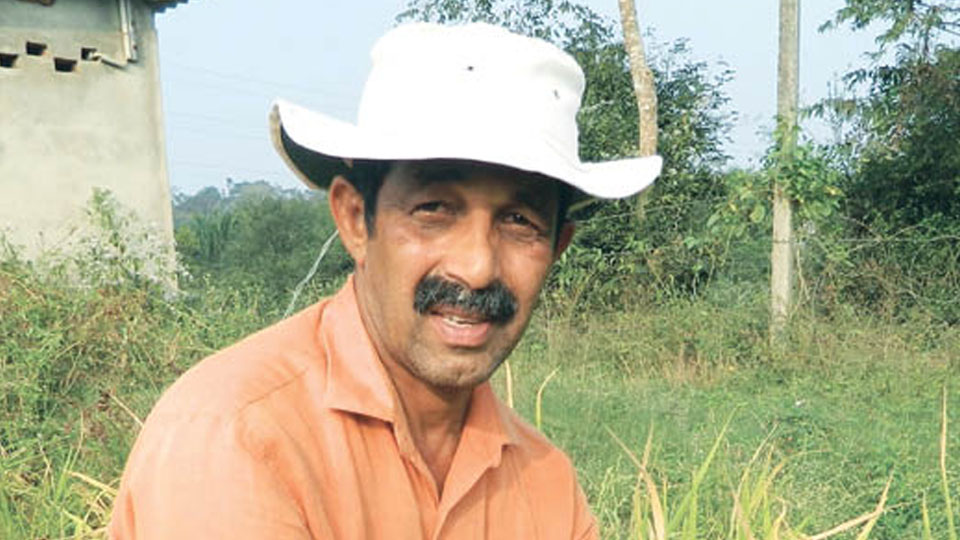
Kodagu’s progressive farmer Somengada Ganesh Thimmaiah of Nallur village near Ponnampet in the southern part of the district has won the Rajyotsava Award for agriculture.
Though coffee and pepper are the prominent commercial crops in Kodagu, Ganesh Thimmaiah has been growing both agricultural and horticultural crops in integrated farming methods and has scripted success.
He is actively involved in innovative agricultural practices since the last 30 years and had earlier served the Indian Army. After retirement from services, he took up agriculture in his 15-acre land and has grown more than 60 varieties of paddy.
To gain additional income, he has a poultry farm and is also involved in apiculture and pisciculture. Apart from the regular crops of coffee, pepper, ginger, mango, orange and jackfruit, Thimmaiah has cultivated rambutan fruit.
In the integrated method in agriculture, he grows areca, coffee and paddy as main crops and a variety of vegetables and fruits and sub-crops. Thimmaiah has also been growing the ‘Beth’ plants required for honey bees and has implemented a mechanised system in agriculture.
At a time when more and more youths are showing interest in jobs and businesses, Ganesh Thimmaiah has earned name and fame as model farmer and has bagged many awards in the past. He won the National-level Babu Jagjivan Ram Krishi Samman Award. The Indian Council of Agricultural Research (ICAR), New Delhi, conferred the prestigious award on Thimmaiah on the occasion of its 92nd Foundation Day in 2020.
In April this year, he gave comprehensive training in agriculture to the batch of IAS officers at Lal Bahadur Shastri National Academy of Administration, Mussoorie.
“I am honoured to be conferred with the prestigious Rajyotsava Award and this gives me an opportunity to innovate further. I have been involved in agriculture for three decades and there is a need of attracting more and more youths to agriculture as it is profitable if innovative,” he said.
source: http://www.starofmysore.com / Star of Mysore / Home> News / October 31st, 2022
As monsoon was the prime season to sow paddy — Kodagu’s main crop in the days of yore — people had no time for any other activity. So, this season was regarded as inauspicious and no ceremonies or celebrations were held. In between, the people would forage for these seasonal treats and prepare mouth-watering delicacies.
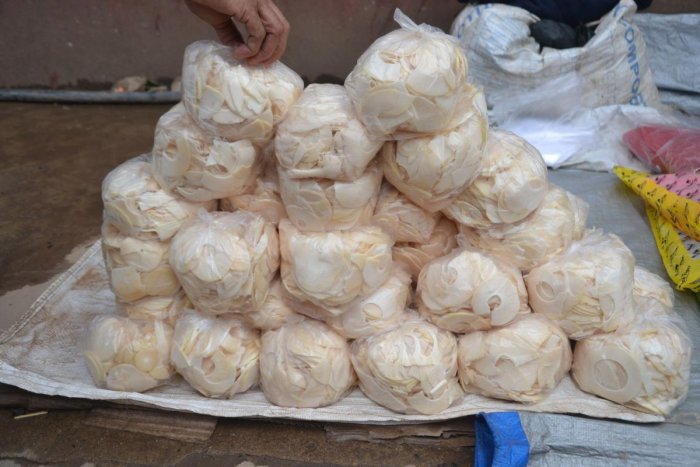
Processed bamboo shoots being sold in Kodagu. Photos by Arjun Bopanna, Niveditha Harish and Nisha Poovaiah
The aromas of baimbale curry (bamboo shoots curry), kummu curry (mushroom curry), kembu curry (colocasia curry), njand curry (crab curry), bhel meen curry (fish found in flooded paddy fields), pole meen curry (stream fish curry), therme thoppu palya (fiddlehead fern fry) are indicative of monsoon in this district located in the Western Ghats. These dishes are exclusively prepared during the wet months.
“The foremost reason these dishes are consumed only during the monsoon months is that the main ingredients such as aal kummu, baimbale are only available during this season,” says Chef Naren Thimmaiah.
According to Naren, cooking styles in each region would have developed purely on a trial-and-error basis. “Our elders would have realised when to eat what, the good and bad traits of a dish through experience,” he adds.
Purple delight
Unique sweet dishes prepared during this season are maddh payasa and maddh putt from maddh thoppu (Justicia Wynaadensis). Maddh translates to medicine in Kodava language and thoppu is leaf. The extract obtained from the leaves and stems of this plant imparts a beautiful, deep bluish-purple colour to the dish.
These dishes are prepared and consumed only on Kakkada padinett, the eighteenth day of kakkada month (early August) in the Kodava calendar, when this plant is believed to have accumulated 18 medicinal properties.
The plant, rich in antioxidative and anti-inflammatory properties, is said to improve overall health. Its anti-microbial properties are also said to boost immunity during the monsoon months, when one is more likely to fall ill.
Another quintessential monsoon dish is baimbale curry made from bamboo shoots. The shoots are cut into small pieces and soaked in water for two days to remove the acidic toxins. The shoots are said to have anti-inflammatory, anti-ulcer, anti-diabetic and anti-oxidant properties. The baimbale curry is best had with akki roti called otti.
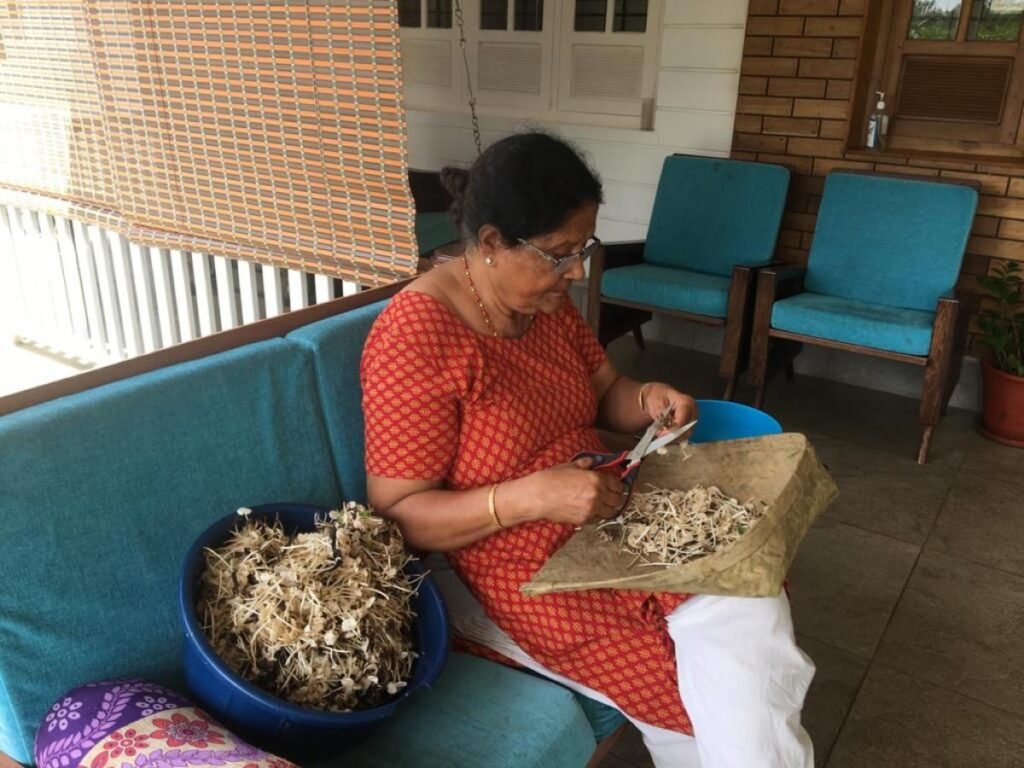
A woman preparing Kodagu delicacies. Photos by Arjun Bopanna, Niveditha Harish and Nisha Poovaiah
Surprise yields
Mushrooms, called kummu, also make great ingredients. These edible fungi grow in small patches and gathering them is a fun activity but it takes a trained eye to distinguish between edible and poisonous mushrooms.
Another Kodava delicacy is prepared from fiddlehead ferns, called therme thoppu. These ferns are found near the banks of water bodies such as ponds, streams and rivers. Only the tender shoots of these wild ferns are selectively picked. The easiest way to cook it is to saute it with onions, dried chillies and salt. It is best had with otti.
Like therme thoppu, kembu (colocasia) is generally found near water bodies and marshy lands. There are three varieties of kembu: red stemmed (chonda) kembu, green stemmed kembu and mara kembu. Mara kembu grows under the shelter of large trees. While Tulunadu is famous for the patrodes made from colocasia leaves, in Kodagu people mainly prepare curry using it.
With the onset of the monsoon, people also make dishes from jackfruit seeds.
Apart from these seasonal plants, people also get a good catch of crabs and fish in the flooded paddy fields and streams. Piping hot curries prepared from crabs and fish add to the charm of the monsoon months.
“All the traditional food prepared during the chilly monsoon season adds heat to the body. Also, pepper is used widely in the region, which again adds heat to the body,” Naren says.
Naren explains that as the people were expected to work in the rains and were most likely to get cuts and wounds, the food consumed would build up body temperature and aid in quicker healing of the wounds. “There were no tablets available then, the the foods themselves had medicinal values,” he says.
Preserved for future use
While these dishes are prepared only in the rainy season, bamboo shoots, jackfruit seeds, hog plums (ambatte) and fish are preserved for later use.
Bamboo shoots and hog plums are stored in brine; fish are coated with salt, smoked and dried.
These foods are so culturally ingrained that people staying elsewhere either make it a point to go to Kodagu to procure these food items or get their relatives to send across these delicacies.
“The food items sourced from Kodagu have an altogether different taste. So, preparing dishes by getting the ingredients from Kodagu is a special feeling,” says Sudha Poovaiah, who is settled in Bengaluru.
source: http://www.deccanherald.com / Deccan Herald / Home> Spectrum> Spectrum Top Stories / by Dhanyata M Poovaiah / September 18th, 2021
WELCOME. If you like what you see "SUBSCRIBE via EMAIL" to receive FREE regular UPDATES.
Read More »